Review: The Bitter Tears Of Petra Von Kant (Mophead Productions)

mopheadVenue: Old Fitzroy Theatre (Woolloomooloo NSW), Oct 11 – Nov 12, 2016
Playwright: Rainer Werner Fassbinder (translated by David Tushingam)
Director: Shane Bosher
Cast: Taylor Ferguson, Judith Gibson, Matilda Ridgway, Mia Rorris, Eloise Snape, Sara Wiseman
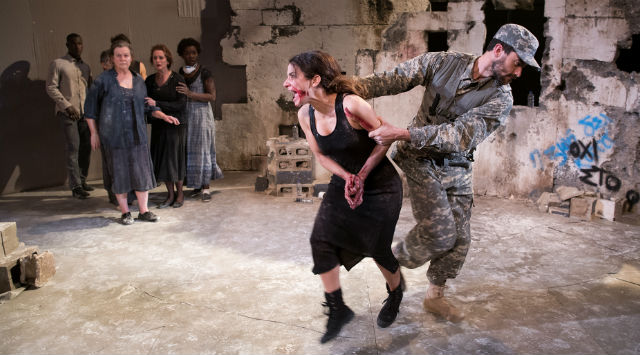
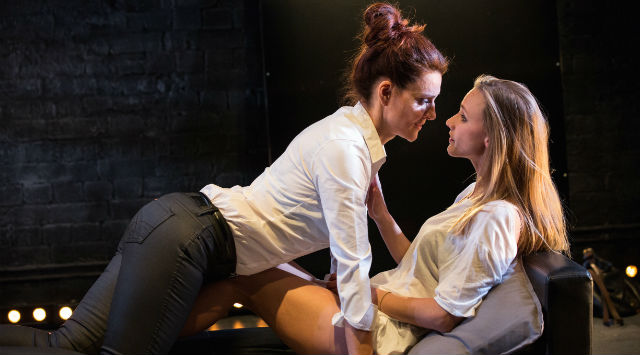
Image by Clare Hawley

Theatre review
In Fassbinder’s The Bitter Tears Of Petra Von Kant, we search for the meaning of love. Petra had just ended a marriage, but now finds herself enamoured with another. Through an examination on the nature of unrequited love, the play is an invitation to meditate on one of life’s biggest mysteries, by looking at the space between being in love, and being out of love. Petra has an object of desire, someone she obsesses over, who responds with nonchalance. Her devotion is both voluntary and involuntary, she gives of herself in hope of reciprocation, but continues to invest her all, even when the outcome is not as intended. She thinks only that her suffering bears a purpose of winning favour, but does not realise the masochistic pleasures that envelope the burning sensations of pain she thrives on.

The writing is phenomenally thrilling, and deeply important. Masochism is a pivotal part of our psyche, but we make little acknowledgement of it. In our human inability to be perfect, we all experience on a daily basis, the impulse to do what is not going to deliver the best results. Although we wish for a level of optimal performance in all the things we do, we are not machines, and we know that the instinctive tendencies to jeopardise are always strong. We are expected to be good, but really, we cannot stop from wanting to be bad. Our ethics prevent us from being destructive with the decisions we make at work, at home, in society, but when discussing the romantic and the carnal, destructiveness becomes personal and we have the right to choose how bad we wish to be. In his creation of Petra’s tragicomedy, Fassbinder reveals an honest aspect of humanity, and the inherent darkness of our existences. In our heroine’s pursuit of a very fiery love, she uncovers her true self, perfectly beautiful yet devastatingly vicious.

Sara Wiseman is resplendent in her warts and all portrayal of the title role. Operatic and visceral, it is a stunning performance of a woman in control, and out of control, overwhelmed by infatuation and lust, completely unhinged, motivated only by her own desires. Wiseman unleashes profound emotional and psychological accuracy that makes every debauched plot detail believable, along with a magnetic sensuality that has us entranced from beginning to end. Furthermore, it is not a narcissistic display that she puts on, but a thoroughly nuanced study of dynamics between Petra and the people around her, with the star manufacturing scintillating chemistry with every co-actor for a show that keeps us frothing at the edge of our seats. Also fabulous is Matilda Ridgway, sensational in an entirely speechless role but powerfully present at the periphery of every scene. Marlene is a controversial servant character, made even more confronting by Ridgway’s fierce dedication. It is a hugely impressive study of the only woman on stage who gets everything she wants.

The production looks sophisticated, severe and sexy. Georgia Hopkins’ set is executed with a confident minimalist edge, radiantly glamorous and intimidating in its strict glossy blackness. Shane Bosher’s direction breathes new, electrifying life into a play approaching its fiftieth year, proving that Fassbinder’s ageless legacy continues to be relevant and resonant, especially when it comes to issues of our libido. Bosher’s love of the strong female is magnificently showcased, with every woman bold and alluring in her uniqueness. His fetishistic depiction of Petra as Goddess, allows the show to bewitch and to inspire awe. The temptress and us, breathe the same air, but we are at her mercy, and anywhere she wishes to take us in the theatre, we must surrender, and revel in it.
www.mophead.com.au

Review: After The End (The Kings Collective)

thekingscollectiveVenue: Kings Cross Theatre (Kings Cross NSW), Oct 8 – 22, 2016
Playwright: Dennis Kelly
Director: Michael Abercromby
Cast: Josh Brennan, Grace Victoria
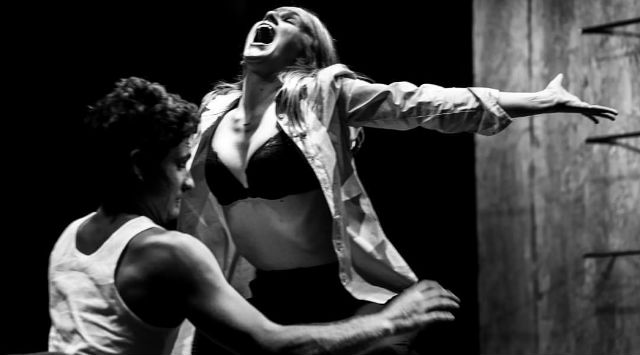
Image by Rupert Reid

Theatre review
Louise and Mark are locked in a bunker. We are not quite sure how they got there, but we know that it is the male of the pair who is calling the shots. It could be the apocalypse, and the end of the world is a complex matter for those who survive. Dennis Kelly’s After The End is a quirky, but dark, story about the atrocities that happen in a world where nobody thinks that they’re the bad guy.

Although its contexts are dramatic, its plot is simple and unfortunately, a predictable one. There is discernible concerted effort put into creating tension for the staging, but only its later sequences are able to captivate, and when we do become engaged, it is the portrayal of violence that draws us in, rather than inherent ideas that can seem superficial, with insufficient provocative power. Some of the play’s mysteries could be more effectively manipulated, but both performers (Josh Brennan and Grace Victoria) are remarkably focused, well-rehearsed and enthusiastically present.

In After The End, a woman is made victim when she finds herself waking up in an environment completely controlled by a man. Unable to negotiate a renewal of circumstances that will provide a level playing field, Louise is forced into combat for the top dog position, squarely on Mark’s terms. Determined for his desires to dominate their microcosm, Mark’s impositions are a representation of the obstacles that feminists are up against, and reason for the deterioration of advancements that had been made. It is a pessimistic view that the play proffers, but an accurate depiction of a state of affairs where everybody loses, if we perpetuate that status quo.

www.thekingscollective.com.au

Review: Do Something Else (The Old 505 Theatre)

old505Venue: The Old 505 Theatre (Newtown NSW), Oct 4 – 22, 2016


Devisor / Director: Michael Pigott
Devisors / Cast: Cloé Fournier, Ryuichi Fujimura, Brigid Vidler
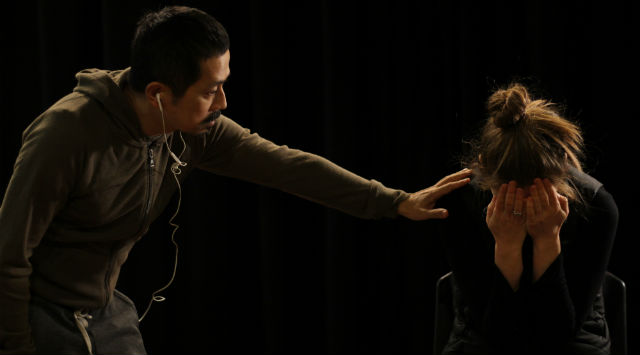
Image by Michael Pigott

Theatre review
Meaning can be derived from anything, because being human requires that we make sense of the things we come in contact with, even if their inherent characteristics are not readily intelligible. In Michael Pigott’s Do Something Else, the deliberate absence of a narrative relocates the audience from a position of passivity to one of mental vigour. The work provides visual and aural cues that seem to be, on a superficial level, incoherent, trusting that our response is a creative one that will formulate personally resonant symbols and messages.

It is an elegant work, but also surprising and challenging, with a confidence that allows its abstract approach to communicate with authority. Pigott’s work on sound and lights creates a hypnotically gripping atmosphere, balanced by the dynamic physical expressions he introduces to the piece. The three performers have distinct and strong presences that connect with us effortlessly. Cloé Fournier and Ryuichi Fujimura are memorable for their idiosyncratic and nuanced movement styles, while Brigid Vidler captivates with her incisive delivery of text. Fascinating words are also provided by Diana Shahinyan and Ari Mattes whose prerecorded voices guide us with scholarly ideas to reach an increasingly precise interpretation of the work.

A key concern of Do Something Else pertains to a neurosis that emerges with the rise of the metropolis. We can choose to see that city life drives us crazy, or we can adopt an alternate view that the innate insanity of life has proven to be untameable by a culture of industrialism. Our chaos simply takes on a different form. It is naive to think that nature is independent of technology, and falling into nostalgic fantasies for an imagined world of primitive perfection is futile, and erroneous. Technophobia however, is an interesting and helpful concept that can help us in discussions about ecology and environmentalism. It also encourages a healthy cynicism of progress that interrogates our priorities, and questions our values. Our societies run on a momentum that thinks that big is better, and more is good. Civilisations must move forward, but the choices we make within that propulsive trajectory must never be left unexamined.

www.old505theatre.com

5 Questions with Matilda Ridgway and Eloise Snape

Matilda Ridgway

Matilda Ridgway

Eloise Snape: If you could compare your character in The Bitter Tears Of Petra Von Kant, Marlene, to other wonderful women, fictional or non fictional, who would they be?
Matilda Ridgway: Mary Gaitskill’s characters in Bad Behaviour, Lee Holloway from Secretary, O from The Story of O, Lucia Atherton from The Night Porter.

Whats the most challenging thing about this play for you?
Not speaking is challenging. Subservience is challenging. Understanding Marlene’s relationship to these choices. How it affects her and her relationship.

If you had to be locked in a small confined space for 24 hours with one of the characters in the play (apart from Petra), who would you choose and why?
There is nobody apart from Petra.

Hypothetical. Would you rather have twigs for fingers or cheese toes? A hard cheese like a pecorino.
Hard cheese toes rather than twig fingers. I need my fingers for touching fruits and jellies and pink bits and babies. Twigs would pierce these soft things or break off into a million things.

If you bumped into Donald Trump and his hair in the street, what would you say to him? In one sentence only.
You’re fired!

Eloise Snape

Eloise Snape

Matilda Ridgway: Hypothetical: would you rather have feet made of cottage cheese or have super magnetic hands?
Eloise Snape: Definitely super magnetic hands. Imagine all the stuff you could steal.

Can you tell people about when we first met?
Tilly and I met in high school at SCEGGS Darlinghurst. We did a production of Secret Bridesmaids Business together with a bunch of legends. Then I watched her in all the plays at Sydney Grammar and got super jealous.

Please play fuck, marry, kill with our cast and crew who do you choose and why?
Ok – entering dangerous territory. Can I pick the same person for all three? I say Alistair Wallace because I’ve known him for years and I don’t think he would bat an eyelid if I fucked him, married him and then killed him.

What is one thing you admire about your character Sidonie and one thing that makes you feel uncomfortable?
Sidonie is proud, intelligent, sticks to her guns and wears fluffy things. That’s cool. But her entire value system and approach to life makes me totally uncomfortable. And wearing high heels all the time is pushing the comfort zone.

If you could be one character in the play who would you be in real life?
Oooh defs Gaby I reckon. I wouldn’t mind being 14 again and figuring all that stuff out. Also she’s a designer’s daughter – there are major pros to that. Also cons but you have to see the play to know what they are.

Matilda Ridgway and Eloise Snape are appearing in The Bitter Tears Of Petra Von Kant by Rainer Werner Fassbinder.
Dates: 11 October – 12 November, 2016
Venue: Old Fitz Theatre

Review: Antigone (Sport For Jove Theatre)

sportforjoveVenue: Seymour Centre (Chippendale NSW), Oct 6 – 22, 2016
Playwright: Sophocles (adapted by Damien Ryan)
Directors: Terry Karabelas, Damien Ryan
Cast: Andrea Demetriades, Anna Volska, Deborah Galanos, Elijah Williams, Fiona Press, Janine Watson, Joseph Del Re, Louisa Mignone, Marie Kamara, Thomas Royce-Hampton, William Zappa
Image by Marnya Rothe

Theatre review
In Damien Ryan’s adaptation of Antigone, a single word ‘terrorism’ leads the charge in transforming the ancient text into a story for our times. Language and its accompanying sensibilities are disarmingly modern in the suddenly new play, and we are compelled to engage with its ideas in a thoroughly contemporary manner. It makes us think about the inconvenient evolution of democracy in the age of social media, and the frightening consequences of vacuous personalities running for office. We confront the demonisation and scapegoating of people who have been turned into the public enemy du jour, and examine the eternal dilemma of making sacrifices for the greater good. Almost like a time capsule of culture as it stands, with many of today’s concerns contained in a tale from ages past.

The production encourages our minds to build associations between the unfolding story with our immediate realities, delivering resonances that can feel disparate and divergent, but direction of the work (by Ryan and Terry Karabelas) maintains a dramatic focus with its emphasis on characters and atmosphere. The use of percussive instruments provide tremendous manipulation to mood, and to meaning; Thomas Royce-Hampton’s ability to create just the right sounds at every crucial moment of tension is one of the show’s strokes of genius. The chorus is effectively utilised to steer our moral compasses, along with our emotions, for a theatrical experience that captivates our senses and intellect. It must be noted that there is an elegance and often very delightful approach to the chorus’ stylistic work that brings surprising texture to the show. Visual design is beautifully considered and confidently executed, with Matt Cox’s lights and Melanie Liertz’s set, impressive from the very start.

It is an appealing cast, fortified by excellent chemistry and timing, exuberantly alive for the entire duration. Andrea Demetriades is an earthy Antigone, restrained and almost minimalist in performance style, but consistently believable. More could be made of her crises, that will allow the actor greater space to showcase her abilities, and for us to feel closer to the plight of Thebes’ people. Courage, determination and strength of will are Antigone’s dominant qualities, but they are often left offstage. We witness the aftermath of her heroic deeds, but not the very moments of bravery that are central to how we know her to be. When Antigone defies the demands of community and the state’s decree, she is moved by conscience and love. Through her actions, we arrive at an absolute truth, discovering something fundamental to human experience. She urges us to persist with what we know to be right, and her tender age teaches us to be suspicious of grown-up notions of shades of grey. How a person chooses to live in the real world, becomes that person’s own reality. Antigone is dead at 15, but her life held only pure and good.

www.sportforjove.com.au

Review: Marat/Sade (New Theatre)

newtheatreVenue: New Theatre (Newtown NSW), Oct 5 – Nov 5, 2016
Playwright: Peter Weiss (translated by Geoffrey Skelton and Adrian Mitchell)
Director: Barry French
Cast: Tom Aldous, Kaiya Bartholomew, Andrea Blight, Debra Bryan, Lyn Collingwood, Garreth Cruikshank, Tahlia Hoffman Hayes, Tim De Sousa, Gregory Dias, Patrick Howard, Isaro Kayitesi, Mark Langham, Leilani Loau, Jim McCrudden, Lynn Roise, Emmanuel Said, Irene Sarrinikolaou, Alia Seror-O’Neill, Liam Smith, Peter Talmacs, Annette van Roden, Jacque Vickers
Image by Bob Seary

Theatre review
Originally conceived as a work set inside a psychiatric hospital, director Barry French’s version moves the action to a modern day asylum centre, with characters transposed from the mentally ill to asylum seekers who have gone mad from incarceration. A lot of the production makes good sense, with the play’s concerns and motivations proving to stand the test of time, but the text remains a difficult one half a century after its 1964 premiere.

Fragmented and purposefully incoherent, Marat/Sade is a fiercely anti-capitalist work that challenges how we think of society and art, and was never meant to be an easy one to stomach. It relies on the creation of spectacle and a sense of presence unique to the experience of live theatre, to keep the audience intrigued and captivated. French does well at manufacturing a dynamic stage with powerful imagery, featuring excellent design work by Tom Bannerman (set), Spiros Hristias (lights) and Nicola Block (costumes). Further, the incorporation of a very large cast comprising over 20 actors provides a sumptuous visual majesty, but the calibre of performers are highly inconsistent.

Our attention fades in and out, depending on the quality of acting being showcased, and the general sense of visceral energy stirred by the writing’s violent insanity, is only occasionally authentic and seldom severe enough to fascinate or convince. There are however, memorable personalities in the show, including Jim McCrudden as the Herald who demonstrates exceptional flair and nuance in his charming theatrics, as well as Debra Bryan and Leilani Loau whose committed portrayals of tragic hysteria, deliver some of the play’s richer characterisations.

Also noteworthy is Nate Edmondson’s original music, thoroughly creative, with a welcome exuberance adding texture and depth to the staging. Performed to a backing track, we are struck by the beauty of the score’s arrangement, and are left hankering for an opportunity to hear the songs sung completely live in tandem with musicians.

On the surface, Marat/Sade urges the downtrodden to rise up for a revolution, but what it really does, is facilitate discussion on social injustices that have to be rectified. The play talks about the French Revolution of 1808, but with the passage of time, ideas of radical action seem to have lost their lustre. Many of us at the theatre are the complacent middle class, and shows like this aim to help expand our consciousness to include the lives of those who suffer under our oppression, but doing more than providing lip service seems always to remain a challenge. Stories of asylum seekers who ask for our mercy continue to be told, but how we respond is presently inadequate, if all we can do is talk.

www.newtheatre.org.au

Review: Dream Lover (Sydney Lyric Theatre)

dreamloverVenue: Sydney Lyric Theatre (Sydney NSW), Sep 22 – Nov 27, 2016
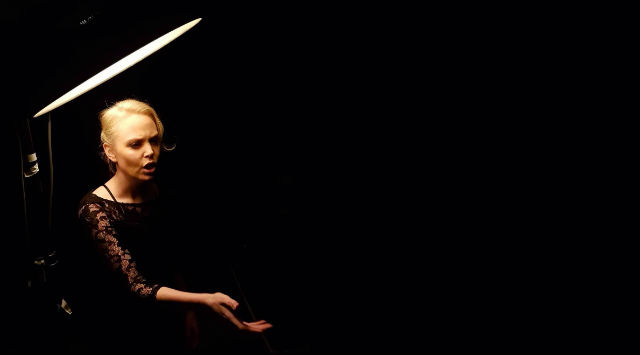
Original concept and stage play: Frank Howson, John Michael Howson
Dramaturg/Script Consultant: Carolyn Burns
Director: Simon Phillips
Cast: David Campbell, Martin Crewes, Hannah Fredericksen, Bert LaBonte, Marney McQueen, Caroline O’Connor
Image by Brian Geach

Theatre review

In the musical Dream Lover, Bobby Darin is a nice guy with a career to be proud of. Undeniably talented, the Italian-American from New York’s Bronx county made it big in show business in the middle of the twentieth century, leaving behind an impressive catalogue of songs, but an uneventful life story. The show starts off slowly, with characters that take time to connect, and a doggedly polite plot that resists sensationalism, mindful of a need to honour the late star, thereby sacrificing opportunities for a greater sense of theatricality and humour. Our emotions are guided by the quietly simmering narrative, so even though all its musical numbers are strong, the viewing experience only becomes exuberant later in the piece when its dramatic stakes finally gain height.

The jukebox musical format is carefully and cleverly utilised here, with preexisting songs from Darin and his era, assembled and rearranged to form a surprisingly coherent and entertaining show. Set design is striking but inflexible, with an undiminishable glitz distracting from its many sombre scenes, although remarkably effective in its visual demarcation of space. The production boasts an outstanding cast, with quintessential showman David Campbell in the lead, overflowing with extraordinary charm and skill, stealing hearts in every melody. There are moments when Campbell seems restrained and overly cautious in his portrayal of a venerated hero, and occasional issues with sound balance can be disappointing, but his powerful presence, astonishing commitment and infectious passion, guarantee a spectacular night at the theatre. Also noteworthy are Martin Crewes as Darin’s manager Steve Blauner, and Hannah Fredericksen as Darin’s wife Sandra Dee, both captivating personalities who provide solid support with unequivocal artistic brilliance.

Bobby Darin is from a time when we knew to celebrate dignity. There is no dirt in Dream Lover, which will take many of today’s audiences by surprise. Scandalous biographies are where the money is; in entertainment today, whether reality TV, tell-all books or on any other conceivable digital configuration, we consume crudeness as a matter of habit. It is troubling that the kind of career that Darin had enjoyed, could cease to be valued and appreciated in this new economy of vulgarity and gossip on steroids, where music is routinely sold in a package along with celebrity humiliation. Dream Lover may be about the past, but its ability to remind us of better days offers a nostalgic glimmer of hope. It inspires a longing for something purer, and on days like these, it could be the best that we can cling to.

wwww.dreamlover.com.au

Review: Hitchcock’s Birds (Edgeware Forum)

edgewareforumVenue: Erskineville Town Hall (Erskineville NSW), Sep 27 – 30, 2016
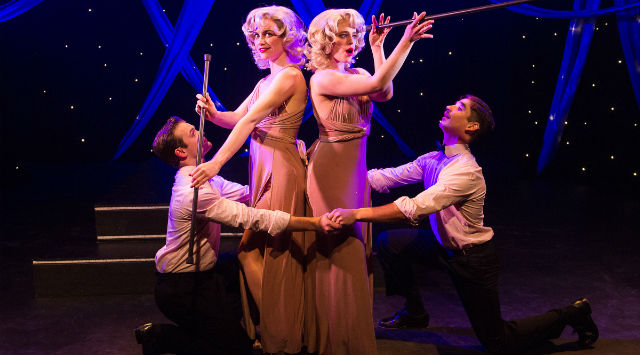
Playwright: Laura Johnston
Director: Laura Johnston
Cast: Laura Johnston

Theatre review
Even though Alfred Hitchcock’s films were usually about male protagonists, it is his leading ladies that remain unforgettable. In Hitchcock’s Birds, Laura Johnston presents a compilation of anecdotes, ranging from the cautiously dubious to the downright objectionable, by a series of legendary blonde bombshells who had worked with the master of suspense. Misogyny in Hitchcock’s films is a common topic of discussion, so the insight that Johnston’s one-woman show wishes to provide, will not be new to many. It is however, wonderfully nostalgic, with characters and a performance style that harks back to the golden age of 1950’s Hollywood, and because “they don’t make them like they used to,” this is a production that will appeal to many who continue to hunger for that old world glamour.

As actor, Johnston is most effective in sultrier and heavier sections. At home in the skin of the femme fatale, she brings excellent theatricality to the likes of Tippi Hedren, Grace Kelly and Kim Novak. Zanier personalities like Doris Day and Janet Leigh on the other hand, can seem less confident, and slightly laboured. Even though Johnston does well in creating different voices and mannerisms for her various roles, it is clear that Hitchcock’s penchant for archetype does not make it easy for a greater sense of differentiation between each woman, and the use of slide projections is required to help us identify the stars being depicted. Hitchcock’s Birds is a strong concept and there is good work to be found in the way mood is manufactured for this staging, but its duration is too brief for our emotions to engage at a gratifying level of intensity.

Hitchcock’s is a man’s world, and the women in it must play by its rules or risk condemnation. When workplaces are patriarchal, as so many continue to be, its women must choose whether to obey, withdraw or defy. Whichever option is selected, it is uncommon that power imbalances are ever subverted or given redress. Film in Hollywood and everywhere else, is still dominated by men, but theatre is an alternative to the art form that is currently experiencing a vigorous progression towards gender equity. It is only when we tell our stories, on our own terms, that empowerment for our sisterhood can truly begin to materialise.

www.edgewareforum.com

Review: Side Show (One Eyed Man Productions)

oneeyedmanVenue: Hayes Theatre Co (Potts Point NSW), Sep 23 – Oct 16, 2016
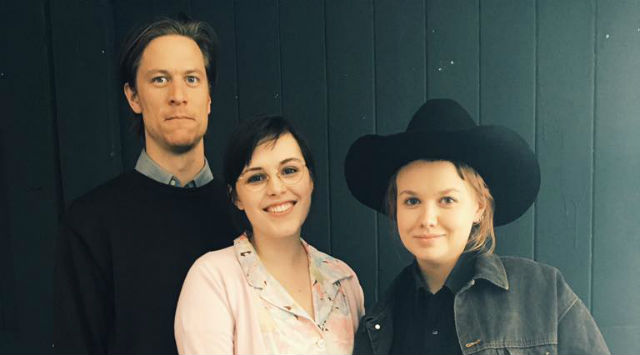
Book & Lyrics: Bill Russell
Music: Henry Krieger
Director: Richard Carroll
Choreography: Amy Campbell
Musical Direction: Conrad Hamill
Cast: Daniel Belle, Gabriel Brown, Laura Bunting, Kerrie Anne Greenland, Michael Hart, Bree Langridge, Lachlan Martin, Joshua Mulheran, Elenoa Rokobaro, Berynn Schwerdt, Timothy Springs, Hannah Waterman
Image by Kurt Sneddon

Theatre review
Daisy and Violet Hilton were conjoined twins who in the 1930s, caused a sensation in the American vaudeville circuit. We meet them in the musical Side Show, as their ascent to fame begins, and encounter the highs and lows of the women’s irrefutable difference, in a world determined to treat them as anything but normal. Its plot is unconventional, and for a musical to have at its centre an unpredictable story, is remarkably refreshing. Instead of distinct good and bad categories as is common for the genre, characters exist in spaces of grey, resulting in a tale that surprises with its realism. The songs are beautifully composed, with unusual depth and textures that forsake formulaic writing in favour of accurate representations of human emotion.

Laura Bunting and Kerrie Anne Greenland are the splendid twins, with a persuasive sisterly closeness that keeps us firmly on their side. Bunting plays the extrovert Daisy with an alluring effervescence, while Greenland uses an earnest approach to tug at the heartstrings. Both are excellent singers, although Greenland’s very big notes are undeniably scene-stealing. In the role of Buddy is Gabriel Brown, who impresses with nifty footwork, along with a striking presence, for a character memorable for his exceptional charm. Director Richard Carroll successfully introduces a dignified air to the “freak show” context, but the production often seems too stagnant and minimal in its use of space. There is an admirable restraint in Carroll’s rejection of creating scenes that are overly sentimental, but the show would benefit from greater amplification of its more humorous elements.

Side Show is an elegant work that is respectful in its portrayals, but there is a persistent gentleness that can make it feel somewhat distant. Art must always be aware of cliché and do all it can to avoid it, like it does on this occasion, but the temptation to resort to the tried and tested is always present. The musical format has a strong tendency towards the “garden-variety”, mainly due to commercial pressures, but also because of the seemingly inherent limitations of the genre. There are few avant-garde musicals for good reason. It is a theatrical form with rules that cannot be broken, and that insists on subjugation of its artists, but for some of those who do give in, the rewards can be spectacular. True fulfilment might have been elusive, but Daisy and Violet had a taste of fame and fortune by giving the crowds what they want, and that is a level of success many could only ever dream of.

www.hayestheatre.com.au

Review: Late: A Cowboy Song (Ladylike Theatre Collective)

ladylikeVenue: Erskineville Town Hall (Erskineville NSW), Sep 27 – Oct 1, 2016
Playwright: Sarah Ruhl
Director: Sarah Dunn
Cast: Andreas Lohmeyer, Annabel Mathieson, Eliza Oliver

Theatre review
The simpler the story, the deeper we can delve into the nature of being human. We have a tendency, in life and in art, for complication. Believing in the more the merrier, we cloud up our transient existences with illusory fixations that distract from the truth. Sarah Ruhl’s Late: A Cowboy Song takes the shortest distance between two points, and in the process, deconstructs some of the biggest myths that govern our every day. It questions the meaning of things like marriage, reproduction, money and work, central tenets that dictate how we live from minute to minute. We see Mary fall pregnant and marry Crick, who goes to get a job to provide for the family. It all happens without thought and passion, completely automatic. Their lives take shape as though controlled by an external entity, until they chance upon something else that truly moves them.

It is a funny play, though not always overt with its humour. Delightfully sarcastic, with a distinctly queer sensibility that informs its representations of gender, sexuality and relationships, Sarah Dunn’s work as director is very charming indeed. Mary is played by Eliza Oliver who brings nuance and poignancy to the piece, through an understated style that encourages understanding of her character’s peculiarities. Less quiet with his presentations is Andreas Lohmeyer whose eccentric approach provides great amusement, along with an intriguing but bizarre aura appropriate to the subversive material being explored. The eponymous cowboy is a mysterious figure, with Annabel Mathieson cast against type to bring focus to the text’s interest in exploring issues of identity and conformity.

Who we think we are, may not always be an accurate estimation of the person who walks the earth, but that self-perception must always be allowed to change. To know oneself can be a difficult process, but what is infinitely harder, is to pretend to be someone else. Mary and Crick try to come to terms with their own desires, but arriving at that state of honesty proves to be an elusive privilege. The cowboy is completely out of place, but what they experience, is a serenity and fulfilment that many others fail to attain. It is human to want to fit in, but it takes courage to stake one’s claim for a share of the world, without playing by all the stupid rules.

www.facebook.com/ladyliketheatrecollective