
Review: The Adonis Procedure (The Leftovers Collective)

theleftoverscollectiveVenue: Hustle & Flow Bar (Redfern NSW), Nov 1, 2016
Devisors/Performers: Liam Benson, Curly Fries, Chantelle Jamieson, Tim Kemp, Lou Pollard, Courtney Stewart, Ronan Sulich, Paul Wilson
Image by William Suen

Theatre review
In a small bar, a drag queen by the name of Aphrodite greets us, as we gather to participate in a rare happening, a throwback to art events of the sixties that most have only read about. The performance is carried out by all in presence, as everyone is required to invest into the playacting that creates a scene of a high-status auction. First part of the show involves a series of presentations that investigate the 5 lots being put on sale. Classic Greek statues, brought to life by 5 actors emulating poses and reciting classic verse, while a cameraman zooms in tightly into a single spot on their bodies. A screen shows us skin and hair in hyperbolic detail. Thereafter, the crowd is encouraged to bid on the items, using money previously distributed by Aphrodite.

The crowd very quickly begins to pool their cash. We realise that these iconic objects are beyond the ownership of single persons. Entities begin to form, and wars break out over these relics of beauty. Ronan Sulic, the auctioneer from Christie’s is conducting the proceedings and we are all swept up in his verve and excitement, for the art, and for the money. Frantic contests to acquire esteemed works of art have occurred since the rise of the middle class, but it is an unusual episode for independent theatre and emerging artists. Our society values art, but not all of it. Money is channelled to certain people, while others languish in neglect. The system pretends to be based on merit, but it is not. In its alleged estimation of values such as beauty, skill and social significance, artists are placed in a triangular hierarchy that favours few and subjugates many. It is a problem of economic rationality, and a problem of applying capitalistic principles to how art comes to be in our lives.

When the crowd battles it out for their desired articles, it is the squabble that becomes the centre of attention, and any intrinsic qualities each statue might have had, fade into irrelevance. Art is social, and in this case, it is about who comes out on top, and who faces defeat. Of course, we all understand that great works should exist in the public domain, and not be controlled by individuals or organisations, but we are unable to fulfil that idealistic principle in how we actually carry out the business of art. Our institutions fail us, and our governments fail us. The increasing privatisation of everything in Australia, means that how we do art, is in accordance with how the elites will profit from all activity in the industry. The big guys are a dictatorship that determines the rules of what art should look like, and the small guys have to choose whether to submit to a career of emulation and placation. Forces in the economy want everyone to believe in the survival of the fittest, and when artists forget to question things, which is their most sacred purpose, art will die. In The Adonis Procedure however, subversion and interrogation of norms is its intent, and the key to making a kind of art that is lively, surprising, and necessary.


www.theleftoverscollective.com

5 Questions with Charlotte Hazzard and Alastair Osment

Charlotte Hazzard

Charlotte Hazzard

Alastair Osment: What do you think Sydney audiences will enjoy most about Sweet Phoebe?
Charlotte Hazzard: It’s hard to pinpoint exactly what Sydney audiences will enjoy most about Gow’s play. I think the fact that it is set in Sydney will resonate with audiences. He paints such an unexpected, unpredictable and genuine picture of the private homes of others that Helen and Frazer find themselves and I think that’s thrilling – what sits indoors. That’s hopefully just one of the many.

How would you describe your character Helen in five words.
Open. Willing. Bubbling. Observant. Fire.

What made you decide to be an actor?
I was very shy when I was younger and so my mother forced me to do speech and drama classes and it quickly turned into a real passion. I was also mentored by a wonderful actress through high school and she made me really believe that I could pursue this career path.

What is your favourite role you’ve played in your career to date.
Tough… I’m going to answer this without considering this play…

Last year I worked on Angela Betzien’s War Crimes and played a character called Jade. Was my favourite because of many things cast/crew/sisterhood/everything but also the character is a total badass. She’s 16 years old and has been through hell and back- but despite all that she is the ultimate warrior. Never the victim, relentless, full of strength, life and love. I was really inspired by her.

What has been your greatest challenge with the text so far.
This has been such a wonderfully challenging play. There is a lot of white space on the page and also in the lives of the characters- there a not a lot of answers in the script but instead a lot of clues of what this pair are dealing with. With how they deal with each, their language and how they evolve through the play. Excavating and discovering these characters and their relationship with the very little purposely given has been a welcomed challenge. Michael Gow has also written without punctuation and when I first picked up the text I was like wow! What a freeing gift! but one of the other challenges, because although there is no punctuation it has been quite purposefully composed and discovery is still ongoing.

Alastair Osment

Alastair Osment

Charlotte Hazzard: Why did you decide to become an actor?
Alastair Osment: It’s the only thing I wanted to do when I left school… and to be honest it’s the only thing I was ever good at. My parents encouraged me to do a trade after high school . So after I completed my 4-year apprenticeship to become a qualified electrician I went off to WAAPA to study acting.

What has been the greatest challenge so far with this text?
This play was deliberately written without punctuation to allow the actors playing it to find the thoughts and syntax through discovery, rather than it being prescribed. That’s a great freedom… but also a massive challenge because I’ve found I’ve had to explore every ‘wrong’ way, to get to the ‘right’ way of delivery/sense.

Have you ever lost a dog?
A few times actually! Our childhood dog, Heidi, used to escape by slipping through the handrails on the upstairs veranda and jumping from the 1st floor!! Insane. We always found her again… but she kept on making those death-defying leaps.

What type of dog did you having growing up?
We had a Blue Heeler named Jude. And later we had a Fox Terrier named Heidi.

How would you describe your character Frazer in 5 words?
Passionate, Determined, Aspirational, Front-footed, Proactive.

Charlotte Hazzard and Alastair Osment are appearing in Sweet Phoebe by Michael Gow.
Dates: 1 – 12 November, 2016
Venue: Old Fitz Theatre

Review: Faith Healer (Belvoir St Theatre)

belvoirVenue: Belvoir St Theatre (Surry Hills NSW), Oct 22 – Nov 27, 2016
Playwright: Brian Friel
Director: Judy Davis
Cast: Colin Friels, Pip Miller, Alison Whyte
Image by Brett Boardman

Theatre review
Frank makes his living as a faith healer, travelling all over Britain with a performance that showcases his charismatic arrogance, and sometimes actually, miraculously healing people in the process. There are serious troubles in private however, but none of his energy is put into finding a cure for the suffering at home. Brian Friel’s play is meandering, and often obscure, with its Rashomon style of getting at the truth by taking us through layers of subjectivity and delusions, in a simple format of successive monologues.

Three characters, speaking in distinctive voices, help us piece together a puzzle that is both confusing and intriguing. Talent manager Teddy’s warm candour is endearingly portrayed by Pip Miller, who captivates with a precise and dynamic approach. The vividness of his storytelling is inviting, and contrasts with Frank’s enigmatic style that can often alienate, in spite of actor Colin Friels’ powerful presence. The shamanic showman’s life is occupied by smoke and mirrors, and his penchant for embellishments and denials have us mystified even when his followers are kept mesmerised. In the role of Frank’s wife, Grace, is Alison Whyte, impressive with an extraordinary emotional agility, perfect for a character replete with volatility.

Director Judy Davis insists that we watch closely at the cast, but her stagnant presentation is demanding of us, and probably excessive in its minimalism. Design however, is noteworthy, with a spectacular cyclorama by Brian Thomson depicting a wide variation of cloudy skies, transforming with every one of Verity Hampson’s lighting changes. The weather we see in the backdrop is often the most truthful element on stage.

When Frank’s audience falls into his concoction of fiction and non-fiction, they are willing participants in a show, all wishing to believe. When people turn to the faith business for salvation, it is because tall tales feel more real than reality. The afflicted come to Frank for a cure, but more accurately, what they seek most is certainty. A life of doubt and ambiguity is unbearable, and the allure of faith lies in its ability to turn hope into surety. When the whole world turns cruel, comfort can only come from the extraterrestrial.

www.belvoir.com.au

Review: Next Fall (Seymour Centre)

boyslikemeVenue: Seymour Centre (Chippendale NSW), Oct 26 – Nov 19, 2016
Playwright: Geoffrey Nauffts
Director: Andy Leonard
Cast: Cormac Costello, Mark Dessaix, Alex Ewan, Victoria Greiner, Mary Anne Halpin, Darrin Redgate

Theatre review
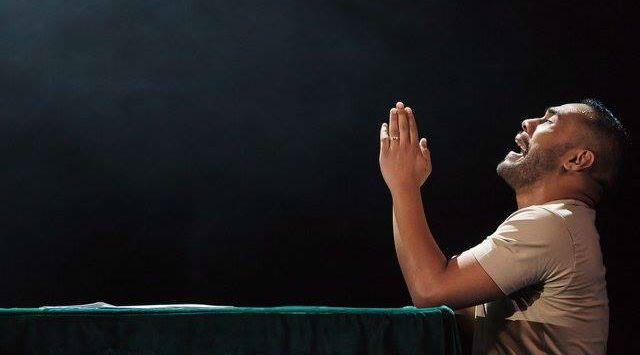
Luke is a gay man who believes in God and all that his church teaches. The contradictions that exist between his religion and his sex life are complex, but Luke is able to create enough justification for himself to negotiate and tolerate those intense personal discords. When he falls in love with the agnostic Adam, things become destabilised and the couple has to confront not only their spiritual incompatibility, but also the problem of Luke’s refusal to come out to his parents.

Geoffrey Nauffts’ Next Fall is a romantic tragicomedy that deals with the issue of familial and internal oppression that can often figure in unconventional or non-traditional relationships. In Luke’s case, it is about the homophobia he endures from his family, as well as his own internalised hatred that come into focus, and we observe that the ones who suffer the most, are the lovebirds themselves, while Luke’s church and parents are blissfully oblivious to the damage they cause.

The writing is charming, with excellent comedy and an honest melancholy intermingling for a play that takes aim directly, at the heart. It is surprisingly old fashioned, with little that would prevent it from being re-contextualised from 2009 to, say, 1978, revealing that while thoroughly enjoyable, the work offers nothing that has not already been said many times before. Society’s snail-paced advancement for queer movements around the world is truly disappointing.

Andy Leonard proves himself to be an earnest director, whose straightforward approach tells the story with clarity and an effective sentimentality. Actors in the piece are similarly impassioned. Alex Ewan’s naturalistic style provides Luke with a convincing innocence that helps us make sense of his predicament. Adam is played by Darrin Redgate who entertains with effective comedy and authentic emotions. Mary Anne Halpin and Cormac Costello, as Luke’s flamboyant parents, are probably the most impressive of the cast. Both are theatrical yet warm with their presence, executing precise and nuanced interpretations of their parts that give the show an excellent sense of texture and credibility.

People like us, in places that are free and rich, must take responsibility for our own happiness. Luke thinks that he is answerable to a higher power, but what the facts disclose, is that the only one who jeopardises his relationship with Adam, is himself. Of course, this is a glaring reality that everyone but Luke is able to see, and what the play indicates, is that each of us has individual crosses to bear that are not unlike those on stage. We can tell the characters in the show, with no difficulty at all, what their lives would have needed, but when it comes to our own existences, nothing is quite as simple.

www.seymourcentre.com

Review: Othello (Bell Shakespeare)

bellshakespeareVenue: Sydney Opera House (Sydney NSW), Oct 25 – Dec 4, 2016
Playwright: William Shakespeare
Director: Peter Evans
Cast: Ray Chong Nee, Joanna Downing, Alice Keohavong, Edmund Lembke-Hogan, James Lugton, Huw McKinnon, Elizabeth Nabben, Yalin Ozucelik, Michael Wahr
Image by Daniel Boud

Theatre review
As the saying goes, “well behaved women seldom make history”. Desdemona and Emilia are slaughtered by their respective husbands after displaying only wifely devotion, as well as prudent decorum to all and sundry in Othello. It is not a battle of the sexes in the play, for there is nothing that resembles a level playing field, but an examination of tyrannical brutality against women, and the treatment of women, in art and in society, as mere objects and possessions. Toxic masculinity is the villain, and it resides in every one of the play’s male characters. Jealousy and egotism are their driving force, and great drama certainly does ensue, along with observations on some of our ugliest traits as human beings.

It is a remarkably well-rehearsed production, with director Peter Evans’ innovative ideas keeping things fresh and relevant for contemporary audiences. Imagery is often beautifully manufactured; Evans’ efforts at adding visual resonance to Shakespeare’s text is admirable, especially noteworthy in Cassio’s “party scene”, involving strobe lights and levitating cask wine bladders. Lighting design by Paul Jackson is thoroughly adventurous, and relied upon heavily for scene transitions and atmospheric transformations, in the presence of a very minimal set, consisting little more than a big wheely table that is manoeuvred around the stage for a large portion of the show, breathtaking when effective, but unbelievably jarring when at its worst.

The cast is polished and energetic, but the show suffers from portrayals of very big emotions that are not necessarily persuasive. Ray Chong Nee is a stately and handsome Othello, perfect in his depiction of the character’s noble qualities, and enthralling as a romantic figure in the early sequences, but Othello’s descent into darker barbaric emotions is significantly less convincing. Bad guy Iago is powerfully performed by Yalin Ozucelik, charismatic and full of conviction, in a role that gives the plot its strongest propulsive vigour. Although slightly lacking in texture, the actor’s work remains captivating, with a delicious Machiavellianism that makes for excellent entertainment.

It is reported that one woman is killed by her partner every week in Australia. When the women are slain at the bitter end, our attention is drawn squarely onto the behaviour of the perpetrators. We begin to wonder if much has changed over the last four centuries, and are disturbed by the thought that the lowest of our nature continues to persist through aeons of civilisation. Shakespeare’s Othello, is a man’s story for men. It is a tragedy with logic and consequences, where a black man is used, in a highly prejudiced manner, to demonstrate that primordial impulses can lead to catastrophe. Our salvation can lie only in the understanding of our destructive nature, and in every effort to restrain and reshape those instincts. If we choose to improve, life becomes better, but where we take the cowardly alternative, there can only be loss.

www.bellshakespeare.com.au

Review: Rats – Moonshine (Fledgling Theatre Co)

fledglingVenue: Old 505 Theatre @ 5 Eliza St (Newtown NSW), Oct 25 – Nov 5, 2016
Playwright: Chris Huntly-Turner
Director: Chris Huntly-Turner
Cast: Shelley Casey, Sylvia Keays, Carla Nirella, Abigail Honey, Jeremy Rodmell, David Woodland

Theatre review
It is the early 1940s, and women in the Central West region of NSW are figuring out a life at home, while their sons and husbands are away at war. Tired of pining for the men, and sick of being bored, their enterprising spirit begins to emerge. For a moment in (fictional) history, great success comes to a group of three peddlers of moonshine, who brew and sell alcohol to surrounding townships that are hungry for distraction from hard times. Moonshine by Chris Huntly-Turner takes time to establish itself, but its story becomes increasingly exciting as the women go on to discover their newfound freedom and learn to embrace their independence.

It is a joy seeing these characters transform unwittingly into outlaws, and the bond of sisterhood that develops is reassuring. There is vibrancy to each, but a lack of idiosyncrasy makes for personalities that can seem generic and consequently distant. Emotional scenes are actualised more effectively than in humorous sections where chemistry between actors can sometimes be hesitant. Live music accompaniment by David Woodland manipulates atmosphere cleverly, but several instances of the women’s dance-inspired flourishes require much greater finesse to achieve their desired elegance. The cast shows impressive conviction, and although not completely persuasive with their impetuses and narratives, the performers have a tenacious energy that holds our interest for the entire duration.

The play shows us what we are capable of, when the going gets tough. In a state of volatility and fear, brought on by countries going to war, individuals can escape into inspiration that lead to the creation of extraordinary things, but can also collapse into abject destruction. The women do their best, but remain vulnerable to external forces infinitely greater than their sphere of control. When days are dark, it seems easy to perpetuate hurt and injury, because making normalcy out of pain is deceptively sedating. When making lemonade from lemons feels to be a tall order, we must rise to that challenge. We can all be resilient, but it is in our efforts to overcome that our spirits shine the brightest.

www.fledglingtheatre.com

Review: The Turquoise Elephant (Griffin Theatre Company)

griffinVenue: SBW Stables Theatre (Kings Cross NSW), Oct 14 – Nov 26, 2016
Playwright: Stephen Carleton
Director: Gale Edwards
Cast: Catherine Davies, Maggie Dence, Julian Garner, Belinda Giblin, iOTA (pre-recorded), Olivia Rose
Image by Brett Boardman

Theatre review
The Turquoise Elephant takes place some time in the not so distant future. Temperatures in Sydney have gone up to 48 degrees, and people are still squabbling about how to, and whether to, fix climate change. The right and left wings of politics have gone completely extreme with their demands, allowing nothing to be achieved, and all the common person can do is either to take to the streets in inconsequential protest, or wallow in non-action.

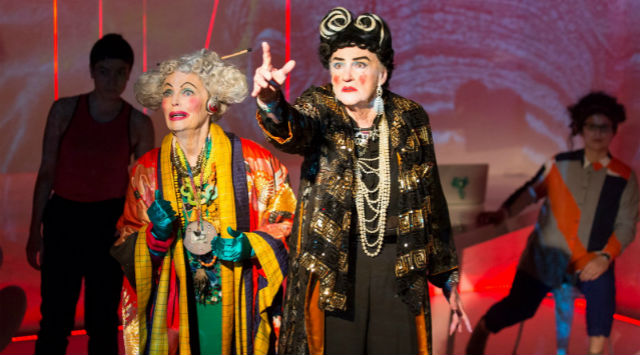
Stephen Carleton’s writing is pessimistic, but also very funny. Madcap characters and outrageous dialogue make the play drip with irony, as it shows us ugly amplified visions of how we are today, as we fail at addressing environmental problems that are already prevalent. The plot is a simple one, by nature of its characters’ stagnation and inability to do anything useful, The Turquoise Elephant does not develop very far story-wise. Director Gale Edwards does spectacular work with her show’s comedy, highly effective in its flamboyant commedia dell’arte influenced approach, but scenes begin to feel repetitious toward the bitter end. The gravity of the play’s core message does not take hold with great vigour, although that could well be a result of the undeniable apathy that we are being accused of.

Actor Belinda Giblin is remarkably vivid in her portrayal of Olympia, the disaster tourist who takes perverse pleasure in witnessing the annihilation of our planet. Giblin is tenaciously larger than life, enthralling even when her character is asleep, making us laugh whether the material is broad or obscure. The cast is hugely charismatic, and uniformly enjoyable. Also remarkable is the production’s visual elements. Emma Vine’s wonderfully wild costumes inject a vibrant, deliciously sinister edge, while Brian Thomson’s set and Verity Hampson’s lights effectively depict decadent wealth with fantastic imagination and marvellous ingenuity.

Our climate calamity is news to no one. If the play says anything useful at all, it is that our habitual social divisiveness can be as destructive as the weather we fight about. As communities become increasingly accepting of class conflicts that come with drastically unequal wealth distribution and fanatical political polarities, we will be less and less likely to know how to solve problems. A lack of social cohesion may not be as dramatic an idea as glaciers melting or islands disappearing under water, but the danger it poses is no less serious.

www.griffintheatre.com.au

Review: The Days Are As Grass (Resource Performance Workshops / Stories About Humans)

depotVenue: The Depot Theatre (Marrickville NSW), Oct 19 – 29, 2016
Playwright: Carol Hall
Director: Jane Edwina Seymour
Cast: Richard Cotter, Christine Greenough, Susan M Kennedy, Kimball Knuckey, Sarah Plummer, Felicity Steel
Image by Clare Hawley

Theatre review
Eight short plays about life as older people, make up the anthology in The Days Are As Grass, covering a range of experiences, from the funny and frivolous, to the more sobering moments of our humanity. Carol Hall writes with humour, wisdom and extraordinary sensitivity, giving voice to Australian seniors, in a style that speaks to audiences of all ages. Its characters are vivid, and their stories refreshing. This collection of short plays is often surprising, yet their subjects always feel authentic (except, it must be noted, for the very unfortunate inclusion of only one person of colour, who ends up a thief).

Director Jane Edwina Seymour keeps the show visually basic, placing emphasis instead on the personalities and relationships that occupy centre stage with excellent conviction. Seymour’s flair for nuance ensures that we engage with the production meaningfully, and that we are charmed by her persuasive cast. Actors Kimball Knuckey and Felicity Steel are especially captivating, playing three roles each, vibrant and movingly vulnerable in every segment. Knuckey consistently delivers poignancy with the most subtle of approaches, while Steel impresses with her physical dynamism and intelligent comedy.

There is no better way to celebrate life, than to celebrate the process of ageing. A linear passage of time ensures that we can always learn from the mature constituents of our communities, if only we take the opportunity to listen. We often dream about foretelling the future, unable to realise that much of our tomorrow already exists in our parents and grandparents. In The Days Are As Grass, it is clear that there are willing participants in the all-important inter-generational dialogue, but those who stand to benefit most, need to pay attention.

www.rpworkshops.com.au | www.facebook.com/storiesabouthumans

Review: E-baby (Ensemble Theatre)

ensembleVenue: Ensemble Theatre (Kirribilli NSW), Oct 13 – Nov 13, 2016
Playwright: Jane Cafarella
Director: Nadia Tass
Cast: Danielle Carter, Gabrielle Scawthorne
Image by Clare Hawley

Theatre review
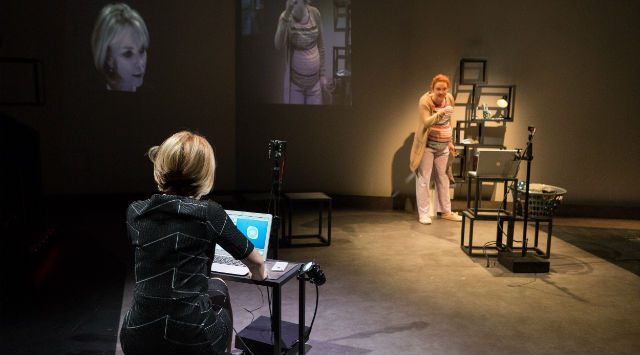
It is 2015, London-based attorney Catherine travels to Massachusetts and meets her pregnancy surrogate, Nellie. Jane Cafarella’s E-baby takes place over a period of 16 months, during which the two women communicate via the internet and phones. 30 years have passed since the first cases of surrogacy, and controversy around assisted reproductive technology has diminished considerably. We are no longer surprised to hear about people conceiving with medical help, and consequently, the play raises no eyebrows.

There are promising elements in the story, but it insists on shying away from a more explosive sense of drama. Both women’s personality flaws are clearly demonstrated, yet neither are allowed to turn into villains, in a play that tries too hard to always be nice. In its attempts to be fair and compassionate to both mothers, we experience little and learn even less. Catherine is self-absorbed and humourless, while Nellie is naively content within her ignorant and fervent religiosity. The show lets us recognise what motivates them, but struggles to help us care.

Humans do ridiculous things, and often, in our failure to explain why we do what we do, we risk feeling misunderstood and alienated. Catherine is unable to justify her unrelenting desire to procreate, and Nellie’s family is unconvinced that her actions are righteous. There are times in life when we are left isolated, with only personal desires as companion. What drives us, is a great many things, infinitely variable, but all valid, and when we choose whether or not to act accordingly, the consequences that follow must never be neglected. Catherine and Nellie believe that they come from a place of generosity but society will question their decisions in bringing innocent life to the world. We may remain unpersuaded, but there is no doubt that their perseverance is admirable. As we become increasingly cynical, it is important that we appreciate optimism and hope when we encounter it, because good things can sometimes be that needle in a haystack, and life is meaningless if we give up looking.

www.ensemble.com.au

Review: Journey’s End (Cross Pollinate Productions)

crosspollinateVenue: ATYP (Walsh Bay NSW), Oct 12 – 22, 2016
Playwright: R.C. Sherriff
Director: Samantha Young
Cast: Alex Beauman, Luke Carson, Alex Chalwell, Jack Crumlin, Oliver Crump, Patrick Cullen, George Kemp, Dean Mason, Sam O’Sullivan, Govinda Röser, Aaron Tsindos, Michael Wood
Image by Mansoor Noor

Theatre review
There are always battles being fought somewhere in the world, but we keep this knowledge compartmentalised, out of sight, out of mind. Horrific thoughts are crippling, and for most of us, to keep on living is to forget the atrocities that are happening in faraway lands. When we hear about them on the news, they can seem abstract and alienating, and we think about them as events that happen to other people.

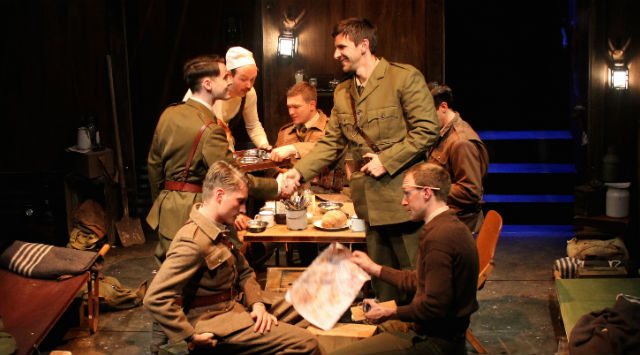
Journey’s End brings us into the intimate setting of the WWI British trenches, where we encounter regular, good men, as they try to keep calm and carry on with the business of war. In R.C. Sherriff’s play, the soldier’s stories and memories feel like personal accounts that can only help to humanise sacrifices made on the front line. It is easy to send young lives off to war, until our own children are the ones being called up.

Drama is punctuated effectively by Samantha Young’s direction, for an engaging plot that belies its age. A clarity of emotion is introduced into the all-male setting, allowing us to perceive the turmoil that the troops try to hide. Actor Sam O’Sullivan is a highlight in the role of Osborne, authentic with his speech and physicality, and tender in his portrayal of the senior officer. Michael Wood is similarly impressive as Hibbert, charming and sympathetic for a boy too immature to be fighting for his country. Jack Crumlin is suitably volatile in the substantial part of Stanhope, although transitions between emotional states can seem abrupt.

The subject matter is important for as long as we continue to participate in warfare, and as was Sherriff’s intention, it is crucial that we look at soldiers, not as concepts, but as palpable individuals. We need these stories to be real, and we need those who survive to tell their truths. Journey’s End is approaching a century old, and bears the look and feel of a period drama. There is a need for today’s equivalent, so that we can get even closer to the abhorrence, in order that we may learn to take greater care in how we treat our neighbours, and ourselves.

www.crosspollinate.com.au