Review: White Rabbit Red Rabbit (Freefall Productions)

Venue: Kings Cross Theatre (Kings Cross NSW), Apr 4 – 15, 2017
Playwright: Nassim Soleimanpour
Cast: Ylaria Rogers
Image by

Theatre review
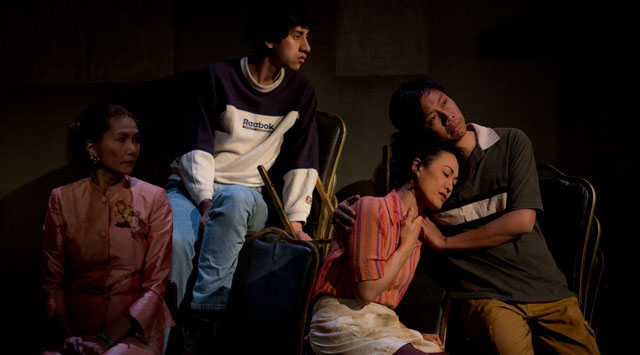
The play requires that its actor comes to the performance “blind”, not knowing anything about what lies on the pages of the playbook. It is a complete mystery to the person on stage, and also to those in the audience who are seeing Nassim Soleimanpour’s White Rabbit Red Rabbit for the first time. It is significant that the 2010 work was created when its 29-year-old author was forbidden from leaving his country Iran. The autocratic regime that he had to endure is not directly denounced in Soleimanpour’s writing, but its presence and influence on the piece, are clear.

We are made to consider how a police state operates, especially in terms of the complicity and compliance of citizens that allow inhumanity to thrive. The play shifts attention away from the way authorities intrude upon private lives, and looks instead at how the everyday person monitors and subjugates one another unconsciously, especially in cultures where freedoms are severely restricted. We are urged to think about the deficiencies in free will, and how easy it is for society to manipulate our empathy and deprive us of compassion. It wants us to see the tragedy that exists in our exploitable susceptibility to mistreating each other, and our readiness at forming habits of intolerance, hate and violence. It is to the writer’s credit that these grave and important issues are not only communicated powerfully in spite of its need to be cryptic, White Rabbit Red Rabbit is surprisingly humorous and entertaining.

Like Soleimanpour at the time of writing this script, actor Ylaria Rogers is in a position of vulnerability as she moves through the lines and instructions of every page. She submits to the text that she holds in her hands, but like those of us who have gathered to witness this unusual theatrical moment, our volition is constantly called to question. Ylaria’s obedience, and ours, come into examination, leading us to confront the nature of authority, and how it is constructed. Authority is often imagined, but even when it is real and life-threatening, the power of the masses can overthrow any dictator that sits atop. The conundrum is in our inability to perceive that collective force, and our failure to understand that the fear we experience is shared and can only manifest if we allow it to.

www.freefallproductions.com.au

5 Questions with Alison Bennett and Dymphna Carew

Alison Bennett

Dymphna Carew: What’s the best thing about devising your own work? What’s the worst thing?
Alison Bennett: Best thing would be letting your imagination run off to different places. Worst, is getting stuck and having no idea what to do.

If you weren’t an actor, what would you be?
A journalist or a bird.

What has been the highlight of creating and performing Trade so far?
Honestly, the highlight of Trade so far is seeing people turn up even when it’s really hard. Also, once we get into performance it is really fun.

Are you a romantic or a realist and why?
I am definitely a romantic but sometimes I think I’m a realist. It’s because I love to escape into my own world. When I was little I had an imaginary place called Ali Land. Not much room for realism in Ali Land.

During the creation of Trade, the biggest question we have had to ask ourselves is “how responsible are you?” What are some of the things you have discovered about yourself? Are you responsible? Have you changed after confronting yourself with this question?
This can get really dark because you start to think that the world can never change. Then I realised that I am responsible. I’m really responsible and I realised what a weird relief that was because that is something that can change. I had trouble seeing the light of the subject matter of change and I think that that’s it. If we can just put our hands up and recognise our own responsibility, then we can change. If it’s always bigger and scarier than us than it can’t.

Dymphna Carew

Alison Bennett: What would be your perfect Monday?
Dymphna Carew: My perfect Monday would be enjoying another day off after the weekend! Escaping for a long weekend and doing something active and adventurous.

What was the last dream you remember?
I had a really vivid dream a few nights ago and dreamt there was someone at my window trying to climb in. I remember desperately trying to move and call out to my partner, but I was paralysed. Then apparently I started to make some strange sounds and screamed, waking myself and my partner up. It was all a bit scary and weird. We probably watched too much Homeland before going to bed. Ooops.

What gets you really excited in the theatre?
I love live theatre and experiencing something so intimate with other people. When the space is used in an innovative and surprising way, that really gets me going. I appreciate experimentation and love original, imaginative and daring pieces of theatre. Any show that uses different art forms to make a story come to life and take the audience on a journey makes my heart sing.

How do you feel about being nude on stage?
Hmm. I don’t personally have a huge issue with being nude on stage, however I wouldn’t be getting my kit off for any old reason.

Skinny dipping? Love or hate?
I don’t mind a little skinny dip now and then.

Alison Bennett and Dymphna Carew can be seen in Trade .
Dates: 4 – 15 Apr, 2017
Venue: Old 505 Theatre

5 Questions with Lucy Goleby and Moreblessing Maturure

Lucy Goleby

Moreblessing Maturure: Fallen is a new Australian work. Why do we need new work and why did you choose this new work?
Lucy Goleby: I think it’s really important that theatre reflects, questions and challenges its social, geographical and political context. New work speaks to audiences with an immediacy, an urgency and a familiarity that makes an audience’s experience inside the theatre change the way they interact with the world outside it. This play, Fallen, allows audiences to do some of that metaphorical work themselves, asking them to draw conclusions and discover points of similarity and difference between London in 1848, we create for them onstage, and the world of Sydney in 2017, as they create for themselves offstage. Fallen seeks to explore the role of women in a patriarchy, how their relationships within a patriarchy are constructed and destroyed, and what, ultimately, empowerment looks like.

Is working in the female-led space that She Said Theatre encourages different to your previous acting experiences? If so, how?
Working with She Said and the incredible company of women has been challenging and empowering. I talk of Facebook and social media as an echo chamber, with my own opinions and passions reverberated back at me by like-minded individuals. In this room, I am surrounded by opinions and passions as fervent as my own. In simultaneously supporting and challenging each other, we have been strengthening ourselves as women to support and challenge the society we live in. Knowing that these remarkable women are conducting themselves with poise, passion, determination, intelligence and love makes me feel stronger and safer in my pursuit to do the same.

How can today’s 21st century society hope to relate to this text and its characters?
I think today’s audiences are smart story-recipients. They’re clever and quick with metaphor and symbolism, and easily capable of drawing comparisons between their own lives and experiences and those presented to them. Beyond that, the enormous revolution in television in the last five-odd years has created an audience that understands how to invest in multiple characters and multiple plotlines. Stories matter to us when we can see ourselves in them. This play and its women are both deeply familiar and uncomfortably confronting to the experience of 21st century Australian women. And men who’ve ever met a woman.

What would your character, Matron, think of 21st Century Australia?
I think Matron would be entirely overwhelmed and relieved. She is in the unenviable position of upholding and maintaining the very system that disenfranchises and devalues her. We’ve been talking a fair bit in rehearsal about the perpetuation of bad advice, and the insidious inheritance of unconscious bias. I believe in that idea that you can only dream what’s seen, and Matron’s capacity to make any kind of difference for the girls in her care is fundamentally flawed because she can’t dream a life for them that’s any different from her own.

Who should I invite to come and see this show?
Anyone who cares about what it means to be human. And those who like a stunning multimedia, fragile soundscape, emotionally rich direction, clever, detailed language, an intricate flexible set or a fully boned corset complete with hand-sewn period dresses. And your mum.

Moreblessing Maturure

Lucy Goleby: Describe the world of the play Fallen in five words.
Moreblessing Maturure: Precarious. Tense. Measured. Full. Live

What is one of the questions you hope this play asks or answers?
This is probably the thing I look forward to the most about this play- the foyer conversations before the play, during the intermission and in pubs, cars and trains after the curtain call. I asked a lot of questions after my first reading and I’d be more than content if the audience was also curious after watching the play, curious enough to read up about the history of Urania Cottage, the history of Australia, the herstory of women and particularly, these women. One burning question I’d hope this play asks is “where are we know?” Compared to 1846- where are we as a society when it comes to our relationship with our history, with femininity and liberation.

What has been the most unexpected moment or discovery of the process so far?
Aside from the phone call from Penny (the director) telling me I was going to play Julia, realising how noticeably different working in an unapologetically female-led and centred space was. Not only for myself as an individual but also as an artist, realising that “the norms” of a theatre space, which I’d learnt to be the ‘rules’ of theatre making-didn’t have to be so- that there was a different way to approach, to analyse to process to imagine stories- and that way was equally as valid . #suchdeep #muchwow

How is your character, Julia, similar to and different from you and what have you learned from her?
Julia, unlike myself, has a steadfast faith in the system she finds herself, in meritocracy- the notion that hard work leads to success (however that manifests) and thus any failure is due to individual inadequacy. That was the first big obstacle i had to work through in understanding Julia, as to WHY someone who has been wronged by her society in so many ways, continues to obey by the rules that actively maintain her lowly position. Julia also manages to be very similar to me in the way she navigates her world, in her ability to master the act of appeasing and knows how to keep-up-appearances when all she wants to do is yell to the heavens..yeah, we’re pretty Kool Kats

How will this play have changed you, as an actor and a person?
As a testament to Penny’s incredible ability, It’s introduced me to a new way to approach, discover and understand a character. This play has also set a precedent for myself as an artists as to the amount of complexity and nuance I am will accept in a role. Female roles aren’t accessories to adorn a male centric narrative- they deserve to be written with truth and dimension and dare I say: virility.

Lucy Goleby and Moreblessing Maturure can be seen in Fallen by Seanna van Helten.
Dates: 6 – 22 Apr, 2017
Venue: Seymour Centre

Review: Ellie, Abbie (& Ellie’s Dead Aunt) (The Depot Theatre)

Venue: The Depot Theatre (Marrickville NSW), Mar 29 – Apr 8, 2017
Playwright: Monica Zanetti
Director: Monica Zanetti
Cast: Meagan Caratti, Margi De Ferranti, Sophie Hawkshaw, Geraldine Viswanathan, Monica Zanetti

Theatre review
Ellie has developed a crush on Abbie, and is trying to figure out how best to ask her along to their year 12 formal. Having only just come out to her mother, who is, predictably, struggling to come to terms with her daughter’s sexual identity, Ellie is lucky to have the ghost of her lesbian aunt show up to help navigate new terrains. Monica Zanetti’s Ellie, Abbie (& Ellie’s Dead Aunt) introduces a new paradigm to the story of same-sex attracted girls. Not only does Ellie benefit from the guidance of role models, the play’s portrayal of lesbian and gay relationships in Australian high schools, as entirely normal and accepted, is thoroughly refreshing.

The work is elevated by Zanetti’s incorporation of LGBT political history. By placing emphasis on the hard won rights of Ellie’s community, we experience a gravity in our protagonist’s story without having to see her go through archaic narratives of homosexual agony. It is important that we make representations of LGBT youth in our art and storytelling that reflect the increasing normalisation of their place in society, while preserving their significance within conceptions of social diversity. Zanetti’s writing is sentimental but considered, innocent but sophisticated; it speaks intelligently to our young, and helps advocate for greater inclusiveness of sexual minorities.

The production is staged with minimal fuss. Little ingenuity is put into direction, and set design is overly bare, but the roles are soulfully realised. Appropriately, leading lady Sophie Hawkshaw is strongest of the cast, with a natural charm that endears Ellie to her audience from the very beginning. It is a gentle performance that feels effortless, but one that is surprisingly convincing. Hawkshaw makes us want the best for Ellie, and it is this emotional investment she elicits that keeps us engaged to the end.

www.thedepottheatre.com

Review: Consensual (New Theatre)

Venue: New Theatre (Newtown NSW), Mar 14 – Apr 15, 2017
Playwright: Evan Placey
Director: Johann Walraven
Cast: Callum Alexander, Michael Brindley, Claire Crighton, Rhys Johnson, Eloise Martin-Jones, Eliza Nicholls, Eamon O’Flynn, Celeste Reardon, Lauren Richardson, Natasha Rose, Anton Smilek, Nicole Toum,
Benjamin Vickers, Paul Whiddon, Emma Wright
Image © Bob Seary

Theatre review
Freddie was a 15 year-old schoolboy when a sexual tryst occurred between himself and his teacher, Diane. Seven years later, a confrontation takes place, with Freddie accusing Diane of rape. In Consensual, playwright Evan Placey poses a challenge to our ethics, not only in terms of what we consider to be sexual assault and what constitutes consent, but also how, as individuals and as society, we determine what is acceptable and what is abhorrent. The play is as much about where to draw the line, as it is about how we find consensus in the way that line should be drawn.

Placey’s gripping drama is often outrageous, but balance is offered by ethical and intellectual investigations that are as considered as they are controversial. Urging us to respond on levels that are both emotional and logical, the play leads us to experience states of struggle and confusion, while we attempt to negotiate right from wrong in all the grey areas of what we see on stage, and in those of our own real world experiences. Characters in Consensual are believable and quite frighteningly, we relate to all of them. Even when we wish to castigate certain behaviour, we understand the fallibility on display, and realise how easy it is to make those same mistakes.

Freddie is played by Paul Whiddon, perfectly cast as the male Lolita, vulnerable yet seductive, manipulative yet naive. We see a man domineering with his sexuality, as well as a lost boy not knowing what he is getting himself into. Whiddon brings a level of authenticity to the show that is quite arresting, allowing us to observe clearly, all the conflicting nuances that make his story so provocative.

Lauren Richardson takes on the highly complex role of Diane, portraying concurrent but contradictory layers of truth that has the audience squirming in nervousness. Some of her motivations could be played with greater conviction, so that the climactic moment can ring truer, but it is an accomplished performance that reveals the disconcerting depths of Diane’s story.

A strong ensemble of extraordinarily engaging young actors make up the high school classroom, typically rambunctious but surprisingly (and unnervingly) grown up in their exchanges about sex. Particularly impressive is Callum Alexander whose excellent focus and commitment, makes the supporting part of the very wise Nathan, especially memorable.

Production design is simple but effective. Renee Halse’s set and Liam O’Keefe’s lights are polished, efficient and unobtrusive, while music composer Nicky D’Silva’s exciting electronica in scene transitions, brings great vigour to the stage. Director Johann Walraven’s exhibits a valuable talent in making Consensual both intelligent and entertaining. More detailed work in dramaturgy would give greater finesse, but the show is nonetheless engrossing.

A child wants ice cream morning, noon and night. No amount of explanation could make the consequences more real than the yearning they experience. Likewise with teenagers and sex. Adults must protect the young, even when they appear headstrong with what they wish to explore. Sex and relationships are complicated, and we will continue to make mistakes no matter how grown up we feel, but as long as the more experienced can keep a watchful eye, the minimisation of harm must always be a priority.

www.newtheatre.org.au

Review: Two (Ensemble Theatre)

Venue: Ensemble Theatre (Kirribilli NSW), Mar 24 – May 6, 2017
Playwright: Jim Cartwright
Director: Mark Kilmurry
Cast: Brian Meegan, Kate Raison
Image by Clare Hawley

Theatre review
All kinds of things can happen in a pub, that old institution that uniquely combines commerce and community. It is wide open, with few restrictions on who and what are allowed to walk through its doors. Jim Cartwright’s Two first arrived at the very end of the 1980’s. Set in regional NSW, it paints a nostalgic picture of Australia before mobile phones, and before we began suspecting neighbours of wanting to bomb each other into pieces.

Men were masculine, women were feminine, and everyone was heterosexual. A comforting predictability existed, along with an indeterminate air of stifled constraint. The play features two actors in a series of roles that explore love and relationships, from an innocent time and space.

Kate Raison plays all the nice ladies with an admirable strength, bringing dimension to their predetermined passivity, and Brian Meegan keeps us entertained by introducing imaginative variation to his wide range of male characters. They make a confident and jubilant pair, adept at providing entertainment and pathos with each of Two‘s warmhearted vignettes. Director Mark Kilmurry stays out of the way of his actors’ talents, and leaves Cartwright’s vision intact, for a production that offers no surprises, but that communicates fluently with a remarkable simplicity.

For those of a certain age, there is no greater romance, than the romance one has with the past. We retain only the sweet, and those memories can make the living of today seem less dulcet. The Aussie pub is required to preserve tradition, but the financial imperative forces it to move along with the times. It is an allegory for us all. The past is often warm and comfy, but it is the essence of life that will insist we be taken in unexpected directions. The local watering hole may no longer know your name, but it still stands, awaiting new stories to be writ.

www.ensemble.com.au

Review: Binary Stars And Best Lives (Old Fitz Theatre)

Venue: Old Fitzroy Theatre (Woolloomooloo NSW), Mar 28 – Apr 8, 2017
Playwright: Samantha Hill
Director: Michael Abercromby
Cast: Katie Beckett, Nathalie Murray, Jenae O’Connor, Amelia Tranter

Theatre review
A gun shot is fired, sending chills down our spines. A woman appears, disoriented, a time-traveller perhaps, or someone from a parallel universe, but more probably, she is just released from prison for shooting her husband some years back. Babe is an astrophysicist, with a keen interest in realms other than the immediate reality. Having given up her own dreams to become trophy wife to a television celebrity, she loses her sense of self, and we find her grasping at straws to justify her existence.

Samantha Hill’s Binary Stars And Best Lives is theatrical, ambitious and complicated, but its cacophony of rich ideas struggle to communicate with clarity. It seems to have a lot to say, including issues about Aboriginality, feminism and materialism, all worthy of exploration, that might be better dealt with if greater attention was put into creating a more cohesive narrative.

Babe is an elusive character, who actor Katie Beckett embraces with conviction, especially in sections of heightened drama and emotion. Amelia Tranter impresses in dual comedic roles, both memorable for different, and absurd, reasons. Nathalie Murray and Jenae O’Connor add further vibrancy and fun to a show that is otherwise more than a little confusing.

We need to have concurrent truths in order that life can be bearable. Whether complementary or conflicting, the different ways we form an understanding of how things happen, must allow some plasticity, or all our days would only be harsh and cruel. Even when Babe is made to face the consequences of her irrefutable actions, her mind provides explanations that she can live with. We all see the world differently, but how we co-exist is the perennial challenge.

www.oldfitztheatre.com

5 Questions with Curly Fries and Tim Kemp

Curly Fries

Tim Kemp: Did you ever imagine you’d start your own company?
Curly Fries: Oh god that’s an interesting question. When I was younger I always fantasized about having a Shakespeare company that was contemporary. But then, the more I got into acting, and acting school, it was seen that Shakespeare or classic verse was ‘daggy’ or ‘not that exciting’. So, I steered away from it even though I really liked it. Looking back now there was a real push at acting school (or maybe actually something that the students put on themselves) that we would be working in the popular culture and Shakespeare wasn’t part of that. It was only last year when I got really pissed off with the situation that I
decided to use Shakespeare as a way of making some sort of connection and use political theatre. ‘The leftovers’ was born. I can’t imagine my life without it and our team behind it.

If you had an infinite budget what would change about the way you make work?
Definitely I’d want to pay my actors triple the award rate because what they give me and the collective, apart from their time and their work, what they give me is their artistry which has no price. I’ve always been totally blown away by the sheer magnitude and interpretation of the work. I would hope to one day be able to give the artists that. I would probably also have a fancier set. Haha! I don’t know maybe not…actually, maybe not. Actually, definitely not. AND – it will always be free to the public.

How many business calls have you taken dressed as a clown doctor?
… erm …Probably each round I’m a clown doctor, and they can range from 1-3 a week. So maybe about 1 call per shift, 5 texts and a couple of emails. The funny thing is having that clown nose on me during those calls gives me a different way of treating the business. It gives me a different slant on it. It reminds me of the bigger picture. The hospital is really great for that. Every time I come out of the hospital after entertaining the patients (children) I’m just so grateful that I have what I have.

Could a Leftovers’ experiment ever be a failure in your eyes, if so, how?
Absolutely. Part of our manifesto is that our experiment can fail. And each experiment sometimes turns a certain way. It can go from looking at the body to ownership of art in one experiment which was a total surprise for us. It can go from a piece about language becoming a piece about guilt of Australian culture, again a total surprise. It can go from a Jacobean ‘who-dunnit’ to questioning the need for gender binary identification. So, each work experiment morphs into something. I used to be scared of failure and now I totally embrace it because it means that we, the artists and the audience, all learnt something together. So, you could say that potentially every experiment thus far has been an absolute failure – and success.

Encounter My Heart was inspired by an execution. How do you separate your own opinions from your experiments to ask unbiased questions?
You need a really pretty fucking good team behind you. You need people that are not afraid of taking your idea, ripping it up and throwing it on the floor in front of your feet. I have a handful of exquisite artists that I trust implicitly with my artistic life. Anytime I have an idea, especially with this last one, Encounter My Heart, I take it to them and I ask them for the honest authentic and visceral response. It is the team behind the yellow ‘X’ that does make the work fair, unbiased and experiential. It is them. Wholly it is them.

Tim Kemp

Curly Fries: We were at dinner once and I said, “take a seat…” You said, “I am.” What’s it like being so tall?
Tim Kemp: I thought that was a joke. I can’t believe that’s one of your 5 questions you absolutely gorgeous fool of a man. At 6ft 1 I’m hardly especially tall? You’re the kind of person that would waste a Genie in a Bottle. To try to take it seriously, one thing that I had to learn at ACA was that you can be big and have good intentions. People will read that and not fear you. I came to Sydney with a lot of baggage from Newcastle as a footballer – that I’d be identified as a thug. It was a kind of self-fulling prophecy because I was so physically guarded it read as stand-offish? To summarise – I think my biggest journey at acting school was learning to be comfortable in my own body.

Why do you work for The Leftovers Collective?
I mean there’s a whole a series of reasons why I do work for the leftovers collective. I think my major motivator is your respect for individual artistry. If I help you make a promotional video, or a document or devise with you on a show, it’s a true collaboration and the product is something I’m proud of. I feel agency and I’m actually more proud of how much we throw away in our artmaking. The objective of the works are always to ask a question and we make sure that we do that.

Encounter My Heart deals with confessions, do you have something small you’d like to
share?

I’m a fiddler. Anytime I’m thinking deeply my hands are busy. I think in all honesty it was a very lame attempt to be cool at 16. Showing off to the ladies my speed records for 3×3 and 4×4 cubes. It is still a great icebreaker though.

Does the strong nature of our work concern you?
In a word no. To take Adonis Procedure for example – our provocations were Greek ideals of beauty and how we still subscribe so much worth to those physical ideals. Yet the night was a carnival of fake cash and glamour and laughter. It wasn’t until AFTER the experiment was over that we talked about the questions the work brought up. People were allowed to experience the work without judgement. I think that’s the key. I think we’re interested in witnessing a true response to our works – ugly, beautiful or indifferent. We’re not at all interested in making a judgement or a statement on those responses.

What’s your take on the conviction, trial and execution of Myu and Andrew?
I think in true “Leftovers’ fashion – I’m unsure. I don’t think there is a simple answer. It is a question of humanity and mercy. Also I understand the fear that leads a community to be uncompromising. It’s a search for security. I think there’s nothing to be gained by vilifying either side. I think the tragedy is sometimes there’s no right answer to a moral dilemma.

Catch Curly Fries and Tim Kemp in Encounter My Heart.
Dates: 21 – 29 Apr, 2017
Venue: The Two Wolves, Broadway

5 Questions with Lauren Richardson and Paul Whiddon

Lauren Richardson

Paul Whiddon: Which pop star would you name your kid after?
Lauren Richardson: If it was a girl, Beyoncé. If it was a boy…Beyoncé.

What challenges did you have to face playing Diane?
Every day in the rehearsal room was a challenge, the role is quite confronting and I had to step outside of my comfort zone in terms of what I was (often quite literally) willing to bare. But I’ve learnt that that can be quite liberating.

What would you have done in Diane’s position as a 22 year old?
I don’t want to give too much away, so I’ll just say I wouldn’t have opened the door.

Who would you go younger for?
I tend to prefer older men 😉 haha

Have you ever considered becoming a teacher?
I come from a family of teachers, my best friend is a teacher, and I’m a passionate advocate for public education. But there’s no way I could do it!!! Nothing but respect and admiration for teaches who work tirelessly and often without due thanks.

Paul Whiddon

Lauren Richardson: Pop star you’d name your kid after?
Paul Whiddon: Of it was a girl Ella, after Ella Fitzgerald. If it was a boy Benjamin, after Macklemore.

Did you ever have a crush on a teacher?
Yes. My Dance teacher. I actually nearly got her in trouble after I sent her a Valentine’s Day card as a joke.

Hardest part about playing Freddie?
Not to you use too much of my own experience. There are many similarities between how Freddie is and how I am. The hardest part was taking on the differences and separating Freddie from myself.

Geek or jock in high school?
I wasn’t really either. I was in second top classes, was pretty athletic all round, but really, I was a shit. The ‘group’ I suppose to could put me in was the smokers. I wagged, smoked cigarettes and weed through school. I wish I’d done more, but I was one of those kids you’d barely see except in school plays.

What do you like about the play?
I like that it isn’t too subjective to a particular character’s point of view. But rather sparks debate with with each audience member relating to different characters

Lauren Richardson and Paul Whiddon can be seen in Consensual by Evan Placey.
Dates: 14 Mar – 15 Apr, 2017
Venue: New Theatre

Review: Richard III (Bell Shakespeare)

Venue: Sydney Opera House (Sydney NSW), Feb 25 – Apr 1, 2017
Playwright: William Shakespeare
Director: Peter Evans
Cast: Ivan Donato, James Evans, Sandy Gore, James Lugton, Kevin Maclsaac, Kate Mulvany, Meredith Penman, Gareth Reeves, Rose Riley, Sarah Woods
Image by Prudence Upton

Theatre review
Born ugly, Richard never understood what it is to be loved, and his story details the effect on a person when rejection is a constant and central defining experience. Coupled with what we now term privilege, his aristocratic life places him in a position of power in spite of that perpetual derision, and what results is a bitter thirst for the reciprocation of inhumanity, that knows no bounds.

It is possible to think of evil as a condition that is somehow innate, even natural to some, or as Shakespeare does in Richard III, we can conceive of evil as a manufactured and socialised phenomenon. In director Peter Evan’s rendition, the way brutality manifests, is an unambiguous process of retribution; Richard’s behaviour is depicted as being a direct consequence of the way he suffers under the mistreatment of a cruel world.

The production is adequately assembled, but there is no overstating its capacity as a showcase for the staggering talents of Kate Mulvany, who takes on the eponymous role with splendid aplomb. Mulvany’s unequivocal brilliance occupies centre stage, having us enthralled at every second, and casting a shadow over the rest of the show. All we want, is to absorb every meticulous minutiae that she serves up in each word and gesture.

It is pure genius at work, and to witness a virtuoso performance that is so exhaustively invested and incredibly rich with resonance, is the kind of theatre that broadens our understanding of what art is capable of doing. When Mulvany strips off at dramatic climax, to reveal her own scoliosis, we see the severely curved spine that she shares with Richard, and in that moment, performativity and reality conflate, for one of the most powerful visions ever brought to stage. Our reaction is appropriately visceral, but we are also made to consider how we attribute a person’s merits, or more accurately in this case, demerits, to their natural traits. If Richard is a villain because of his congenital physical condition, we must question how Mulvany’s and everybody else’s corporeality, is able to determine the people that we eventually become. We wonder about the finality of fate from the point of birth, and the extent to which our existence is written in the stars, and on the flesh.

There are other members of cast who impress, most notably Meredith Penman and Sarah Woods who deliver sensational scenes of heightened emotion, but the piece dulls significantly in the short moments when our star is offstage. Evans’ frequent use of his actors as a chorus is occasionally awkward, although the sense of vigour they create is valuable in ensuring that our attention is sustained. The set and costumes do not quite achieve the luxury and decadence that it aspires to, and the use of a small television set to convey the presence of a dumbwaiter is an inelegant solution and a continual distraction.

Visual aesthetics in this Richard III may not be a strength, but the character we have come to see, is marvellously presented. To live is to learn, and to be human, we need to understand humanity. Art shows us all the possibilities of being, so that we can find ways to negotiate better, both our environs and our selves. It is unlikely that Richard is a straightforward reflection of any one of us, but through this extraordinary rendering of a man who suffers and who retaliates, we gain insight into the nature of personal demons and recognise the way we co-exist in communities. Love can bring about things most beautiful, but its absence, is how we invite every ugliness.

www.bellshakespeare.com.au