Review: Mother (Belvoir St Theatre / If Theatre)

Venue: Belvoir St Theatre (Surry Hills NSW), Jan 24 – Fe 11, 2018
Playwright: Daniel Keene
Director: Matt Scholten
Cast: Noni Hazlehurst
Image by Brett Boardman

Theatre review
Christie’s misfortune is deeper than any we have ever encountered. Having lost everything, she is on the streets with only memories of trauma, to while the days away, like a waking recurring nightmare. Daniel Keene’s Mother is about the hardest life a person can bear, a shocking Greek tragedy made real and salient for our times. It goes beyond an examination of mental health deterioration, to create a portrayal of the person underneath the illness, with all her humanity intact.

Keene is fascinated by the monster or, more accurately, the social pariah, but is interested in reaching a compassionate understanding of what we usually and conveniently regard as abhorrent. Mother insists that we connect with its subject. Countless moments of disarming poignancy, make us identify with this strange creature. It rejects our impulse to think of Christie as alien and disposable, insisting that we walk a mile in her shoes.

The role is magnificently performed by Noni Hazlehurst, who proves that perfection in art, is attainable and not just an abstract construct. She presents her one-woman show with flawless technical brilliance, leaving us in awe of the superhuman feat that is under way, whilst keeping us firmly locked into the narrative of Christie’s utter destitution. Hazlehurst being at the top of her game, allows us to see so clearly, what it is like for a woman languishing at the very bottom of the heap. The actor’s capacity for persuasion is extraordinary. The sense of authenticity that Hazlehurst is able to convey, feels boundless; there seems no delineation between the suffering of actor and character. She tells a tale of pain, and we are shaken by it, no matter where we think the anguish comes from.

It is an exceedingly elegant piece of direction by Matt Scholten, whose minimal approach is impressive in its confidence, but it is questionable if the staging adequately addresses Belvoir’s comparatively large auditorium. The production is a dynamic one that oscillates deftly between states declarative and poetic, with the quieter scenes tending to wane slightly in the big hall. Sound design by Darius Kerdijk is inventive and effectively evocative, and Tom Willis’ lights add an ephemeral beauty to the potent melancholy he establishes for the space. Costume designer Kat Chan ensures that Christie looks every bit the vagrant we pretend not to see in every Australian city.

A tremendous sadness permeates the play, and we are moved to consider our relationship with the homeless. Whether or not we wish to make personal connections, it is of fundamental importance that we are cognisant of our responsibilities regarding all the neighbours who surround us, no matter how they reside. Humanity is worth nothing, if we choose not to care for those in need. Christie, like any human being, is not blameless, but the moment we give up on trying to bring improvements to her life, is when we have to seriously interrogate our priorities as a first-world society.

www.belvoir.com.au

Review: Sorting Out Rachel (Ensemble Theatre)

Venue: Ensemble Theatre (Kirribilli NSW), Jan 19 – Mar 17, 2018
Playwright: David Williamson
Director: Nadia Tass
Cast: Chenoa Deemal, Glenn Hazeldine, John Howard, Jenna Owen, Natalie Saleeba
Image by Heidrun Lohr

Theatre review
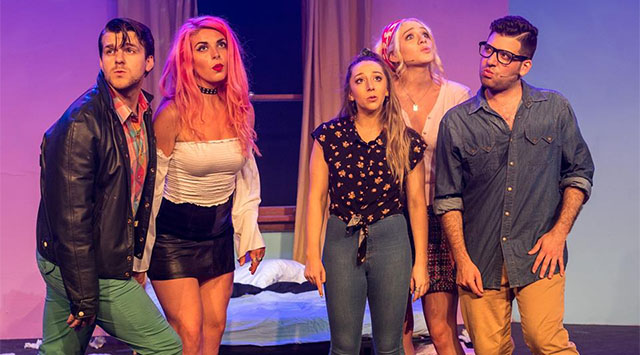
Bruce is an old man with a lot of money, sixty million dollars to be exact, and a life with no troubles except in deciding what to do with it all when he dies. David Williamsons’ Sorting Out Rachel is clearly not a story for the “ordinary Australian”, although some of its scenes where family members connive and fight over inheritance would resonate with many. It is also a “father knows best” story where the patriarch interferes with his daughter Julie’s life, and manages to solve all her problems over a few days quite miraculously, as though a knight in shining armour had descended upon her household, out of the blue.

The play never feels very realistic, with Julie’s unexplained ineptitude particularly conspicuous, but the conflicts that arise from Williamson’s depictions of a feuding family, are nonetheless entertaining. The eponymous Rachel is played by the very compelling Jenna Owen, who impresses with an energetic, if slightly too histrionic, portrayal of a recalcitrant teenager. John Howard is suitably august as her grandfather Bruce, and Natalie Saleeba becomes increasingly believable, as Julie gradually gains strength through the later half.

Glenn Hazeldine is a mischievously charming presence, and probably the most convincing of the group, even if his ploys as Julie’s husband Craig, are far too transparent to hold water. Chenoa Deemal is memorable as Bruce’s illegitimate daughter Tess, the Indigenous personality brought into the story, not only as inspiration for Bruce to think about his wealth as a vehicle for benevolence, but also for us to understand the cultural dimensions of the middle-class crises we encounter.

Ideas about inheritance in Sorting Out Rachel seem in many ways, to be borne out of the family’s European heritage and the individualism that whiteness extols. Wealth, and property, are essentially personal, almost never communal, to the extent that even family members are routinely refused access. Bruce’s prosperity comes from real estate, but in Australia, issues of land ownership remain gravely contentious.

www.ensemble.com.au

Review: Three In The Bed (Birdie Productions)

Venue: New Theatre (Newtown NSW), Jan 11 – 26, 2018
Book, Music & Lyrics: Jonathon Holmes
Director: Jonathon Holmes
Cast: Adin Milostnik, Daniella Mirels, Caroline Oayda, Alicia Rose Quinn, Aaron Robuck
Image by Douglas Frost

Theatre review
It is not the first time we come across a work of fiction, about three women falling crazy in love with one very unexceptional man. These stories never make any sense, of course, and because we are in this supposedly “woke” year of 2018, it is understandable if many were to find that tired narrative a particularly painful one to have to tolerate. Jonathon Holmes’ Three In The Bed is infuriating for the feminist viewer, and the number of us who will not accept that kind of unimaginative and inconsiderate writing, is increasing by the legions.

Its women are completely objectified, and none of the characters bear any sense of complexity or even attempt to be in any way remotely realistic. It is astonishing that songs about “why doesn’t he like me?” and “let me clean your room” are being unleashed on Australian audiences, in this day and age.
Sexually exploitative scenarios (the production’s unabashed selling point) are manufactured, just for laughs, but in the absence of verisimilitude, humour simply becomes impossible. When people do laugh, it is in response to the purposely uncomfortable sexuality being portrayed. The show tries repeatedly to tickle, but we can only cringe in response.

There is however, real talent in Holmes’ musical ability, and his hopeless passion for the Broadway genre is evident. The cast is undoubtedly skillful and their exuberance, quite miraculously, carries the show, with Caroline Oayda eminently memorable in the role of Emma, bringing exceptional flair and prowess to the stage. The performers work hard, and smart, but they are powerless in trying to redeem these deeply unfortunate depictions of womanhood.

www.threeinthebedmusical.com

Review: My Urrwai (Belvoir St Theatre / Performing Lines)

Venue: Belvoir St Theatre (Surry Hills NSW), Jan 19 – Feb 4, 2018
Playwright: Ghenoa Gela
Director: Rachael Maza
Cast: Ghenoa Gela
Image by David Charles Collins

Theatre review
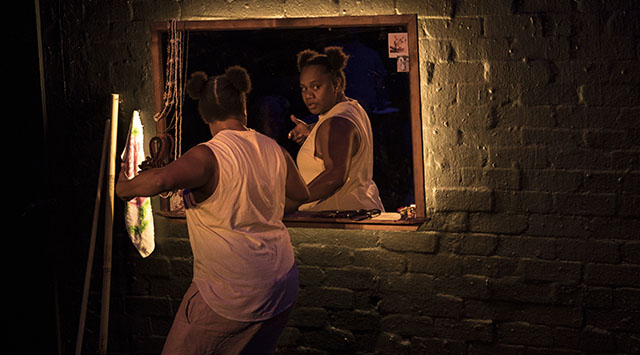
Ghenoa Gela is a Torres Strait Islander born in Rockhampton. Efforts to keep culture in her veins have always been deliberate and laborious; it is a constant battle for Indigenous Australians to resist colonisation and to retain their own identities. In My Urrwai, Gela shows us what it is like to be a woman of native heritage living in modern Australia, bringing particular focus to the unjust burden that black people have to bear, whilst existing on their own rightful lands, that white people had forcefully usurped.

Part of the tale involves a significant first visit to Gela’s extended family in the Torres Strait Islands, where she finds herself in moments of alienation, as well as extraordinary connection. My Urrwai is, among many things, a deep meditation about the need to belong, and with it, we examine the hugely important themes of displacement and repudiation as experienced by our First Nations peoples for 230 years and counting.

Formative and crucial fragments of Gela’s life are compiled intelligently, for an autobiography that feels impressively comprehensive in its scope. Even though My Urrwai does contain colourful idiosyncrasies, the earnest care with which it discusses issues of race is unmistakable, as it is probably inevitable that this one-woman show would be called upon to represent entire communities. The need for more productions featuring Torres Strait Islander voices, simply cannot be overstated.

As performer, Gela is an outstanding talent, combining years of training in stage disciplines, with an enviable presence, to produce the consummate storyteller. Her remarkably exacting and agile physicality, plus an uncanny ability to speak with great resonance, sonorous and philosophical, are the key ingredients in this wonderfully moving piece of theatre. Proving himself to be equally accomplished, is lighting designer Niklas Pajanti, whose work accurately prompts a wide range of emotional responses, from transcendent beauty to chilling terror. Director Rachael Maza’s sensitive manipulations of space, ensures that each scene is received crystal clear, whether in their inception, intent or purpose.

Unlike most plays we see on the Australian stage, My Urrwai is conscientious about acknowledging the multicultural aspect of our audiences. It understands that we do not all come from the same place, even if we do wish to identify as one. It is welcoming of all peoples, but it certainly does not subordinate those whose culture is on display. The ease with which it addresses Torres Strait Islander viewers, and its ability to establish a theatrical language that rejects white experience as the centre of all our orbits, is admirable. The process of decolonisation in how we do and think about art in Australia is a massively difficult one, but Ghenoa Gela and My Urrwai are jubilant rays of hope, undeniable in their brilliance.

www.performinglines.org.au | www.ilbijerri.com.au | www.belvoir.com.au

Review: Buried (The Old 505 Theatre)

Venue: Old 505 Theatre (Newtown NSW), Jan 17 – 27, 2018
Playwright: Xavier Coy
Director: Johann Walraven
Cast: Amelia Campbell, Tara Clark, Xavier Coy, Nicholas Denton
Image by Liam O’Keefe

Theatre review
The Sandpiper is the shorter of two plays by Xavier Coy, featured in Buried. Involving a psychotherapy session where things go awry, the piece is perhaps too conventionally structured, and too brief, resulting in a predictable story that proves anti-climactic. Much more substantial, and persuasive, is Smokin’ Joe, the second Buried play, dealing with class and masculinity in a typically Australian context. Its dialogue is fresh and playful, and its stakes are high, with challenging ideas and curious turns of events that keep us engaged.

Director Johann Walraven, too, invests more deeply into Smokin’ Joe, with nuance and complexities fleshed out effectively, to express the often hidden conundrums of being a man in Australia. Actor Nicholas Denton is captivating as Finn, humorous and exacting in his portrayal of a nineteen year-old discovering himself and finding his place in this often cruel world. Playwright Coy takes on the role of Dylan with admirable conviction and focus, to create a character that is at once familiar, and tenaciously intriguing.

There are secrets in Buried; things that people hide from others, and things that exist in plain sight but that are waiting to be named. Through art, talented individuals can identify the illusory and the elusive that swirl around us in the ether, and give them shape or form, so that we can gain a better understanding of what it is that we do and experience, as beings who walk this earth. It is a high calling, and the consequences are sacred.

www.old505theatre.com | www.facebook.com/wheelscoproductions

Review: On The Border Of Things Part One (PACT)

Venue: PACT Centre for Emerging Artists (Erskineville NSW), Jan 17 – 20, 2018
Creators: Cong Ai Nguyen, James Nguyen
Cast: James Nguyen
Image by Carla Zimbler

Theatre review
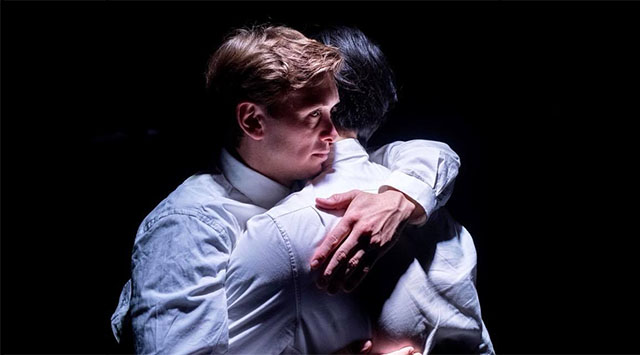
In part one of On The Border Of Things, James Nguyen talks about his travels in search of family and his discovery of personal histories. It all begins with the memory of his uncle Cong Ai Nguyen who had left home for a nomadic regional life, working in transient jobs at disparate locations for over twenty years. James’ need to reconnect sparks a three-year odyssey that takes him to country Australia and also to Vietnam, and we catch him as he drives into Sydney, probably momentarily, to talk about his findings.

Essentially a one-man show, with a storyteller proficient in visual arts who rejects the approach of a conventional acting piece, The Border Of Things has a startling immediacy rarely encountered. When our theatres are working well, we are able to come in touch with truths of the world, and here, the first-person narrative is taken to a new level of intimacy. Artifice is stripped away, for an account of adventures recalled not from rehearsals but from actual experience.

James Nguyen’s investigations into the Vietnamese diaspora and his exploration of our farmlands, creates a potent combination that all Australians should find relevant. Discussion points about the migrant experience, along with diverse notions of home as personal and universal conceptions, as well as the meaning of land in relation to commerce and colonisation, all find consolidation and resonance through the Nguyen family’s tales.

The presentation concludes with a short documentary film, as sensitive and tender as the monologue prior, with a quiet melancholia permeating its depiction of new bonds being formed, as uncle and nephew reunite on farms in country Victoria and South Australia. We get a sense that both are black sheep, each able to see himself in the other’s eyes. To know oneself, questions must be asked, and the answers come best, from those we identify with the most. Our protagonist has had to travel afar to reach someone close, but it is evident that the rewards are joyous, and profound.

www.pact.net.au

Review: Tonsils And Tweezers (Jackrabbit Theatre)

Venue: Kings Cross Theatre (Kings Cross NSW), Jan 12 – 27, 2018
Playwright: Will O’Mahony
Director: Michael Abercromby
Cast: Travis Jeffery, James Sweeny, Megan Wilding, Hoa Xuande
Image by Clare Hawley

Theatre review
Will O’Mahony’s black comedy Tonsils And Tweezers centres itself on two young men, who share not only a very close relationship, but also the unyielding malaise of modern masculinity. We see them bond as outsiders in school, and witness how that relationship shapes the adults that they try to become.

The narrative might be fairly simple, but the plot is a deliberately beguiling one that ends up delivering more confusion than it intends. We sense an emotional crescendo being constructed thoughtfully as each scene progresses, but its inability to have us sufficiently identify with either Tonsils or Tweezers, takes us to a conclusion that never manages to be more than lukewarm.

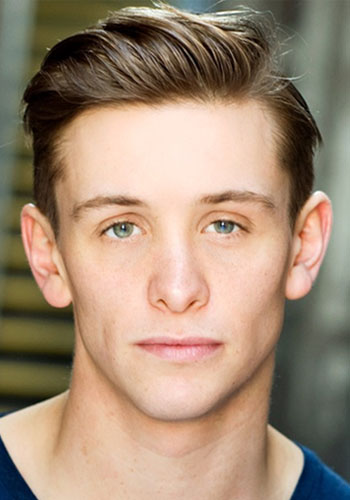
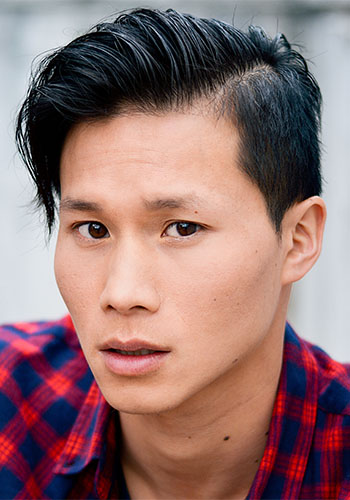
The actors however, are full of conviction and reliably entertaining. Travis Jeffery and Hoa Xuande are the leads, both authentically present and impressive with the gravity they bring to the stage at crucial junctures of drama. Even more appealing, are supporting players James Sweeny and Megan Wilding, memorable with the scintillating humour they are able to introduce throughout the piece. None of these characters are particularly likeable, but it is a cast that we are glad to have spent time with.

Director Michael Abercromby takes us through the play’s many blunt atmospheric shifts with admirable elegance and efficiency. Lights by Liam O’Keefe and sound by James Yeremeyev have a tendency to work slightly too literally, but are highly effective with the way time, place and mood are calibrated for our subliminal comprehension. Patrick Howe does remarkable well as set designer, creating a space beautifully sleek in its minimalism, whilst portraying a cold brutality that is consistent with emotions relevant to the text.

In Tonsils And Tweezers, the Australian man’s problem with self-expression is, characteristically, looked at, but not looked into. The inability of our boys and men, to articulate and to understand their own feelings is, as the play points out vigorously, clearly detrimental, but how all this transpires, is all but neglected. We know the effects of toxic masculinity, but are yet to examine it in a way that can bring us satisfactory solutions. The dismantlement of old structures that we continue to live within, is necessary but strenuous. Some have begun work on that process, but more will have to come on board, if we wish to truly progress.

www.jackrabbittheatre.com

5 Questions with Travis Jeffery and Hoa Xuande

Travis Jeffery

Hoa Xuande: Before you read Tonsils And Tweezers, going purely from the name, what did you think the play would be about?
Travis Jeffery: I had absolutely no idea what the play was about before I read it. I love the title, but the only thing it gives away is two of the characters names, and even that’s not crystal clear. Will O’Mahony is a very intelligent human and writer so I gathered the title wasn’t going to be literal, but the thought did cross my mind that ‘hey maybe it’s just set at the dentist’.

What kind of kid were you at school?
I was the funny chubby kid at school. Or at least I tried to be funny, I was definitely chubby. My passport photo was taken in 2009 when I was around 107 kgs, these days when I whip it out at the airport I occasionally get laughed at… at least I’m getting laughs 😦

What are the similarities or differences between you and your character?
The importance of friendship is definitely something myself and Tonsils have in common. My friendships are one of the most important parts of my life, whether it’s on or off stage it’s wonderful knowing you have people that will be there for you, including you, Hoa Xuande. At the heart of Tonsils And Tweezers is two best friends trying to help each other work through something traumatic, it’s their friendship that drives the play.

What do you think your character’s name actually is and why?
Interesting question Hoa, lets go with Peter. Purely because in one of the rehearsals James Sweeny, who plays Max, called me Peter when he wasn’t cut off in time. Or maybe his name really is just Tonsils, like Cher!

Where do you go to get your dance moves?
I learnt my moves at the school of hard knocks! Don’t be fooled into thinking I woke up one morning and they were there. Years of hard work and dedication has been put into my skills. Hitting the D-Floor rain, hail or shine to keep my moves in peak condition. Actually to be honest I was born with absolutely no rhythm so dancing is incredibly hard for me, come watch the show and see for your self.

Hoa Xuande

Travis Jeffery: What do you enjoy about Tonsils And Tweezers and Will O’Mahony’s writing?
Hoa Xuande: I’ve had the chance to work with Will twice now on his plays, including the original development of Tonsils And Tweezers, and the thing that really sticks with me about his writing is how frivolous and fun his plays are until it drops you into the deep end and puts you into an emotional mess. Without trying to sound smart he creates these ideas and clues along the way, which ironically makes his plays really clever. In Tonsils And Tweezers we just get to be silly and play until we hand the audience the play’s actual intentions and emotional truth. It’s really fun to do that every night!

What’s the biggest difference between this production and the original?
The biggest difference between this production and the original would have to be the pace between the two shows. The original was put on as part of a double-bill of theatre at the Black Swan State Theatre Company in Perth so we had some time constraints so Will, who also directed the piece himself, really got us to rapid-fire the text. I mean, we really spoke quite fast! But this production has allowed me to just re-discover the text and give the play a little more ‘breathing room’ so it’s nice to be able to just take your time a bit more in this version of the production and make new choices that you hadn’t previously thought about before. It’s just been great to be able to do the same text again but in a different way!

This question has 2 parts! Part 1: What do you like most about rehearsals? Part 2: What do you like most about working with me?
Haha, well… early on in rehearsals, it was interesting to re-discover the play with Travis and Michael and because I had done the play before, I thought, “Nah, I’ll be right.” But as they kept mining the text and discovered things I had completely missed before, I found myself questioning what I actually knew and what my choices were in the previous production and whether I had even understood the play in the first place. So stepping through the play once again in these rehearsals has actually been quite a refreshing feeling. Travis, mate, I like your can-do attitude! Strong choices even if they might be wrong, or always wrong, haha! Nah, actually that was me every day!

Is it true you only own one white shirt and wear it every day?
False, my friend, I actually own more than one white shirt. Three, to be precise. One of which is being used in the show right now! But I choose to wear my ‘rehearsal’ white shirt every day for rehearsal purposes. FYI, it does get washed every week, I think!

Did you ever have a nickname that you hated? Do you have one now?
I’ve had plenty of nicknames or more like mis-pronunciations of my name that’ve probably turned into a nickname at some point in time. The strangest reading of my name once was ‘hon’ and I was like, ‘Interesting, don’t know where the ‘n’ came from but I’ll take it!’ It’s pronounced ‘hwa’ by the way, like a karate chop! That phrase has become attached to my name every time I introduce myself now, haha! But no, never really hated any nicknames. Do I have one now? Don’t know, probably, but Xanadu’s been making the rounds because it looks similar to my last name!

Travis Jeffery and Hoa Xuande can be seen in Tonsils And Tweezers by Will O’Mahony.
Dates: 12 – 29 Jan, 2018
Venue: Kings Cross Theatre

Review: There Will Be A Climax (Old Fitz Theatre)

Venue: Old Fitzroy Theatre (Woolloomooloo NSW), Jan 9 – Feb 3, 2018
Playwright: Alexander Berlage and The Company
Director: Alexander Berlage
Cast: Toby Blome, Oliver Crump, Duncan Ragg, Geneva Schofield, Alex Stylianou, Contessa Treffone
Image by Robert Catto

Theatre review
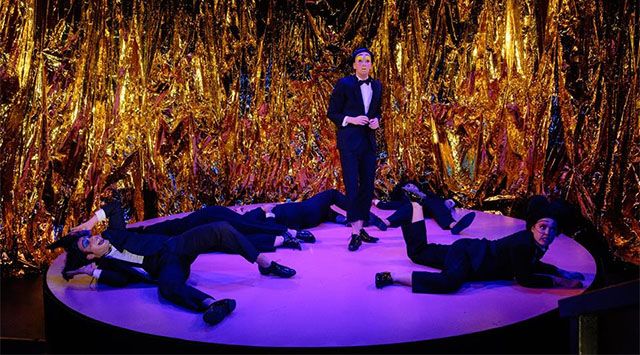
Six clowns in tuxedos are on a constantly revolving stage, wordless but full of shenanigans. We can be certain that Alexander Berlage’s There Will Be A Climax has a strong inner logic. It is abundantly clear that the ensemble knows exactly what they are doing at every moment. What it all means to the viewer however, is quite a different matter.

We can interpret the show to be a meditation on the process of attaining zen, but to approach the production with excessive intellectual interest would probably disappoint. The show is either very funny or curiously macabre, depending on one’s own constitution.

It is a visceral experience, extremely energetic, often impressive with its inventiveness, although with a tendency for monotony in its dogged pursuit for amusement. A more daring approach to lighting would deliver a less predictable outcome, but it is has to be noted that Nicholas Fry’s work on set and costume design is beautifully imagined and cleverly executed.

The cast is a wacky bunch, and very crowd-pleasing; some actors seem more interesting than others, but the team’s ability to share limelight is admirable. There is a lot of trust and generosity amongst the six that gives the show an extraordinary sense of balance and sturdy confidence.

Much of the enjoyment relies on the uncompromising precision being performed, and we feel our attention being manipulated with great rigour, by something incredibly well-rehearsed, but for all its boisterousness, too little of There Will Be A Climax is left to chance. Its artistry, although wonderfully exuberant, can feel too safe. At the theatre, wildness contained, is misplaced politeness. The crowd has been persuaded to listen, but more needs to be said.

www.redlineproductions.com.au

Review: My Name Is Jimi (Belvoir St Theatre / Queensland Theatre)

Venue: Belvoir St Theatre (Surry Hills NSW), Jan 5 – 21, 2018
Playwrights: Jimi Bani, Jason Klarwein
Director: Jason Klarwein
Cast: Dmitri Ahwang-Bani, Agnes Bani, Conwell Bani, Jimi Bani, Petharie Bani, Richard Bani
Image by Daniel Boud

Theatre review
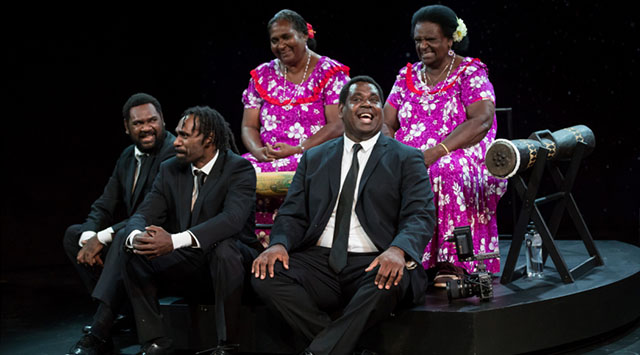
Jimi Bani hails from Mabuiag Island, in the near Western part of Torres Strait. His show My Name Is Jimi, is about culture and tradition, and the resolve to keep the uniqueness of his Wagadagam tribe alive and thriving in the modern age. True to form, the production features performers from his own family, across four generations, illustrating the essence and the importance of what is being relayed.

Small communities are always at risk of losing their identity. The young is seduced by external forces, through cultures of technology and consumption determined to establish a conformity, as required and dictated by Western capitalism. We see Jimi’s son Dimitri devouring the smartphone like any other youth, gradually losing touch with the real kinship that surrounds him.

Ambitiously directed by Jason Klarwein, the work is complex and detailed with its depictions. We learn not only what it is, that Jimi is keen to preserve, but also why and how these traditions have come to be of such value. Folklore and dance feature prominently, to inform and to entertain, but perhaps most importantly, as a demonstration of ancestral pride. There is exquisite humour in the piece, alongside its inherent warmth and poignancy.

Jimi Bani’s naturally commanding presence wins us over from the get-go, allowing us to empathise with his story effortlessly, even though his circumstances are admittedly far removed from many of our daily realities. Dimitri shares his father’s humour, delivering memorable moments of comedy. Agnes and Petharie are the senior women providing music, in ethereal, glamorous and dignified fashion. Conwell and Richard are Jimi’s brothers, appropriately sharing the weight of the show, as nimble sidekicks, particularly effective with their live camera work for filmic projections called upon to represent legends of the land. Especially noteworthy is Justin Harrison’s work as sound and projection designer, beautifully transcendent and crucial to the success of My Name Is Jimi.

Family can mean different things to people, but there is no denying the emotional hold it can have over each of us. Watching Jimi and his loved ones cultivate their extraordinary closeness, is reassuring, but also challenging to those who seek a radical independence in today’s climate of rationalism. It is now normal in many societies, to find definition for the self as an entity distinct from practices of the past, especially when one identifies weaknesses and problems associated with those customs. Jimi’s emphasis on language however, is noble and inspiring. Words contain so much, and they allow us to connect with histories when we choose to. Times will change, but forgetting the past, will only hamper any effort to progress. As we seek to become better, a link with earlier experiences is invaluable. Talking with those who had come before necessitates a bridge, and understanding cultures, especially one’s own, is often more rewarding than we can imagine.

www.queenslandtheatre.com.au | www.belvoir.com.au