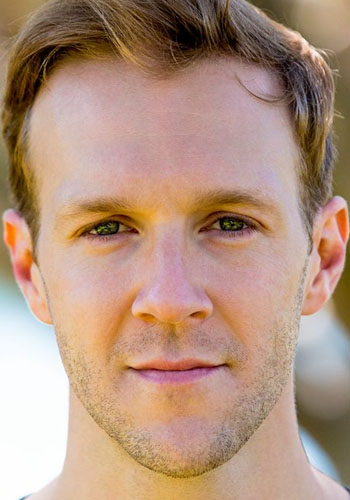
Review: Wink (Wheels & Co Productions)

Venue: Kings Cross Theatre (Kings Cross NSW), Aug 2 – 24, 2019
Playwright: Jen Silverman
Director: Anthony Skuse
Cast: Eloise Snape, Matthew Cheetham, Graeme McRae , Sam O’Sullivan
Images by Robert Catto

Theatre review
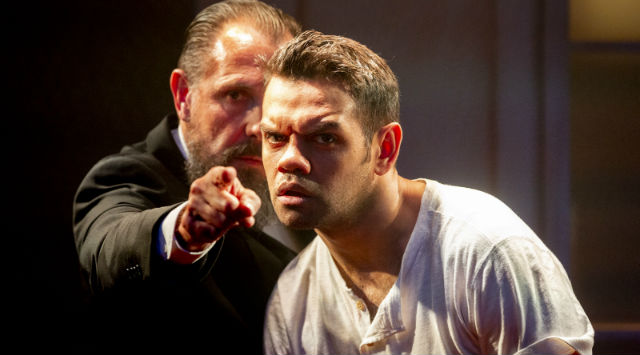
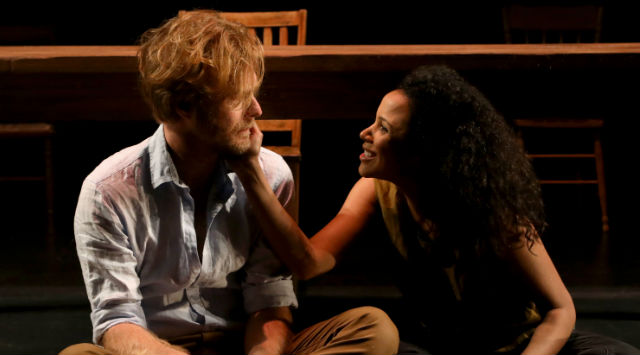
Gregor has skinned his wife’s cat alive, so clearly things are not going well at home. Jen Silverman’s Wink begins at the point of heteronormative ruination, when Gregor and Sophie’s unsatisfying cookie-cutter life together is at breaking point, and something has got to give. Too bad about the cat. Radical transformations happen following Wink’s demise, even the couple’s psychotherapist Frans, undergoes drastic existential alterations. The plan all along to keep things buried, in order to achieve an appearance of success, has failed miserably; something more authentic emerges to take over these lives, but it looks as though this surge of humanity might have come too late.

Silverman’s writing is deliciously wild, with a strong point of view that makes her surreal and irreverent approach sing with purpose. It is a work about the complicated nature of freedom, and the difficulty in returning to one’s true self, after a lifetime of conditioning and conformity. Directed by Anthony Skuse, the show is replete with subtle humour, and its social commentary, informed by a queer feminist sensibility, is delightfully acerbic.

It is a macabre world that we are plunged into, with lights by Phoebe Pilcher and a set by Siobhan Jett O’Hanlon, cleverly conceived to help us situate the action in a range of spaces between real and fantasy. Ben Pierpoint’s sound design impresses with its intricacy, highly effective in how our collective energy is calibrated for every distinct theatrical moment.

Actor Eloise Snape is marvellous as Sophie, delivering the most understated yet powerful comedy through a narrative of frustrated despondency. Her ability to simultaneously convey tragedy and hilarity, whilst performing with deliberate restraint, is extraordinary. Graeme McRae’s portrayal of Gregor is unexpectedly delicate, remarkable for the empathy that he manages to elicit, as the feline murderer. Matthew Cheethan and Sam O’Sullivan play, respectively, the shrink and the cat, both actors wonderfully quirky, for a couple of deeply amusing characters that fascinate at every appearance.

Humans have an insatiable desire for truth, but that impulse is manifested in a million unique ways. We can see the personalities in Wink giving up the external, then turning inward in hope of exchanging their worldly delusions for something genuine. It is tempting to think that our skin is the barrier between truth and lies, that somehow, deep inside, contains something unequivocal and real. This is all conjecture of course, as the human mind, insignificant as it is, will believe what it wishes, and for any of us to think that we are capable of a comprehensive godlike truth, is in itself illusory. We can however, look instead for peace, but how we interpret that concept is, it seems, another million conundrums.

www.facebook.com/wheelscoproductions

Review: Life Of Galileo (Belvoir St Theatre)

Venue: Belvoir St Theatre (Surry Hills NSW), Aug 3 – Sep 15, 2019
Playwright: Bertolt Brecht (adapted by Tom Wright)
Director: Eamon Flack
Cast: Peter Carroll, Colin Friels, Laura McDonald, Miranda Parker, Damien Ryan, Damien Strouthos, Vaishnavi Suryaprakash, Sonia Todd, Rajan Velu
Images by Brett Boardman

Theatre review
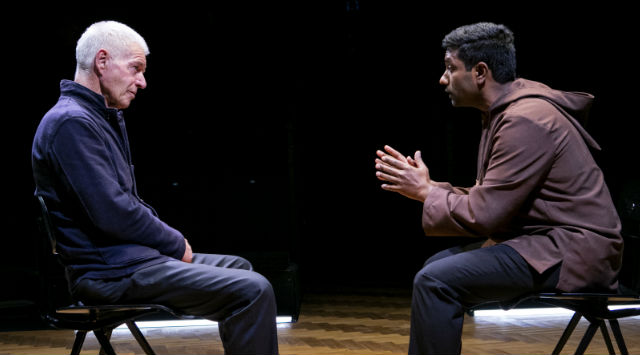
Galileo builds a telescope, and discovers that Copernicus’ theory of a heliocentric solar system, is an unassailable fact. That may be a fundamental truth that Galileo has evidenced in early seventeenth century about our universe, but he is prohibited from making known any facts that contradict doctrinal teachings of the Roman Catholic Church. Bertolt Brecht’s Life Of Galileo talks about the nature of truth, and our human capacity to deal with each other’s realities. Instead of celebrating his momentous findings, Galileo is seen as a threat by the powers that be, and is subjected to decades of suppression.

Adapted by Tom Wright, there is no doubt that the 1943 play remains resolutely pertinent. We wrestle daily with fake news, and we communicate as though the world is in constant adversarial opposition with itself, and that consensus seems to only ever be an abstract notion. We all want to be right, and it is that very refusal of ambiguity that prevents this staging from connecting with sufficient intensity. Eamon Flack’s direction delivers an enjoyable show, including enticing moments of theatricality (Paul Jackson’s lights and Jethro Woodward’s music, work marvellously at these instances of flamboyance), but the point that it ultimately does make, struggles to feel more than rudimentary. No one thinks of themselves as being on the wrong side of truth, and Life Of Galileo certainly never lets us veer away from that complacent sense of self-righteousness.

Consequently lacking in tension, the show relies on its cast to keep us engaged, if only on a level of impulse and immediacy. Leading man Colin Friels delivers conviction as the embattled Galileo, effective in conveying facets of his story that are unequivocally inspiring, even if the actor can occasionally seem slightly under-rehearsed. Excellent humour by Peter Carroll is called upon at regular intervals, to prevent the show from turning monotonous. Andrea, a student who witnesses Galileo’s struggles over decades, is played by Vaishnavi Suryaprakash, remarkable for the sincerity and emotional authenticity that she introduces to the story.

In 2019, we are alarmed by how people can construct realities that seem so far removed from facts. We argue over everything, including the very nature of objectivity, unable or unwilling to come to unity, preferring instead to persist in a world of us and them, as though the demonising of others equates to some kind of perverse comfort in one’s own life. As an audience, we wish to see Galileo stick to his guns, and go down in a blaze of glory, but he chooses survival instead, as if to challenge our notions of integrity. Co-existence means that we must share space, that right and wrong have to find ways to sit side by side. It is not only our passionate selves that are required, when we go to fight our side, but humility, and the understanding that human imperfection evades the foe as much as it does the self, should we come to recognise that the purpose is always to attain the greater good.

www.belvoir.com.au

5 Questions with Sam O’Sullivan and Eloise Snape

Sam O’Sullivan

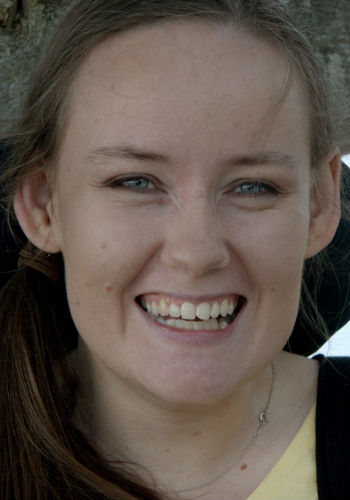
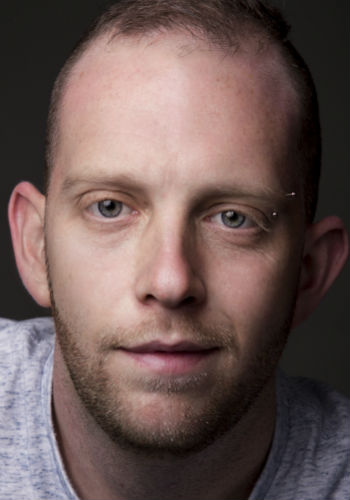
Eloise Snape: In Wink you play the titular character, who is a cat. Seeing as you are slightly obsessed with your own cat, Terry, have you enjoyed observing his behaviour and what has been the most interesting part of your research for this role?
Sam O’Sullivan: First of all, great use of the word “titular”. Second, as you know, I always enjoy observing, photographing, playing with, talking about and hanging out with Terry. I think the best thing about him, and cats in general, is that despite their small stature, they have the attitudes and the instincts of larger cats. When we say someone has the heart of a lion, we mean that they’re brave, determined and loyal. Well, Terry actually has the heart of a lion, its just unfortunate that the rest of him is a British Short Hair.

Jen Silverman has an incredibly unique voice. As a fellow writer, what’s your favourite thing about the way she tells this story and why do you think she is an important contemporary voice?
This play is funny. So right away, you know that Silverman knows what she’s doing. What I love about Wink is the way the humour in the play evolves to carry her message. Things that initially feel like a gag or just plain weirdness over time become incredibly potent metaphors. This play is about a lot of things, but for me what resonates and what makes it important is that it interrogates our ideas and preconceptions about what is “normal” and how unhealthy it can be to cling to those ideas. There is a lot of talk about how civilised people should behave in Wink, but ultimately, for the characters to survive they need to destroy that way of thinking.

You’ve worked with Anthony Skuse and Graeme McRae before, many moons ago in Punk Rock. What has been the most enjoyable thing about working together again, now you are all kinda old?
Way harsh, Tai. This is my forth time working with Skusie (previously Punk Rock, Constellations and Platonov) and third with Graeme (Punk Rock and Platonov). Practically speaking, the more you work with people, the more you develop a short hand which means you can get more work done. You can trust each other to be direct with feedback if something isn’t working and you know nothing’s personal. At the end of the day, we’re all friends, we all respect each other’s work and we’re just trying to make the best show possible. With Skusie, I always feel like we’re exploring and discovering the play together. He has an incredible amount of experience and knowledge but on day one of rehearsals I always feel like where starting from the same spot and that we’re collaborating. Once you’ve started from that place, later when you’re alone on stage, you feel like your director has got your back. Graeme just really likes his job. And that enthusiasm is infectious, especially when it’s backed up by someone who’s done the work and is raising the standard in rehearsals every day. All plays need a Graeme.

Wink explores a very unhappy marriage. What lessons have you learnt from Gregor and Sofie’s failed relationship to ensure the same things won’t happen in your own?
Two things: tolerance and patience. Your partner will never be as perfect as you and the sooner you accept that the happier you’ll be. However, the question now is, which one of us is the imperfect one and which one is being patient? Perhaps that’s something you need to answer for yourself. I’ll wait…

You are a movie buff and have your own movie club which is just you and the cat watching movies. What’s your all time favourite movie and why?
For the record, Movie Club is open to everyone. Terry and I are just more committed than the rest of you. I always find questions about a favourite movie difficult because honestly, I just like movies. They’re my happy place. I don’t like absolutely everything, but I like a lot of stuff, even “bad” movies. My go-to answer for this question is usually Trainspotting because it’s the first movie that I remember having a profound effect on me. I would have been about twelve when I saw it and I think at the time it redefined a lot of what I thought cinema had to be. The narration, the structure, a guy diving into a toilet to retrieve his suppositories. I grew up watching things like Star Wars and Back to the Future and I love those films but Trainspotting broke so many conventions that it opened up a whole new world of storytelling for me.
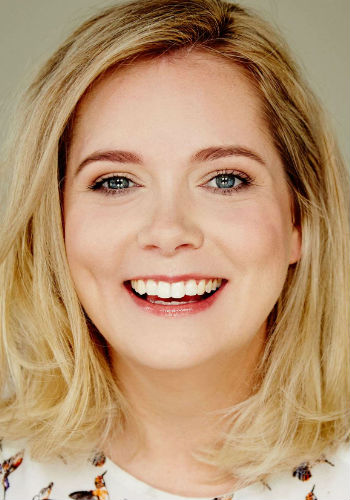
Eloise Snape

Sam O’Sullivan: Why do you watch so much reality television? Is it because you hate art?
Ok first of all, I am very picky with my reality TV viewing. I would call myself a Survivor fan, but I’m not nek level. I was recently invited into the Survivor Super Fan Facebook group and those people are FANS. I am a rookie floating around in there. I also enjoy The Bachelor for the pure lobotomy. When I truly want to switch my brain off and literally dribble, mouth open in front of the television, I watch The Bach. It’s also highly amusing. Everyone has their thing, yours is video games, mine is shit television.

In Wink, your character is struggling with a selfish and uncommunicative partner. How did you prepare for this, given that your real partner is so generous?
As surprising as this may sound, I have dated other people before you, Sam O’Sullivan.

Your character’s cat also goes missing. In a Sophie’s Choice type situation where you had to pick between me and our cat, Terry, honestly, who would you pick and why?
Tricky question. The best thing about cats is they love you unconditionally as long as you can provide them with a quality can of cat food. You on the other hand require more than cat food to keep happy. BUT, Terry doesn’t bring ME food. You are very generous with your feeding of me and you aren’t a shabby cook either. So I choose you. Sorry Terrence.

Wink could be interpreted in a number of different ways. In just three words, what is Jen Silverman’s play actually about?
Identity. Desire. Transformation.

You’ve acted in and produced a lot of Sydney theatre. Is there a production that holds a special place in your heart?
This is super tricky. I have done a lot of independent theatre and the nature of indie productions is that people work above and beyond to create something special and because everyone ends up doing multiple jobs you really all become a family. Also the run never feels long enough – so it’s always hard to say goodbye at the end. But Amy Herzog’s play, 4000 Miles, also directed by Skusie, which I did back in 2013 is the first show I produced and acted in after drama school and it was with my bestie, Stephen Multari. That was why we started MopHead and the show toured around Australia and the rest is history.

Catch Sam O’Sullivan and Eloise Snape in Wink by Jen Silverman.
Dates: 2 – 24 Aug, 2019
Venue: Kings Cross Theatre
Review: Natural Order (Milk Crate Theatre)

Venue: Petersham Town Hall (Petersham NSW), Aug 1 – 10, 2019
Director: Margot Politis
Cast: Aslam Abdus-Samad, Peter Birbas, Shane Ball, Desmond Edwards, Flor Garcia, Owen Gill, Alicia Gonzales, Lisa Griffiths, Sandra Hickey Eugenia Langley, Yen Mekon, Ray Morgan, Matthias Nudl, Ruth Oslington, Darlene Proberts, Steve Simao, Pauline Trenerry, Lucy Watson, Georgina Wood
Images by Lisa Walton
Theatre review
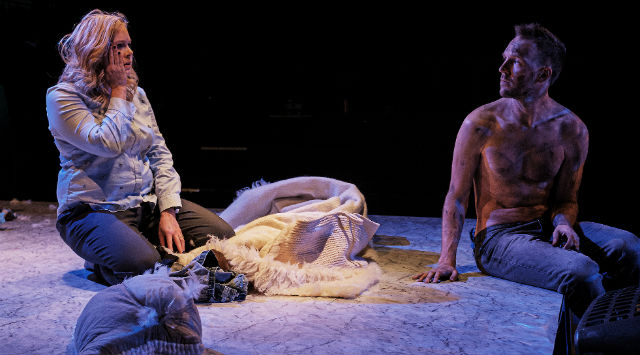
The social services agency in the story of Natural Order is named District Advanced Vocational Outlet, a fictional body no different from any bureaucratic organisation we have had the misfortune to encounter. In the hour long show, we are herded from one room to the next, to witness inefficiencies of a system that seems determined to look busy, but achieve little. We watch people falling repeatedly through its cracks, in an endless queue unable to resolve itself, lost in a system that has forgotten how to care.

Petersham Town Hall is transformed into an electrifying performance space, with evocative set design by Emma White, involving a series of wheeled panels forming simple but unexpected spatial configurations. Liam O’Keefe’s lights are a sensory highlight, effortlessly guiding our vision, as well as our emotions, through the literal and figurative labyrinth of Natural Order. Sound by James Brown and Bella Martin, along with audio-visual installations by David Molloy, offer further enhancements for an experience that many will find touching, regardless of an understandably coy devised text.

Directed by Margot Politis, the production is a stimulating exploration into the way we manage inequalities within our communities. Natural Order is a reminder, rather than a disclosure, of things we already know; its message is communicated gently, and thankfully without a lot of zealous earnestness. Featuring an extremely engaging cast of performers, including Darlene Proberts, whose delightful singing voice has us hopelessly charmed. Shane Bell delivers a powerful monologue, bringing tears to many eyes with his portrayal of Michael, as he recounts his distant glory days. Aslan Abdus-Samad and Alicia Gonzalez depict a couple of robotic red tape staffers, memorable for their cheeky sardonic comedy. Indeed, to talk about old issues that often feel too big to solve, requires a generous sense of humour. Crying is sometimes necessary, but laughing will get us out of the doldrums, for a new invigoration that will help propel us towards further action.

www.naturalorder.com.au

Review: Mars: An Interplanetary Cabaret (The Old 505 Theatre)

Venue: The Old 505 Theatre (Newtown NSW), Jul 30 – Aug 3, 2019
Music: Chelsea Needham
Lyrics: Ang Collins
Director: Andrew McInnes
Cast: Monika Pieprzyk, Amelia Campbell, Tom Matthews, Jacob Mclean, Jack Richardson, Kieran Clancy-Lowe
Images by Zac Jay

Theatre review
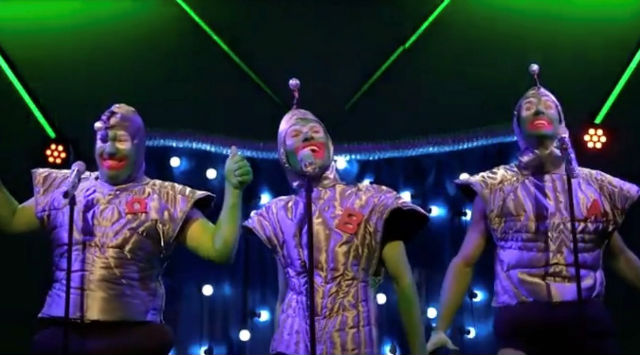
Three Martians have landed, in a spaceship called Incel 9, because apparently, earth girls are easy. The male of that species have had to travel an enormous distance, after women on Mars had wised up to their misogynistic nonsense. Earthlings however, are being protected by Space Cops, who in Mars: An Interplanetary Cabaret, happen to be two women impervious to the sleazy tricks of pickup artists. Written by Ang Collins and Chelsea Needham, this fun-filled work features kooky characters and humorous songs, for a surprisingly wholesome style of entertainment that often feels like a contemporary take on the pantomime form. A show about dirty boys with no dirty jokes, Mars is a remarkably refreshing experience.

Directed by Andrew McInnes, the comedy balances flamboyance with irony, allowing its very broad approach to communicate at somewhat unexpected levels of nuance. The visual style is appropriately lo-fi, with Lucy McCullough’s production design and Tom Houghton’s lights, establishing a lot of playful charm to keep us engaged. Some of the singing is of questionable quality, but the cast is likeable, and they present a well-rehearsed staging that impresses with its verve and spirit of inventiveness. Tom Matthews and Jack Richardson are the more disciplined performers of the group, able to contribute a sheen of professionalism with their vocal and physical polish, although the general lack of refinement remains a major component of Mars‘ appeal.

It is appropriate for our current political climate, to talk as though men are from Mars, women are from, well, Earth. A new generation of feminists have declared that poor behaviour is not acceptable, and that the toxic culture of “boys will be boys” must be changed. We talk of the young as being overly fragile, but it is evident that they are on a mission to make the world a kinder place, that people should not be required to have the fortitude to put up with all manner of bullshit. We should no longer have to laugh along with “casually racist” jokes, just as we should no longer fabricate any reason to blame victims of sexual assault. Those who find this shift in codes of conduct frustrating, are on the wrong side of history.

www.old505theatre.com

Review: City Of Gold (Griffin Theatre Co / Queensland Theatre Co)

Venue: SBW Stables Theatre (Kings Cross NSW), Jul 26 – Aug 31, 2019
Playwright: Meyne Wyatt
Director: Isaac Drandic
Cast: Jeremy Ambrum, Mathew Cooper, Maitland Schnaars, Shari Sebbens, Anthony Standish, Christopher Stollery, Meyne Wyatt
Images by Brett Boardman

Theatre review
Upon the death of his father, Breythe walks off the set of a television commercial, and returns to Kalgoorlie to be with family. The medical establishment’s neglectful treatment of his father sparks a reaction that sees Breythe and his siblings wrestle with difficult discussions, about surviving racism as Indigenous Australians. Meyne Wyatt’s City Of Gold moves between city and bush, to examine one young man’s fight on colonised land. It is a story about the deep prejudice, and of surreptitious genocide, that pervade this country, inescapable no matter where Breythe may go.

Wyatt’s writing is passionate and urgent, able to entertain while it gradually builds intensity. The fury that it contains is an invaluable expression, often hidden away from so-called civilised, Western modes of exchange, where the oppressed must communicate with polite subservience, only to be routinely ignored. Directed by Isaac Drandic, the production pulls no punches, to make a powerful statement about the woeful state of race relations all across this land. Notable work on sound design by Tony Brumpton adds richness to the piece, deftly emphasising the complex emotional dimensions that City Of Gold aims to convey.

As leading man, Wyatt is a compelling presence, entirely persuasive with all that he brings to the stage. Charming in humorous sections, but it is in explicit moments of political confrontation that he absolutely devastates. Wyatt’s monologue at the beginning of Act 2 ranks as one of the most important theatrical moments in our stage history. His siblings are played by Shari Sebbens and Mathew Cooper, both actors captivating with their sincere portrayals, able to demonstrate a resolute dignity alongside their characters’ experiences of adversity and injustice. We are moved by the performances of Jeremy Ambrum and Maitaland Schnaars, who share an unexpected delicacy in their divergent depictions of Aboriginal identities. Dramatic flourishes by Anthony Standish and Christopher Stollery help to provide tension, as a series of unsavoury types who exemplify so much of what is wrong with our societies.

It is the most generous of gestures when our Indigenous artists choose to embody the trauma and pain of their communities. They put themselves through a state of virtual torment, using bodies that know little difference between real and make believe, so that a predominantly white audience can understand the harm that is being inflicted upon legitimate owners of this land. City Of Gold is an extraordinarily difficult story, one that its storytellers have seen, heard and lived for generations. It is regrettable that the responsibility falls upon those who suffer, to educate the rest of us, but there is nothing more profound than the lessons being dispensed here.

/www.griffintheatre.com.au | /www.queenslandtheatre.com.au

Review: Banging Denmark (Sydney Theatre Company)

Venue: Sydney Opera House (Sydney NSW), Jul 26 – Aug 24, 2019
Playwright: Van Badham
Director: Jessica Arthur
Cast: Michelle Lim Davidson, Patrick Jhanur, Amber McMahon, TJ Power, Megan Wilding
Images by Prudence Upton

Theatre review
It is very 2019 to have in a comedy, an online feminist warrior meet a leader of digital misogynistic communities, but as we see in Van Badham’s Banging Denmark, that is exactly the kind of story we need right now. Jake has run out of easy conquests, and is now setting his sights on a Danish librarian, a woman from an enlightened future impervious to his seedy charms. The quickest way to achieve cut-through, he figures, would be to enlist the help of Ishtar, whom he knows to be struggling with poverty, having just sued her through defamation law for every penny. If Ishtar is authority of all things feminist, she would clearly be the one to get Jake into a raging feminist’s pants.

Badham’s writing is keenly observed and very biting. It pours scorn on those who are deserving of insult, for an intensely contemporary experience that appeals to our very à la mode, adversarial tendencies. The work feels original in its scope and structure, a tremendously entertaining tale that proves unpredictable, rich with imagination yet entirely plausible. It bears all the characteristics of a romantic-comedy, only to subvert the narrative time and again, for a meaningful agitation of our nonsensical desires.

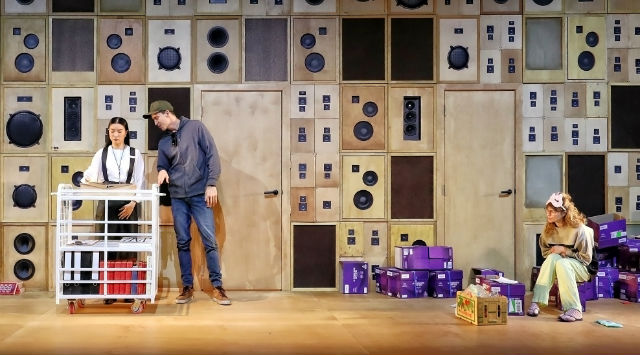
Designed by Renée Mulder, the backdrop is an imposing conglomeration of speakers, a visual delight that doubles perhaps, as a symbolic gesture pointing to our all talking, no listening culture. Director Jessica Arthur introduces just enough acerbity so that her show connects with an easy humour, whilst retaining the valuable intentions of the piece. Although consistently stimulating, the production never gets too intellectually demanding. There is a cheekiness to Banging Denmark that many will find entertaining, and with an emphasis on story over ideology, it demonstrates a prudent need to prevent itself from alienating any of its audience.

Actor Amber McMahon is full of exuberance as the irrepressible Ishtar, delivering a thoroughly enjoyable performance that is as funny as it is intelligent. In the role of Jake is TJ Power, deeply impressive with the dynamic range he brings to the staging, remarkably confident in presence, able to turn a hateful character into something believable, salvageable and human. Three supporting players, Michelle Lim Davidson, Patrick Jhanur and Megan Wilding, offer a variety of textures that make the experience a surprisingly expansive one, that urges us to think beyond the lazy binary.

If Banging Denmark‘s happy ending leaves one unsatisfied, one should probably reflect on their appetite for discord and destruction. We live in such disharmony, largely because of our own design. We have found ways to argue and fight, committed to making things better in accordance with personal perspectives, but we keep moving further and further away from all fabled notions of peace. Addiction to technology is real, and with that it seems, we have become addicted to disunity; happier to wrestle with aggression and rivalries, than to find ways for friendly co-existence. This is an age with unprecedented, and unlimited, capacity for speaking, but it can often look like no one is listening.

www.sydneytheatre.com.au

Review: Table (White Box Theatre)

Venue: Seymour Centre (Chippendale NSW), Jul 25 – Aug 17, 2019
Playwright: Tanya Ronder
Director: Kim Hardwick
Cast: Charles Upton, Stacey Duckworth, Mathew Lee, Julian Garner, Danielle King, Chantelle Jamieson, Annie Stafford, Brendan Miles, Nicole Pingon
Images by Danielle Lyonne

Theatre review
It was over a hundred years ago, that David Best built a table on the occasion of his marriage. Six generations of Bests later, the table still stands, modestly and in the background, accumulating scars inevitably derived from the passage of time. A substantial portion of Tanya Ronder’s Table centres around the globe-trotting Gideon Best, whom we meet at various points through the years, from his conception in Africa in 1951, to his return to England at 62 years old. The play features scintillating dialogue and fascinating characters, to explore the dynamics of a family that, for all their adventurous diversions, are ultimately no more than regular people.

The production is exceedingly elegant, with Isabel Hudson’s set and Martin Kinnane’s lights offering consistently sumptuous imagery, if slightly too insistent in creating a sense of moodiness. Nate Edmondson contributes two hours of music and sound, intricately magnifying every sensory peak and trough, highly effective in helping us find focus for all of Table‘s deliberately abrupt plot shifts. Director Kim Hardwick’s sensitive approach can at times seem too quiet, but the psychological and emotional accuracy that she is able to convey, for every aspect of the story, makes for a staging that sings with authenticity from beginning to end.

Actor Julian Garner brings an understated complexity to Gideon, for a convincing and empathetic portrait of a flawed individual. It is an often inventive performance by Garner, who also plays Gideon’s father Jack, oscillating effortlessly between humour and sentimentality, to deliver some of the show’s more powerful moments. Danielle King demonstrates a wonderful versatility in three roles, particularly impressive when taking the production to a satisfying crescendo at its final sequences. Also memorable is Chantelle Jamieson, an effervescent presence who introduces exceptional vitality, whether playing a carefree sixties commune member, or a nun.

The table is left behind by person after person. We watch it outlive its owners, roughed up but still sturdy, able to withstand centuries more trials and tribulations. Not all of us are leaving children behind, but personal legacies, big or small, good and bad, will have resonances that linger after our headstones are concreted. When Gideon comes back hoping for reconciliation, we see an older man finally recognising the magnitude of his actions, and the simultaneous insignificance of his egotistical self, and we wonder if it is only wishful thinking when we say that it is never too late turning over a new leaf.

www.whiteboxtheatre.com.au

5 Questions with Emily Dash and Dean Nash

Emily Dash

Dean Nash: What’s your favourite line of dialogue in Freefall and why?
Emily Dash: “I’m not your inspiration, I’m a fucking incineration”. I think this line sums up the vibrant character of Megan in a lot of ways. It very deliberately references the concept of “inspiration porn” and pushes against that, because that was something important to me. But it also shows her humour, her spirit, the way she doesn’t take anything – even conversations about death – too seriously.

What inspired you to write Freefall?
It was, of course, an opportunity to represent diverse issues and voices. Initially I was really interested in the dynamic between two people who are very different but love each other deeply, because I think it resonates with a lot of people. Love is beautiful, and challenging, but by no means simple – and nor is grief. Freefall is not a true story, but it’s a very real story – and it’s a testament to hope, to honour a great many experiences and various people who are close to my heart.

Describe your perfect Sunday.
My perfect Sunday would involve coffee and brunch with close friends, and then a relaxing indulgent day – walking my dog Bailey, reading, writing, watching TV and listening to music, doing a cryptic crossword with my mum. To finish it off would be dinner and a few drinks with my family – my parents, my brother Campbell, my sister Steph and her husband Simon – while we debate the answers to this week’s quiz in the Good Weekend.

If you could collaborate with any artist alive or dead who would it be.
Honestly? Sheridan Harbridge, or Daniel Monks.

What inspires you?
Strong, resilient people (especially women) being authentically themselves and having the courage to chase their dreams, who respect themselves, who value their relationships, build people up and strive to make a difference in the world.

Dean Nash

Emily Dash: Why do you think theatre is important?
Dean Nash: I’ve always seen the art of storytelling as an incredibly effective catalyst for positive change. Theatre entertains but it also challenges perceptions, poses questions, incites empathy, and informs; I think that is really important.

What makes a good scene partner?
Acting is reacting! I love working with actors that I know are going to make bold choices that I am going to be able to play off, and who in turn are going to catch whatever ball I throw to them. In Freefall I’m blessed to be working alongside a whole cast of beautifully honest and emotionally intelligent actors and I cannot wait for people to see this show.

What’s going to surprise people about Freefall?
I don’t think people will be prepared for the spectrum of emotions they will feel over the course of this show. Freefall is definitely a rollercoaster!

What songs do you think Shane would pick to represent each of the characters?
Megan – Walk On the Wild Side by Lou Reed
Millie – Paranoid Android by Radiohead
Carmen – Cigarettes Will Kill You by Ben Lee
Eleni – I’ll Be There For You by The Rembrandts
Shane – You’ve Got A Friend In Me by Randy Newman

A penguin walks through that door right now wearing a sombrero. What does he says and why is he here?
“The ice caps are melting and I want to taco’bout it!” The Mariachi penguin is on a crusade to bring awareness to the climate crisis!

Catch Emily Dash and Dean Nash in Freefall by Emily Dash, part of the “3x3x2 Festival of New Works”.
Dates: 14 – 24 Aug, 2019
Venue: PACT Centre for Emerging Artists

Review: Lord Of The Flies (Sydney Theatre Company)

Venue: Roslyn Packer Theatre at Walsh Bay (Sydney NSW), Jul 23 – Aug 24, 2019
Playwright: William Golding (adapted by Nigel Williams)
Director: Kip Williams
Cast: Joseph Althouse, Justin Amankwah, Nyx Calder, Yerin Ha, Daniel Monks, Mark Paguio, Rahel Romahn, Eliza Scanlen, Contessa Treffone, Nikita Waldron, Mia Wasikowska
Images by Zan Wimberley

Theatre review
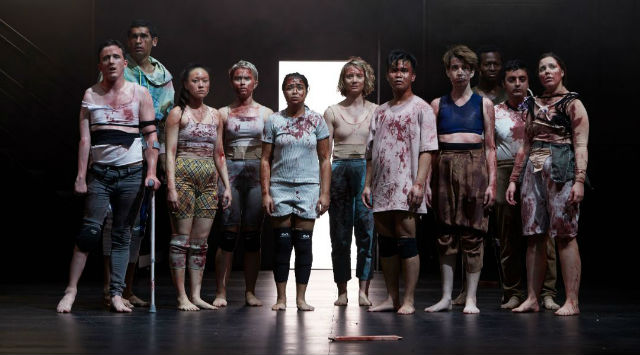
The boys are sent away from war, but their plane crashes and they land on an uninhabited island, having to fend for themselves, using instinct, along with their memories of civilisation. In Nigel Williams’ stage adaptation of William Golding’s Lord Of The Flies, the question of nature versus nurture once again comes to the fore. Jack is the unequivocal villain of the piece, a horrific specimen of mankind, hell-bent on causing death and destruction. His quick ascent to position of warlord tempts us to interpret the child’s evil tendencies as learned behaviour, although there is no denying the parts of ourselves that seem naturally drawn to causing harm.

The pessimistic tale is given a modern staging by director Kip Williams, who brings new dimensions to Golding’s concerns of 1954. Where many had in the past regarded Lord Of The Flies as a work about being human, Williams’ vision allows us to interrogate the text from perspectives of culture and gender, that had been routinely neglected. The diversity of cast (but alas, not of creatives) inspires discussions about whiteness and masculinity, as we ponder on the meanings of women playing boys, and of people of colour playing the colonials. Indeed, the production rarely lets us look away from the Brechtian artifice of its presentation, always consciously involving itself with a stylised design aesthetic that never tries to fool us with attempts at naturalism. The experience becomes one of theatre as commentary, rather than art as representation.

Instead of manufacturing a landscape of delusive vegetation, set design by Elizabeth Gadsby exposes the stage’s bare bones, for a chilling Brutalist effect, that establishes from the outset an appetite for subversion. Intensive work on lights by Alexander Berlage may lack restraint, but is undoubtedly spectacular with its many bold manoeuvres. James Brown’s sound design guides us through the story’s legendary descent into savagery, particularly impressive when it operates in conjunction with actors at their most dramatic and vivid.

There are moments when stagecraft overwhelms, but the ensemble proves nonetheless to be engaging, with Daniel Monks especially memorable in the role of Roger. Vile, vicious and thrilling in his depiction of a boy’s darkest inclinations, Monks delivers moments that are quite genuinely terrifying, and enormously powerful in what he has to say about our capacity for cruelty. The purest one is played by Rahel Romahn, who gives us a Piggy that is completely adorable, and in his nuanced demonstration of what virtue looks and sounds like, the actor ensures that all the show’s arguments can only be won by the good side. As the democratically elected leader of the pack, Mia Wasikowska is a passionate Ralph, but the actor tends to be too subtle in approach for the vast and cacophonous stage. Much more persuasive is Contessa Treffone as the big bad Jack, made resonant by Treffone’s intricate mimicry of masculine voice and gesture, for a portrait of male toxicity at its most despicable.

It is easy to get lost in discussions about how the boys have turned out so awfully, but more worthwhile is to find ways we can improve, or indeed reverse, this dreadful state we are in. Whether a result of genetics or of social conditioning, the characters in Lord Of The Flies are broken, and while one can choose to take a fatalistic reading of the text, the show certainly encourages a more hopeful interpretation. Boys will be boys, if we accept the status quo. Racism will remain a component of our structures, if we persist with them. Golding suggests that an intrusion is necessary for the lost ones to be rescued, but to sit and wait, is no solution for those who proclaim to be young and free.

www.sydneytheatre.com.au