5 Questions with Sonya Kerr and Madeleine Withington

Sonya Kerr

Madeleine Withington: What are you loving right now? Why?
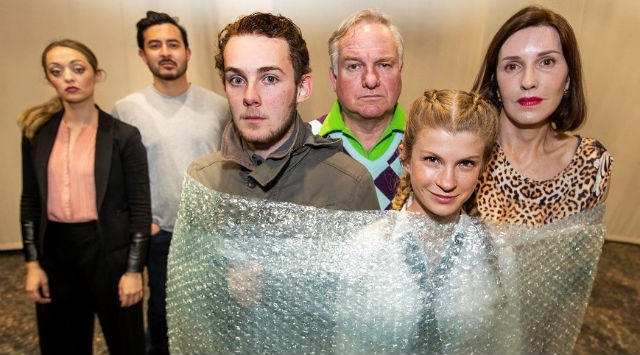
Sonya Kerr: So many things!! Rewatching old favourite shows, trying out new recipes, working on The Angry Brigade with such an awesome cast! Haha. I’m a busy person so right now I’m actually really loving spending the small amount of time I have free hanging out with my husband.

What will always make you belly laugh? 
Monty Python. I grew up watching them and no matter how many times I’ve watched Flying Circus or any of the films I still laugh like it’s the first time. The Two Ronnies also makes me laugh ridiculously hard.

Has doing this play changed or shifted your beliefs/philosophies in any way?
I don’t think it’s changed my beliefs but it has certainly made me see how anarchy can be attractive. When you feel like the system is built against you, it certainly seems like smashing against that system is the only option. I’m a big believer in the power of protest and of the people, so I think if I was around in the 70s in London I definitely would have been a supporter of The Brigade.

Does anger come easily to you?
Not really. I get disappointed, especially in relation to politics. Irritation comes easily. Lots of things irritate me, but true anger? It takes a lot for me to get really angry. I honestly can’t remember that last time I was angry. I think I’d be a member of the Mildly Irritated Brigade.

Does violence solve anything?
That’s such a hard question! While I do believe that violence begets violence, situations occur when violence is the only effective response. From something as simple as self defence to something as complex as a world war, I think the best I can say is that we should avoid violence whenever we can and exercise restraint whenever we cannot. 

Madeleine Withington

Sonya Kerr: What makes you angry?
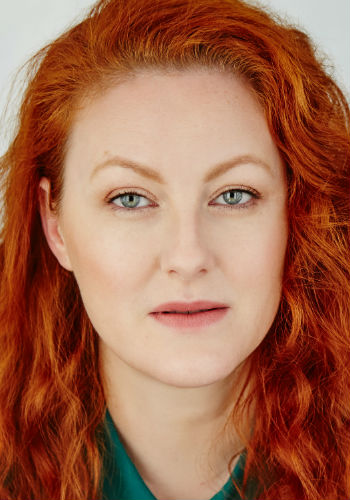
Madeleine Withington: So many things. I get angry a bit too easily, I feel. There are things that are worth my anger and there are things that aren’t. I’m still learning to tell the difference. Injustice gets me, when people are disrepectful, if someone does something to hurt someone I love. I get angry at the media, and the politicians, and Australia in general, very often. Capitalism. That gets me furious. The kyriarchy. That’s a bit general, but it is probably best not to turn this into a dissertation. I got mad at the Angry Birds 2 film recently. I haven’t seen it. Just that it exists. See? Still learning. There’s so many things, I honestly don’t know if I can go into them all. 

Do you believe in the power of protesting?
Yes I do. Even outside of creating change at a structural level, I think it can be very important in showing people that they aren’t alone. At the climate strike that was the feeling I had. After months and months of crumbling internally, to show up to thousands of people demanding change together, it definitely made me teary. It was weirdly nourishing? And definitely made me eager for more action on a personal level, rather than encouraging complacency. I think in that sense particularly, protest can be crucial.

What do you hope audiences will get from The Angry Brigade?
Hope and fury. Momentum. An impulse to examine their convictions? Questions for themselves. I really hope that people come away feeling a little bit uncomfortable, like there is something in the corner of their vision they don’t really want to look at, and that they then work up the courage to look at it directly. Does that make sense? If someone came out and said they weren’t sure how to feel, I’d be happy with that I think.

What brings you joy?
Again, so many things! I guess that’s a good balance? Working, I love working. I feel very joyful onstage. My partner. Drinking coffee with my partner on the weekend in our flat. My friends. My friends are incredible. Playing pool badly and having a beer and talking absolute nonsense. Writing. Being underwater, I love being underwater. Animals, any animals at all, they’re all hilarious, except for moths, not a fan of moths. Terry Pratchett books. Music. My family. Showers. Oh god, hot showers. Shower oranges. If you know, you know. I have reasonably simple joys I guess.

You play the role of Anna in The Angry Brigade. Do you identify with anything in her personality or politics? 
Yes, quite a lot actually. It was her who initially drew me to the play. She is going through this very human thing of trying to align her ideas of what should be, with what “the soft animal” of her body wants. I think if you are someone who is at all given to introspection, that that is a very recognisable feeling. She also keeps questioning what “real” is, trying to keep her ideas free of influence. I mean that’s fighting a losing battle, but again, relatable. Also, destroy capitalism. The system is broken. I think Anna would be on board with that.

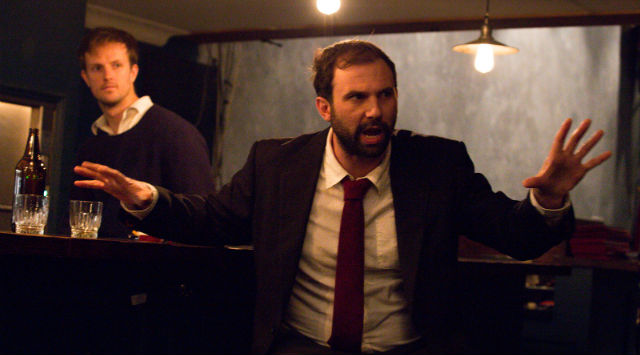
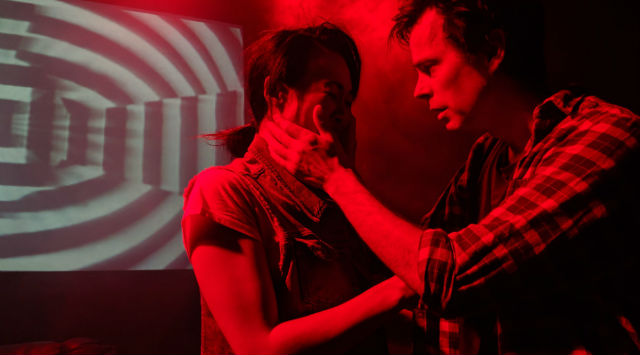
Sonya Kerr and Madeleine Withington can be seen in The Angry Brigade, by James Graham.
Dates: 1 Oct – 2 Nov, 2019
Venue: New Theatre
Review: None So Blind (The Sydney Fringe)

Venue: Erskineville Town Hall(Erskineville NSW), Sep 24 – 28, 2019
Playwright: Garreth Cruickshank
Director: Susan Jordan
Cast: Thomas Burt, Russel Cronin, Dale Weseley Johnson-Green, Martin Portus

Theatre review
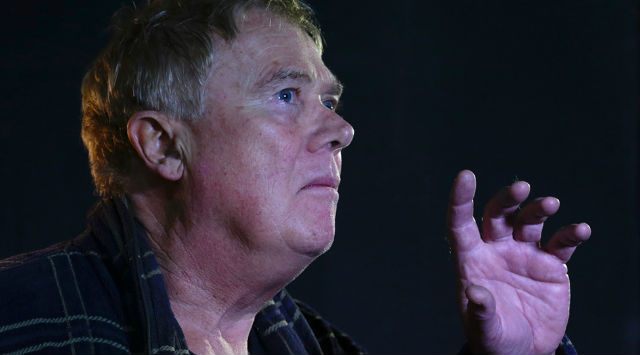
Shepherd is outside his house seeking help. He is blind and has lost his can opener, unable to prepare soup for dinner. Kind passerby Jude is lured in, but their newfound friendship turns sour in an instant, when it is revealed that Shepherd is a paedophile. Garreth Cruickshank’s None So Blind examines the evil lurking in our communities, placing a well-known archetype at the centre of its narrative to help us make sense of bad neighbours, who must somehow co-exist with the general population.

Cruickshank’s work contains strong ideas that will instigate valuable discussions. The Shepherd character is sufficiently complex to prevent us from dismissing him too easily, although audiences can rest assured that there is no sympathy for the devil here. Directed by Susan Jordan, the hour long play begins with an engaging nuance, but becomes too obvious as we approach its conclusion, with dialogue turning overly expository as tensions escalate. Actor Martin Portus depicts the monster as both grotesque and delicate, able to convey human qualities that are as awful as they are real. Jude is played by Russel Cronin, whose performance of compassion does not quite match the effectiveness with which he is able to articulate scornful disdain for the despicable villain of the piece.

We know so little of the subject, because the mere thought of it is so repulsive, we can hardly spare more than a moment’s deliberation. None So Blind challenges us to consider deeper, a truth that we have to live with, about people who will cause harm, whether we are vigilant or complacent. We often deal with dangers, by pretending that they do not exist. It is true that being paralysed with fear is no way to have a good life, but reminders are necessary, especially when we let our guard down too much.

www.sydneyfringe.com

Review: Shaz And Tina: Waiting For Uber (The Sydney Fringe)

Venue: Erskineville Town Hall(Erskineville NSW), Sep 24 – 28, 2019
Devisors & Cast: Nisrine Amine, Lisa Robinson

Theatre review
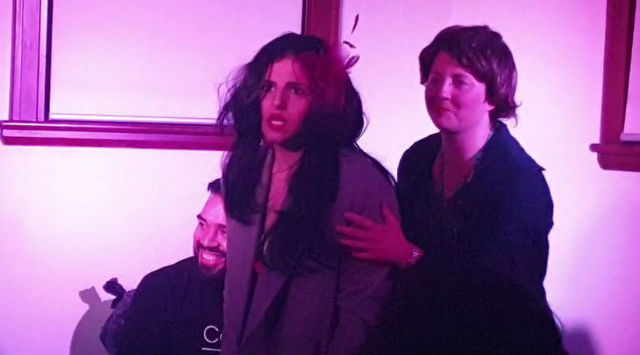
Shaz and Tina have stumbled out from the races, and are in an alleyway waiting for their ride to arrive. It is unclear if their hyperactive behaviour is due to an overindulgence of alcohol, but in their show Shaz And Tina: Waiting For Uber, the two young women spend fifty minutes being restless and incoherent, as though in a Samuel Beckett play that goes nowhere. In this case however, our storytellers are less in an existential crisis, than they are trying to entertain by creating mayhem. There is a lot of audience participation.

Shaz in particular is keen to engage the strangers around her, especially if they are of the tall, dark and handsome variety. It is the races after all, and her harmless flirting certainly befits the spirit of things. In fact, a substantial portion of the show involves a dating game, like those seen on television, with Tina trying to find Shaz a match from three volunteers. The production is humorous, although it must be said, in an awkward way, just as the two personalities we encounter are themselves extremely awkward specimens of the suburban kind.

The presentation feels improvised, loosely structured, but very live. Although the laughs delivered are not always as big as one would hope, they are both consistently amusing, able to fill the time with with quirky inventions and a frenzied energy. As Tina, Nisrine Amine is intense and snarky, and as Shaz, Lisa Robinson is gawky and mischievous. The pair’s easy chemistry provides a solid foundation for the work, allowing us to trust that no matter how long the Uber is going to take, the women are determined to keep us occupied.

www.facebook.com/shazandtina

Review: A Girl In School Uniform (Walks Into A Bar) (Futura Productions)

Venue: Kings Cross Theatre (Kings Cross NSW), Sep 20 – Oct 5, 2019
Playwright: Lulu Raczka
Director: Hannah Goodwin
Cast: Michelle Ny, Caitlin Burley
Images by Jarryd Dobson, Indiana Kwong

Theatre review
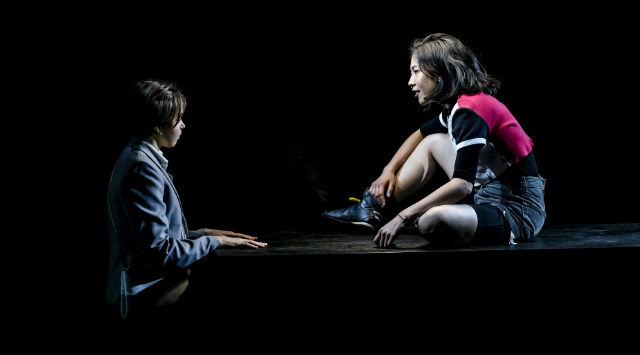
The city has been experiencing frequent blackouts, during which women and girls would disappear, many of whom would be subsequently found murdered. 16-year-old Steph is out looking for her best friend who has gone missing. She is certain that Bell, a young woman working in a bar, is withholding valuable information. Lulu Raczka’s A Girl In School Uniform (Walks Into A Bar) sees those two characters imagining the fate of a vanished girl. They play out scenarios by pretending to be male perpetrators of violence, thereby revealing the dangers that women know themselves to be subject to.

In the many blackouts that occur during the course of the production, the audience is repeatedly thrust into a state of anxiety, made even more unnerving by Hannah Goodwin’s very taut direction. Fear is always in the air, with the audience positioned to confront the constant threat that defines daily reality for most women. It is that sensation of when we walk into a bar, and our awareness of being looked upon as a piece of meat, is instantly heightened. The show is incredibly well designed, with Sophie Pilcher’s lights and Jessica Dunn’s sound wonderfully precise in manipulating our visceral responses for this gritty journey. Ella Butler’s work on set and costumes too, is highly accomplished. There is a sharpness to the aesthetic of A Girl In School Uniform that translates as a certain brutal coldness in how the world can be, even for young girls.

Actor Michelle Ny brings sass as well as dramatic intensity to the part of Bell, demonstrating impressive versatility in a role that requires of its performer, a wide range of attitudes and emotions. Steph is brought to life by the strong stage presence of Caitlin Burley, marvellous in conveying both innocence and fortitude for the role. The pair is exceptionally well rehearsed. Their chemistry and timing for this extremely technical two-hander has us agape in amazement, leaving us firmly persuaded by all that they present.

In the play we observe the dark to be infinitely more harrowing for women, but the incessant power failure is allowed to become a new status quo, exposing the ease with which society disregards our safety. We are comfortable with the idea that there is a weaker sex, and continue to foster behaviour and beliefs to reinforce that repugnant imbalance. We make things harder for women, often through the disinformation that women are naturally more challenged, usually due to bogus notions of biology or religion. The system will insist that we accept our fate, that we must respond to blatant injustice with resignation. Realising that acquiescence is almost always a choice, is how we can begin to address these issues of gender.

www.futurafilms.co

Review: The Weir (The Vanguard)

Venue: The Vanguard (Newtown NSW), Sep 24 – 29, 2019
Playwright: Conor McPherson
Director: Vanessa Papastavros
Cast: Nick Barker-Pendree, Damien Carr, Martin Estridge, Daniela Haddad, Alex Neal
Images by Natalie Cartney

Theatre review
Valerie is moving from Dublin to the northwest of Ireland, and in between looking at properties, parks herself at a small rural pub where she is acquainted with several locals. In Conor McPherson’s The Weir, a sleepy town provides the perfect setting for the time-honoured tradition of telling ghost stories. Residents have little to distract themselves but each other, and a landscape that bears histories most fondly remembered through word of mouth, morphing and fantastical. While various supernatural tales form the entertaining crux of The Weir, they are surpassed by a nostalgic depiction of community, one that leaves a strong and perhaps surprising impression.

With the theatrical action set in a real bar, we are immediately engaged through the unmissable familiarity and intimacy of the physical context. Directed by Vanessa Papastavros, the production is pared down but effective. Dynamics between characters are rendered with a remarkable authenticity, with a cast of five that is endearing and compelling, manufacturing an easy chemistry that provides foundation for their performance, able to transport us effortlessly through time and space.

Actor Damien Carr brings a richness to the role of Jack, animated but also considered, adept at communicating a sense of depth that gives the show its gravity. Realtor Finbar is played by Nick Barker-Pendree, memorable for the confident zeal he introduces to proceedings. Valerie, the blow-in, is portrayed by Daniela Haddad with an understated and elegant naturalism, appropriate for these tight confines. Martin Estridge and Alex Neal are charming and very believable pub dwellers, both offering valuable colour to this memorable representation of small-town life.

No matter how outlandish our stories, for as long as they resonate, we can be sure that truth can be located therein. If ghosts are real, it is only because we believe in a certain essence of life, that exists beyond the flimsy nature of matter. It reflects an understanding of the eternal, that in one form or another, each entity leaves behind an imprint, whether significant or minuscule, and that our actions when alive must have an impact. This could be construed as wishful thinking or indeed, delusions of grandeur, but the fact remains that ghosts have always been, and we have always known ourselves to be consequential.

www.thevanguard.com.au

Review: Doctor Shopping / In The Bag (Cobbstar Productions)

Venue: Cobbstar Productions (Paddington NSW), Sep 11 – 22, 2019
Playwright: Shaun Angus Hall

Doctor Shopping
Director: Tamara Cook
Cast: Patrick James, Rory O’Keeffe, Monica Sayers, Kristian Schmid

In The Bag
Director: Brian Cobb
Cast: Angela Elphick, Michael Kotsohilis, Giuseppe Rotondella, Lukey Timmins
Theatre review
The late Shaun Angus Hall was only in his twenties when he wrote these two plays in the 90s. Both very broad comedies with intentions only to entertain, they bear a sensibility that seems dated now, as we go through an era of hypersensitivity in relation to issues of race, misogyny and homophobia, but Hall’s proficiency with dialogue remains evident.

Doctor Shopping takes place mainly in a living room with four people who do nothing but abuse prescription drugs, while action in In The Bag happens at the race course, with goofy men gambling big bucks to dire results. Well crafted, but lacking in sophistication, these are plays with a specific appeal, that will prove very popular with the right crowd.

Direction for both shows prove accomplished. Tamara Cook gives Doctor Shopping an enjoyable playfulness, notable for her non-judgemental representation of addiction. Brian Cobb embellishes every moment of In The Bag with an overt humour, delivering robust energy from start to end.

Each story features four performers, all of whom are focused and enthusiastic; the quality of acting is an unequivocal highlight of the event. Kristian Schmid demonstrates excellent range as Ferris in Doctor Shopping, able to convey the light and dark of his character with ease. Giuseppe Rotondella’s strong presence as Angus provides In The Bag with a reliable anchor, and Angela Elphick’s multiple roles too are memorable, each one distinct and confident.

Some words seem to move with the times, but others can feel like relics. The nature of theatre allows old writing to be revived, and when necessary, it provides the opportunity for obsolete ideas to find relevance in a different era. Audiences however, can be stuck in the past, whether nostalgic or simply traditional. Theatre too, can decide whether to progress, or to ignore the future.

www.cobbstarproductions.com

Review: John (Outhouse Theatre)

Venue: Seymour Centre (Chippendale NSW), Sep 19 – Oct 12, 2019
Playwright: Annie Baker
Director: Craig Baldwin
Cast: James Bell, Maggie Blinco, Belinda Giblin, Shuang Hu
Images by Clare Hawley

Theatre review
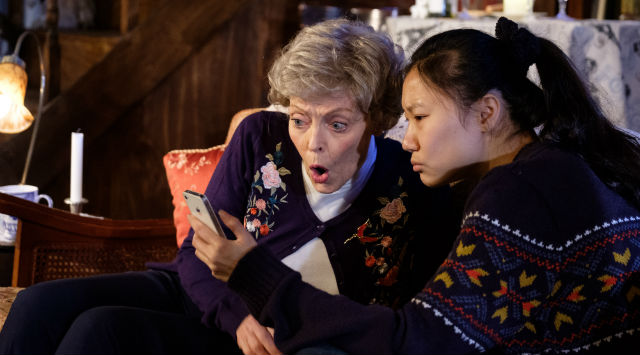
Jenny and Elias are visiting Gettysburg, Pennsylvania whilst trying to mend a rough patch in their relationship. They stay at a bed and breakfast, run by an elderly lady named Mertis, who is very nice, but who is also more than a tad mysterious. Her eyes, like her house, are secretive and cavernous, and in Annie Baker’s John, we always feel as though things are not quite what they seem. We see the young couple attempt to make things work, both trying hard not to let go, inside Mertis’ tchotchke-filled house, where past and present converge, unable to disentangle from one another.

Baker’s intriguing play is filled with characteristics of scary stories; lights that turn on and off by themselves, a pianola that plays unprompted, portraits and dolls imbued with a presence that can only be described as supernatural. There are lots of creepy goings on, but in the absence of an obvious genre style pay off, our minds are made to regard Mertis’ world with an unusual complexity, that quite matter-of-factly ventures into the metaphysical.

Director Craig Baldwin manufactures this eerie atmosphere with considerable diligence and detail, supported magnificently by set designer Jeremy Allen and lighting designer Veronique Bennett, who deliver exquisite imagery that has our imagination running wild. The house is in some ways the star of the show, and the work that has gone into making it come alive, is absolutely terrific.

Incredibly nuanced performances by the cast of four take charge of our attention for the entire three-and-a-half hour duration, keeping us guessing at every juncture, making us see things that may or may not be there. Efforts to render a spooky vibe can sometimes feel awkwardly lethargic, especially in Act One, but we are always engaged, always filled with curiosity, even when feeling impatient.

Belinda Giblin is electric as landlady, hugely impressive with the intelligence and rigour that she brings to her portrayal of the enigmatic Mertis. Her close friend Genevieve is played by an exhilarating Maggie Blinco, whose kooky vivacity adds much needed energy to the show. The troubled young couple is depicted with great chemistry by James Bell and Shuang Hu, who are convincing whether loving or fighting, but there is a restraint to their approach that can at times feel at odds with the humour of the piece.

There is much that can be interpreted as strange in Mertis’ home, but there is also a peculiarity to how the visitors struggle with their lives that can easily get unnoticed. The older women share a sense of ease that escapes Jenny and Elias, who we observe to be constantly at odds with the world, always responding to it with resistance and frustration. Mertis accepts things as they are, and nothing seems to unnerve her. She exists in harmony with a cosmos that many think is chaotic. The young ones on the other hand, appear to play by the rule book. They look like normal people doing normal things, but they are in contradiction with a bigger scheme of things, as exemplified by the house they temporarily occupy. The house just is, and it is us who have to learn to adhere to it.

www.outhousetheatre.org

Review: Trojan Barbie (New Theatre)

Venue: New Theatre (Newtown NSW), Sep 16 – 21, 2019
Playwright: Christine Evans
Director: Maddison Huber
Cast: Anthea Agoratsios, Sophie Avellino, Deng Deng, Sam Flack, Cathy Friend, Tristen Knox, Anjelica Murdaca, Taleece Paki, Lisa Robinson, Shannon Rossiter, Amy Sole, Kristelle Zibara

Theatre review
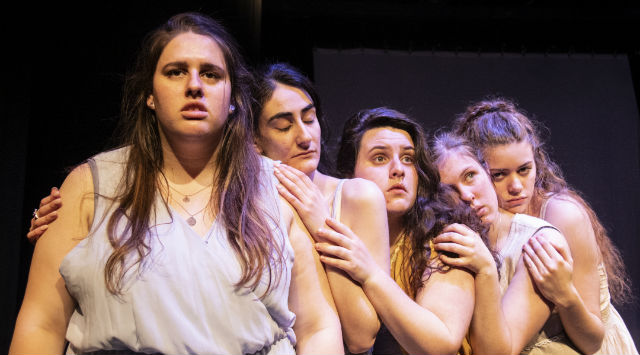
An homage to Euripides’ The Trojan Women, Christine Evans’ 2009 play Trojan Barbie places focus on legendary women of the Trojan War. Modern day tourist Lotte, who restores dolls in her normal life, is flung back to ancient times, where she is trapped in a women’s camp, witnessing the atrocities of war. Evans’ work is suitably tragic, but also surprisingly humorous in many of its early scenes. Familiar characters are rendered with a contemporary sensibility, allowing us to relate better to their stories, and to keep us amused.

Time travel aspects are not always presented effectively in the production, leaving us confused at several points, but director Maddison Huber ensures that each personality we encounter in her show, is distinct and memorable. Actor Lisa Robinson demonstrates strong comic abilities as Lotte, adept at delivering laughs even in the midst of battleground horrors. Kristelle Zibara is a convincing Hecuba, intense with the sorrow her maternal role is charged to convey. Sophie Avellino and Cathy Friend take on different kinds of madness, for Helen and Cassandra respectively, both performers bringing appropriate flamboyance to invigorate the stage. The show succeeds at dramatic moments of catastrophe, but when the action calls for a gentler touch, its lack of nuance can make for a less than satisfying experience.

A Chinese proverb says that women hold up half the sky. Even as men insist on occupying positions of power, we are always required to be on hand to pick up the pieces, whenever they bring degradation and destruction to the world. It is important that we look beyond how things currently operate, and commit to working towards a new system that does not simply replace men with women. These hierarchical modes of organising society have proven to be severely deficient, no matter who sits on top of the pile. If we want to ensure that nobody loses, it must mean that old ways of thinking about success, about winning, must be radically eliminated.

www.facebook.com/Scribe-Theatre

Review: High Performance Packaging Tape (Sydney Opera House)

Venue: Sydney Opera House (Sydney NSW), Sep 18 – 22, 2019
Collaborating Artists: Phil Downing, Mickie Quick, Lee Wilson, Mirabelle Wouters
Cast: Lee Wilson
Images by Daniel Boud

Theatre review
The man assembles a whole lot of household and industrial items, including plastic chairs, oversized balloons, rubber bands, cardboard boxes, and an endless supply of packaging tape. Using them like big boys toys, he performs a series of daredevil type stunts, usually with gravity as his opposition, almost like a circus act. Except Lee Wilson is dealing entirely with physics in High Performance Packaging Tape, leaving nothing to chance, and therefore unlike the circus, we are not fearful of things going wrong. No one is at risk of plunging to their deaths, and certainly no lions are hanging around waiting to maul him to death.

In the absence of danger, our attention is then free to shift towards intellectual aspects of this physical work. We wonder what it is that compels man to place obstacles before himself, as Wilson does incessantly in his show. Questions about gender, ethnicity and therefore social advantages, begin to arise. We wonder if privilege means that a person would tend to create challenges for the self, if challenges are not already present. In 2019, if we are no longer interested in what a white man has to say about the way Australian life is experienced, it appears that we leave him to his own devices, and he goes to prove his worth by exploring his existence in spaces that seem devoid of politics, in cultural frameworks he is able to determine for himself, that can disregard all the urgent discussions being had in the real world.

It is arguable if audiences can be as easily persuaded. Some might be able to invest in the statements being made about the body, as entirely apolitical objects, scientific and subject only to natural laws of matter and energy. The rest of us will struggle to extricate our corporeality from the implications of daily stresses, unable to relate to this ethereal vacuum, where suffering and injustice are so conveniently shut out.

Within this world of childlike play, where the creators make up their own rules, the production is faultless, and very sleek, with what it sets out to achieve. The humour is sophisticated, and the stunts are original. Wilson’s nonchalant composure is a cool juxtaposition against the dramatic intensity of the visual presentations. Auditory effects are remarkably inventive, involving digital manipulations of live sounds that heighten tensions in the auditorium. High Performance Packaging Tape is quite unlike anything one has seen before, an escape from realities that not all can bear.

www.branchnebula.com

Review: The Becoming (New Theatre)

Venue: New Theatre (Newtown NSW), Sep 15 – 20, 2019
Playwright: Katie Pollock
Director: Brett Heath
Cast: Alison Benstead, Jo Goddard, Ben Hanly, Patrick Holman, Sarah Maguire, Paul Wilson

Theatre review
Greta and Gregor are rich kids from the eastern suburbs of Sydney, both going through significant transformation, as a response to the world’s current state of tumult. Katie Pollock’s The Becoming can be seen as a coming-of-age tale, but is more likely to be taken as commentary on the sociopolitical mess we are experiencing today. We see Greta deciding to be a nicer person, whilst Gregor turns angry and militant; it is as though one environment has bred two extremists on either ends of a spectrum, both of which the play presents as ineffectual and regrettable. It is an amusing context that Pollock has located, inspired by Franz Kafka, and obviously pertinent with its thematic concerns. As a work of absurdist comedy however, its characters never really depart sufficiently from the mundane, with a sense of humour that is probably too subdued.

Directed by Brett Heath, the show is thankfully raucous in atmosphere, although the players never really attain a level of authenticity that would allow its ideas to resonate. Each role is approached with an enjoyable sense of theatricality, but we struggle to connect with anything meaningful even if the text does point to matters contemporary and troubling. Sarah Maguire’s indefatigable ebullience as Greta helps sustain our attention, and Patrick Holman is suitably offbeat as the misguided Gregor, particularly noteworthy for his performance of live drums that prove to be a rousing and sophisticated touch.

It is true that so much of what we observe to be happening in society, can be infuriating. Greta and Gregor may have found radical ways to express their dissatisfaction, but they achieve nothing, other than to escape that dreadful sense of helplessness when one is crippled with inaction. When the system is broken, those of us who are more intrepid, like the siblings in The Becoming, might be moved to try for solutions, but it is revealing that the two do not confer, choosing instead to operate independently even though they live under the same roof, and share the same blood. They are unable to listen to the other, each so certain of their own beliefs. Watching the collapse of this kinship, of humans failing to connect, it becomes unsurprising that disaster should unfold.

www.newtheatre.org.au