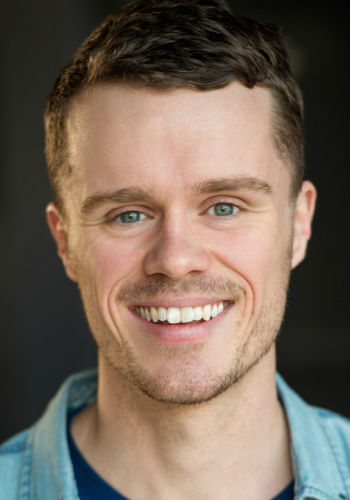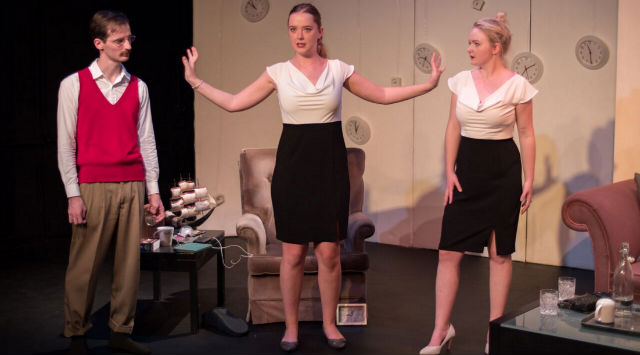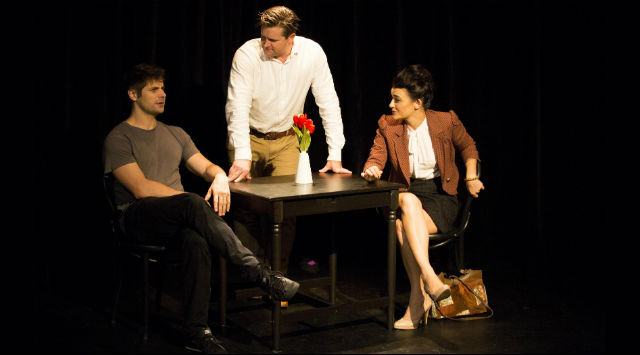
5 Questions with Ayeesha Ash and Heather Manley

Ayeesha Ash

Ayeesha Ash

Heather Manley: Rent is your first musical after studying Acting at WAAPA. How do you find the rehearsal process compared to a straight play?
Ayeesha Ash: The rehearsal process hasn’t been extremely different, it’s just focusing on song lyrics instead of dialogue and making sure I know my choreography perfectly, so that I don’t accidentally hit someone in the head with a prop.

If you had to choose one cuisine to eat for the rest of your life what would it be?
Definitely Japanese. Sushi, sashami, wakame, edamame. SOY SAUCE.

What has been your favourite performing experience?
In my final year at WAAPA my class toured a show that we wrote to Dublin. It was such a great experience being able to perform a piece we were so connected to on the other side of the world.

What strange fact about you do not many people know?
When I was a kid I would only have a shower if I was wearing my rain hat (I’ve grown out of that phase now).

Would you rather be married to a man with a fish head and a normal body or a normal head with a fish body, and why?
Normal head and fish body because he would probably be a really good ocean swimmer. He could take me on ocean dates and introduce me to all of his whale friends.

Heather Manley

Heather Manley

Ayeesha Ash: What’s been the most challenging piece to learn in Rent?
Heather Manley: I think the whole thing was a bit of a challenge because it’s a return season and we are entering a cast where almost all of the members were in the first run and knew all the numbers already. My brain was so full of lyrics and choreography within the first week.

Who is your favourite character to play in the show and why?
I really like playing Mimi’s sassy mom and singing in Spanish. Who doesn’t love to be sassy when they get the chance?

If you were an animal, what type of animal would you be?
Definitely a bird. It’s always been a fantasy of mine to be able to fly. And I’m a bit obsessed with birds – I have four cockatiels as pets back home in Guam.

If you could turn any movie into a musical what would it be?
I think Miss Congeniality is screaming to be a musical!

Who did you prefer in the 90s: Britney or Xtina?
Britney Spears’ album with ‘Hit Me Baby One More Time’ was the first album I bought, so definitely Britney.

Ayeesha Ash and Heather Manley can be seen in the new season of Rent the musical.
Dates: 29 Mar – 17 Apr, 2016
Venue: Hayes Theatre

Click here for Suzy’s review of last year’s production of Rent.
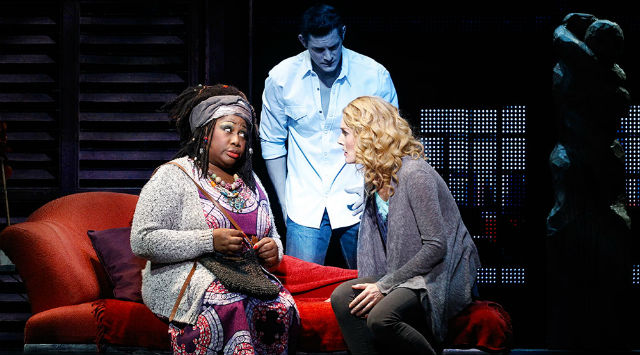
Review: Ghost (Theatre Royal)

ghostVenue: Theatre Royal (Sydney NSW), Mar 18 – May 14, 2016
Book & Lyrics: Bruce Joel Rubin
Music & Lyrics: Glen Ballard, Dave Stewart
Director: Matthew Warchus
Cast: Wendy Mae Brown, Ross Chisari, David Denis, Rob Mills, Jemma Rix, David Roberts, Lydia Warr, Evette Marie White
Image by Jeff Busby

Theatre review
The 1990 film Ghost is remembered for its fantastical melodrama involving spirits, murderers, a psychic, and a pair of lovers with a penchant for ceramics. The 2011 musical version retains the very eventful narrative of its original, as well as an extravagant sentimentality that has become closely associated with Ghost. It is undoubtedly a cheesy operation, but no one on stage or in the audience pretends that it is anything otherwise. Its characters are two-dimensional, all singing formulaic showtunes, and the chorus makes sure that the very last row of nosebleeds would notice their every move, even though choreography is already terribly obvious.

There is no room for subtlety here, and the production calls for a certain amount of toughness on the part of its audience in order to stomach its garish approach on all fronts. It is paint by numbers Broadway style, but those predictable blueprints are established for a reason. Ghost provides entertainment, escape and amusement. It gives us moments where we suspend disbelief and reach for the most naive parts of our minds to indulge in all its saccharine wonder, as we gasp at its melange of levitating bodies, disappearing apparitions and actors walking through doors. We might find our intelligence insulted at certain points, but we are accepting of it, as evidenced by box office takings the world over for productions of this nature.

Accolades for Whoopi Goldberg’s film performance as the outlandish Oda Mae, including an Oscar, demonstrate our appetite for the brash and gaudy. The role is performed here by Wendy Mae Brown who does a close proximation of the very memorable hustler-turned-psychic. The delightful character is played by a spirited actor with an impressive voice who relishes every punchline and their accompanying laughter. The leads are much more subdued in tone. Rob Mills and Jemma Rix are excellent performers assigned big songs but nothing much else. Their singing is often spectacular, and both are easy on the eye, which makes them perfectly cast.

It is hard to be enthusiastic after the fact, when a show gives you everything that you had seen many times before, but there is no doubt that we find ourselves powerless and captivated by its tried and tested moments of musical theatre. Ghost provides a familiarity that many wish to revisit time and time again. It reduces us to a childlike stupor, and many would pay good money for that fleeting pleasure. It may not be a special work of art, but in comparison to everyday life, this is magic through and through.

www.ghostthemusical.com.au

Review: That Eye, The Sky (New Theatre)

Venue: New Theatre (Newtown NSW), Mar 15 – Apr 16, 2016
Playwrights: Richard Roxburgh, Justin Monjo (adapted from the novel by Tim Winton)
Director: David Burrowes
Cast: Alex Bryant-Smith, Joel Horwood, Shaun Martindale, Jenae O’Connor, Romney Stanton, Simon Thomson, Emma Wright
Photography © Bob Seary

Theatre review
Religion is a subject that art can always rely on to evoke and provoke, especially in these modern times when scarcely any two persons are able to find complete agreement about who, what or how it is that we are being looked over, or indeed that supreme beings exist at all who we have to be answerable to. We meet the 13 year-old boy Ort just as his young mind begins to understand abstract concepts about faith. He finds God, but the relationship is a rocky one, and salvation continues to elude him.

That Eye, The Sky is a tender story about a sensitive child in challenging circumstances, but David Burrowes’ direction does not deliver an emotionally charged experience capitalising on our susceptibility to impassioned empathising of the pure or the weak. His show is polished and quiet, a feast for the senses, but it keeps us at a distant position of observation, never giving us the opportunity to delve into the romance of the piece. The work is consistently cerebral, which feels somewhat contradictory to the issues being explored, but all facets of production are impressively executed. The design team does exceptional work, especially Benjamin Brockman on lights, and the duo of Hugo Smart and Dean Barry Revell on sound and music, with brilliantly conceived flourishes that play much more than a subsidiary role to the actors on stage. Set design by Tom Bannerman and costumes by Alana Canceri create a sophisticated and powerful visual impact in spite of their understated approach.

The actors are equally strong, with Joel Horwood’s portrayal of Ort remarkable for its deceptive ease. Horwood is a grown, and very tall, man who makes us believe unreservedly in the innocent and prepubescent being he brings to the stage. The wide-eyed wonder he performs seems effortlessly achieved and every youthful quirk of voice and gesture is convincing and delightful. His family is played by Romney Stanton and Emma Wright, both resplendent with sensitivity, nuance and psychological accuracy. Their work is restrained and elegant, but surprisingly memorable. Shaun Martindale plays the pivotal role of Henry with an energetic spontaneity. He brings a sense of danger to the show, and although not always sufficiently effective at key plot moments, there is a quality of enigma in his work that adds to the complexity of what is being said.

We should not expect every work of theatre to produce the same emotional effects. Art can do much more than to speak to one’s feelings, and on this occasion, we discover the sensation of being moved without having to respond with sentimentality. The production’s style is perhaps at odds with the very substance of its story that seem to call for a more gushy approach, but what it does create is a sensual landscape that we can watch in admiration. Beauty is sublime, but it will not always move you how you wish.

www.newtheatre.org.au

Review: Golem (1927 Productions)

Venue: Roslyn Packer Theatre at Walsh Bay (Sydney NSW), Mar 16 – 26, 2016
Playwright: Suzanne Andrade
Director: Suzanne Andrade
Film, Animation & Design: Paul Barritt
Music: Lillian Henley
Cast: Esme Appleton, Will Close, Lillian Henley, Rose Robinson, Shamira Turner
Images by Bernhard Müller

Theatre review
It is in the nature of cities around the world to be obsessed with progress. Some economies are determined to find opportunities in international markets to bring communities out of poverty, while others are simply caught up in capitalism’s readiness to encourage and facilitate greed. Whether intentions are noble or otherwise, all of us in developing and industrialised countries are on a fast train to a future shaped almost exclusively by concepts of financial and technological advancement. Suzanne Andrade’s Golem is not only about the fear of being left behind, it is also interested in the involuntary embroilment that we often find ourselves, fuelled by the voracious appetite of today’s way of the world, with its monetisation of virtually everything and the impossibility of detaching oneself from these increasingly sinister systems of economy. Andrade’s work leaves no room for doubt about damage that results from the insatiable process of consumption. Disguised as machines of betterment, we participate and contribute to a never-ending order of perpetual buying, one with increasingly bigger promises at every step of the way.

The show combines the projection of an animated film, with live actors and musicians. It is a unique aesthetic, thoroughly idiosyncratic with a wide appeal that many would find delightful. The performance involves a high level of precision and technical sophistication (ironic considering its critique of technology), for a captivating experience that is as satisfying as its themes are troubling. A sense of wonder pervades the production, with a child-like tone that would speak to audiences young and old. Its message is grave, but also simple. It spells out what we secretly know to be true, but prefer to leave uncovered for we fear its inevitability and know not to act against it. Reality does not allow us to turn back the hands of time, but on stage, Golem is able to do just that. With brilliant imagination and refined wizardry, the show takes us to an earlier period of our industrialisation, and charts the path of our irreversible progress. We recognise all its allegories, and respond with appreciation, to the way it voices our apprehensions about modern life.

No one truly knows how to tame that monster within. We see it do its dirty work, and acknowledge our complicities. Some of us remain aware of its every pitfall, while others choose to turn a blind eye. Golem offers no alternatives or solutions to the civilisation it disparages, and its nostalgic longing for an innocent past seems futile. The result is either a melancholy that finds no emancipation, or the embrace of a certainty that is not all light. Tales of pessimism do their part in reminding us of the oft forgotten dark sides of being, if only to turn us into more compassionate people, but we have to make the best of what we do have, and even though far from perfect, it is easy to recognise the elements that are good in the way we live today.

www.19-27.co.uk

5 Questions with David Burrowes and Joel Horwood

David Burrowes

David Burrowes

Joel Horwood: If you could shadow any director, dead or alive, who would it be and why?
David Burrowes: I would have loved to be in the room with Piña Bausch. Every snippet of work I’ve seen by her blows my mind a little bit, I would have loved to see her make, not so I could replicate the process but, so I could experience it. I can’t image the work she made came from a banal place, she knew how to tap into something special with her art.

You certainly enjoy a cup of coffee. How do you take it, and what does that say about you?
I want to say strong and black like me, but I drink flat whites to which I hope I have zero correlation.

What is the most powerful piece of theatre you’ve ever seen?
Simon Stones’ Thyestes blew my mind when I first saw it. I’ve seen a lot of incredible theatre since but that was the production that made me consider the stage as a medium I wanted to work with.

When you’re not directing incredible theatre productions, what gives you the greatest joy in life?
Being told I direct incredible theatre productions. I’ve also recently started to snowboard, which is mad fun.

You also direct for the screen. What are the major differences, and do you have a preference?
Don’t make me pick. There’s a lot of safety as a screen director in the fact that when you show a film it’s going to be exactly the same every time you show it. Theatre changes every night and that terrifies me, but it’s also why you do it.

Joel Horwood

Joel Horwood

David Burrowes: What’s the biggest challenge about playing a 13 year-old?
Joel Horwood: Being six foot tall with stubble that insists on growing back daily hasn’t made life easy, but I think the biggest challenge has been in finding that sense of naivety and wide-eyed wonder. Even for a 13 year-old, Ort reads as quite young, so it’s been difficult not to let my cynical, judgemental brain get in the way. Reactions to events that are instinctual to me read far too old for a 13 year-old, so it’s been a difficult task to hold back on those instincts and preconceptions.

As an official WA resident for most of your life, how on point is our regional dramaturgy?
As thrilling as it has been to see so many references to my home in the novel and in the play, for me, the story really does transcend its setting. It’s undoubtedly very Australian, and that sense of isolation and remoteness is definitely something we west coasters know all too well, but the sense of longing and hope for something bigger than us is true universal.

How influential was Tim Winton’s novel in helping you find the onstage Ort?
Hugely. Ort’s voice is so clear and detailed in the novel, and you get to spend 170 odd pages living inside his head. It informs so much of the subtext in the play, that mightn’t otherwise be as clear. I’ve spent the entire process constantly referring back to the novel to clarify and enrich moments. It’s been a real luxury having this beautifully realised character just itching to be brought to life on stage.

If you weren’t acting, what would you be doing?
As a kid, I would drag my Mum along to home opens on the weekend so I could assess the originality of the designs and take home brochures for me to obsess over for the next week. So, I guess I would probably be an architect. I still sometimes drive around to house inspections on weekends just to perv on people’s homes. The domain app gets a lot of use on my phone!

If you could invite one person to see this show, who would it be?
Probably either David Wenham, so he could school me on how it’s done. Or one of my favourite high school teachers, Leigh Hannah, who cast me as Seymour in Little Shop Of Horrors. That show is probably the reason I’m pursuing this, and not designing houses.

David Burrowes directs and Joel Horwood stars in That Eye, The Sky by Tim Winton (adapted for the stage by Richard Roxburgh and Justin Monjo).
Dates: 15 March – 16 April, 2016
Venue: New Theatre

Review: The Bald Soprano (King Street Theatre)

kingstreettheatreVenue: King Street Theatre (Newtown NSW), Mar 15 – 26, 2016

Playwright: Eugene Ionesco (translated by Donald M. Allen)
Director: Barry Walsh
Cast: Timothy Hope, Ellie May, Luciana Nguyen, Matthew Neto, Cheng Tang, Rhiannon Watson

Theatre review
The play is set in a nondescript living room, awash in beige and old furniture, with no cause for excitement except for an inordinately large number of clocks greeting the audience. Eugene Ionesco’s The Bald Soprano is an absurdist, and perhaps surreal, piece that addresses the potentialities of theatre from a very fundamental standpoint. It explores the very nature of people on a stage, and how theatre practitioners are moved to act in the pursuit of an endeavour that might be termed artistic.

Ionesco removes notions of stories, characters and logical coherence, to locate a theatrical entity that can make sense without the reliance on narrative and other conventions for communication. Quite similarly, director Barry Walsh’s focus on time, with ticking sounds and aforementioned clocks, takes our attention to the way we might create meaning to fill up the very passage of time in our daily lives. The personalities on stage appear to be regular English folk, and like us, they try to go about their business as though full of reason and fortitude, yet there is no disguising their alien-like demeanour in the absence of rational dialogue. Without proper context or a sense of regular storytelling to guide us, ordinary people (or in this case, middle class suburbanites) begin to dissolve into a strange melange of movements, interactions and emotions, allowing us to observe human behaviour as though from an alternate universe. We are encouraged to find an understanding of the self through a process of detachment. For a moment, we become the aliens, looking in on Earth with fresh eyes to study the human process, and to realise the Dada ridiculousness of it all.

Walsh is adept at creating an atmosphere of awkwardness, which in itself is an intriguing sensation to experience, but also curiously relevant to the play’s essence. There is a gently comic quality to the scenes that he composes, but chemistry between actors can seem lacking in key moments where bigger laughs could be delivered. Performances are effective when the players become adventurous and are able to momentarily spin out of control, but there seems a tendency for them to feel needlessly restrained most of the duration. Timothy Hope as Mr Smith is the most mischievous in the cast, and leaves an impression with exaggerated manoeuvres that not only entertain, but are also in line with the spirit of the work.

Through strangeness, we approach truth. When encountering the bizarre, our instincts respond by identifying scant elements that provide familiarity, in order that we may formulate personal associations that resonate. How we read any instance of obscure artistic expression, relies heavily on the constitution of each individual audience member, thus presenting an opportunity for self-reflection. The act of theatre attendance is one of community, so the construction of meaning also occurs in the meeting of minds, and hence a collective reality can be manufactured. It is human to experience and interpret, and with The Bald Soprano, there is certainly plenty of room for both those pleasures.

www.kingstreettheatre.com.au

5 Questions with Sheridan Harbridge and Ryan Johnson

Sheridan Harbridge

Sheridan Harbridge

Ryan Johnson: Is 80 Minutes No Interval exactly what it claims to be?
Sheridan Harbridge: It is exactly that. 80 minutes of punchy fun dark love with no breaks for a wee. Compact theatre for the average functioning bladder.

Your character has a real issue with theatre. Do you empathise?
My character Clare has a real problem with artsy fartsy theatre. She sits in the audience and feels ignored by the plays she sees. I don’t have that problem, I go dreamy for a beautiful classic where the director gets out of the way and honours the playwright’s intention, but I do also like risk and experimentation in my theatre. Unlike Clare, I am empathetic with the nature of risk and that more often than not, it doesn’t work, and you’re left with 35 actors running around on stage for 7 hours in diamante G-strings, holding dildos stuck on the end of some glittered sceptres singing Kylie Minogue hits in Latin. But when the risk pays off, the “Locomotion” in Latin is a real winner.

Do you think theatre needs to be more accessible?
I love the theatre scene in Australia. For the small arts community we have, we have a range of companies ticking the boxes for whatever may be your flavour. The problem is always the struggle for money, and how quickly these companies and artists burn out trying to consistently produce quality accessible and experimental theatre. Then they have to take less risks to stay safe and afloat and we all begin to complain again.

What makes our play different?
It’s a beautiful dark dark comedy with so much heart, and so so much absurdity. And plenty of fake blood, S&M whippings and nudity from an actor so handsome even Nanna will like it.

Most ridiculous thing I have ever seen in the theatre?
I saw a girl spill a tin of pencils on the floor and stand on them for half an hour trying to stay upright while monologuing. She fell so many times, the pencils were splitting in pieces and cutting the hell out of her legs. Exceptional.

Ryan Johnson

Ryan Johnson

Sheridan Harbridge: Is 80 Minutes No Interval exactly what it claims to be?
Ryan Johnson: Yes, depending on how many laughs we get and also how fast we act. It is absolutely endeavouring to be 80 minutes and it definitely has no interval.

Your character Louis is desperate to make a great work of art, to leave a legacy behind. What will people say about the legacy of Ryan Johnson?
I don’t think I’ll be remembered as a great actor or father or husband. It won’t be as ‘that scallywag who always seemed to have time for a chat with everyone.’ No – I’ll be remembered as the guy from the Cadbury Favourites commercial.

What do you think about 8-hour plays with 2 intervals and a dinner break?
I would rather eat hair. No one needs that in their life. Maybe the tech operators on the show who get paid by the hour but for anyone else, I’d say “don’t buy a ticket, you’re just enabling them”. If you want to be confused for 8 hours while watching A-list Australian actors talk funny in silly costumes, just watch one of the Hobbit movies.

What’s your favourite moment in the show?
The bits where you and Robin do anything. I think you are both comically brilliant and I feel very fortunate I get to share a space with you both!

What’s the most ridiculous thing you have ever seen in the theatre?
90’s Australian Basketball megastar Andrew Gaze in Jack And The Beanstalk at the Gold Coast Art Centre. The production was brilliant but he just didn’t capture the giant’s vulnerability. I wanted to know what was behind his ‘hunger’ for Jack but I couldn’t help but feel like Andrew was just ‘playing evil’.

Sheridan Harbridge and Ryan Johnson can be seen in 80 Minutes No Interval by Travis Cotton.
Dates: 8 March – 9 April, 2016
Venue: Old Fitz Theatre

Review: Space Cats (Brevity Theatre)

Venue: The Old 505 Theatre (Newtown NSW), Mar 1 – 12, 2016
Playwright: Samantha Young
Composer & Musical Director: Matthew Predny
Director: Samantha Young
Cast: Jonny Hawkins, Graeme McRae, Gautier Pavlovic-Hobba, Eliza Reilly, Samantha Young
Images by Andre Vasquez

Theatre review

It takes a considerable amount of egomania for people to reach the highest positions of government, and in Space Cats, the same is true for alien cats in outer space. Queen Cat is a fascist leader with enormous arrogance, and the ignorance to match, on a rampage to destroy all that she deems to be inferior or objectionable. Her planet is now close to complete eradication, and we wonder if her thirst for annihilation will ever find satiety. This is of course, not at all a serious musical, even if the felines do pontificate on immigration, homelessness and sexual discrimination. In fact, the show does its best to create a ridiculous havoc for an audience that it wishes to amuse in the most outrageous ways possible. The darkness at its heart only makes the experience edgier, and is the element that remains after waves of manic laughter have subsided.

Samantha Young does not play the Queen, but is the indisputable triple-threat boss of the production, responsible not only for its writing and direction, but also for playing the key role of Bin Cat. Young’s script is wildly imaginative and relentlessly humorous, and while it may lack complexity, Space Cats contains sufficient poignancy to prevent its persistent hilarity from becoming banal. Direction of the work will be remembered for its incredible exuberant spirit, with Young’s boundless sense of playfulness littered through every moment. The degree at which her show is determined to entertain is almost merciless. Young also happens to be the strongest singer in the production, and along with Eliza Reilly, the funniest performers in the cast. Reilly plays the aforementioned Queen Cat with splendid flair and a fierce wit, leaving an excellent impression with her enthusiasm for extremely bawdy comedy.

Equally accomplished is Matthew Predny’s work as composer and musical director, simultaneously mocking and embracing the Broadway musical genre for a refreshingly joyful take on something that is often too conceited and cheesy. Set and lighting designer Benjamin Brockman transports us to a parallel universe where every molecule of air seems to be impregnated with glitter, and an involuntary shimmer emanates from each object and being. The team appears to be in competition for turning up the camp, and there is no clear winner with every aspect of production pushing at the limits of all things gay, gaudy and gasp-inducing. Pearls are certainly recommended for spontaneous clutching at Space Cats, no matter what gender, creed or species.

www.brevitytheatre.com.au

Review: 80 Minutes No Interval (Thread Entertainment)

redlineVenue: Old Fitzroy Theatre (Woolloomooloo NSW), Mar 8 – Apr 9, 2016
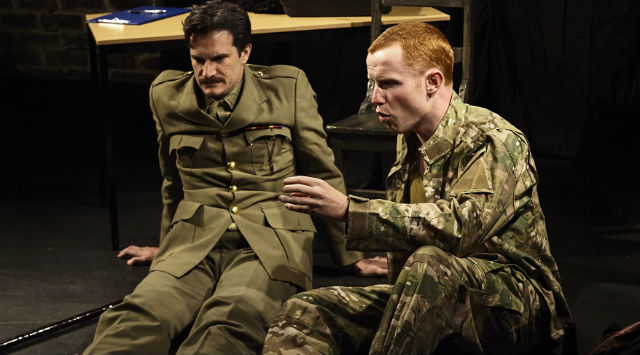
Playwright: Travis Cotton
Director: Travis Cotton
Cast: Jacob Allan, Robin Goldsworthy, Sheridan Harbridge, Ryan Johnson, Julia Rorke
Image by Rupert Reid

Theatre review
Travis Cotton’s play is as much an analysis on the creative process as it is about entertainment. 80 Minutes No Interval interrogates its own writer’s abilities, ambitions and approach to art and life, but its self-indulgence is very consciously altered to accommodate Cotton’s awareness of a paying crowd’s expectations of enjoyment and fulfilment. A brilliant wit provides coherence between the simultaneous, and usually divergent, needs of being innovative and crowd-pleasing, with an unabashed lust for laughter that determines its every stage moment.

When the show is not delivering unadulterated and outrageous hilarity, it is at least piercingly amusing. Constantly alternating between juvenile and sophisticated tones of humour, it tickles our funny bone relentlessly, and aggressively, insisting on our immersion into its worlds of humour. Robin Goldsworthy and Sheridan Harbridge play a range of supporting characters, and are linchpins to the effectiveness of this fun factory. Both gloriously adventurous and bold, the actors are faultless in their precise comedy, no matter how broad or how subtle they choose to attack the material. Their work here is unmissable. Leading man Ryan Johnson has the hard task of playing straight man in the midst of a lot of hysteria, and although not quite as funny, he certainly holds his own with graceful charm and an ever-present all-knowing glint in his eyes. The role of Louis is perhaps too unsentimental a creation for the play to establish poignancy, but Johnson is nonetheless able to introduce a valuable humanity that elevates it from mere farce.

The production is designed with ingenuity and admirable exactitude. Sound and music by Hamish Michael and Hue Blanes are crucial to how the audience’s emotions respond at every plot juncture, and Ross Graham’s dynamic lights create unexpected variety and dimension to what is essentially a small and blank black space. Beautifully executed by stage manager Liam Murray, the show’s technical accuracy contributes significantly to the way we are kept persuaded and engrossed.

80 Minutes No Interval is a study of negotiations between art and entertainment in theatre. The joy it provides is undeniable, and it makes statements about art that are acute and intelligent. Using autobiography as a point of departure, but disallowing the ego from getting in the way of a good time, Travis Cotton finds himself in a space that is both critical of the art world, and also deeply self-deprecating. It is hard to imagine better ways of spending eighty minutes than with this gleeful concoction of silly and smart, whether just for laughs or food for thought.

www.oldfitztheatre.com

Review: Bully Boy (Blood Moon Theatre)

nightofplayVenue: Blood Moon Theatre (Potts Point NSW), Mar 10 – 26, 2016
Playwright: Sandi Toksvig
Director: Deborah Mulhall
Cast: Patrick Cullen, Jaymie Knight

Theatre review
Plays about the consequences of war appear frequently, because their message never seems to speak loudly enough to overwhelm what governments are able to have us believe. On any given day, it only takes a two-minute news report on any broadcast media to convince us of sending troops to fight in places we know virtually nothing about, for reasons that are contentious at best. Rich or poor, East or West, cultures everywhere engage in warfare as though a completely natural part of human nature. We send young people away, understanding the risks but convinced that the honour of the exercise makes it all worthwhile.

Sandi Toksvig’s Bully Boy reveals the damage inflicted on our soldiers, as well as the camaraderie built under circumstances of trauma and suffering. Its context might not be original, but this is a piece of writing that provides access to a deeper psychological understanding of the destruction being continuously dispensed. Toksvig’s characters are British, but they represent the humanity of military personnel everywhere, beyond exteriors of stoic infallibility.

Barely an adult, Private Eddie Clark is already surrounded by death. Played by Patrick Cullen, the character is authentic, complex and moving. Cullen’s powerful performance provides heart and soul to a production that relies on little more than its two actors to tell its story. Jaymie Knight looks to be half the age of his role, and takes time to make Major Oscar Hadley a convincing presence. The actor is stronger in scenes of intense emotion, but the challenge of truthfully depicting someone under decades of anguish is evident. Nevertheless, the couple is energetic and compelling, with director Deborah Mulhall keeping things lively and pacey. Mulhall’s clever use of space liberates the simple two-hander format, but emotions can be portrayed with greater specificity, and scene transitions could be managed with better flair for stronger plot and narrative effectiveness.

It is hard to imagine a world where we no longer deliver our young to the battlefield. Horrors are a fact of life, and we learn to co-exist, but one of the things that art can do, is to wake the sleeping dogs. Art prevents us from indulging in delusions and convenient misbeliefs, while others lay victimised by our ignorance. Bully Boy and other tales of tragedy may not be able to bring us world peace, but they are sometimes the only thing we can count on to remind us of truths that many want to keep buried.

www.facebook.com/bloodmoontheatre | www.anightofplay.com