Review: Playing Beatie Bow (Sydney Theatre Company)

Venue: Wharf 1 Sydney Theatre Company (Walsh Bay NSW), Feb 22 – May 1, 2021
Playwright: Kate Mulvany (based on the novel by Ruth Park)
Director: Kip Williams
Cast: Tony Cogin, Lena Cruz, Claire Lovering, Heather Mitchell, Sofia Nolan, Rory O’Keeffe, Guy Simon, Catherine Văn-Davies, Ryan Yeates
Images by Daniel Boud
Theatre review
Two Sydney girls connect across centuries, through supernatural means, leaving indelible marks upon one another’s destinies. In Kate Mulvany’s brand new revision of Ruth Park’s 1980 novel Playing Beatie Bow, teenager Abigail wormholes from 2021 to 1873, meeting young Beatie Bow and her migrant Scottish family, in a story that broaches the sensitive subject of our colonial history. It also touches upon themes of female solidarity, of matrilineality, and on the nature of love, for places and for people, in a three-hour long epic that is as expansive as it is adventurous.

Abigail and Beatie are able to time travel, because they were born spaewives, ready to transcend physical realms of earthly existence. Mulvany as writer too, ventures beyond the obvious, so that the audience is never allowed to linger in the mundane. With Playing Beatie Bow, she insists that we look under every surface, to reach for a deeper appreciation and understanding about the people we like to think we are. The action takes place at The Rocks, where our history is especially rich, and where its cultural influence is particularly far reaching. To excavate at that location, is to uncover the gems, and the dross, that shape our Australian identities.

Direction by Kip Williams takes care to address both the issues, of who we are and who we ought to be. His work is honest, but also highly aspirational. It provides so much that is warm and fuzzy, through the nostalgia of the piece, and the saccharine sweetness of the relationships being depicted. The notion that we are good people, is reinforced through the classic, if slightly hackneyed, salt-of-the-earth tone of the staging. Concurrent though, is the refreshing incorporation of Aboriginal and Asian perspectives, that prove fundamental in encouraging a reimagination of community. The inclusion of people of colour within this context of an “Australian classic” addresses the exclusionary strategies, that have informed the ways we have been permitted, and not permitted, to conceive of ourselves, over centuries of white imperialism. Williams’ reformation of our collective attitude, is somewhat surreptitious but undoubtedly political.

David Fleischer’s set design takes full advantage of a very deep stage (at the extravagantly renovated Wharf Theatres), utilising configurations of sparseness to communicate elements of time and distance, that are central to a story that has us frequently thrust into moments of magical abyss. Lights by Nick Schlieper are appropriately ethereal, reliably transporting us through one translucent apparitional scene after another. Renée Mulder’s costumes provide great assistance, so that characters are convincing from the get-go. Music by Clemence Williams and Matthew Doyle, are sentimental and beautiful, and along with David Bergman’s restrained sound design, provide us with meditative spaces so that our thoughts and emotions can be activated, in the audience’s pursuit of interpretation and introspection.

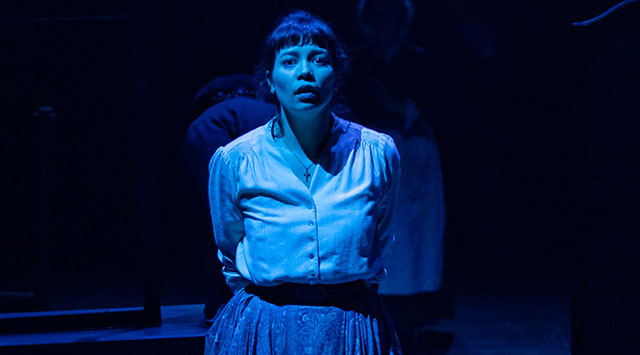
A remarkable warmth emanates from the cast; they seem to be saying that this tale is for all of us, and that we are in this together. Catherine Văn-Davies is powerful as Abigail, an urgent and compelling presence whose sense of precision, keeps us attentive to all the valuable dimensions of what we discover to be a surprisingly complex exercise. Văn-Davies brings an authentic earthiness that anchors the production in a place that feels universal and meaningful, even when its flights of fancy take us far away from reality. It is often a deeply moving performance, one that tethers us to humanity, of the self and of others.

Guy Simon is unforgettable in his various roles, but as Johnny Whites, his controlled delivery of an Indigenous man whose daughters have been stolen by the crown, is utterly devastating. Heather Mitchell is a sheer delight as two vastly different matriarchs, both wonderfully comical, yet profound with what they convey. The precocious Beatie is played by Sofia Nolan, with excellent timing and a formidable exuberance. The show requires of its actors, a high level of technical proficiency, but they are unrelenting with the heart and soul of the piece, and as a result, the audience cannot help but be thoroughly affected.

We need to know our origins, in order that our destinations can be properly mapped out. We have for the longest time, misunderstood our past, and therefore so many have to suffer painful consequences. This is a task that has no room for delusions. We can no longer pretend to be wholly benevolent. People need to own up to their mistakes, make reparations, and correct our pathways. Travelling back in time to face the demons is hard, but for the brave, it is the only way forward.

www.sydneytheatre.com.au

Review: Young Frankenstein (Hayes Theatre)

Venue: Hayes Theatre Co (Potts Point NSW), Feb 18 – Mar 20, 2021
Book: Mel Brooks, Thomas Meehan
Music & Lyrics: Mel Brooks
Director: Alexander Berlage
Cast: Matthew Backer, Olivia Charalambous, Shannon Dooley, Nick Eynaud, Ben Gerrard, Amy Hack, Luke Leong-Tay, Lucia Mastrantone
Images by Daniel Boud

Theatre review
American neurosurgeon Dr. Frederick Frankenstein has to make a trip to Transylvania, in order that he may secure the inheritance of a vast estate, upon the untimely death of his infamous nature-meddling grandfather. Mel Brooks’ 2007 musical version of Young Frankenstein, came to Broadway 33 years after the success of his 1974 film. What was originally a spoof of classic horror cinema, is now turned into a parody of Brooks’ own comedy oeuvre. It is arguable how well his body of work has stood the test of time, but as this new iteration of the musical at Hayes Theatre demonstrates, Mel Brooks’ writing contains indubitable genius, and with the right approach and attitude, a brilliant masterpiece can be unveiled.

Directed by Alexander Berlage (winner of 2018 and 2019 gongs for Best Direction of a Musical at the Sydney Theatre Awards), Young Frankenstein is post-modern, high-camp theatrical amusement at its best. Berlage takes radical liberties with the text, stridently ensuring that every moment of the show delivers something disarmingly witty, or at the very least kooky and fascinating. What results is a fast-paced production that feels constantly buoyed by humour, shimmering with inventiveness. Central to Berlage’s method, is an unyielding allegiance to principles of queerness, that locates for the intrinsic irony of Brooks’ universe, an amplified sense of flamboyant absurdity. Although not exactly the wildest of rides, the show is perhaps better suited to the open-minded.

The staging looks exquisite, even though many jokes are made about budgetary constraints met by Australian independent theatre. Isabel Hudson’s set is comprised of staircases that go nowhere, and doorways of unusual proportions, splendidly converting M.C. Escher’s legendary drawings into physical reality. In turn, these unusual architectural structures make for fantastical contortions, in how human figures traverse the space, for laughs as well as for sheer eccentricity. Costumes by Mason Brown combine the traditional with the subversive, making Savile Row meet Leigh Bowery, for an aesthetic that feels unexpectedly cohesive, and a true visual delight. Trent Suidgeest’s lighting design too is an absolute joy. Oscillating between vibrant clashes of primary colours, and a green monochrome that pays tribute to the black and white of the 1974 film and of the ones from early last century to which Brooks refers, Suidgeest provides a deeply satisfying sense of stylistic dynamism that is both relentless and surprising.

Leading man Matthew Backer’s appearance may be nothing like Gene Wilder’s, but fears of an inferior depiction of Dr. Frederick Frankenstein are laid to rest from the very first scene. The performer is meticulous yet instinctual, thoughtful but rambunctious, with mesmeric eyes that seize our attention, as they reveal all we need to know about the story, and the wider cultural implications of what we are witnessing. Also noteworthy is his reliably marvellous singing voice, a proverbial cherry on top that has us endlessly spoilt.

Shannon Dooley plays Elizabeth with wonderful idiosyncrasy, an admirably brassy presence whose scintillating confidence seems to know no bounds. The problematic German “dumb blonde” character Inga is given a clever twist. By casting male performer Ben Gerrard in the role, its offensive quality is dampened, and Gerrard’s respectfully controlled drag interpretation proves that intelligent, innovative thinking can solve many artistic conundrums, even those related to sacred, often archaic, legacies. Performers in Young Frankenstein are, without exception, accomplished and appealing. Luke Leong-Tay’s Igor and Lucia Mastrantone’s Frau Blucher are both effervescent and irresistibly mischievous. Nick Eynaud’s irreverent take on The Monster further emphasises the audacious flaunting of queerness, for a show that seems to have much more interesting things to say, than what Brooks had ever intended.

It is likely true, that many of us have reached a point of exhaustion, after a year of the pandemic, and half a decade of Trumpism and tumult from the far-right. If the Americans’ embrace of the silly 1974 Young Frankenstein film, was a reflection of their disillusionment and fatigue, from their participation in the war in Vietnam, then this new musical rendition arrives just in time to fulfil our need for something thoroughly and unapologetically frivolous. It is not always a good time for levity; the world has serious things to sort out, and art is sometimes all we have. For now, however, the brain deserves a rest, and the soul needs nothing more than a good hard laugh.

www.hayestheatre.com.au

Review: Symphonie Fantastique (Little Eggs Collective)

Venue: Kings Cross Theatre (Kings Cross NSW), Feb 17 – 27, 2021
Director: Mathew Lee
Cast: Lloyd Allison-Young, Alex Beauman, Cassie Hamilton, Clare Hennessy, Annie Stafford, Nicole Pingon, Chemon Theys, LJ Wilson
Images by Patrick Boland, Julia Robertson

Theatre review
In 1830, French composer Hector Berlioz created Fantastical Symphony: Episode in the Life of an Artist… in Five Sections, a work from the Romantic period that is now considered seminal in what is known to be the Program music genre. The piece involves obsessive love and morbid fantasies, which the Little Eggs Collective, under the direction of Mathew Lee, extracts to use as central themes in their 45-minute theatrical presentation, named Symphonie Fantastique after the original French. Examined through contemporary eyes, Berlioz is less romantic, and a lot more rapey.

Transformed into a genderless protagonist, the reimagined maestro is frustrated, cowardly, out of control. Grandiose and insufferable, their story is reminiscent of Fellini’s , in which we see an artistic genius trapped inside their own paranoia-filled process, filtering everything they encounter into a self-serving narrative, as though the world has been created in their own image. The play Symphonie Fantastique is virtually wordless, with deconstructed interpretations of Berlioz’s music (by Oliver Shermacher’s inventive and inspired musical direction) forming a foundation, on which the show is built.

The ensemble of eight are called on to dance, act, sing and even to play musical instruments, for a multidisciplinary exploration of the performing arts, that audiences will find captivating, at least on sensorial levels. Director Lee has a tendency to be overly literal with his storytelling, but the unfettered impulse to surprise, makes for an enjoyable experience. Performer LJ Wilson offers a strong portrayal of the lead character; not always detailed with emotions being conveyed, but certainly a magnetic presence. As a team, the eight are tightly rehearsed, and extraordinarily cohesive with the constantly undulating energies they bring to the stage.

Visual concepts are ambitiously concocted, and manufactured, for this Symphonie Fantastique. Costumes, hair and makeup by Aleisa Jelbart are marvellously assembled, with an impressive eye for sophistication and finish. Lighting and set designer Benjamin Brockman’s combination of mirrored surfaces and bold colours, insist on firing up our synapses, for unforgettably transcendent moments that are nothing less than electric.

There is a considerable amount of gender bending in this iteration of Symphonie Fantastique, and if the dissolution of gender parameters is essential in approaching, or perhaps advancing, a feminist theatre, then this production is on the right path. There are conundrums, of course, as is the case whenever we attempt to address problems of a sexual nature, whilst working simultaneously to dismantle old frames of thought. We want to bring justice to victims, yet we wish to deny hierarchical power structures their persistence. Feminism is the key to a future where no one is powerless, but it also presents the greatest challenge, for us to understand our world, without tops and bottoms.

www.littleeggscollective.com

Review: The Pass (Seymour Centre)

Venue: Seymour Centre (Chippendale NSW), Feb 11 – Mar 6, 2021
Playwright: John Donnelly
Director: Ed Wightman
Cast: Ben Chapple, Deng Deng, Cassie Howarth, Tom Rodgers
Images by Becky Matthews

Theatre review
Jason is an English superstar on the football field. Spectacularly talented, and with an unquestionable dedication to his sport, but the fame and fortune bestowed upon him, as is the case with many in his position, are completely beyond reason. In John Donnelly’s The Pass, Jason’s excesses come at a high price, one that is disproportionate to the actual activity that he is ostensibly being rewarded for. The story is ultimately about human dignity, and how individuals in these modern times, can so easily and unknowingly, find their souls peddled off to the highest bidder.

We understand that to make a living requires a certain amount of sacrifice, that for the vast majority, trading labour and skill are the only ways to secure money for paying off bills. As part of that exchange, we think it reasonable to concede to things like codes of behaviour and of clothing, or to concepts pertaining to company and professional culture. It is a persistent commodification of our minutes and days, that slowly erodes away idiosyncrasies and sometimes humanity, in service of an economic system with dubious priorities.

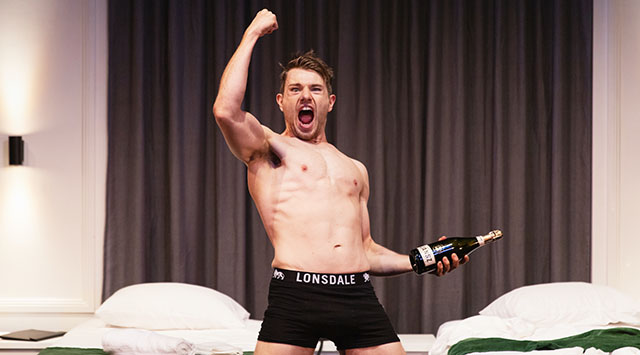
In The Pass, it is Jason’s sexuality that suffers the worst, in a process of dehumanisation that accompanies what he perceives to be the pursuit of success. As he becomes increasingly well-known, the need escalates, to sublimate everything personal that might contradict the longstanding image of an idolised footballer. To play the part of an invulnerable straight white male, he pushes away his sexual attraction to men, gives up on his relationship with his Black best friend, and hides in hotel rooms drowning his sorrows in drugs and alcohol. To be a lean mean money-making machine, Jason constantly finds himself at breaking points, unable to retreat or reform, only knowing to endure the anguish that he clearly thinks to be justified.

Donnelly’s writing is a strong, powerfully observed piece on what may be termed advanced capitalism, and its devastating effects on a person’s nature. The protagonist’s fear of his own homosexuality is juxtaposed against conventional parameters of success, to offer a meaningful perspective into one of the ways money can turn into a destructive force, in each of our lives. This theatrical cautionary tale is directed effectively by Ed Wightman, who brings purposeful attention to central themes of The Pass; whiteness, heteronormativity and misogyny, all of which are usually invisible, due to their insidiously mundane prevalence.

Set design by Hamish Elliot delivers a series of convincingly swish hotel rooms, in a resolutely cool palette that communicates the detachedness with which Jason regards his existence. Matt Cox’s lights help us navigate a variety of moods, as we watch Jason go through a gamut of volatile emotional states. Gay pop star Ricky Martin’s 1998 hit She Bangs, now resonant for its connotations of closeted sexuality, is featured throughout, in a sound design by Daryl Wallace.

Leading man Ben Chapple gives a rhapsodic performance as the very lost Jason, with an enjoyable intensity that makes him a compelling watch. The actor’s robust energy is memorable, but a greater exploration into nuances would allow audiences a richer appreciation of the text. Cassie Howarth is gloriously sassy and remarkably intricate in her portrayal of Lyndsey, adult entertainer with a heart of gold, who brings valuable depth to a production that can sometimes, gloss over less dramatic but nonetheless important portions of dialogue. Jason’s intimate confidante Ade is played by Deng Deng, a likeable and sensitive, if slightly too introspective performer. The very comical Tom Rodgers brings to life, the young hotel attendant Harry, raucous and genuinely funny, but whose poor execution of a transphobic joke, leaves a bad taste in the mouth.

In dealing with the downfall of a sporting hero, The Pass presents an opportunity to talk about ubiquitous power structures that benefit few, yet are upheld by virtually everyone. We can focus the story to talk about white supremacy and racism, misogyny and the patriarchy, homophobia and transphobia, ableism, poverty, etc., but that requires us to acknowledge that the way we rally around heroes, sporting or otherwise, is symptomatic of the problems we suffer. It seems to be a natural impulse for us to create gods out of humans, but once systems of hierarchies are manufactured, it is always easy to forget those at the bottom rungs. It is only logical to submit to the fact that any disadvantage is inherently abhorrent, but for us to give up our idols, is clearly not something we seem ever to be capable of. Even if the gods themselves, would be better off, taking a step down from their pedestals.

www.fixedfootproductions.com

Review: Green Park (Griffin Theatre Company)

Venue: Green Park (Darlinghurst NSW), Feb 5 – Mar 6, 2021
Playwright: Elias Jamieson Brown
Director: Declan Greene
Cast: Joseph Althouse, Steve Le Marquand
Images by Brett Boardman

Theatre review
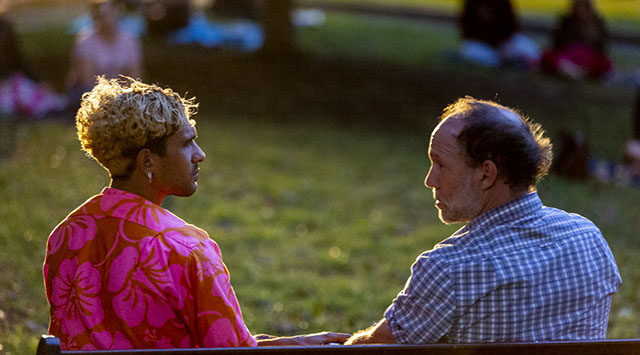
Two men meet in a park, after having connected on a hook up app. Edden is young, out and Black, and Warren is middle-aged, closeted and White. In Elias Jamieson Brown’s Green Park, it is the sexual dalliance that brings different worlds together. Juxtaposing the most intimate of human acts against the severe divisions of twenty-first century life, the two characters engage in a constant tug-of-war, as we meditate on hopes of camaraderie and unity. Sex is by nature a binding force, yet it is able to reveal so poignantly, the fractures that exist between individuals.

It is a passionate and deeply truthful piece of writing from Jamieson Brown. His tragically flawed personalities offer insight into the ills of the day, shedding light on what we lack as a society, including the unfinished business of what many may consider the fulfilled destiny of the twentieth-century gay movement. We can now marry people of our own sex, but as we see in Green Park, so much harm continues to be inflicted on those unable to adhere to the straight and narrow. There is a lot that is painful and profound in the work, but the clandestine quality of this illicit and salacious encounter, makes for a rivetingly enjoyable show.

Directed by Declan Greene, who places the action inside the actual Green Park of Darlinghurst, with all walls of a usual theatrical space removed, insisting that the audience sees not only the performers, but also the historically significant location that lends its name to the play. Unintended supporting actors surround the action, offering real life noise that make us look over our shoulders, as we sense the omnipresent threat of violence that queer people must live with, everyday of our lives. Greene imbues an uncanny realism that draws us in, for both the theatrical moment unfolding, and the palpable non-fiction concerns to which his work refers.

Actor Joseph Althouse is remarkably convincing as the erratic Edden, powerfully embodying the risky existence of a young lost soul. He introduces a resonant defiance to his nuanced depiction of a sexual masochist, confronting us with the disturbing notion of a Black man roaming the streets (and the internet), asking to be dominated, albeit in his own terms. Steve Le Marquand skillfully turns a sad cliché of a man into someone whose story proves to be surprisingly moving. It is a complicated range of emotions that the role requires, and Le Marquand’s deftness at bringing clear articulation to each of Warren’s interior states, is very impressive. Also laudable is the degree to which the pair is in sync with one another. They move through the show’s many tonal fluctuations in tight unison, always keeping in mutual rhythm, no matter how the narrative alters its trajectory.

It is noteworthy that performances are enhanced by the provision of headphones, that prevent us from losing any word of dialogue to the open air conditions. David Bergman’s sound design is effective in manufacturing a sense of the natural to accompany the outdoors context of the production, and equally potent when dialing up the theatrical, for sequences that involve greater sensory elevation.

Edden and Warren think all they want is some no-strings sex, but it is evident that to compartmentalise sexuality, to separate it from the rest of our lives, is not as simple as it may seem. We are made from sex, and we continue to live in cultures that are always partially, but fundamentally, defined by sex. It creates conventions, tells us what is acceptable and what is not; it upholds hierarchies, aggrandising certain people and oppressing others. Both men in Green Park suffer as a result of their libidinal impulses. They are punished by others, as well as by themselves, for something that occurs naturally between consenting adults. The play Green Park, like its namesake on which the Gay and Lesbian Holocaust Memorial stands, is a reminder that so much of what underpins our ways of lives, is dreadfully unkind. Hence, no matter which stripe of the rainbow one aligns with, complacency is not quite yet, a luxury any of us can afford.

www.griffintheatre.com.au

Review: Videotape (Montague Basement)

Venue: Kings Cross Theatre (Kings Cross NSW), Jan 29 – Feb 13, 2021
Playwright: Saro Lusty-Cavallari
Director: Saro Lusty-Cavallari
Cast: Laura Djanegara, Jake Fryer-Hornsby, Lucinda Howes
Images by Zaina Ahmed

Theatre review
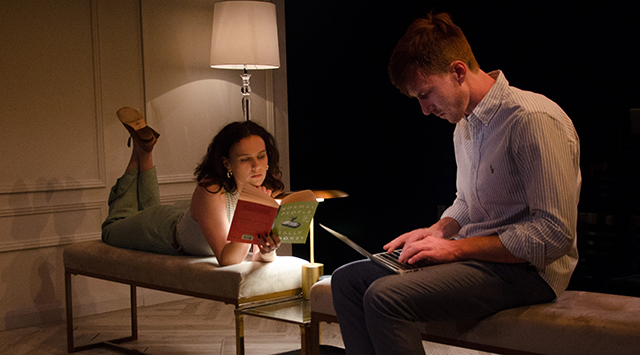
Juliette and David are a young couple, isolated in their Sydney apartment, in the middle of this pandemic. They live together because there is an unmitigated conventionality to their relationship, although we are never sure if there is any love between the two. Saro Lusty-Cavallari’s Videotape borrows its premise from David Lynch’s 1997 film Lost Highway, where a mysterious videotape is delivered, containing frightening visions that threaten to discombobulate a household. The pleasure in Lusty-Cavallari’s creation, lies in the unexpected amalgamation of comedy, drama and horror; although not perfectly harmonised, the mishmash of intonations does deliver something with an enjoyable quirky charm.

In Lynch’s deeply misogynistic original, the femme fatale comes in two guises, both of whom are helpless yet maligned. In Videotape, we wonder if Juliette stays with David because of the virus, or if she is a sucker for punishment. The work’s occasionally obtuse intimations provide a sense of texture to an otherwise uncomplicated plot, and although ambiguous in its intentions, allows the audience plentiful room for wide ranging interpretations.

Production design by Grace Deacon is noteworthy for its ability to convey wealth and polish, in a succinct manner. Lights by Sophie Pekbilimli too, help to tell the story in an economical way. Jake Fryer-Hornsby and Lucinda Howes are engrossing as lead performers, both evocative with what they bring to the stage. Laura Djanegara is effective in her smaller roles, offering a valuable hint of the surreal to the show.

We are stuck being humans, and in many ways, trapped in the past. The VHS tapes function as a device of excavation, opening wormholes that make us reach back, whilst materially positioned in the present. Videotape is both a new story, and an old one, not only with its intertextual obsessions, but also in its examinations of how history repeats. The cassette tape stands as an allegory, in our understanding of humanity, and in our experience of it. Rewinding it, fast forwarding, recording over, pause, play or stop, it is its finiteness that is truly chilling.

www.montaguebasement.com