5 Questions with Nyx Calder and Julia Robertson

Nyx Calder

Julia Robertson: In your experience, what was the best part about being a kid?
Nyx Calder: It was definitely the boundless curiosity and hunger for knowledge, I remember spending hours finding new words in dictionaries and looking up synonyms to broaden my vocabulary. I was so eager to learn how to read that I drove my parents half mad, they eventually taught me to read out of sheer frustration.

What’s a big similarity between you and Joe? What’s a major difference?
In terms of similarity, definitely the gentle and quiet nature. While I get pretty wild after getting comfortable with folks, I tend to be quite slow to develop connections, and I am inherently quite shy – I have a lot of social anxiety that I think Joe shares. Unlike Joe, I tend to wear my heart on my sleeve! I’m slow to develop connection, but I tend to overshare quite a fair bit and without knowing people very long, while Joe tends to keep his personal history under lock and key.

You’ve recently graduated from NIDA, how does it feel to surface from the depths of drama school and dive straight into a two person text?
It’s an absolute dream! While NIDA educated me in a great many ways, it also left me feeling very boxed in at times, especially towards the end of my stay. Being able to step into a rehearsal room as an actor and not a student is such a pleasure, and even more so to do it with a text as rich and expansive as Jess & Joe Forever. It’s also incredibly liberating to be working in such an intimate and direct form of theatre with such giving and wonderful folks.

What is something that has challenged you during the rehearsal process of Jess & Joe?
The voices! I underestimated just how many perspectives we see through this play in spite of the cast size, and when you start throwing dialects into the mix, it can all be quite overwhelming. Fortunately, everyone has been very patient and nurturing, and we’ve had wonderful input from our dialect coach, so it’s been entirely manageable.

What makes this story worth seeing, and why should audiences see this production in particular?  
I think this story speaks to something quite universal in the experience of puberty; the sense of loneliness and isolation felt during those vulnerable developmental years, and the yearning for companionship and acceptance. This play allows us to see a beautiful connection blossom between two kids who do not just survive their circumstances, but start to thrive and prosper alongside each other. Jess & Joe Forever is for those of us who, in our adolescent years, struggled to find ourselves in the world around us. This play speaks to that uncertainty in a tender, honest and loving way, and I believe audiences will be thrilled to join us on such a moving journey.

Julia Robertson

Nyx Calder: Given that we’re both twenty eight years old, what has your process been in finding your inner adolescent?
Julia Robertson: My inner adolescent is… disturbingly accessible? Julia means youthful after all! I spend a lot of time with teenage girls as a drama and singing teacher. Their complexities, empathy and curiosity are continually fascinating to me. Teenage me made a lot of mistakes, felt very alone but always wore a smile on her face. I like in this production that we are able to see the truths, whatever they may be, underneath the polite smile that has been forced upon young women for a very long time.

What’s the biggest difference, and the biggest similarity, between you and your character Jess?
I find differentiating myself from a character once I’ve gotten them under my skin quite difficult! But let’s try. Difference: in her younger years Jess is very feminine and proper. I was not. I was a “boy-girl” and pretty determined to be an entomologist when I grew up. When I began at an all girls school, I was suspended for punching someone in the face a week in. Jess takes a little longer to find her physical prowess! Similarity: Too many. She’s lovable and annoying. I hope/think that’s me. 

What’s your favourite rom-com of all time?
Goshhhhhh I honestly don’t know if I have one! I used to like How To Lose A Guy In Ten Days? Maybe? The hairless dog in it is good?

What sets Jess & Joe Forever apart from other plays and makes it a must-see?
Jess & Joe Forever is unique. It tenderly explores hardships that only a minority of us have ever or will ever experience. Jess and Joe are like and unlike any tweens you know and love. And that’s what makes this story so special. 

What even is a scotch egg, anyway?
A tiny, bald, white man in a kilt. Nah, jokes it’s some bacon-crusted egg thing? Sounds gross. Apparently it’s artisanal. 

Nyx Calder and Julia Robertson can be seen in Jess & Joe Forever by Zoe Cooper.
Dates: 13 – 30 Mar, 2019
Venue: Belvoir St Theatre
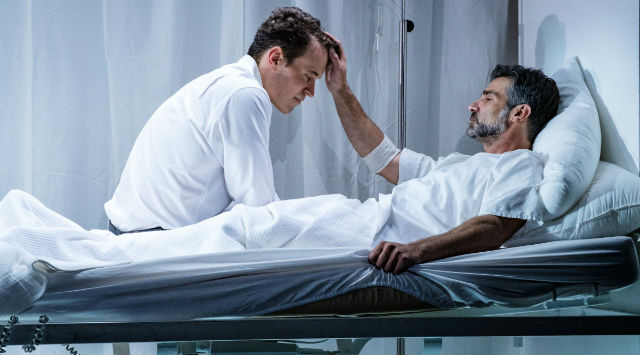
Review: Angels In America (Apocalypse Theatre Company)

Venue: Old Fitzroy Theatre (Woolloomooloo NSW), Feb 15 – Mar 16, 2019
Playwright: Tony Kushner
Director: Dino Dimitriadis
Cast: Joseph Althouse, Catherine Davies, Maggie Dence, Ben Gerrard, Jude Gibson, Ashley Lyons, Gus Murray, Timothy Wardell
Images by Robert Catto

Theatre review
At the centre of Tony Kushner’s Angels In America, are the breakdown of two relationships, from two different worlds. We might like to term those seemingly separate existences the left and the right, as we are want to do in so much of our political conversations. In the middle of catastrophe however, when the devastation of human frailty becomes palpable, categories dissipate as they prove increasingly impotent and therefore meaningless. Set in the middle of the 1980s AIDS crisis, Angels In America is an ode to desperation, that condition for which the face of humanity has to reveal its truest nature.

In their hopelessness, characters in the story are met with divine intervention. Ghosts, angels and other apparitions descend upon their consciousness, not always as a form of salvation or even reprieve, but as a refusal of the finitude to which we regard life, especially during sickness and disease. Kushner summons the vastness of our mental capacities; call it belief, imagination, or fantasy, to render a theatrical representation of being, that extends our conception of sentience to include metaphysical dimensions.

Not that our bodies are unimportant. In fact, in this deep interrogation of material versus immaterial, we are consumed more than ever, by our very corporeality. Flesh and blood are never far from the centre of our attention, functioning as literal concerns and as symbols, reiterating time and again, that we are immovably both vessel and soul. Heaven and earth are inextricably linked at the location where skin breathes, making us simultaneously, painfully so, sacred and profane.

This transcendental drama is communicated through director Dino Dimitriades’ pursuit of the sublime. The aesthetic world that he manufactures as vehicle for Kushner’s words, is heavy yet delicate, a sentimental embrace of past sacrifices, and a benediction that regards our future, as LGBTQI communities, with caution. At over seven hours long, it is probably inevitable that the journey would feel uneven, with certain portions coming across less powerful than others. It is a massive undertaking, and the considerable confidence with which the epic is approached, sets our expectations very high, and we struggle to overlook moments win which our awe is allowed to falter.

Jeremy Allen’s set design is carefully proportioned and elegantly conceived, but the minimalism of its style is unforgiving of construction imperfections. The colour palette of costumes is thoughtfully calibrated by Maya Keys, who perhaps exercises too much restraint in her visual representation of personalities and their physicality. Lights by Benjamin Brockman are memorable for their dark sensuality, moving us between spaces of despair with an artistic finesse reminiscent of Rembrandt and Caravaggio. Ben Pierpoint is tasked the impossible challenge of providing original music for the endurance piece, understandably deficient in its thoroughness, but sensational at each key juncture of the plot.

The show boasts some extraordinary acting by its indefatigable cast. Mormon wife Harper is played with luxuriant and interminable nuance by Catherine Davies, whose disarming authenticity brings invaluable poignancy to the entire operation. Her husband Joe is interpreted with unexpected tenderness by Gus Murray, tremendously convincing in the complex duplicity that he is charged to portray. The dynamic Ben Gerrard offers up a depiction of a dying man at all his extremes. As Prior, he is more provocative than he is moving, successful at engaging our minds for an intellectual understanding of the story. Ashley Lyons plays another AIDS patient Roy, admirable for the energy and colour that he brings to the stage.

As Belize and Mr. Lies, Joseph Althouse is a scintillating presence, with a marvellous, precise use of voice and gesture that gently steals all of his scenes. Timothy Wardell goes on an emotional roller coaster, able to convey Louis’ passions with aplomb but insufficiently lucid with the role’s philosophical attributes. The Angel is given the Maggie Dence treatment and proves quite the phenomenon, appropriately strong and otherworldly. Jude Gibson impresses in a variety of roles, particularly memorable as Mormon mother Hannah and as Dr. Henry, intricate and humorous with everything she presents.

When we reach for the esoteric, it is a greater truth that we seek, but being mortal, we can only understand its messages within our ultimately insurmountable limits. What we receive will always bear a reflection of ourselves, no matter how much bigger a version we can perceive. Angels In America suggests however, that we can move beyond good and bad, right and wrong, past and present. We are encouraged, through this spiritual fable, to think and act radically, to turn boundaries into starting points, for where we know things to end, is but the beginning of mystery. Much as we are essentially flawed and addicted to destruction, it is in our nature to imagine a higher power, and be able to conjure a notion of purity. The choice whether to follow that celestial magnificence, determines how we paint the destiny of each breath, in all our days.

www.apocalypsetheatrecompany.com