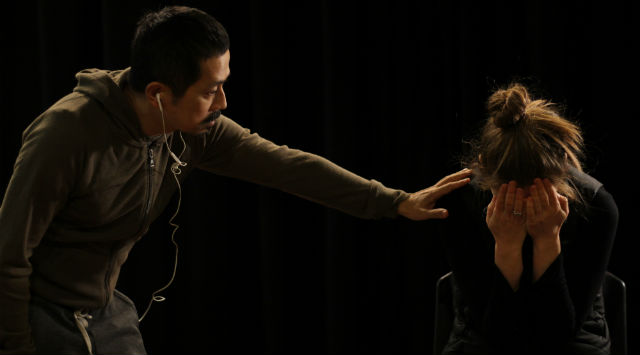
Review: Do Something Else (The Old 505 Theatre)

old505Venue: The Old 505 Theatre (Newtown NSW), Oct 4 – 22, 2016
Devisor / Director: Michael Pigott
Devisors / Cast: Cloé Fournier, Ryuichi Fujimura, Brigid Vidler
Image by Michael Pigott

Theatre review
Meaning can be derived from anything, because being human requires that we make sense of the things we come in contact with, even if their inherent characteristics are not readily intelligible. In Michael Pigott’s Do Something Else, the deliberate absence of a narrative relocates the audience from a position of passivity to one of mental vigour. The work provides visual and aural cues that seem to be, on a superficial level, incoherent, trusting that our response is a creative one that will formulate personally resonant symbols and messages.

It is an elegant work, but also surprising and challenging, with a confidence that allows its abstract approach to communicate with authority. Pigott’s work on sound and lights creates a hypnotically gripping atmosphere, balanced by the dynamic physical expressions he introduces to the piece. The three performers have distinct and strong presences that connect with us effortlessly. Cloé Fournier and Ryuichi Fujimura are memorable for their idiosyncratic and nuanced movement styles, while Brigid Vidler captivates with her incisive delivery of text. Fascinating words are also provided by Diana Shahinyan and Ari Mattes whose prerecorded voices guide us with scholarly ideas to reach an increasingly precise interpretation of the work.

A key concern of Do Something Else pertains to a neurosis that emerges with the rise of the metropolis. We can choose to see that city life drives us crazy, or we can adopt an alternate view that the innate insanity of life has proven to be untameable by a culture of industrialism. Our chaos simply takes on a different form. It is naive to think that nature is independent of technology, and falling into nostalgic fantasies for an imagined world of primitive perfection is futile, and erroneous. Technophobia however, is an interesting and helpful concept that can help us in discussions about ecology and environmentalism. It also encourages a healthy cynicism of progress that interrogates our priorities, and questions our values. Our societies run on a momentum that thinks that big is better, and more is good. Civilisations must move forward, but the choices we make within that propulsive trajectory must never be left unexamined.


www.old505theatre.com

5 Questions with Matilda Ridgway and Eloise Snape

Matilda Ridgway

Matilda Ridgway

Eloise Snape: If you could compare your character in The Bitter Tears Of Petra Von Kant, Marlene, to other wonderful women, fictional or non fictional, who would they be?
Matilda Ridgway: Mary Gaitskill’s characters in Bad Behaviour, Lee Holloway from Secretary, O from The Story of O, Lucia Atherton from The Night Porter.

Whats the most challenging thing about this play for you?
Not speaking is challenging. Subservience is challenging. Understanding Marlene’s relationship to these choices. How it affects her and her relationship.

If you had to be locked in a small confined space for 24 hours with one of the characters in the play (apart from Petra), who would you choose and why?
There is nobody apart from Petra.

Hypothetical. Would you rather have twigs for fingers or cheese toes? A hard cheese like a pecorino.
Hard cheese toes rather than twig fingers. I need my fingers for touching fruits and jellies and pink bits and babies. Twigs would pierce these soft things or break off into a million things.

If you bumped into Donald Trump and his hair in the street, what would you say to him? In one sentence only.
You’re fired!

Eloise Snape

Eloise Snape

Matilda Ridgway: Hypothetical: would you rather have feet made of cottage cheese or have super magnetic hands?
Eloise Snape: Definitely super magnetic hands. Imagine all the stuff you could steal.

Can you tell people about when we first met?
Tilly and I met in high school at SCEGGS Darlinghurst. We did a production of Secret Bridesmaids Business together with a bunch of legends. Then I watched her in all the plays at Sydney Grammar and got super jealous.

Please play fuck, marry, kill with our cast and crew who do you choose and why?
Ok – entering dangerous territory. Can I pick the same person for all three? I say Alistair Wallace because I’ve known him for years and I don’t think he would bat an eyelid if I fucked him, married him and then killed him.

What is one thing you admire about your character Sidonie and one thing that makes you feel uncomfortable?
Sidonie is proud, intelligent, sticks to her guns and wears fluffy things. That’s cool. But her entire value system and approach to life makes me totally uncomfortable. And wearing high heels all the time is pushing the comfort zone.

If you could be one character in the play who would you be in real life?
Oooh defs Gaby I reckon. I wouldn’t mind being 14 again and figuring all that stuff out. Also she’s a designer’s daughter – there are major pros to that. Also cons but you have to see the play to know what they are.

Matilda Ridgway and Eloise Snape are appearing in The Bitter Tears Of Petra Von Kant by Rainer Werner Fassbinder.
Dates: 11 October – 12 November, 2016
Venue: Old Fitz Theatre

Review: Antigone (Sport For Jove Theatre)

sportforjoveVenue: Seymour Centre (Chippendale NSW), Oct 6 – 22, 2016
Playwright: Sophocles (adapted by Damien Ryan)
Directors: Terry Karabelas, Damien Ryan
Cast: Andrea Demetriades, Anna Volska, Deborah Galanos, Elijah Williams, Fiona Press, Janine Watson, Joseph Del Re, Louisa Mignone, Marie Kamara, Thomas Royce-Hampton, William Zappa
Image by Marnya Rothe

Theatre review
In Damien Ryan’s adaptation of Antigone, a single word ‘terrorism’ leads the charge in transforming the ancient text into a story for our times. Language and its accompanying sensibilities are disarmingly modern in the suddenly new play, and we are compelled to engage with its ideas in a thoroughly contemporary manner. It makes us think about the inconvenient evolution of democracy in the age of social media, and the frightening consequences of vacuous personalities running for office. We confront the demonisation and scapegoating of people who have been turned into the public enemy du jour, and examine the eternal dilemma of making sacrifices for the greater good. Almost like a time capsule of culture as it stands, with many of today’s concerns contained in a tale from ages past.

The production encourages our minds to build associations between the unfolding story with our immediate realities, delivering resonances that can feel disparate and divergent, but direction of the work (by Ryan and Terry Karabelas) maintains a dramatic focus with its emphasis on characters and atmosphere. The use of percussive instruments provide tremendous manipulation to mood, and to meaning; Thomas Royce-Hampton’s ability to create just the right sounds at every crucial moment of tension is one of the show’s strokes of genius. The chorus is effectively utilised to steer our moral compasses, along with our emotions, for a theatrical experience that captivates our senses and intellect. It must be noted that there is an elegance and often very delightful approach to the chorus’ stylistic work that brings surprising texture to the show. Visual design is beautifully considered and confidently executed, with Matt Cox’s lights and Melanie Liertz’s set, impressive from the very start.

It is an appealing cast, fortified by excellent chemistry and timing, exuberantly alive for the entire duration. Andrea Demetriades is an earthy Antigone, restrained and almost minimalist in performance style, but consistently believable. More could be made of her crises, that will allow the actor greater space to showcase her abilities, and for us to feel closer to the plight of Thebes’ people. Courage, determination and strength of will are Antigone’s dominant qualities, but they are often left offstage. We witness the aftermath of her heroic deeds, but not the very moments of bravery that are central to how we know her to be. When Antigone defies the demands of community and the state’s decree, she is moved by conscience and love. Through her actions, we arrive at an absolute truth, discovering something fundamental to human experience. She urges us to persist with what we know to be right, and her tender age teaches us to be suspicious of grown-up notions of shades of grey. How a person chooses to live in the real world, becomes that person’s own reality. Antigone is dead at 15, but her life held only pure and good.

www.sportforjove.com.au

Review: Marat/Sade (New Theatre)

newtheatreVenue: New Theatre (Newtown NSW), Oct 5 – Nov 5, 2016
Playwright: Peter Weiss (translated by Geoffrey Skelton and Adrian Mitchell)
Director: Barry French
Cast: Tom Aldous, Kaiya Bartholomew, Andrea Blight, Debra Bryan, Lyn Collingwood, Garreth Cruikshank, Tahlia Hoffman Hayes, Tim De Sousa, Gregory Dias, Patrick Howard, Isaro Kayitesi, Mark Langham, Leilani Loau, Jim McCrudden, Lynn Roise, Emmanuel Said, Irene Sarrinikolaou, Alia Seror-O’Neill, Liam Smith, Peter Talmacs, Annette van Roden, Jacque Vickers
Image by Bob Seary

Theatre review
Originally conceived as a work set inside a psychiatric hospital, director Barry French’s version moves the action to a modern day asylum centre, with characters transposed from the mentally ill to asylum seekers who have gone mad from incarceration. A lot of the production makes good sense, with the play’s concerns and motivations proving to stand the test of time, but the text remains a difficult one half a century after its 1964 premiere.

Fragmented and purposefully incoherent, Marat/Sade is a fiercely anti-capitalist work that challenges how we think of society and art, and was never meant to be an easy one to stomach. It relies on the creation of spectacle and a sense of presence unique to the experience of live theatre, to keep the audience intrigued and captivated. French does well at manufacturing a dynamic stage with powerful imagery, featuring excellent design work by Tom Bannerman (set), Spiros Hristias (lights) and Nicola Block (costumes). Further, the incorporation of a very large cast comprising over 20 actors provides a sumptuous visual majesty, but the calibre of performers are highly inconsistent.

Our attention fades in and out, depending on the quality of acting being showcased, and the general sense of visceral energy stirred by the writing’s violent insanity, is only occasionally authentic and seldom severe enough to fascinate or convince. There are however, memorable personalities in the show, including Jim McCrudden as the Herald who demonstrates exceptional flair and nuance in his charming theatrics, as well as Debra Bryan and Leilani Loau whose committed portrayals of tragic hysteria, deliver some of the play’s richer characterisations.

Also noteworthy is Nate Edmondson’s original music, thoroughly creative, with a welcome exuberance adding texture and depth to the staging. Performed to a backing track, we are struck by the beauty of the score’s arrangement, and are left hankering for an opportunity to hear the songs sung completely live in tandem with musicians.

On the surface, Marat/Sade urges the downtrodden to rise up for a revolution, but what it really does, is facilitate discussion on social injustices that have to be rectified. The play talks about the French Revolution of 1808, but with the passage of time, ideas of radical action seem to have lost their lustre. Many of us at the theatre are the complacent middle class, and shows like this aim to help expand our consciousness to include the lives of those who suffer under our oppression, but doing more than providing lip service seems always to remain a challenge. Stories of asylum seekers who ask for our mercy continue to be told, but how we respond is presently inadequate, if all we can do is talk.

www.newtheatre.org.au

Review: Dream Lover (Sydney Lyric Theatre)

dreamloverVenue: Sydney Lyric Theatre (Sydney NSW), Sep 22 – Nov 27, 2016
Original concept and stage play: Frank Howson, John Michael Howson
Dramaturg/Script Consultant: Carolyn Burns
Director: Simon Phillips
Cast: David Campbell, Martin Crewes, Hannah Fredericksen, Bert LaBonte, Marney McQueen, Caroline O’Connor
Image by Brian Geach

Theatre review

In the musical Dream Lover, Bobby Darin is a nice guy with a career to be proud of. Undeniably talented, the Italian-American from New York’s Bronx county made it big in show business in the middle of the twentieth century, leaving behind an impressive catalogue of songs, but an uneventful life story. The show starts off slowly, with characters that take time to connect, and a doggedly polite plot that resists sensationalism, mindful of a need to honour the late star, thereby sacrificing opportunities for a greater sense of theatricality and humour. Our emotions are guided by the quietly simmering narrative, so even though all its musical numbers are strong, the viewing experience only becomes exuberant later in the piece when its dramatic stakes finally gain height.

The jukebox musical format is carefully and cleverly utilised here, with preexisting songs from Darin and his era, assembled and rearranged to form a surprisingly coherent and entertaining show. Set design is striking but inflexible, with an undiminishable glitz distracting from its many sombre scenes, although remarkably effective in its visual demarcation of space. The production boasts an outstanding cast, with quintessential showman David Campbell in the lead, overflowing with extraordinary charm and skill, stealing hearts in every melody. There are moments when Campbell seems restrained and overly cautious in his portrayal of a venerated hero, and occasional issues with sound balance can be disappointing, but his powerful presence, astonishing commitment and infectious passion, guarantee a spectacular night at the theatre. Also noteworthy are Martin Crewes as Darin’s manager Steve Blauner, and Hannah Fredericksen as Darin’s wife Sandra Dee, both captivating personalities who provide solid support with unequivocal artistic brilliance.

Bobby Darin is from a time when we knew to celebrate dignity. There is no dirt in Dream Lover, which will take many of today’s audiences by surprise. Scandalous biographies are where the money is; in entertainment today, whether reality TV, tell-all books or on any other conceivable digital configuration, we consume crudeness as a matter of habit. It is troubling that the kind of career that Darin had enjoyed, could cease to be valued and appreciated in this new economy of vulgarity and gossip on steroids, where music is routinely sold in a package along with celebrity humiliation. Dream Lover may be about the past, but its ability to remind us of better days offers a nostalgic glimmer of hope. It inspires a longing for something purer, and on days like these, it could be the best that we can cling to.

wwww.dreamlover.com.au