Review: The Beauty Queen Of Leenane (Sydney Theatre Company)

Venue: Roslyn Packer Theatre at Walsh Bay (Sydney NSW), Nov 18 – Dec 21, 2019
Playwright: Martin McDonagh
Director: Paige Rattray
Cast: Noni Hazlehurst, Hamish Michael, Shiv Palekar, Yael Stone
Images by Brett Boardman

Theatre review
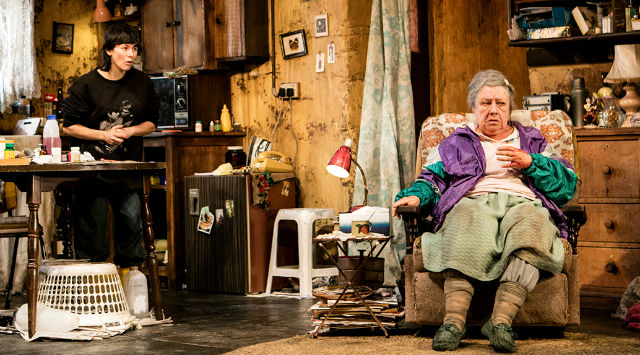
Maureen is full of resentment, because she has to live at home to care for her incapacitated and very demanding mother Mag. After a passionate night with Pato however, Maureen starts to think of a brighter future, and in Martin McDonagh’s The Beauty Queen Of Leenane, we wonder how much of destiny is indeed predetermined, as our protagonist navigates what appears to be a new shift in luck.

The play is savage in its depictions of hard lives. Maureen and Mag are Irish women of the lower classes, and fending for themselves is nigh on impossible, as made abundantly clear in this painful story, about the compounding disadvantage of living with disability and poverty, as well as the structural sexism that functions as a major component keeping them at the bottom of the pile. McDonagh’s comedy is of the darkest variety, becoming pitch black as we approach its end.

It is a magnificently accomplished production that director Paige Rattray has assembled. Humour and drama are balanced exquisitely against dread and revulsion, for an entirely mesmerising experience at the theatre. Production design by Renée Mulder offers sensational rendering of the Folan’s home, both inside and out, for a vision of unimaginable decrepitude, reminiscent of the stuff nightmares are made of. The Beauty Queen Of Leenane is a masterpiece in the style of the modern Gothic horror; although devoid of supernatural elements, its atmosphere is unmistakably ominous.

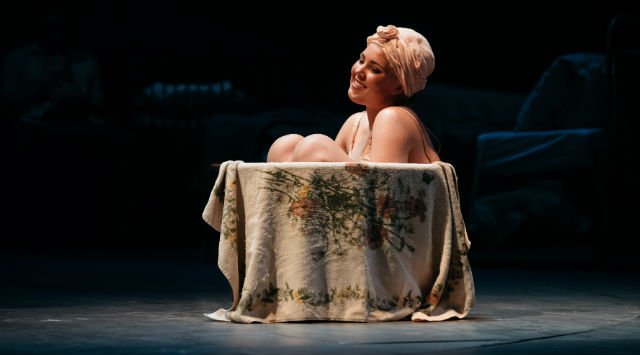
Stunning performances by all four actors have us absolutely riveted. Maureen is played by Yael Stone who dances on a knife’s edge, in an intoxicating portrayal of a woman at the end of her tether, having us on the edge of our seats, with the psychological thrill of witnessing someone on the brink of losing her mind. Our perception of mother Mag oscillates precariously between humour and terror, as the fantastic Noni Hazlehurst masterfully manipulates her role to offer us immense entertainment.

Shiv Palekar has us amazed with his exceptional comic timing, as the puerile and very laddish neighbour Ray, able to deliver huge laughs with every one of his precise and intuitively executed punchlines. Maureen’s object of affection Pato too is a funny character, made tender and surprisingly earnest by Hamish Michael, who brings valuable sentimentality to the often brutal narrative.

Maureen’s world is a horrible existence, one that she has been taught to never leave. Poverty keeps people in their place. It works as a form of indoctrination that hopes to make large numbers feel a sense of acceptance of their stations, so that they can remain exploited for generations, if not for eternity. The two women are stuck at home, languishing and never daring to move beyond the familiar. They will not be rescued, but the rules are there ready to be broken, if only they were to choose defiance.

www.sydneytheatre.com.au

Review: Avalanche: A Love Story (Sydney Theatre Company)

Venue: Roslyn Packer Theatre at Walsh Bay (Sydney NSW), Aug 29 – Sep 14, 2019
Playwright: Julia Leigh
Director: Anne-Louise Sarks
Cast: Maxine Peake (with Jethro Jensen, Amy Wahhab)
Images by The Other Richard

Theatre review
Humans have an inexhaustible capacity for obsession. As individuals, we see the world in infinitely different ways, and each of us has our own private passions that can easily be seen as meaningless or bizarre by others. What is of fundamental importance to one, can be interpreted as totally nonsensical by another, yet we all cling on to these idiosyncrasies, often letting them consume and define us.

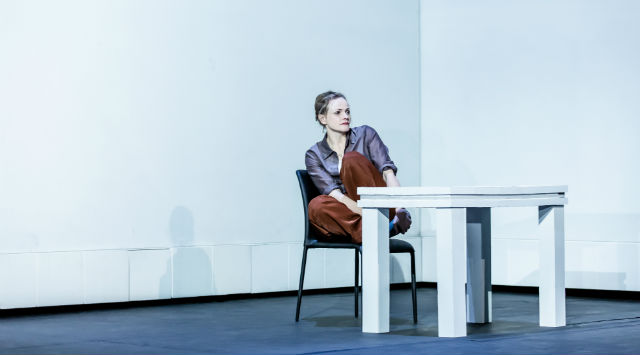
In the case of Julia Leigh’s Avalanche: A Love Story, an unnamed protagonist spends years absolutely absorbed by the notion of having to bear a child, and subjects herself to expensive and traumatising IVF treatments in hope of falling pregnant. She sacrifices relationships and a prestigious career in film making, to devote all her energies and resources, into the seemingly uncontrollable urge to have a baby. The play comprises scene after scene of one woman’s deep disappointments, and her inability to extricate herself from a suffering that only ever looks to be self-imposed. We watch in amazement, her persistence with this pipe dream, but certainly not all of us will be able to muster up the empathy that the playwright is intent on appealing to.

At best, the show is an honest and painful examination of experiences many have shared, but at its worst, Avalanche: A Love Story is a melodramatic and highly indulgent study of rich people’s problems, manifestly unaware of the way it opens itself to ridicule. The very skilful Anne-Louise Sarks brings, as director, an atmospheric intensity that almost has us forgetting, that the story requires our emotions invest in a kind of torment that can only befall the privileged.

There is no question that the production is adroitly assembled. Everything is considered, purposeful and remarkably polished, with not a hair out of place. Marg Horwell’s spectacular set design is unforgettable. Lizzie Powell’s lights and Stefan Gregory’s sounds are incredibly delicate in their rendering of a woman’s very genuine struggles. The contentious nature of this subject matter notwithstanding, the creative forces have no doubt accomplished a work of theatre replete with technical brilliance.

Maxine Peake too, is precise and inspired as performer of this 75 minute monologue. She holds our attention throughout, and convinces even the most sceptical, of the profound sorrow being expressed on stage. Her efforts are detailed and sensitive, always aiming to communicate at a level of uncompromising accuracy.

It is unlikely that Avalanche: A Love Story can preach beyond those already converted. The character’s anguish is undeniable, but the more that we delve into that narrative of grief, the more we question her choices. A woman can make any choice she so desires, but whether her need for sympathy as a result can ever be satisfied, is quite another matter.

www.sydneytheatre.com.au

Review: Lord Of The Flies (Sydney Theatre Company)

Venue: Roslyn Packer Theatre at Walsh Bay (Sydney NSW), Jul 23 – Aug 24, 2019
Playwright: William Golding (adapted by Nigel Williams)
Director: Kip Williams
Cast: Joseph Althouse, Justin Amankwah, Nyx Calder, Yerin Ha, Daniel Monks, Mark Paguio, Rahel Romahn, Eliza Scanlen, Contessa Treffone, Nikita Waldron, Mia Wasikowska
Images by Zan Wimberley

Theatre review
The boys are sent away from war, but their plane crashes and they land on an uninhabited island, having to fend for themselves, using instinct, along with their memories of civilisation. In Nigel Williams’ stage adaptation of William Golding’s Lord Of The Flies, the question of nature versus nurture once again comes to the fore. Jack is the unequivocal villain of the piece, a horrific specimen of mankind, hell-bent on causing death and destruction. His quick ascent to position of warlord tempts us to interpret the child’s evil tendencies as learned behaviour, although there is no denying the parts of ourselves that seem naturally drawn to causing harm.

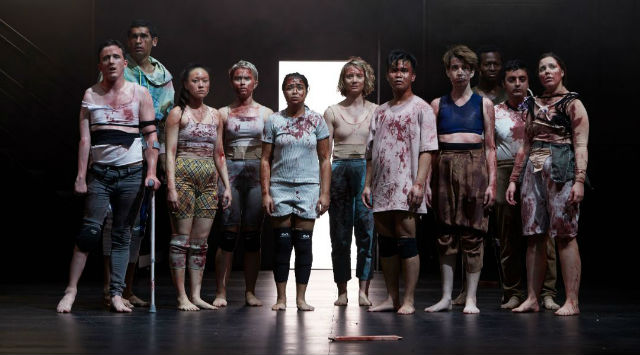
The pessimistic tale is given a modern staging by director Kip Williams, who brings new dimensions to Golding’s concerns of 1954. Where many had in the past regarded Lord Of The Flies as a work about being human, Williams’ vision allows us to interrogate the text from perspectives of culture and gender, that had been routinely neglected. The diversity of cast (but alas, not of creatives) inspires discussions about whiteness and masculinity, as we ponder on the meanings of women playing boys, and of people of colour playing the colonials. Indeed, the production rarely lets us look away from the Brechtian artifice of its presentation, always consciously involving itself with a stylised design aesthetic that never tries to fool us with attempts at naturalism. The experience becomes one of theatre as commentary, rather than art as representation.

Instead of manufacturing a landscape of delusive vegetation, set design by Elizabeth Gadsby exposes the stage’s bare bones, for a chilling Brutalist effect, that establishes from the outset an appetite for subversion. Intensive work on lights by Alexander Berlage may lack restraint, but is undoubtedly spectacular with its many bold manoeuvres. James Brown’s sound design guides us through the story’s legendary descent into savagery, particularly impressive when it operates in conjunction with actors at their most dramatic and vivid.

There are moments when stagecraft overwhelms, but the ensemble proves nonetheless to be engaging, with Daniel Monks especially memorable in the role of Roger. Vile, vicious and thrilling in his depiction of a boy’s darkest inclinations, Monks delivers moments that are quite genuinely terrifying, and enormously powerful in what he has to say about our capacity for cruelty. The purest one is played by Rahel Romahn, who gives us a Piggy that is completely adorable, and in his nuanced demonstration of what virtue looks and sounds like, the actor ensures that all the show’s arguments can only be won by the good side. As the democratically elected leader of the pack, Mia Wasikowska is a passionate Ralph, but the actor tends to be too subtle in approach for the vast and cacophonous stage. Much more persuasive is Contessa Treffone as the big bad Jack, made resonant by Treffone’s intricate mimicry of masculine voice and gesture, for a portrait of male toxicity at its most despicable.

It is easy to get lost in discussions about how the boys have turned out so awfully, but more worthwhile is to find ways we can improve, or indeed reverse, this dreadful state we are in. Whether a result of genetics or of social conditioning, the characters in Lord Of The Flies are broken, and while one can choose to take a fatalistic reading of the text, the show certainly encourages a more hopeful interpretation. Boys will be boys, if we accept the status quo. Racism will remain a component of our structures, if we persist with them. Golding suggests that an intrusion is necessary for the lost ones to be rescued, but to sit and wait, is no solution for those who proclaim to be young and free.

www.sydneytheatre.com.au

Review: Cat On A Hot Tin Roof (Sydney Theatre Company)

Venue: Roslyn Packer Theatre at Walsh Bay (Sydney NSW), Apr 29 – Jun 8, 2019
Playwright: Tennessee Williams
Director: Kip Williams
Cast: Addison Bourke, Tristan Bowes, Peter Carroll, Harry Greenwood, Emily Harriss, Jye McCallum, Josh McConville, Zahra Newman, Pamela Rabe, Holly Simon, Nikki Shiels, Lila Artemise Tapper, Arie Trajcevski, Hugo Weaving, Anthony Brandon Wong, Jerra Wright-Smith
Images by Daniel Boud

Theatre review
Characters in Tennesse Williams’ Cat On A Hot Tin Roof suffer immense anguish. Regardless of where they happen to reside in the hierarchy of their social order, powerful or powerless, Maggie, Brick and Big Daddy are each unable to escape a torturous existence. A result perhaps of the family’s wealth, or maybe the American deep south in 1950s had truly been indiscriminately stifling, or life is simply unbearable no matter one’s choices and orientations; the beauty of Williams’ play is that it explains little. In its exhaustive excavations of human emotion however, we identify the truths of our beings at their deepest, but Williams leaves us to draw our own conclusions, on the causes of, and the resolutions for, all the pain that inevitably befalls us.

There is a lot that is sublime in director Kip Williams’ vision. A momentary glimpse of sitting Vice President Mike Pence on Brick’s television set, is a powerful suggestion of the play’s timelessness. Oppressive aspects of Western values, rooted in white patriarchy, is the undercurrent disquiet that drives the action. The production manifests a sense of hopelessness appropriate to the playwright’s pessimism, one that is masochistically gratifying, as is typical of classic melodrama, but also undeniably thought-provoking.

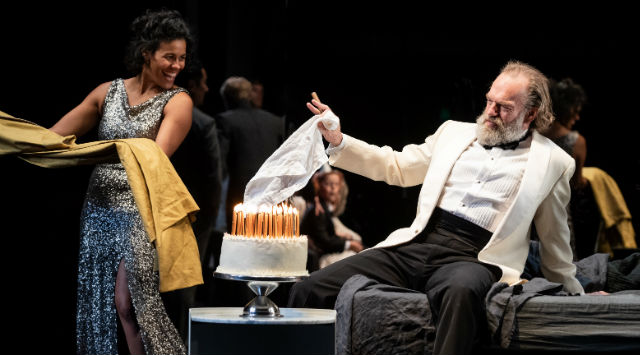
Brick and Maggie’s bedroom is sleek and modern in style, with dark colours and hard edges representing a masculine space in which Maggie’s lack of status is evident. Designed by David Fleischer, the stage is visually seductive, but arguably ineffectual with invisible doors, for a play that repeatedly involves itself with notions of intrusion. Stefan Gregory’s music takes its cues from film noir, nostalgically evocative and very pleasurable. Lights by Nick Schlieper are cold, almost menacing in their depiction of emotional torment. The many instances of fireworks in Act II are controversially manufactured, each time overwhelming our senses for several seconds, with their cacophonous, and repetitive, disruptions into Brick and Big Daddy’s long confrontation.

Actor Zahra Newman is entirely splendid as Maggie, dejected but determined, a broken woman hanging on to the little that she has, to turn a living hell into something coherent. Newman’s extraordinary instinct and artistic inventiveness, along with an uncompromising vigour, make Act I of Cat On A Hot Tin Roof a personal tour de force that has us hopelessly exhilarated. Big Daddy is masterfully performed by Hugo Weaving, who although brings to the role nothing that is unexpected, demonstrates his unparalleled stage presence and a searing conviction that absolutely captivates. The exaggerated theatricality he employs is riveting, with a psychological accuracy that allows us to perceive complicated dimensions of human nature, as we luxuriate in the sumptuousness of his delivery. Also very resonant, is Harry Greenwood as Brick, who overcomes his physical dissimilarity to the character, for a convincing portrayal of a defeated man who retreats into self-abuse. Greenwood’s approach is restrained by comparison, but he adds dynamism and texture to how the story is conveyed, on what is often a very loud stage.

Brick’s indulgence in alcoholism looks as though he is willing himself to die. Maggie on the other hand, who has much less to live for, can be seen maniacally scrambling for survival at every moment. Those are the extremes of how we can be, when facing the worst. The people in Cat On A Hot Tin Roof are all left to their own devices. Although under one roof, this is a family whose bonds are weak, with relationships built on mendacious foundations (the word “mendacity” is mentioned multiple times). Unable to locate anything honest and real, what they have can only feel empty; distracted by material riches, it is loneliness that is left unnoticed and festering. We see no love in this household, and realise that no peace or happiness could ever come their way.

www.sydneytheatre.com.au

Review: Mary Stuart (Sydney Theatre Company)

Venue: Roslyn Packer Theatre at Walsh Bay (Sydney NSW), Feb 5 – Mar 2, 2019
Playwright: Kate Mulvany (after Friedrich Schiller)
Director: Lee Lewis
Cast: Fayssal Bazzi, Caroline Brazier, Simon Burke, Peter Carroll, Tony Cogin, Andrew McFarlane, Rahel Romahn, Helen Thomson, Matthew Whittet, Darcey Wilson
Images by Brett Boardman

Theatre review
Queen Elizabeth I of England must finally decide whether to sign the death warrant of her cousin Mary, Queen of Scots, after 19 years’ imprisonment. In Kate Mulvany’s adaptation of Friedrich Schiller’s 1800 play Mary Stuart, we look at the final days of this historical feud, paying attention to political machinations, as well as the fascinating psychological processes that the two women would have had to go through, in what is clearly the most difficult and traumatising of human experiences. A highly intelligent work, Mulvany transposes the ancient story into a contemporary tale foregrounding themes that matter today, with renewed focus on the feminist implications of this conflict between powerful women.

Surprisingly funny, featuring witty dialogue that transcends the ages to connect with our everyday ears, Mulvany transforms the royals into flesh and blood individuals that we can easily relate to. With none of the pretension often associated with period pieces about European queens and kings, we are free to examine all the sublimated dynamics between Elizabeth and Mary, to come to our own conclusions about power structures, whether or not one chooses to share the playwright’s feminist lens. Mary Stuart is also effective in delivering drama, powerful in the way it conveys the palpable emotions of a woman compelled to put a loved one to death, and another who faces her own demise.

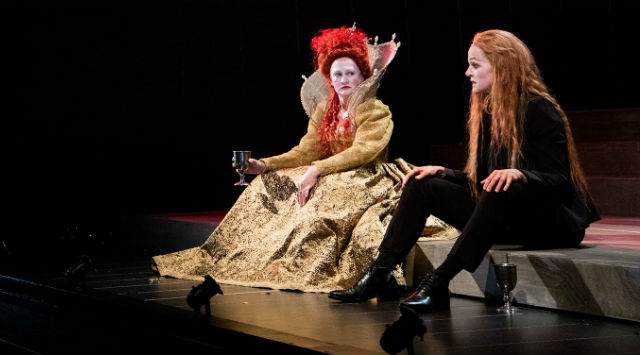
The vast auditorium is put to good use by Elizabeth Gadsby who situates the action in a suitably grand setting, palatial but austere. Lights by Paul Jackson are especially effective in the graver sections, to facilitate the sensation of mounting pressure as we move toward the inevitable. Music and sound can sometimes be too subdued, especially in the earlier more comedic scenes, but when things turn serious, Max Lyandvert is certainly on hand to heap on the tension. Costumes are a highlight, perhaps predictably, with Elizabeth’s opulent gowns really making an impact. Mel Page’s work on all the women’s looks are unequivocally remarkable.

Director Lee Lewis exercises a stylistic restraint over her stately presentation, determined not to let pomp and ceremony distract from its central concerns. Visuals can sometimes feel sparse and incommensurate with our imagination of both the queens’ worlds, but Lewis’ strength in elucidating rationale behind all manner of human behaviour, is sublime. Actor Helen Thomson is electrifying as Elizabeth, appropriately majestic and piercingly humorous, insisting that entertainment value accompanies all the intellectual stimulation that the play so doggedly provides. Thomson continually reveals layers to the queen throughout the two-hour duration, consistently unpredictable with her depictions, including moments of poignancy that are quite unexpected. Her rendering of Elizabeth as a real and authentic person, is an astounding achievement. Mary is played by Caroline Brazier, whose very deliberate portrayal of grace under pressure is as beguiling as it is intriguing. Her penultimate scene of exposure is truly arresting, as she performs an outpouring of intense and contradictory emotions that gives us a glimpse of the woman under the crown.

Women compete because our power is scarce. We are pit against one another, and we participate in these battles, rarely challenging these absurdly unjust systems and the beliefs that they perpetuate. American Professor Emerita of Sociology and Women’s Studies, Gail Dines suggests that empowerment is a false hope, for to place ourselves within patriarchal hierarchies necessitates the exploitation of many women. Liberation on the other hand, evokes a collectivism that prohibits oppression of any kind. The two queens in Mary Stuart were able to wield power of all kinds, but it is clear that their lives were never their own. Enslaved by their fathers, their states and their religions, we watch them at war, inside a living hell not of their own making, and wonder how much of our own lives are just the same.

www.sydneytheatre.com.au

Review: The Harp In The South (Sydney Theatre Company)

Venue: Roslyn Packer Theatre at Walsh Bay (Sydney NSW), Aug 16 – Oct 6, 2018
Playwright: Kate Mulvany (from novels by Ruth Park)
Director: Kip Williams
Cast: Joel Bishop, Luke Carroll, Tony Cogin, Jack Finsterer, Benedict Hardie, Emma Harvie, Anita Hegh, Ben O’Toole, Lucia Mastrantone, Heather Mitchell, Tara Morice, Rose Riley, Rahel Romahn, Jack Ruwald, Guy Simon, Bruce Spence, Helen Thomson, Contessa Treffone, George Zhao
Images by Daniel Boud

Theatre review
When Margaret Kilker met Hugh Darcy in 1920, life in rural Trafalgar was idyllic but inert. The couple, both Irish-Australian, young and hopeful, soon headed to Sydney for a brighter future, setting up home in Surry Hills, where they found community, and formed the foundations of a legacy never intended or even imagined.

The Harp In The South is a six-and-a-half hour epic, in two parts, by Kate Mulvany, based on two of Ruth Park’s novels from the 1940’s and another from 1985. Composed mainly of migrant perspectives as experienced by three generations of Irish women, the play offers contemporary audiences a version of our city’s recent history that feels counter-cultural, one that is derived not from contrivances of the establishment, but from stories told by the poor and disadvantaged. All the wonderful things we associate with this city, are built upon the fortitude of those who bear injustice and genuine hardship. Instead of hearing once again about the great white forefathers who take every credit, The Harp In The South restores the voices of forgotten individuals, and places them in the mythical centre of Sydney’s eminence.

Mulvany’s adaptation is exhilarating and witty, replete with irresistible drama, and brimming with inspiration. A palpable soulfulness informs her every manoeuvre, revealing a deep love of the subject and the material, that proves to be completely and profoundly affecting. Although concerned with a cultural specificity, Mulvany’s play contains a sensibility of inclusiveness, that understands the diverse realities of those to whom this story is relevant. The Kilker-Darcy household leads the action, but their truth can only resonate within a context of multiculturalism, and the accompanying portrayals of Indigenous, Chinese, Greek and Italian characters provide not only a degree of ethnological accuracy, they also make an important statement about the way we have, for a long time, sought to share space in harmony.

Director Kip Williams’ vision is exquisite, for a production extraordinary in what it achieves, not only in aesthetic terms, but even more valuable is its promise to galvanise society, through highly persuasive, and sentimental, depictions of our common past, involving all the complexities in our endeavours to be good families, friends and neighbours. Even though the events that unfold are from a different era, every scene rings true, with a familiarity that emanates from its absolute honesty. The Harp In The South is tremendously soulful, and it speaks to all who have an intimate connection with Surry Hills and its surrounds.

Flawlessly designed, the show looks and sounds magnificent. David Fleischer’s sets, Nick Schlieper’s lights and Renée Mulder’s costumes, form an impeccable collaboration delivering theatrical grandeur, with a pervasive and melancholic nostalgia best described as beautiful. Music by The Sweats and sound design by Nate Edmondson, combine new with old, real with abstract, seamlessly cajoling us from one dimension to another, making us laugh and cry at will. The songs we choose to sing, are the truest indication of who we are, and the many melodic renditions of The Harp In The South are like spiritual disclosures, engineered to touch us in the heart and in the mind.

A large cast of actors, play a very large number of characters, each one fabulously evocative, no matter how brief their appearance. Contessa Treffone, marvellous as both Josie and Dolour, is onstage for a substantial portion of this durational challenge, persistently impressive with her spirited and delightful comedy, and triumphant with the integral vulnerability she brings to the show. Margaret and Hugh are brought to life by Anita Hegh and Jack Finsterer, both reliably poignant, but also cuttingly humorous when appropriate. Heather Mitchell too is splendid, and thoroughly amusing, as the matriarch Eny Kilker.

Unforgettably funny, are Benedict Hardie and Rahel Romahn in all their innumerable guises, although Helen Thomson is a clear favourite, unequivocally outstanding with an incomparable volume of laughs, particularly wonderful as the bawdy brothel madam Delie Stock. Lesbian nuns Theopilus and Beatrix are a thrilling pair, performed playfully yet tenderly, by Lucia Mastrantone and Tara Morice, endearing as a sisterly set, and independently formidable in an astonishingly varied range of personalities.

We can proclaim to know ourselves, but art can often surprise with new epiphanies. There is no end to how humanity can understand itself, and it is imperative that we are committed to finding ever greater truths, if we should continue to believe in better tomorrows. We may not be direct descendants of the people in The Harp In The South, but they show us so exhaustively, who we are, as Sydneysiders, as Australians. The shoulders we stand on were not always solid, but all our strength today must be attributed to that past.

www.sydneytheatre.com.au

Review: Saint Joan (Sydney Theatre Company)

Venue: Roslyn Packer Theatre at Walsh Bay (Sydney NSW), Jun 5 – 30, 2018
Playwright: George Bernard Shaw (additional text by Emme Hoy, Imara Savage)
Director: Imara Savage
Cast: Gareth Davies, John Gaden, Brandon McClelland, Sean O’Shea, Socratis Otto, Sarah Snook, Anthony Taufa, David Whitney, William Zappa
Images by Brett Boardman

Theatre review
Joan of Arc never even made it to her twenties. Executed at the age of nineteen, her story represents the worst of our misogyny, and in director Imara Savage’s version of George Bernard Shaw’s play, that absurd fear of powerful women is given elucidation, as we see state and religion go to great lengths to exterminate Joan, so that the threat that she poses to the patriarchy is banished. In Saint Joan, instead of the usual veneration and idolatry, a war hero is swiftly and mercilessly taken down, for the sole reason of her gender.

Men can have daring ambition and resolute faith, but in a girl, those qualities are turned into the charge of heresy. Shaw’s original vision proclaimed “no villains in the piece,” but Saint Joan is, on this occasion, thoroughly subverted, to expose the inhumanity of forces we hold in reverence, of those so much power is lavished upon. Church and government do not get off scot-free in this rendition of Joan’s legend. Their guilt in the historical episode, is brazenly exposed. Our father figures are rightfully condemned, made to own up to the brutal murder of an heroic warrior.

Full of passion, the work is powerful and gritty, made spectacularly riveting by the presence of its leading lady. Sarah Snook is an unequivocal sensation in the role, equally intense whether depicting vulnerability or majesty, marvellously incisive with the delivery of each line. She conveys meaning and emotion with admirable depth and a disarming authenticity, having us pining for her every artistic bestowment. Her interactions with the cast are replete with chemistry, and the men (all other players here are the culpable masculine) bring generous support, often brilliantly engaging in their own right.

David Fleischer’s set design is a restrained, highly sophisticated evocation of our traditional institutions, with a heavy curtain that encapsulates all that is required to express a simultaneous sense of awe and oppression. Lights by Nick Schlieper and sound by Max Lyandvert, take us through atmospheric and spatial transitions with admirable precision, manipulating our instinctual responses with great dexterity, so that our attention is focused always and only, on the exact resonating point.

Evil has a knack for hiding in plain sight. What was once a story about men being dutiful, is today revealed to be a site for the unravelling of abhorrent systems that thrive on ruthless subjugation. Where we were once entangled in the ambiguity of Joan’s assertions and behaviour, we can now depart from the doctrines that had given justification for the unforgivable persecution of a girl who had done nothing wrong. Corrupting forces will remain, but our ability to act virtuously with courage, truth and justice, is forever in ascension.

www.sydneytheatre.com.au

Review: Blackie Blackie Brown: The Traditional Owner Of Death (Sydney Theatre Company)

Venue: Wharf 2 Sydney Theatre Company (Walsh Bay NSW), May 12 – Jun 30, 2018
Playwright: Nakkiah Lui
Director: Declan Greene
Cast: Ash Flanders, Megan Wilding
Images by Daniel Boud

Theatre review
Dr Jacqueline Brown is a mild-mannered archaeologist, who spends her days looking for evidence of the Australian past. Aboriginal histories are often kept buried, so it only makes sense that she should take matters into her own hands, in order that the primal urges to connect with her cultural heritage could find gratification. Learning that some of one’s family had been subject to genocide however, will have quite extreme effects on any person’s psyche. Nakkiah Lui’s Blackie Blackie Brown: The Traditional Owner Of Death charts the rise of a new superhero. A parody of blaxpolitation and Hollywood superhero films, the play depicts the underdog’s ascent and revenge, in a wildly fantastical setting typical of those genres.

Inspired by 70s blaxploitation tropes, antagonists in Blackie Blackie Brown are characterised as the white establishment, but more radical is its requirement that we see regular white folk, those we are conditioned to think of as “ordinary Australians”, as the enemy. In our heroine’s audacious mission to kill 400 white people, each individual’s sins and transgressions fade into irrelevance, and we have to confront instead, the legacy of illegitimate occupation, and the ongoing usurping of space and privilege, by the ruthless project of white supremacy, to which this nation has fallen prey over the last two-and-a-half centuries.

The message is a hard one to swallow, for the predominantly white audiences who will find themselves directly and personally castigated, but as with all good works of comedy, it is the humour that provides magical mollification, as though its sense of absurdity provides relief from the harsh truth. The laughter that Blackie Blackie Brown delivers, is relentless and uproarious. Lui’s very astringent jokes are cutting, sometimes controversially so, offering its players plentiful opportunity to raise temperatures in the auditorium.

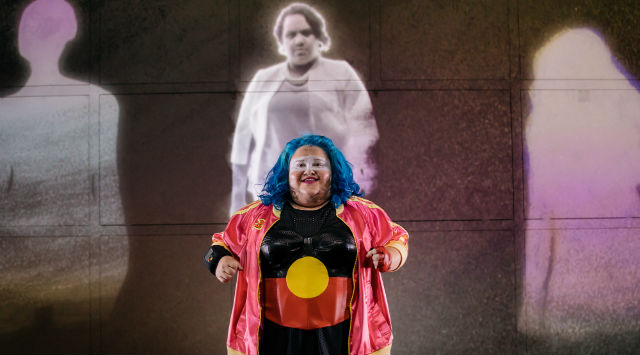
Megan Wilding is a mesmerising leading lady, effortlessly alternating between the earnest vulnerability of Dr Brown and her alter ego Blackie Blackie Brown’s extravagant vivacity. The character’s barbarous adventures could easily have us turning against her, but Wilding is impossible to dislike. Full of charm, and with a striking presence, we devour all that she brings, whether madcap, or profoundly authentic. In accompaniment is the high camp stylings of Ash Flanders, equally endearing in a range of screwball guises, each one hilarious and wonderfully inventive.

The pair is well-rehearsed, for an intricate production that involves extensive use of visual projections (animated by Oh Yeah Wow, designed by Verity Hampson), allowing the show to leap across spaces, geographical and metaphysical, with great efficiency. Filmic influences, particularly in relation to the cartoonish violence being portrayed, are cleverly incorporated in this live meets video amalgamation, by director Declan Greene, whose vision seems boundless in its daring and grandness. Also marvellous is the work on sound by Nate Edmondson and Steve Toulmin, who keep adrenaline pumping for the duration of the piece, having us under control with an exquisite blend of sounds that seems to have direct authority over our viscera. Technical aspects although not entirely flawless, are complex and precise, and there is no denying the scale of ambition necessary for this show to come together; the stage management team is worthy of commendation.

There are few places where minorities can speak freely about their own oppression. The nature of the beast determines that those under the thumb, are well-behaved and polite in the presence of their oppressor, or risk having to suffer even greater abuse. Art has the ability to let all voices be heard. A society that believes in art, will allow a space for a kind of honesty that other spheres are unable to withstand. Art encourages communication in ways that are truthful, and compensate where regular language proves deficient. To kill 400 innocent white people is a ridiculous proposition that anyone would disregard, but to be able to understand the idea beyond the literal, would bring us deep into a discussion that Australians need to have.

www.sydneytheatre.com.au

Review: Kiss Of The Gallery Guard (Scene Theatre Sydney)

Venue: Sydney Philharmonia Choirs Hall (Walsh Bay NSW), May 11 – 26, 2018
Playwright: Carol Dance
Director: Murray Lambert
Cast: Justin Amankwah, Jesse Northam, Chloe Schwank, Cara Severino
Images by John Leung

Theatre review
After making the local news in less than dignified fashion, Amber leaves her rural town in shame, and lands a job in a city art gallery. Carol Dance’s Kiss Of The Gallery Guard asks if it is possible for the leopard to change its spots, and through its own discussions about the ever evolving meanings of art, the play looks at the constantly mutating quality of human nature, in relation to art objects that are characterised as stable and inanimate.

It is a concept worthwhile of exploration, but Kiss Of The Gallery Guard has a plot structure that tends to be overly tangential, with a writing style that mature audiences will find too expositional. Performers for the show are not short of conviction, although their exaggerated approach can interfere with the authenticity that they attempt to bring to the narrative. Cara Severino is a delightful presence as Amber, impressive with the detail she brings to the role, even if the excessively animated mode of presentation is a blemish.

The ephemeral nature of theatre, is what sets it apart from other art forms. A work can always be revisited, revised and remounted, and no two shows can ever be exactly the same. People will grow, and artists will transform. Much as we are inclined to hold unshifting opinions about others, we also know that the world is a surprising place, and people will always have the potential to evade underestimations.

www.kissofthegalleryguard.net.au

Review: Still Point Turning: The Catherine McGregor Story (Sydney Theatre Company)

Venue: Wharf 1 Sydney Theatre Company (Walsh Bay NSW), Apr 21 – May 26, 2018
Playwright: Priscilla Jackman
Director: Priscilla Jackman
Cast: Nicholas Brown, Andrew Guy, Chantelle Jamieson, Ashley Lyons, Heather Mitchell, Georgina Symes
Images by Philip Erbacher

Theatre review
For those of us who are transgender, the experience of life is always a little bit extraordinary. Radically othered, by virtue of the fiercely homogenising quality of gender, there is a part of us that cannot help but perceive things from the periphery, whether we feel ourselves to be accepted or marginalised. Catherine McGregor is a media star, in many ways Australia’s answer to Caitlyn Jenner, both sixty-something, both extremely privileged and established in their professional fields, and both coming out as trans in spectacular fashion in the 2010s. They are not trailblazers by any means, for we have existed since the dawn of humankind (assuming gender had existed from the very beginning), but their stories coincide with a particular time in Western history, when being trans is suddenly a thing to celebrate.

This new interest in our identities contains unquestionably, a hint of the freak show; we often find ourselves a curiosity that everybody else feels as though they finally have license to poke and prod at. It can be argued however, that we are the ones who have demanded attention be paid to our difference, in this, for many, lifelong battle for approval and recognition. In Priscilla Jackman’s Still Point Turning, a delicious balance is struck, in which the object of our gaze is simultaneously accommodating and commanding. The audience is intrusive, but at the protagonist’s insistence. She proclaims to not want the responsibilities of being a poster-girl for the movement, but presents herself with blunt candidness and a fearless embrace of the prying spotlight. The work is “based on interviews with Catherine McGregor”, and she is very forthright with her disclosures.

It is a political and benevolent act, but also narcissistic (as she admits), and that seemingly dissonant combination provides a potent vitality for playwright and director Jackman, whose creation here proves to be a remarkably rich piece of theatre. The show satisfies our need for the sordid and gossipy, allowing us into the profoundly personal struggles of a public figure, whilst offering some of the most informative and thought-provoking content of any biographical account. For a play about a personality whose interests are in sport and the military, Still Point Turning is perhaps surprisingly entertaining, relentlessly so, but its true value is in its frank and unembellished, and thus rare, depiction of a transgender experience.

We may not have arrived at a point where a story of this nature does not bear the burden of having to make that desperate plea for understanding, and we find McGregor’s suffering often occupying front and centre of the stage (alongside her charming sense of humour) but it is noteworthy that the show does go quite a distance beyond an exploitative depiction of trans tragedy. Societal progress can be observed in its ability to discuss its issues inquisitively and genuinely, offering perspectives that are less emotional and more sincerely exploratory. For audiences of all persuasions, the play’s statements and contemplations about how each of us negotiates gender (and other identity markers or constraints) is a rewarding opportunity for deep reflections about our places in social life; who we think we are, how we wish to be perceived, and the things we do to create a persona that each can be personally content with.

The production is passionate and polished, with clever lighting by Nick Schlieper creating comfortable shifts between time and space, whilst helping contain an unnecessarily large performance area. Music and sound by Steve Francis are conventional but highly effective in their calibrations of atmosphere. Designer Michael Scott-Mitchell’s costumes are simple but very smart, with the lead’s pristine white Carla Zampatti suit a breathtaking, memorable design feature.

Actor Heather Mitchell delivers a brilliant performance in the starring role; intelligent and insightful with her dramaturgy, impressively precise, bold in presence, and gloriously funny. Eminently convincing and disarmingly charismatic, we cannot take our eyes off of her. Her Catherine is fascinating and delightful, and we almost wish for the show not to end, if only to retain her company. A supporting ensemble of five effervescent players add to the fun, each one independently compelling and endearing, but wonderfully cohesive as a team, thick as thieves and marvellously engaging.

Even though Catherine McGregor has accomplished a great deal in her illustrious life as journalist, cricket commentator and military officer, the woman presented in these 100 minutes of Still Point Turning is defined principally by her transness. Whether or not this is an accurate depiction of McGregor’s own truth, it is an intriguing proposition that one’s fundamental sense of identity can be so firmly attached to ideas of gender. It is perhaps a consequence of unyielding persecution, of oppression and cruel humiliation, that what should only be an incidental element of a person’s being, is turned into a subsuming component.

McGregor puts blame on no one, talking only about transphobia as a personal demon, but the undeniable truth remains, that when we harm ourselves, it is always a result of conditioning by the outside. It is easy to think of McGregor as a person who has it all, and as such, we require that she expresses only humility and gratitude. However, the prejudice that all trans people continue to be subject to, range from insidious to barbaric. It is pervasive, even in progressive regions, and there is no doubt that we must always take the opportunity, to step up to defend the rights of our transfolk. To be visibly trans is crucial to our progress, and Cate’s indomitable capacity for attention, is to be admired and more importantly, emulated.

www.sydneytheatre.com.au