Spring Comedy Double Bill (Blancmange Productions)

summerofbloodVenue: TAP Gallery (Darlinghurst NSW), Aug 27 – Sep 7, 2013

Brad Checks In
Playwright: Paula Noble
Director: Steven Tait
Actors: Chris Miller, Sam Smith, Katherine Shearer, Laura Holmes, Jim Gosden, Katrina Rautenberg

Summer Of Blood
Playwright: Robert Armstrong
Director: Stephen Carnell
Actors: Brennan Muhoberac, Chris Miller, Katherine Shearer, Laura Holmes, Jim Gosden

Theatre review
Two comedies that have very little in common thematically are staged successively over 3 hours. Both are structured almost like film scripts with numerous scene changes and emphasis on character development. Four of the actors appear in both shows, displaying range by taking on drastically different roles.

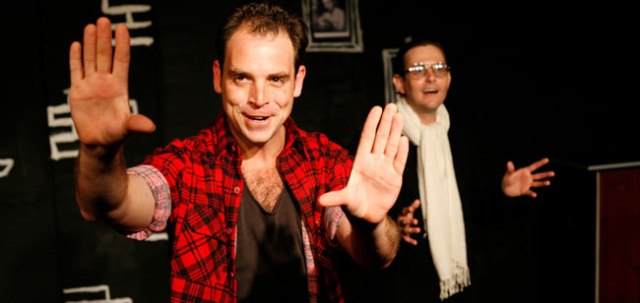
Brad Checks In deals with relationships in the modern era of online social networking. It is a familiar premise that many would easily relate to, but the play strangely features a central character entwined in a web with three women’s affections, without establishing or explaining his appeal. There are however, enjoyable performances, including Katherine Shearer’s Di who is dynamic and mischievous, and the only female character who was not entirely defined in terms of her relationship with the main character Brad. Sam Smith plays a womanising cad with charm and humour with a more naturalistic approach that contrasts well with the rest of the cast.

Summer Of Blood showcases a cast of manic characters, with frequently funny results. Laura Holmes delivers the biggest laughs with her confident comedic abilities. Chris Miller’s exhilarating performance is crucial to the liveliness of the play, setting the bar for his co-actors in terms of energy levels. Brennan Muhoberac is utterly convincing as an adult virgin who becomes increasingly tainted by greed. Director Stephen Carnell uses film effectively and relevantly, interplaying with live action in a memorable section of the play. Film geeks will relish in the facts and trivia introduced into the script, with references ranging from Alfred Hitchcock to Mary Harron. This is a satisfying, albeit messy romp about genre film, and the aspirations of people in the B-movie industry, but audiences will remember it for the schlocky blood letting, colourful characters and the many laughs it delivers.

www.facebook.com/…

The Merchant Of Venice (Sydney Shakespeare Company)

Sydney Shakespeare CompanyVenue: TAP Gallery (Darlinghurst NSW), Aug 7 – 24, 2013
Playwright: William Shakespeare
Director: Steven Hopley
Actors: Mark Lee, Lizzie Schebesta, Anthony Campanella, Alex Nicholas
Image by Rob Studdert

Theatre review
In the modern age of advanced technology and new media, our attention spans continue to diminish at alarming rates. The prospect of sitting through any film or play that runs over 90 minutes can spell torture, but director Steven Hopley’s production makes three hours shrink into just a few blinks of an eye. It is true that time flies when you’re having fun. The Merchant Of Venice is mostly a comedy, and the cast makes full use of comic opportunities, unafraid to explore with silliness and to play for laughs. It can be argued that some of the players are engaged mainly for their ability to make us laugh, and this a decision we are grateful for.

The stand-out actors however, are the ones who excel with the drama they bring to the show. Mark Lee is by far the most accomplished of the group, and is enthralling as Shylock. Lee’s level of focus and conviction in his role brings a level of dignity to the “problematic villain” created by Shakespeare 4 centuries ago. This is an intense and disciplined performance that lifts the entire production, giving it a surprisingly polished gleam. Lizzie Schebesta brings youth and gravitas simultaneously, providing credibility to the otherwise frivolous central love story. Her strong presence holds its own within the male-dominated group, and her Portia impresses as an unexpected feminist figure (as much as the Shakespearean text could allow). Anthony Campanella plays the secondary role of Antonio, but he impresses from the start with excellent command of his lines, somehow able to make every word ring with clarity and truth.

Antonio however, has an awkward relationship with Portia’s fiancé Bassanio, The closeness of these characters is overplayed with a palpable sexual chemistry. This does not lend to the overall balance of the play, especially at its conclusion where all’s well that ends well and Bassanio and Portia are overjoyed at being together at last, with Antonio forgotten in the background. Another matter of disquiet is the handling of the anti-semitic nature of Shakespeare’s work. This production is faithful to its original vision, which does not sit well with contemporary Australian audiences and is a genuine quandary. This issue lingers on after the play has concluded, and one is left with quite shocking ideas of racial prejudice to ponder over, which of course, is never a bad thing.

www.sydneyshakespearecompany.com

Two Rooms (Ledlight Theatre Company)

tworoomsVenue: TAP Gallery (Darlinghurst NSW), Jul 17 – Aug 4, 2013
Playwright: Lee Blessing
Director: Duncan Maurice
Actors: Nick Dale, Laura Huxley, Coralie Bywater, Eli King

Theatre review
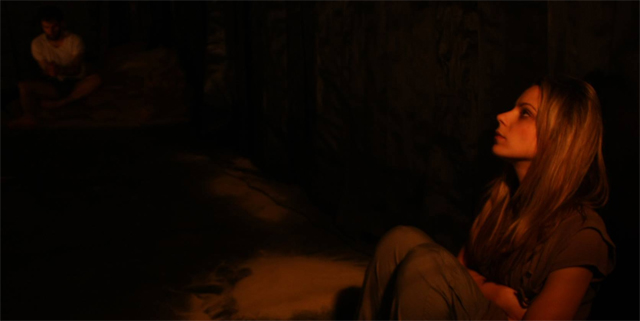
This is a story about terrorism and love. It goes into dark territory, dealing with loss and death, and the devastating failings of government. Design elements of the production are appropriately bleak and menacing. Both set and lighting work around the limitations of the space beautifully, creating a mood of foreboding that locates the story in a space of terror all post-9/11 audiences are familiar with. The theatre is totally darkened before the show begins, and members of the audience are given flash lights to navigate the way to their seats. These flash lights also allow an “interrogative process” to take place when we illuminate the actors already positioned on stage, both in states of distress, one with wrists bound and a bag covering his head. The implication of our complicity in the act of terrorism is immediately engaging, and spine-chilling.

Nick Dale’s performance as the captive, Michael, hits many right notes. He is on stage for virtually the entire duration, and the energy he is able to sustain in the portrayal of a disintegrating man gives the show its air of calamity and relentless tension. The actor’s physicality with his overgrown hair, unshaven face, and gaunt body is a manifestation of the level of commitment he brings to the role. Laura Huxley performs the depression and fear experienced by her character convincingly, and the slightness of her stature amplifies that mournful sadness. There is however, a lack of rage, or at least a more energetic edge that she could introduce, to create a more palpable sense of believability.

The play has beautiful moments when the lovers meet, figuratively or metaphysically. Perhaps sound could have been more effectively utilised to make those scenes more extraordinary, but it remains a great strength of the writing, that Lee Blessing is able to meld both worlds together. Two Rooms become one, and they become its other; it is the deconstruction of “us and them” that will always be a crucial element in the discussion of war, politics and (dare we imagine it?) peace.

www.facebook.com/…

Haus (Black Raven Productions)

Haus at the Tap Gallery 9th 14thVenue: TAP Gallery (Darlinghurst NSW), Jul 9 – 14, 2013
Playwright: Dimitri Armatas
Director: Dimitri Armatas
Actors: Ruth Murphy, Jorjia Gillis, Paddy Lester, Zacharie Di Ferdinando

Theatre review
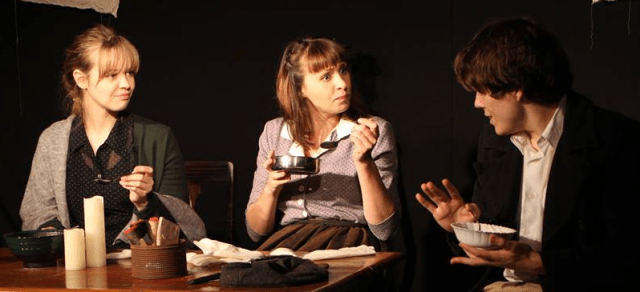
A small stage, at a small venue, telling a little tale, set in a tiny cellar, with simplicity and elegance. This is bare bones theatre, but with charming and meticulously thought out set and props. The script fits in perfectly with the space. All the action convincingly surrounds a table, content in the production’s budgetary and spacial limitations. Some effort is made with lighting to provide variation in mood and tone, but while design is effective, its realisation is unsteady. Perhaps the equipment lacks the flexibility required for its desired effects.

The story itself is a dramatic one, set in Nazi occupied Poland. The central theme of family allows some level of identification but the historic nature of the work is alienating. A good amount of tension and emotion is achieved, principally through the determination and stamina of actor Ruth Murphy, but one questions the relevance of a tale that seems to bear no contemporary parallels, and no obvious allegorical applications.  Additionally, the female characters are bewilderingly weak, and their powerlessness is discomforting and distracting.

Jorjia Gillis is miscast, but shows great potential. Although lacking in maturity, she has good presence and displays an unwavering devotion to her matronly character. Similarly, Paddy Lester shows great promise with a natural charm and has good physical agility that seems to elude most young actors. The aforementioned Murphy is a real talent, taking charge of the entire play through sheer grit and with meaningful clarity. Her thorough understanding of the play’s inner workings shows a very intelligent actor who understands not just acting, but also writing. She outshines other members of the cast at the play’s climax, and performs with such intense emotion that one is reminded of early twentieth century German Expressionism, which is completely delightful and suits perfectly the context of the work.

Director and playwright Dimitri Armatas is a brave young man with an idiosyncratic vision. Artists with original voices stand the test of time. There is no doubt that his creative facilities will flourish and the Armatas voice will reverberate for years to come.

www.facebook.com/…

Rocket Man (Subtlenuance)

Rocket_Man_Hero_Shot_low_res.jpg  902×586Venue: TAP Gallery (Darlinghurst NSW), Jul 4 – 14, 2013
Playwright: Paul Gilchrist
Director: Paul Gilchrist
Actors: Daniel Hunter, Sylvia Keays, Alyssan Russell, Stephen Wilkinson
Photo Credit: Zorica Purlija

Theatre review
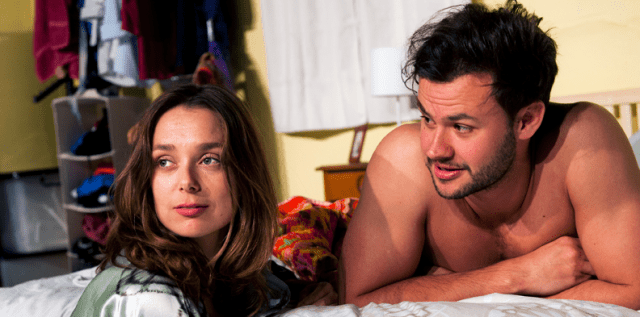
There’s something charming about a play that transports you from the real world, and into a world of theatrical hyperrealism. The actors’ performances, the uncomplicated set, the lack of lighting and audio effects, the language and structure of the script, all contribute to creating an unabridged, uncondensed fly-on-the-wall glimpse into a single hour inside one small bedroom.

Director and playwright Paul Gilchrist begins with several interesting self-referential elements that help connect with and acknowledge the audience, but mostly, his script seems to be concerned only with developing four characters’ journeys within that one hour. This allows a wealth of scope for the actors to explore and actualise their individual roles; and it is indeed their performances that are the most gratifying about this production. There is however, a fragmentation that exists from a lack of chemistry between certain characters, and prevents the story from being even more compelling. The actors have developed their own characters thoroughly and convincingly but they do seem to require a greater understanding of what the other players are trying to achieve, in order to incorporate those other perspectives and tell a more authentic story.

Stephen Wilkinson plays a supporting role in terms of stage time, but gives a wonderfully honest performance, creating a Justin that is truly touching in his vulnerability (even though his spectacles and hairstyle suggests that Justin should probably be an accountant, rather than a house painter). Daniel Hunter is central to the story and lives up to the challenge. His transformation from adorable man in underwear, to violent freaked out monster during the course of the play, without a moment spent offstage, is impressive. If only his leading lady would be more responsive when he does all he can to antagonise her.

www.subtlenuance.com