Review: This Bitter Earth (New Theatre)

Venue: New Theatre (Newtown NSW), Jul 11 – 27, 2019
Playwright: Chris Edwards
Director: Riley Spadaro
Cast: Mitchell Bourke, Michael Cameron, Matthew Predny, Elle Mickel, Sasha Simon, Ariadne Sourgos
Images by Bob Seary

Theatre review
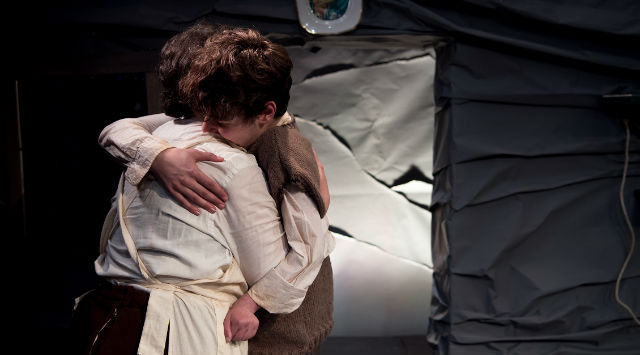
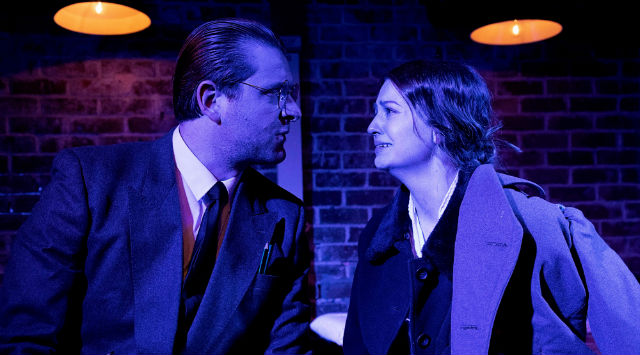
Comprising six scenes, This Bitter Earth by Chris Edwards is essentially a series of short plays about being young, queer and white in Sydney. Although not particularly profound, Edwards’ writing is ultimately insightful, with an absorbing balance of light and dark to keep us intrigued and entertained. A refreshing addition to the legacy of queer playwriting, This Bitter Earth deviates from the tradition of torment and trauma, for a theatre that presents the hardship of coming-of-age as humorous and strikingly natural. The oppressive closet is conspicuously missing in action.

The staging is polished, elegant and very attractive, assembled by an excellent design team, who all but steal the show with their remarkable sense of style. Set and costumes by Grace Deacon are inventive and sophisticated, beautifully considered in each of its spatial transformations between scenes. Phoebe Pilcher and Morgan Moroney’s lights are sensual and poetic. There is a passion in their practice that proves to be quite captivating.

Riley Spadaro’s confident direction gives This Bitter Earth a gravity that helps it sing with purpose. His ability to convey nuance prevents the show from turning flimsy, even at moments when the narrative shifts to frivolous concerns. The show is performed by a charming cast, including an effervescent Elle Mickel whose comic timing is a real asset to the production. Matthew Predny introduces palpable vulnerability to his characters, along with a dynamism that is satisfyingly disarming. Also impressive is Mitchell Bourke, whose portrayal of the classic but tricky combination of camp and despair, resonates with surprising authenticity.

Generations of LGBTQI people have worked hard for today’s social and legal advancements; the equality that we do have are hard-won, to say the least. Watching our young, privileged ones in This Bitter Earth go through their 2019 version of rites of passage, is a joyous exercise, even as we watch them suffer through their growing pains. Coming out stories have dramatically changed, as we had hoped. Our tribe can now begin to experience early adulthood in a way that is no longer exponentially harder than their straight counterparts. Their challenges remain different from the mainstream, but the additional labour of having to deal with structural prejudice, is quickly vanishing. Understanding sex will never be easy, but there is no need for the process to be made more difficult by anyone’s ignorance.

www.newtheatre.org.au

Review: The Cripple Of Inishmaan (Mad March Hare Theatre Company)

Venue: Old Fitzroy Theatre (Woolloomooloo NSW), Jul 11 – Aug 10, 2019
Playwright: Martin McDonagh
Director: Claudia Barrie
Cast: Josh Anderson, Sarah Aubrey, Alex Bryant-Smith, Laurence Coy, Jude Gibson, John Harding, Megan O’Connell, William Rees, Jane Watt
Images by Marnya Rothe

Theatre review
It is the Great Depression, and in the small Irish town of Inishmaan, we meet Billy who has grown up an orphan and with a disability. He is cared for by aunts, and by the town folk who are always in each other’s pockets, but the prejudice that he suffers, although fairly benign, is constant and unrelenting. When Hollywood comes calling, he takes no time at all to pack up and go, certain that greener pastures await. Martin McDonagh’s The Cripple Of Inishmaan is a witty examination of parochial rural societies, looking at the way we can be, when there is little to do but to occupy oneself with other people’s business. In the tension between staying and leaving, Billy demonstrates who we are, as dreamers always seeking something better. Hope is our way out, even if hope does on occasion prove itself empty.

Actor William Rees contributes a gentle innocence to the show. As Billy, his performance is unpretentious, relying only on honest impulses to tell the story. It is an accomplished ensemble. Although not quite as funny as the writing seems to require, there is certainly no lack of authenticity in the personalities they aim to portray. Jude Gibson and Laurence Coy are memorable as a mother-and-son team, with a wicked streak to their dynamic that unnerves and delights. Sarah Aubrey and Megan O’Connell are the aunts, captivating at each appearance with their marvellously sardonic approach, for a couple of sullen pessimists.

Claudia Barrie’s direction depicts a bleakness that accurately conveys the environment under scrutiny, but its lack of vibrancy makes compromises to the play’s humour that can cause the experience to feel underwhelming. Set design by Brianna Patrice Russell is effective in transporting us to a distant time and place, while Benjamin Brockman’s lights bring valuable visual variety to the narrative. Sound and music by Kailesh Reitmans is restrained, with a subtlety that adds a sense of tranquil beauty to the piece.

Sleepy towns are both idyllic and frustrating. They allow us to be slow with nature, but the peace that it promises tends to be short-lived. The corrupting forces so commonly found in urban existences, are not absent when we escape to rustic locales, they simply take on a different form. People will find trouble with one another, no matter where we structure our lives. As long as ignorance persists, and people are unable to recognise their bigotry, or see the consequences of their cruelty, we will struggle to find harmony. We care for Billy, but for him to be well, the world needs to change.

www.madmarchtheatreco.com | www.redlineproductions.com.au

Review: Skyduck: A Chinese Spy Comedy (25A Belvoir)

Venue: Belvoir St Theatre (Surry Hills NSW), Jul 11 – 20, 2019
Playwright: Sam Wang
Director: Aileen Huynh
Cast: Sam Wang
Images by Jasmin Simmons

Theatre review
Chinese agents Chang and Yan have stolen a flight simulator from the Americans, and are surreptitiously turning Skyhawk into Skyduck, to claim illegitimate supremacy in the world of military technology. They come up against good guys from the West; Kendrick is from the USA, and Tucker is Australian. There is also a love interest Little Swallow in the mix somewhere, along with pop star Xiao Peng who makes a short but memorable appearance.

Sam Wang plays all these characters in his Skyduck: A Chinese Spy Comedy, a lampoon of Hollywood action flicks, from Top Gun to Inception, in which nothing is allowed to get in the way of a good time. Wang’s show is imaginative and wonderfully quirky, with an artistic audacity that is highly persuasive; there are lots of outlandish ideas, some of which are completely bonkers, but they all work.

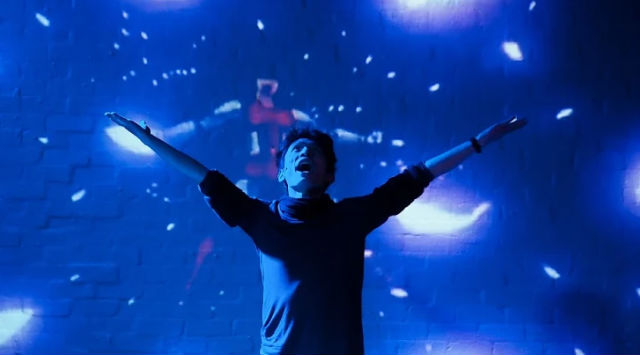
Directed by Aileen Huynh, the production’s idiosyncratic tone is perfectly pitched, for a style of humour that feels one of a kind. A remarkable ingenuity pervades Skyduck. From its clever video projections to some surprisingly elaborate prop making, everything about this staging is a delight.

Performed in Mandarin and English, Wang’s flamboyant take on characters is cheeky and very charming, underpinned by a truly splendid sense of timing. His ability to command attention proves to be quite incredible, as we are kept enthralled for the entirety, thoroughly bemused by what is being offered.

Skyduck is the funniest of contemporary Australian comedies, showcasing an exceptional emerging talent. Sam Wang’s instincts are accurate yet unpredictable. He seems to know better than ourselves, what it is that makes us laugh, and it is in his jocular prowess that we luxuriate. Skyduck pretends to be something it is not. It presents itself as an inferior imitation of blockbusters, and misleads us into thinking that we are laughing at a hack job, but the genius at play is almost furtive, and it is at our own risk that we should ever underestimate it.

www.facebook.com/skyduckandco | www.belvoir.com.au

Review: Van De Maar Papers (Ratcatch / The Old 505 Theatre)

Venue: The Old 505 Theatre (Newtown NSW), Jul 9 – 20, 2019
Playwright: Alexander Lee-Rekers
Director: Camilla Turnbull
Cast: Melissa Hume, Jessie Lancaster, Tom Matthews, Lucy Miller, Nathalie Murray, Terry Serio, Sophie Strykowski, Simon Thomson
Images by Clare Hawley

Theatre review
A man of extraordinary wealth and influence has died, leaving behind a secret manuscript that he wishes to get published, now that he is no longer here to face the critics. The family however, will have to suffer the consequences of a book that could well destroy the family name. Alexander Lee-Rekers’ Van De Maar Papers is concerned with ambition. Levi Van De Maar, the deceased, had wanted to achieve something that he only saw possible after leaving this mortal coil. His wife Christine has her own priorities of self-preservation, as does Frank, a nephew trying to make his own mark in a world that only sees him as a surname.

Lee-Rekers’ writing is often fascinating, with an idiosyncratic humour that keeps us amused. The production can however feel too serious and slow, with director Camilla Turnbull placing emphasis on conveying psychological accuracy, and comedic impulses made somewhat secondary. Lucy Miller and Simon Thomson play the main surviving Van De Maars, both actors believable if slightly too subtle in their approach. The role of unscrupulous publisher Ron Huck is depicted with an enjoyable theatricality by Terry Serio, whose relentless vibrancy is a real asset for the show. At times, he seems to be the only one who is in on the joke with the audience.

The obsession with money and status in Van De Maar Papers encourages us to question our own values. Juxtaposed against the inevitability of death, we are struck by the intensity with which the shallow and the materialistic can overwhelm and determine every course of action. We know with absolute certainty the brevity of existence, yet we submit to meaningless pursuits, letting the appetite to outdo one another, take over the entirety of our being. There are better things to do than to invest in keeping up with neighbours; the tricky thing is to be able to identify that which will be truly fulfilling, and stick with it.

www.old505theatre.com

Review: Glittery Clittery: A Consensual Party (Griffin Theatre Co / The Furies)

Venue: SBW Stables Theatre (Kings Cross NSW), Jul 8 – 20, 2019
Playwright: Fringe Wives Club (Victoria Falconer, Rowena Hutson, Tessa Waters)
Director: Clare Bartholomew
Cast: Laura Frew, Rowena Hutson, Tessa Waters
Images by Kate Pardey

Theatre review
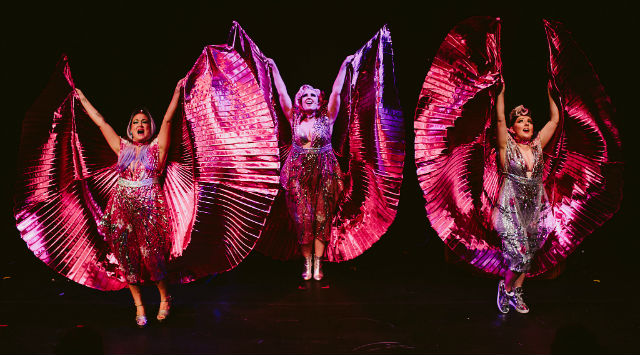
It is a rowdy cabaret with three women in sequinned jumpsuits, very excited by feminism, and thrilled at the prospect of preaching to the converted. Christened Glittery Clittery: A Consensual Party, the show is perfectly suited to our current climate of placing centre stage, all things woke and womanly. Devised by Victoria Falconer, Rowena Hutson and Tessa Waters, collectively known as the Fringe Wives Club, the work consists of relentlessly amusing songs, and witty repartee that make for an enjoyable hour. It has a coalescing power, through its comical observations and vivacious representations, that makes us feel like a tribal audience, united in laughter against the patriarchy.

Directed by Clare Bartholomew, the cabaret presentation is intensely energetic, if slightly frenetic and unfocused in parts. Music is one of its indubitable strengths, although sound engineering could be improved to exploit more fully, the rousing pop potentials of the backing tracks. The performers bring a palpable warmth to the space, perhaps too polite in their approach, but all three are earnest personalities who insist on our adoration; Hutson is particularly likeable when temporarily assuming the scintillating part, “Lagoon of Mystery”.

Glittery Clittery is a sweaty, joyous mess; its text accurately expresses the thoughts and experiences of modern women everywhere in the Western world, but more importantly, the bawdy vigour with which its characters conduct themselves, is a marvellous exemplification of a new feminist spirit that we can utilise in conjuring up new feminine identities. This “clitterati” is unlikely to be anything close to what our grandparents had envisioned, and that is a sure sign of the progress that is under way for us all.

/www.facebook.com/fringewivesclub

Review: We Are The Himalayas (Brave New Word Theatre)

Venue: Fringe HQ (Potts Point NSW), Jul 3 – 21, 2019
Playwright: Mark Langham
Director: Richard Cornally
Cast: Charlotte Chimes, Steve Corner, James Gordon, Chelsea Hamre, Ben Mathews, Emilia Stubbs Grigoriou
Images by David Hooley

Theatre review
It was 1938 when Anna Larina was first incarcerated. With her husband Nikolai Bukharin charged with treason against the Soviet Union, Larina found herself similarly persecuted by the paranoid state, for simply being a wife. Mark Langham’s We Are The Himalayas tells the tale of the individual versus an oppressive regime, featuring characters from a specific point of history, but is timeless in its relevancy. Scintillating dialogue is the work’s greatest pleasure. Its narrative can be slightly lacklustre, but there is much to enjoy in the dynamics between characters, and in Langham’s words themselves.

Leading lady Charlotte Chimes offers focus and intensity, although a greater exploration of range and depth for Larina would create a stronger sense of empathy for her audience. A more complex rendering of personality comes from Ben Mathews who gives a Bukharin that feels layered, and hence intriguing. As secret police apparatus Lavrentiy Beria, is the exceptional Steve Corner, whose nuanced dramatics has us enthralled. His scenes with Chimes and Mathews have them lifting their game, for a second half of We Are The Himalayas that quite suddenly turns explosive.

Not every actor is able to deliver with enough resonance for the show to be consistently meaningful, but director Richard Cornally keeps his storytelling disciplined, with a considered approach that successfully accumulates tension over the duration. Sound design by Patrick Howard is especially noteworthy for its impressive precision, guiding us across time and space with remarkable sensitivity.

There is strength in numbers, although our collectivism can easily turn evil when left unchecked. The greater good is always a noble consideration, but the autonomy of singular entities must never be conveniently disregarded. In 2019, we can see with great clarity, the corruptible nature of power, with those in high places becoming increasingly wanton in the way they execute their affairs. It is tempting to think that our Western democracy is a world away from Stalin’s communism, but the second we ease pressure on the brakes, our ruling class will no doubt drive us to a destination that few will appreciate.

www.bnwtheatre.com.au

Review: Once (Darlinghurst Theatre Company)

Venue: Eternity Playhouse (Darlinghurst NSW), Jun 26 – Aug 4, 2019
Book: Enda Walsh
Music & Lyrics: Glen Hansard, Markéta Irglová
Director: Richard Carroll
Cast: Joe Accaria, Stefanie Caccamo, Cameron Daddo, Victoria Falconer, Toby Francis, Conrad Hamill, Drew Livingston, Abe Mitchell, Rupert Reid, Alec Steedman, Joanna Weinberg
Images by Robert Catto
Theatre review
Guy meets girl, and girl decides to spend all her days helping insecure guy fulfil his dreams. Once is only about a decade old, but already feels like a story from an archaic era. The musical is however not unappealing, with an avalanche of beautiful melodies, and the now famous concept of having its cast double up as musicians for the show’s entirety. It is quite a spectacle, watching eleven performers playing instruments, singing and acting. Entertainment value for Once is predictably high, even with all of its unrelenting cliches.

Directed by Richard Carroll, the production is thoroughly sentimental, to emphasise the romantic nature of the central relationship, although it does seem to diminish the potential for greater humour through the plot. Set design by Hugh O’Connor elegantly transforms the stage into a very believable Irish pub, with Peter Rubie’s lights bringing a dusty melancholia to proceedings. Remarkable work by sound engineer Dylan Robinson translates all the live music into honey for our ears, making the sounds of Once a truly memorable feature.

Lead performers Stephanie Caccamo and Toby Francis are exceptional singers, both deeply impressive with their renditions of these saccharine show tunes; we are left wanting to hear their voices forever. Their acting however is rarely convincing, with chemistry between the two a conspicuous absence. Charisma is compensated by several of its supporting performers, most notably, Victoria Falconer and Drew Livingstone, who create adorable characters that try to bring a sense of effervescence to the stage. On occasions where movement director Amy Campbell has the opportunity to work her magic, everything comes to life, but those moments are few, in this frequently sombre presentation.

Once allows us to celebrate the extraordinary talent of those who live amongst us. There is so much that our artists are capable of, if only they have all the platforms necessary to demonstrate what they do best. When we first meet the protagonist, he had all but given up hope of finding an audience for his wonderful songwriting. This is sadly an all too common truth for so many. Humans are creative by nature, but the way we live today, so often negates those capacities, in favour of conventional systems that require the repression and impediment of our best tendencies. Artists need self-belief, and they need to be supported, especially when the going gets tough, as it invariably does.

www.darlinghursttheatre.com

Review: I Hope It’s Not Raining In London (Bearfoot Theatre)

Venue: PACT Centre for Emerging Artists (Erskineville NSW), Jun 26 – 29, 2019
Playwright: Nicholas Thoroughgood
Director: Riley McLean
Cast: Daniel Cottier, Cassie Hamilton, Nicholas Thoroughgood, Zoe Walker
Images by Riley McLean

Theatre review
It begins with two young people in a mysterious room, both of whom are not quite sure who or where they are. The amnesia gradually fades away, as they proceed to recollect memories explaining how they got here. We learn soon enough, that Nicholas Thoroughgood’s I Hope It’s Not Raining In London is about these protagonists’ relationships with their parents. They look back at the warm and the chilling, and try to figure out, where to from here. It is a sensitive piece of writing, well considered but perhaps not quite as powerful as it wishes to be. The structure elicits a healthy dose of intrigue, although we find ourselves arriving at its climax with insufficient dramatic tension.

Directed by Riley McLean, the production is elegantly styled, with an emphasis on chemistry between actors that keeps our attention on the story. Daniel Cottier and playwright Thoroughgood perform the central characters, both persuasively naturalistic, with an ease and familiarity with the material that allows them to bring sizeable confidence to the stage. Also noteworthy is McLean’s lighting design, simple but varied, efficient with the management of scene transitions, and effective in conveying atmospheric transformations.

Some say that heaven, hell and purgatory are not about the afterlife, but are allegorical concepts for the here and now. Indeed, it is helpful to always think about today as a consequence of yesterday, in order that we may learn to make improvements. In our storytelling too, causation, of one thing leading to another, shapes all our narratives. We can however, disconnect from the past, or at least, formulate new beginnings, so that we can experience radical reconstructions, when so desired. What’s done cannot be undone, but what we do with the future is only restricted by imagination.

www.facebook.com/bearfoottheatreaus

Review: The Astral Plane (25A Belvoir)

Venue: Belvoir St Theatre (Surry Hills NSW), Jun 12 – 29, 2019
Playwright: Charlie Garber
Director: Charlie Garber
Cast: Eden Falk, Emma Harvie, Julia Robertson, Imogen Sage, Ella Scott Lynch, Michael Whalley

Theatre review
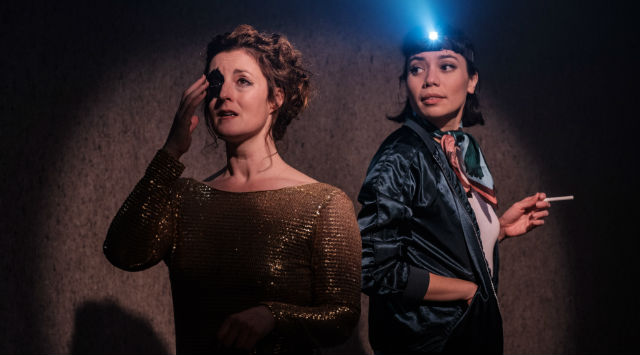
Charlie Garber’s The Astral Plane happens in that space one arrives at before attaining nirvana, where imagination easily turns into reality, or to be more accurate, material. It is all very strange. Depending on personal inclinations, Garber’s sense of humour can be appealing, even in an adventure featuring talking rats and social media influencers that proves to make no sense whatsoever. It is a comedy about nothing, that can leave one feeling quite empty by its end, but there are certainly laughs to be had in every one of its wacky scenes.

An energetic cast, full of conviction, takes us on a spirited ride. They are determined to entertain, and their presence is consistently infectious. In the role of Romi is Imogen Sage, who brings to the stage, an exaggerated effervescence and more than a hint of quirkiness. Julia Robertson is impressive as Deborah, very powerful with an artistic approach that is always daring and robust. Emma Harvie and Michael Whalley are the rats, both performers extraordinarily charming, able to convince us of anything, no matter how farfetched their story.

There is tremendous creativity in The Astral Plane, but its idiosyncrasy will only find appreciation from some. Art can hope to be universal, but it must originate from a personal place if we require it to be honest. Thinking that people are all the same is dangerous, for we are only equal and never replicants of each other. There must be generous allowance for artists to express their individuality, no matter how off-kilter, as long as we are prepared for it to land where we do not predict.

www.facebook.com/theastralplane | www.belvoir.com.au

Review: The Happy Prince (Little Ones Theatre)

Venue: SBW Stables Theatre (Kings Cross NSW), Jun 25 – Jul 6, 2019
Director: Stephen Nicolazzo
Cast: Catherine Davies, Janine Watson
Images by Robert Catto

Theatre review
It is the perfect symbiotic relationship, when the swallow meets the statue and they see deep into each other, not through some mutually obsessive infatuation, but by a shared fervour for bringing peace unto others. In this adaptation of Oscar Wilde’s short story The Happy Prince, we observe selflessness as the ultimate joy and fulfilment. Independently, each entity can do little, but together, they are able to help people in need, and it is only in bringing happiness to strangers, that they themselves are at their most exultant.

Directed by Stephen Nicolazzo, the show is correspondingly generous. Its messages are earnest, fiercely so, and it stringently disallows any room for our customary cynicism. A profound sense of melancholia works almost as its guiding light, taking us down a journey of meditative reflection, to facilitate an examination of the values we use to navigate this thing called life. The swallow and the statue exist in a concurrent state of joy and pain, and we feel every nuanced articulation of emotion depicted by this extraordinary staging. Poetic, with a sublime beauty that transcends all manner of convention, The Happy Prince speaks its truth with remarkable clarity, to deliver an hour of theatre that is as moving an experience as any fairy tale could wish to be.

Music by Daniel Nixon holds us tight, keeping us firmly in the grasp of a show determined to connect with the best of our humanity. Nixon’s work is tender, tremendously stirring, and we respond only with an attitude of pure benevolence. Katie Sftekidis’ lights have a similar effect, drawing us into a sentimental dreamscape, gently pushing away inhibitions so that our capacities know to welcome all the warmth, and wistfulness, of Wilde’s story.

Catherine Davies and Janine Watson are our players, both enchanting and majestically impassioned, full of soul in their performance of a piece that all our broken hearts need to encounter. Watson is the statue, the eponymous Happy Prince who shows us that glory means nothing when left enshrined and static. The actor communicates powerfully, the best of human nature, with a stylistic restraint that barely contains the urgency of what she wishes to convey. Davies takes flight as the swallow, giving us comedy and pathos in equal potent measure, precise at every point in the illustration of her character’s vacillating transformation, from apathetic to spirited. The robust couple is inventive, with an extraordinary charisma that demands our attention. Their sensuality adds a dimension of eroticism to the work, that operates to enhance the theme of compassion, as the play’s central concern.

It is easy to think of sacrifice in terms of loss. In The Happy Prince however, we are reminded that the purpose of sacrifice is to attain something greater, that more often than not, paying a price will lead us to a reward. We watch the statue and her swallow go through considerable suffering, but we are left without doubt as to the immense satisfaction they experience as a result of their pain. Pleasure does not always involve the sting of its cost, but when one is compelled to give until it hurts, what returns is usually from the realms of the divine.

www.littleonestheatre.com.au