Review: Mortido (Belvoir St Theatre)

belvoirVenue: Belvoir St Theatre (Surry Hills NSW), Nov 7 – Dec 23, 2015
Playwright: Angela Betzien
Director: Leticia Cáceres
Cast: Toby Challenor, Tom Conroy, Colin Friels, Louisa Mignone, Renato Musolino, David Valencia
Image by Brett Boardman

Theatre review
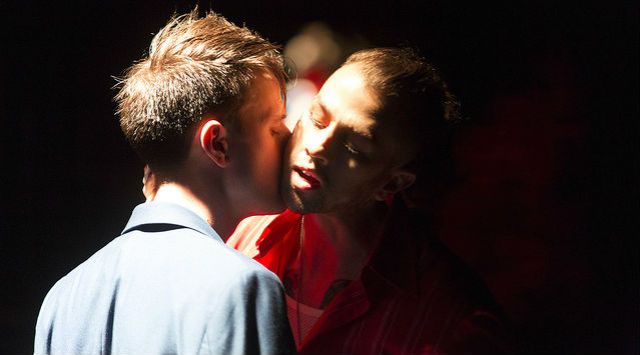
At the centre of Angela Betzien’s Mortido, is a wretched life. Jimmy is a soft and kind soul, misguided by family and exploited by every person he trusts. Emerging into adulthood from a background of poverty and addiction, the only barometer he possesses for a better life is a need for acceptance, along with our definitive measure of success, money. Without the support of anyone who has Jimmy’s own interests at heart, and with no education to speak of, his fate is sealed, and doomed. The story is a dark one about the underbelly of Sydney, and how our affluence is built upon the perpetuation of an underclass, kept aspirational and concurrently ignorant.

Betzien’s script is highly ambitious and vast in scope. It encompasses themes of family, money and addiction, set against historical contexts, to explore attitudes and machinations of our current sociopolitical environment. The play looks at our problems with narcotics and poverty from micro and macro perspectives, refusing to diminish their complex enormity for convenient storytelling. What results is a piece of writing that is detailed and intricate, but also challenging, for audiences and theatre makers alike.

Director Leticia Cáceres does well at providing the production with tension and intrigue, but the plot’s clarity suffers from that tautness of pace. In its second half especially, too much is revealed too quickly, and our minds struggle to process every poignancy. Each revelation is an important one that contributes, not only to our appreciation of each character’s circumstances, but also to our understanding of the real world. Many of the story’s elements will resonate deeply if given the chance, but the show seems to rush quickly past and we are left wondering if we had learned everything that is worth knowing.

Nevertheless, Mortido is gripping, and very exciting, with each scene holding surprises, frequently overwhelming with its keen portrayal of brutality, both physical and psychological. Composer The Sweats and Sound Designer Nate Edmondson do exceptional work with their manipulations of atmosphere. The production relies heavily on its sounds to control our responses, and the precision at which it guides our emotions through every sequence and transition is remarkable. A disappointing contrast does occasionally occur however, when it takes a back seat, leaving the actors to their own devices, and we begin to feel the emptiness of space.

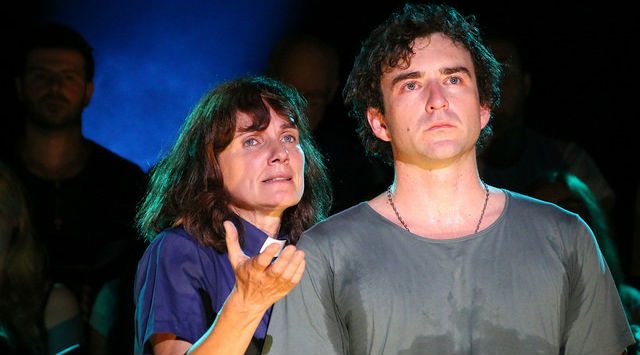
There is plenty of impressive acting to be found, including the very young but very compelling Toby Challenor, whose immovable focus on each task in every appearance, belies his tender age. Colin Friels plays several disparate characters, displaying a good level of versatility and enthusiasm, but is probably most effective as Detective Grubbe and El Carnicero. The star’s presence is undeniable and the intensity he brings to the stage has an effortless drama that is absolutely captivating. The central character Jimmy is performed by Tom Conroy with a faultless vulnerability. For all of Jimmy’s regrettable mistakes, we are always on his side, hurting for his every adversity and hoping that a twist of fate appears. Conroy excels in the role, successfully depicting Jimmy’s personal difficulties as well as the social connotations of a problematic life. We understand the responsibilities that are due young people like Jimmy, and realise how we have failed those who share his disadvantage. Also noteworthy is David Valencia as the enigmatic Spanish-speaking El Gallito, memorable for his simultaneous delivery of danger and ethereality, and an aggressive sex appeal that electrifies the stage.

The title of the work refers to our human tendencies toward self-destruction. It is a discussion about weakness, and along with that, we encounter ideas surrounding ethics, responsibility and social harmony. Mortido is a cautionary tale about the seduction of death, and the perils involved when allowing lives to be less than honourable. It confronts the inequity that exists in our wealthy cities, and our complicity in maintaining that damaging status quo. We can always identify good from bad, but we do not always make the right decisions.

www.belvoir.com.au

Review: Kryptonite (Sydney Theatre Company)

sydneytheatrecoVenue: Wharf 1 Sydney Theatre Company (Walsh Bay NSW), Sep 11 – Oct 18, 2014
Playwright: Sue Smith
Director: Geordie Brookman
Cast: Ursula Mills, Tim Walter
Image by Lisa Tomasetti

Theatre review
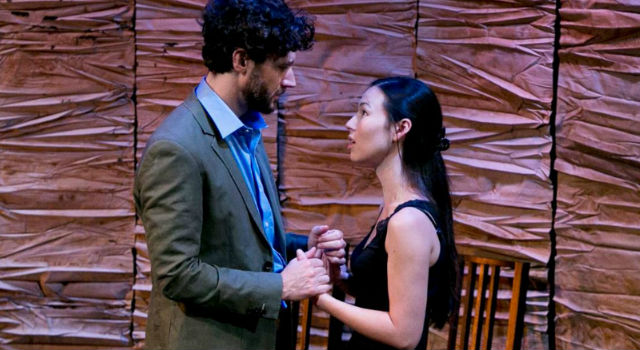
Through an international love story, Sue Smith’s Kryptonite examines the relationship between the personal realm and our wider circumstances. When Lian first met Dylan at an Australian University in pre-Tiananmen 1989, she was a new immigrant from China and Dylan had looked every bit the quintessential middle class Australian preoccupied with surfing and student protests. Over the years, Lian returns to Dylan for a series of brief but dramatic encounters, and by 2014, they are almost entirely different people, and we question if the countries from which they emerge, have evolved correspondingly, into virtually unrecognisable entities.

Freedom, idealism and innocence are put through the wringer in Smith’s play, in which we witness the ravages of time on the beauty of youth. Growing old is a tragedy, but not because of the inevitable deterioration of flesh. It is what happens to the heart and soul as time wears on, not just for each person, but also for the worlds in which we dwell. We cannot travel back in time, and our nations will never revert to a purer state. Indeed, the past is painted as though through rose-coloured glasses, but it is a persuasive picture that Smith creates. In Kryptonite, the loss of our innocence is certain, and sad. Smith’s work is emotional and powerful, with a perspective of our recent histories that feels accurate and is deeply perceptive.

The character Lian is particularly well-written, with an authenticity in speech and sense of humour that is quite outstanding. Performed by the brilliantly astute Ursula Mills, the role becomes thoroughly familiar, even though realistic Chinese women are rarely seen on our stages. She is surprisingly funny, and her motivations in each sequence are concise, keeping us engaged with her storytelling in a plot that can be a little convoluted at times. Mills is required to speak and sing in Chinese languages over the course of the show, but proficiency is lacking although her conviction remains strong. There is an oversimplification in some of Lian’s darker moments, but the actor never fails to bring a delicious fire to the drama when required. Also captivating is Tim Walter who is yin to Mills’ yang. Chemistry between the two are not quite exceptional, but they find a harmonious balance that brings great elucidation to the play’s themes and concepts. Walter’s work is thoughtful and confident, but the lightness in his presence, while delightful for the younger Dylan, is a hindrance in several of his graver moments. His depiction of a jaded politician in his late forties is not entirely convincing, but as a young man confused and enchanted by the object of his affections, Walter is charmingly captivating.

Geordie Brookman’s direction retains the challenging nature of the plot’s non-chronological timeline, but provides a good sense of clarity to the narrative. He succeeds in manufacturing a believable romance out of a complex framework of dramatic shifts in time and spaces, but some of the script’s political details are subsumed by his emphasis on pace and rhythms. The show is an enjoyable one. Its scenes are dynamic and unpredictable, always introducing fresh elements to ensure a gripping experience. Design aspects are not greatly ambitious, but they help tell the story with efficiency and elegance.

Kryptonite talks about how we have changed as nations of people, but its views of China are more exacting than how it sees its own country. The Australian play shows the evolution of a foreign land through its distinct junctures of transformation, but it is less brutal with its self-reflection. Yet again, we find meaning through the definition of an other, but this time, we move focus from our perverse European obsession to a place closer to home. China is a significant trading partner, with an astronomical rise in recent times that sees its influence spread across the world, not only in monetary terms, but also cultural and social. The first officially recorded Chinese migrant arrived in 1818 and today, Australians with Asian heritage number at 2.4 million. While we still seem to avoid it like a comic hero avoids a mythical adversary, the importance of finding a way to articulate that experience and relationship is impossible to overstate.

www.sydneytheatre.com.au

Vere (Faith) (Sydney Theatre Company)

Photo by Matt NettheimVenue: Sydney Opera House (Sydney NSW), Nov 6 – Dec 7, 2013
Playwright: John Doyle
Director: Sarah Goodes
Actors: Paul Blackwell, Matilda Bailey, Matthew Gregan, Ksenja Logos, Rebecca Massey, Geoff Morrell, Yalin Ozucelik

Theatre review
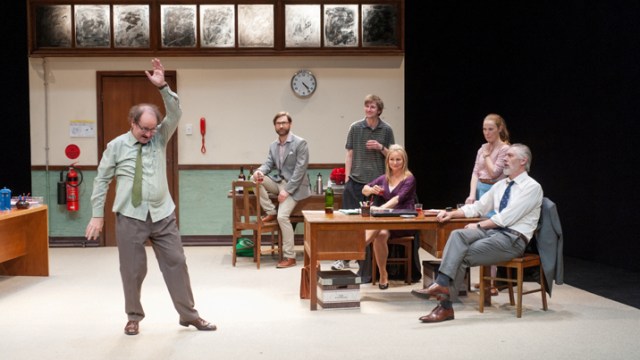
This is a story about a highly regarded physicist, Vere, who falls victim to Parkinson’s disease. Vere has built a life based on science and intellect, but is now faced with the cruel obliteration of his mental capacities by dementia. John Doyle’s play explores the remains of a life, as its subject goes through a metamorphosis so exhaustive and fundamental. In Vere’s disintegration, we see the curious way in which memory functions, and from it, we gain an appreciation of what is immortal and invaluable. Themes of love, relationships, religion, work, mortality, and the transience of life itself, are meaningfully woven along with humour and pathos to create a show that is simultaneously entertaining and profound.

The first half is set in a university before Vere’s disorder takes effect, and the second, at his home when it is in full swing. The show speaks at first to our minds, with exuberant and witty repartee among cerebral academics, then to our hearts, as family dynamics come into play with decidedly greater sentimentality. It is as though Vere’s illness can wipe out the contents and function of the brain, but the soul is unbreakable and eternal. Director Sarah Goode’s work is quiet, and not particularly showy, but her hand is a confident one. She understands the strengths of the script, and ensures those strengths shine through with minimal intrusion.

Design elements are excellent, if a little conservative. The production is demanding of the actors, who (aside from the lead) each play two sets of characters, and they rise to the challenge beautifully. Geoff Morrell’s flamboyant style ensures that his characters are memorable, and his vivacity is a welcome addition to any event. Rebecca Massey portrays an unintelligent character with brilliant irony and meticulous timing. She delivers many laughs with a camp sensibility but is careful to retain a level of realism and believability.

Paul Blackwell’s performance is sublime. His presence is remarkable and the audience falls for his Vere from the very first words. He fascinates us, and we are completely enthralled, like putty in his hands. Blackwell’s biggest success is the ability to elicit great empathy while depicting a very sick man with utmost dignity. Through him, we see the humour in our fragility, but that frailty he depicts is also deeply touching. Blackwell, and Vere, guide us through a poignant meditation on growing old, on lost love, and on death, and we conclude at a place that is, surprisingly, not very frightening at all.

www.sydneytheatre.com.au