Venue: Belvoir St Theatre (Surry Hills NSW), Aug 27 – Sep 20, 2015
Creators: Ash Flanders, Declan Greene
Director: Declan Greene
Cast: Ash Flanders, Emma Maye Gibson, Michael Lewis, Zindzi Okenyo
Images by Patrick Boland
Theatre review
Giuseppe Verdi’s opera La Traviata is about love and money. In Ash Flanders and Declan Greene’s radical re-imagination, a third theme of art is added to create a work of theatre that moves emphasis away from sentimental indulgence, to something that is altogether more contemporary, and intellectual. The exploration of ideas becomes an explicit one. Through five separate sequences, we are encouraged to think about our economy and consider the extent to which our lives are required to be commodified in order to survive, or at least to be able to find justification for our social existences.
Flanders and Greene are interested in the problems of thinking about art as product, and in their attempt to determine what it is that gives art a sense of value, a series of funny but thoughtful scenes are created. Each one a different genre, their presentation also addresses the clichés of art reflecting upon itself, and the difficulties in producing anything original, especially within this contemporary and introspective concept. The same operas are staged every year, yet artists are pressured to be innovative, and in our current political climate, the capitalistic ideal of “excellence” is applied to art in an attempt to understand and indeed, control how artists do their work. These absurdities are effectively, and entertainingly, encapsulated in Flanders and Greene’s show. Each section is executed with charm and sharp humour, but the transitions between them are not always managed with the same amount of flair. One also questions the straightforward division of scenes, which comes across too simple and convenient. The fourth sequence involves a question and answer format that aims to perform a sort of “reality” genre that accurately depicts the state of communications today, but the discussions demystify the abstractions that had come before, and the transformation of what was ephemerally beautiful into plainer terms is unfortunate. Perhaps a statement is made about the diminishment of romance and mystery in our lives, but it is an ironic and disappointing loss.
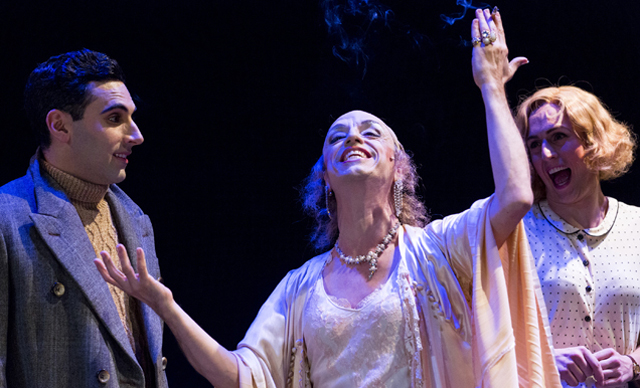
Greene’s talent with aesthetic and atmosphere is a drawcard of the production. Along with designers Marg Horwell (set and costumes), Matthew Marshall (lighting) and Steve Toulmin (music and sound), this overhaul of La Traviata is a consistently fascinating one, particularly at its more classically operatic moments. There is a strong desire for the work to connect, which often results in an appealing brashness that matches its quite madcap humour. It takes every opportunity to express itself with flamboyance and extravagance, but unlike the lavish operas at bigger venues, its sensibility is firmly anti-establishment. Quirky and queer, the world it creates is adventurous, dynamic and consistently idiosyncratic, with compelling symbols that interrogate our imagination and delight our eyes and ears. Performers Emma Maye Gibson and Michael Lewis leave an impression with their accomplished voices late in the piece, surprising us with morsels of operatic singing that we had all but given up expecting. It is a strong cast, each with solid presences and a confidence in their material that helps us appreciate the topics being dissected. In the absence of narrative, their cohesion in energy and comedy styles gives the show its compelling driving force.
Our hero Violetta chooses love over money at every stage of her life story. There is never a hint that money could ever mean more than her one true love. The sacrifices she makes for Alfredo eventually destroys her, and although we observe in sadness her tragic death, the profound meanings of integrity and truth emerge clearer than ever. Death pales in comparison to passion. When one is able to identify the greatest love of all, life is worth living.
www.belvoir.com.au | www.sistersgrimm.com.au


 Venue: Wharf 2 Sydney Theatre Company (Walsh Bay NSW), Oct 9 – Nov 8, 2014
 Suzy Goes See