Review: John (Outhouse Theatre)

Venue: Seymour Centre (Chippendale NSW), Sep 19 – Oct 12, 2019
Playwright: Annie Baker
Director: Craig Baldwin
Cast: James Bell, Maggie Blinco, Belinda Giblin, Shuang Hu
Images by Clare Hawley

Theatre review
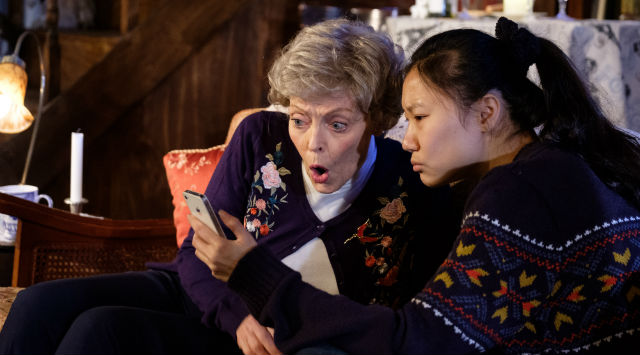
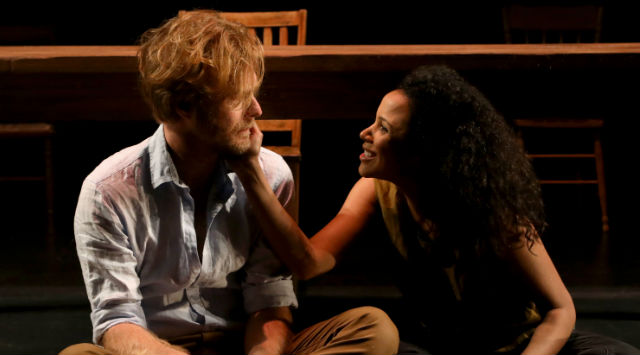
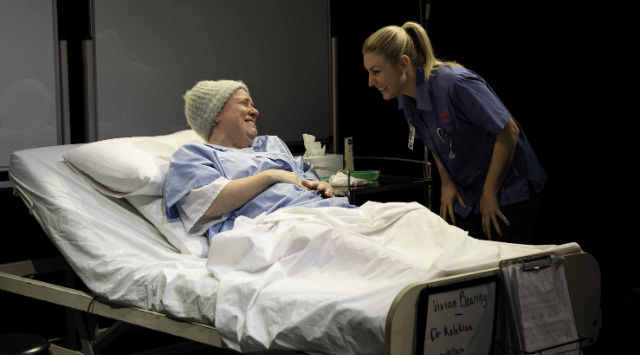
Jenny and Elias are visiting Gettysburg, Pennsylvania whilst trying to mend a rough patch in their relationship. They stay at a bed and breakfast, run by an elderly lady named Mertis, who is very nice, but who is also more than a tad mysterious. Her eyes, like her house, are secretive and cavernous, and in Annie Baker’s John, we always feel as though things are not quite what they seem. We see the young couple attempt to make things work, both trying hard not to let go, inside Mertis’ tchotchke-filled house, where past and present converge, unable to disentangle from one another.

Baker’s intriguing play is filled with characteristics of scary stories; lights that turn on and off by themselves, a pianola that plays unprompted, portraits and dolls imbued with a presence that can only be described as supernatural. There are lots of creepy goings on, but in the absence of an obvious genre style pay off, our minds are made to regard Mertis’ world with an unusual complexity, that quite matter-of-factly ventures into the metaphysical.

Director Craig Baldwin manufactures this eerie atmosphere with considerable diligence and detail, supported magnificently by set designer Jeremy Allen and lighting designer Veronique Bennett, who deliver exquisite imagery that has our imagination running wild. The house is in some ways the star of the show, and the work that has gone into making it come alive, is absolutely terrific.

Incredibly nuanced performances by the cast of four take charge of our attention for the entire three-and-a-half hour duration, keeping us guessing at every juncture, making us see things that may or may not be there. Efforts to render a spooky vibe can sometimes feel awkwardly lethargic, especially in Act One, but we are always engaged, always filled with curiosity, even when feeling impatient.

Belinda Giblin is electric as landlady, hugely impressive with the intelligence and rigour that she brings to her portrayal of the enigmatic Mertis. Her close friend Genevieve is played by an exhilarating Maggie Blinco, whose kooky vivacity adds much needed energy to the show. The troubled young couple is depicted with great chemistry by James Bell and Shuang Hu, who are convincing whether loving or fighting, but there is a restraint to their approach that can at times feel at odds with the humour of the piece.

There is much that can be interpreted as strange in Mertis’ home, but there is also a peculiarity to how the visitors struggle with their lives that can easily get unnoticed. The older women share a sense of ease that escapes Jenny and Elias, who we observe to be constantly at odds with the world, always responding to it with resistance and frustration. Mertis accepts things as they are, and nothing seems to unnerve her. She exists in harmony with a cosmos that many think is chaotic. The young ones on the other hand, appear to play by the rule book. They look like normal people doing normal things, but they are in contradiction with a bigger scheme of things, as exemplified by the house they temporarily occupy. The house just is, and it is us who have to learn to adhere to it.

www.outhousetheatre.org

Review: Nine (Seymour Centre)

Venue: Seymour Centre (Chippendale NSW), Sep 5 – 14, 2019
Book: Arthur Kopit
Music & Lyrics: Maury Yeston
Director: Alexander Andrews
Cast: Maddison Burton, Sophia Charters, Phoebe Clark, Kelly Goddard, Ellyn Gwillim, Amy Humphrey, Tayla Jarrett, Tisha Kelemen, Katelin Koprivec, Michele Lansdown, Andy Leonard, Victoria Luxton, Matilda Moran, Sarah Murr, Sophie Perkins, Caitlin Rose, Petronella van Tienen, Megan Walshe
Images by Blake Condon

Theatre review
Guido Contini is caving under pressure, unable to start work on another film, after the failure of his last three efforts. Instead his mind wanders, and in the 1982 musical Nine, we see him obsess over all the women he has loved, as though longing for one of them to turn into a muse and solve his writer’s block. An old-fashioned work, with a male protagonist placed firmly at the centre, surrounded by innumerable women often looking disposable, Nine however still boasts some of the finest melodies in the Broadway canon, with Maury Yeston’s songs remaining as stirring as they had always been.

Director Alexander Andrews assembles all the parts proficiently, and his production bears a level of polish that almost glosses over the regressive nature of its gender representations. Antonio Fernandez’s energetic musical direction, Madison Lee’s imaginative choreography, and James Wallis’ multifaceted lighting design, all combine to deliver an enjoyable, if slightly too traditional, musical extravaganza.

A cast full of conviction, determined to bring vibrancy to the stage, with Andy Leonard in the leading role, offering nuance in his acting, but not quite satisfactory in terms of vocal requirements for several of his songs. The quality of singing is in general slightly disappointing, although it must be noted that the “Folies Bergeres” number is performed with remarkable wit, by Katelin Koprivex as Stephanie and Michele Landsown as La Fleur, both impressive with the vigour they introduce for their memorable scene.

Writing can date, but theatre must always be made for now. Some works need a greater attempt at innovation, so that they can speak more resonantly with audiences of the time, and Nine is certainly an example of how a relic should be updated to match conversations of the day. Many will find it jarring to see so many women on this stage serving no other purpose than to facilitate the narrative of a man in delusion. For many others though, the sheer pleasure of hearing these splendid songs, is more than enough to make up for its political faux pas.

www.littletriangle.com.au

Review: Table (White Box Theatre)

Venue: Seymour Centre (Chippendale NSW), Jul 25 – Aug 17, 2019
Playwright: Tanya Ronder
Director: Kim Hardwick
Cast: Charles Upton, Stacey Duckworth, Mathew Lee, Julian Garner, Danielle King, Chantelle Jamieson, Annie Stafford, Brendan Miles, Nicole Pingon
Images by Danielle Lyonne

Theatre review
It was over a hundred years ago, that David Best built a table on the occasion of his marriage. Six generations of Bests later, the table still stands, modestly and in the background, accumulating scars inevitably derived from the passage of time. A substantial portion of Tanya Ronder’s Table centres around the globe-trotting Gideon Best, whom we meet at various points through the years, from his conception in Africa in 1951, to his return to England at 62 years old. The play features scintillating dialogue and fascinating characters, to explore the dynamics of a family that, for all their adventurous diversions, are ultimately no more than regular people.

The production is exceedingly elegant, with Isabel Hudson’s set and Martin Kinnane’s lights offering consistently sumptuous imagery, if slightly too insistent in creating a sense of moodiness. Nate Edmondson contributes two hours of music and sound, intricately magnifying every sensory peak and trough, highly effective in helping us find focus for all of Table‘s deliberately abrupt plot shifts. Director Kim Hardwick’s sensitive approach can at times seem too quiet, but the psychological and emotional accuracy that she is able to convey, for every aspect of the story, makes for a staging that sings with authenticity from beginning to end.

Actor Julian Garner brings an understated complexity to Gideon, for a convincing and empathetic portrait of a flawed individual. It is an often inventive performance by Garner, who also plays Gideon’s father Jack, oscillating effortlessly between humour and sentimentality, to deliver some of the show’s more powerful moments. Danielle King demonstrates a wonderful versatility in three roles, particularly impressive when taking the production to a satisfying crescendo at its final sequences. Also memorable is Chantelle Jamieson, an effervescent presence who introduces exceptional vitality, whether playing a carefree sixties commune member, or a nun.

The table is left behind by person after person. We watch it outlive its owners, roughed up but still sturdy, able to withstand centuries more trials and tribulations. Not all of us are leaving children behind, but personal legacies, big or small, good and bad, will have resonances that linger after our headstones are concreted. When Gideon comes back hoping for reconciliation, we see an older man finally recognising the magnitude of his actions, and the simultaneous insignificance of his egotistical self, and we wonder if it is only wishful thinking when we say that it is never too late turning over a new leaf.

www.whiteboxtheatre.com.au

5 Questions with Mathew Lee and Annie Stafford

Mathew Lee

Annie Stafford: What’s the best (and/or worst) advice a family member has given you?
Mathew Lee: I never met my grandfather on my mother’s side, but I have been told his motto was “never go to bed angry”. That no matter how pissed off you are, just sort it out before you go to sleep so it doesn’t stew. My Dad also lives by this rule and it’s something that has always been said in our house. Sometimes it’s really hard to abide by it, but I definitely try.
 
What shaped you the most growing up in Newcastle?
I am very proud of Newcastle and I love going back to visit. My parents have been a huge influence on my life, and I like to think I live with their sense of standing up for what is right and for treating everyone with the same respect. Also, they are literally the most popular people in Newcastle so I have a lot to live up to.

I would also say growing up in the Hunter shaped my identity in different ways. My school life was really brilliant, I was provided with many opportunities, but naturally I was a drama kid in a very sporty public school, and I most definitely experienced bullying because of my sexuality. This is something that many people in our community have to deal with and overcome well in to adulthood. So, in many ways it made me tough. I think I protect myself a lot and I have pretty thick skin, which can be good and bad. Also, I don’t think this is specific to Newcastle and kids cop it everywhere, but perhaps that fear of being seen as openly gay diminished moving to a big city where no one really cares about the way you express yourself. Even just this year, I feel more comfortably myself than ever before. On the other hand, maybe I just got older and stopped caring about what people thought.

Do you have anything that’s been passed down the family (object or trait)?
Mum and I are very similar and I’ve definitely inherited her sense of order and organisation. She writes to-do lists every day and there are lists all over our kitchen in Newcastle, highlighted and stuck to the walls. I do the same in my diary and a weekly schedule. It’s totally mad but I do have to admit that it makes me feel at ease to get all of it onto paper so I can free up my brain. Like most actors in the indie scene, I am juggling three or sometimes four different jobs a week to afford rent, so I need my play-by-play organised and written out so I can see it, and have that moment of pure bliss crossing something off after a stressful day.
 
What would your characters drag names be?
Girl, okay. You know me so well. After thinking long and hard about this, my drag names would be: Bea Haven-Badleigh for Finley Best, Poor Miss Fortune for Anthony Best and Queen LaReefer for Chris.

Word on the street is that you write a mean Limerick, prove it. Write one about Table. 
I am low-key so pleased about this because I have never had a limerick published on the internet. Here we are:
Our table has stood to the test,
Through war and spiritual quest.
From leopards to nuns,
A father who runs-
It lives on in the house of a Best.

Annie Stafford

Mathew Lee: If you could host a dinner party for one person – dead or alive – who would it be?
Annie Stafford: Ella Fitzgerald. Don’t laugh, but I listen to her every day at work and often harmonise with her… loudly. I would invite her over, cook her lasagna, drink wine and talk about jazz. There might be a piano involved but I don’t want to push it. She made me love jazz.

Other than your support network in Melbourne, what do you miss most about home?
Melbourne is a pretty easy place to miss. But family and friends and good coffee aside, I miss sleep-ins. I’ve never been good at them, and living in Sydney has made that even more apparent. You don’t want to miss anything, you want to start the day by achieving something, you don’t want to fall behind. But now, when I go home to Melbourne, suddenly there’s time. And I can just stop and I don’t feel guilty for getting in a few extra Z’s. Until my mum comes in and passive aggressively opens my blinds and fills my room with vicious sunlight so I have get up and spend time with her. Which I secretly love.

When you imagine the house you grew up in, what do you see most vividly?
A very bold colour palette. I’m talking strong offers coming at you from every angle, but not one of them cohesive. This little house had a little front veranda with bright purple wisteria covering it. Nice right? Magical, whimsical, a sign of things to come. Well take a step inside and be slapped in the face with a ruthlessly green carpet. It was there when my parents bought it so they can’t be blamed. However they can be blamed for the intrusive hot pink paint they beat the hallway with. Like I said, bold colour palette.

Describe your character(s) using only song titles.
Oft. Okay. Well I’m in a 70s mood so we’re going to hang there for this one…
Margaret : Stayin’ Alive, Bee Gees
Babette : Joy To The World, Naturally
Aisha : I Want You To Want Me, Cheap Trick

What is something about yourself you hope to pass down to your children (if you choose to have them)?
My dad once told me that when my mum was pregnant with me and they were daydreaming about the big deal I was going to be, all they truly wanted was for me to have a sense of humour. I could achieve whatever I wanted and be whoever I wanted but lord help us give the girl a sense of humour. And I think that’s what I would want to pass down. Not that I’m calling myself funny, but I think it’s so important to take what you do seriously and not yourself. And I love to laugh just as much as I love to make others laugh. And if I ever have children, hearing them laugh and laughing with/at them would give me great joy.

Catch Mathew Lee and Annie Stafford in Table, by Tanya Ronder.
Dates: 25 Jul – 17 Aug, 2019
Venue: Seymour Centre

Review: Gloria (Outhouse Theatre)

Venue: Seymour Centre (Chippendale NSW), Jun 6 – 22, 2019
Playwright: Branden Jacobs-Jenkins
Director: Alexander Berlage
Cast: Justin Amankwah, Annabel Harte, Reza Momenzada, Michelle Ny, Georgina Symes, Rowan Witt
Images by Clare Hawley

Theatre review
The story happens at the most innocuous of places. In offices and a Starbucks cafe, characters from Branden Jacobs-Jenkins’ Gloria do their best to stay afloat, in what feels like a never ending rat race. These humans are flesh and blood, but we see them caught inside machines, trying to navigate circumstances that are highly unnatural, and failing to do anything with integrity. Almost everyone ends up looking like a bad person, but it is hard for the audience to cast blame on any individual. It becomes clear that it is the environment that is toxic, and collectively we encourage horrible behaviour in one another. Gloria is about culture; the state we are in, and how we are trapped in a quagmire of our own doing, yet unable to figure a way out of it.

Jacobs-Jenkins’ penetrating look at Western civilisation is composed of fascinating dialogue and scintillating diatribes. A passionate expression of the frustrations we experience of city life, Gloria offers in theatrical form, an astute and scathing reflection of the games we play on a daily basis, that only serve to drag us down. The production opens with absorbing exuberance for a first act that portrays regular moments between colleagues at a publishing house. Jeremy Allen’s set design is commendable for its very persuasive insistence on incorporating a conventional proscenium, perhaps as representation of “the establishment”.

Director Alexander Berlage’s rendering of a bitchy workplace, communicates with a mischievous familiarity that many will find irresistible; we laugh at how mean-spirited we can be, with people we see every day, who should be our closest allies and compatriots. Acts 2 and 3 turn much darker, and the show’s energy dissipates slightly. Where it should begin to speak more stirringly, as we get closer to the crux of the issue, the staging struggles to maintain a focus on the essence of what is being said, leading us to a conclusion that feels somewhat cool.

Enjoyable performances include Michelle Ny as Kendra and Jenna, both roles sassy and strong, with the actor’s beaming confidence holding us captive, and head-over-heels dazzled. Rowan Witt is very funny as Dean and Devin, and highly impressive with the inventiveness that he is able to summon in bringing them both to life. Georgina Symes as the diametrically opposed Gloria and Nan, proves herself effective at each end of the hierarchy, powerful whether playing high or low on the social scale.

Like nature documentaries with predictable predator-and-prey patterns of behaviour in all manner of species, Gloria shows us to be a tribe engaging in ruthless activity, as though free will is but a figment of some crackpot imagination. The truth however, is that although there is no question of our causing harm to one another, many of us do think and try to do better. The argument therefore, is about how much control we believe ourselves to possess, and how much each person is able to manoeuvre themselves to try evade these narratives to which we seem to be condemned. If we understand ourselves to have been indoctrinated, we must believe that deprogramming is possible. The nature of culture is that it is pervasive, but history shows that it is never insurmountable. Change happens all the time, and it might as well begin with the self.

www.outhousetheatre.org

5 Questions with Reza Momenzada and Michelle Ny

Reza Momenzada

Michelle Ny: What is the one piece of advice you’d tell your 10 year old self?
Reza Momenzada: I would tell myself to never give up on my dreams. Never ever. Never lose hope and never stop trying. It’s something that I probably wouldn’t have understood straight away but I would’ve definitely understood later and used for the rest of my life. It’s something I’m still struggling with, perhaps because I didn’t get that advice when I was ten.

You’re stuck on a desert island and you only have three movies to watch for the rest of your desert island life. What would they be?
If you had said a TV show I would’ve said Friends. I’d never get tired of it!

I think the performance that Heath Ledger gave as the Joker in The Dark Knight is something out of this world. Something that’ll never be repeated again. And it just shows what an actor is capable of doing once they’re fully committed to the role.

Django Unchained. Everything about this movie is just perfect, especially the performances DiCaprio and Christopher Waltz give. They’re the kind of actors whose performances just keep getting better and better.

And The Kite Runner. I’m not gonna tell you what it’s about and why I like it so much. I invite you to watch it, then you’ll know.

Describe your life when you are 60 years old in one sentence.
I’m retired, living with my beautiful wife in a big house surrounded by our children and grandchildren.

What is your favourite food and why?
There’s a dish called Kabuli/Quabili Palaw. It’s the most popular dish in Afghanistan (one might even say it’s the national dish). It consists of steamed rice mixed with fried raisins, carrots, orange peel strips with pistachios and almonds. It’s made with slow cooked lamb that’s placed in the middle of all this delicious mix. My mouth is already watering! Although right now I love anything that my wife makes and I prefer it to anything else.

What is your favourite line in Gloria?
“Why are we like this?” It’s probably the shortest line in the play but I think has a lot of meaning. It’s a question that I think the writer wants us to ask ourselves. Hopefully we can find the answer to it. I won’t say which character says it, when or why do they say it. If you’re reading this, come see the play and you’ll find out.

Michelle Ny

Reza Momenzada: You play two different characters in Gloria. In what ways are these characters similar to you?
Michelle Ny: Okay, Kendra is kind of a mean person who wouldn’t give a second thought to throw someone under a bus to get what she wants, but what I really connect with her ambition. She is highly ambitious and driven, and will do whatever it takes to be successful in her career. She’s also very honest and sometimes can be a bit hurtful. I’ve definitely learnt the hard way about being too honest with people and others reading it as being bitchy, but I’d rather just say what I mean than giving a white lie to make someone feel better. Jenna is a smaller character but, in a sense, much the same as Kendra — i.e. a power bitch.

What’s the most exciting thing for you about this play or the characters you portray?
Branden Jacobs-Jenkins’ writing is so incredible; I love discovering more things about it every day. Half of the characters are nasty to each other but I think/hope you fall in love with them because of their desire and ambition of success in their industry. And, also, how good is a spat when you have juicy, well written text? And some side trivia, the play used to have the subtitle after Gloria: ‘Or Ambition’.

And what’s the most challenging?
Definitely the amount of talking I do and justifying taking all this time and space for my opinions. Sometimes I hear myself speak halfway through some big text and I think “IS MY VOICE ANNOYING?”, but that’s probably just my anxiety talking plus my own need to work on justifying my character’s beliefs in what she’s saying and really wanting to make the other characters in the play believe it too.

What’s the rehearsal process been like so far, working with Alex Berlage [the director] and everyone else in the room?
Everyone is so, so, so great; I feel spoilt. Alex is a wonderful director who makes the room feel really safe and super fun as well! I love his process of asking heaps of questions after we’ve run a section of the piece so we’re thoroughly detailing every moment. I also love talking so much shit at Rowan Witt (Dean). It’s so much fun to play an awful character and know we can both berate each other without actually hurting the other actor’s feelings (or so I hope, hehe.)

Is acting something you always wanted to pursue as a career and, if so, when did you realise this? If not, how did you discover your passion for acting?
I actually wanted to become a ballet dancer! I danced ballet for 14 years, so I did drama in high school to help with acting when I was dancing and from there, fell in love with it. I was really lucky to be a part of Long Cloud Youth Theatre in New Zealand where the artistic director, Willem Wassenaar, truly changed my life by really believing in the power of young people telling stories.

Reza Momenzada and Michelle Ny can be seen in Gloria, by Branden Jacobs-Jenkins.
Dates: 6 – 22 Jun, 2019
Venue: Seymour Centre

Review: Made To Measure (Seymour Centre)

Venue: Seymour Centre (Chippendale NSW), May 16 – Jun 1, 2019
Playwright: Alana Valentine
Director: Tim Jones
Cast: Tracy Mann, Sam O’Sullivan, Megan Wilding
Images by Lisa Tomasetti

Theatre review
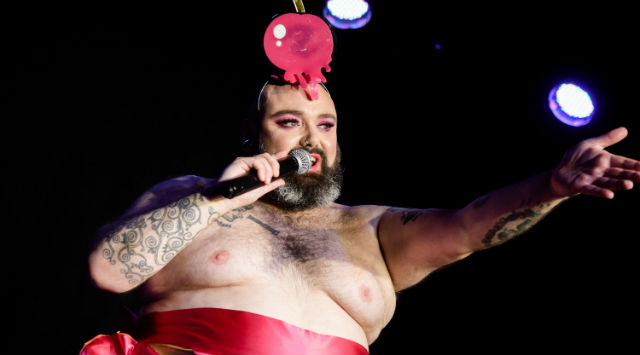
Society’s hatred for fat bodies is placed under scrutiny, in Alana Valentine’s Made To Measure. Ashleigh, our protagonist, is preparing for her wedding, and the process of getting a gown made, is provoking tremendous anguish and frustration. Her dress designer Monica is nice enough, but it seems neither is able to talk about Ashleigh’s large figure, without turning it into a problem. We see an insidious prejudice in operation, a pervasive attitude of disrespect that constantly subjects fat people to criticism and chastisement. Not only does Monica struggle to avoid comments that make her client feel bad, Ashleigh herself often believes those degrading remarks to be true. Society is her worst enemy, but Ashleigh’s own opinions about her own body, are not much better.

The playwright’s elucidations are detailed and often very powerful. With an important agenda to push, Valentine’s play has a tendency to be didactic and slightly dry, but Made To Measure is ultimately highly effective, in pointing out the objectionable nature of our fatphobia, and may even succeed, over its ninety minutes, to change the way we think and act. The production is beautifully assembled, with Melanie Liertz’s set and Verity Hampson’s lights particularly delightful and well-considered. Director Tim Jones’ straightforward approach imbues the work with a sense of integrity, but a more imaginative use of space could provide an improved theatrical experience.

Leading lady Megan Wilding brings to the stage, an exceptional vulnerability that does at least as much as the writing, to help us understand the gravity of the issue at hand. Her depiction of pain is thoroughly convincing, with a potency that defies any audience member to regard the play with even a minutiae of scepticism. Also impressive is Tracy Mann, whose multi-faceted interpretation of Monica prevents the show from oversimplification. It is an authentic performance that encourages us to appreciate the story’s themes with complexity and humanity. Sam O’Sullivan plays a variety of roles with admirable gusto, able to represent both the best and worst of our community, with charm and humour.

It seems that very few of us in capitalist societies are able to be satisfied with our physical appearance. The free market takes aim at our self-esteem, relentless in its attempts to make us insatiable consumers, by ensuring that we feel eternally inadequate. The issue is not whether there is anything wrong with Ashleigh’s body. The problem is that we think we have a right to an opinion about it. We routinely remove bodily autonomy from fat people, always allowing that transgression to occur under the pretence of concern and compassion. When we know to bestow genuine kindness upon one another, differences between persons fade away. When there is no capacity for kindness, even the most perfect creature can be made a monster.

www.seymourcentre.com

Review: Cake Daddy (Seymour Centre)

Venue: Seymour Centre (Chippendale NSW), Feb 16 – 22, 2019
Playwrights: Ross Anderson-Doherty, Lachlan Philpott
Director: Alyson Campbell
Cast: Ross Anderson-Doherty

Theatre review
When we first meet Ross Anderson-Doherty in his one man show, he plays a success story at Cakewatchers, an internationally renowned weight-loss programme. The performer’s large body is the location on which the farce takes place, as he takes us through a series of absurd guidelines, that claim to help individuals achieve some semblance of satisfaction for one’s own physicality, by becoming thin. Cake Daddy by Anderson-Doherty and Lachlan Philpott is an incisive summation of what is termed “diet culture”, the horrendous relationship many of us have with food and body image; that bottomless pit of cruelty, dealt by the self and by society, determined to infect each of us with an overwhelming sense of inadequacy.

As the jokes and songs pass us by, we see Anderson-Doherty shedding the spokesperson’s plastic facade, to reveal real experiences of a fat person who struggles to find self-acceptance. The disclosures are by no means original or new, but the honesty of the performer’s display of emotion, is channelled by director Alyson Campbell to communicate a remarkable poignancy that turns the show subtly, into a discussion about compassion, both for the self and for others. As Anderson-Doherty oscillates between hating his reflection, and loving the freedom of an emancipated mind, we witness the most authentic portrayal of humanity. Even when we have the answers to life’s big mysteries, there will always be hard work waiting to be done, in order to get through some of the days.

Musical numbers in the piece can sometimes feel extraneous, as we tend to lose a powerful sense of immediacy when Anderson-Doherty drifts into song, but to encounter his exceptional singing voice is an unequivocal pleasure. As comedian, his ability to read the audience is uncanny, and we find ourselves always kept on our toes by his vigilant stage awareness, although some of his pacing can be needlessly languid, in a production that is most effective when manic in tone. Cake Daddy skates close to self-deprecation, but its subject is never humiliated. In fact, we watch him in all his glory, and wonder if he actually shares in our vision of his greatness. However each person comes to dislike parts of themselves, it is crucial that one is committed to finding peace within, even if it proves an endless task.

www.wreckedallprods.com

Review: The Moors (Siren Theatre Co)

Venue: Seymour Centre (Chippendale NSW), Feb 6 – Mar 1, 2019
Playwright: Jen Silverman
Director: Kate Gaul
Cast: Romy Bartz, Thomas Campbell, Enya Daly, Brielle Flynn, Alex Francis, Diana Popovska
Images by Clare Hawley

Theatre review
It is the Victorian era, and Emilie has left London for the countryside, looking for love and employment. Out on the wily moors, she encounters all manner of strange people and occurrences, in Jen Silverman’s spoof of the gothic romance The Moors, a comedy that brings gentle subversion to a world that is often too corseted and restrictive, in its portrayal of what it means to be female. Through its surreal renderings of familiar tropes, old scenes are turned odd, and where there is usually softness, we find instead ideas that are sharp and twisted. Women are much more interesting than genres can portray, even in the early 1800s.

Directed by Kate Gaul, it is a fabulously moody atmosphere that supports the play’s dark humour. A queer sensibility frees up all its characters, including animals, to become unexpected, almost beyond our grasp; they just refuse to be pinned down. The production is probably slightly too restrained and not as extravagant in style as it could be, with the exception of Diana Popovska’s splendidly wild performance of the maid, alternately named Marjory/Mallory/Margaret, bringing us endless mirth by making creative choices that are as weird as they are joyful. Romy Bartz is a glamorous Agatha, a solid presence whose nuances add texture to the show, especially valuable in manufacturing a quality of heightened austerity so specific to the times.

The actors are well-rehearsed, and impressive with their mastery of the revolving stage, always perfectly timed with positions and gestures that offer up a series of sumptuous tableau. Fausto Brusamolino’s lights take us to where it is dreamy and erotic, and Eva Di Paolo’s costumes make certain that desire is kept a central theme. Composer Nate Edmondson surpasses all expectations with the astonishing detail in the sounds that he provides. We are spooked and tickled at the same time, thoroughly entertained by the purposefully arty approach to his portion of the storytelling.

We should always try to see people as atypical, even if the way we construct narratives, and thus understand the world, always insists that individuals are turned into types. We become more human when we display contradictions, and when women turn inconvenient, is when we can begin to fathom the truth about who we are. In a world that only sees us as madonnas and whores, we cannot hope to be real, when we are cast merely as objects that facilitate power structures in which we must be the losing party. When we dare to imagine ourselves as complex and unconventional, leaving behind all notions of categories to live out original lives, is when things can feel meaningful, even if we have to learn to get used to being thought of as prickly and difficult.

www.sirentheatreco.com

5 Questions with Romy Bartz and Enya Daly

Romy Bartz

Enya Daly: If our characters, Huldey and Agatha, went on the X Factor, who do you think would get further in the competition?
Romy Bartz: Agatha is the ultimate strategist and excels in competition. Although her singing voice may leave something to be desired, she would surpass Huldey and most likely go on to win X Factor. She would locate a weak spot in each contestant and use it to destroy them, pegging them off one by one until, by default, she was the last one stranding. Simon Cowell would be gobsmacked, but there you have it.

What have you learned from the character you’re playing, Agatha?
I am learning to be still and let other people do the work. I am learning to squash self-doubt and maintain a sense of self-assurance at all times. Agatha is incredibly ambitious and single minded in the pursuit of an objective. She is not afraid to use unorthodox methods to get what she wants, and she has an unwavering belief in her own power to bring about change. I love this, and I delight in playing such a strong and uncompromising woman!

What is your favourite stage of working on a production?
Definitely the technical rehearsal. The cast and crew are all trapped in a darkened theatre for around 12 hours and slowly the world of the play starts to form. All the elements – lights, sound, set and costume – are integrated like puzzle pieces and you sort of allow yourself to be enveloped by it. It can feel quite magical.

Do you keep a diary? If so, tell me (and the nosy public) the best secret you’ve got in there. If not, tell me the secret you WOULD put in there.
I kept diaries all through my teens and into my early twenties. I still have them somewhere. The ravings of a pubescent, emotional wreck! Everything that every happened went into them. I’m sure most of it was ‘shameless’, saucy and highly passionate. The secret that I would put in my diary, if I had one today, would be that I am terribly attracted to red heads who play the lute.

Have you ever harboured murderous thoughts about a sibling? Please elaborate.
No, but my children, who are two years apart, harbour murderous thoughts about each other constantly. Harbouring may not be the right word, more blatant thoughts constantly manifesting as violence. I suppose there is nothing more frustrating than sharing the space with someone who has known you forever and knows exactly which buttons to press in order to achieve maximum results.

Enya Daly

Romy Bartz: What do you enjoy most about playing Huldey and what are the challenges?
Enya Daly: I love her heart. She’s been given more than enough reason to be guarded and cold, but has miraculously remained earnest, transparent and hopeful. I think the most challenging thing about this play, from a technical standpoint, is finding and maintaining the lightness of touch and truthfulness required to make the comedic moments sing.

What was it about the play, The Moors, that made you want to audition?
Honestly, when I read the audition brief, I smelt the whiff of a period drama costume and thought, “I’m there!”. I’m a period drama fanatic. I love how heavily loaded with subtext and coded behaviour they are. When I discovered that this play is not a traditional period drama but takes that familiar form and turns it on its head by subverting traditional representations of gender, I was hooked.

If Huldey had a gaming avatar, what would it look like?
I’m visualising a gauche combination of Daenerys Targaryen from Game Of Thrones, Miss Scarlet from Cluedo and Carmen Sandiego (that last one is for the 90s kids). The design should clearly be an attempt to conjure up an air of mystery and intrigue. The more elaborate, the better.

If Huldey was alive today in Sydney, Australia what would her circumstances be?
There is no doubt in my mind that she’d be a budding social media influencer. She’d have an Instagram, Snapchat, YouTube channel, Twitter and blog. Somehow, I think she has what it takes to be quite a fabulous social media influencer. She’s dramatic, loves attention and has no filter. A long-term goal of hers would be to have her very own reality TV show. She’d definitely still be living with, and supported by, her parents.

What is your favourite part of the rehearsal process?
I love the freedom you feel when you’ve gotten off book but are still sculpting each moment in the piece. I find that stage of rehearsal to be very playful.

Romy Bartz and Enya Daly can be seen in The Moors by Jen Silverman.
Dates: 8 Feb – 1 Mar, 2019
Venue: Seymour Centre