Review: Mary Stuart (Sydney Theatre Company)

Venue: Roslyn Packer Theatre at Walsh Bay (Sydney NSW), Feb 5 – Mar 2, 2019
Playwright: Kate Mulvany (after Friedrich Schiller)
Director: Lee Lewis
Cast: Fayssal Bazzi, Caroline Brazier, Simon Burke, Peter Carroll, Tony Cogin, Andrew McFarlane, Rahel Romahn, Helen Thomson, Matthew Whittet, Darcey Wilson
Images by Brett Boardman

Theatre review
Queen Elizabeth I of England must finally decide whether to sign the death warrant of her cousin Mary, Queen of Scots, after 19 years’ imprisonment. In Kate Mulvany’s adaptation of Friedrich Schiller’s 1800 play Mary Stuart, we look at the final days of this historical feud, paying attention to political machinations, as well as the fascinating psychological processes that the two women would have had to go through, in what is clearly the most difficult and traumatising of human experiences. A highly intelligent work, Mulvany transposes the ancient story into a contemporary tale foregrounding themes that matter today, with renewed focus on the feminist implications of this conflict between powerful women.

Surprisingly funny, featuring witty dialogue that transcends the ages to connect with our everyday ears, Mulvany transforms the royals into flesh and blood individuals that we can easily relate to. With none of the pretension often associated with period pieces about European queens and kings, we are free to examine all the sublimated dynamics between Elizabeth and Mary, to come to our own conclusions about power structures, whether or not one chooses to share the playwright’s feminist lens. Mary Stuart is also effective in delivering drama, powerful in the way it conveys the palpable emotions of a woman compelled to put a loved one to death, and another who faces her own demise.

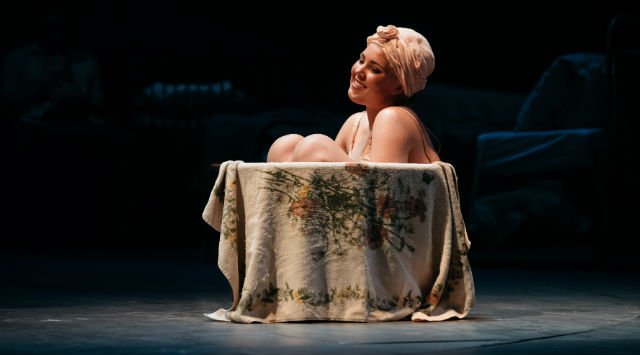
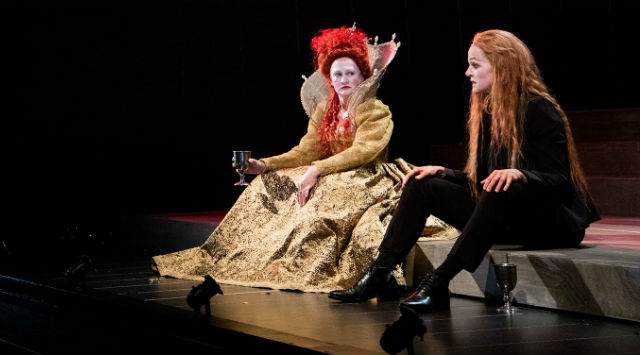
The vast auditorium is put to good use by Elizabeth Gadsby who situates the action in a suitably grand setting, palatial but austere. Lights by Paul Jackson are especially effective in the graver sections, to facilitate the sensation of mounting pressure as we move toward the inevitable. Music and sound can sometimes be too subdued, especially in the earlier more comedic scenes, but when things turn serious, Max Lyandvert is certainly on hand to heap on the tension. Costumes are a highlight, perhaps predictably, with Elizabeth’s opulent gowns really making an impact. Mel Page’s work on all the women’s looks are unequivocally remarkable.

Director Lee Lewis exercises a stylistic restraint over her stately presentation, determined not to let pomp and ceremony distract from its central concerns. Visuals can sometimes feel sparse and incommensurate with our imagination of both the queens’ worlds, but Lewis’ strength in elucidating rationale behind all manner of human behaviour, is sublime. Actor Helen Thomson is electrifying as Elizabeth, appropriately majestic and piercingly humorous, insisting that entertainment value accompanies all the intellectual stimulation that the play so doggedly provides. Thomson continually reveals layers to the queen throughout the two-hour duration, consistently unpredictable with her depictions, including moments of poignancy that are quite unexpected. Her rendering of Elizabeth as a real and authentic person, is an astounding achievement. Mary is played by Caroline Brazier, whose very deliberate portrayal of grace under pressure is as beguiling as it is intriguing. Her penultimate scene of exposure is truly arresting, as she performs an outpouring of intense and contradictory emotions that gives us a glimpse of the woman under the crown.

Women compete because our power is scarce. We are pit against one another, and we participate in these battles, rarely challenging these absurdly unjust systems and the beliefs that they perpetuate. American Professor Emerita of Sociology and Women’s Studies, Gail Dines suggests that empowerment is a false hope, for to place ourselves within patriarchal hierarchies necessitates the exploitation of many women. Liberation on the other hand, evokes a collectivism that prohibits oppression of any kind. The two queens in Mary Stuart were able to wield power of all kinds, but it is clear that their lives were never their own. Enslaved by their fathers, their states and their religions, we watch them at war, inside a living hell not of their own making, and wonder how much of our own lives are just the same.

www.sydneytheatre.com.au

Review: The Harp In The South (Sydney Theatre Company)

Venue: Roslyn Packer Theatre at Walsh Bay (Sydney NSW), Aug 16 – Oct 6, 2018
Playwright: Kate Mulvany (from novels by Ruth Park)
Director: Kip Williams
Cast: Joel Bishop, Luke Carroll, Tony Cogin, Jack Finsterer, Benedict Hardie, Emma Harvie, Anita Hegh, Ben O’Toole, Lucia Mastrantone, Heather Mitchell, Tara Morice, Rose Riley, Rahel Romahn, Jack Ruwald, Guy Simon, Bruce Spence, Helen Thomson, Contessa Treffone, George Zhao
Images by Daniel Boud

Theatre review
When Margaret Kilker met Hugh Darcy in 1920, life in rural Trafalgar was idyllic but inert. The couple, both Irish-Australian, young and hopeful, soon headed to Sydney for a brighter future, setting up home in Surry Hills, where they found community, and formed the foundations of a legacy never intended or even imagined.

The Harp In The South is a six-and-a-half hour epic, in two parts, by Kate Mulvany, based on two of Ruth Park’s novels from the 1940’s and another from 1985. Composed mainly of migrant perspectives as experienced by three generations of Irish women, the play offers contemporary audiences a version of our city’s recent history that feels counter-cultural, one that is derived not from contrivances of the establishment, but from stories told by the poor and disadvantaged. All the wonderful things we associate with this city, are built upon the fortitude of those who bear injustice and genuine hardship. Instead of hearing once again about the great white forefathers who take every credit, The Harp In The South restores the voices of forgotten individuals, and places them in the mythical centre of Sydney’s eminence.

Mulvany’s adaptation is exhilarating and witty, replete with irresistible drama, and brimming with inspiration. A palpable soulfulness informs her every manoeuvre, revealing a deep love of the subject and the material, that proves to be completely and profoundly affecting. Although concerned with a cultural specificity, Mulvany’s play contains a sensibility of inclusiveness, that understands the diverse realities of those to whom this story is relevant. The Kilker-Darcy household leads the action, but their truth can only resonate within a context of multiculturalism, and the accompanying portrayals of Indigenous, Chinese, Greek and Italian characters provide not only a degree of ethnological accuracy, they also make an important statement about the way we have, for a long time, sought to share space in harmony.

Director Kip Williams’ vision is exquisite, for a production extraordinary in what it achieves, not only in aesthetic terms, but even more valuable is its promise to galvanise society, through highly persuasive, and sentimental, depictions of our common past, involving all the complexities in our endeavours to be good families, friends and neighbours. Even though the events that unfold are from a different era, every scene rings true, with a familiarity that emanates from its absolute honesty. The Harp In The South is tremendously soulful, and it speaks to all who have an intimate connection with Surry Hills and its surrounds.

Flawlessly designed, the show looks and sounds magnificent. David Fleischer’s sets, Nick Schlieper’s lights and Renée Mulder’s costumes, form an impeccable collaboration delivering theatrical grandeur, with a pervasive and melancholic nostalgia best described as beautiful. Music by The Sweats and sound design by Nate Edmondson, combine new with old, real with abstract, seamlessly cajoling us from one dimension to another, making us laugh and cry at will. The songs we choose to sing, are the truest indication of who we are, and the many melodic renditions of The Harp In The South are like spiritual disclosures, engineered to touch us in the heart and in the mind.

A large cast of actors, play a very large number of characters, each one fabulously evocative, no matter how brief their appearance. Contessa Treffone, marvellous as both Josie and Dolour, is onstage for a substantial portion of this durational challenge, persistently impressive with her spirited and delightful comedy, and triumphant with the integral vulnerability she brings to the show. Margaret and Hugh are brought to life by Anita Hegh and Jack Finsterer, both reliably poignant, but also cuttingly humorous when appropriate. Heather Mitchell too is splendid, and thoroughly amusing, as the matriarch Eny Kilker.

Unforgettably funny, are Benedict Hardie and Rahel Romahn in all their innumerable guises, although Helen Thomson is a clear favourite, unequivocally outstanding with an incomparable volume of laughs, particularly wonderful as the bawdy brothel madam Delie Stock. Lesbian nuns Theopilus and Beatrix are a thrilling pair, performed playfully yet tenderly, by Lucia Mastrantone and Tara Morice, endearing as a sisterly set, and independently formidable in an astonishingly varied range of personalities.

We can proclaim to know ourselves, but art can often surprise with new epiphanies. There is no end to how humanity can understand itself, and it is imperative that we are committed to finding ever greater truths, if we should continue to believe in better tomorrows. We may not be direct descendants of the people in The Harp In The South, but they show us so exhaustively, who we are, as Sydneysiders, as Australians. The shoulders we stand on were not always solid, but all our strength today must be attributed to that past.

www.sydneytheatre.com.au

Review: Saint Joan (Sydney Theatre Company)

Venue: Roslyn Packer Theatre at Walsh Bay (Sydney NSW), Jun 5 – 30, 2018
Playwright: George Bernard Shaw (additional text by Emme Hoy, Imara Savage)
Director: Imara Savage
Cast: Gareth Davies, John Gaden, Brandon McClelland, Sean O’Shea, Socratis Otto, Sarah Snook, Anthony Taufa, David Whitney, William Zappa
Images by Brett Boardman

Theatre review
Joan of Arc never even made it to her twenties. Executed at the age of nineteen, her story represents the worst of our misogyny, and in director Imara Savage’s version of George Bernard Shaw’s play, that absurd fear of powerful women is given elucidation, as we see state and religion go to great lengths to exterminate Joan, so that the threat that she poses to the patriarchy is banished. In Saint Joan, instead of the usual veneration and idolatry, a war hero is swiftly and mercilessly taken down, for the sole reason of her gender.

Men can have daring ambition and resolute faith, but in a girl, those qualities are turned into the charge of heresy. Shaw’s original vision proclaimed “no villains in the piece,” but Saint Joan is, on this occasion, thoroughly subverted, to expose the inhumanity of forces we hold in reverence, of those so much power is lavished upon. Church and government do not get off scot-free in this rendition of Joan’s legend. Their guilt in the historical episode, is brazenly exposed. Our father figures are rightfully condemned, made to own up to the brutal murder of an heroic warrior.

Full of passion, the work is powerful and gritty, made spectacularly riveting by the presence of its leading lady. Sarah Snook is an unequivocal sensation in the role, equally intense whether depicting vulnerability or majesty, marvellously incisive with the delivery of each line. She conveys meaning and emotion with admirable depth and a disarming authenticity, having us pining for her every artistic bestowment. Her interactions with the cast are replete with chemistry, and the men (all other players here are the culpable masculine) bring generous support, often brilliantly engaging in their own right.

David Fleischer’s set design is a restrained, highly sophisticated evocation of our traditional institutions, with a heavy curtain that encapsulates all that is required to express a simultaneous sense of awe and oppression. Lights by Nick Schlieper and sound by Max Lyandvert, take us through atmospheric and spatial transitions with admirable precision, manipulating our instinctual responses with great dexterity, so that our attention is focused always and only, on the exact resonating point.

Evil has a knack for hiding in plain sight. What was once a story about men being dutiful, is today revealed to be a site for the unravelling of abhorrent systems that thrive on ruthless subjugation. Where we were once entangled in the ambiguity of Joan’s assertions and behaviour, we can now depart from the doctrines that had given justification for the unforgivable persecution of a girl who had done nothing wrong. Corrupting forces will remain, but our ability to act virtuously with courage, truth and justice, is forever in ascension.

www.sydneytheatre.com.au

Review: The Resistible Rise Of Arturo Ui (Sydney Theatre Company)

Venue: Roslyn Packer Theatre at Walsh Bay (Sydney NSW), Mar 21 – Apr 28, 2018
Playwright: Bertolt Brecht (translated by Tom Wright)
Director: Kip Williams
Cast: Mitchell Butel, Peter Carroll, Tony Cogin, Ivan Donato, Anita Hegh, Brent Hill, Colin Moody, Monica Sayers, Hugo Weaving, Charles Wu, Ursula Yovich
Images by Daniel Boud

Theatre review
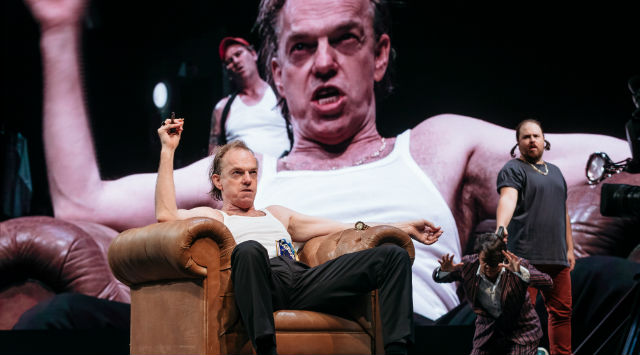
A gangster film is projected on screen, as we witness it being shot on a sound stage. The action happens across not two, but three platforms. We watch a film, the making of the film, and a theatre production, all simultaneously and frantically taking place before our eyes. Bertolt Brecht’s The Resistible Rise Of Arturo Ui is concerned with artifice and image, written at the time of Al Capone and Bugsy Siegel. Director Kip Williams’ decision for a multimedia presentation may seem initially, to be little more than gimmickry, but his profusion of Brechtian devices transcend academic tribute, proving themselves relevant and ultimately, highly effective.

Brought up to date by Tom Wright’s very shrewd adaptation, Arturo Ui’s story is now unquestionably of our time. A criminal hungry for attention, he stops at nothing to satisfy an interminable and narcissistic urge for notoriety. To make his presence a permanent fixture, Arturo takes on political ambitions in order that his influence may turn pervasive and inescapable. We can think of more than a few public figures who operate in a similar vein. It is a witty and wise transposition, taking Brecht’s meditations on the Hitler phenomenon and applying them to the current state of our world. Retaining the spirit of epic theatre, Wright’s work is dark but rarely pessimistic. A parable and cautionary tale, it demonstrates human nature at its worst, but is deliberate with its manipulations of our autonomy as audience and citizens. It always reminds us of our capacity to resist and reverse the actions of those with an appetite for destruction.

Williams’ production is sophisticated, often extravagant and flamboyant in its attitude and accompanying style. Its theatrical grandness is alluring; we find ourselves seduced by its many clever manoeuvres, and are surprised by our unequivocally political response to its ideas. The show knows what it wants to do, and achieves it well. Sections of dense dialogue might be lost, when we get distracted by the very busy stage, but the simple overall point of it all, is clear and powerful under Williams’ interpretations. The director’s ability to shift our attention between screen and stage becomes impressive, once we get over the shock of the unusual. Once we stop questioning the validity of the complicated form being presented, the efficacy at which information is being conveyed, through its complex amalgamations, is quite astounding.

The set takes the shape of an efficient film studio that accommodates complicated camera work whilst prioritising direct audience access, designed by Robert Cousins with appropriate restraint. Nick Schlieper’s lights are attractive and suitably dramatic, conspiring closely with cinematography to provide stunning live visuals with some very advanced video technology. Justine Kerrigan’s adventurous and imaginative cinematography is quite an amazing thing to behold. Also deeply satisfying is Stefan Gregory’s music, inspired by early genre films, and assisted by excellent sound engineering, to offer great drama and intrigue, electrifying from prologue to epilogue.

Hugo Weaving’s performance as Arturo Ui exhausts the gamut of emotions, as well as all the superlatives a critic is tempted to use in describing his brilliance. If there is ever perfection in art, Weaving embodies it here. The man is in charge every second, and we are putty in his hands, hopeless and lost in whatever he wishes to impart. His skill is second to none, and his mesmerising charisma is bewildering. It is hard to come close to the standard that he sets, but others in the cast too, are truly remarkable. Peter Carroll in particular, contributes extraordinary incisiveness as Dogsborough, depicting the blurred lines of good and bad with wonderful flair and persuasiveness.

If we see the natural world as an organism with tendency for chaos, and humankind’s insatiable need for creating order, in our own image, a kind of violation, then man’s obsession with power is an abomination. Arturo Ui goes against everything that we want to think of as good and right in the world, in his continual seizure of power and domination over every being, but it is likely that the only language he and his ilk understand is power, and to rival them requires that we take mirroring actions. Pacifism and the qualities of integrity that it encompasses, may be a more idealistic way of approaching peace, but in The Resistible Rise Of Arturo Ui it is hard to not see these romantic notions as ineffectual or much worse, calamitous. It is time perhaps to find better ways to fight fire with fire.

www.sydneytheatre.com.au

Review: Muriel’s Wedding (Sydney Theatre Company)

Venue: Roslyn Packer Theatre at Walsh Bay (Sydney NSW), Nov 6, 2017 – Jan 27, 2018
Book: PJ Hogan
Music & lyrics: Kate Miller-Heidke, Keir Nuttall (with songs by Benny Andersson, Björn Ulvaeus, Stig Anderson originally written for ABBA)
Director: Simon Phillips
Choreographer: Andrew Hallsworth
Musical Director: Isaac Hayward
Cast: Annie Aitken, Prue Bell, Ben Bennett, Briallen Clarke, Justine Clarke, Hilary Cole, Tony Cogin, Helen Dallimore, Dave Eastgate, Manon Gunderson-Briggs, Jaime Hadwen, Sheridan Harbridge, Mark Hill, Madeleine Jones, Caroline Kaspar, Adrian Li Donni, Luigi Lucente, Stephen Madsen, Maggie McKenna, Kenneth Moraleda, Laura Murphy, David Ouch, Tom Sharah, Connor Sweeney, Gary Sweet, Aaron Tsindos, Michael Whalley, Christie Whelan Browne
Images by Lisa Tomasetti

Theatre review
Like legions of girls through the ages, Muriel was brought up to believe that life is incomplete without a man. It is a fallacy so deeply ingrained into our consciousness, that many are never able to outgrow the absurd notion, that marriage is required as a fundamental validation of our very being. In PJ Hogan’s Muriel’s Wedding, we see a young woman responding to her subjugation; it is a coming-of-age story, an underdog story, and a feminist proclamation. Once a much-loved feature film, now 23 years later, it returns to prominence in the guise of a dazzling new stage musical.

Genuinely funny, and irresistibly moving, Muriel’s Wedding is an unequivocal triumph. Original songs by Kate Miller-Heidke and Keir Nuttall are brilliantly conceived, telling the story of an everygirl, by rigorously combining the many facets of Muriel’s universe. Her thoughts, desires and emotions, along with the people and places that attempt to define her, and the symbolic cultural emblems of her epoch that she cannot escape (including her tremendous affection for ABBA); all are present in the songs that passionately depict her narrative of emancipation, and that envelope us with a remarkable sense of immediacy and pertinence, to have us hopelessly invested.

Direction by Simon Phillips and choreography by Andrew Hallsworth, conspire to deliver an unabashedly sentimental journey, taking us through a seamless blend of happy and sad moments that constitute all of Muriel’s bittersweet experiences. We never lose sight of the gravity so essential and universal in her painful story, but every episode of false hope and disappointment, brims marvellously with theatrical hilarity. This is Australian humour at its best, ironic and self-effacing. Supporting players Michael Whalley (as brother Perry) and Christie Whelan Browne (as arch nemesis Tania Degano) create some very sharp comedy, and we greet each of their appearances with rapturous laughter. These are ugly images of who we are, but there is no denying the authenticity of what we see, and the embarrassing social dysfunctions that they embody.

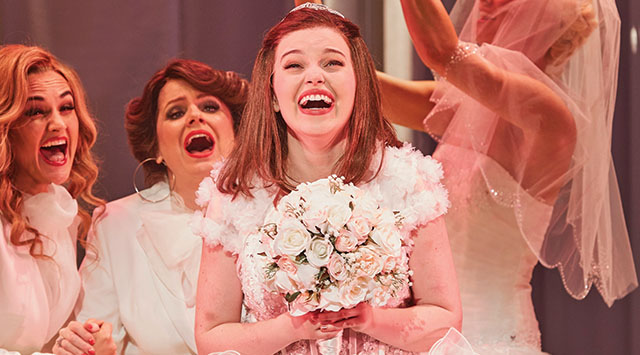
Maggie McKenna exceeds every unrealistic expectation, in taking on the role of our all-new singing Muriel. The performer is quite simply perfect for the part, with a glorious voice that drives each lyric powerfully into our minds, an extraordinary quotient of charisma that disarms and opens wide our jaded hearts, and an incredible likeness with our memory of the old film version that has proven unshakeable. The more we fall in love with the protagonist, the more we can enjoy the show, and on this occasion, McKenna has us head over heels, completely bowled over. No less wonderful, is Madeleine Jones as Rhonda, bestie and catalyst for Muriel’s self-discovery. Jones is a strong, gutsy presence, who brings in full force, the rebellious spirit crucial to Muriel’s awakening. The two make a formidable pair, invulnerably tight in harmony and chemistry, for a portrayal of a resplendent friendship that lucky ones will find deeply familiar.

There are a small number of forgivable flaws in the production, including the earless casting of Muriel’s father, a strangely flat set design involving the Sydney harbour bridge, and early portions of the book that seem to require a cursory knowledge of the film. These aside, the artistic accomplishments here are significant and monumental, not least of which, are costumes by designer Gabriela Tylesova, who draws joyful inspiration from the original, and from the work of fashion notables like Viktor & Rolf, Roberto Cavalli and Camilla Franks. Straddling opposing ends of glamour, from kitsch to exquisite, for a visual sensibility informed by a derivative and hodgepodge aesthetic, that our colonised nation is never able to rid of.

Muriel’s Wedding is the greatest Australian musical yet. Full of character and inventiveness, it is unceasingly entertaining whilst capturing so much of who we are, and who we wish to become. More than a successful reboot of a modern classic, it brings together some of our biggest talents, for the birth of something that feels new and important, having arisen from adventurous negotiations of what is usually a restrictive art form. It is a big day, and we are more beautiful than we had ever been.

www.sydneytheatre.com.au

Review: Velvet (Roslyn Packer Theatre)

Venue: Roslyn Packer Theatre at Walsh Bay (Sydney NSW), Jul 26 – Aug 20, 2017
Director and creator: Craig Ilott
Musical director: Joe Accaria
Choreographer: Lucas Newland
Cast: Joe Accaria, Kaylah Attard, Emma Goh, Marcia Hines, Mirko Köckenberger, Rechelle Mansour, Tom Oliver, Craig Reid, Stephen Williams

Theatre review
The show begins when a young man appears on stage with luggage. Dressed as a Jehovah’s Witness, or maybe a Mormon, the wide-eyed innocent finds himself in a new city, and we imagine that he encounters disco for the first time. This would mean that the action takes place in the late 1970s, when Donna Summer and the Bee Gees ruled the charts, and in New York, the notorious night club Studio 54 was the epicentre of society and culture. Craig Ilott’s Velvet is essentially a variety show, an homage to the era of the hustle, the afro and cocaine. All is light and frothy, with the protagonist’s journey offering a vague sense of narrative, that holds everything together.

At the centre is a slew of hits, unforgettable songs that defined a generation, marvellously reassembled and executed by musical director Joe Accaria, who ensures that their sparkly appeal is always accompanied by a deep appreciation for the soul and funk roots of these dance-floor stompers. Living legend Marcia Hines plays the diva with effortless grace, trusting that her exceptional voice to take us away from daily humdrum to her realm of sequinned ethereality. Leading man Tom Oliver works harder to prove himself, in archetypal musical theatre style, energetic and earnest in his efforts to reach out to everyone in attendance. Acrobats and circus performers provide excellent spectacle and thrills, each of them accomplished and beautiful. The production relies heavily on two very versatile talents Kaylah Attard and Rechelle Mansour, to maintain its effervescence but later sections require more surprises, perhaps in the form of bigger costumes or additional dancers, to sustain our enthusiasm.

Colours of the rainbow flag make more than a few appearances. We cannot be sure if our boy comes out as gay, but he certainly does come out of his shell in the process. Disco may be about debauchery and hedonism, but we remember it also, for the liberation it inspires and represents, even today. At its best, disco is uplifting while it keeps us feeling dirty. It makes us think of sex as salvation, and creates a space where heaven and hell can meet to reveal so much that is dichotomous about being human.

www.velvettheshow.com

Review: 1984 (Sydney Theatre Company)

Venue: Roslyn Packer Theatre at Walsh Bay (Sydney NSW), Jun 28 – Jul 22, 2017
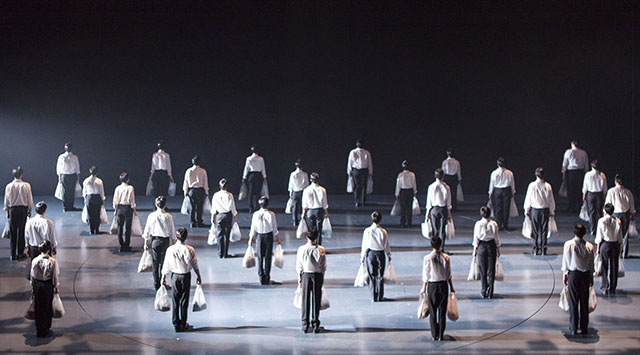
Playwrights: Robert Icke, Duncan Macmillan (based on the George Orwell novel)
Directors: Robert Icke, Duncan Macmillan
Cast: Molly Barwick, Paul Blackwell, Tom Conroy, Terence Crawford, Coco Jack Gillies, Ursula Mills, Renato Musolino, Guy O’Grady, Yalin Ozucelik, Fiona Press
Image by Shane Reid

Theatre review
People often look back at calamitous histories, and are grateful that they had emerged unscathed. In Robert Icke and Duncan Macmillan’s version of 1984, dystopia is not only an imagined future, but also a tragic past that its characters are happy to have left behind. When the worst is over, we think that life returns to a state of healthy normalcy. We choose to believe that those who had committed atrocities are wiped away, and all is good in the world again.

In our need to survive, memory has to become elastic. Self-preservation necessitates that we forget the painful, and in the case of 1984, forgive the unforgivable. Facts are erased, so that ideologies can dominate. The play portrays a simultaneous past and future, but its concern is firmly on the now. It believes in an essential sense of truth, along with the human tendency to obfuscate those truths, in order that power may be won and lost.

With obvious parallels with current political events, it is tempting to say that Orwell’s story is more pertinent today than ever before, but societies have never been pure. Certainly, technology does play an important part in how we control one another, but long before the discovery of electricity, men had sought to suppress thought and expression, with the sole intention of gaining influence and authority. Using lies as apparatus and methodology, devious personalities have risen to positions of leadership, while the rest of us are turned complicit, through acquiescence, obedience and silent surrender.

It is a sleek production, conceived and executed with an admirable sophistication. Orwell’s philosophical interests are powerfully presented, translated from book to stage effectively, though not always with great clarity. The protagonist Winston’s existence is a confused one, and on certain levels, we are accordingly, perhaps appropriately, bewildered. Its messages are unambiguous, however, with all of 1984‘s prominent themes and ideas, articulated emphatically, with conspicuous relevance and urgency.

Chloe Lamford’s scenic design transforms Orwell’s original futuristic outlook into a retrogressive frame of reference; after all, we are now looking at the world 33 years ago. Lights by Natasha Chivers and sound design by Tom Gibbons, play integral roles in the brutal depiction of ruthless tyranny. The assault on our senses is indeed severe, with aggressive noises and strobes unrelenting in trying to seize our nerves and inflict terror.

Actor Tom Conroy has the unenviable task of performing Wilson’s extended suffering, including a lengthy scene featuring quite gruesome physical torture. His work is painfully convincing, and the vulnerability he brings to the role, insists that we are affected by all his adversities. Terence Crawford turns up the drama as the frighteningly menacing O’Brien. His operatic approach to the enigmatic personality seduces us, keeps us on edge and captivated, as the play’s savagery escalates.

The deep pessimism of 1984 demands a strong response. It aims to provoke us into radical thought, if not radical action, with its revelations about a world ruled by evil. We think about governments, religions and corporations, the insidious ways in which they impact upon our lives, how they encroach upon our liberties, and the deficiencies of our resistance. Survival requires degrees of submission, but within any submission, the spirit of defiance can always be found, whether minuscule or vigorous, to spark a change that could pivot the course of history, one can only hope, for the better.

www.sydneytheatre.com.au | www.1984play.com.au

Review: The Play That Goes Wrong (Roslyn Packer Theatre)

Venue: Roslyn Packer Theatre (Sydney NSW), Apr 5 – 23, 2017
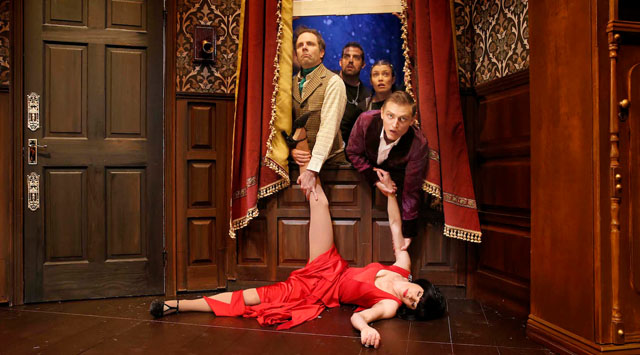
Playwrights: Henry Lewis, Jonathan Sayer, Henry Shields
Directors: Mark Bell, Sean Turner
Cast: Darcy Brown, Adam Dunn, Luke Joslin, George Kemp, James Marlowe, Brooke Satchwell, Nick Simpson-Deeks, Tammy Weller

Theatre review
When embarking on any project, passion is a key propulsive ingredient that will make things happen, but nothing will go well if passion is the only positive quality it has going for it. A community theatre group in Cornley, UK puts on a 1920s murder mystery, with little more than the fire in their bellies. The lack of talent and skill onstage and off, generates a series of fantastic mishaps that constitutes the high energy comedy brilliance we find in The Play That Goes Wrong.

It is pure farce and slapstick, at their maximum amplification. Stories and characters are barely relevant, in this ambitious exploitation of high octane physical comedy, involving people and objects falling about constantly, in the most satisfying manner. It is an old-fashioned style of show, made new by its unusually voracious need for speed and excitement. Directors Mark Bell and Sean Turner may not be visionaries in the conventional sense, but what they brings to the stage is extraordinarily precise and wildly imagined. The laughs on offer here are ceaseless, limited only by the audience’s ability to respond with a sustained level of energy that could match the hilarity that unfolds on stage.

The charismatic cast gives an exceptionally tight performance. In the presentation of a play where everything goes wrong, nothing is allowed to falter, and the actors are simply impeccable. George Kemp and James Marlow display no limits to their capacity for silliness, proving themselves to be very endearing indeed. Brooke Satchwell and Luke Joslin impress us with their physical presence and agility, allowing their beings to flail and flounce about with great force and ingenuity, for unimaginably powerful comic effect.

Stage managed by Anneke Harrison, the production’s technical excellence is crucial to its success. The Play That Goes Wrong can be seen as a love letter to stage managers everywhere, the unsung heroes of all the great shows we have ever seen. These women and men make themselves invisible, so that we can lose ourselves in the illusion of every staged moment. We fawn over actors and the words of playwrights, but forget the operations out of sight that allow magic to happen, until they draw attention to themselves when things do go wrong. The character of the inept Cornley stage manager (played by Adam Dunn) is a hoot, but also a constant reminder of the magnificence that has to take place backstage in order that theatre can do its best.

www.theplaythatgoeswrong.com.au

Review: Chimerica (Sydney Theatre Company)

Venue: Roslyn Packer Theatre at Walsh Bay (Sydney NSW), Feb 28 – Apr 1, 2017
Playwright: Lucy Kirkwood
Director: Kip Williams
Cast: Matthew Backer, Gabrielle Chan, Jason Chong, Tony Cogin, Geraldine Hakewill, Brent Hill, Rebecca Massey, Monica Sayers, Mark Leonard Winter, Anthony Brandon Wong, Charles Wu, Jenny Wu
Images by Brett Boardman

Theatre review
Massacres, no matter how catastrophic, can get forgotten. Unlike the 9/11 attacks that we memorialise everyday, fuelled partially by economic imperatives of the USA, incidents such as the 1989 Tiananmen Square protests have faded away with time, and in this particular case, with rigorous effort on the part of Chinese officials.

The arresting image of a man standing in front of battle tanks however, still packs a punch, and 27 years after the event, it remains in circulation as one of the most influential and famous photographs ever taken. The enigma of Tank Man leaves many questions unanswered. It is an irrefutable document of an historical moment, but nothing of that moment (or the moments leading up to, and thereafter) has ever been explained.

Playwright Lucy Kirkwood’s imagination goes wild in Chimerica. It is 2012, and we meet a fictive photographer, Joe, who had famously captured the shocking moment at Tiananmen Square. He is now on a tenacious search for Tank Man, determined to uncover the truth, and through his escapades, we explore China as it stands today, or at least, are offered a Western conception of China’s current state of affairs. It is predictably precarious, for an American writer to offer critical assessment of the Chinese experience, but Kirkwood brings balance to her piece by portraying American institutions with a comparable level of disparagement; they are as bad as each other, perhaps.

The narrative of Chimerica is thoroughly enjoyable, a thriller that manages to grip right from the start, and that delivers a formidable jaw-dropper at its end. In this production however, details and personalities in the fairly complex story can become confusing. Direction by Kip Williams establishes a tautness in pace and atmosphere that makes for enthralling viewing, aided by Nick Schlieper’s very clever and diligent lighting design, but uneven acting for the main roles prevents the show from reaching its greatest potential.

Mark Leonard Winter is convincing as Joe the photographic journalist, but the emotional dimensions to his depictions often feel too vague and distant. The other lead character Zhang Lin is played by Jason Chong, who delivers several captivating scenes of poignancy, but the actor struggles to overcome the role’s quality of mystery, and he too is unable to help the audience connect at a more satisfying depth. Scene-stealer Charles Wu sparkles the brightest in two smaller parts. As Benny, he is refreshing, lively and charming, and as young Zhang, Wu is authentic and engaging. Also notable are the twenty performers who make up the ensemble, all impressive with their physical discipline, all in command of their excellent, and crucial, collective presence.

The song Long De Chuan Ren (Descendants of the Dragon) is a recurring sonic motif, introduced by sound designer The Sweats with wonderful inventiveness and cultural sensitivity, to orchestrate a representation of Chinese culture and its people, throughout the play. The song likens China to a dragon, a creature to be feared and revered, and it is true that iron fists have always ruled the nation, throughout different centuries, dynasties and governments, but the country is no stranger to revolutions. Whether or not we think of our governing mechanisms as democratic, systems of oppression will always attempt to ambush and exploit how we live, and it is up to the masses to find a way to resist, and to overturn the forces that wish to breach each and every one of our human rights.

www.sydneytheatre.com.au

Review: Speed-The-Plow (Sydney Theatre Company)

stcVenue: Roslyn Packer Theatre at Walsh Bay (Sydney NSW), Nov 8 – Dec 17, 2016
Playwright: David Mamet
Director: Andrew Upton
Cast: Rose Byrne, Damon Herriman, Lachy Hulme
Images by Lisa Tomasetti

Theatre review
It is the simple story of a man caught between good and evil, one that never seems to get old. It is the eternal experience of us all, no matter where or when in the annals of history we find ourselves. Bob is a Hollywood executive who has to choose between art and commerce, and in David Mamet’s Speed-The-Plow, that relationship is a strictly dichotomous one. Art is good, commerce is bad, and like the devil and angel who take up traditional residence on either sides of our minds, Bob finds himself caught in a tug-of-war between Karen and Charlie, each one neatly representing each side of the argument.

This basic premise is stretched out to fill a 90-minute play, but it feels deficient, lacking in depth despite its thorough expositions on money, work and benevolence. Andrew Upton’s direction gives the show an engaging sense of momentum, but Mamet’s words are only occasionally resonant, almost as if philosophy is sacrificed in the effervescence and tempo of the presentation. We enjoy the dynamics between characters, and are titillated by the suspicious duplicity that may or may not colour their intentions, but ultimately, the audience is left with nothing fresh or inspiring, even though a barrage of noisy ideas seem to be thrown about on stage ad nauseam. Design by David Fleischer does well in providing a visual focus ensuring that the small play does not get lost on a very large stage, but the overly minimal set in Act Two seems awkward for both players and slightly confusing for the audience.

Damon Herriman has a powerful start in the role of Bob, every bit the eighties corporate monster and womaniser, but is unable to sustain our interest as the character transforms. The play allows the secondary personalities to overwhelm Bob, while keeping narrative focus on his predicament. Even though the actor’s conviction is clear to see, it seems that there is little in the text that lets our leading man remain arresting after Act One. Karen is played by Rose Byrne, who brings surprising complexity, along with excellent comic timing and intellectual acuity to the production. Her interpretation of the ingénue is by far the most exciting element of the show, requiring us to pay close attention to all her purposeful nuances, while challenging prejudices as they pertain to female ambition, in this world of cutthroat business wretchedness. Charlie is a stereotypical entertainment desperado, performed by the imposing Lachy Hulme, who luxuriates in every opportunity for heightened tough guy drama.

Mamet’s writing has no room for grey areas. Our protagonist can only choose between good and evil, art and power. Their inability to recognise the realistic possibilities of negotiating between polarities, detracts from how we are able to identify with the story. We all live between black and white, having to make decisions that are never completely ideal, but most of us are able to find points of balance that are at least momentarily satisfactory. We all want our cake and eat it too, but it is this constant shifting of circumstances and choices that gives each day its corporeal vibrancy.

www.sydneytheatre.com.au