Review: The Lieutenant Of Inishmore (New Theatre)

Venue: New Theatre (Newtown NSW), Apr 24 – May 26, 2018
Playwright: Martin McDonagh
Director: Deborah Mulhall
Cast: Lloyd Allison-Young, Michael Becker, Alice Birbara, Steve Corner, Angus Evans, Patrick Holman, James McCrudden, Nicholas Sinclair
Images by Bob Seary

Theatre review
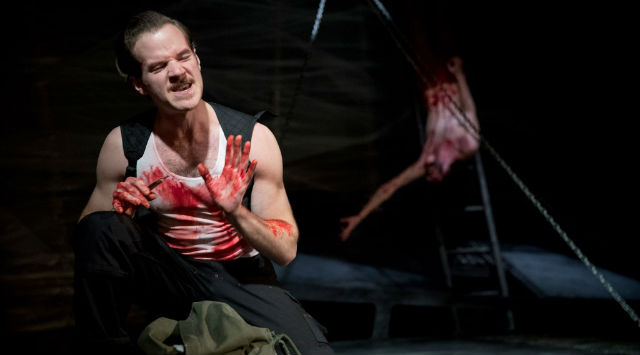
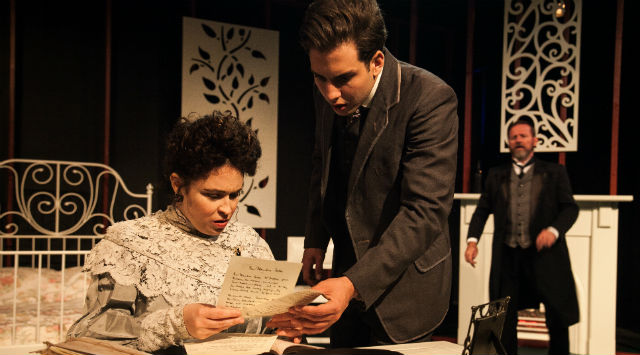
It is 1993, and the threat of devastating violence in Northern Ireland is a daily reality. Groups are formed, and re-formed, in accordance with shifting political ideals that deliver little more than bloodshed and suffering. Martin McDonagh’s The Lieutenant Of Inishmore first appeared in 2001, only a few years after the abatement of conflict, when the memories of terror were still fresh, and the play’s comedy is therefore, predictably dark.

Also completely absurd and deeply ironic, a narrative is built around Padraic, a homicidal maniac who kills in the name of nationalism, and the very unlikely soft spot he has for Wee Thomas, the pet cat at home. Blisteringly funny, the sardonic The Lieutenant Of Inishmore deals with real life trauma, by channelling the senselessness of recent history through heightened humour, into a digestible form. Every time we laugh at a joke, we are required to reflect on the wounds to which it refers, and in that process find a way to reach an understanding, of things too difficult to find psychological and emotional resolution for.

Director Deborah Mulhall sets the tone perfectly, for an outrageous ride of a show. The bold comedy is as enjoyable as it is thought-provoking, and our communal laughter works to create a sense of unity around the play’s discussions of terrorism and war. A delightful cast keeps us amused from the very start, when the formidable duo of Patrick Holman and James McCrudden open the production with an energetic confidence and delightful eccentricity. Chemistry between the two is nuanced and tenacious, and thoroughly enjoyable to the bitter end. Lloyd Allison-Young is a very compelling leading man, incisive in his portrayal of Padraic. Inventive and charismatic, with an enviable knack for comic timing, he lands every punchline with finesse and flair.

The story is ridiculous, but we leave the theatre thinking its wild fiction is no stranger than the truth. As we grapple with the idea of children in foreign lands being bombed, and of our neighbours being arrested for charges of terrorism, we often experience disorientation and confusion, as though the world had been turned upside down. We try to install order into things to form a semblance of logic, because information must be arranged to cohere somehow, for the alternative of ignorance and apathy is unforgivable. So much of how we are is bizarre, and bizarrely inhumane, but even when we are unable to locate the reasons for our atrocities, to prevent them from occurring must always be fundamental to who we are.

www.newtheatre.org.au

Review: Still Point Turning: The Catherine McGregor Story (Sydney Theatre Company)

Venue: Wharf 1 Sydney Theatre Company (Walsh Bay NSW), Apr 21 – May 26, 2018
Playwright: Priscilla Jackman
Director: Priscilla Jackman
Cast: Nicholas Brown, Andrew Guy, Chantelle Jamieson, Ashley Lyons, Heather Mitchell, Georgina Symes
Images by Philip Erbacher

Theatre review
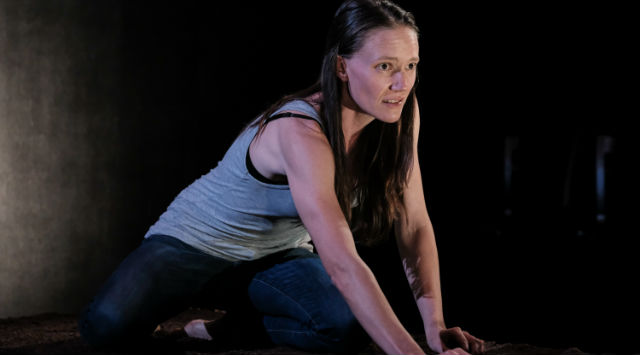
For those of us who are transgender, the experience of life is always a little bit extraordinary. Radically othered, by virtue of the fiercely homogenising quality of gender, there is a part of us that cannot help but perceive things from the periphery, whether we feel ourselves to be accepted or marginalised. Catherine McGregor is a media star, in many ways Australia’s answer to Caitlyn Jenner, both sixty-something, both extremely privileged and established in their professional fields, and both coming out as trans in spectacular fashion in the 2010s. They are not trailblazers by any means, for we have existed since the dawn of humankind (assuming gender had existed from the very beginning), but their stories coincide with a particular time in Western history, when being trans is suddenly a thing to celebrate.

This new interest in our identities contains unquestionably, a hint of the freak show; we often find ourselves a curiosity that everybody else feels as though they finally have license to poke and prod at. It can be argued however, that we are the ones who have demanded attention be paid to our difference, in this, for many, lifelong battle for approval and recognition. In Priscilla Jackman’s Still Point Turning, a delicious balance is struck, in which the object of our gaze is simultaneously accommodating and commanding. The audience is intrusive, but at the protagonist’s insistence. She proclaims to not want the responsibilities of being a poster-girl for the movement, but presents herself with blunt candidness and a fearless embrace of the prying spotlight. The work is “based on interviews with Catherine McGregor”, and she is very forthright with her disclosures.

It is a political and benevolent act, but also narcissistic (as she admits), and that seemingly dissonant combination provides a potent vitality for playwright and director Jackman, whose creation here proves to be a remarkably rich piece of theatre. The show satisfies our need for the sordid and gossipy, allowing us into the profoundly personal struggles of a public figure, whilst offering some of the most informative and thought-provoking content of any biographical account. For a play about a personality whose interests are in sport and the military, Still Point Turning is perhaps surprisingly entertaining, relentlessly so, but its true value is in its frank and unembellished, and thus rare, depiction of a transgender experience.

We may not have arrived at a point where a story of this nature does not bear the burden of having to make that desperate plea for understanding, and we find McGregor’s suffering often occupying front and centre of the stage (alongside her charming sense of humour) but it is noteworthy that the show does go quite a distance beyond an exploitative depiction of trans tragedy. Societal progress can be observed in its ability to discuss its issues inquisitively and genuinely, offering perspectives that are less emotional and more sincerely exploratory. For audiences of all persuasions, the play’s statements and contemplations about how each of us negotiates gender (and other identity markers or constraints) is a rewarding opportunity for deep reflections about our places in social life; who we think we are, how we wish to be perceived, and the things we do to create a persona that each can be personally content with.

The production is passionate and polished, with clever lighting by Nick Schlieper creating comfortable shifts between time and space, whilst helping contain an unnecessarily large performance area. Music and sound by Steve Francis are conventional but highly effective in their calibrations of atmosphere. Designer Michael Scott-Mitchell’s costumes are simple but very smart, with the lead’s pristine white Carla Zampatti suit a breathtaking, memorable design feature.

Actor Heather Mitchell delivers a brilliant performance in the starring role; intelligent and insightful with her dramaturgy, impressively precise, bold in presence, and gloriously funny. Eminently convincing and disarmingly charismatic, we cannot take our eyes off of her. Her Catherine is fascinating and delightful, and we almost wish for the show not to end, if only to retain her company. A supporting ensemble of five effervescent players add to the fun, each one independently compelling and endearing, but wonderfully cohesive as a team, thick as thieves and marvellously engaging.

Even though Catherine McGregor has accomplished a great deal in her illustrious life as journalist, cricket commentator and military officer, the woman presented in these 100 minutes of Still Point Turning is defined principally by her transness. Whether or not this is an accurate depiction of McGregor’s own truth, it is an intriguing proposition that one’s fundamental sense of identity can be so firmly attached to ideas of gender. It is perhaps a consequence of unyielding persecution, of oppression and cruel humiliation, that what should only be an incidental element of a person’s being, is turned into a subsuming component.

McGregor puts blame on no one, talking only about transphobia as a personal demon, but the undeniable truth remains, that when we harm ourselves, it is always a result of conditioning by the outside. It is easy to think of McGregor as a person who has it all, and as such, we require that she expresses only humility and gratitude. However, the prejudice that all trans people continue to be subject to, range from insidious to barbaric. It is pervasive, even in progressive regions, and there is no doubt that we must always take the opportunity, to step up to defend the rights of our transfolk. To be visibly trans is crucial to our progress, and Cate’s indomitable capacity for attention, is to be admired and more importantly, emulated.

www.sydneytheatre.com.au

Review: The Effect (Old Fitz Theatre)

Venue: Old Fitzroy Theatre (Woolloomooloo NSW), Apr 18 – May 19, 2018
Playwright: Lucy Prebble
Director: Andrew Henry
Cast: Emilie Cocquerel, Firass Dirani, Emma Jackson, Johnny Nasser
Image by John Marmaras

Theatre review
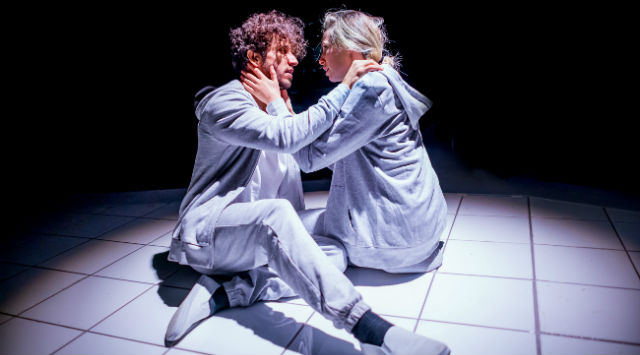
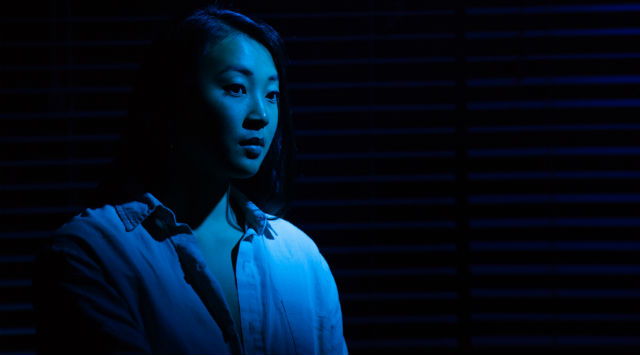
Connie and Tristan are participants in a medical trial involving antidepressants. Temporarily shut off from the world, they live inside a science facility with only each other for company, and very quickly develop a strong romantic connection. Lucy Prebble’s The Effect is interested in the chemical aspects of what we understand to be human nature, and the moral implications of drugs we design to alter our experience of life. It poses questions about what we consider to constitute authenticity in being human, and looks at the ways in which we place value on things we term natural and synthetic.

The play is ridden with anxiety, fuelled by the pervasive scepticism we have of pharmacology and the money around it, but a puerile disquiet is undeniably present, that relies on reductive ideas presupposing the natural to always be unquestionably better. The Effect features scene after scene of tense drama, which director Andrew Henry is certainly not averse to amplifying at every opportunity for maximum theatricality. Alexander Berlage’s lights are accordingly bold and intrepid, effective in delivering some memorably stark imagery. The show is often gripping, with an intensity that sustains our attention, but its arguments are not always persuasive. It arouses intrigue, without providing sufficient rationale for us to feel satisfied with the statements it attempts to make.

Actor Johnny Nasser brings valuable subtlety to the role of Toby, alternating between good and bad guy, for a sense of complexity that resonates with truth, in this discussion of mental health and modern medicine. Other players have a significantly more grandiose approach, that can restrict us from reaching a greater understanding of the text’s nuances. Their extravagant gestures make for an energetic performance, but our access to the psychology of characters is consequently limited. The Effect contains philosophy that matters to us all, although a more detailed conveyance of meanings would be necessary for the production to affect us deeper.

As we watch ourselves being challenged by medicine, unable to submit easily to the science, we see an obstinate belief in a state of purity, and are prompted to interrogate the validity of our trust in naive ideals associated with all things “natural”. It is also similarly evident that when individuals are called upon to put their lives in the hands of others, trust is an issue that can never be made completely unassailable. Underlying these thoughts are fears that reflect our need for self-preservation. We can doubtless see the insignificance of the human race in the widest scheme of things, but our indomitable hunger for control seems essential to how we think and act, even when we know the futility of our efforts.

www.redlineproductions.com.au

Review: Get Her Outta Here (107)


Venue: 107 (Redfern NSW), Apr 19 – 21, 2018
Creator: Isabella Broccolini
Cast: Isabella Broccolini
Images by Phil Erbacher

Theatre review
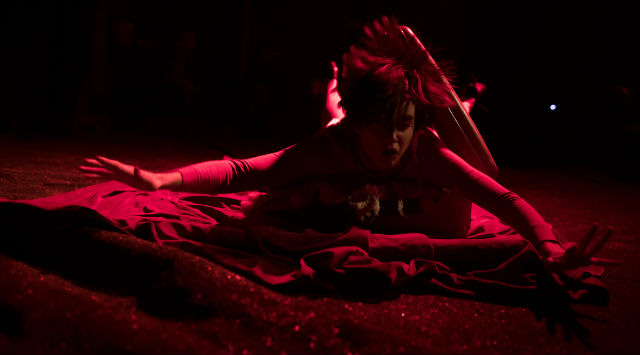
Isabella Broccolini is the lady in red, swathed in an uncompromising colour representative of all things fiery. We see a picture of obstinacy, a woman of dogged determination making single-minded statements about selfhood, and of identity in general. Her red suitcase never leaves her side, like a snail with her home attached, adding to the image of tenacity, but symbolising discontentment, in a performance piece that seems to talk a lot about the unexpected duality of perseverance and relocation.

Get Her Outta Here is wonderfully engrossing, fuelled by the inexorable presence of its creator. Broccolini’s physicality is confident and powerful, with an idiosyncratic style to its movement that has us captivated. Her body is untethered to the homogenising nature of dance training, but offers a clarity and strength to what it wishes to convey, as though disciplined in accordance with her own ideals.

The work is abstract, beautifully so, and audiences will interpret it how they wish. When art refuses to be obvious, it runs the risk of leaving us apathetic, but Broccolini’s enigmatic (and often very funny) approach is deeply alluring. We find ourselves opening up to her, allowing her obscure expressions to provoke and inspire. Music by Grace Huie Robbins moves the show through its various phases with excellent effect, creating shifts in dimensions that help enrich our imagination. Lights however, are under-explored and regretfully monotonous, for a production that is otherwise an aesthetic delight.

Broccolini’s speech is coy, but glimpses of honesty are revealed in her storytelling, to help our minds assemble a sense of truth for the red lady. Under the quirky and jokey, almost camp, deflecting exterior, lies a distinct rage, drenched in blood, perhaps too gory to expose unadorned. Get Her Outta Here is a woman’s fight with territory, even as she resists every place that she finds herself. Outsiders wish to be anywhere but here, and for us, the cliché is especially true, that it is the journey, and not the destination, that fulfils. Our project of reclaiming and redefining space, is not yet able to afford any room for complacency. For the time being at least, the red lady’s adventures with her red suitcase shall not cease.

www.107.org.au | www.isabellabroccolini.com

Review: Sex & Death (Blood Moon Theatre)

Venue: Blood Moon Theatre (Potts Point NSW), Apr 10 – 28, 2018
Something In The Basement
Playwright: Don Nigro
Director: Garreth Cruickshank
Cast: David Luke, Annette van Roden

It’s Time
Playwright: Garreth Cruickshank
Director: Garreth Cruickshank
Cast: Russell Cronin, Jack Douglas, Kitty Hopwood, Annette van Roden

Theatre review
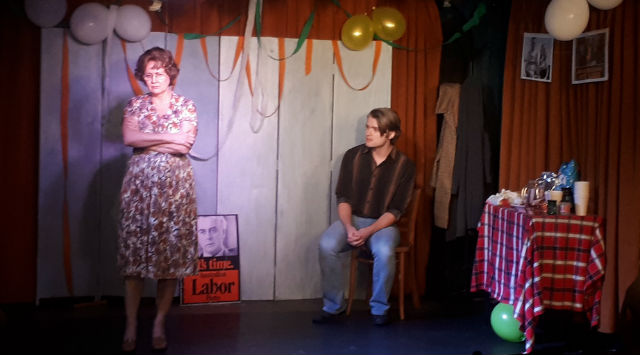
Two short plays, both concerned with marriage, form a double bill entitled Sex & Death. The first, Something In The Basement by Don Nigro is ostensibly about the mystery of sex, and the second, It’s Time by Garreth Cruickshank, deals with family violence. They both point to some fundamental ideas about the traditional unity of two persons, perhaps questioning the validity of that ancient institution for our current times.

Something In The Basement is a comedic exploration of sex, using the basement of a couple’s home as allegory, for the strange workings of compatibility and the libido. Humour is obscure for the piece, and its performers never quite manage to make it a sufficiently funny show. The meanings, as represented by their relationship with each other and with their house, too are rarely satisfactorily conveyed, left abstract with scant resonance. The production’s naturalistic approach seems an inappropriate choice, exposing only the mundanity of married life, and little else besides.

It’s Time dwells on the harrowing experiences of a housewife from the 1950s, who receives regular beatings from her husband. We meet her later in life, but it is her recollections of her darkest days that she wishes to share. Mrs O’Brien tells all, as flashbacks are introduced, with regrettable inelegance as actors walk in and out of view for sequences that last mere seconds. Annette van Roden plays the role with great sensitivity and maturity, exhibiting exceptional strength as a woman put through the wringer, and who emerges victorious. We wish to see how she escapes abuse and grows stronger in the aftermath, but the play ends abruptly, allowing only her suffering to define this version of Mrs O’Brien.

The people in Sex & Death fail at marriage, but we see them work hard at salvaging things to fulfil their commitments. Marriage is full of promise. We are told that it is essential to a good life, although arguments are never more than tenuous. Tethering the self to another, through measures religious and legal, is a bizarre habit that continues to prove hard to break. We aim to understand ourselves through science, logic and facts, but it often appears that irrationality plays the biggest part in being human. There is no rhyme or reason for so much of what we do, and hence we are prone to repeat our foibles time and again. Marriage will never live up to the grandness of its pitch, but we will nonetheless keep buying in. It is romance, idealism and delusion, but we are only human.

www.bloodmoontheatre.com

Review: The Time Machine (Strange Duck Productions)

Venue: NIDA Parade Theatres (Kensington NSW), Apr 11 – May 2, 2018
Playwright: Frank Gauntlett (based on the novella by HG Wells)
Director: Gareth Boylan
Cast: Mark Lee
Images by Robert Catto

Theatre review
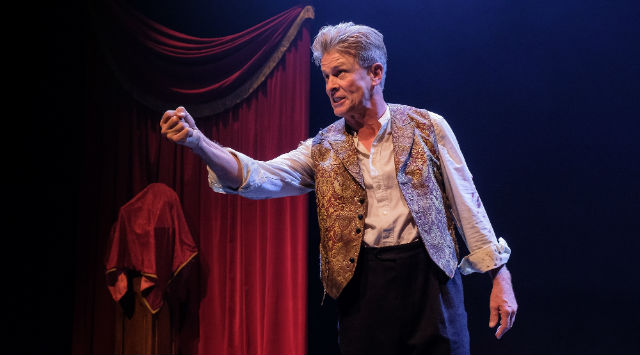
In the space of science fiction, our imagination of what is yet come, reveals less about the truths of the future, and more about the values and beliefs that we hold today. In Frank Gauntlett’s adaptation of HG Wells’ The Time Machine, an Englishman travels from Victorian times to the year 802,701 AD, where he encounters an evolutionary state of humankind, split into clear distinctions of species, good and bad.

Instead of luxuriating in the welcoming utopia that he stumbles upon, our protagonist pursues the evil creatures who had stolen his machine, and in the process interferes with the ecosystem that he discovers. There is also a romantic encounter, with the hero claiming a female character from the new world, as he tries to bring themselves back to the 19th century. The Time Machine is an action-packed one-man show that puts on display, the narcissistic self-aggrandising tendencies of men, who are persistent in figuring themselves as braver, more righteous, more long-suffering and under attack than anyone else in their fictional narratives.

The true hero is actor Mark Lee, whose energetic precision provides all the theatrical entertainment we require. He is a captivating presence, interminably persuasive with all that he serves up. A highly skilled performer, with an astonishing familiarity with the text, Lee is intense, inventive and tenacious in approach, leaving his audience impressed, even if the material he presents is less than inspiring. Director Gareth Boylan introduces a healthy quantity of visual variation to the show that helps draw our attention back, when we begin to lose interest in the monotonous narration of unwavering gallantry. Lights by Martin Kinnane are particularly useful in this regard. Michael Waters’ sound design too, works hard to facilitate our concentration.

It is a recurring theme in our stories, where we find ourselves in places belonging to others, then quickly and convincingly asserting our victimhood, before successfully overcoming the enemy. There is truth in saying that life requires us to move outside of ourselves, that the spirit of curiosity and discovery is essential to a meaningful existence, but the belief that “the world is your oyster” must be examined with greater sensitivity. Spaces are defined long before we enter them. Wherever we choose to venture, we must be mindful of how it is configured. If we decide to cause disruption, we must tread with utmost care and caution.

www.nida.edu.au

Review: Alison’s House (The Depot Theatre)

Venue: The Depot Theatre (Marrickville NSW), Apr 4 – 21, 2018
Playwright: Susan Glaspell
Director: Julie Baz
Cast: Matthew Bartlett, Veronica Clavijo, Penny Day, Dominique De Marco, Elliott Falzon, Nyssa Hamilton, David Jeffrey, Brendan Lorenzo, James Martin, Tasha O’Brien, Sarah Plummer
Images by Katy Green Loughrey

Theatre review
Fewer than a dozen of Emily Dickinson’s poems were published during her lifetime. Her body of work, comprising approximately 1,800 pieces, only saw the light of the day after her passing; she was female after all. In Susan Glaspell’s Alison’s House, Alison Stanhope is a surrogate for Dickinson, and we meet her family on the eve of the year 1900, 18 years after her death. The Stanhopes are moving house, but Alison’s presence is strong and a mystery around her posthumous success emerges. Although a Pulitzer Prize winner, the play feels every bit her 88 years of age. Central concerns about authorship and artistic legacy remain valid, but its dramatic structure is now gauche, with stodgy dialogue that many will find alienating.

Its first two acts are particularly inaccessible, and the cast’s divergent approaches make the show a difficult one to engage with. The third act however, is a fortunate change of pace, with the plot suddenly turning lively, when the crux of the matter is finally revealed and addressed. Actor Brendan Lorenzo is a delight in the role of Eben, with intense conviction and a buoyant energy that helps introduce a quotient of enthralment. The production is a faithful rendition of a dated script, with everything kept coloured inside the lines. It is an adventurous spirit that dares take on this forgotten play, but this execution of Alison’s House requires greater imagination to resurrect it from obscurity.

Our great writers write from personal perspectives, but what is put on paper may not always be intended for public consumption. Time however, has the capacity to change anything. What was once private, objectionable or simply unfinished, could transform, over the years, into something that serves a greater purpose. We must then consider what it is that we want to hold sacred, when tossing up between the private and the public, or the dead and the living. When ambiguities abound, coming to decisions is difficult, but it is the very quality of ambiguity that interrogates the deepest of our beliefs, and that shows us who we truly are.

www.thedepottheatre.com

Review: A Girl Is A Half-formed Thing (Brevity Theatre)

Venue: Kings Cross Theatre (Kings Cross NSW), Apr 6 – 21, 2018
Playwright: Eimear McBride (adapted for the stage by Annie Ryan)
Director: Erin Taylor
Cast: Ella Prince
Images by Clare Hawley

Theatre review
Our destinies are written long before our flesh is are conceived. The unnamed girl in the story was born into an underprivileged Irish family, of a conservative Catholic town where ancient rules are upheld without question or suspicion. Women are allocated their place, but men occupy everything, including the female body. In Eimear McBride’s novel A Girl Is A Half-Formed Thing, violations take the form of rape, physical but also mental, emotional and spiritual. The entirety of the girl’s adolescence is characterised by the abusive imposition of all surrounding characters, determined to prevent any sense of individual agency from developing. She is deemed an object, an empty vessel with which society can do whatever it wishes.

It is a problematic adaptation by Annie Ryan who retains the “stream of consciousness” form of McBride’s book. One actor is designated to play not only the girl, but also every significant personality of her microcosm. Conversations are brief and unanticipated, often leaving us confused about the identities of people being portrayed, although we might as well think of them all as one uniform perpetrator, considering the analogous way in which our protagonist is being defiled. Actor Ella Prince is unable to provide clarity in terms of detail from the difficult text, but her capacity for authenticity and focus are certainly impressive. It is an extremely powerful presence that she brings to the show, and the gravity of the play’s concerns are never compromised under Prince’s depictions. The traverse stage proves challenging, requiring half of the show to be performed with her back to the audience, which proves unsatisfactory for a production that relies so heavily on its star’s facial expressions.

There is however, very fine design work being accomplished here. Isabel Hudson’s sophisticated set makes for a morbid but dramatic evocation of ideas around burial and death. Lights by Veronique Bennett are surprisingly dynamic, whilst administering a relentless austerity that is crucial to the play’s very specific tone. Chilling sounds created by Clemmie Williams ensure that we never deviate from the mournful devastation being analysed.

The girl is defiant, aggressively so, but she holds no power. We watch as she is put through a progression of torment, wondering if a person like this could ever grow into something whole. In places where freedom exists, we can imagine individuals flourishing, beyond the bounds of inevitable social restrictions. We want to believe that each human bears potential that is unique and good, and opportunities are available where against all odds, people can create the best out of their embryonic selves. This may or may not be true, but where there is no freedom, the only certainty is the unremitted spawning of deformed lives.

www.brevitytheatre.com.au

Review: Greater Sunrise (Belvoir St Theatre)

Venue: Belvoir St Theatre (Surry Hills NSW), Apr 5 – 21, 2018
Playwright: Zoe Hogan
Director: Julia Patey
Cast: Laurence Coy, Jose Da Costa, Cassandra Sorrell, Alexander Stylianou
Images by Hon Boey

Theatre review
Australia’s history with Timor-Leste is chequered, to say the least. In Zoe Hogan’s Greater Sunrise, we see an account of the evil that we are capable of, when dealing with a neighbouring nation rich with oil, but poor in influence. Australian aid worker Joana discovers the ugly operations that her government undertakes in the country she is assigned to help, and tries to find a way for justice to prevail.

It is admirable that Hogan brings attention to the important but under-reported issues surrounding our relationship with Timor-Leste, but the play struggles to speak powerfully, with a plot structure that is perhaps too filmic in its approach to work on the stage. The erratic timeline and its excessively frequent scene changes, prevent us from becoming invested sufficiently in Joana’s story.

Cassandra Sorrell shows good conviction in the lead role, but performances in Greater Sunrise are rarely more than adequate. The production feels distant and vague, preventing us from finding any meaningful resonance that could correspond with its grand message. Lights by Benjamin Brockman and sound by Clare Hennessy, however, provide a level of polish that helps sustain our attention. The emotional cues provided by design elements give the narrative some tenacity when other aspects falter.

Greater Sunrise provides valuable elucidation about the ongoing project of colonisation in our region. It tells us that we need to find satisfactory methods of reparation for the way Indigenous communities have been unjustly exploited, and also to take responsibility for the immoral and unethical dimensions of our insatiable capitalistic drives. The planet provides immense wonder, but its allure seems determined to elicit human behaviour that is cruel and deplorable.

www.belvoir.com.au

Review: The Flick (Outhouse Theatre)

Venue: Seymour Centre (Chippendale NSW), Apr 5 – 21, 2018
Playwright: Annie Baker
Director: Craig Baldwin
Cast: Justin Amankwah, Matthew Cheetham, Mia Lethbridge, Jeremy Waters
Images by Marnya Rothe

Theatre review
Almost every cinema in the world has completed the transition from analogue to digital, and with it comes aficionados bemoaning the loss of authenticity and tradition, in an art form that touches the lives of all. In Annie Baker’s The Flick, not only is celluloid under threat of annexation by blu-ray, the employees at a small picture house have friendships that are challenged by what they think to be real or illusory. They spend days together, becoming increasingly intimate, but always conscious of the distances between. They experience comfort in each others’ presence, but trust is never a certainty. When push comes to shove, the surprise of betrayal rears its ugly head, and like the technology in their projection room, convenience and cost takes precedence.

The play is beautiful in its sensitivity, and wonderfully humorous. Development of its characters and relationships, are cleverly written, replete with nuance and acuity. Dialogue is amusing and brilliantly observed, with contemporary colloquialisms thoughtfully utilised, for an accurate reflection of Western society at this very point in time. These people may or may not be familiar, but we always know exactly how they feel. For cinephiles, The Flick‘s obsessive enthusiasm with film culture, is a very big added bonus.

It is a glorious set, designed by Hugh O’Connor and constructed by Rodger Wishart, thrillingly realistic in its replication of the typical interiors of a movie theatre. Music paying tribute to genres of film, are meticulously crafted by Nate Edmondson, who also creates a variety of unmistakably unique sounds, in the form of whirrs and purrs to be heard emanating through the walls whenever we congregate for a movie. Martin Kinnane achieves a surprising range of atmospheric modifications with his lights, and has us transfixed with the unusual perspective offered by having us looking, wrong way round, into the projector lens, watching rays instead of images that have accompanied us hundreds, if not thousands, of times before. Led by stage manager Steph Kelly, technical aspects are remarkably well managed for this production of The Flick.

Directed by Craig Baldwin, the show is full of resonance; comical, whimsical and emotional. Chemistry between actors is masterfully harnessed, for a thoroughly honest and genuine depiction of social dynamics in The Flick. Actor Justin Amankwah is convincing, and very charming, in the role of Avery, the withdrawn youngster who loves movies more than he does any human being. His minimal, but precise approach gives depth and intrigue to the story, with a portrayal of mysterious qualities that has us captivated. Also very entertaining is Jeremy Waters as Sam, the Gen X slacker who finds himself suddenly older but not much wiser. It is an endearingly animated performance by Waters whose nuances are a joy to watch, and whose confidence with punchlines delivers some excellent laughs. Mia Lethbridge plays Rose the projectionist, with a delightful playfulness that prevents the less than agreeable character from becoming too alienating. The three form a tight partnership, and even though the show does extend to the three-hour mark, we never tire of their company.

The Flick is completely satisfying, but there is no question that in it, people are disappointing. Avery’s adoration of Hollywood is a reflection of his idealism, and his struggles in engaging with real life can be considered in terms of society’s deficiencies, or we can think of it as Avery having problems understanding the world as it actually is. Accompanying the cynicism in Annie Baker’s play, is our unambiguous desire for virtue. The stories we tell may not always be happy and uplifting, but they invariably contain our eternal faith in things that are good. Although new films no longer come to us on film, nothing will stop us from imagining better lives and better worlds, in all our arts and sciences. Of humanity’s many flaws, our naive belief in progress seems forever invincible.

www.outhousetheatre.org