Review: Hamlet At The Bottle-O (Blood Moon Theatre)


Venue: Blood Moon Theatre (Potts Point NSW), May 15 – 26, 2018
Playwright: Pat H Wilson
Director: Adrian Barnes
Cast: Nick Mercer
Image by Marek Wojt

Theatre review
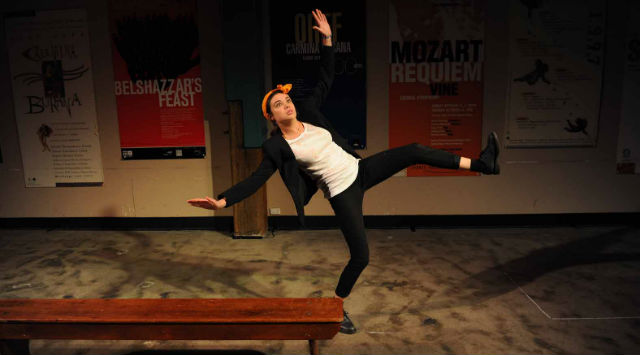
Like most of us who pursue careers in the arts, Nick is an actor who has to hold down a “real job” to pay the bills. Managing a bottle shop may not be his favourite occupation, but he does it well, in between sneaky practice sessions for imminent auditions. There are five short scenes in Pat H Wilson’s Hamlet At The Bottle-O Or The Wineshop Monologues, with Nick relaying amusing but inconsequential stories about colourful personalities and quaint occurrences at his workplace.

The one-man show features actor Nick Mercer, charismatic and highly energetic in a simple work that demands little more than an enthusiastic familiarity with the text. Mercer proves himself an engaging presence, but the material is limiting in terms of character development, and the proficiency that we encounter never progresses beyond its somewhat basic requirements. The cordial man behind the wineshop counter has a simple job ringing up your purchase, and the performer too, on this occasion, needs only be pleasant, and he passes with flying colours.

We are more than the jobs we do, but often it is how we are employed that determines our identity in the eyes of the world. People can be useful to society in a myriad ways, and it is what we contribute that allows others to form an understanding of who we are. It is however, equally important that the individual knows the self beyond the face that they present on the outside. Most know Nick as the affable bottle-o guy, but Nick knows that he is capable of very much more.

www.bloodmoontheatre.com

Review: Kiss Of The Gallery Guard (Scene Theatre Sydney)

Venue: Sydney Philharmonia Choirs Hall (Walsh Bay NSW), May 11 – 26, 2018
Playwright: Carol Dance
Director: Murray Lambert
Cast: Justin Amankwah, Jesse Northam, Chloe Schwank, Cara Severino
Images by John Leung

Theatre review
After making the local news in less than dignified fashion, Amber leaves her rural town in shame, and lands a job in a city art gallery. Carol Dance’s Kiss Of The Gallery Guard asks if it is possible for the leopard to change its spots, and through its own discussions about the ever evolving meanings of art, the play looks at the constantly mutating quality of human nature, in relation to art objects that are characterised as stable and inanimate.

It is a concept worthwhile of exploration, but Kiss Of The Gallery Guard has a plot structure that tends to be overly tangential, with a writing style that mature audiences will find too expositional. Performers for the show are not short of conviction, although their exaggerated approach can interfere with the authenticity that they attempt to bring to the narrative. Cara Severino is a delightful presence as Amber, impressive with the detail she brings to the role, even if the excessively animated mode of presentation is a blemish.

The ephemeral nature of theatre, is what sets it apart from other art forms. A work can always be revisited, revised and remounted, and no two shows can ever be exactly the same. People will grow, and artists will transform. Much as we are inclined to hold unshifting opinions about others, we also know that the world is a surprising place, and people will always have the potential to evade underestimations.

www.kissofthegalleryguard.net.au

Review: The Sugar House (Belvoir St Theatre)

Venue: Belvoir St Theatre (Surry Hills NSW), May 5 – Jun 3, 2018
Playwright: Alana Valentine
Director: Sarah Goodes
Cast: Sheridan Harbridge, Sacha Horler, Lex Marinos, Josh McConville, Kris McQuade, Nikki Shiels
Images by Brett Boardman

Theatre review
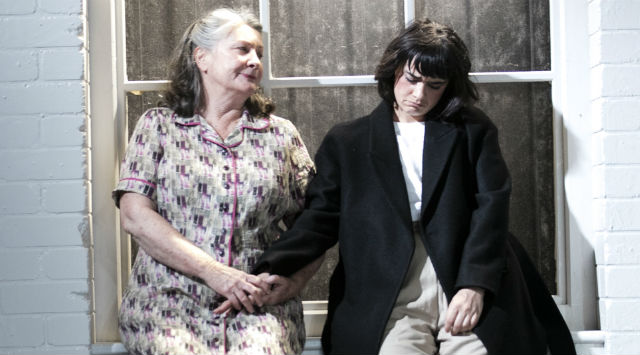
Narelle is the first of her family to go to university. Growing up under her grandmother June’s strict guidance, Narelle carries the hopes of generations of McCreadies, whose existences in Sydney have struggled persistently with poverty and criminality. In Alana Valentine’s The Sugar House, we observe the life story of one Sydneysider and her family, alternating between the years 1966, 1985 and 2007, watching the evolution of Narelle along with this city, forming an understanding of our own growth and gradual gentrification.

Our daily endurance of life in one of the world’s most expensive cities, can often delude us into believing only in its sophistication and varnished veneers. We try hard to forget its past, particularly in relation to invasions and genocide, as well as the deep seated impact of convict and refugee immigration. We imagine ourselves to be worldly and refined, and become precious in our embodiment of this glamoured image. In some ways, this is what June had always wanted for Narelle. Breaking the poverty cycle, might have meant for the matriarch, an end to suffering and injustice, but Narelle and our reality in Sydney today, has serious complications that she probably never foresaw.

The play is unmistakably sentimental, with sounds in its dialogue that are authentic and profoundly beautiful. The plot does meander slightly, but vivid personalities keep us attentive and intrigued. The Sugar House is passionately constructed, by playwright Valentine and director Sarah Goodes, who establish a soulfulness for the production that forms its irresistible allure. It talks about our community, the forgotten and hidden parts of it, with a refreshing honesty that many will find engaging. Narelle’s story is not all our stories, but no Sydneysider can escape the reverberations of her family’s experience.

Actor Sheridan Harbridge is a charming Narelle, persuasive at all ages but especially impressive with her sensitive portrayal of the 8 year-old version, impeccable in her presentation of a child full of intelligence and infectious life. June is played by the very compelling Kris McQuade, whose powerful combination of warmth and austerity, gives anchor, and accuracy, to a play concerned with history and accountability. Sacha Horler delivers a stunning performance in the supporting role of Margo, Narelle’s mother, depicting immense and glorious strength alongside the incessantly cruel torment she tolerates.

The stage is flanked on two sides by tall, mid-century windows (elegantly created by set designer Michael Hankin) demarcating a space that can be read either as glossy and new, or coarse and antiquated, depending on the scenes taking place before them. How we think of our city, should be similarly complex and heterogeneous. Our surface wishes to project a certain ideal, and that represents one truth of Sydney, which has emerged from our earnest aspirations, but layers beneath contain aspects that many have less pride for. Regrettable and shameful pasts make people rewrite histories. Lies can be used to mislead others, but the more that we try to deny ourselves the real stuff that we are made of, the more we will feel the emptiness in its place.

www.belvoir.com.au

Review: Good Cook. Friendly. Clean. (Griffin Theatre Company)

Venue: SBW Stables Theatre (Kings Cross NSW), May 4 – Jun 16, 2018
Playwright: Brooke Robinson
Director: Marion Potts
Cast: Fayssal Bazzi, Tara Morice, Kelly Paterniti
Images by Brett Boardman

Theatre review
Sandra says and does everything right, but ends up failing at every housemate interview, unable to find a place to live. Brooke Robinson’s Good Cook. Friendly. Clean. features a heartbreaking series of scenes depicting Sandra at those interviews, being rejected for no ostensible reason, other than the fact that she is a middle aged woman battling cancer. This is what we, as a people, have come to. The play is a fierce indictment of Sydney, and cities like it, where inhabitants have allowed money, and access to property, turn us into monsters that spend our entire lives trying to devour real estate and accumulate wealth, without any consideration for those among us who have basic needs yet to be fulfilled.

All Sandra needs is a home. Her budget although modest, is reasonable, but we discover, quite literally, that no one wants her. Playwright Robinson has identified something so ugly but so accurate, about modern Australia, and the reflection she offers up through the mirror of her play, is so hideous, it is almost unbearable to watch. We do of course, find ourselves mesmerised by the car crash scenario, a human catastrophe unfolding before our eyes, powerfully directed by Marion Potts who never once lets us off the hook. Potts shows us not only that the system is broken, but the individuals who operate within said system, people like us, are revealed to be the degenerates that we often are; selfish, uncaring and cruel, participants in a rat race that will inevitably deliver more losers than winners.

In the central role is Tara Morice, who retains for Sandra a sense of dignity, whilst telling a compelling story of desperate despondency. It is a splendid performance, rigorously gauged to provoke just the right response from her audience, not only of compassion, but also a more deliberate and contemplative one, involving the way we think about our interactions with the needy in real life, and also to picture what it would be like, should we one day, find the shoe on the other foot. Fayssal Bazzi and Kelly Paterniti play a variety of roles, mostly unsavoury types, to excellent effect. Whether eccentric or plainly despicable, the pair keeps us attentive, always anticipating the worst, but masochistically enjoying the black comedy that inevitably arises. It is a tight trio on this stage, confident and sleek with a presentation that is as entertaining as it is hard-hitting.

The negative byproducts of our capitalism are evident, but it seems we are too far gone, to be able to imagine a radical turn around. It is a system that demands pragmatism, leading us to act only with self-interest and greed. Sandra is not a home owner, maybe by choice or maybe by circumstance, and we watch her being punished for not playing by the rules. We are all required to want the same, and any deviation can mean disaster, yet the competition that we are all meant to participate in, is predicated on the dispossession of many. This is part of a very big debate that has gone on for decades. Words will continue firing from all sides, but efforts to find solutions that will make life better, for the greatest number of people, will also persist. Kindness may no longer cost us nothing, but it is a price we must be willing to pay.

www.griffintheatre.com.au

Review: Shirley Valentine (Ensemble Theatre)

Venue: Ensemble Theatre (Kirribilli NSW), May 3 – Jun 9, 2018
Playwright: Willy Russell
Director: Mark Kilmurry
Cast: Sharon Millerchip
Images by Anna Kucera

Theatre review
It was only 30 or so years ago, that millions of women had lived like Shirley Valentine; lonely housewives who spoke to walls at home, subsisting with no real purpose, and suffering from the ill effects of misplaced self-esteem from years of marriage and motherhood. After decades of obeying rules of society and religion, id est to wed a man and fall pregnant, and then realising that the second half of their lives could easily turn meaningless, when their assigned function in procreation expires at middle age.

Willy Russell’s 1986 monologue Shirley Valentine can seem a relic, about a type of repressed womanhood, which has disappeared from our new century, but even though that particular archetype no longer occupies front of our minds, Shirley’s challenges remain resonant. Many of us adhere to the expectations of others, trusting in the promises of tradition and convention, rather than determining for ourselves, the constituents of a personally fulfilling life. The argument of course, is that it is never too late to start living, although to break free of one’s own shackles, is always easier said than done.

Even though the play is no longer the breath of fresh air that some remember, Mark Kilmurry’s direction ensures that its ageless pertinence is kept pronounced and pervasive. Alongside the highly entertaining whimsy of Shirley’s personality, is an ever-present sense of profundity accompanying all phases of the joyful evolution that we watch her undergo. Full of charm and airy wit, it is an engaging show from start to end, with actor Sharon Millerchip’s charisma proving irresistible, tenaciously so, as we observe her transformations, from strength to strength. Millerchip invites us, with exacting resolve, to root for her character, and we feel as though we take the journey together, with her as captain and us the motor that propels her forward. Shirley’s successes need to be witnessed, and we are there, happily, for her.

Shirley Valentine is a vaguely feminist piece, showing little resentment for power structures determined to keep women subjugated, but celebrates instead, its protagonist’s ability to fight for her own emancipation. The play ends where a new chapter is about to begin. That ambiguity is an accurate representation of many who dare to rise up and reclaim power. For a moment at least, the individual will have to come face to face with opposing forces, that had been hitherto dormant and appeased. Once materialised, this re-positioning of status and relationships, is an unknown quantity, that may lead to a new equilibrium, or more likely, cause ruptures that if sufficiently substantial, will deliver a greater sense of independence and self-determination. To achieve what is fair and just, often involves significant sacrifices that are initially inconceivable. Shirley wants her cake and eat it too. We can only keep our fingers crossed.

www.ensemble.com.au

Review: The Readers (Belvoir St Theatre)

Venue: Belvoir St Theatre (Surry Hills NSW), May 5 – 19, 2018
Playwright: Scott Smart
Director: Elizabeth Nabben
Cast: Anni Finsterer, John McNeill, Scott Smart
Images by Clare Hawley

Theatre review
It is tempting to judge ourselves by things we read in the news. The extremities of society, whether the great successes or our dismal failures, give a powerful impression of the people we are, but routinely neglected are the smaller stories of millions of individuals, those that offer a more accurate picture of daily Australian life. Scott Smart’s The Readers puts focus on those who make up the regular working class, the ones who rarely make the papers.

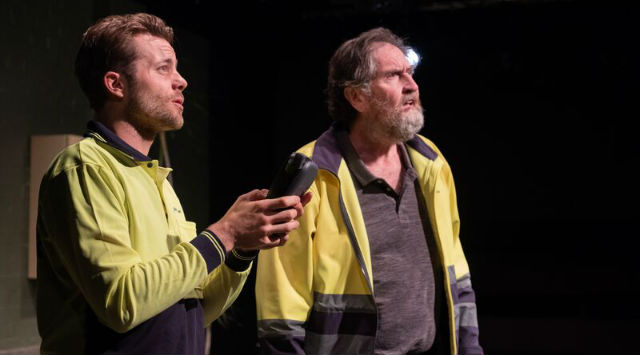
Peter and Lachlan read electricity metre boxes for a living, going about their business with little fuss or drama. They are two white men who seem to suffer no disadvantage, but their lives are not without challenges. In our current state of accelerating capitalism, what were once perfectly respectable jobs, are gradually turned humiliating. The play shows the insidious nature of how money is allowed to compromise the dignity of our workers. Peter and Lachlan have rules to abide by, but not all of them are reasonable.

The production is elegantly directed by Elizabeth Nabben, who manifests a quiet charm around her characters and situations. It seems society has accepted that employers will, by some degree, infringe upon their staff, and The Readers embodies a quality of nonchalance that reflects that reality. Working for someone does not mean that one becomes a stakeholder, one simply becomes an instrument of functionality, and will have to accept a certain amount of dehumanisation within their prescribed responsibilities. It is the profit motive that takes precedence, rather than the welfare of our communities.

John McNeill and Scott Smart play the key roles, both subtle but strong with their humour, delivering excellent nuance for this gentle piece of theatre. They form an amusing duo, comedic but also poignant, without having to reach for creative choices that may be too obvious. The third wheel Annie, a flimsy character with arguably unconvincing traits, is performed by Anni Finsterer who plays up the silliness to great effect, for moments of extraordinary hamminess that prove surprisingly delightful.

In The Readers, we see that the only thing trickling down from top to bottom, is the anxiety of business ownership. Profits, on the other hand, remain exclusively within the upper crust. Managers do not hesitate to exert pressure on those who have to put in the hard yards, but only shareholders stand to gain monetary wise. Peter and Lachlan never complain. Like most of our work force, people accept their lot, accustom to the feeling of disempowerment. We are taught to work hard, to grin and bear it, in order that rewards may be delivered. That belief is not a lie, but it is clearly not the entire truth.

www.belvoir.com.au

Review: Revolt. She Said. Revolt Again. (House Of Sand)

Venue: The Old 505 Theatre (Newtown NSW), May 2 – 19, 2018
Playwright: Alice Birch
Director: Charles Sanders
Cast: Violette Ayad, Anna Cheney, Enya Daly, Richard Hilliar, Moreblessing Maturure, Eliza Sanders
Images by Jasmin Simmons

Theatre review
The play begins as though a manual providing instruction on becoming a radical feminist, offering steps of revolutionary action to attain some kind of ideal state of being. For those who understand their subjugation, the idea of taking down the powerful is always appealing, but the truth remains, that vacuums are nonviable and breaking something down requires the installation of something new. Alice Birch’s Revolt. She Said. Revolt Again. is a thrilling ride for anyone with a taste for rebellion. Its militant spirit is seductive, with powerful declarations that will excite those similarly inclined. The piece evolves unexpectedly, introducing in later portions, complexities that confront its own passionate proclamations of earlier scenes. Birch wants us mobilised, but in a smart way. Activism cannot thrive only on impulse. Long term strategies must accompany courses of action, or we risk ending up at a place worse than before.

The show speaks resonantly, with director Charles Sanders’ intellect a fortifying authority that establishes clarity for all its arguments. The politics in Revolt. She Said. Revolt Again. are made compelling by Sanders’ palpable enthusiasm for the subject matter, and their insistence that we hear its messages, translates into excellent drama. Design style is fairly simple for the production, with Joanne Joy’s visual projections particularly effective in helping to assert some of the highly provocative concepts.

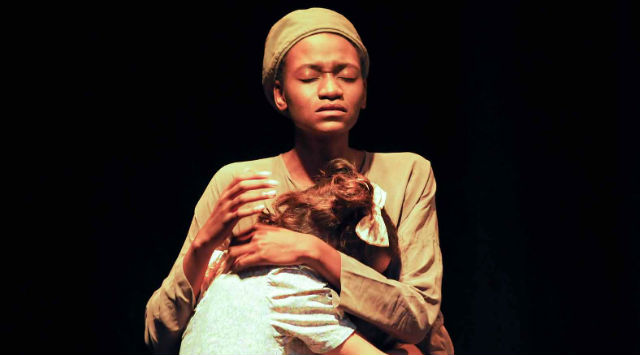
All six performers for the piece are impressive, each one given ample opportunity to put on display their individual talents, as well as a unifying and admirable conviction pertaining to the material at hand. Eliza Sanders imbues her lines with authenticity and precision, delivering a delightful acerbity with every utterance, and equally memorable for her disciplined physical expressions. The imposing figure of Moreblessing Maturure is accompanied with a tender vulnerability, especially convincing in a maternal role, conveying unassailable qualities of our humanity with beautiful restraint and confidence. The lone thorn among the roses is Richard Hilliar, whose comedy hits all the right notes, whether understated, madcap or frighteningly bombastic. Violette Ayad and Enya Daly bring emotion when we least expect it, creating additional dimensions to an already rich work, and Anna Cheney’s ability to oscillate between realism and the flamboyantly bizarre, has us fascinated and entertained.

Anarchy may not be the answer we need, but the power of resistance must never be underestimated. Revolt. She Said. Revolt Again. is full of inspiration, for those of us who recognise the concerns that it raises. Revolutions must start somewhere, and the personal can be the site on which we begin positioning the battleground. Warriors have the capacity for long, hard slogs, and they understand that to suffer the pains of combat, far surpasses the unbearable torment of injustice. Fights are best undertaken when there is light at the end of tunnel. In the business of social activism, soldiers will get beaten down every day, but a resilient optimism is the key conspirator, to the ability to know right from wrong.

www.houseofsand.org

Review: Yours The Face (Blood Moon Theatre / LZA Theatre)

Venue: Blood Moon Theatre (Potts Point NSW), May 1 – 12, 2018
Playwright: Fleur Kilpatrick
Director: Liz Arday
Cast: Daniela Haddad
Image by Liz Arday

Theatre review
Emmy is a female fashion model, and Peter is a male photographer. They meet on a job in London, both excited to be visiting from abroad, and both finding themselves attracted to one another. We watch nervously, waiting for disaster to strike, predicting the inevitable in this tale of power imbalance, but Fleur Kilpatrick’s Yours The Face refuses to fit into the mould. It is a relief to see Emmy resist being infantilised, that her sexuality and sense of self are presented as valid, even if the structures that she operates within are problematic.

The work challenges us to think about institutionalised sexism, whilst it presents individuals who seem blameless and who look to be acting with agency. It questions our participation in industries that thrive on inequity, making us think about the meaning of responsibility, in situations when acting in accordance with what is considered legal and permissible, are arguably ethically inadequate.

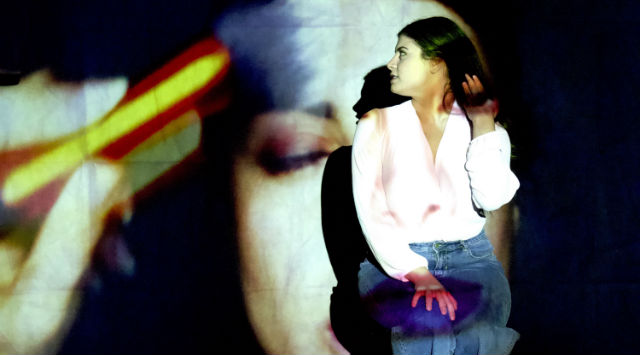
Daniela Haddad plays both roles, and proves herself sufficiently prepared, but the actor’s inexperience is evident in the demanding work. Positioned in front of a screen, with projections accompanying her entire performance, Haddad’s face is often obscured by the imagery, and we find ourselves routinely distracted by competing visual elements. Director Liz Arday’s concepts are strong, and they make for a show that is ultimately thought-provoking and rewarding, but the production is certainly demanding of its audience’s ability to concentrate.

When we are not actively taking down and taking over old systems, our involvement only serves to sustain them. There will be benefits that come with playing by the rules, but hidden costs have to be examined, and measured against what we deem to be genuinely decent. What Emmy and Peter do, are conventional and accepted, in fact they stand to become rich and famous if the stars align, but in Yours The Face, we observe that all is not well. Disease festers and exacerbates, when we choose only to pay attention to all that glitters.

www.lza-theatre.xyz | www.bloodmoontheatre.com

Review: Youth And Destination (Manifesto Theatre Company)

Venue: Kings Cross Theatre (Kings Cross NSW), Apr 27 – May 12, 2018
Playwright: James Raggatt
Director: James Raggatt
Cast: Jack Angwin, Georgia Blizzard, Gloria Bose, Julia Christensen, Maree Cole, Skyler Ellis, Alex Malone, Bardiya McKinnon, Nikita Waldron, Ross Walker
Images by Emily Havea

Theatre review
There is no conventional narrative in James Raggatt’s Youth And Destination, only a series of short sequences that offer insight into his young mind. The brevity of scenes allows the playwright to touch on a broad range of topics over the course of an hour, but the format prevents sufficient depth from being reached, aside from occasional dialogue that might inspire a sense of intrigue that encourages us to see beyond the mundane.

There is much to admire in the young; they are often inquisitive, passionate and fearless. Wisdom, although never restricted to the mature, can however be elusive. On this occasion, thoughts expressed are honest and very earnest, but the lack of life experience is evident, and Raggatt’s attempts at circumspection will not be able to satisfy every member of audience. Some nonetheless, will see themselves accurately reflected, in this work by young people, for young people.

An exceedingly pleasant group of actors prove themselves accomplished, with no fiction to perform but instead, putting on stage a convincing semblance of the self. In the absence of more complex story lines, their task is to make compelling, snippets of modernity, whether banal or extraordinary. Star of the show is not an actor, but lighting designer Martin Kinnane, whose aesthetic inventiveness and technical excellence, bring to the production a necessary polish, along with rigorous calibrations of mood, from scene to scene.

The young can tell us so much about the world, but pinning down the meaning of life, is not usually their strongest suit. Youth And Destination is a sensitive work, slightly overcautious with how it wishes to be perceived. Whether young or old, we all have to grapple with how others look upon us; we are so fundamentally social. It is incumbent on the artist however, to be courageous, and to always be revealing of their own truth, especially that which is unique and idiosyncratic in quality. Few can claim to speak for communities, but when we return to the individual in an exhaustive and meticulous way, what we say about the personal can become unimaginably significant.

www.kingsxtheatre.com.au

Review: Carmen, Live Or Dead (Oriel Entertainment Group)

Venue: Hayes Theatre Co (Potts Point NSW), Apr 28 – May 13, 2018
Music & Lyrics: iOTA
Book: Craig Harwood
Director: Shaun Rennie
Cast: Natalie Gamsu, Stefanie Jones, Andrew Kroenert
Images by David Hooley

Theatre review
It is true that Frida Kahlo had had an affair with Soviet politician Leon Trotsky, but it is entirely fictional that a lovechild was born as a result of that brief relationship. Nonetheless, Craig Harwood’s vividly imagined Carmen, Live Or Dead almost has us believing in its fantasy, that Kahlo’s offspring does exist, and that Carmen Frida Leon Davidovich had once lived in Australia.

It is an appealing fabrication; the idea that Kahlo’s magnificence lives on beyond her legendary paintings, and Harwood does create a persona that is as colourful and spirited as any fan could wish for, even if the writer’s plot structure has a tendency to be unnecessarily convoluted. Prominent in the presentation, are eight original songs by iOTA, all of them charming, often very quirky in style, and thankfully not too derivative of the Broadway genre.

Visually sumptuous, the production features a whimsical set, exquisitely decorated and painted by designer Dann Barber, evoking quintessential Mexican beauty, alongside enchanting imagery that pays tribute to the art of Kahlo. Benjamin Brockman’s lights are sensual and alluring, providing a sensation of transcendence that convincingly elevates the theatrical experience, whilst retaining its delicious and unique aura of street-smart griminess.

Director Shaun Rennie manufactures a series of captivating moods, allowing every scene to intrigue, with moments of visceral engagement that leave an impression. Performer Natalie Gamsu is a warm presence who shines in each song, but the character being portrayed does not always feel authentic; her true emotions are elusive and the connections we make can feel tentative. Stefanie Jones and Andrew Kroenert provide musical accompaniment, as well as actorly support, both accomplished with their contributions, for a show memorable for the surprising effectiveness of its restrained approach to instrumentation.

Carmen announces her impending death early in the show, inviting us to partake in flashback summations of her life and times, that constitute this piece of musical theatre. We are also inspired to consider our own deaths, and how our individual stories will eventually be told. Footprints will fade, but nothing matters more than how much good we are able to leave behind.

www.carmenliveordead.com