Review: Bran Nue Dae (Opera Australia)

Venue: Riverside Theatres (Parramatta NSW), Jan 15 – Feb 1, 2020
Book: Jimmy Chi
Music and lyrics: Jimmy Chi, Kuckles
Director: Andrew Ross
Cast: Czack (Ses) Bero, Marcus Corowa, Adi Cox, Ernie Dingo, Damar Isherwood, Taj Jamieson, Tehya Jamieson, Teresa Moore, Andrew Moran, Tuuli Narkle, Callan Purcell, Bojesse Pigram, Ngaire Pigram, Tai Savage, Danielle Sibosado
Images by Prudence Upton

Theatre review
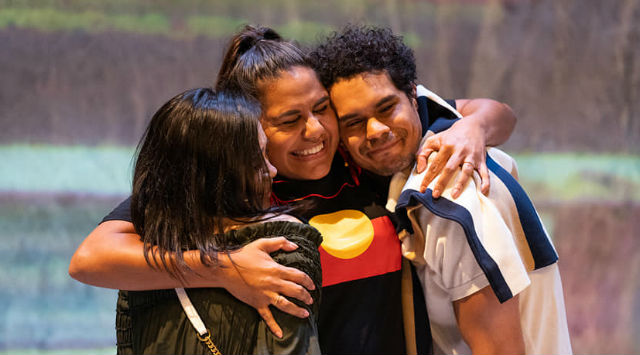
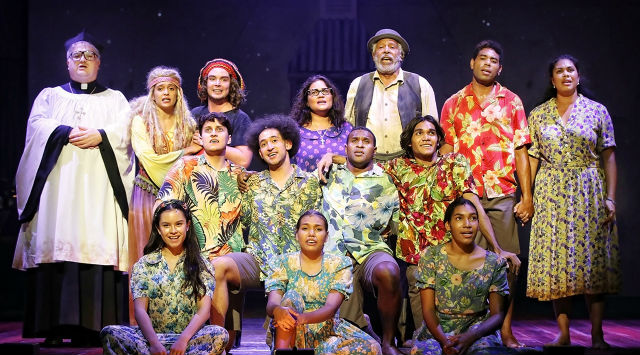
Bran Nue Dae is the semi-autobiographical story of Aboriginal music star Jimmy Chi, who as a teenager in the 1960’s, hitchhiked from his mission school back home to Broome. A musical of the coming-of-age variety, the work features splendid songs written some thirty years ago by Chi and his band Kuckles, now beautifully nostalgic and sentimental, with strong country and soul influences that move us evocatively to the Western Australia outback.

Musical direction by Patrick bin Amat and Michael Mavromatis provide an emotional dimension to the show, effective in conveying a sense of the Australian bush, and of Indigenous cultures through their sensitive arrangement of each and every tune. Directed by Andrew Ross, the comedy is a sleek one, but insufficiently humorous, often lacking in the energy required to fill the large auditorium.

Performer Ernie Dingo leaves a strong impression, with an easy charm and confidence as Uncle Tadpole that sustains our interest. Protagonist Willie is played by an equally likeable Marcus Corowa, who lights up the stage with his vocal cords whenever they get a workout. The ensemble is a nimble uplifting group, with the four women proving particularly memorable, when singing their bright and resonant choruses.

Being the very first Aboriginal musical, Bran Nue Dae is undoubtedly significant in theatrical history. What is more important however, are the subsequent shows that should follow, but examples are scarce. Of course, Indigenous peoples continue to practise other art forms that are culturally specific, and the wider community must always provide support when invited to, although the dream remains, where Western institutions can be much more inclusive, that more Indigenous participation can be seen in what has become this nation’s dominant platforms. The fact that our black sisters and brothers continue to be missing from so much of our cultural activity, is a seismic problem that we cannot afford to take lightly.

www.brannuedaemusical.com.au

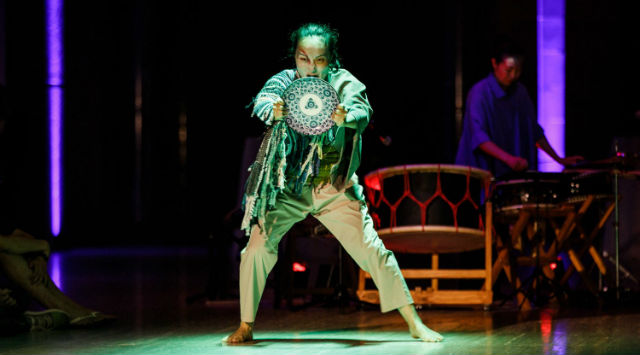
Review: Night Parade Of One Hundred Goblins (Clockfire Theatre Company)

Venue: Art Gallery of NSW (Sydney NSW), Jan 16 – 25, 2020
Director: Emily Ayoub, Arisa Yura
Cast: Madeline Baghurst, Ryuichi Fujimura, Alicia Gonzalez, Masae Ikegawa, Emily Ayoub, Arisa Yura

Theatre review
Based on the illustrations of Toriyama Sekien (1712–1788) and Itaya Hiroharu (1831-82), the Japanese folklore of 百鬼夜行 Hyakki Yagyō is brought to fantastic life for a 21st century audience, in a modern iteration entitled Night Parade Of One Hundred Goblins. A long runway is formed, so that the stage action reads like a scroll, commencing with performers racing past us, a succession of curious entities travelling across time and space, to share ancient stories from a supernatural realm.

It is a thoroughly physical work, informed by traditions of dance, mime and clowning, featuring a cast of five taking on a variety of characters, each one stranger than the other. They are alternately comical, frightening and dramatic, but always intriguing, and certainly inventive with their bodily faculties. Dialogue is kept to a minimum, so we rely almost entirely on visual communication, although music does play an inordinately big part of the exercise.

Masae Ikegawa creates her music live, a thrilling feature that works magically with the echoes of the hall, to take us away from the mundane, as it thrusts our imagination into something altogether more mysterious and instinctual. Recorded sounds by Ben Pierpoint are an electronic counterpoint that keeps sensibilities within this modernity, complete with thumping beats that make sense of the dance, for bodies we see on stage, as well as the rhythmic pulsations we experience inside our seated selves.

Lights by Martin Kinnane are colourful and very dynamic, able to spirit us away from the interiors of a concrete jungle to somewhere far more mythical and magical. Tobhiyah Stone Feller does brilliantly as designer, with unforgettable work on costumes and makeup that deliver extraordinary whimsy and quite unexpected beauty.

Directed by Emily Ayoub and Arisa Yura, the presentation is a marvellous feast for the eyes, a clever blend of theatrical disciplines that playfully entertains, whilst challenging our artistic literacy. There is much that Night Parade Of One Hundred Goblins can offer to teach, but probably more significantly in terms of how we read its stories, rather than the stories themselves.

www.clockfiretheatre.com

Review: Anthem (Roslyn Packer Theatre)

Venue: Roslyn Packer Theatre (Sydney NSW), Jan 15 – 19, 2020
Playwrights: Andrew Bovell, Patricia Cornelius, Melissa Reeves, Christos Tsiolkas, Irine Vela
Director: Susie Dee
Cast: Maude Davey, Reef Ireland, Ruci Kaisila, Thuso Lekwape, Amanda Ma, Maria Mercedes, Tony Nikolakopoulos, Eryn Jean Norvill, Sahil Saluja, Osamah Sami, Eva Seymour, Carly Sheppard, Jenny M. Thomas, Dan Witton
Images by Victor Frankovski

Theatre review
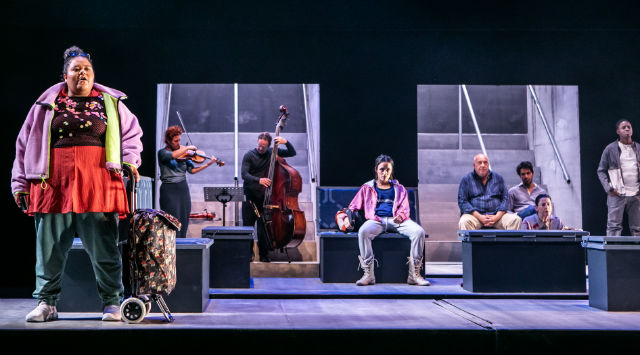
Much of the action takes place in train carriages around the Greater Melbourne area, where more than anywhere else, an accurate cross section can be obtained of who Australians are today. Rich and poor have to sit together, as do black, brown and white, along with young and old. When extricated from our respective communities, classes and silos, we are forced to look at the real differences that define us, probably more so than the similarities that we like to imagine give meaning to our national identity. In Anthem, it is the very nature of discrepancies, of wealth, power and all that might constitute a person’s cultural capital, that are exposed and very powerfully discussed.

On a land that remains unceded by its Indigenous who make up only an estimated 3.3% of the current population, it is absurd that the rest of us should experience privilege of any description. Director Susie Dee does a splendid job of articulating, not only that injustice, but also the harmful collective delusion driving this nation, that some of us deserve more than others. Anthem makes it clear that no one here can legitimately possess more than others; for as long as Indigenous peoples are marginalised and unable to exercise rights of ownership, the rest of us can only ever be holders of dubious property and position.

The politics of the piece is made saliently resonant by Dee, who imbues every vignette of Anthem with accuracy and urgency, accompanied by a strident level of realism that defies us to ignore the problems residing in the very foundation of our Australian existences. An extraordinary cast keeps us mesmerised for the entirety of these 150 passionate minutes. Tremendously well-rehearsed and unbelievably cohesive, their performance represents some of the most gripping theatre one could ever hope to see. Actor Carly Sheppard is unforgettable, giving voice to Black Australia, able to portray humour alongside a virtuous fury, to make an important and conclusive statement about Indigenous rights.

Ruci Kaisila, Jenny M. Thomas and Dan Witton provide live music over the duration, sensational in their manipulation of atmosphere and emotions, through the very accomplished works of composer and sound designer Irine Vela. Set and costumes by Marg Horwell are intelligently executed, able to convey a sense of veracity for characters and situations, whilst offering theatrical dynamism to our experience of the show. Paul Jackson’s lights too, bring animation to the stage, and is valuable in establishing tone for every nuanced moment of this sensitively rendered play.

As Australians, we have grown accustomed to tolerating inequalities in our social order. It has become acceptable that the rich get richer, at the expense of the poor, who can obviously only get poorer as a result. Marginalised communities, most notably Indigenous peoples, are routinely subjugated and muzzled, as our structures continue to privilege voices that adhere to conditions stipulated by white patriarchy. We have learned to think of the downtrodden as deserving of their lack of position in society. Even when we find ourselves oppressed by those with money and power, we take on the blame in accordance with the conditioning enforced by those at the top. It is no wonder then that James Baldwin’s The Fire Next Time is invoked in both the prologue and epilogue of Anthem. The only solution is a revolution, if only enough of us can see beyond the lies.

www.performinglines.org.au

Review: 1984 The Musical (New Theatre)

Venue: New Theatre (Newtown NSW), Jan 8 – 25, 2020
Book and Lyrics: Tom Davidson McLeod, Diana Reid (based on the novel by George Orwell)
Music: Riley McCullagh
Directors: Tom Davidson McLeod, Georgia Vella
Cast: Christie Auchamp, Jordan Barnes, Vevie Brook, Tom Davidson McLeod, Alex Gonzalez, Charlie Hollands, Jude Horsburgh, Elizabeth Jones, Joshua Karras, Jessica Loeb, Joshua Macqueen, Anna Della Marta, Ezara Norton, Emilie Ritchie, Sophie Roderick, Coco Veksner-Shaw, Olivia Siegloff, Georgia Vella, Olivia Wolff
Images by Zaina Ahmed

Theatre review
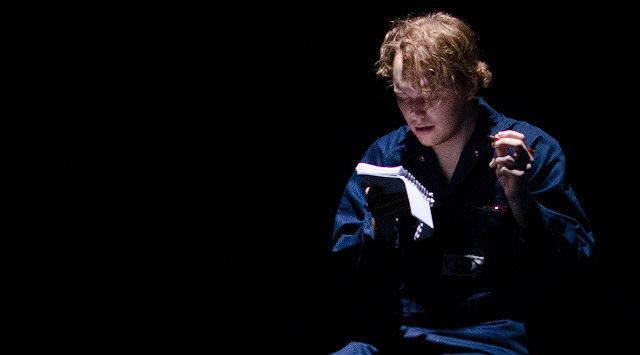
Turning George Orwell’s 1984 into a musical comedy, is more than a novel idea. The exasperation of experiencing, in the current political climate, a totalitarian dystopia so close to Orwell’s predictions, is indeed worthy of satire. With book and lyrics by Tom Davidson McLeod and Diana Reid, this farcical revisit to Orwell’s familiar text, is an appropriately sarcastic affair, as we witness imaginary scenarios from 7 decades ago come to pass, both here and overseas.

Music by Riley McCullagh provides consistency to McLeod and Reid’s humour, which ranges from clever to puerile. Although a raw work, 1984 The Musical is energetic and inventive on many fronts, with direction by McLeod and Georgia Vella contributing a valuable exuberance to the staging.

Performer Charlie Hollands is a likeable Winston Smith, able to balance tragedy and comedy in his interpretation of the everyman under tremendous stress. His love interest Julia is played by Anna Della Marta, who impresses with a sonorous voice. The memorable Joshua Mcqueen demonstrates considerable comedy chops as the antagonist O’Brien, although his singing does leave a lot to be desired. The role of Charrington is taken on by director Vella, who proves herself equally accomplished on stage, delivering many laughs as the unscrupulous undercover agent.

Sometimes all you can do is laugh, and it does feel as though we have arrived at a point in our evolution, where we can only respond to the state of things with incredulity. There is an idealism in Orwell’s writing that represents a spirit of resistance against what he knew was to come, but it may seem today that most of us have submitted to the tyranny not only of governments but of corporations, that conspire to exploit and subjugate all of us. We have become accustomed to constant surveillance, and are no longer fearful of our desires being manipulated by nefarious interests. Increasingly, we learn to sleep with the enemy, to accept catastrophe as the new normal, and understand reality to be disappointing and irredeemable. In 2020, Orwell’s 1984 no longer reads like a precautionary tale, but a documentation of the beginning of our extinction.

www.1984musical.com/

Review: Six (Sydney Opera House)

Venue: Sydney Opera House (Sydney NSW), Jan 4 – Mar 5, 2020
Creators: Toby Marlow, Lucy Moss
Directors: Jamie Armitage, Lucy Moss
Cast: Kiana Daniele, Kala Gare, Loren Hunter, Vidya Makan, Courtney Monsma, Chloé Zuel
Images by James D. Morgan
Theatre review
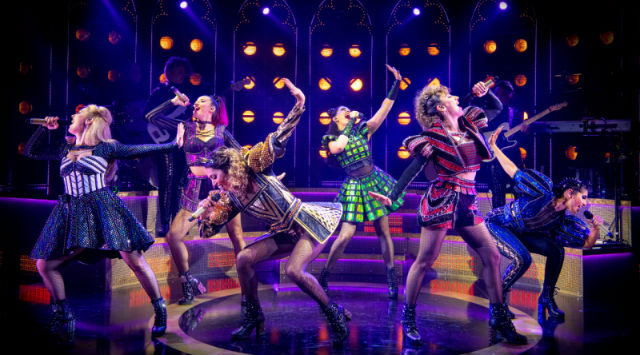
King Henry VIII of England is famous for having had six wives, and each of those women are in turn remembered only for her short reign as queen, having to share that position with many others. To tell the story of quick successions between the years 1509 and 1547, Toby Marlow and Lucy Moss create a work of musical theatre, by having the queens form a pop group in the tradition of the Spice Girls; each member bears a distinct personality type, but are collectively a cohesive whole. The show takes the form of a pop concert, comprising solo numbers during which each individual provides an account of her instalment in the narrative arc, and two group songs bookending those episodes.

Cleverly conceived, but insufficiently witty, Six feels to be squarely targeting a teenage crowd, complete with a multitude of bleeped out expletives. Composition and arrangement of music is undoubtedly joyful, and completely scintillating, and like most pop concerts, Six relies on a connection of instincts, rather than appealing to our analytical capacities. At just 75 minutes, many stones are left unturned, but the show is probably satisfying enough for those seeking light entertainment without a lot of nuance and complexity.

The six Australian performers present an imaginary girl group so dynamic and technically proficient, one can hardly recall ever seeing the real thing anywhere near this level of expertise. Kiana Daniele and Chloé Zuel are sassiest of the bunch, with presences so strong, one often wishes that the staging focuses only on their two characters, Cleves and Aragon. Funny ladies Kala Gare and Courtney Monsma bring on the laughs, as Boleyn and Howard, both with splendid timing offering a sense of much needed theatricality to proceedings. Big sentimental ballads are sung by Loren Hunter and Vidya Makan, memorable for knocking our socks off with some truly remarkable vocal acrobatics.

Six tries to offer an opportunity for the queens to reclaim power, even if they seem destined to remain in their king’s shadow. It is now the dawn of 2020, and the Duchess of Sussex has announced intention to “step back” from responsibilities as a senior royal. This comes after persistent abuse by the English press since announcement of her ascendance in 2017. It can be interpreted that Meghan Markle is in fact taking charge of her personal destiny in the most daring and radical way. We have all operated within systems not of our own choosing, but few of us have been willing to cut our losses, and go where our integrity tells us. For women, this is the difference between yesterday and today. It might be true that we continue to find ourselves inadvertently falling into situations that we recognise to be unjust, but for many of us, to disengage is now a realistic option.

www.sixthemusical.com | www.sydneyoperahouse.com

Review: Lady Tabouli (National Theatre of Parramatta)

Venue: Riverside Theatres (Parramatta NSW), Jan 9 – 18, 2020
Playwright: James Elazzi
Director: Dino Dimitriadis
Cast: Nisrine Amine, Deborah Galanos, Antony Makhlouf, Johnny Nasser
Images by Robert Catto

Theatre review
Danny is compliant and cheerful, as he lends a hand to his sister Josephine, who is causing a frenzy at home, preparing for her son’s christening. They are modern day Lebanese-Australians, very much a part of mainstream contemporary life, but not without their own traditions, as is common amongst minority groups. In James Elazzi’s Lady Tabouli, we celebrate the uniqueness of that cultural heritage, but together with everything good that contributes to the diverse tapestry defining our experience of identity on this land, comes a regressiveness determined to oppress the same people who wish to preserve those values.

As the hour draws close for the big event, in the midst of a lot of spirited hullabaloo, Danny decides to come out of the closet. The incongruity of sensibilities in Lady Tabouli, of a man revealing his true self whilst his family attempts to enact the most symbolic of ceremonies, forces us to acknowledge the complexities of our multiculturalism, especially in terms of LGBTQI issues, and how Australia must look beyond legislation to address the prejudice inherent in so much of our cultural practice. Gayness may no longer be illegal, but in so much of Australian society, gay people continue to be shunned.

Elazzi’s writing is powerful and passionate. Its incisive honesty provides an urgency that grips us, having us invested in the family’s story, regardless of where we stand in relation to its arguments. An abrupt conclusion however, suggests that more could be explored, even if we do appreciate the ambiguity pertaining to Danny’s subsequent developments. Directed by Dino Dimitriadis, the work is mesmerising when emotions run high. Early scenes are appropriately manic, but its humour never really takes flight. When things turn serious is when the magic happens. There is a depth to the way its characters and narrative are presented that absolutely captivates, alongside a sorrow that sings with disarming authenticity, of rejection and of loss.

That melancholy is exhaustively manufactured by the formidable partnership of Benjamin Brockman’s lights and Ben Pierpoint’s sounds, both elements hellbent on having our emotions respond with intense empathy. The show begins in the kitchen, depicted by production designer Jonathan Hindmarsh with middle class respectability, prosperous but ordinary, that transforms into the proverbial good room, where a more idiosyncratic notion of selfhood can be expressed.

Actor Antony Makhlouf is a compelling Danny, accurate in his portrayal of frustrated despondency, for a young man caught between two worlds. His mother is played by Deborah Galanos, a big presence bringing resonance to themes of piety and control, in a story about emancipation and freedom. Josephine the overbearing sister, is made scintillating by an exuberant Nisrine Amine, and Johnny Nasser is wonderfully nuanced in dual roles, adding intriguing texture to the show.

We have always tried to exercise control over nature, whether using commerce as a form of logic to plunder earthly resources, or to obliterate the most beautiful of human connections in the name of religion. We constantly position ourselves above, interpreting our variety of intelligence as solution for what we deem to be chaos in the world. More than ever before, we can see clearly that rather than being able to achieve order, what we do best is destruction. In pessimistic times, it is hard to talk about growth and progress, but our capacity for evil becomes painfully comprehensible.

www.riversideparramatta.com.au/NTofP

Review: Black Ties (Ilbijerri Theatre Company / Te Rēhia Theatre)

Venue: Sydney Town Hall (Sydney NSW), Jan 10 – 18, 2020
Playwright: John Harvey, Tainui Tukiwaho
Director: Rachael Maza, Tainui Tukiwaho
Cast: Brendan Boney, Jack Charles, Mark Coles Smith, Mayella Dewis, Lana Garland, Laughton Kora, Tawhirangi Macpherson, Lisa Maza, Tuakoi Ohia, Brady Peeti, Tainui Tukiwaho, Dalara Williams, Dion Williams
Images by Luke Currie-Richardson

Theatre review
Love is in the air, but Hera is a Māori woman and Kane an Aboriginal man, each with strong connections to their respective families and lands. When the pair decide to marry, the place at which they choose to settle down, becomes a matter of serious contention for all their kin. As colonised peoples, Hera and Kane’s relations take with utmost seriousness, the manner in which their roots are to be planted. Each group is determined to maintain its own bloodline, and from the many conflicts that soon arise, it would appear that love may not conquer all so easily.

Black Ties by John Harvey and Tainui Tukiwaho tackles meaningful subjects, but does so with glorious humour. The play is endlessly amusing, impressive in its ability to balance serious with silly, for an experience that is at once poignant and hilarious. Directed by Rachel Maza and Tukiwaho, the production has a tendency to feel somewhat haphazard, but the enormity of its ambition is truly remarkable. Jacob Nash’s set design is a huge undertaking that thrills us with its capacity to surprise, effectively assisted by James Henry’s video projections that move us quickly between New Zealand and Melbourne. Live music by Brendon Boney, Mayella Dewis and Laughton Kora is consistently delightful, and a real highlight of the presentation.

Performers Mark Coles Smith and Tuakoi Ohia are the adoring couple, both very likeable, and appropriately wholesome in their depiction of the young innocents. Scene stealers include Jack Charles and Brady Peeti, who bring exquisite timing and captivating presences to this staging. Lana Garland and Lisa Maza play maternal roles, each one as strong and commanding as the other. Playwright and director Tukiwaho proves himself a compelling comic, delivering a great number of laughs as Hera’s oafish father.

We can hold firm to our cultural identities, but there must always be room for evolution and compromise. Thinking about our ancestors as monolithic is unhelpful and probably inaccurate. Allowing ourselves to progress with the times, in a manner decided upon by ourselves, and not by colonisers, is a realistic way of retaining valuable aspects of our heritage. Our only option is to adapt, and to trust in the fact that after centuries of diasporas and imperialism, we are still here.

www.ilbijerri.com.au | www.terehiatheatre.com

Review: Black Cockatoo (Ensemble Theatre)

Venue: Ensemble Theatre (Kirribilli NSW), Jan 4 – Feb 8, 2020 | Riverside Theatres (Parramatta NSW), Feb 18 – 22, 2020
Playwright: Geoffrey Atherden
Director: Wesley Enoch
Cast: Joseph Althouse, Luke Carroll, Chenoa Deemal, Aaron McGrath, Colin Smith, Dubs Yunupingu
Images by Prudence Upton

Theatre review
When Johnny ‘Unaarrimin’ Mullagh went to England in 1868 as part of Australia’s ‘First XI’, he probably never expected to become our first international cricket star. A century and a half later, his descendants probably never expected that the legend would today be so easily forgotten. Black Cockatoo by Geoffrey Atherden reintroduces the historical figure as a true Indigenous trailblazer, an Aboriginal example of black excellence that the white patriarchy of our sporting arenas seems so determined to wipe away from memory. The play has a tendency to feel overly wholesome, as though sanitised for public consumption, but its importance as cultural emblem cannot be understated.

Directed by Wesley Enoch, the show is a sincere and tender proclamation, paying tribute to Indigenous identities past and present. The complexity of black experiences as colonised peoples, is meaningfully, albeit politely, portrayed in Black Cockatoo. We see our protagonist in a state of conflict, able to recognise his privilege as star on the field, but never ignorant of injustices that befall himself and those he considers his community.

Set design by Richard Roberts establishes elegance for the production’s overall visual aesthetic, but requires greater versatility to help us imagine dramatic shifts in time and place. Lights by Trent Suidgeest and music by Steve Francis are sensitively rendered, both proving effective in conveying poignancy for the piece.

Actor Aaron McGrath is full of charm as Mullagh, dignified and beautifully nuanced in his depiction of a true blue hero. Black Cockatoo‘s narrative does not offer very much that is emotional or surprising, but McGrath makes us fall for the central character effortlessly. In the role of Lady Bardwell is the noteworthy Chenoa Deemal, who brings to the stage an august presence. Also impressive is Colin Smith as coach of the team, remarkably convincing as an ethically dubious Charles Lawrence.

Our Indigenous continue to have to navigate the absurdity of being seen as exotic on their own land. The ‘First XI’ went to England to play cricket, but often found themselves perceived as a circus act, a curiosity that robbed them of their humanity, a persisting strategy that provides legitimacy to mistreatment at the hands of colonisers. We need to hear the voices of minorities, because an understanding of their autonomy is fundamental to the betterment of all our lives. We no longer want our stories told by others. We want the right to talk about ourselves, whether or not the others are willing to listen.

www.ensemble.com.au

Review: Meet Me In St. Louis (New Theatre)

Venue: New Theatre (Newtown NSW), Dec 17 – 21, 2019
Book: Hugh Wheeler
Songs: Ralph Blane, Hugh Martin
Director: Matt Hourigan
Cast: Denzel Bruhn, Jayden Castle, Phoebe Clark, Sinead Cristaudo, Lana Domeney, Grace Driscoll, Lincoln Elliott, Amy Humphreys, Claudia Joller, Katelin Koprevic, Victoria Luxton, Alexis O’Donnell, Jared Palessen, Matthew Predny, Oliver Roach, Caitlin Shannon-Duhigg, Jerome Studdy, Andrew Symes

Theatre review
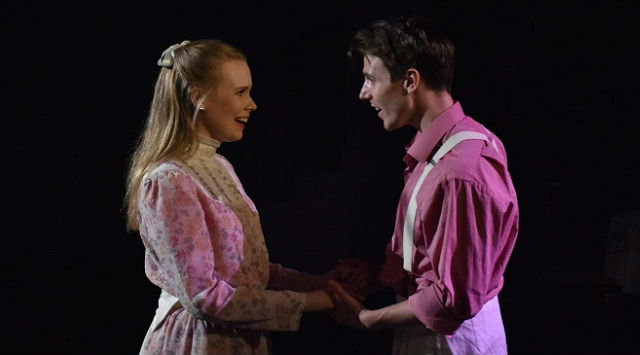
Young Esther is in love with John, the boy next door, but her family is set to move to New York as a result of her father’s recent promotion at work. It is clearly not the story of Meet Me In St. Louis that captivates, but its celebrated songs that we connect with. Based on the legendary 1944 film, this is a musical production of the most traditional kind, that holds special appeal for audiences of a conservative vein. There is nothing unpredictable or original here, only an abundance of nostalgia that many will no doubt find satisfying.

Matt Hourigan directs and choreographs, displaying considerable theatrical flair, although use of space can be more inventive. The band can sound somewhat distant, but music direction by Oscar Balle-Bowness remains a delight. Visual elements are adequately assembled, to help us imagine America at the dawn of the previous century. Performers look, comically, either too old or too young for their roles, but the quality of singing is consistently high, with leads Phoebe Clark and Matthew Predny leaving strong impressions with their vocal abilities.

“Have Yourself a Merry Little Christmas” has since become one of the most popular songs of the festive season. A deeply melancholic lyric that wistfully harks back to an idealistic past, “once again as in olden days, happy golden days of yore,” overzealous with the trust we place on old memories, and the frankly strange belief that things always used to be better, back in the day. The truth is that we have progressed in many ways, and although life is never without its challenges, to yearn for anything that might involve a regression of our existences, is simply unwise.

www.facebook.com/starkeeperproductions/

Review: Blue Christmas (New Ghosts Theatre Company)


Venue: Kings Cross Theatre (Kings Cross NSW), Dec 11 – 22, 2019
Images by Clare Hawley

Good People
Playwright: Katy Warner
Director: Lucy Clements
Cast: Clementine Anderson, Laura Djanegara, Sasha Dyer, Chika Ikogwe, Jane Watt, Emma Wright

Shandy’s Corner
Playwright: Gretel Vella
Director: Lucy Clements
Cast: Clementine Anderson, Meg Clarke, Laura Djanegara, Harriet Gordon-Anderson, Zoe Jensen, Vaishnavi Suryaprakash

Theatre review
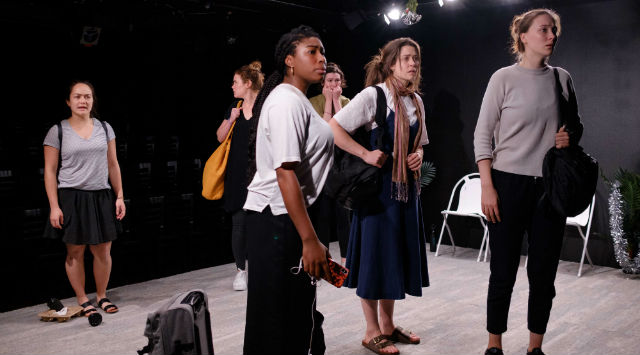
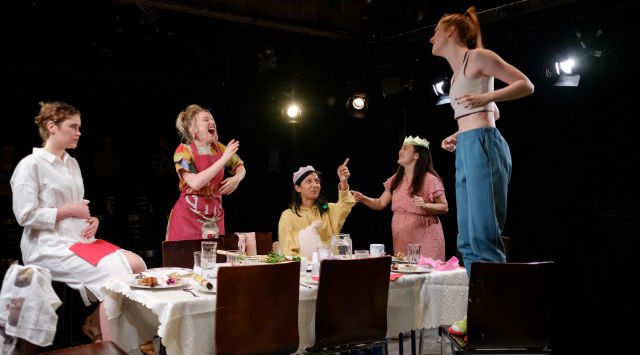
It is Christmas time, when things come to a boiling point for two groups of women. In Katy Warner’s Good People, old friends have their holiday in Indonesia cut short by a state of emergency, as violence breaks out and tourists are corralled and confined to an airport. These Australians have witnessed the true face of poverty, and are now confronting the brutal implications of their privileged first world lives. Shandy’s Corner by Gretel Vella takes place in a women’s shelter, in first world Australia, where the consequences of our patriarchal systems are on full display, with broken individuals trying to regain their agency and a sense of dignity.

Both hour-long works are sensitively written and immensely contemplative, offering valuable perspectives on the kinds of lives we currently inhabit. Directed by Lucy Clements, the double-bill presentation grips from start to end. Good People is provocative, able to instigate meaningful conversations, while Shandy’s Corner is fabulously entertaining, with a dark humour that proves deeply satisfying. Clements injects an infectious passion into every scene, for a theatre that communicates with efficacious power.

An excellent impression is left by a very strong and cohesive cast, remarkably engaging in their delivery of two ensemble pieces, with not a single weak link. Clementine Anderson and Laura Djanegara perform in both stories, taking the opportunity to demonstrate versatility, but are especially memorable in Shandy’s Corner for their compelling portrayals of women overcoming adversity in wildly different ways. Harriet Gordon-Anderson and Emma Wright bring complex characterisations and excellent drama to the staging, intense with the emotions they convey. Funny ladies Meg Clarke and Zoe Jensen are thoroughly enjoyable in comedic roles, each actor with approaches as bold as their imaginations.

It is appropriate that the Christmas message here relates to the inherent injustices of our way of life. To respond to these plays, we can do no better than to think, “what would Jesus do?” in the face of these man-made tragedies. Christianity proclaims to be about caring for the poor and the oppressed, as it preaches in Proverbs 31:8-9, to “speak up for those who cannot speak for themselves, for the rights of all who are destitute. Speak up and judge fairly; defend the rights of the poor and needy.” When we look around us, there is little that can be construed as holy, but good art remains, and it is eternally sacred.

www.newghoststheatre.com