Review: Keep Calling (PACT Centre for Emerging Artists)

keepcallingVenue: PACT Centre for Emerging Artists (Erskineville NSW), Sep 13 – 17, 2016
Playwright: Chelsea Ingram
Director: Herman Pretorius
Cast: Chelsea Ingram, Luke Edward Smith
Image by Isabelle Munhos

Theatre review
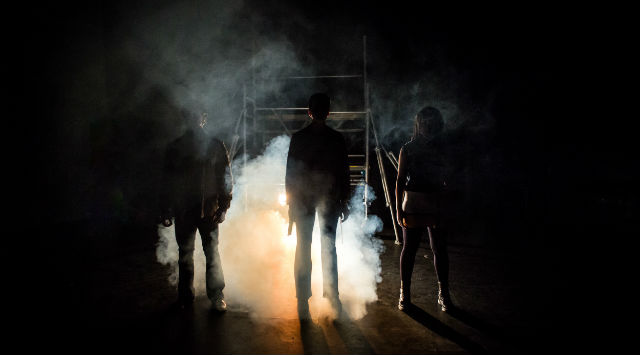
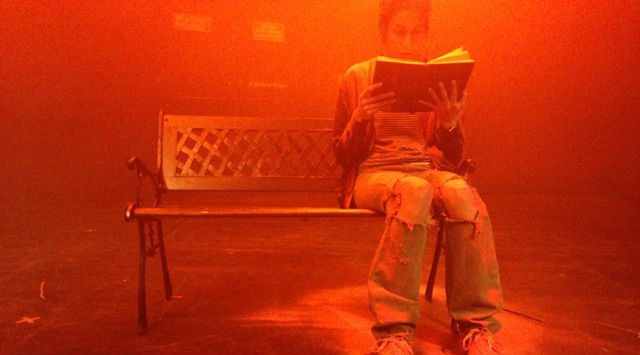
Chelsea Ingram’s Keep Calling is about an unusual relationship, and the agony of existence when taboo becomes an integral element to one’s identity. The play presents a valuable opportunity to take a rare look at something deemed objectionable, and even though it stops short of advocating any specific ethical perspective, it nonetheless confronts the way we think of the themes being portrayed. For some, the material might prove controversial, but for others, its depictions can seem coy; it is a delicate balance that Ingram tries to maintain, but an edgier approach would make the show more memorable.

There is an undeniable mystery built into the plot, even though the production struggles to effectively manufacture a sense of intrigue. Its characters are vulnerable, but Keep Calling‘s immersion in their suffering is insufficiently convincing for us to respond with empathy. The style of presentation is wild and loud, allowing us to access the emotional upheavals taking place, but we rarely make contact with an authentic foundation on which the drama should be built upon, and the play leaves us feeling somewhat detached.

We can all understand Stacey and Sam’s desolation even though few of us have experienced their circumstance. Their story is unique, but only a flimsy membrane away from our realities. How we formulate rules for living is often arbitrary, and Keep Calling</em is a reminder of the ambiguity that can exist in what we wish to be incontrovertibly true. Societies have come to accept that love can take many forms, but there are limits to what they can accept. What is considered illicit in a particular time and place, is legitimate in another. It is easy to say "as long as nobody gets hurt," but how we define and detect damage is yet another quandary.

www.pact.net.au

5 Questions with Chelsea Ingram and Luke Edward Smith

Chelsea Ingram

Chelsea Ingram

Luke Edward Smith: What inspires you?
Chelsea Ingram: I am inspired by life. I am an extremely sensitive person and embrace the crazy energies that are constantly surrounding us. I guess I am inspired by others stories, most people in this world underestimate their strength and tales and I have always wanted to express their stories and triumphs through my art.

What advice would you give to other young female actresses and writers?
Learn to hussle. Have your mum on speed dial. Be strong, humble and most importantly love and embrace yourself. Geoffrey Horne my teacher at Strasberg and a gifted actor once wrote “I’ve lived my life expecting things to take care of themselves. I told myself that all I had to do was be a good actor. Believe me, that’s not the way it works.” – I kind of live by this.

Do you have a method to prepare for your roles?
After studying at The Lee Strasberg theatre and film Institute for 2 years, I am a huge believer in the method. I personalize my characters emotions by using my personal experiences to embody and find the truth of the characters journey. To prepare I will study their lives, loves, woes and highs to understand and fully embrace their stories.

How was working in the big apple?
Incredible and unbelievable. Actors in New York are so giving and have immense respect for the art and its craft. I can’t really put into words how magnificent life is as a actor in NYC, but it’s like nothing I had ever experienced. I worked on the stage, feature and short films and web series – every project was amazing. New York is a hard city, most months it’s a struggle to even pay rent. I can’t help but respect every actor who throws themselves into the NYC world of arts and embraces that extreme and yet amazing life style.

Do you have any upcoming projects to watch out for?
Currently I am working on an upcoming film. My play Keep Calling plans to move over to NYC in later 2017. I am connected to an unbelievable theatre company in NYC, Primitive Grace, directed by Paul Calderon and David Zayaz, with shows coming out soon. I have a few other projects that I am unable to speak about but please keep an eye out on social media.

Luke Edward Smith

Luke Edward Smith

Chelsea Ingram: What made you come back from NYC to do Keep Calling as part of the Sydney Fringe?
Apart from the convenient excuse to visit friends and family? It was the punch in the guts the script gave me. I read it and was still thinking about it a few days later. Always a good sign. I’m always looking for that element of fear in bringing something to life in a performance and this role left me thinking, “can I pull this off?” I wasn’t sure, but I knew I’d like to give it a red hot go.

How did you approach working on the role?
It wasn’t too different an approach from any other. I always start with what about them is similar to me. It’s much easier to work from those similarities and then layer in those things that make us different. It helps me ground the performance and hopefully it makes it all the more believable when an audience comes to see it.

Did you find much that was similar between you and Sam?
I recognised that attraction to something you know isn’t good for you. I’ve never been in the same shoes exactly (thank God), but I saw the behaviour, the longing, the need to belong and that I think is universal. It’s something anyone can identify with, being attracted to or trying to please someone or something that can’t or won’t be pleased. That coupled with the huge regret and confusion and anger that comes with not being strong enough to give it up. I like to work very personally so I’ve gone back to moments in my life where I’ve felt the same way as Sam.

What do you do to come down from working on something that intense and personal?
I go home and do the complete opposite of what I’ve been doing in the rehearsal room that day! I listen to upbeat music, I watch TV, lots of comedies, or curl up with a trashy novel. And tea. Tea makes everything better. Anything that puts the balance back into life. Everything I put into that day’s work I try to leave in the room. It’ll be there tomorrow.

When you’re in New York, what do you miss most about Australia?
Tim Tams. I’ve eaten way too many packs since I got back. I always take two big jars of Vegemite with me when I go back, so I’ve got that covered. But Tim Tams? You can get them but they go for about $7 a pack in the States, and if any other Australian knows you’ve got them…

Chelsea Ingram and Luke Edward Smith can both be seen in Keep Calling in the Sydney Fringe Festival.
Dates: 13 – 17 September, 2016
Venue: PACT, Erskineville

Review: Black Hands Dead Section (Sydney University Dramatic Society)

sudsVenue: PACT Centre for Emerging Artists (Erskineville NSW), Aug 3 – 13, 2016

Playwright: Van Badham
Director: Zach Beavon-Collin
Cast: Adrien Stark, Alice Birbara, Amelia McNamara, Anna Rowe, Anna Williamson, Bianca Farmakis, Cameron Hutt, Charlie Meller, Elliott Falzon, Eloi Herlemann, Emma Throssell, Hal Fowkes, Hannah Craft, Helena Parker, Henry Hulme, Isabella Moore, Jimmy Pucci, John Kenedey, Joshua Powell, Julian Hollis, Laura McInnes, Louisa Thurn, Maddie Houlbrook-Walk, Nick Jackman, Nell Cohen, Oliver Ayres, Patrick Sunderland, Victoria Boult, William Hendricks
Image by Clare Hawley

Theatre review
West Germany’s Baader-Meinhof Group were a far-left militant group in the early 1970’s, that had orchestrated acts of terror, including bombings and assassinations, in its efforts to instigate social and political change. In Black Hands Dead Section, playwright Van Badham provides a history lesson on the gang, looking at past events through a contemporary lens, mindful that terrorism is the hottest of today’s issues. No society thinks of itself as aggressors; in Australia, terrorists are foreign and we are its innocent victims. The simple but dishonest dichotomy frees our conscience, so we can continue with life as we know it, without having to understand the complexities of how we are responsible for our own woes.

Characters in the play begin as perfectly reasonable Western middle-class individuals, passionate about what they believe to be right, and although sometimes radical with their ideas, these personalities are familiar ones that we relate to readily. We want the same things of life, and our world views coincide. Gradually however, their actions become increasingly reprehensible, and we struggle to find the line at which us had become them. It is this ambiguity that is missing from public discourse about “religious extremists”. Dehumanising the enemy makes things convenient, but the lack of transparency and truth in how we talk about perceived threats, compounds our fears and prevents us from solving problems.

This student production features 29 enthusiastic actors, some more talented than others. The unevenness in ability certainly makes for challenging viewing, and although nuances and details are sorely lacking in their interpretations, they make their point loud and clear. Acts I and II feature an inordinately large number of characters and scene changes, which would test even the most accomplished directors and designers, so it comes as no surprise that this simple staging often leaves us confused with its every who, what, where and why. Thankfully, Act III turns uncomplicated and is more successfully rendered, eventually leading us to a cogent conclusion.

There are no easy answers in any war, because all life must be valued equally. If we believe that those in opposition must be annihilated, then no one is safe, and human nature is nothing but a perpetual death wish. We have to find the root of every evil before we can genuinely be rid of them, but this is not how we do politics (never have and probably never will), and when we look at the past, the truth is unquestionably full of doom and gloom. War has always been, but so has the longing for peace, and we cannot give up the desire for something better as it is that very desire that defines humanity. Characters in Black Hands Dead Section wishe for a better future, but it is their refusal to include every adversary in their vision of the ideal, that keeps them fettered.

www.sudsusyd.com

Review: Edward Gant’s Amazing Feats of Loneliness (Polyamorous Productions)

polyamorousVenue: PACT Centre for Emerging Artists (Erskineville NSW), May 4 – 7, 2016
Playwright: Anthony Neilson
Director: Natasha Pesce
Cast: Ralph Andrews, Will Hickey, Jonathan Lagudi, Nicole Wineberg
Image by Liam O’Keefe

Theatre review
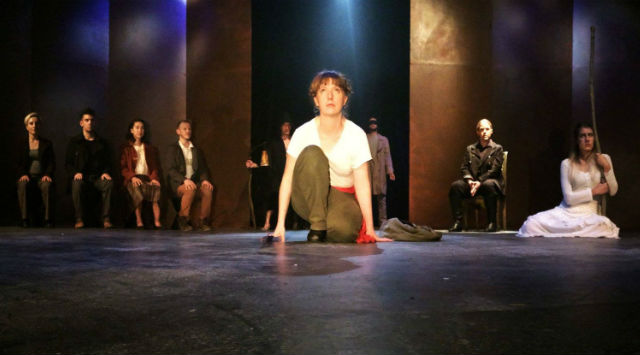
Edward Gant runs a vaudeville specialising in tall tales of loneliness. Even though the theme is one of sadness, his show is full of rambunctious fun, designed to elicit squeals of pleasure with outrageous and flamboyant sequences featuring his troupe of three mad performers. Edward Gant’s Amazing Feats of Loneliness is Anthony Neilson’s take on the “show within a show” format, brilliantly scripted to deliver extraordinary spectacle accompanied by disarming humour and an unrelenting melancholy. It is the most sophisticated of writing, traversing the basest of human experience to the most profound of our emotional landscapes. Subtly philosophical yet undeniably poignant, the audience is offered a plethora of ways to access its meanings, at whichever level of depth we choose to receive its wisdom.

The wild stories are brought to life by Natasha Pesce’s exuberant direction. Her style is exciting, bold and very funny, particularly effective in the production’s first half where the text presents greater opportunities for ostentatious tomfoolery. Pesce’s eye for beauty is reflected in charming design details that provide a visual splendour, delightful for our senses while helping to convey story and sentiments. Four dedicated actors form a tight ensemble, boundless in mischievous energy and unified in what they convey. Nicole Wineberg is a perfect blend of slapstick, nuance and sexual allure for her demanding role. The actor is captivating in all her guises, whether coy, gruesome, rugged, or ludicrously vivacious in a bear suit, Wineberg is completely engrossing and very entertaining indeed. Equally madcap in approach is Ralph Andrews, memorable for his confident frivolity and distinctly wanton sense of comedy. His work is not the most physically disciplined, but the presence he brings to the stage is replete with an enthusiastic whimsy that appeals to our need for something more tender.

In loneliness, longing is the ringmaster who takes centre stage, controlling thoughts, decisions and behaviour. It is a driving force that can lead one to many possibilities, but its motive is self-obliteration. Longing may replace loneliness with some other sensation, but desire will always remain albeit in a different form, for life simply cannot be without desire. Edward Gant faces a dilemma with the eradication of his own loneliness and the show that must go on. Joy can take the place of pain, but it only exists in relation to its dark other. The pursuit of a happy life is meaningless without sadness, and the resolve of its existence is to be ignored at our own peril.

www.edwardgant.com

Review: The Tragedy Of Antigone (Ninefold / PACT)

ninefoldVenue: PACT Centre for Emerging Artists (Erskineville NSW), Apr 20 – 30, 2016
Playwright: Eamon Flack (after Sophocles)
Director: Shy Magsalin
Cast: Aslam Abdus-samad, Bodelle de Ronde, Dave Buckley, Erica J Brennan, Gideon Payten Griffiths, Kiki Skountzos, Pollyanna Nowicki, Scott Parker, Victoria Greiner

Theatre review
Antigone’s story is about defiance. Motivated by love and duty, she goes against the law of the land to do what she believes to be unquestionably right. Contradicting the wishes of Creon (who is Queen in this rendition), Antigone goes to bury her dead brother believing in the superiority of God’s will over the ruler’s whims. Based on Eamon Flack’s recent adaptation of Sophocles’ classic, The Tragedy Of Antigone is concerned with the place of government in the life of individuals, its impositions on our liberties and the spirit required for an authentic and dignified existence.

Director Shy Magsalin’s work is transcendent, compelling and powerful. Her gloomy atmospherics, beautifully established by Liam O’Keefe’s lighting design, transport us to our protagonist’s living hell where we discover a world of struggle and suffering. Greek tragedies are often less about psychology than they are about principles, and in this case, Magsalin’s ability to connect emotion with her play’s virtuous propositions is key to the production’s effectiveness. Precise and disciplined choreography permeates every movement on the stage, but strong impulses underlie all its physical contrivances for their symbolism to convey with poignancy.

Nine very well-rehearsed performers form an ensemble that does an outstanding job of finding cohesiveness, nuance and energy, for an intriguing interpretation of a meaningful but challenging text. Leading lady Erica J Brennan is full of passion. Attacking her role with impressive accuracy and tremendous focus, the actor’s tough presence provides a remarkable soulfulness to a heroine who is staunch and courageous in constitution. Equally accomplished is Pollyana Nowicki as Tiresias, the blind clairvoyant, equal parts ethereality and gravitas. Nowicki’s portrayal is macabre, mysterious and flamboyant, contributing significantly to the show’s exciting but dark sense of extravagance. It is noteworthy that the use of voice is especially potent in the production, with actors demonstrating excellent versatility and dynamism in the way they wish to be heard.

Love can move mountains, and as we see in The Tragedy Of Antigone, it can make women out of girls. Fearlessness may not be a rare quality in any of our legends, but it is hard to deny the importance of gender representation in Antigone’s tale. In an economy obsessed with action heroes, women characters principally defined by bravery, are desperately few and far between. This is theatre that we need, not to coincide with the current trendiness of feminism, but because it offers a kind of inspiration that would be of benefit to anyone. Believing that women can fight, and must fight, with the best of them, is a form of liberation crucial to people of all genders. Everyone has the potential to achieve the best of humanity. It is whether we allow ourselves and others that freedom, that will determine the extent of our evolution.

www.ninefoldensemble.com

Review: Tropical Hypeisms‏ (PACT Centre For Emerging Artists)

pactVenue: PACT Theatre (Erskineville NSW), Jan 13 – 16, 2016
Choreographer: Caroline Garcia
Cast: Caroline Garcia

Theatre review
Discussing the effects of colonisation on many of our racial identities is a highly complicated one. It requires an understanding of histories/herstories that we might be able to research and study, but will ultimately involve nostalgic longings of an imagined past that can no longer be wholly authentic. Caroline Garcia is a post-colonial artist interested in the evolution of identities based on ideas of gender and ethnicity as they relate to the Westernisation of cultures. Tropical Hypeisms is a work that appreciates the complexities of those concepts and makes representations that are similarly intricate and elaborate.

There is certainly no watering down of what the artist wishes to say, which means that deciphering her consolidation of symbols can be challenging. Garcia rejects conventional approaches of berating and castigating the forces of domination, and attempts to present a personal conception and experience of what it is like to be outside of the mainstream, and the results are truly unique. Her show is charming yet bold, with a sensational cocktail of sounds and music by Mei Saraswati, and costumes by Matthew Stegh providing an aesthetic that is quite close to being original. Lighting could perhaps assist better with some of the more languid portions of the production, but Garcia ultimately wins us over with charisma, and the confident physicality of every sensual dance.

Invoking Carmen Miranda and Josephine Baker, Tropical Hypeisms is an exercise in locating the self through the deities and divas of one’s choosing. We look into mirrors that do not lie, but how we receive its reflective messages depends on what we want to see. We can accept the impositions of social norms and their requirements, or we can turn against them, to investigate something that corresponds with what we believe to be true. It is a question of soul, and of getting to the heart of the matter.

www.pact.net.au

Review: Hamlet (Montague Basement)

montaguebasementVenue: PACT Centre for Emerging Artists (Erskineville NSW), Dec 1 – 5, 2015
Playwright: William Shakespeare
Director: Saro Lusty-Cavallari
Cast: Zach Beavon-Collin, Robert Boddington, Christian Byers, Lulu Howes, Patrick Morrow
Image by Zaina Ahmed

Theatre review
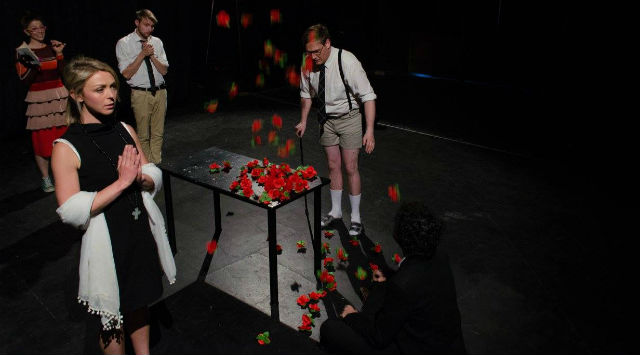
If Hamlet lives today, his claims about seeing the ghost of his recently deceased father would probably not be taken very seriously at all. In Saro Lusty-Cavallari’s adaptation, the Prince of Denmark deals with his bereavement by locking himself away with Disney films, and spends too much time online. We also only ever see the apparition in Hamlet’s presence (through television sets), which allows us to bring his sanity to question. This version of Hamlet explores youth and its detachment from reality, especially in the context of modern technology. It is about isolation, delusion, and that sense of entitlement often attributed to the privileged lives of children born in the economic boom of late twentieth century.

Lusty-Cavallari’s vision is focused and powerful. Substantial omissions are made to serve his reinterpretation, but his choices are interesting and thoughtful ones that challenge our preconceived notions about the text, and urges us to look with fresh eyes. We are made to consider if this Hamlet presents the same man in a different light, or whether this rendition is indeed an entirely different character from the one we had known. Performances do not always live up to the demands of Shakespeare’s writing, but Christian Byers brings good tension and drama with the title role, even if there is little variation in his approach to the prince’s temperament or gesticulations. Supporting player Patrick Morrow leaves a strong impression as Polonius, with effortless charm and a natural pace that help him stand out on a stage that does not shy away from outlandish theatrics.

Set design is beautifully executed, with components of media and technology strewn across the space, representing Hamlet’s room, and illustrating the disposable nature of our contemporary lives. “To be or not to be” almost becomes a flippant statement for a generation that struggles to find meaning, but the team in this production of Hamlet is determined to locate, in Shakespeare, relevance and resonance for themselves, and subversion it seems, is the only way.

www.montaguebasement.com

Review: Tender Indifference‏ (Arrive Devise Repeat)

arrivedeviserepeatVenue: PACT Theatre (Erskineville NSW), Sep 8 – 12, 2015
Playwright: Arrive Devise Repeat (after Albert Camus)
Director: Alexis Hammerton, Victor Kalka
Cast: Joanne Coleman, Ryan Devlin, Alexis Hammerton, Patrick Howard, Victor Kalka, Troy Kent
Image by Jack Gorman

Theatre review
Through the absurd, we can examine what it is that gives life a sense of coherence. Albert Camus’ L’Étranger tells of a man who does not grieve his mother’s death. In Tender Indifference, he is distanced from the world, floating through scenarios almost like an apparition, never involving his emotions with all that occurs in the environment. His alienation is ubiquitous in the play, and we struggle to find a point of connection with his story. It brushes us off, pushes us away, and only the extremely persistent can afford attention for its entirety.

Direction of the work is adventurous but lacking in maturity. Scenes are created for superficial effect, without offering enough innovation to affect fascination, and with characters and narratives that fail to engross. The cast is well rehearsed, but quality of performance is uneven. Stand-out players include Alexis Hammerton whose presence is strongest in the group, and who displays a confidence that addresses our need to be entertained. Patrick Howard takes on the more daring parts, with a flamboyance that keeps us amused. His comedy in the piece is simple and coarse, but refreshing nonetheless, in an atmosphere that aims to be comprehensively dark.

It is challenging to find value in alienation if what follows is emptiness. A work of art can have the best intentions, but if it falters with its communication, the theatrical event represents a missed opportunity. The viewer gains little from Tender Indifference, but its participants probably are conversely enriched by its process. The nature of performance however, requires a kind of partnership between those on and off stage, and both must benefit from that shared experience, no matter what the message therein may be.

www.facebook.com/arrive.devise.repeat

Review: Unend‏ (Never Never Theatre Co)

neverneverVenue: PACT Theatre (Erskineville NSW), Sep 10 – 12, 2015
Playwright: Harry Black
Director: Jess Arthur
Cast: Emma Harvie, Eliza J Scott

Theatre review
Abstraction in theatre can bring tremendous pleasure or great boredom, depending on the kinds of communication that do or do not happen between the stage and its audience. Unlike media such as paintings and sculpture, one is trapped in a seat, unable to simply walk away to a different work. Harry Black’s Unend is entirely abstract, and although elements of reality and points of reference are peppered through, it persists with its sublime incoherence, unafraid to cause alienation. The themes are broad, and characteristically open to interpretation. The work talks about the creative process, and the obstacles to progress. It might also be concerned with the relationship between artist and muse, and the self-jeopardising nature of humanity. Many things can be read into Black’s writing, and it is that vagueness that allows an appreciation of Unend to be a dynamic and involving one.

Adding to the sophistication of the script is Jess Arthur’s direction, which delights in manufacturing a sensual and ghostly beauty (ably materialised by Jeremy Allen’s set and lights, and Gayda de Mesa’s sound) to accompany the free-flowing ideas that occur in the text. Dialogue is relayed with impressive detail, and even though its ephemeral quality evades our instinctive need to rationalise every sentence, we never doubt the truth that is being explored on stage. A solid and palpable chemistry is established early on and stays for the entirety of this two-hander. Emma Harvie’s work is thorough and complex, with motivations that feel powerfully honest. The actor balances an inner authenticity with a robust physical portrayal, to create a character that encourages identification in spite of her many ambiguities. Similarly buoyant is Eliza J Scott’s depiction of an earthy angel, reverberating with conviction and enthusiasm. Her vibrant energy gives grounding to a show that can easily turn impenetrable, and the playfulness she introduces reflects a passion to entertain.

This production of Unend speaks differently to each viewer. It requires intellectual investment on our part, so it follows that passive consumption of the work may not gratify, but if one is able to connect with some of its assertions, a rewarding theatrical experience will emerge. The world is full of mystery, but its participants must find ways to understand their very existence. Like an author with a blank screen, meaning begins with that singular leap of faith.

www.facebook.com/nevernevertc

Review: Everything I Learned At NIDA‏ (Pact Centre For Emerging Artists)

kylewalmsleyVenue: PACT Theatre (Erskineville NSW), Sep 8 – 12, 2015
Playwright: Kyle Walmsley
Director: Kyle Walmsley
Cast: Kyle Walmsley

Theatre review
The beauty of youth cannot be divorced from its anxieties, frustrations and arrogance. Kyle Walmsley’s Everything I Learned At NIDA is about a young man’s experiences with acting teachers, and his struggles at balancing his ego with the acquisition of skills that promise fame and glory. It is also extremely funny and outstandingly detailed in its observations of clichés in that particular field of education. Walmsley performs the show not as a student, but as the condescending and self-absorbed instructor who treats his crowd as though we are desperate and ignorant parish at his church. His style ranges from very subtle to ridiculously bombastic, and the show’s comedic effectiveness keeps growing through the duration. It is a caustic tone that drives the production, and although the approach can seem juvenile, the material is substantial enough for rumination after the laughter subsides.

Walmsley’s abilities as comedian, writer and director are all impressively showcased. It is a highly idiosyncratic presentation, but with finely tuned nuances that engage us in often clever and unexpected ways. There is a bold and crass sensibility to his brand of humour, but Walmsley does not rely on cheap or vulgar laughs. His punchlines are genuinely hilarious. In many ways similar to a stand-up format, his very acute sensitivity to our responses and his hunger for attention, creates a level of engagement that is immediate and thrilling. His fondness of audience participation certainly keeps us on edge.

The work is cagey when it comes to the artist’s own feelings and beliefs about his time at NIDA, but a lot is revealed through his portrayal of the culture he had experienced. The tension between talent and effort, and the conundrum of being true to oneself while abandoning the ego, are questions about art education that come into focus. Institutions can provide answers, but the student has to choose whether to learn. Places and personalities hold valuable opportunities for development, and the individual must decide how best to make their dreams come true.

www.kylewalmsley.com