Review: Kill The PM (Unhappen)

unhappenVenue: Old 505 Theatre (Surry Hills NSW), Oct 8 – 26, 2014
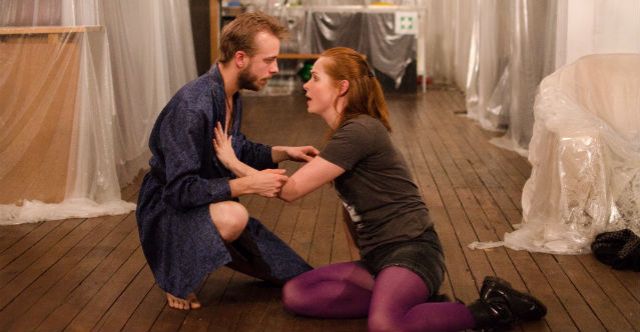
Playwright: Fregmonto Stokes
Director: James Dalton
Cast: Nicholas Hiatt, Zoe Jensen, Michael McStay, Lily Newbury-Freeman
Image by Lucy Parakhina

Theatre review
We must not take our democracy for granted. It is a key element to meaningful lives, as it insists that every person and their liberties are included. The ideal is a world in which everyone has an equal say, even if we end up with a messy and inconvenient state of affairs, but today’s reality sees a grave inequality of power and influence. As Australia becomes increasingly capitalistic, previous notions of a classless society are quickly eroded, acquiescing to the dominance of the 1%. Our leaders are still democratically elected, but there is no camouflaging the fact that prevailing ideologies of government are disproportionately geared towards the benefit of the wealthiest. One person may still receive one vote, but our voices do not carry the same weight, and the loudest have proven themselves to be the most selfish.

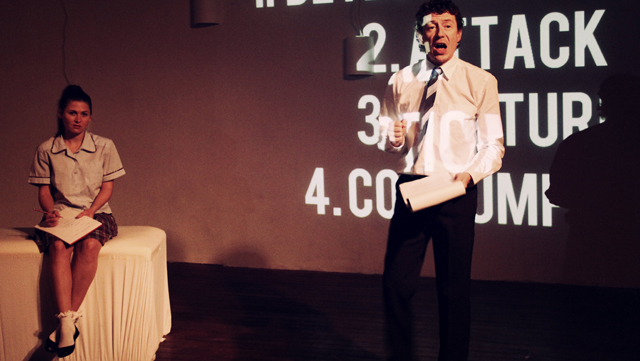
Fregmonto Stokes’ Kill The PM is inspired by the fantasy of the masses, and begins with the most simplistic of ideas. The assassination of a leader is a proposition symptomatic of the disquiet that citizens experience, but the play does not indulge extensively in that premise. Instead, it explores the absurdity of the suggestion that the murder of one person is all the revolution that is required to cause an effective change in the way our nation carries on its business. Stokes’ writing has a sense of wildness that is dramatic and exciting, with surrealist aspects that keep us intrigued. There are unexpected ambiguities which make the script rich and thoughtful, but its narrative structure falters at certain junctures when a more poetic approach takes over. Stokes’ work is thought-provoking, but it has an uncomfortable gentleness that contradicts its powerful subject matter.

Direction of the piece by James Dalton suffers the same shortage of aggression. The characters are blinded by passion but what happens on stage is oddly subdued. The cast does not portray sufficient conviction for the story to take hold, and their relaxed disconnection from the plot (and each other) is frustrating. This is a story that should speak to anyone who is even remotely interested in politics, but none of the players manage to find points of resonances for the contentious issues being discussed.

Fortunately, the production shifts gears in the middle, giving up its unsuccessful naturalism for a spectacular theatricality in a series of dreamlike sequences. Dalton’s strengths with visual aesthetics and his talent at manipulating atmosphere rescue the show to some extent, although its core messages would benefit from greater elucidation. It is the formidable design team that shines in this production, with Dylan Tonkin’s set leaving the greatest impression, having given the venue an extreme transformation with daring innovation, excellent taste and a sophisticated flair. Benjamin Brockman’s lights are another highlight, cleverly adapting to the theatre’s unconventional facilities, and using gadgets that function charmingly as set pieces in addition to providing interesting illumination.

Kill The PM suggests that the elimination of any single person or group would not be advantageous, regardless of how blood thirsty our primitive selves can be. We see the importance of community in the process of affecting policy changes, but also the difficulties in locating ways that people can unite to find strength and commitment. Having a voice in any political climate is challenging, and it is only as collectives that we will be heard. The theatrical arts are fundamentally collaborative, and we must value the egalitarianism that allows individuals to come together to create and to speak. Regimes come and go, but art endures, and at the theatre, the subversive can find expression, and sometimes, have an impact.
www.unhappen.org

Review: Wouldman (The Old 505 Theatre)

wouldman1Venue: Old 505 Theatre (Surry Hills NSW), Sep 17 – 28, 2014

Playwright: Justin Buchta
Director: Justin Buchta
Cast: Justin Buchta

Theatre review
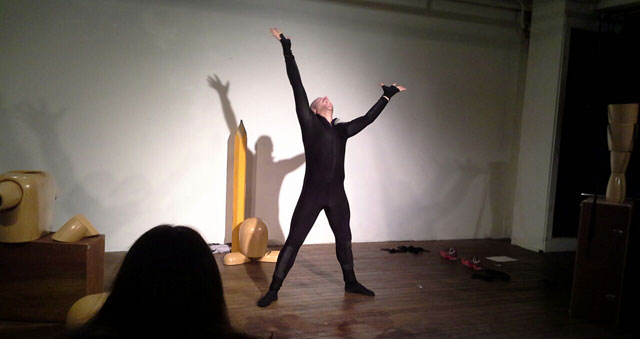
Wouldman is like a super hero. His costume is made of wood and in it, he would do many things. Justin Buchta’s very unique one-man show is an amalgamation of many disciplines and forms. There are influences from mime, dance and mask work. He even does yoga and attempts auto-fellatio (simulated). There are songs and poetry, and stories are sometimes narrated but the show is not at all narrative driven. It is abstract, almost dadaist, with segments that flow into each other, some chapters more decipherable than others. This is a fascinating show that is frequently funny and amusing, with an expansively creative approach to communication.

Buchta is an extremely energetic performer, who uses his solid presence to give the production an air of impulsiveness. He seems to leave many elements to chance, creating an atmosphere that is consistently surprising and alive. Buchta keeps us thoroughly engaged even while he bewilders us with his avant garde antics, and we respond with a complex mix of thoughts and emotions. The show’s style of ambiguity is an inviting one that can be challenging at times, but always with sufficient frames of reference to construe meanings.

The artist’s creativity is characterised by a sense of boundless freedom, one that does not require adherence to conventions and expectations. Buchta is concerned with the act of expression itself, and meanings are left to fashion their own lives. This is an art that encourages open hearts and minds in order that interaction can occur. Justin Buchta proves himself in Wouldman to be risky and fearless, but it remains to be seen if his audience is equally gallant.

www.venue505.com/theatre

Review: Jennifer Forever (Two Peas)

twopeas1Venue: Old 505 Theatre (Surry Hills NSW), Sep 17 – 28, 2014
Playwright: Tara Clark
Director: Tara Clark
Cast: Dominic McDonald, Gemma Scoble

Theatre review
Note: This review reveals a key plot twist.

The play begins with ambiguity, danger and tension. Our minds and emotions struggle with meanings and morals, trying to form a narrative while jostling for head space with our own senses of right and wrong, theatrical representations and social acceptability. The work is about sexual predators, sex work and the way sex is used to construct perspectives of the world and the way we live in it. These ideas are best enjoyed in an air of uncertainty, instability and disquiet. When Tara Clark’s Jennifer Forever is provocative, it has a fierce and unsettling energy, but when it dissolves into a more assertive political position, its arguments lose their edge to become more conventional.

The strength of Clark’s writing lies in its passionate dialogue and the textured characters it presents. Fiery and thought-provoking confrontations between Man and Girl are used to great dramatic effect by Clark’s own direction. Playing Girl is Gemma Scoble who attacks her counterpart with a sadistic glee. She performs Girl’s two age brackets convincingly but can sometimes be too surface in her approach. She is persuasive as a figure of power and aggression but moments of vulnerability are not as compelling. Dominic McDonald’s performance as Man is impressive in its complexity. He makes the role despicable, intriguing and palpable, with an ability to find qualities that are universal to the human experience. McDonald has a sensitivity that allows us to connect with the daunting character that he portrays, and the several stages of transformation he performs is gripping entertainment.

For several scenes, Man addresses the audience directly in a series of lectures, but it is not just this element that makes the play feel excessively didactic. Clark has a clear message she wishes to relay, and her voice is unapologetic and direct. The story quickly subsides and we witness intense quarrels about the main themes of the text. The characters give way to the big ideas that take centre stage, but what remains becomes too simple and obvious in comparison. Jennifer Forever‘s timely look at paedophelia is honest and refreshing. It reflects our contemporary concerns and even though its theatrical effectiveness waivers, it addresses our need for discussion on the topics. We are at the precipice of a disintegrating taboo and achieving a greater understanding that will protect and heal is crucial.

www.thetwopeas.com

5 Questions with Gemma Scoble

gemmascoble‏What is your favourite swear word?
I think “fuck me dead” even though that’s three words and when you think about it, it’s pretty gross.

What are you wearing?
Jeans, cons, a black jumper (cause I like to keep things classsssssy).

What is love?
Love is… Well. When I eat something. Like ribs. Or like a good steak that comes with fries on the side. I always save the best bit till last… Like, I portion off the best bit of steak, and make sure there is just enough fries and sauce to accompany that bite into my mouth. Normally, if someone tried to take that from me I’d stab that motherfucker’s hand with my fork. So I guess Love, in it’s purest form, would be sharing my last bite of my favourite meal with them. Probs not 50/50 though. Maybe 70/30.

What was the last show you saw, and how many stars do you give it?
The last show I saw was Tartuffe. I laughed a lot at the script, and thought the adaptation worked really well. Kate Mulvany is just a bit excellent… but then again so is the entire cast. The women in it, like Helen Dallimore seemed to take on their roles with a contemporary approach or ambition so that the idea of them being “supporting characters” was knocked out the window. To me that’s really inspiring. I would give it 11 stars?

Is your new show going to be any good?
Hells to the yeah.

Gemma Scoble is starring in Jennifer Forever by Tara Clark, for Sydney Fringe 2014.
Show dates: 17 – 28 Sep, 2014
Show venue: The Old 505 Theatre

5 Questions with Dominic McDonald

dominicmcdonaldWhat is your favourite swear word?
I prefer swear phrases: God’s fuck! Jessica Christ! Christ on a stick! Christ’s cunt! (Can anyone say, Catholic School boy?)

What are you wearing?
A knowing smile.

What is love?
Baby don’t hurt me, don’t hurt me, no more.

What was the last show you saw, and how many stars do you give it?
Theatre is like golf, fun to play but no fun to watch.

Is your new show going to be any good?
You do know that I’m in it?


Dominic McDonald is playing the role of Man in Jennifer Forever by Tara Clark, for Sydney Fringe 2014.
Show dates: 17 – 28 Sep, 2014
Show venue: The Old 505 Theatre

Review: Bad Day Insurance (Old 505 Theatre)

old505theatreVenue: Old 505 Theatre (Surry Hills NSW), Aug 6 – 24, 2014
Playwright: Lisa Chappell
Director: Drew Fairley
Cast: Lisa Chappell, Sarah Hynter

Theatre review
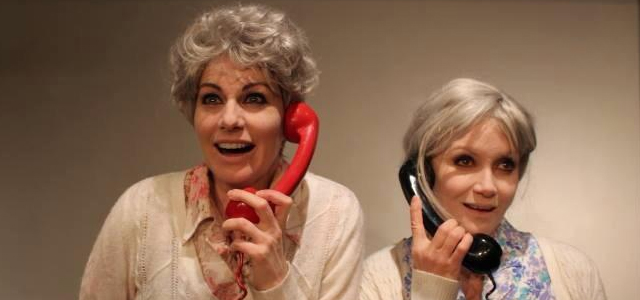
The quote, “resentment is like drinking poison and waiting for the other person to die,” has been attributed to different sources, including Nelson Mandela. In Bad Day Insurance, two elderly women spend their days in each other’s company, secluded from the world except for people on telephones who ask for insurance payouts due to having a bad day for all kinds of reasons. Esther and Mavis have to listen to these first world complaints every waking moment, and we soon get the impression that their state of torture would have been for a lot more than a few years. They are watched over by an invisible non-human entity named Boob, who exercises absolute control over these women, although we wonder if, like many of our gods, its existence is entirely in their minds. Esther and Mavis are grey haired and grey skinned, having waited an inordinately long time in their “call centre” (they sleep and work there) for an inscrutable something, or perhaps simply for their days at Bad Day Insurance to come to an end. They are trapped, and we wonder why. We wonder if they have imprisoned themselves and are punishing each other for something that had happened. We never hear the other end of the phone lines, and they do not ring on their own accord. The women verbalise a “ring ring” if a call arrives to taunt the other.

Lisa Chappell’s script is humorous, but its more striking feature is its strange darkness. The mystery and intrigue that Chappell creates is riveting, and her brand of empathetic absurdity brings out an unexpected compassion in the viewing experience. There are many loose ends to the piece, but meaningful details are peppered throughout so that our imagination is kept busy. We are entertained by a lot of silliness, but at the same time, we are completely engrossed on a cerebral level, seduced by all its somber resonances that point to something deeper that wants to be unearthed.

Performances by Chappell and Sarah Hynter are flawless. The actors are energetic, mischievous and magnetic, with a consummate professionalism that easily convinces us that all bases are covered. We are taken on a ride that involves laughter, surprise, curiosity, terror and poignancy. Under the directorship of Drew Fairley who provides a sensitive, nuanced third eye, the production they have created is a prime example of how showbusiness and art can collude to communicate something enjoyable, disarming and very clever. Talent of this calibre is a rare and beautiful thing, and to see Chappell and Hynter invent something that moves us on so many levels, is awe-inspiring.

Freedom is prized by everyone. It is not available to all, but in places like Australia, it is certainly within reach. Understanding how to attain that emancipation depends largely on an understanding of one’s own circumstances. Bad Day Insurance shows us that we almost never see the completeness of our lives. There are always annoyances, disappointments and pains that hold our attention, and we are always waiting for something to facilitate a release. Esther and Mavis have suffered an eternity. Prisoners of fear, despair and defeat, they have formed a hellish life, unaware of their power for creating better days for themselves. They fail to see that the locks enslaving them require keys that only they can manufacture. This is a show about our freedom, and it challenges us to seize it.

www.lisachappell.net

5 Questions with Dan Graham

SONY DIGITAL CAMERAWhat is your favourite swear word?
Money (or lack thereof)! This from someone who paid $50 to wrap an entire set in Gladwrap when all else failed.

What are you wearing?
My lucky purple jumper (aka my security blanket).

What is love?
The spirit of Monty, my dog who passed (my spirit guide).

What was the last show you saw, and how many stars do you give it?
The Pet Shop Boys Concert at Carriageworks, part of Vivid Festival. I’ll give it 4/5. Would have had the extra star but my feet hurt having to stand for the whole show (I must be getting old!)

Is your new show going to be any good?
Like anything I obsess about, this has been two and a half years in the making. Orphans by Dennis Kelly is a great play. I have a talented and committed cast, and a wonderful crew. Of course it’s going to be brilliant.

Dan Graham is directing Orphans by Dennis Kelly.
Show dates: 5 – 20 Jul, 2014 (Update 05/07/2014: show is now cancelled)
Show venue: The Old 505 Theatre

5 Questions with Jonathan Wald

jonathanwaldWhat is your favourite swear word?
My favourite swear word in Winter is cocksucker, and the best profanity anyone has called me is butt-pirate. Hmm, I notice a pattern there.

What are you wearing?
A very comfortable and warm Mexican blanket.

What is love?
Love is seeing the worst of a person’s behaviour and still caring about them just as much.

What was the last show you saw, and how many stars do you give it?
Sport for Jove’s Alls Well That Ends Well – 4 stars.

Is your new show going to be any good?
If it isn’t, then I’ll probably be muttering my answer to question number 1 a lot.

Jonathan Wald is directing Winter by Jon Fosse.
Show dates: 7 – 22 Jun, 2014
Show venue: The Old 505 Theatre

Review: Winter (Persophia / The Old 505 Theatre)

winter2Venue: Old 505 Theatre (Surry Hills NSW), Jun 7 – 22, 2014
Playwright: Jon Fosse
Director: Jonathan Wald
Cast: Susie Lindeman, Berynn Schwerdt

Theatre review
Extramarital affairs remain a taboo subject in the twenty-first century. Marriage is still considered sanctimonious, and of course betrayal in any relationship will never be greeted with nonchalance. Taboos are by nature difficult to discuss, and language often escapes those who transgress. When one is acting against better judgement, explanations struggle to find logic, and words fail. In the space of impulse and emotion, expression is not always best achieved through speech.

Jon Fosse’s Winter demonstrates those inadequacies in the theatre, with a script that uses words to propel action, and to evoke sentiments, but not to describe motives or to divulge feelings. The nameless characters, a woman and a man, speak in incomplete sentences, and with repetitive words that reveal little. Under Jonathan Wald’s direction, the play is surprisingly digestible. A clear sense of narrative is achieved in spite of the text’s poetic style. Assisted by Stephen Colyer’s expertise as a movement choreographer and an accomplished design team, the dynamic and inventive use of space creates an experience that is visually exciting and charged with sensuality.

Susie Lindeman’s performance is suitably quirky, creating a refreshing character with an intriguing allure. Qualities of desperation and desire are beautifully conveyed. Lindeman introduces a vulnerability that gives the story complexity, and keeps us engaged. Berynn Schwerdt’s presence is genuine and weighty. His style is minimal but effective, which adds an air of sophistication to the production. The actor seeks to build meaning into his character’s silences, with quite powerful results.

Winter makes us see and hear from an alternate perspective. It experiments with the way meanings are formed from all that occurs on stage. It is concerned with convention, and the lack of it, in relation to how our senses and minds function. This is not an emotional work, but it does not leave you cold. It is more about the nature of art than it is about relationships and illicit affairs, and fortunately, art can sometimes be more seductive than the prospect of a secret rendezvous in a fancy hotel room.

www.venue505.com/theatre