Review: Dinkum Assorted (New Theatre)

newtheatreVenue: New Theatre (Newtown NSW), Nov 17 – Dec 19, 2015
Playwright: Linda Aronson
Director: Sahn Millington
Cast: Debra Bryan, Melissa Burgess, Colleen Cook, Emily Crotti, Bodelle De Ronde, Alison Eaton, Sonya Kerr, Denise Kitching, Gemma Laffan, Amanda Laing, Cassady Maddox, Lois Marsh, Patricia McLoughlin, Hannah Raven Smith, Alizon Vosburgh
Photography © Bob Seary

Theatre review
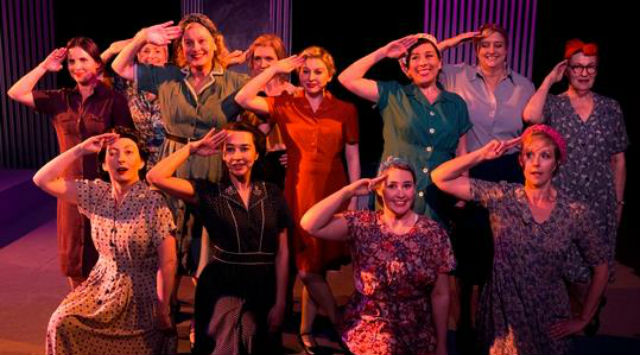
It is wartime 1942, and the fictional Australian country town of Warrabadanga is left with only its womenfolk to fend for themselves. They find plenty to keep busy with, and thankfully, spend little time worrying about the ones who have gone to battle. They are a spectacularly confident group determined to make the most of their situation, and go about their business in fine form. Linda Aronson’s Dinkum Assorted is an idealistic portrait of our country women. Dynamic, fun-loving , resourceful and optimistic, their strengths encompass the best of humanity, and represent an excellent example of how communities should view themselves.

Although written in the late 1980’s, the script is a predictably old fashioned one that feels faithful to language and presentational styles of the time it depicts. It is nostalgic and quaint, with a sense of humour that would appeal to those who have a taste for more traditional types of theatre. Direction by Sahn Millington brings out the vibrant spirit of all its characters, but the show struggles to captivate. The players are raucous but rarely meaningful, unable to deliver nuance or authenticity to help us locate points of identification or emotional involvement.

There are however, smaller scenes that feature pairings of actors that work well to offer glimpses of poignancy. Amanda Laing and Hannah Raven play wannabe showgirls, whose friendship is portrayed with good chemistry, along with a purity that resonates endearingly. Bodelle de Ronde and Debra Bryan create memorable characters who connect in a scene about being outsiders, both thoughtful and sensitive in their approaches.

It is in hardship that the best in humanity shines through. War takes on a different form in the twenty-first century, but we must only face it with that same bravery and positive outlook. The women in Dinkum Assorted are undefeated because they are engrossed in life, and they shun thoughts of demise. They are constructive in their own town, while the ravages of destruction take hold overseas. It is this simple lesson that our real lives need today. The purpose of war is destruction, and we must respond with the most vibrant and spirited ways of living out our each and every day.

www.newtheatre.org.au

Review: The Real Thing (New Theatre)

newtheatreVenue: New Theatre (Newtown NSW), Oct 6 – Nov 7, 2015
Playwright: Tom Stoppard
Director: Alice Livingstone
Cast: Peter Eyers, Charlotte Hazzard, Ainslie McGlynn, Christopher Tomkinson, Emily Weare, Benjamin Winckle
Photography © Bob Seary

Theatre review
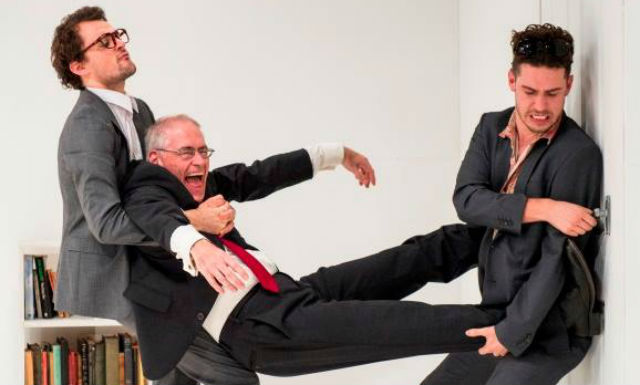
There are two main things being discussed in Tom Stoppard’s The Real Thing; the nature of relationships, and the process of making art. Through several “play within a play” segments, we attempt to get to the bottom of what is most honest, by looking past pretences for a grasp of the real. Monogamy, fidelity and longevity of relationships are dealt with in the most intellectually frank way, and although the play is now well over 30 years old, its propositions are no less refreshing and controversial. The extraordinarily articulate dissection of the creative process, along with the analysis of values that we place upon art, are also full of poignancy and resonance. The play is witty and pointedly intelligent, with challenging concepts and brilliantly delightful use of language that keep us entertained while placing our brains on overdrive.

Director Alice Livingstone is uncompromising with the depth of the text, while simultaneously introducing, quite miraculously, a jaunty pace to a staging that delivers solid laughs alongside a consistently astute level of discourse. The work suffers from a lack of visual imagination that results in stagnant and predictable physical compositions, but its meticulous attention to nuances in dialogue is more than impressive.

Leading man Christopher Tomkinson is the perfect blend of eccentricity, smarts and vulnerability. The actor’s thorough appreciation of the writing offers up an interpretation of Stoppard’s lines that is completely fascinating. He opens up a world of thinking that we rarely encounter; one that seems original yet is able to ring true on a very intimate level. Equally precise is Ainslie McGlynn in the role of Annie, whose embodiment of her character’s conflicts with monogamy and love are thoughtful and provocative. For all the talk about sex, the production’s energy is not particularly libidinous, but chemistry between players is of a good standard. The cast is a cohesive one that tells the story from a unified perspective, and the consequences are often powerful.

The Real Thing is an important work about universal experiences. Love may be hard to define, but it shapes everyone. We chase it constantly but seldom do we stop to reflect on these impulses. Tom Stoppard resists romantic delusions and preconceived notions to locate a truer understanding of that mysterious force underscoring so much of our lives. We want to know what love is, and he intends to show us.

www.newtheatre.org.au

Review: Slut (New Theatre)

newtheatre2Venue: New Theatre (Newtown NSW), Sep 22 – 26, 2015
Playwright: Patricia Cornelius
Director: Natarsha Wrensted
Cast: Ashley Avci, Christopher Broadbent, Brigitta Brown, Jordan Keyes-Liley, Sophie Mccrae, Rowan McDonald, Felicity Mckay, Eliza Scott, Zoe Tomaras, Jane Watt

Theatre review
Sex is one of the most natural and fundamental of all human experiences, yet it is tainted by endless negative connotations and meanings, informed by cultural and religious thought that aim to control behaviour in all our societies. Women especially, struggle to embrace and celebrate their sexual selves without having to deal with stigmas of all kinds rearing their ugly heads. Patricia Cornelius’ Slut talks about a Lolita who fails to recognise her power. Instead of valuing her attractiveness appropriately, she uses it to earn indiscriminate affection. We witness her being taken advantage of, and the chastisement that follows. This realm of discussion should be a complex one full of ambiguity, but the play seems simplistic in its attitude, and the powerlessness of its Lolita is concerning and unfortunate. Certainly weak people of all genders exist everywhere, but the juxtaposition of strong sexuality with low intelligence as a central subject matter seems too convenient and obvious.

We do not hear very much of what Lolita has to say, but learn about her exploits from the mouths of her vicious peers. Natarsha Wrensted’s direction illustrates all the hearsay and makes real what could have been only rumours. We see Lolita make mistakes, but she is rarely given the opportunity to speak for herself. We are a society that is capable of using the term “slut” as insult for any woman, and although it is not the play’s intention to label Lolita’s behaviour as reprehensible, there is a troubling disquiet in witnessing a character described only in sexual terms. We want to see the young woman’s worth, but they are reduced, and although we catch glimpses of her personal feelings, they do not offer sufficient balance for the text’s emphasis on her sexuality. The message it wishes to impart seems to be about the danger that we can put ourselves in when desperate for love, but the production needs to take greater care not to imply that aggressive feminine sexuality is in itself problematic.

Politics aside, there is much to enjoy in the 35-minute show’s standard of performance. The cast is uniformly strong, and the predominantly chorus format of presentation is sensitively choreographed and the actors are well-rehearsed. There is a cohesion to the group that is fascinating to watch, and their work is even more effective when individuals are able to bring unexpected flashes of nuance and variation to their parts. Energy and conviction is never an issue in the production, but scene transitions require greater support from lighting and sound.

Criticising any person’s sexuality is without doubt, archaic and senseless. Using the word “slut” as a derogatory term only exposes an inability to communicate with intelligence, and a severe lack of sophistication. We have exhausted the culture of “slut-shaming”, but young people must continue to be taught to value their own bodies, and the bodies of others. We should always try to become better persons, and in that process, how we think about our sex lives is crucial.

www.newtheatre.org.au

Review: Britannia Waves The Rules (New Theatre)

newtheatre1Venue: New Theatre (Newtown NSW), Sep 22 – 26, 2015
Playwright: Gareth Farr
Director: Deborah Mulhall
Cast: Vincent Andriano, Jane Angharad, Patrick Cullen, Alan Faulkner, Nick Rowe

Theatre review
This is a tale about the transformation of a poet into a soldier, but it is not a romantic journey that addresses our deluded need to see heroes emerging from wars. Gareth Farr’s Britannia Waves The Rules is quite the opposite. It talks about the ruling class’ persistent use of young men in poverty through generations, and the innocent lives sacrificed for the insatiable need of Western forces to invade. More than an anti-war piece, Farr’s writing is subversive and bold in its approach, and his protagonist Carl is a creation marvellously imagined and thorough in its embodiment of experience and truth. The distillation of the phenomenon of war into the private plight of a singular character is powerfully realised by the intimate nature of its speeches, dialogue and monologue, that seem to hail from a place of brutal and rare honesty.

Deborah Mulhall’s adventurous direction embraces the text’s poetic machismo to deliver a work that is wild and emotional, but also deeply sensitive in the way characters and relationships are established. In the role of Carl is Vincent Andriano, a turbulent presence that depicts anger, anxiety, fear, and sorrow with remarkable accuracy and energy. His highly dramatic interpretation is a beautiful accompaniment to the often introspective voice of the script, and we are transfixed from the very start to the bitter end. Also memorable is Nick Rowe, who plays Bilko with a dynamism that matches the lead’s. The chemistry between the two is intense and convincing, and the heartache that transpires is as authentic as it can get at the theatre. Performances are excellent in the production, all cleverly conceived and fluently executed.

As a collective, we understand things from an abstract perspective, and details are neglected, often deliberately hidden. Mainstream discourse does not reveal the personal losses that occur every day, but we must not stop talking about the ravages of war. Britannia Waves The Rules does not present any surprising facts. We already know that death is the currency of conflict and victory, but the way it tells the age old story of destruction is unusually poignant. It wants us to see that every young person sent to the battlefield is a son and daughter, and our brother and sister. As long as this keeps happening, the voices that oppose it must be heard.

www.newtheatre.org.au

Review: The Women (New Theatre)

Venue: New Theatre (Newtown NSW), Aug 11 – Sep 12, 2015
Playwright: Clare Boothe Luce
Director: Deborah Jones
Cast: Heidi Baleisis, Melissa Burgess , Kailey Higgins, Jordan Keyes-Liley, Celia Kelly, Susan M Kennedy, Jess Loudon, Emma Louise, Joy Miller, Nell Nakkan, Lauren Orrell, Alexandra Plim, Jade Potts, Eleanor Ryan, Annie Schofield, Helen Stuart , Vola Vandere, Sandy Velini
Photography © Bob Seary

Theatre review
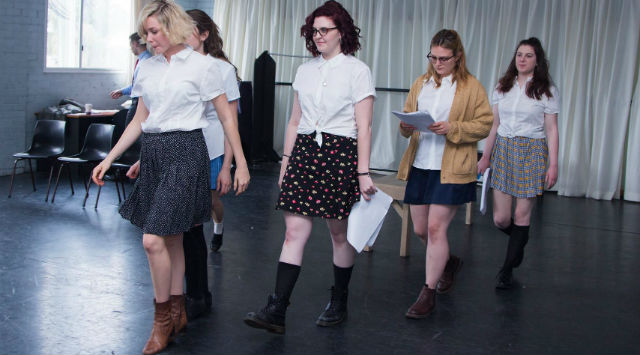
The play first appeared in 1936, with film versions following in 1939 and in 2008. Clare Boothe Luce’s The Women features a big roster of characters, all female, but it does not fit conveniently into notions of feminism. Arriving several years before the first World War, the play embraces life in the post-Great Depression era, reflecting no concern for big social issues of the day. Girls grew up to become heterosexual wives, and success was measured by her ability to keep a happy home. By today’s standards, the stakes in the play are incredibly low, but Boothe Luce’s exaggerations of domestic upheaval remains amusing, even though much of its regressive politics are undoubtedly irritating, notwithstanding its many outspoken and bold characters.

Direction by Deborah Jones pays homage to films and stars of the era, with outlandish performances and vaudeville humour pitched at an ideal where bigger is better. It is a welcome revisit to an almost forgotten style of theatre that proves to be unexpectedly refreshing and often very funny indeed. The production is not completely successful at bringing clarity to all depictions of characters and narratives, but every sequence is entertaining, with impressive power from a cast that is determined to play hard.

The very enthusiastic Jessica Loudon is Sylvia Fowler, a shallow and narcissistic troublemaker who fans every flame only to feign agony when lives are burnt to ashes. Loudon’s brand of brazen sass is a seductive combination of Mae West and Lucille Ball, and her persistently vibrant presence is an infectious one, which grabs our attention and demands that we engage in the party, of which she is the scintillating life of. Also outstanding is Helen Stuart who plays Mary Haines, the jilted misérables. It is not a particularly attractive role, but the actor brings grace and a beautiful authenticity to her depiction of heartbreak, desperation and betrayal that can only be met with empathy. Her focus needs greater tenacity, but she makes us believe, and understand, the far-flung world of privilege that she inhabits. Jade Potts plays a smaller role but leaves an excellent impression with a charming portrayal of a feisty and intelligent young girl.

It must be remarked upon that although the production makes the wise decision of not casting black women in the roles of servants, actors who are not of Caucasian appearance, are noticeably absent from the very large group of 18. We must celebrate a production that features talented women of all ages and sizes, but monoethnicity at this particular juncture of time and space, is an uncomfortable issue that requires attention.

In The Women, characters are split into madonnas and whores, and all of them are defined against unseen men who wield control over their emotions and destinies. We have, thankfully, evolved far enough to be able to recognise its many archaic and disappointing representations of womanhood, but the production needs to acknowledge more distinctly, this distance created by feminist developments over the decades, for a more meaningful approach to the text, and potentially, for greater comic effect. We have travelled a great distance from “there’s only one tragedy for a woman; losing her man!” of Boothe Luce’s script, and although it is certainly true that social equity remains a struggle, we can at least be grateful to be able to quote instead, the immortal Joan Crawford’s words in Mommie Dearest, “Don’t fuck with me, fellas. This ain’t my first time at the rodeo.”

www.newtheatre.org.au

Review: The Diary Of Anne Frank (New Theatre)

newtheatre1Venue: New Theatre (Newtown NSW), Jun 9 – Jul 11, 2015
Playwrights: Frances Goodrich, Albert Hackett
Director: Sam Thomas
Cast: James Bean, Caroline Levien, Rowena McNicol, Jessie Miles, Jodine Muir, Martin Portus, Martin Searles, Geoff Sirmai, Justina Ward, David Wiernik
Photography © Matthias Engesser

Theatre review
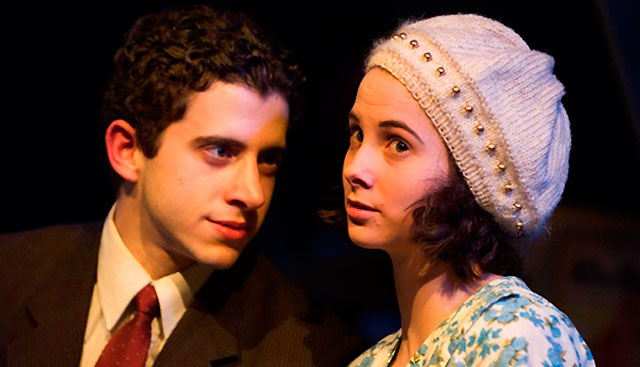
Based on Anne Frank’s The Diary Of A Young Girl, this classic play by Frances Goodrich and Albert Hackett premiered 1955 in New York City. It is classic in structure and subject matter, with characters and a narrative that follows all the rules of conventional drama. Even though the work is based entirely on true events, the script is filled with elements that ensure a theatricality that writers of fiction can scarcely dream up. Anne Frank’s story is a significant part of our literary and social history, and although not particularly groundbreaking or trendy by today’s expectations, its resonances are intense and undeniable.

Direction by Sam Thomas is nuanced and sensitive, but also exuberantly dynamic. She has created a rare cohesiveness in a cast that is unified by a vision and tone that aims to tell Anne Frank’s story with clarity and a lot of heart. Thomas’ measured approach is quiet, and her hand is an invisible one. Front and centre are not the egos of artists, but the tragedy of WWII and a young girl’s experiences and understanding of it. All the cruelty and savagery of war, and the catastrophic debasement of Jewish peoples are presented powerfully, with a formidable tension that builds gently and gradually through accomplished design work from all aspects, most notably Heidi Brosnan’s lights and James Ackland’s sound. Costume by Famke Visser, and Allan Walpole’s set both contribute effective and elegant solutions to the expression of time and space, quickly drawing us into life in the now legendary attic in Amsterdam.

All 10 actors involved are perfectly cast, each with an individually memorable presence and all creating poignancy from different perspectives. The chemistry on stage is effortless but unmissable, and we never question the authenticity of their very close relationships. In the role of Anne is Justina Ward, who never quite looks thirteen years-old, but who has us firmly in the palm of her hand, delighting us with an animated personality and a precisely studied interpretation of Anne’s psychological and emotional evolution over the two years. Palpable, joyful and thoroughly adorable, Ward’s work as leading lady in The Diary Of Anne Frank is quite the revelation.

The problem with old stories is that we dismiss them as stale, forgetting what it is that makes them persevere. Sam Thomas and her team have well and truly dusted off every cobweb and revealed afresh, a tale of humanity and hope, that will touch even the hardest of hearts. The work moves us by appealing to our common benevolence, but is never overly sentimental. The characters are simply realistic and genuine, so we cannot see them as anything but our sisters and brothers. The memory of Anne lives on because our belief in justice never fades, and the need to uphold it in our societies never diminishes. The fallibility of human nature means that different groups are persecuted at different times, but there is also a determination in us all that want to do right, and it is to that spirit that this play speaks.

www.newtheatre.org.au

Review: The School For Scandal (New Theatre)

newtheatreVenue: New Theatre (Newtown NSW), Apr 29 – May 30, 2015
Playwright: Richard Brinsley Sheridan
Director: David Burrowes
Cast: Tel Benjamin, Richard Cotter, Sasha Dyer, Peter Flett, Emma Harvie, Rhys Keir, Chantel Leseberg, Moreblessing Maturure, Lillian Silk, Marty O’Neill, Nick Rowe, Billie Scott, Eleanor Stankiewicz, Samantha Ward, Jacob Warner, Madeleine Withington
Photography © Matthias Engesser

Theatre review
Money makes the world go round, but it is also the root of all evil. No ordinary person is able to escape the claws of modern economy, and we all have to define our existences in, at least, partially monetary terms. The School For Scandal is about greed, and our ability to be blinded by wealth. Richard Brinsley Sheridan’s script is a wickedly funny one, and his outstanding wit has ensured that his story about deception and decadence is still well-regarded 238 years later.

Direction by David Burrowes is ambitious and visually striking, with a very contemporary rendering that draws inspiration from the nouveau riche of Australia’s more brazen social set. The work is wildly energetic, and comedy is always being created around the text, but less attention is paid on the nuances of the writing. The resultant work is flamboyant and amusing, but the actual story is often a secondary aside. Plot is sacrificed for effect, and while the experience is not always satisfying, there certainly is a lot that is remarkable in terms of the generous amount of creativity being featured. Isabella Andronos’ set and costume designs are mischievous and refreshing, adding to the Sydney theatre landscape an exciting aesthetic that is reflective of a particular generational and cultural segment. The representation of dominant social tribes is important in the understanding of our selves, and Andronos’ contribution is an acute study of the way things are, for some of us, in the absolute now.

All performances in the show are strong. The cast is committed to Burrowes’ vision of creating something extravagant, and to keep us entertained. Rhys Keir as Charles Surface is a quirky combination of sex appeal and clownish tomfoolery. The actor’s larger than life presence is determined to captivate, and his comedy is quite irresistible. Keir’s sharp instincts and confident timing make his joyful showmanship a real pleasure to witness, and his ability to manufacture chemistry with colleagues demonstrates a natural flair of someone born for the stage. Equally gifted is Madeleine Withington who plays Lady Teazle, a shrewd young lady with an impetuous, ditzy edge. Withington’s style feels unfettered, but there is an exacting focus to her manoeuvres that help provide a clarity to a plot that often gets lost in the incessant pandemonium. There is noteworthy work by two of the show’s smallest roles, played by Emma Harvie and Moreblessing Maturure, but it must be said that there is more than a little discomfort in watching the only actors who are not of Caucasian appearance, take on the parts of servants.

Theatre can do many things, but an audience will always concentrate on story if one exists, and treat other elements as subordinate. This production of The School For Scandal has a fierce experimental spirit that resides in every corner, but although undeniably passionate in approach, much of the effort does not translate as anything more than embellishment. Sheridan’s work is solid, and it resists obfuscation. There is much to admire in the show, but what we crave is something deeper and more substantial, something quite the opposite of surface.

www.newtheatre.org.au

Review: (Extra)ordinary, (Un)usual Episode III (The Monologue Project)

themonologueprojectVenue: New Theatre (Newtown NSW), May 13 – 27, 2015
Playwright: Pete Malicki
Director: Pete Malicki
Cast: Debbie Neilson, Glenn Wanstall, Luke Reeves, Matt Friedman, Raechel Carlsen, Rosemary Ghazi, Tiffany Hoy, Yannick Lawry, Miss Suzie Q

Theatre review
The production comprises eight monologues, all written and directed by Pete Malicki. His writing is mainly concerned with the ordinariness of Australian lives, but he delves into fantastical inventions on occasion, to create stories that aim to entertain and amuse. Malicki finds the small and mundane parts of existence and places them in the spotlight. His characters all seem neurotic, as their solitude allows them to reveal their deepest idiosyncrasies. The programme is a light-hearted one, with little room for gloom or poignancy, but it does offer social observations through sarcastic jabs and slapstick comedy.

Malicki’s direction is not particularly versatile, but he ensures that each segment is energetic and vibrantly quirky. He has a knack for extracting confident and quite wild performances from his cast, all of whom appear to bubble with excitement when placed centre stage. Glenn Wanstall’s performance in That Time Harold Borgenstein Went Speed Dating And Got Taken Over By All Of The Greek Gods, is impressively athletic and irresistibly funny. The actor’s intuition is remarkably precise, and the level of conviction he displays is entirely captivating. The piece is somewhat pointless, but it serves as a secure platform for Wanstall to present some of the most outrageous and flamboyant spectacles one is likely to encounter.

Artists often need boundaries to instigate the creative flow, and in Malicki’s case, the short monologue format is a framework that he is clearly very comfortable in. His ability to find tension and humour within his preferred structure is well-honed, but like the faces in his cast, greater diversity is required. Presenting eight works together is an appealing idea, and as much as it is a showcase of one’s strengths, it is able also to unwittingly expose one’s weaknesses. Malicki may not speak universally, but he is certainly an expert in his chosen field.

www.monologues.com.au

5 Questions with Pete Malicki‏

petemalickiWhat is your favourite swear word?
Cunt. Sorry, it’s a terrible word, but it does the job.

What are you wearing?
I wouldn’t even know if I didn’t look down. I’m clothes blind.

What is love?
Depends who you ask. Semantics etc.

What was the last show you saw, and how many stars do you give it?
Take the fifth!

Is your new show going to be any good?
It’s going to be fantastic, actually. The Monologue Project has been growing rapidly since its formation two years ago and now runs dozens of workshops, courses, shows and tours each year. Our pool of talent is growing and we’ve been fortunate enough to find the most suitable actors for the pieces we’re staging. The monologues have won 15 major awards between them and the cast are incredible. We’ve been working on this for close to half a year and it’s going to be epic.

Pete Malicki is writer, director and producer of (Extra)ordindary (un)usual III .
Show dates: 13 – 27 May, 2015
Show venue: New Theatre

Review: When The Rain Stops Falling (New Theatre)


Venue: New Theatre (Newtown NSW), Mar 17 – Apr 18, 2015
Playwright: Andrew Bovell
Director: Rachel Chant
Cast: Olivia Brown, Tom Conroy, Peter McAllum, Hailey McQueen, Renae Small, Helen Tonkin, David Woodland
Photography © Bob Seary (top gallery) / Benjamin Brockman (bottom gallery)

Theatre review
Upon entering the auditorium, the rumbling sounds of a tropical monsoon emanates from the stage to greet us. Without characters and narratives, we sit listening, surrendering to the voluntary effects that our physical selves cannot help but react with. Emotions surface, seemingly for no rhyme or reason. The art that we experience changes us, without letting us know how and why. A delicious melancholy, like a calm sadness, washes over. When the story begins, we are already hypnotised. Andrew Bovell’s When The Rain Stops Falling is a play about family ties and the challenges that can be passed on from one generation to the next. Personal anguish and relational discordance affect the development of children, and we see the inevitable inheritance of wounds that result from flawed parents and imperfect parenting. Bovell’s poetic use of language and his liberal approach to plot construction, make for an intriguing script that is dramatically unpredictable and achingly beautiful. Its outstanding storytelling connects with every person’s complex feelings about home, and appeals to our thirst for a brand of theatre that is deeply moving.

Direction of the piece is provided by Rachel Chant, who impresses with an extraordinarily deft hand at emotive expression. Our senses are captivated for the entire two-hour duration, by her sensitive and adventurous exploration of sound and sight, along with an inventive use of the cast’s physical and spiritual presence in the space, to create a quality of pathos that is intensely lyrical but never melodramatic. Chant succeeds in reaching us through atmospherics and narrative, enveloping us both consciously and unconsciously, so that our attention is steered carefully through every twist and turn of the play. Excellent work is achieved in establishing a singular vision through an evidently trusting collaboration with every actor and designer of the production, although one bizarre blemish does exist in the unexplained transformation of character Gabrielle’s speech accent, which goes from a broad Australian voice to an unmistakably British one with the passage of time.

The ensemble of seven is uniformly arresting, each with their own distinctive presentation styles, but all are able to find for the piece, an exacting cohesion in tone and pace. Tom Conroy is thoroughly convincing, giving a performance memorable for its heartbreaking vulnerability and almost unbelievable simplicity. Conroy’s pared-down approach is a refreshing one, filled with subtleties that reveal just enough, and also, everything. The stoic Elizabeth is played by Helen Tonkin who mesmerises in extended sequences of Butoh-esque silence, with unwavering concentration and a painful depiction of inner struggle and sorrow. Suffering is also portrayed brilliantly by Peter McAllum, whose moments of quiet authenticity turn a small role into a profoundly meaningful one.

Hailey McQueen’s naturalistic interpretation of her role is solid and elegant, but a decision to downplay a crucial scene of confrontation is questionable. Similarly, David Woodland’s performance is most compelling, but an opportunity to erupt with greater wildness is foregone perhaps unwisely. The play is rich with regret, despair and longing, qualities that tend to be dark and heavy, and even though its sombre beauty is unquestionably enthralling, a hint of brutality would provide a greater sense of theatricality, .

From a design perspective, the creative team is a formidable one. Tom Bannerman and Martelle Hunt’s set carves out modern shapes that delineate spaces quietly but efficiently. Its hard lines and sparseness represent the chilling emptiness that is at the centre of much of the text, and ensures that the audience is affected accordingly. Lights by Benjamin Brockman provide spacial transformations and emotional cues, constantly evolving on stage to manufacture shifts in time and space, and to reflect fluctuating states of minds, and hearts. It is a rare occurrence to have the sound design of a non-musical theatre production steal the thunder, but Nate Edmondson and Alistair Wallace’s partnership is a clear triumph. Their work is original, surprising and experimental, but always effective and often powerful. It is omnipresent, but never distracting. There is an accuracy to the way the sound of When The Rain Stops Falling parallels, or perhaps determines, the stage action that makes the show inexorably involving and at many points, sublimely devastating.

There is a masochistic pleasure in witnessing the secrets of broken families unravel. We are relieved that our own private pains are shared, and we gain a sense of redemption from the realisation of that universality. At the theatre, we are never alone. With good plays, we can gain insight, and think of impending rainbows.

www.newtheatre.org.au