Review: Jumpy (Sydney Theatre Company / Melbourne Theatre Company)

Venue: Sydney Opera House (Sydney NSW), Mar 26 – May 16, 2015
Playwright: April De Angelis
Director: Pamela Rabe
Cast: Laurence Boxhall, Caroline Brazier, John Lloyd Fillingham, Brenna Harding, Tariro Mavondo, Marina Prior, David Tredinnick, Jane Turner, Dylan Watson
Images by Brett Boardman

Theatre review
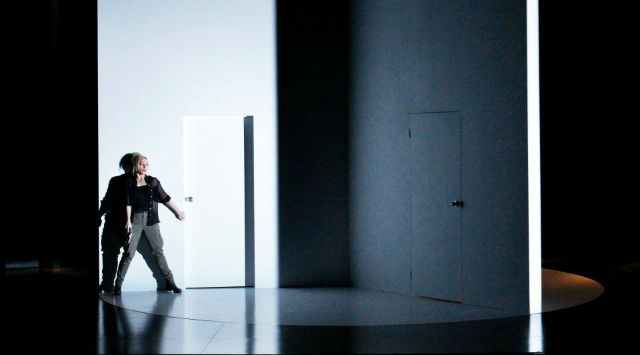
With each scene of Jumpy, pieces of furniture travel across the stage on castor wheels, moving past its protagonist Hilary. She is fifty of age, her only daughter Tilly has turned sixteen and is beginning her own sex life, and we meet them at a time when Hilary has come to realise that a period of stasis is coming to an end. Like the set that keeps rolling past, life seems to have left her behind while she dutifully plays the role of mother and wife. April De Angelis’ script is concerned with women who had grown up with second-wave feminism, particularly those from the era marked by the legacies of Germaine Greer, Gloria Steinem and Helen Reddy. Idealism and militancy fades or perhaps evolves into a modernity that bears little resemblance to the dreams that were birthed, like Hilary, half a century ago. Tilly is in some ways, a disappointment for her mother. De Angelis is critical as well, of the young woman’s need to build her identity around the male gaze. She allows many of her decisions to be determined by a need for the affections of men, and the dissatisfaction she derives from those behaviour evade her self-awareness. Hilary is confounded, and we all wonder how it has come to be that a generation can grow so contrary to its parental intentions. The text does not however, go so far as to say that child-bearing is pointless (although there is a tendency to characterise some parents as being selfish and afraid of loneliness), but we are certainly encouraged to assess the choices Hilary had made for herself.

The context is simple, with a sense of the everyday found in all aspects of its plot. Characters and events are familiar, but De Angelis’ ironic humour is omnipresent. Her comedy depicts middle class existence with a healthy cynicism, and is indeed, thoroughly entertaining. Each personality’s flaws are exposed shamelessly, but the writer’s compassionate approach prevents anyone from turning into clowns or villains. In fact, we identify with all of them, and find most to be very charming. Pamela Rabe’s direction is nuanced and gentle, with no big political proclamations and few dramatic gestures. Relationships are established convincingly, and every narrative is delivered clearly to make us care, and to keep us engaged.

Star of the show, Jane Turner’s outstanding ability and likeability as one of Australia’s top comic performers is well utilised in the production. We are always on her side, and we laugh whenever she wants us to. Turner’s trademark vaudevillian style of performance keeps her at some distance from her role, but there is enough authenticity and commitment in her portrayal to keep things believable. Reasons for the production not being transposed to an Australian context is unclear, but Turner’s British accent is less than satisfactory. It is an unnatural and overly posh affectation that can be uncomfortable to hear, and slightly inappropriate for the story being told. Other cast members are more adept speech-wise, and every supporting character is colourfully performed and memorable. Hilary’s best friend Frances is played by Marina Prior whose captivating vibrancy and self-deprecating humour keep the show buoyant. The contrast, and similarities, between the two middle-aged women are fascinating to observe, and their friendship is deeply meaningful, even though other relationships are given greater weight in the text. Also impressive is Tariro Mavondo’s performance as Lyndsey, the sixteen year-old new mother who treads the fine line between ignorance and purity, spouting pearls of wisdom when least expected. A heart of gold can be tricky to inhabit, but the actor’s effortless charisma turns her character’s innocence into a thing of beauty, and poses a challenge to the way we think about teen moms.

The production is a hugely enjoyable one that keeps our attention firmly under its control. There is a mildness in tone that reflects the theme of maturation, but it finds ways to amuse us from start to end. Its message arrives in the form of questions, but it leaves answers ambiguous. Middle class lives are full of anxiety, and Jumpy shows that the state of peacefulness does not emerge spontaneously with age and happiness does not necessarily materialise upon the fulfilment of duties of one’s choosing. The show does not hold the key to peace and happiness, but it provides inspiration, or at least a reminder, that it is never too late.

www.sydneytheatre.com.au | www.mtc.com.au

Review: Once (The Gordon Frost Organisation / Melbourne Theatre Company)

Venue: Princess Theatre (Melbourne VIC), from Oct 1, 2014
Playwright: Enda Walsh (based on film by John Carney)
Music & Lyrics: Glen Hansard, Markéta Irglová
Director: John Tiffany
Cast: Tom Parsons, Madeleine Jones, Anton Berezin, Ben Brown, Gerard Carroll, Colin Dean, Brent Hill, Keegan Joyce, Amy Lehpamer, Jane Patterson, Greg Stone, Susan-ann Walker,
Images by Jeff Busby

Theatre review
Once is probably not the first musical that makes understatement its central intention, but it is certainly the most celebrated of the kind. Enda Walsh’s quietly sentimental work is not ambitious in a conventional sense. There are no stunning set changes or breathtaking costumes, nobody dies and no predictable resurrections occur. Instead, it is determined to find poignancy and emotional resonance through story, characters and songs. There is a distinct and appealing simplicity to Glen Hansard and Markéta Irglová’s musical compositions that make an impact in the absence of ostentatious spectacle, and Walsh’s ability to create affable yet colourful personalities make for a show that is powerfully endearing.

Direction by John Tiffany is sensitive to the melancholic sensibilities of the work, although the presentation of a large scale production in muted tones is sometimes clearly challenging, especially in the few, but important, scenes where music acquiesces to dialogue. An inordinate amount of versatility is required of the performers, including the ability to play instruments (accompaniment is provided by the cast itself) and in the case of leading man Tom Parsons who is a highly impressive vocalist, but a less compelling actor, several crucial sequences of emotional gravity tend to feel weaker when he communicates without the aid of music. His counterpart Madeleine Jones is more evenly talented, and she executes comedic aspects with an elegant flair. Tiffany handles lighthearted moments brilliantly, allowing an intimate connection with its audience that elevates the musical to something quite visceral, and spiritual.

The humorous role of Billy is played by Colin Dean who has the kind of eclipsing presence that wins our hearts with minimum effort. His authenticity is compelling to watch, and the confidence he displays gives his work an uplifting quality. Also memorable is Amy Lehpamer as the fiery Czech, Reza. Lehpamer is a quadruple threat who inspires with proficiencies in singing, dancing, acting and on the violin. Her comic timing is a marvel, and even though the supporting role is a small one, the vibrant performer finds opportunities to steal the limelight with delightful results.

The production is finely balanced, relying heavily on the shifting elements of live performance on each night to make the experience rewarding, leaving little room for complacency. The silences in the show mean that imperfections can become glaring, even if they are few and far between. Choreography by Steven Hoggett is effective and beautiful at times, but also awkward and overdone in certain numbers. The cast moves well, but when gestures become elaborate, the performers tend to appear uncomfortable. The story of Once talks about art and aspiration, dreams and conviction, and the way life can be designed by one’s own imagination. It swims against the tide with an unusual determinedness and audacity, to create something original, moving and thoroughly surprising.

www.oncemusical.com.au

The Crucible (Melbourne Theatre Company)

Melbourne Theatre CompanyVenue: Southbank Theatre (Southbank VIC), Jun 22 – Aug 3, 2013
Playwright: Arthur Miller
Director: Sam Strong
Actors: David Wenham, Brian Lipson, Sarah Ogden, Anita Hegh

Theatre review
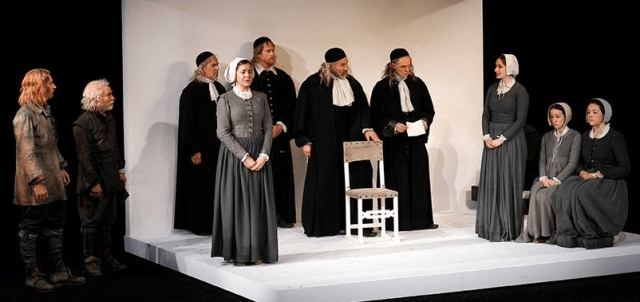
David Wenham headlines this production of The Crucible, and predictably garners widespread attention and brings good numbers into the theatre. He is adequate in the role of John Proctor, but is subsumed by the size of the stage and hall, and also by some of the more “theatrical” in the cast. Wenham is perhaps more suited for a more naturalistic setting, and on filmic close ups, but this staging of an outlandish tale in a large auditorium seems not to be the best showcase of his talents.

There are efforts in the set and lighting design to visually shrink the stage into small rooms, but while effective in that regard, the actors performances sometimes become overly subtle for the size of this production’s audiences. Sections seem to drag on while characters have intimate exchanges that are unable to reach out beyond the first few rows. The pivotal scene towards the end of the play where the Proctors discuss their mortality lacks the dramatics and gravity necessary at such a crucial point of the tale.

Accordingly, it is the more vivid performances that shine. Brian Lipson plays Judge Thomas Danforth, and Sarah Ogden, the Proctors’ maid Mary Warren stand out and are thoroughly engaging and entertaining. In comparison, it becomes clear that they possess a style that is necessary for the language of the writing, and also for the space in which this production takes place. None of the actors are weak, but this production seem to demand a level of heightened drama that eludes many of today’s performers.

Interestingly, Arthur Miller’s text remains relevant. Its warnings of the power ascribed to the “loud minority” in our societies resonate, especially within the context of religious extremism. It also discusses the dangerous culture of “wowserism” and that too, applies easily to contemporary society. An interesting coincidence occurs with a line from Danforth,  “But witchcraft is ipso facto, on its face and by its nature, an invisible crime, is it not?”, drawing an irresistible parallel to an Australian political leader’s use of the same term “invisible” last week to describe (and diminish) carbon emissions in the debate about climate change. Great plays may age, but they no doubt hold great lessons for any generation, and it is for the theatre makers to bring forth these learnings.

www.mtc.com.au