Review: We, The Lost Company‏ (Clockfire Theatre Company)

clockfireVenue: Old 505 Theatre @ 5 Eliza St (Newtown NSW), Oct 13 – 31, 2015
Devisors: Emily Ayoub, Madeline Baghurst, Alicia González, Kate Worsley, Arisa Yura
Director: Emily Ayoub
Cast: Madeline Baghurst, Alicia González, Arisa Yura
Image by Geoff Magee Photography

Theatre review
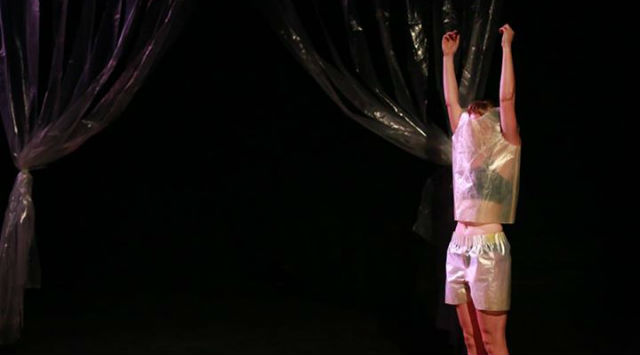
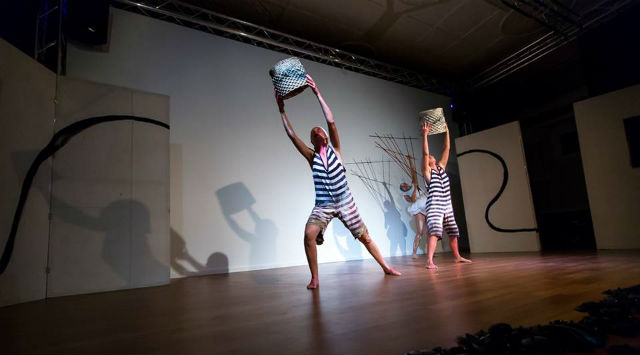
Since time immemorial, we have danced in honour of the gods that watch over us. It is an acknowledgement of our vulnerabilities and reflects our hopes for better days during this time on earth. We, The Lost Company is an intertextual exploration into our relationship with water, finding inspiration from the paintings of Brett Whiteley to create a work of physical theatre informed by the disciplines of mime and dance. It is gently humorous but wildly imaginative. It touches on subjects of migration, ecology, community and ageing, revelling in the beauty of abstraction but powerfully connecting with its audience, if not in terms of meaning, then certainly with the level of engagement it manages to instil into what is usually a challenging form of performance art.

Music and sound by Ben Pierpoint is complex, evocative and spirited. His work controls our imagination, and leads us to grand and eccentric spaces within our minds that provide a context for the three dancers on stage. Charming anecdotes about water obtained from interviews with mature members of Sydney communities are woven into the soundtrack to anchor the production with a warm authenticity that keeps our shared humanity firmly inside what is being developed.

The dancers’ weird and wonderful physical language is a thoroughly amusing one that sustains a sense of intrigue and holds our attention for its entire fifty-minute duration. Their poetry is whimsical but ruggedly sincere, allowing us to understand its intentions from a drastically unconventional kind of theatrical expression. Arisa Yura’s very memorable but very short monologue in Japanese about childhood, the forces of nature, ice cream and beach balls, extends the theme of memory from the audio recordings, and touches us unexpectedly with its dramatically emotive and nostalgic pseudo drama. The production is full of adventure and sensitive innovation, but its lighting feels inadequate within the extravagance of its multi-disciplinary articulations. The space requires greater depth and colour to achieve a stronger sense of visceral lift off that is always just within reach.

To know something, does not necessitate the ability to put it into words. Call it a feeling, intuition, or a soul thing, art is fundamentally about communication and the modes through which communication happens. We, The Lost Company has vocabularies of its own that are refreshing, unique and dare we say, original, but what it speaks can be understood by all, and like the themes that it is concerned with, we are all embroiled in this mysterious undertaking as one.
www.venue505.com/theatre | www.clockfiretheatre.com

Review: Reflections (Primal Dance Company)

primaldanceVenue: King Street Theatre (Newtown NSW), Oct 13, 2015
Choreographer: Alyssa Casey
Cast: Natasha Clancy, Cassandra Clarke, Tasmin Cummins, Caitlin Drysdale, Brianna Hatter, Danni Hegarty, Lucas Hughes, Emma Macpherson, Bryony Munro, Ryan Ophel, Zac Smith, Michael Stone, Georgie Walsh

Theatre review
Reflections features a series of dance sequences set to the recorded music of Hayden Tee’s “Generation WhY? Live” album, comprised mainly of 80’s hits interpreted with acoustic and orchestral arrangements by Nigel Ubrihien. The vocals are emotional and powerful, in the style of musical theatre that many are familiar with, and that same attitude is adopted by choreographer Alyssa Casey, who chooses to present pieces in a sincere and quite literal manner, in accordance with the themes of each song. Physical language is largely lyrical with influences from classical, ballroom and gymnastics adding to the movement schema. Casey is also responsible for costuming of the show, which works well to provide visual variation between numbers, but is most effective when minimal in approach.

It is a cast of exuberant and athletic dancers, extremely well-rehearsed and full of conviction in what they produce. Some have a tendency to express too much sentimentality, but there is no doubt that all are steely focussed and keen to put forward their best. The group of 13 is well utilised, with most members receiving a moment in the sun to showcase their individual talents, although the bigger numbers can feel overwhelming in its intimate venue. Memorable performers include Emma Macpherson and Michael Stone who bring confidence, professional polish and solid presences to the stage.

For all its technical proficiencies and impressive discipline, the work requires greater innovation and sophistication in order to deliver a sense of transcendence promised by the medium of dance. Much of its endeavours are derivative, and in this space of creativity, our senses seek originality over emulation. Each of us has an unrivalled familiarity with our bodies, but we need artists to shed new light on the capacities and meanings of all that is flesh. Dance is uniquely able to speak with us, body to body, and its continuing mission to defy convention is what makes it beautiful.

www.facebook.com/Primaldanceco

Review: Moondance – Isotopic Reflections‏ (De Quincey Co)

Venue: Erskineville Village Anglican Church (Erskineville NSW), September 4 – 19, 2015
Choreography: Tess de Quincey
Video Animation: Samuel James
Photography: Vsevolod Vlaskine
Sound: Vic McEwan
Cast: Tess de Quincey
Images by Vsevolod Vlaskine

Theatre review
We face the far end of the church. There are two narrow stained glass windows, and the central double doors are painted white, as is the wall on which it sits. A video is projected onto the entirety of that surface, composed of photography created from the moon’s light, the beautiful images we see are completely abstract, monochromatic blobs and scribbles that could mean nothing or everything, with sound that is more cinematic than musical, atmospheric and visceral in its transmission. A person emerges in a long, white hooded raincoat, devoid of gender, ethnicity and age, Tess de Quincey performs the majority of the piece with her back to us. She responds and reacts, attempting to understand her relationship with the imagery before her, and we ponder the connection between dancer and photography, human and moon.

Our appreciation of the work does not occur immediately. It is all too strange and silent, and we feel lost in the bareness of its audacious start. Every visual and aural element conspires to move our awareness away from everyday mundanity, and in time, we are unknowingly hypnotised. A meditative quality sets in, captivating our senses, but perhaps more importantly, our minds. We go through periods of thought, trying to create meaning in the sight of dancer against photographic patterns, and we go through periods of release, allowing our senses to experience things as they are, without the interference of logic. It is an unusual pleasure, emerging from the idiosyncrasy of de Quincey’s presence, drawing us in to share in her perspective of the world. In the show’s best moments, time stands still, and we fear for it to end. We want the indulgence to go on, and we want to luxuriate in the sense of elevation it provides, lulled away from our usual petty concerns, into a space of hallucinatory ethereality and eternal bliss.

Lunar tributes have existed since time immemorial. Life on earth is meaningful only when we reach beyond, for the stars and moon. We cannot understand ourselves only from within; humanity requires that we look outside to make sense of what we go through on this planet. Whether sending rockets to Mars or dancing our bodies, art must think of infinity, in order to locate significance, value, or magic. To be human, is to move beyond corporeality, sometimes towards the far reaches of the ether, even if only in our heads.

www.dequinceyco.net

Review: Dancendents (PACT Centre For Emerging Artists)

pactVenue: PACT Theatre (Erskineville NSW), June 17 – 20, 2015
Choreographers: Flatline, Leah Landau, Rhiannon Newton
Cast: Flatline, Leah Landau, Rhiannon Newton
Image by Matt Cornell

Theatre review
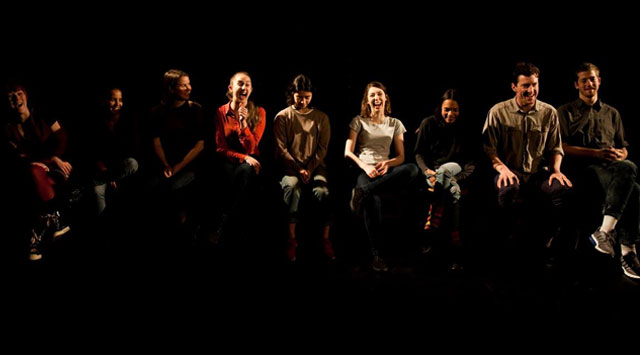
In the search for a definition of art, Flatline’s work Drawn To Move relies on the exposure of process in dance choreography to give meaning to a completed work. Two pencil scribblings are displayed on a wall, emulating archetypal notions of the art establishment. From a fine art perspective, the pieces are primitive and ugly, but in the live drawing of the third, the creators reveal the rationale behind the pieces, rendering irrelevant the commodified hanging objects, and shifting attention to the dance, and time, behind the inanimate finished products.

In a charming parallel, Rhiannon Newton’s Assemblies For One Body is concerned with using the rehearsal process quite literally, to present a performance piece. Newton goes through repetitive movements, with facial expressions and an eyeline that demonstrates an inward focus, as she seeks to unlock motion and gesture for reaching an intangible target of perfection. Without the presentational vocabulary of a conventional show, Newton relies on an enduring vitality to keep her audience engaged. We are drawn in by the energy of her tenacious commitment in exploring body and space, and she fascinates us with an intelligent juxtaposition of sounds (rhythmic and otherwise) with her physicality. We can never fully grasp Newton’s mental processes in each moment, but she certainly encourages us to form personal narratives and interpretations in the presence of her visual elucidations.

Leah Landau’s approach in Summer Bone is decidedly different. Inspired by ideas about nature, wildlife, farming and food, the work is underlined by a serious and earnest environmental concern, but with manifestations on stage that are humorous and thoroughly whimsical. Landau creates language with her body, and communicates persuasively, basic concepts of conservation, that would otherwise struggle to find sophistication in more conventional paradigms. It is hard to find new perspectives on long-standing issues, but art can establish new depictions so that we understand them with refreshed interest. Beyond its political message, Landau’s is a delightful piece of physical theatre that captures imagination, and amuses sight. It is dance that breaks a few rules, so that we come to a renewed appreciation of the artist’s passions.

When theatre abandons narrative, we see more clearly, why we do the things we do, and what it means to make art. Modern life is all but usurped by capitalism, and we forget our humanity outside its gluttonous and all-consuming monetary imperatives. Reading abstract dance, is to explore reasons behind human behaviour. Allowing incoherence to transpire, within the restrain of truth, will deliver a kind of beauty and transcendental pleasure that is unique to the art form, and it is in its embrace that we are reminded of the deeper and more rewarding facets of life.

www.pact.net.au

Review: Listen! I’m Telling You Stories‏ (PACT Centre For Emerging Artists)

pact4Venue: PACT Theatre (Erskineville NSW), July 20 – 25, 2015
Director: Katrina Douglas
Cast: Courtney Ammenhauser, Alicia Dulnuan Demou, Amber Jacobs, Carissa Licciardello, Jessica McKerlie, Tasha O’Brien, Mitchell Whitehead, Steve Wilson Alexander, Dubs Yunupingu
Image by Katy Green Loughrey

Theatre review
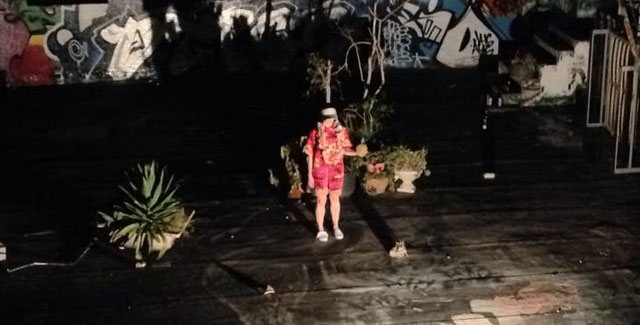
Presented by a group of young artists studying the theatrical arts through the exploration of spacial awareness, physical training and team rapport, Listen! I’m Telling You Stories‏ is an earnest demonstration of their journey as apprentices of performance. Each creates a short vignette offering varying degrees of insight into their life and mind, but it is not the content of what they have to say that is actually fascinating. The show is a cohesive and sensitive amalgamation of nine lives brought together temporally, and we witness their creative energies in motion, all focused on generating something purposeful, at least from their own perspective. What results is a succinct work, under an hour, that is more about practice than communication. Their approach is a sincere one, and although engaging for its duration, no great resonance is sustained beyond the curtain call.

There is a beautiful uniformity in the ensemble’s voice and attitude for the piece. Our attention goes to a singular entity of the whole, even though disparate elements are always present in the work’s intelligent plurality. Direction by Katrina Douglas brings out the strengths of her performers and successfully balances the individual with the group, so that the piece always feels even. The work of designers, Amber Silk (lighting) and Peter Kennard (sound) are prominent features that give the production polish and depth, in the absence of a compelling script. Our eyes and ears are ingeniously and constantly surprised in the show, and the sense of wonder provided by the team is a notable achievement, but there is nothing that seems to be able to connect on a more meaningful, or perhaps emotional, level.

On many levels, Listen! I’m Telling You Stories‏ appears to be experimental, with inventive modes of expression a distinguishing feature. At the same time, there is a safeness to the production’s artistic choices that keeps it from being more exuberant or idiosyncratically memorable. Artists in training need to understand rules and gain skills that will help them attain their visions for the stage, but often it is in the calculated abandonment of those standards that something spectacular can materialise.

www.pact.net.au

Review: An Hour With Kay‏ (Kworks / The Old 505 Theatre)

kayarmstrongVenue: Old 505 Theatre (Surry Hills NSW), June 30 – July 5, 2015
Playwright: Kay Armstrong
Director: Kay Armstrong
Cast: Kay Armstrong

Theatre review
Meanings can be found anywhere, and in anything, but it requires that the observer draws their own conclusions on what, if anything, is being said. An Hour With Kay is abstract and absurd. The fact that time itself is highlighted by its very inclusion within the title of the work, makes us consider how we value those 60 minutes, and whether the artist Kay Armstrong justifies her procurement of the audience’s presence. Indeed, our presence is an important factor in the piece, which is characterised by an unusual freedom in Armstrong’s eagerness in incorporating our bodies and minds into the creation of a kind of theatre that is on some level, about the subversion of passive viewership. A quality of democracy figures heavily in her art. Maybe we are not in control of the action at all times, but we are certainly the ones who have to decide what it is that we experience.

Armstrong is a strong performer with excellent conviction, but she is uninterested in manipulating the resolutions we may or may not attain from participating in her work. It is about the here and now, and those 60 minutes of activity and energy that we are involved with. What happens after, is entirely reliant on our own creativity. The work is fascinating and engaging, with tempo that changes regularly, so that it evades predictability. Armstrong’s ability to surprise at every juncture keeps us intrigued, and a gentle sense of instability demands that we are attentive to what she might unleash upon us next.

An Hour With Kay satisfies with its concoction of all that is weird and wonderful, yet it challenges us, both in terms of our notions of components and definitions theatre and art, and also of our expectations as public consumers of culture. Art has the privilege of being able to take any form, and to break any rule. It is however, required to reconstitute something new in place of what it seeks to dismantle. The new is never easily understandable, but we can hope for it to connect in some way, and Kay Armstrong’s show reacquaints us with joy and wonder, which seem to become increasingly scarce with each passing year.

www.venue505.com/theatre | www.kworks.co

Review: Dining [Uns]-Table‏ (PACT Centre For Emerging Artists)

pact1Venue: PACT Theatre (Erskineville NSW), June 17 – 20, 2015
Choreographer: Cloé Fournier
Director: Cloé Fournier
Cast: Cloé Fournier
Image by Katy Green Loughrey

Theatre review
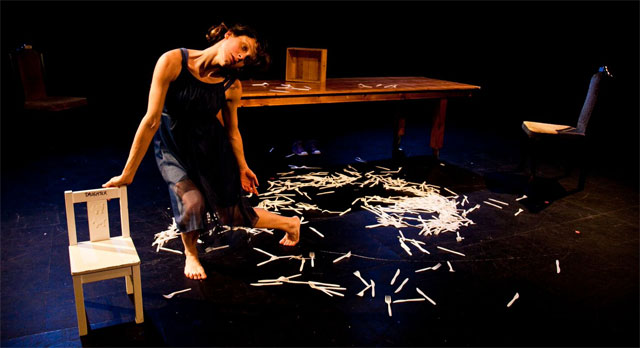
Events from childhood have the potential to shape a person’s entire life, no matter how innocuous they might seem at the time. Little souls have a kind of sensitivity that adults forget, and things that we do and say can have a lasting effect beyond any of our intentions. Cloé Fournier’s Dining [Uns]-Table is an exorcistic ‏work that draws inspiration from memories of a Christmas party with family members many years ago. Fournier works from a base of dance and physical theatre, but she establishes a definite sense of narrative, to provide her audience with reference points that allow us to connect with the surprising range of emotions that are being expressed. The style of art on stage is experimental and its language is thrillingly original, but all its moments are communicative and we read the unconventional presentation from an instinctive and familiar space of interior intimacy. Fournier’s exploration of her personal memory, is in conversation with our own remembrances, and the commonalities we are able to locate, are divine.

If essential ingredients for theatre are inventiveness and a spirit for adventure, Dining [Uns]-Table scores top marks. Furthermore, it is performed with exceptional gusto and flair, by a dancer whose talents are diverse and irrepressible. Fournier’s physicality is flawlessly employed by her own choreography, which is in turn, always thoughtful and refreshing. Her presence is that of a seasoned actor, with the ability to convey story and sentiments clearly and succinctly, always keeping us enthralled. The artist has a precise approach that leaves no stone unturned, and the show feels exhaustive both in terms of what it wishes to depict, and how it does so. The experience is fascinating and all-consuming, and by the end, we are completely satisfied and leave the space thoroughly impressed.

When we approach a work of art, we hope to see a reflection; not an exact facsimile of selves, but a representation of the human condition that we can relate to. This requires both creator and viewer to take a step forward, and to find a point of contact that will spark imagination and hopefully discover something meaningful. In Cloé Fournier’s work, we get in touch with elements that are fundamental to the construction of our identities, shared or personal. The depth that she leads us to, comes not as a result of the divulgement of details from her own experiences, but from the way she seeks to move us in the space that we temporarily encounter. There is so much power in the meeting of strangers at the theatre, and Dining [Uns]-Table agitates an eruption that brings new definition to how things are made and received on Australian stages.

www.pact.net.au

Review: The Dream (The Australian Ballet)

ausballetVenue: Sydney Opera House (Sydney NSW), Apr 29 – May 16, 2015
Choreographer: Frederick Ashton (reproduced by Francis Croese)
Image by Daniel Boud

Theatre review
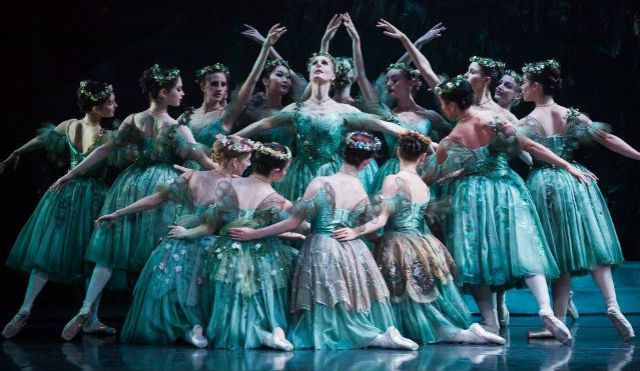
Frederick Ashton’s adaptation of Shakespeare’s A Midsummer Night’s Dream distils all the magic and fantasy of Titania and Oberon’s Fairyland, and uses the ethereal qualities of ballet to provide lyrical expression. Familiar characters are vividly brought to life in dance form, with performers from The Australian Ballet investing in their roles surprising colour and fitting charm. Particularly engaging is Chengwu Guo as Puck, whose powerful and nuanced work is an effervescent highlight of the production.

Retaining original visual design elements for the programme is perhaps unexpectedly effective, especially for Ashton’s Symphonic Variations, which is presented as a prelude to The Dream. Sophie Fedorovitch’s delightful set and costumes for the 1946 piece looks as modern today as it must have seven decades ago, with a stunning backdrop reflective of the early emergence of post modern design at the end of the second World War and in the wake of the Art Deco movement. Ashton’s work features six dancers, all of whom remain on stage for its entire duration, and although adventurous and dynamic by nature, its presentation on this occasion seems too aloof, and energy levels too consistent, to portray the multi-dimensional qualities of its choreography.

The first (of three) Ashton works in the schedule is Monotones II, created in the mid 1960’s to the music of Erik Satie. With just three dancers and a disarming starkness to its visual language, the piece is absolutely unforgiving, and requires of its performers, the utmost in precision, focus and cohesion. When moments coalesce, we obtain the kind of sublime beauty that we seek of the art form, and as inevitable imperfections reveal themselves, one is reminded of the “wabi-sabi” philosophy from Japanese aesthetic principles. Absence makes the heart grow fonder, but it also gives greater meaning to the rest that are present. Perhaps more than any other discipline, ballet’s incessant pursuit of perfection is fundamental to its very meaning and existence. For those of us who deny the possibility of perfection (and hence probably not possess the traits required of professional dancers), it is that very act of pursuance that appeals. The spirit is always willing and pure in our best performers, so even if the body can never live up to our abstract fabrications, what we witness in good theatre is always that passionate belief in something greater, something borne of the brave hearts of our most courageous idealists.

www.australianballet.com.au

Review: Swan Lake (The Australian Ballet)


Venue: Capitol Theatre (Sydney NSW), Feb 20 – 28, 2015
Choreographer: Graeme Murphy
Images by Branco Gaica and Lisa Tomasetti

Theatre review

Graeme Murphy’s Swan Lake is deeply romantic, with a narrative involving a love triangle, savage betrayals, and a descent into madness. It depicts emotions that many are familiar with, only with an intensity that few can bear to experience. Having established a framework with Tchaikovsky’s music from 1876, Murphy’s creation is a fantastical universe based on the old tale of a young maiden’s heartbreak, drawing on its supernatural elements and the woeful tragedy that befalls her. First performed in 2002, this recent incarnation of Swan Lake is faithful to classical styles, but also modern in its sensibilities. Murphy’s characteristic use of fabrics is incorporated into his choreography on several occasions, the physical expression of insanity is refreshingly unconventional, and the removal of sorcerers and curses from its story to provide a contemporised context of mental illness, all contribute to a production that is of and for our times.

The work is operatic and epic in tone, and its duration is certainly not brief. The three-act saga can feel self-indulgent in the later portions of the piece, but execution on all fronts is consistently of a high standard. Kristian Fredrikson’s sets and costumes, and Damien Cooper’s lights in the century old Capitol Theatre is a dream materialised before our eyes. As a thing of beauty, Swan Lake is intricately constructed to deliver a luxuriant feast for the senses, appealing especially to our need for traditional aesthetics that offer comfort, as well as offering a sublime sensuality that is best represented by those who know their bodies best.

Dancers of The Australian Ballet are vibrant and enthusiastic, almost rhapsodic in their connection with their assignment. Their enthusiasm is a source of infectious joy, and there are few pleasures in life sweeter than witnessing accomplished dancers caught in a moment of euphoria. Madeleine Eastoe as the forlorn Odette, proves herself to be a formidable talent with physical abilities that enthral, an impressive capacity to convey emotion, and most of all, an innate understanding of grace that brings a sense of the sublime to her performance. Eastoe has a quietly magnetic presence, but she delivers all the dynamic range required of the choreography, often surprising us by the power that radiates from her slight being.

Odette’s retreat into a secure space of her imagination is symbolic of the increasingly insular ways we live our lives. With the evolution of technology, and the increase in wealth in many cities, we are more than ever before, disconnected from one another. The ballet is a social institution, an enjoyment of which cannot be replaced by any screen of any size. Life can seem too daunting and reality can sometimes be too painful, but artists do what they do, so that we can enter into their world momentarily to find an instance of contact. It is magic to see world class talent in action on a grand old stage, and it is also magic to sit in the dark with many hundreds of others who are for a few minutes, looking at and hoping for the same things.

www.australianballet.com.au

Review: PUNCTURE (Legs On The Wall / Form Dance Projects / Vox – Sydney Philharmonia Choirs)

Venue: Riverside Theatre (Parramatta NSW), Jan 21 – 25, 2015
Director: Patrick Nolan
Choreographer: Kathryn Puie
Composer: Stefan Gregory
Images by Prudence Upton

Theatre review
Dancers are at the forefront in the exploration of theatrical space. Without the burden of words and narratives, they open up senses to what the physical presence of things and bodies can do on a stage, and how we communicate between persons, to create meaning where little or none had existed before. Puncture features a great number of people, some are dancers, and the others singers, introduced as though emerging from the audience, and we are encouraged to identify with them, and to read their performance as though what they present have come from us, even if we feel secure in our seats with temporary passivity. The mix of characters features a beautifully diverse range of ages and ethnicities that reflect the breadth of human experience, and of Australian life. The vocalists in particular, are almost a visual copy of the viewing crowd, and efforts at incorporating them into the dance, provide some of the more emotional moments of the piece.

Patrick Nolan and Kathryn Puie have created in Puncture, something that is a little less self-conscious, and a little more accessible than what we have come to expect of modern dance. They investigate the notion of inclusiveness to address the art of performance, as well as the consumption side of show business. It is a noble ambition to blur the lines of where the show starts and where it ends, but redefining audienceship is a difficult exercise. While not always successful, the ideology of breaking barriers provides strong impetus that shapes the show into something that feels adventurous and earnest. We are at our most engaged when the cast tackles the unconventional. The incorporation of rigging (executed behind the scenes by Jon Blake and Felix Kerdijk) to lift bodies 4 metres away from the ground, the soprano on an aerial hoop, and the tender interchanges between choristers and dancers; we are kept fascinated and entertained.

The 22-strong choir is led by Music Director Elizabeth Scott and Composer Stefan Gregory, with accompaniment on piano by Luke Byrne and on percussion by Bree Van Reyk. The marriage between what we hear and see is wonderfully cohesive, with the music at its most successful when it ventures into the avant garde. Even at its most daring, all the sounds are elegantly resolved, except when words like “hello” and “love” are used, disrupting the abstract beauty that wishes to be experienced in personal ways. It is noteworthy that there are many intriguing personalities in the choir, who could have been featured more heavily in the work’s choreography. Trained dancers tend to lose their individualities in the very discipline they invest in, and the juxtaposition provided on this occasion with non-dancers on the same stage is a main feature. Getting the singers to do more with their bodies is probably challenging, but it is precisely the idea of redefinition that would be elevated further, and the meanings that one draws from Puncture can therefore be more powerful.

Many in the show are dedicated and accomplished dancers, but this is not a piece about athleticism or superhuman faculties. It is an expression of how we live, feel and breathe as individuals and as collectives. Its themes are not always clear, but it articulates its concerns with sensitivity and focus. These artists intend to show us something important in their inimitable ways, and if we think that everything important can be put into words, then they have proven us wrong.

www.legsonthewall.com.au / www.form.org.au / www.sydneyphilharmonia.com