Review: Sugarland (ATYP)

atypVenue: ATYP (Walsh Bay NSW), Aug 27 – Sep 13, 2014
Playwright: Rachael Coopes, Wayne Blair
Director: Fraser Corfield, David Page
Cast: Narek Arman, Michael Cameron, Rachael Coopes, Elena Foreman, Hunter Page-Lochard, Dubs Yunupingu
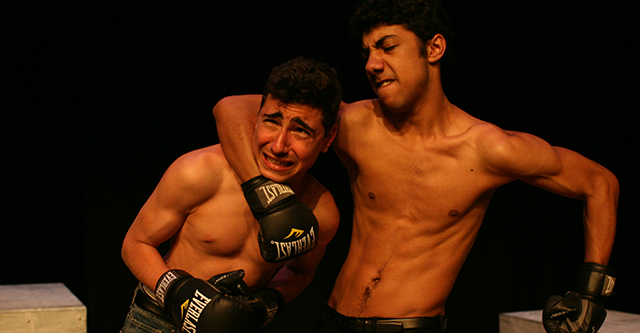
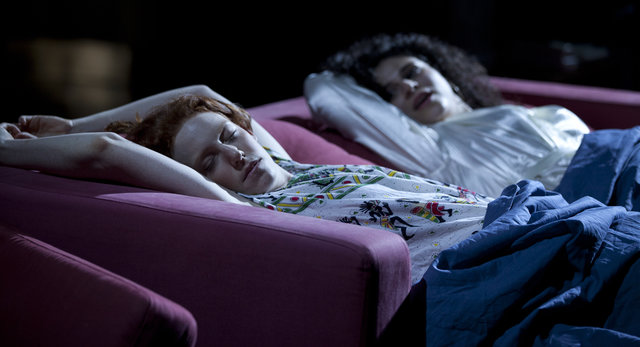
Image by Tracey Schramm

Theatre review
Sugarland is a work about teenagers in Katherine, a remote town in the Northern Territory. The play is performed by young actors, aged 17 to 21, but written by adult artists who have studied the youth of the region over a two-year period. Rachael Coopes and Wayne Blair’s script is powerful in its authenticity, with controversial elements that resonate with a disarming honesty. The truths it reveals, both beautiful and ugly, would be challenging for any audience. Like most memorable work about teenagers, from Puberty Blues (Gabrielle Carey and Kathy Lette) to Kids (Larry Clark), it is the shocking transgressions they depict that leave an impression, and it is precisely the taboo nature of what is being discussed that makes these texts significant and valuable.

Directed by Fraser Corfield and David Page, the production is unexpectedly elegant and subdued. The confronting issues it tackles are not sensationalised. Instead, they are presented in a quietly pragmatic way so that we are prevented from feeling any sense of alienation from its characters. We are seduced into a deceptively cosy world, which in fact contains many aspects that disturb our middle class notions of conventions and acceptability. Corfield and Page’s achievement is in their creation of a political theatre that chooses to speak rationally, rather than to appeal with overblown emotion and hysterical expression. Their gentle approach allows the play’s message to seep through, and to strike a chord where dismissive delusions usually reside.

Performances are not always accomplished, but every actor’s creation on this stage is thoroughly fascinating. The teenage characters seem familiar, but we are provided rare insight into a depth that habitually evades public scrutiny. Dubs Yunupingu plays Nina, a disenfranchised high school girl of indigenous background. Yunupingu has a sensitive quality that we connect with, and a fragility that secures our empathy. The lack of pretension in her craft is refreshing and often very moving. The unhinged Jimmy is portrayed by Hunter Page-Lochard whose impressive presence gives the show a dangerous edge. Page-Lochard is an exuberant performer who brings an exciting unpredictability to his every appearance. Narek Arman is a jovial and charming actor, and his interpretation of the recent Iraqi migrant Aaron is a delightful contrast to the other moodier personalities.

The beginning of political action is awareness, and awareness begins at giving a voice to the disadvantaged. The isolated inhabitants of Sugarland cannot see the privileged lives of its Sydney audience, but their stories and adversities are told to us without ambiguity. They do not seem angry or claim to be desperate, but we know that every young Australian deserves more. The distinction between the haves and the have nots in this lucky country is an unequivocal disgrace, and the journey towards greater equity must be accelerated.

www.atyp.com.au

In Rehearsal: Sugarland

Rehearsal images above by Gez Xavier Mansfield and Kar Publicity from Sugarland,
by Rachael Coopes and Wayne Blair.
At ATYP, from Aug 27 – Sep 13, 2014.
More info at www.atyp.com.au

Review: Mr Kolpert (Pantsguys)

pantsguysVenue: ATYP (Walsh Bay NSW), Jul 30 – Aug 16, 2014
Playwright: David Gieselmann (translated by David Tushingham)
Director: James Dalton
Cast: Paige Gardiner, Garth Holcombe, Claire Lovering, Tim Reuden, Edan Lacey, Tom Christophersen
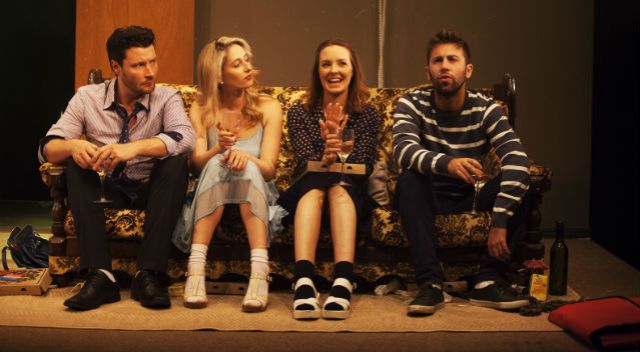
Image by Gez Xavier Mansfield

Theatre review
The theatre is a gift that takes many forms. Audiences sit in darkness full of anticipation, waiting for a revelation, never really knowing what is to be unraveled. Mr Kolpert quickly assures us that it is intent on providing entertainment and laughter, but we discover very soon, that the comedy is black, and the true depth of its morbidity is not known until we arrive at the very end. Although tremendously funny, the comical work is first and foremost an absurdist one. We might be laughing from start to finish, but it is only the loudness of that reaction that disguises a greater response that occurs, in which our minds and emotions are constantly being confronted and agitated, and we struggle to grapple with our own morals and etiquette.

The play presents an omnibus of transgressions through a series of unrealistic and improbable events, and every taboo that the narrative comes into contact with, it aggressively explores, keeping us unnerved and outraged. The comedy that comes along with these controversies is the additional challenge it issues, and we are constantly questioning the appropriateness of our laughter. It makes us wonder if we are keeping polite company in this quite classy venue. Theatre is a communal event, and the meaning of laughter in this social setting can be contentious, but the extremity of what transpires on stage protects our civility. It is simply silly to assume that any of the crowd’s giggles or guffaws can ever be taken as a sign of condonation of the horrific behaviour we see. Still, we are never allowed to feel too at ease. The show is at its core, a disturbing one.

James Dalton’s marvelous direction is sensitive not only to our senses, but also to our hearts and minds. He keeps us fascinated by everything we see and hear, and always keeps our intellect and emotions engaged. His is a theatre that feels all encompassing, intensely engaging and completely stimulating. Dalton does not allow the audience to sit back and observe. This is art without passivity, and he wants us to be on tenterhooks.

Assisting with Dalton’s vision is an excellent team of designers, including composer Marty Jamieson, who also partners up with Alistair Wallace for sound design. Their work provides rich textural variation between scenes, and is often crucial in heightening the quality of irony in the work. Lighting by Benjamin Brockman establishes the production’s aesthetic sophistication, and is memorable for his adventurous sensibility. The extent to which Brockman pushes his creativity is impressive, especially with fairly limited facilities, but two moments of bloodshed are too darkly shadowed, causing momentary, and unintended ambiguity.

The team of actors is exuberant, animated and bold. The playfulness they inject is hugely important to the enjoyment of the piece, with Paige Gardiner’s performance as Edith Mole standing out as a delightful highlight. Gardiner’s remarkable and confident comic ability is showcased perfectly by a creation that is at once, wild yet nuanced. There is a fierce determination to connect, with both cast and viewers, that makes her work irresistible, and thoroughly hilarious. Equally compelling is Claire Lovering, who consistently surprises with a gentle presence that readily transforms into convincing madness. Lovering demonstrates greater subtlety than other cast members but never fails to attack with savagery at every appropriate opportunity. This production of Mr Kolpert features thoughtful and skilled entertainers who must all be commended for a brilliantly vibrant show.

David Gieselmann’s writing exposes the chaos of this thing we call life, and our ravenous need for making logic out of randomness. He talks about the abnormal that resides within everything that seems normal, thereby tempting us to dismantle our standards of morality and ethics, in order to realise their artifice, frailty and inconstancy. The show is about society’s hypocrisies as well as its requirement for order. It does not say that our lives are lies, but it does encourage us to think about the rules we live by, how they are manufactured and the svengalis who might be behind them all.

www.pantsguys.com

5 Questions with Tim Reuben

timreubenWhat is your favourite swear word?
Fuck. It’s so versatile. Take it anywhere. It’s the swiss army knife of swear words.

What are you wearing?
A red thermal top and trackie pants. I’m a fashionista. Also I’m about to go and help paint the set at ATYP.

What is love?
Love is a surprise party on your birthday.

What was the last show you saw, and how many stars do you give it?
I saw A Good Person Of Szechuan at the Malthouse in Melbourne. 5 stars. It was gripping, comical and poignant.

Is your new show going to be any good?
Yep. I love the play, and we have an amazing director in James Dalton. He’s in his element. I think the show is gonna be a real ride for the audience.

Tim Reuben is starring in Mr Kolpert.
Show dates: 30 Jul – 16 Aug, 2014
Show venue: ATYP

Review: His Mother’s Voice (Bakehouse Theatre Company)

rsz_attachmentVenue: ATYP (Walsh Bay NSW), Apr 30 – May 17, 2014
Director: Suzanne Millar
Playwright: Justin Fleming
Actors: Alice Keohavong, Angela Tran, Arisa Yura, Dannielle Jackson, Harry Tseng, John Gomez Goodway, Jonathan Lourdes, Michael Gooley, Monica Sayers, Renee Lim, Isaiah Powell
Image by Tessa Tran, Breathing Light Photography

Theatre review
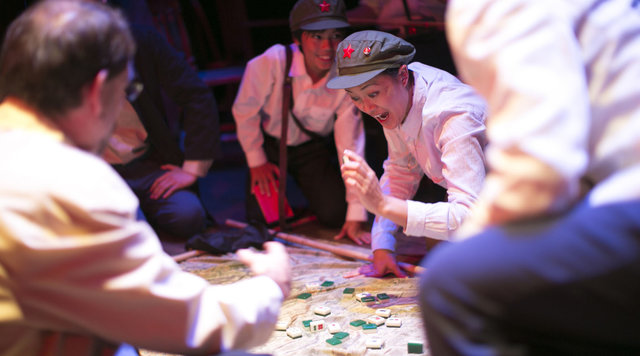
China’s Cultural Revolution ended officially in October 1976, but its after-effects are felt everyday the world over. Today, China’s influence on the global economy develops rapidly, and the country is now widely known to be Australia’s largest trading partner. According to the 2011 census, 4 percent of Australians identify themselves as having Chinese ancestry, and that number continues to grow. Justin Fleming’s His Mother’s Voice is a story about the Cultural Revolution, and the defection of a Chinese pianist to Australia.

Fleming’s script is colourfully structured. With the story of Qian Liu as a young boy, it sets out to provide a dramatic background of the Cultural Revolution that would assist audiences who might be unfamiliar with that slice of history. When Qian matures and becomes a successful pianist, he takes an opportunity to defect to Australia, and the story takes a turn that allows a more direct connection with its intended audience. Fleming’s focus however resides with the relationship between Qian and his mother Yang Jia, who struggles against all odds to teach her son the piano, in the firm belief that music is integral to their family identity and survival. The universal ties between parent and child is rightly central to the story, as it is a theme that we all have an affinity for.

Director Suzanne Millar’s sensitive creation of scenes from the revolution are dynamic and fascinating. Her talent in the use of space and sounds crafts a show that is relentlessly engrossing (lighting designer Christopher Page and sound designer James Colla execute Millar’s vision with great elegance). She has a deep understanding of the audience’s senses, and we are kept entirely under her spell. The stage is kept very busy, but our minds are always carefully guided through all the action with clarity. The show she has built is an entertaining one, but casting issues prevent it from being the moving experience it wishes to be.

Henry Tseng is a perfect visual fit for the lead role, but a lack of authenticity in his characterisation disrupts the crucial relationships Qian has with his mother, and his wife. Without a believable emotional centre, the story is one we hear, but do not feel. Qian’s Australian wife is Emma Fielden, played by Dannielle Jackson. Jackson has a delightful effervescence that brings a necessary lightness to the often heavy going narrative, but can be slightly distracting when scenes require more gravity.

Renee Lim as Qian’s mother Yang Jia, is star of the show. Her performance is powerful yet varied, and her strong presence is consistently engaging. The level of commitment she exhibits is impressive, and it is noteworthy that she exercises restraint effectively on many occasions, although her emotional scenes are unmistakably remarkable. John Gomez Goodway and Michael Gooley both play their paternal roles with excellence, and Alice Keohavong and Monical Sayers are memorable in a humorous scene as bumbling officials negotiating Qian’s farcical reconciliation.

His Mother’s Voice is earnest, and beautiful. It does not always resonate, but it is fiercely captivating. The exoticism involved in dealing with foreign cultures is often tricky, but this production handles matters with respect and dignity. Fleming and Millar are to be commended for looking abroad in their search for artistic inspiration, and for a show that tells us who we are by finding the similarities that lie in the seemingly drastic differences between us and them.

www.bakehousetheatrecompany.com.au

5 Questions with Monica Sayers

rsz_1386076465What is your favourite swear word?
F#$%ING…. that’s fishing right? 😉

What are you wearing?
Yoga gear; lime green Lululemon singlet top and 3/4 length black leggings.

What is love?
Sing it, “baby don’t hurt me, don’t hurt me, no more!” Ah, good old Haddaway said it best in 1993 with this dance track. I believe love is multi-faceted. It can take on different forms of love like friendship, family, or a committed relationship, but ultimately it involves listening from your heart and acting out of loving kindness to the other or even to yourself.

What was the last show you saw, and how many stars do you give it?
Just saw a comedy on Friday night last week, Heaven Help Us at the Bordello. It was fantastic! Clever witty writing with a solid cast. 4 out of 5 stars.

Is your new show going to be any good?
Is it? Well… you’ll just have to come check it out for yourself and see! You’ll never never know unless you do. Personally, I think it’s going to be FAB!

Monica Sayers is appearing in His Mother’s Voice, from Bakehouse Theatre Company.
Show dates: 30 Apr – 17 May, 2014
Show venue: ATYP

Review: Stop Kiss (Unlikely Productions / ATYP)

rsz_gxmphotogrpahy2014-1-3Venue: ATYP (Walsh Bay NSW), Mar 5 – 22, 2014
Director: Anthony Skuse
Playwright: Diana Son
Actors: Olivia Stambouliah, Gabrielle Scawthorn, Aaron Tsindos, Ben McIvor, Robert Jago, Kate Fraser, Suzanne Pereira
Image by Gez Xavier Mansfield

Theatre review
One of the main things explored in theatre is emotion. We ask, what are these different things we feel, how do we create these feelings, how do we differentiate between cheap and authentic sentiment, and how do they affect our lives as individuals and collectives? Stop Kiss leaves its audience with such emotional intensity that these questions come to the fore. Diana Son’s script tells the simplest of stories, but its unique structure in terms of a non-linear timeline, and an unusual depiction of romantic love, keeps us enthralled, and speaks deeply to the most basic humanity in us all .

Under Anthony Skuse’s wonderful direction, Stop Kiss is both theatrical and sincere. There is masterful use of space, which gives the production a sophisticated aesthetic. In spite of budget constraints, the show is a handsome one. Set design is thoroughly considered, and elegantly executed by Gez Xavier Mansfield, and lighting by Sara Swersky is subtle yet varied and effective. The many scene transitions are established with elegant flair. We jump around in time and space with minimum fuss and maximum efficiency.

The love story and its romance are managed with restraint. Skuse deliberately downplays a lot of the drama, so that its powerful concepts work overtime in our heads. Like a striptease, we are only ever given just enough information so that our minds can conjure up all the salacious details on their own. The cast benefits from this sense of inhibition, as it allows for a somewhat ironic magnification of their inner worlds. We seem to obtain a better insight into what people are thinking and feeling when they are prevented from doing too much.

Gabrielle Scawthorn’s performance as Sara is marvelous, culminating in a final scene that can only be described as heartbreaking. The character she has created is not only believable, we find ourselves in constant need of seeing more, and knowing more. Her work is equally committed whether playing light or dark, and she tells her character’s story with careful compassion that is beautiful to watch. The connection Scawthorn makes with her audience is as intense as Sara’s falling in love in the story.

Olivia Stambouliah plays Callie with vivacity and complexity. Her energy keeps the show uplifted and dynamic, and her focus is magnetic. There is a steely determination in her performance that is at times impressive, but at others, slightly distracting. The actor sometimes works too hard but her final moments onstage are truly remarkable, and intelligently crafted. Ben McIvor has two memorable scenes as Peter. He finds a balance between tenderness, frustration and despondency, and portrays a character that is empathetic and immediately affable.

It is probably not a rare occurrence that tears are shed in the theatre, but the emotions in Stop Kiss are exceptional. We cry because we understand that true love is precious and rare, but we also cry in the knowledge that homophobic violence is widespread and alive. The play ends in a dark place, but it thankfully leaves us with a morsel of hope. Tears can be self-indulgent, but they are also the beginning of every important and necessary change in the places we live. This play may not be obviously political, but one hopes that its gentle approach would have an effect on those who have yet to be converted by our more strident preachers.

www.facebook.com/unlikelyproductionspresent

5 Questions with Olivia Stambouliah

oliviastambouliahWhat is your favourite swear word?
Cunt.

What are you wearing?
Skirt, tank, boots and rehearsal sweat.

What is love?
Trust. To surrender and to evolve. A tingle down below helps too ;)


What was the last show you saw, and how many stars do you give it?
I just saw Falsettos. I’d never seen it before and was super surprised, in a great way! A beautiful production.

Is your new show going to be any good?

Come along and see for yourselves. If you like to kiss, you won’t want to miss this…


Olivia Stambouliah is starring in Stop Kiss.
Show dates: 5 – 22 Mar, 2014
Show venue: ATYP Studio 1

Review: Bite Me (ATYP)

rsz_bite_me_5_gxmphotographyVenue: ATYP Under The Wharf (Walsh Bay NSW), Feb 5 – 22, 2014
Director: Anthony Skuse
Playwrights: Jory Anast, Jake Brain, Sophie Hardcastle, Tasnim Hossain, Julian Larnach, Zac Linford, Felicity Pickering, Emily Sheehan, Kyle Walmsley, Keir Wilkins
Actors: Airlie Dodds, Darcie Irwin-Simpson, Joel Jackson, Angelica Madeni, Sam Marques, Paul Musemeci, Julia Rorke, Emily Sheehan, Kate Williams

Theatre review
Each year ATYP (Australian Theatre for Young People) brings together 20 young writers aged between 18 and 26 to participate in their National Studio. As part of the week, the writers are given a common theme and each creates a seven minute monologue for a 17 year old actor. Bite Me presents 10 of those scripts, in an unusual format that brings them together, not as a coherent whole, but a visceral entity that stands alone as a singular work of theatre.

The common theme in all the writing is food, but Anthony Skuse’s direction does not rely on that convenience to tie things together into one obvious unit. Instead, he focuses our attention on the actors’ work and design aspects of the production, to create an experience that is dramatic, thrilling, and avant garde. Skuse is acutely aware of the audience’s senses and all the potentialities an empty space holds for addressing them. His respect for actors and all their capacities is evident, and we are given the best sides of all his performers. Along with movement coach Adèle Jeffreys, Bite Me showcases a kind of image driven theatre that wonderfully imagines bodies in spaces, and pushes the boundaries of creativity within a realm of minimalism.

The cast is a young one, and while their standards of performance vary, all are allowed to present their strengths, and an excellent sense of evenness is achieved in terms of stage time. Julia Rorke, in Kyle Walmsley’s Food Baby, is easily the funniest in the ensemble. Her comic timing is natural and gleeful, and her determination in connecting with the audience is irresistible. Paul Musumeci’s performance of Keir Wilkins’ George is beautifully restrained. Like a caged lion, Musumeci exhibits a powerful magnetism, one resulting from a very controlled expression of a certain mysterious intensity that resides in the actor’s being. Jory Anast’s Pip Nat Georgie is performed by Airlie Dodds who delivers, without the aid of makeup and costumes, a memorable depiction of an archetypal young Australian masculine character. Dodds’ feminine appearance provides the perfect juxtaposition for her character, and allows us to see the actor’s interesting work with great clarity.

Set, lighting and sound design are thoughtful and exquisite. Narratives are scarce in Bite Me, but its atmospherics are dynamic and beautiful. This is a great achievement, given the minimalist approach taken by all the technical components. There have been many other showings of short plays that have entertained or titillated more, but this is a production that fascinates and impresses. It is thoroughly original.

www.atyp.com.au