Review: Ulster American (Outhouse Theatre Co)

Venue: Seymour Centre (Chippendale NSW), May 13 – 29, 2021
Playwright: David Ireland
Director: Shane Anthony
Cast: Harriet Gordon-Anderson, Brian Meegan, Jeremy Waters
Images by Richard Farland

Theatre review
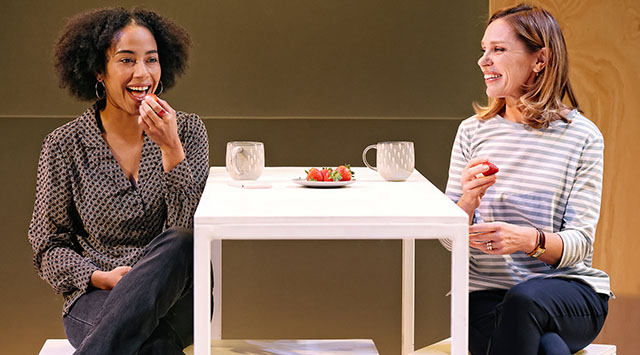
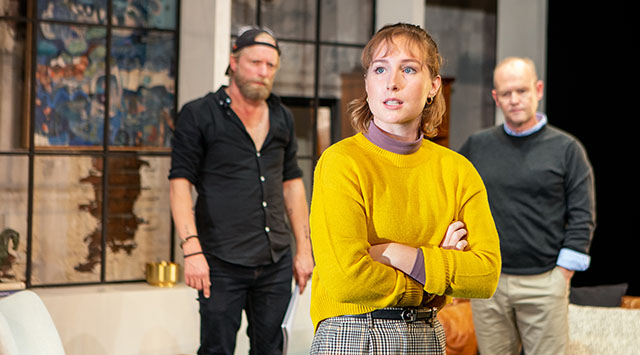
Ruth has come to London, from Northern Ireland, to begin rehearsals on her play. Unlike the show’s lead actor Jay, and its director Leigh, Ruth the playwright is not a star of the stage, and neither is she a man. This gendered imbalance of power is apparent right from the start, in fact even before Ruth appears, when the two men involve themselves with political conversations, in the absence of anyone who might understand first-hand, any experience of marginalisation. Ruth’s subsequent entrance proves an unbearable disruption, as we witness the savage implementation of patriarchal violence upon the young woman, at her every attempt to exert her rights, as a supposed equal creator in the artistic process.

All of this happens in David Ireland’s satirical Ulster American, a piercing interrogation of the uncomfortable relationship that the privileged have, with what seems to be a trendy phenomenon, of performative virtue signalling. Both Jay and Leigh believe themselves to be on the right side of history, always consciously using language that demonstrate their purported progressiveness, but it is their action that speak louder. In Ruth’s presence, the men cannot help but operate from positions of power and authority, fiercely protecting their status of dominance, and therefore the status quo.

Irreverent and genuinely funny, Ireland uses searing comedy to make palatable, ideas that are usually conveyed too dry and sanctimonious. It is perhaps an ironic choice to have a white man at its helm, but director Shane Anthony injects excellent nuance to ensure that we are always made aware of meanings and intentions. The production is fast-paced, enjoyably so, and Anthony validates that entertainment does not have to come at the price of a valuable message. Additionally, set design by Veronique Bennett and costumes by Claudia Kryszkiewicz, contribute a sleekness to the staging’s imagery, further convincing us of Ulster American‘s dissections of the contemporary bourgeoisie.

Actor Harriet Gordon-Anderson brings to the role of Ruth, a marvellous complexity that prevents her from devolving into a simple victim of circumstance. There is a confidence to her presence that offers fortitudinous juxtaposition against the two hysterical men railing against her. Oscar winner Jay is played by the highly engaging Jeremy Waters, who once again establishes himself as a storyteller of the highest calibre, in a brilliantly amusing and sarcastic take on the vacuous Hollywood monster archetype. Brian Meegan as English theatre director Leigh, is comically imposturous, and wonderfully authentic in its portrayal of a man who imagines himself a much better person than he actually is.

So much of art education, involves a certain inculcation of humility. Whether in the making of, or in the appreciation of it, one learns that the ego, is almost always a destructive force. In Ulster American, we watch egos get in the way, and observe how a person’s sense of aggrandized selfhood, prevents the creation of anything good. This manifests as a fight for space in David Ireland’s play, with the implication that those with privilege can only conceive of justice as a zero-sum game. When under threat, Jay and Leigh scramble to win back lost ground, always thinking in terms of deprivation, instead of dreaming up possibilities of more for everyone. Ruth has to fight tooth and nail, even resorting to unscrupulous means, but that is only because no real recourse is available to the oppressed.

Greed is not good, yet it remains central, in the pursuit of what so many of us perceive to mean success. Our lives need redefinition. Priorities and values need to be adjusted so that justice can prevail. It is debatable if a revolutionary overhaul is the answer, or if small steps and big words can count towards improvement, but to do nothing is without question, reprehensible.

www.outhousetheatre.org

Review: A Room Of One’s Own (Belvoir St Theatre)

Venue: Belvoir St Theatre (Surry Hills NSW), May 6 – 23, 2021
Playwright: Virginia Woolf (adapted by Carissa Licciardello, Tom Wright)
Director: Carissa Licciardello
Cast: Anita Hegh, Ella Prince
Images by Brett Boardman

Theatre review
It was almost a hundred years ago, when Virginia Woolf had given her lectures espousing the importance of championing women writers. Subsequently compiled and published in 1929 as an extended essay, A Room of One’s Own has since become a prominent work of twentieth-century feminist literature, providing language and concepts that have helped advance the cause.

Woolf’s meditations on liberation are, of course, much further-reaching than its immediate academic concerns. Finding ways to empower women writers, as we have discovered, involves an interrogation of how power is fundamentally distributed in our lives. These analyses about the people who do, and those who do not, have the space to think and write, generate a political discourse whereby women can contextualise their experience of freedom, or more likely lack thereof.

Adapted into a theatrical format by Carissa Licciardello and Tom Wright, we discover that Woolf’s words remain potent, even if her approach to these persistent issues can at times seem dated. We also observe that although much of how she had conveyed her thoughts, bear a passion that translates well to the stage, some of her writing is probably more effective when encountered in a book.

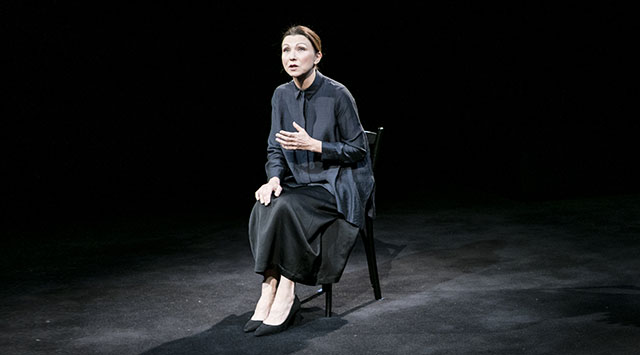
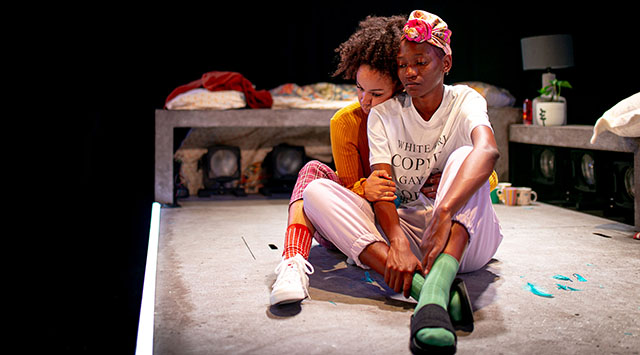
Performer Anita Hegh demonstrates a baffling super human memory, completely at ease with the enormous barrage of words she has to deliver. Her graceful gravitas creates for us, a version of Virginia Woolf who is engaging and persuasive, a formidable force of nature that lives up to our imagination, of what the legendary agitator could have been like in the flesh. Hegh’s work is extremely detailed, able to sustain our fascination with the intensity of her depictions, even in moments when one’s intellect falters at trying to keep up.

Licciardello’s direction of A Room of One’s Own introduces a substantial element of abstraction, to provide the show with a sense of elevation. In addition to what remains a lecture by Woolf, is a second performance space, a smaller cube in which a second actor Ella Prince is housed, as she manufactures physical augmentation to what is said and heard. These brief sequences are perfectly conceived, to add much needed theatricality, and to aide digestion of Woolf’s dense words.

David Fleischer’s work on set and costumes, are technically proficient but also surprisingly sensual. Lights by Kelsey Lee too, are soft and almost romantic in quality. The visuals offer a valuable counterpoint, to the understandably militant tone of the text. Music by Alice Chance is luscious, maybe even dreamlike, and along with Paul Charlier’s uplifting sound design, our mind is maintained in a mode of inspiration, as we welcome Woolf’s passionate call for progress.

“500 pounds a year” is the author’s unmissable refrain, reflecting a way of looking at equality that places emphasis on giving to women, what men possess. In the new century, we learn that what men possess, is no longer that which represents a better way of being. Woolf implies that to be rid of menial tasks, is the only way for women to think, but she was wrong. Many of modern feminism’s greatest thinkers were/are never able to leave the trenches of patriarchal oppression.

It is appropriate that both performers in the show are white women. Although much of what Woolf has written is valuable, it comes from a position of privilege that the author was evidently unwilling to confront. There is a deceptive simplicity to her message, and a strong tendency to preserve structures that should be called thoroughly into question. All she wants it seems, is to swap male for female, in these old ways of running things. What we need is to admit that these very systems of running things, are a problem, no matter who occupies positions within.

www.belvoir.com.au

Review: Dogged (Griffin Theatre Company)

Venue: SBW Stables Theatre (Darlinghurst NSW), Apr 30 – Jun 5, 2021
Playwrights: Andrea James, Catherine Ryan
Director: Declan Greene
Cast: Blazey Best, Sandy Greenwood, Anthony Yangoyan
Images by Brett Boardman

Theatre review
The story begins with a dingo in the lands of alpine Victoria, on Gunaikurnai country, looking for her babies. During her search, she encounters a dog and his human owner, a white woman hunter on the prowl for dogs in the wild, to collect their skin for profit. Dogged by Andrea James and Catherine Ryan, explores the broken relationship between modern humans and nature, as well as the difficult bonds between Indigenous Australians and their colonisers.

The 80-minute play is ambitious in scope, with a complex structure that reflects its creators’ desire to encapsulate many discussions being conducted by the wider community. In addition to topics pertaining to environmentalism and racism, Dogged touches on feminism and capitalism, for a work about injustice that cares to be vastly inclusive. Its approach however, is purely allegorical, sometimes obvious but mostly obtuse, which suggests that Dogged is likely to speak more intimately to those already invested in these ideas.

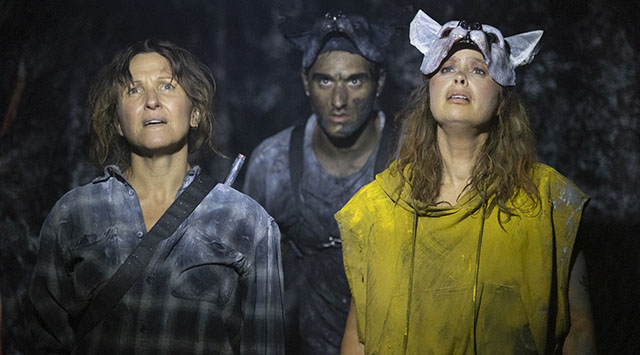
For those less initiated, the action-packed production incorporates energetic sequences, choreographed by Movement Director Kirk Page, that provide an exquisite dimension of visceral excitement to the narrative. Three extraordinary performers hold us captive, for this strange and sometimes bewildering tale of inter-species adventure. Sandy Greenwood is spectacular as Dingo, incredibly detailed with what she is able to convey between the lines, as a First Nations woman actor. We watch her as dingo and as human simultaneously, like a sort of transmorphic genius, illustrating the parallel plights of being Indigenous, of being female, and of being mother earth. Even though her main concern is the portrayal of desecration in its many forms, it is Greenwood’s defiant strength that really mesmerises. Also remarkable are the depths of emotion she summons at will, always replete with intensity, and flabbergasting in her authenticity.

Also impressive is Blazey Best who plays the unnamed human Woman, with a fierce mental concentration to accompany an excellent capacity for nuance, successfully preventing the hunter from devolving into a simple villain. Anthony Yangoyan does a marvellous impression of a dog, both physically and in attitude. The actor is completely believable playing canine in this fantastical thriller, with an endearing sprightliness that introduces a layer of tenderness to an often brutal landscape.

Director Declan Greene uses the writing’s complexity to deliver an exciting show, gripping on several levels. Dogged can be received as an intellectual piece, one that is highly critical of our reprehensible values, and confrontational in addressing our immorality. On the other hand, its dramatics are taut, with characters that interact deliciously, in the telling of a story whose stakes remain high from start to finish.

Design work on the production is inventively and skilfully implemented. An intricate set by Renée Mulder and Peter Waples-Crowe, guides our imagination into dark bushlands, mysterious and scary as though stepping into a living nightmare. Mulder’s costumes convince us of the roughness of these creatures’ existence, and the danger that constantly surrounds them. Lights by Verity Hampson meaningfully amplify every resonance of the text, bringing focus to all the profound messages that fundamentally anchor the show. Along with sound and music by Steve Toulmin, mood transformations in Dogged are accurately and intuitively accomplished, and the way Hampson and Toulmin collaborate to keep the staging unpredictable, is truly praiseworthy.

The colonisation of this land must not be seen as anything but cruel, unjust and inhumane. Commencing with European invasions in the 18th Century, to all the subsequent waves of migration, the incremental and devastating dispossession that our First Nations have had to suffer, is unforgivable. Like the destruction on nature, that modern technology, industrialism and commerce, have conspired to enact, we have arrived at a point of apocalyptic discombobulation, where we have no choice but to better understand the impact of many of those sins, past and ongoing.

Dingo tells Woman to “fuck off!” but one wonders if we are already in too deep, and if the idealistic wish for a simple reversion to a historic purity, can ever be possible. So much of the damage has been permanent. There needs to be a rebuild, as though from ashes, a rebirth that centres all the reparations that have to be made. If the moment of reckoning does not take place today, we are only waiting for things to get worse, before the dreaded inevitability happens.

www.griffintheatre.com.au | www.forcemajeure.com.au

Review: Goddess: The Elizabeth Burton Story (Old Fitz Theatre)


Venue: Old Fitzroy Theatre (Woolloomooloo NSW), May 4 – 8, 2021
Co-creators and Performers: Elizabeth Burton, Betty Grumble, Aaron Manhattan
Images by Joseph Mayers

Theatre review
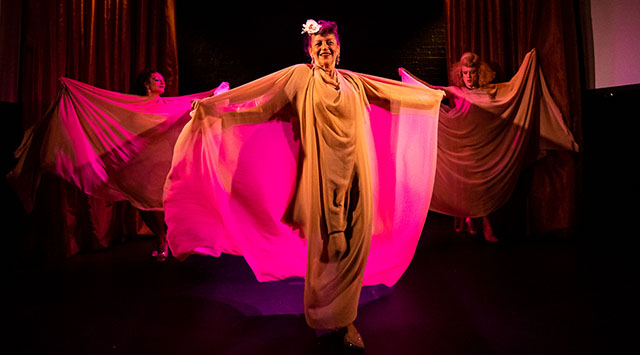
Striptease artist Elizabeth Burton’s career began in the late 1960’s. When she discovered Go-go dancing, doors opened for Burton to travel the world, allowing her to meet people of all kinds, and to put her stamp on an artform that never ceases to be subversive. Now at the grand age of 73, Burton continues to create, and in Goddess: The Elizabeth Burton Story, takes to the stage once again, not only to usher us into the indulgent realm of exotic performance, but also to share anecdotes and wisdom, in a way only someone who has truly lived, can do.

Fearless and boundary-breaking, Burton’s stories are not all triumphant. Instances of tragedy and misfortune are many, as is the case with people who take roads less travelled, but these recollections are told with an astounding sense of objectivity, almost counter-theatrical in approach. Burton is wistful for sweet memories, but it is with a sense of duty, and sometimes humour, that she brings up trauma. There is little wallowing, and certainly no performative pensiveness for dramatic effect. It is clear that the show is intended to uplift, but there is no denying its capacity to devastate. The truth resonates powerfully, no matter how the storyteller wishes to present her account of events.

To have a living legend at close proximity, especially one who seems incapable of pretension or any hint of defensiveness, is to come in contact with the divine. In a culture that persistently celebrates youth, the meaning of time is lost on us. We are taught to cultivate desirous visions of ourselves at half our age, rather than think about what we could be when twice our age. Burton can reminisce about things sordid or wholesome, extraordinary or mundane; there is no end to the details she can offer up, in this attempt to encapsulate an existence too immense, but of greatest value is to look into her eyes, and to see with absolute certainty, that dark as this world can be, everything is simply going to be all right.

Providing on stage support are Betty Grumble and Aaron Manhattan, both looking like faithful disciples to the esteemed one, on hand not only to prompt for stories and to help illustrate them, but also to represent meaningfully, a sense of community. The image being created is anti-establishment and queer. Goddess is about a woman who breaks the rules in the most profound manner. It talks about a person’s worth, not in ordinary terms of success and status, but through the re-framing of one woman’s radical definition of selfhood, Goddess dismantles our priorities as a culture, and adjusts our social values, to one that more accurately reflects the important things in life. We also learn that there is nowhere more edifying, than from our queer elders, especially those emancipated from so many pointless pursuits of conventionality, that we can uncover those very important things in life.

Hierarchies are only of benefit to those on top. This is painfully obvious, yet we live as though unaware, completely invested in systems that exploit our participation at the lower rungs. We are required to endlessly obey, in the faith that rewards are assured, and that those on top are playing by the same rules. Both are empirically false. Goddess provides inspiration, for each of us to search for ways to exist on the outside. Fulfilment can never be dictated, it must only be discovered independently. Elizabeth Burton discovered a love of herself, and today altogether, we bask in her divine glory.

www.redlineproductions.com.au | www.performinglines.org.au

Review: Fun Home (Sydney Theatre Company / Melbourne Theatre Company)

Venue: Roslyn Packer Theatre (Sydney NSW), Apr 27 – May 29, 2021
Book and Lyrics: Lisa Kron (based on the graphic novel by Alison Bechdel)
Music: Jeanine Tesori
Director: Dean Bryant
Cast: Gilbert Bradman, Ryan Gonzalez, Emily Havea, Mia Honeysett, Lucy Maunder, Jensen Mazza, Maggie McKenna, Adam Murphy, Marina Prior
Images by Prudence Upton

Theatre review
In the American musical Fun Home, based on the autobiographical graphic novel by Alison Bechdel, we observe the cartoonist hard at work on her drafting table, looking back at memories of her difficult father. Bruce was a baby boomer, and like many queer people of that generation, never came to terms with being gay. Even as Alison began to come out as lesbian, his personal anguish never diminished, struggling even to offer support to his own daughter at a time when she had needed him most.

Clearly intended to be an emotional theatrical experience, the show’s reliance on an unlikeable character is risky, and even though the music is predictably and relentlessly sentimental, it is doubtful if audiences could ever feel the full impact of the hardship that this family had gone through. Alison goes to considerable lengths to find forgiveness and understanding for her father, but it is arguable if the musical provides sufficiently for us to respond with deep compassion, or even to care enough for these characters, to be able to invest adequately into their story.

The staging is a polished one, with Alicia Clements’ design facilitating efficaciously, the need for frequent oscillations of time and space. Matt Scott’s lights are beautiful, especially when depicting illusory moments during which we see characters suspended in the undefined abyss of Alison’s imagination. Director Dean Bryant introduces an excellent sense of pizzazz to the production, making sure that we are entertained to the fullest of the show’s potential. He ensures that the story is told with clarity, including the unsavoury revelations relating to Bruce’s life.

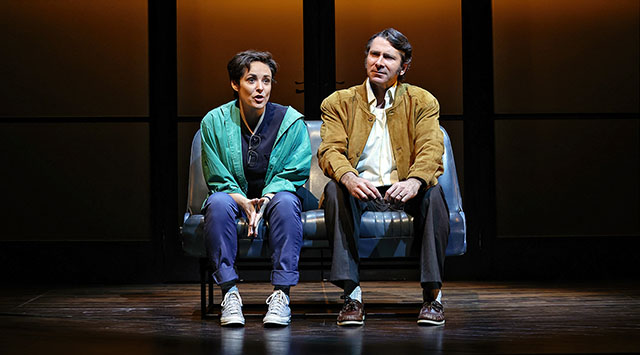
We see Alison at three periods of maturity, from childhood and her college years, to the grown woman she is today. Child star Mia Honeysett is fantastic as Small Alison, wonderfully nuanced and authentic, in her portrayal of a child navigating complicated family dynamics, as well as her own blossoming homosexuality. Medium Alison is performed by Maggie McKenna whose singing voice proves a divine pleasure, and Lucy Maunder is captivating as Big Alison, bringing a palpable tenderness that underpins the show. The striking Adam Murphy does his best to honestly depict Bruce, warts and all, but it is Marina Prior who leaves a strong impression playing his wife Helen. When she finally breaks her silence and delivers a faultless solo number, Prior’s technical prowess brings momentary elevation to the production, inviting us to luxuriate in the sheer genius of her singing.

It should come as no surprise that humans are sometimes much more troubling, than a 100-minute Broadway musical can accommodate. The formulaic nature of these creations, requires a form of storytelling that follows many rules, and we discover that truth can sometimes become its nemesis. Bruce’s sexual encounters with underaged boys, is not forgivable, especially in this space of commercial theatre. Fun Home requires us to regard Bruce’s past sins with generosity, the way his daughter has to, in order that our emotions may become engaged in accordance with the traditional peaks and valleys of a conventional musical. Bruce’s transgressions however, are much too severe, at least for the old-fashion song-and-dance format.

www.sydneytheatre.com.au

Review: Honour (Ensemble Theatre)

Venue: Ensemble Theatre (Kirribilli NSW), Apr 23 – May 5, 2021
Playwright: Joanna Murray-Smith
Director: Kate Champion
Cast: Ayeesha Ash, Lucy Bell, Huw Higginson, Poppy Lynch
Images by Prudence Upton

Theatre review
After 32 years of marriage, George, a renowned writer, suddenly decides that he is no longer in love with Honour. To be more precise, he simply no longer wants a life with her. Unsurprisingly, this change of heart is precipitated by the appearance of a younger woman, Claudia, who had been assigned to interview George for a publication. In Joanna Murray-Smith’s wonderfully contentious play Honour, the meanings of love, marriage and fidelity, are brought under scrutiny.

Some of our most fundamental values come into scintillating question by the work, as good art is want to do. Four characters, with differing perspectives, challenge the way we think about something that seems so often, to be prescribed and immovable. Additionally, a modern approach to the depiction of female desire, encourages us to examine romantic partnerships in renewed ways. Issues around duty and responsibility, as they apply to womanhood (who we care for, and who to care for us) further broaden the scope of how we regard these long-established notions of matrimony and family.

Although never too radical in temperament, Murray-Smith’s work bears intellectual dimensions that are deeply compelling. She presents her ideas in a way that feels accessible, but encourages us to go further with how we consider repercussions (for her characters, and for ourselves) as they appear through her narrative. Directed by Kate Champion, there is no shortage of richness in how the production discusses these topics. In fact, it often appears that philosophy comes before drama, in Champion’s presentation of Honour. The result is a rewarding experience of theatre, even if its dialogue can sometimes move quicker than our minds can keep up with.

Actor Lucy Bell invests heavily into emotional authenticity for her portrayal of Honour, the jilted wife. The human complexities in Honour’s reactions to her predicament are rendered soundly by Bell, who makes believable the extraordinarily cerebral way that this wronged woman processes her trauma. The other woman Claudia is compassionately interpreted by Ayeesha Ash, who prevents the audience from too easily dismissing the role for her problematic actions. It is in our understanding of Claudia, that we can attain a more sophisticated appreciation of the play’s ideas. George is made surprisingly sympathetic by Huw Higginson, a sensitive performer unjudgmental of the celebrity writer’s dubious choices. Honour and George’s daughter Sophie is played by an energetic Poppy Lynch, who succeeds at making substantial, a comparatively small role.

Production design by Simone Romaniuk is elegant and evocative, with a simplicity that complements the show’s performance style, focussing our attention closely on the intricacy of dynamics between characters. Damien Cooper’s lights too, offer generous enhancement to the tone of each scene, gracefully moving us from one mood to another. Music by Nate Edmondson adds a sense of flamboyance to the story’s inherent dramatics, effective at turning every seemingly mundane circumstance into something unequivocally theatrical.

We put so much time and effort into this thing called love, but rarely do we interrogate the impulses that lead us to it. In the play Honour, we can recognise that the experience of love, is influenced so much by factors that relate to social conditioning, or “the way we are brought up”. What feels natural and organic, is so heavily informed by beliefs that have been unconsciously, but actively, cultivated, yet to dare shift parameters around what is and is not permitted in how one chooses to experience love, is often met with disapproval. When George declares that he is no longer in love, in the old-fashioned way, with Honour, the overwhelming pang of betrayal is obvious to all. To want him to stay because of guilt, debt and responsibility however, is not what Honour deserves.

www.ensemble.com.au

Review: Yellow Face (Dinosaurus Productions)

Venue: Kings Cross Theatre (Kings Cross NSW), Jan 23 – May 8, 2021
Playwright: David Henry Hwang
Director: Tasnim Hossain
Cast: Jonathan Chan, Helen Kim, Adam Marks, Kian Pitman, Whitney Richards, Idam Sondhi, Shan-Ree Tan
Images by

Theatre review
It is not such a strange move that a playwright should make themself the central character in their own work, but in David Henry Hwang’s Yellow Face, it is an obviously absurd conceit, that the Asian-American writer should commit the theatrical cardinal sin, of mistakenly casting a white man to play one of his Asian characters. Hilarity does ensue, perhaps unsurprisingly, in this quirky comedy, about race relations in America, and racial representation in the arts.

Much has changed in these political discussions, since the play’s original 2007 premiere, and some of its arguments can seem slightly dated, as do some of its humour, but the essence of what it wishes to impart, remains valuable. The current resurgence of anti-Asian sentiment, most notably in post-Trump USA, and in the middle of the Covid-19 pandemic, have brought back analysis and commentary around the concept of the “model minority”, which Hwang certainly embodies, being one of the biggest success stories of Asians who have made it on Broadway.

When people from marginalised cultures are given mainstream recognition for remarkable achievements, we are celebrated for having triumphed in spite of particular challenges. We also become intractably associated with those limitations, and unlike our white, straight, cisgender, non-disabled counterparts, we struggle to be perceived as whole persons, and as being more than the narrow identities ascribed upon us. Hwang laments that he too, has to play “yellow face”, that it is perhaps an inescapable fate to have to always be thought of, as the good Asian.

Yellow Face is a complicated work. It begins fairly innocuously with the farce surrounding an actor’s mistaken identity, but develops quite unexpectedly, with its core subject of prejudice, into deeper and more consequential spaces. The play is both fictional and autobiographical, with elements of both featuring prominently, although not always distinct, in the storytelling. The audience instinctively wishes to separate fact from fantasy, but we eventually realise that it is the moral of the story that matters.

The production is directed by Tasnim Hossain, who brings unmistakable passion to the project. Her sense of mischief, proves a good fit with Hwang’s sardonic voice, and the combination delivers for the stage, a confident wit that many will enjoy. Also noteworthy is Prema Yin’s sound design, able to manufacture subtle tonal shifts in atmosphere, to guide us through each scene, for emotional responses that may be conscious or subconscious. Visual elements are less inventive, but adequately implemented nonetheless.

Actor Shan-Ree Tan is extraordinary in the role of David Henry Hwang, comically pompous yet tragically self-deprecating in equal measure. It is a highly detailed rendering of both personality and narrative, with a steely focus that as leading man, keeps us attentive to all that is unfolding. Jonathan Chan is memorable as Hwang’s father Henry, a highly idiosyncratic character, very rough around the edges but ultimately an endearing figure.

The white guy masquerading as Asian, is played by a delightful Adam Marks, who brings wonderful vibrancy to the pivotal role of Marcus G. Dahlman. Equally charming are Whitney Richards and Idam Sondhi, ensemble players who leave excellent impressions with their remarkable versatility and dynamism. Helen Kim and Kian Pitman are more restrained in their approach, and although not as powerful as a result, both performers are unquestionably committed and very well rehearsed.

What the idea of a “model minority” implies, is that there are minorities whose presences are less than ideal. We are judged with more severity than any other citizen, and have to live by standards higher than others are subjected to. Hwang does not wish to bear the burden of being a famous writer from an Asian background, but is unsure if it will ever be possible for him to simply be a famous writer. There is a resentment in having to overcome challenges that are unique to being Asian-American, but concurrently, there is also a sense of pride that must accompany the ability to surmount those difficulties, unjust as they may be.

Today we seem to be more aware of difference, than we ever did before. For some, identity politics is bothersome, but for others it is liberating and empowering. We can no longer be complacent, and assume that all individuals experience the world in the same way. As we endeavour to improve lives, it is important that we understand deeply, the nature of our communities, with all their nuances and divergences. Above all, we need to find ways to manifest into reality, the old adage that although we are all different, we are all equal.

www.facebook.com/DinosaurusProd

Review: seven methods of killing kylie jenner (Darlinghurst Theatre Company)

Venue: Darlinghurst Theatre Company (Darlinghurst NSW), Apr 7 – May 2, 2021
Playwright: Jasmine Lee-Jones
Director: Shari Sebbens
Cast: Vivienne Awosoga, Moreblessing Maturure
Images by Teniola Komolafe

Theatre review
Twitter is blowing up, and Cleo is unable to go to sleep. The idea that an extraordinarily privileged white woman could be declared a “self-made billionaire” is not just absurd, it is proving completely enraging to the young Black student living in her tiny English flat. When Cleo whips out her phone, and starts to tweet her feelings in response to the announcement of Kylie Jenner’s newly minted status, her words come fast and furious. For those who have nothing to lose, anonymity in the Twittersphere is especially useful, in challenging authority and for exposing injustice. Speaking truth to power is incredibly seductive, as we see in Jamine Lee-Jones’ very twenty-first century play seven methods of killing kylie jenner, until one discovers that the incendiary capabilities of social media, can work in all directions.

Playwright Lee-Jones is so ahead of the curve, one is tempted to label her, an original. Her ability to distil incredibly complex concepts pertaining to discussions around race, feminism and queerness, that have been swirling like confused wildfire in recent years, into a coherent and powerful 90-minute two-hander for the stage, feels so much to be a sort of inconceivable genius. The way Lee-Jones is able to focus all our messy arguments into something persuasive and lucid, is completely remarkable. Also very noteworthy, is the wit that she introduces into every scene, no matter how heavy things get, that demonstrates a deep understanding of how theatre operates. The laughs are incessant, as are the searing hard facts that Lee-Jones exposes unapologetically.

Bringing scintillating life to Lee-Jones’ words of wisdom, is Shari Sebbens’ meticulous yet spirited direction of the work. There is an exuberant boldness to Sebbens’ approach that delivers to the audience an exceptionally jubilant experience; her show is full of infectious joy yet, importantly, we are never let off the hook. Every morsel of difficult truth is driven home with a fierce stridency. seven methods of killing kylie jenner however is not a didactic exercise. One can hardly imagine its tone to be conducive for the conversion of any adversaries, but for preaching to the choir, it is pure gospel.

Actor Moreblessing Maturure inhabits Cleo with unparalleled authenticity, making it impossible to discern any disparity between the performer and the role she brings to the stage. There is not one ounce of fakery in Maturure’s depictions. The intensity with which she conveys every political assertion, coupled with the sheer perfection of her comedic timing, delivers to us a theatre that is nothing less than life affirming. Also very dynamic is Vivienne Awosoga, who plays Kara, the lighter-skinned queer counterpart, offering crucial balance to Cleo’s sometimes sanctimonious beliefs. Awosoga exhibits impressive versatility, for a character who has to traverse a wide range of emotions and intentions within the duration. The pair’s glorious chemistry (along with so much else of the production) is one for our herstory books. They are splendid together, so impossibly tight in sensibility and rhythm, keeping us hopelessly captivated and wishing that their show would never end.

Cleverly paced video projections by Wendy Yu, that display text and imagery from Twitter, play a significant part in the storytelling. Along with sounds by Kim ‘Busty Beatz’ Bowers, the production never fails to stoke our passions, and to have us riled up at will. Kate Baldwin’s lighting design accurately and sensitively calibrates tone or mood for each sequence, while Keerthi Subramanyam’s set and costumes work with our imagination, to establish time and place for this tale of the Twitterati.

It has taken a long time for a show of this nature to materialise in our city. It has taken so much effort for culture to shift in so many quarters, in order that two Black women could appear on a prominent stage, be supported by other women of colour behind the scenes, to make grand pronouncements aimed at taking down the white supremacy that has plagued this land.

There is no guarantee however, that this seminal occasion will not just be a flash in the pan, that everything would revert to old ways. The worry that all energies have been depleted is not unfounded, as what seems on the surface to be an auspicious beginning, has in fact required years of investment and sacrifice. On the other hand, activists have always been tired. In fact, we become activists precisely because we are tired, of all the nonsense that fills our days. Being tired is not new to us, and our capacity for hope continues to lay beyond the bounds of human possibility, online and in real life.

www.darlinghursttheatre.com | www.greendoortheatrecompany.com

Review: Is There Something Wrong With That Lady? (Griffin Theatre Company)

Venue: SBW Stables Theatre (Darlinghurst NSW), Apr 13 – 24, 2021
Playwright: Debra Oswald
Director: Lee Lewis
Cast: Debra Oswald
Images by Brett Boardman

Theatre review
Debra Oswald is a writer who has experienced great successes, but the periods of disappointment in between, are long drawn out and much too frequent. Like most artists, Oswald just keeps persisting, which is probably why she names her autobiographical one-person play, Is there Something Wrong with that Lady? The answer of course is that, it is entirely normal that artists in this country go through extended stints of neglect and even humiliation. In fact it may seem that artists do not require encouragement to be, for we continue to thrive even as conditions worsen in this climate of inescapable economic rationalism. One might be tempted to go so far as to say, that to be an artist in Australia, you will have to be born this way, and a beneficiary of some twisted curse perhaps.

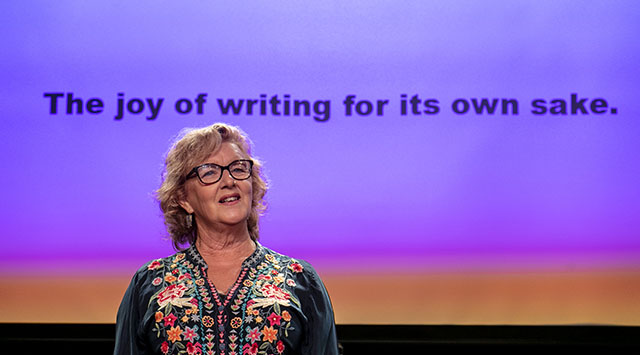
Oswald is unstoppable. She keeps churning out books, plays and teleplays, like her life depends on them, or more to the point, like she has something to say. In her 80-minute solo effort, Oswald is charming, brimming with humour, always affable and delightful. A true blue Australian, she never takes herself too seriously, but it becomes clear that what she stands for, is something worth fighting for. Embracing creatives like Oswald, is crucial in dismantling the old boys club that runs so much of this country. Elevating women of a certain age, will redefine the values we hold as a nation. At the very least, as exemplified by Oswald’s play, we will learn that a person’s worth is not to be measured only by money, but by their imagination, their resilience, and most of all, their capacity to help communities connect.

Lee Lewis’ direction of the work is fairly minimal, demonstrating a sense of confidence that allows the staging to place emphasis completely on the physical presence of Oswald herself. There are minor enhancements in terms of music by Jessica Dunn and lights by Ben Brockman, but it is the inordinate clarity with which we receive the writer’s words that is the most enchanting. Although not the most natural of performers, Oswald is a vibrant personality who holds our attention effortlessly. Her piece may benefit from a slight edit, if only to accommodate our twenty-first century attention span.

Artists work to bring cohesion to society, whether intentional or not. Oswald is a storyteller of the purest kind. Her impulse is to share with the world, the characters and narratives that come through her, as though a sacred duty, so that we can be captivated as groups, to find consensus, instead of thinking incessantly about the divisions in-between. If we understand the importance of finding ways to conceive of the world beyond parameters of money and power, we will understand that those in public office and in private corporations, are not likely to be our answer. Art will set us free, terrifying as it may be.

www.griffintheatre.com.au

Review: Home, I’m Darling (Sydney Theatre Company)

Venue: Sydney Opera House (Sydney NSW), Apr 6 – May 15, 2021
Playwright: Laura Wade
Director: Jessica Arthur
Cast: Gareth Davies, Andrea Demetriades, Chantelle Jamieson, Tracy Mann, Kirsty Marillier, Anthony Taufa
Images by

Theatre review
Judy seems to live the most idyllic existence, having shaped her life after the prototypical 1950s British housewife. From her head to her shoes, from her kitchen to her bathroom, everything is authentic of the era. Even her meals are prepared with historical accuracy. Her husband Johnny the realtor, too is required to adhere to these rules, as he dresses in suspenders and a trilby hat, driving off to work in the right model of car, with a very vintage lunch box in tow.

Judy’s world is quite strange indeed, considering that the year in which we meet her, is actually 2018. In Laura Wade’s Home, I’m Darling, we see a woman desperately trying to find a sense of harmony, by retreating into a space where she feels control over, and where she has decided that moving back 60 years in time, is how she is going to manufacture order out of chaos. Inside her inner sanctum, Judy wears high heels, girdles and swing skirts. She cleans behind furniture, in addition to cooking and baking all day. It never quite occurs to her, that to attain the peace and freedom that have evaded her outside in the real world, she has paradoxically locked herself into a past that we know to be anything but emancipatory, for women especially.

Home, I’m Darling is an intriguing work. Wade’s writing inspires curiosity from the very beginning, with Judy’s strange choices provoking us to ponder on the conditions outside of her house, ergo our collective realities, that have driven a woman to seek refuge in such an extreme manner. We come up with some very big questions, that the play may not necessarily be equipped to answer. It relies on our imaginations, and that intellectual process is certainly enjoyable, but a certain coyness in Wade’s style, seems to prevent Judy’s story from being as deeply affecting as it should.

With a set and costumes by Genevieve Blanchett, the production looks a candy coloured concoction of cartoonish artifice, at once pleasurable and alarming. Together with Verity Hampson’s lighting design, the imagery presented is exaggeratedly twee, a commentary perhaps on the conflicting ways one may feel about the very concepts of femininity and prettiness.

Home, I’m Darling is clearly about gender politics, but Director Jessica Arthur takes care to prevent the show from being reduced to only that one thing. Judy is allowed to be complicated, an inconvenient protagonist, neither a feminist champion nor a victim of misogyny. Even though we might crave easy and passionate theatrical proclamations in a more militant style, we are asked to see Judy the way she sees herself, which must be the best way to honour a central character, from a feminist perspective. Even though Arthur says all the right things with the show, there is a tendency to be overly cautious in approach, that can cause the staging to feel somewhat restrained. Judy is really quite mad, but the comedy never gets very wild.

Actor Andrea Demetriades is glorious as Judy. In a triumphant performance, Demetriades conveys all the difficult layers of the lead character, able to accommodate our conflicting feelings about a woman and her dubious choices, keeping us simultaneously challenged, enthralled and entertained.

Husband Johnny is appropriately rendered with a sheen of Disneyesque innocence, by an eminently likeable Anthony Taufa. His boss Alex is given a refreshing effervescence by an engaging Kirsty Marillier. Judy’s best friend, Fran proves a welcome respite with every one of Chantelle Jamieson’s humorous and energetic appearances. Fran’s husband Marcus is played by Gareth Davies, irrepressible and genuinely hilarious, although less effective when the tone turns sombre. Tracy Mann is marvellous as Sylvia, old school feminist and Judy’s mother, particularly endearing when called on to deliver a pivotal and rousing speech, that helps us place the story in proper perspective.

One of the strategies of dealing with social and economic systems that are unsatisfactory or indeed unjust, is to attempt to withdraw from participation. It is of course arguable if it is ever possible to entirely extricate oneself from these pervasive systems, as evidenced in Home, I’m Darling. Much as Judy tries to live by her own rules and stays firmly inside her own home, seepages will come through, to disrupt every best laid plan.

It is easy to be derisive of Judy’s 50s fantasy, but ways to attempt deviation from the hegemony, are extremely limited. The real world is unsuitable for many, not just Judy, and those of us who find ourselves disadvantaged, have to find ways to make do. Compromises are a constant, as are disappointments. When one comes to a realisation that the investment of time and energy, does not bear fruit as promised, it is understandable that one would retreat, and look for alternate courses. In breaking the mould, one can only look an oddball. For some, this is more tolerable than an enduring commitment to blind conformity.

www.sydneytheatre.com.au