Review: Rogues Double Bill (Fringe HQ)


Venue: Fringe HQ (Potts Point NSW), Oct 9 – 19, 2019

Gravity Guts
Playwright: Sophia Simmons
Director: Erica Lovell
Cast: Naomi Belet, Angie Brooke, Kathryn Edmonds, Jessica Loeb, Emily McKnight, Monika Pierprzyk, Monica Sayers

Ginger.Black.Brunette.Blonde.
Playwright: Peter Maple
Director: Simon Thomson
Cast: Jessie Lancaster, Emily McKnight, Nell Nakkan

Images by Robbi James, Christopher Starnawski

Theatre review
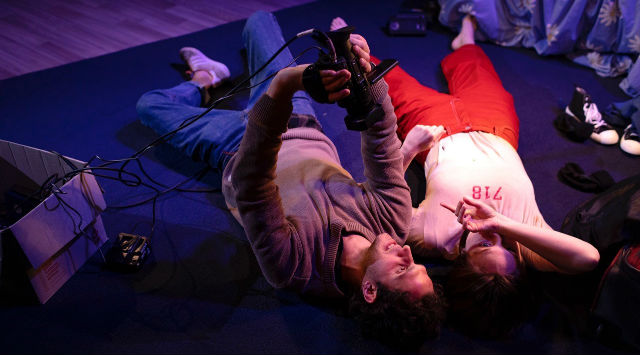
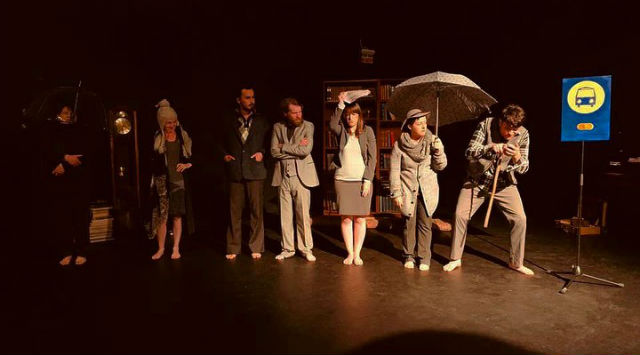
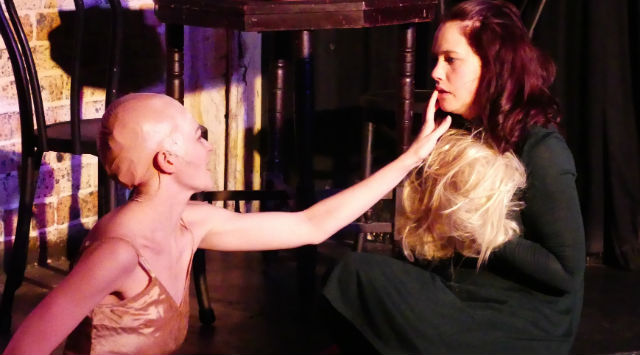
In two separate plays, actor Emily McKnight plays two young women, both trying to grow out of their parents’ shadows. In Sophia Simmons’ Gravity Guts, a young Sophia wishes to become an astronaut, because her intelligence refuses to be contained by the planet, and also because she needs to flee as far away as possible, from an angry alcoholic father. Peter Maple’s Ginger.Black.Brunette.Blonde. features Sarah, traumatised by her mother’s death, and unable to establish a selfhood independent of painful, cancerous memories. Both plays are spirited and imaginative, with Simmons’ work memorable for its thoroughly realistic depiction of a triumphant character, while Maple’s writing goes very melodramatic and abstract, perhaps too pretentious for meaningful resonance.

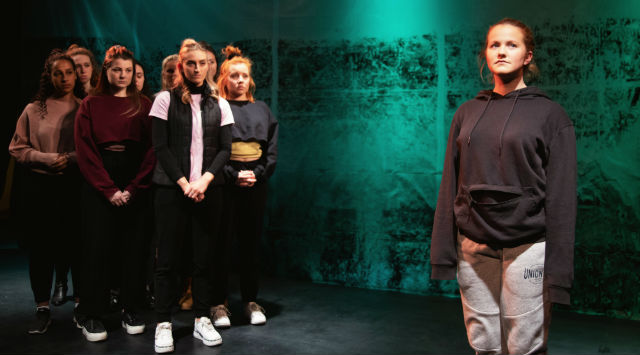
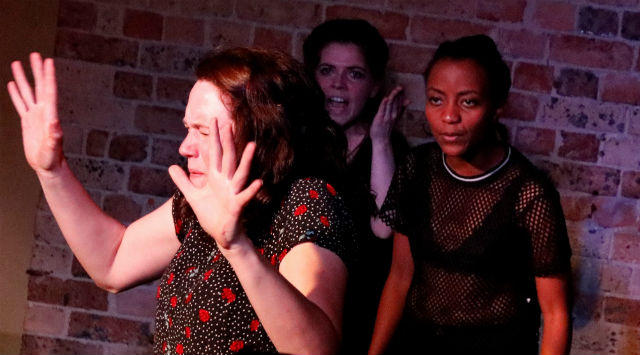
Directed by Erica Lovell, Gravity Guts boasts excellent use of a chorus, comprised of six energetic women, perfectly choreographed to enhance its protagonist’s story of defiant resilience. McKnight is convincing as Sophia, very passionate with the way she presents the role’s irrepressible ambitions. As Sarah however, her emotions are similarly intense but rarely authentic. Directed by Simon Thomson, Ginger.Black.Brunette.Blonde. is appropriately heightened in style, although sound and lighting requires greater finessing. Jessie Lancaster and Nell Nakkan make the most of this opportunity of an unusually flamboyant piece, both performers leaving good impressions with their interpretations of powerful personalities.

It is likely that there is no surer way for a person to mature, than when they come to accept their parents’ flaws. When one is able to completely recognise their parents to be unremarkable humans, capable of the worst behaviour, one can begin to develop a true adulthood. Some believe that we are all damaged, no matter how well-intentioned the ones who bring us up, but we must believe that old wounds can heal. Whether permanent or not, the problems we inherit, must be thought of as amendable, even if they require a lifetime’s attention.

www.companyrogues.com

Review: Homesick (The Old 505 Theatre)

Venue: The Old 505 Theatre (Newtown NSW), Oct 8 – 12, 2019
Playwright: Sally Alrich-Smythe
Director: Claudia Osborne
Cast: Annie Byron, Deborah Galanos, Eliza Scott, Alex Stylianou
Images by Phil Erbacher

Theatre review
Samantha has suddenly come home to Wallerawang, from New York where she is yet to complete her higher education in music. Things are not well but she is unable to articulate them. In Homesick by Sally Alrich-Smythe, we observe the environment in which the young woman has grown up, that may have contributed to her emotional troubles, although we remain uncertain if those are entirely to blame for her illness. She seems to have identified her mother’s displaced ambition as a cause, but Samantha’s inability to bring adequate expression to her emotions, forms the central mystery on which the narrative of Homesick is built.

Its dark themes notwithstanding, Alrich-Smythe’s play features charming personalities and sparkling dialogue that keep us engaged. A generous measure of video projections (by Lucca Barone-Peters and Suzie Henderson) is used to help tell the story, integrated with a sensitive elegance by director Claudia Osborne, whose minimalist approach proves effective in this investigation into small town Australia.

Actor Eliza Scott offers an understated but compelling naturalism that makes believable, all of Samantha’s hidden struggles. Her mother Rachel is played by Deborah Galanos, whose effortless warmth assures us that the home in question, is loving and not overbearing. Annie Byron is quirky as the inconvenient grandmother Eadie, effective at introducing exuberance to the staging, and Alex Stylianou is memorable as Samantha’s ex-boyfriend Jess, confident with the instinctual comedy he brings to the very relaxed personality.

There are no doctors in Samantha’s story to tell us where her problems are coming from, so we try, as lay people, to arrive at our own diagnosis, which is neither reliable nor satisfactory. Mental health is complex. We may be able to detect feelings, but chemistry is best left to professionals. Samantha keeps her illness hidden, and we see her attempting to get out of the woods on her own, to no avail. It might be wishful thinking that the medical system represents a quick fix, but it bears reminding that help is always available, and even if the healing process turns out to be arduous, it is unequivocal that there is light at the end of the tunnel.

Mental Health Line 1800 011 511

www.bontom.com.au

Review: The Angry Brigade (New Theatre)

Venue: New Theatre (Newtown NSW), Oct 1 – Nov 2, 2019
Playwright: James Graham
Director: Alex Bryant-Smith
Cast: Benjamin Balte, Will Bartolo, Sonya Kerr, Nicholas Papademetriou, Kelly Robinson, Davey Seagle, Madeleine Withington
Images by Bob Seary

Theatre review
John Barker, Hilary Creek, Jim Greenfield and Anna Mendelssohn were sentenced to ten years’ jail for carrying out a series of bombings in London, in the early 70’s. They were home-grown terrorists, university degree holders with a self-righteous streak that had clearly gone out of control. Playwright James Graham completed The Angry Brigade in 2014, at a time when terrorism is routinely presented as a phenomenon akin to foreign invasion, used by politicians and the media to capitalise on our penchant for racial prejudice.

The play demonstrates that it is far more likely to be the disenfranchised within our communities who are drawn to such extremities, that the root of these problems are well within our own purview, and much less likely to emanate from an outside enemy that can only be controlled with further violence. The way our patriarchal capitalistic societies are currently structured, necessitates that a portion of us must face disadvantage, in order that all our hierarchical systems can function. We observe the anarchic activity of The Angry Brigade with a degree of empathy, and although unlikely to agree with their radical methods, their grievances about the Western world, so wonderfully articulated by Graham, are certainly persuasive.

A wonderful passion is introduced by director Alex Bryant-Smith, who assembles a production replete with humour as well as a sense of political urgency. Set design by Sallyanne Facer manufactures distinct spaces for the two acts, each of them evocative and efficient. Lights by Michael Schell add dramatic flourish to the staging, and Glenn Braithwaithe’s work on sound ensures tension is appropriately calibrated from one scene to another.

Strong performances by a well rehearsed team keep us fascinated and invested in this true crime story, where meaningful breaking of rules lead to indefensible ethical violations. Davey Seagle leaves a remarkable impression with his actorly intensity for the dual roles of Smith and John, brought to life with wit and vigour. Madeleine Withington brings emotional authenticity to the pivotal part of Anna, deftly delivering a narrative climax that packs a punch. Benjamin Balte and Sonya Kerr play the remaining transgressors, both able to generate moments of brilliance that have us captivated. A range of smaller roles are shared by Will Bartolo, Nicholas Papademetriou and Kelly Robinson, all accomplished with admirable style and imagination.

Like many things that are dangerous, anarchy can be useful in small doses. It is undeniable that some of what has been institutionalised, would be better off demolished, and in these instances, a hint of nihilistic chaos could help instigate change. Revolutions occur because they are necessary but it is unimaginable that shifts in power can ever happen without conflict and disorder, although violence should always be regarded as preventable. Anarchy can be looked upon as a transitory concept, a methodology for those who have nothing to lose, to rise up and demand for improved conditions, even when they do not have all the answers close at hand.

www.newtheatre.org.au

Review: Hair (Sydney Opera House)

Venue: Sydney Opera House (Sydney NSW), Oct 3 – 6, 2019
Book & Lyrics: James Rado, Gerome Ragni
Music: Galt MacDermot
Director: Cameron Menzies
Cast: Stefanie Caccamo, Angelique Cassimatis, Emma Hawthorne, Luke Jarvis, Joe Kalou, Julian Kuo, Louis Lucente, Matthew Manahan, Sun Park, Paulini, Keshia Paulse, Callan Purcell, Monique Salle, Hugh Sheridan, Prinnie Stevens, Harris M. Turner,
Images by Daniel Boud

Theatre review
Hair debuted 1967, in the middle of the anti-Vietnam war movement. An icon of the peace-loving hippie counterculture era, the musical contains many anti-establishment elements that remain its defining feature, including the incorporation of profanity, illicit drugs, and nudity. It is the story of a New York City bohemian tribe, culminating in tensions that bring strain to the group when it is discovered that a member, Claude is being conscripted.

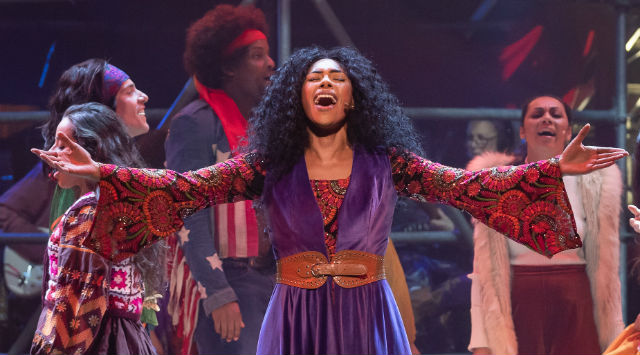
Act One is an exuberant cornucopia, of mischievously colourful expressions pertaining to ideals and identities of the flower power generation. Director Cameron Menzies and choreographer Amy Campbell manufacture a joyful visit to an optimistic past, enjoyable not only for its nostalgic value but also for an innocence, that proves so moving in the current bitter climate. Act Two turns serious, with the narrative shifting more firmly onto the Vietnam war, but sound engineering, although beautifully optimised for the cast’s vocalisations, does little to enhance diction in the reverb of the auditorium. Without clear enough access to dialogue and lyrics, the drama is unable to resonate. Lighting by Paul Lim on the other hand, is innovative and exciting, and together with James Browne’s spirited work on costumes, the production is a delight for the eyes.

A marvellous ensemble, full of conviction and vigour, gives us a cohesive gang of personalities, remarkably convincing in their depiction of an adopted family affair, powerful with the warmth they emanate. Matthew Manahan is a charming presence as Claude, commendable for the complexity he brings to the role. An imposing Harris M. Turner is the show’s unequivocal scene-stealer, equally impressive whether singing or dancing as Hud, the militant black rights activist. The astonishing Paulini sings some very big notes, reliably bringing the house down at each appearance. The group’s alpha male Berger is played by a tremendously likeable Hugh Sheridan, whose vivacity knows no bounds, even if completely unbelievable as a high school student.

When psychologist and LSD advocate Timothy Leary said half a century ago, to “turn on, tune in, drop out”, many were persuaded by his statement of subversion, and sought an alternative to socioeconomic and political systems that had revealed themselves to be oppressive and unjust. It seems all these years later, we are once again at a breaking point. A new generation, fuelled by the same disillusionment, is now trying to find new answers to old questions. Bell bottoms and patchouli may no longer be en vogue, but we still want peace, equity and a restorative love for mother earth, and with any luck, our efforts will have a permanent impact this time round.

www.sydneyoperahouse.com

Review: The Great Divorce (Flight Path Theatre)

Venue: Flight Path Theatre (Marrickville NSW), Sep 25 – Oct 5, 2019
Playwright: Roslyn Hicks (based on the novel by C. S. Lewis)
Director: Richard Woodhouse
Cast: Peter David Allison, Hannah Forsyth, Jamey Foxton, Roslyn Hicks, Jessica Kelly, Emily Pollard, Isaac Reefman, Richard Woodhouse

Theatre review
Lewis finds himself in hell, but not permanently it seems, as the gates to heaven remain open, to the possibility of repentance. He witnesses a series of debates, between the ghosts of hell and spirits of heaven, about where one would choose to reside. C. S. Lewis’ The Great Divorce, adapted for the stage by Roslyn Hicks, is a work of the Christian tradition, fundamentally reliant on binary concepts, but is nonetheless valuable with the many philosophical ideas it raises. At its best, the writing is transcendental and inspiring, but it can also bear a sanctimonious attitude to its representations that, predictably perhaps, proves grating.

Directed by Richard Woodhouse, the split between heaven and hell, is dramatically amplified. There is certainly no ambiguity permitted in the staging, and we always know who the us and them are, in The Great Divorce. Provocative discussions are depicted in a slightly too obvious manner, as if fearful that its essential beliefs could ever be misconstrued. Eight actors ranging from bombastic to the excessively dry, present a big roster of characters, with lead performer Isaac Reefman’s unassuming approach as Lewis, often seeming deficient in confidence. There is however, a quality of sincerity in all of the cast, that helps to sustain our attention.

The title of the piece reveals heaven and hell as human constructs, and the need some may have, not only for clear distinctions about the nature of the afterlife, but also for guiding doctrines that pertain to the here and now. C. S. Lewis presents his arguments in convenient dichotomies, although it is clear that these supposedly opposing thoughts exist in a singular mind. We observe the struggles in The Great Divorce, understanding that things are presented in the form of good and bad, but there is no denying our ability to easily identify with both sides. Faith is necessary because doubt is interminable, just as heaven cannot exist without hell.

www.flightpaththeatre.org

Review: Hairworm (The Old 505 Theatre)

Venue: The Old 505 Theatre (Newtown NSW), Oct 1 – 5, 2019
Playwright: Emma Wright
Director: Jess Davis
Cast: Phoebe Atkinson, Bernadette Fam, Jennifer Hart, Alex King, Rebekah Parsons, Amelia Robertson-Cuninghame, Grace Stamnas, Sophie Strykowski, Laura Wilson
Images by Becky Matthews

Theatre review
Emma Wright’s first play Hairworm is about anorexia. It details the experience of an unnamed protagonist, as she suffers that very severe form of mental illness. We watch her go through tremendous anguish, in a writing style that is often clinical, able only to have us regard the condition from an intellectual distance, without having to invest heavily in emotional dimensions of the subject. As a theatrical work, Hairworm does not connect with immediacy, but is valuable in terms of the insight it no doubt provides, into something real and troubling.

Directed by Jess Davis, the production is dynamic and exacting, with Priyanka Martin’s lights and Cecelia Strachan’s sound, conspiring to carefully render a sense of texture for each of its scenes. A disciplined cast brings further polish to the staging, with Rebekah Parsons’ conviction as the afflicted lead character, giving urgency to the show’s pace and rhythm. Alex King plays the sister, memorable for introducing a moment of genuine sentimentality to proceedings.

Theatre does not always have to engage our emotions, but it should find ways to make us care. Conventional narrative structures can seem banal when we have them deciphered and deconstructed, but the way we choose to tell stories, are in direct relation with our very nature, and it seems humans are mostly predictable beings. We see the suffering in Hairworm, just as we see all the suffering in real life, and as is commonplace, our instinct is to respond with an insulating nonchalance that is perhaps inevitable. Art can pierce through that veil of apathy, to get to what one would hope is an essential compassion that unites us. Without art and compassion, hope becomes unimaginable.

www.facebook.com/eyecontacttheatreco | www.facebook.com/fixedfootproductions

Review: None So Blind (The Sydney Fringe)

Venue: Erskineville Town Hall(Erskineville NSW), Sep 24 – 28, 2019
Playwright: Garreth Cruickshank
Director: Susan Jordan
Cast: Thomas Burt, Russel Cronin, Dale Weseley Johnson-Green, Martin Portus

Theatre review
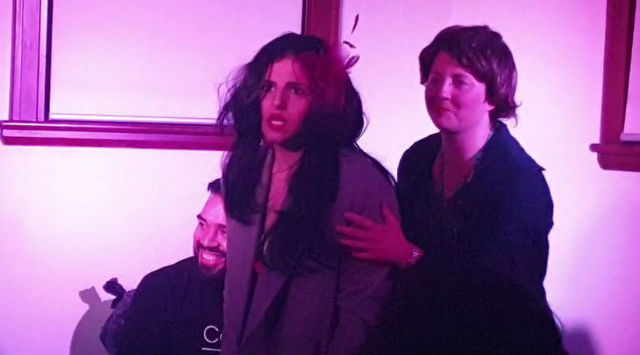
Shepherd is outside his house seeking help. He is blind and has lost his can opener, unable to prepare soup for dinner. Kind passerby Jude is lured in, but their newfound friendship turns sour in an instant, when it is revealed that Shepherd is a paedophile. Garreth Cruickshank’s None So Blind examines the evil lurking in our communities, placing a well-known archetype at the centre of its narrative to help us make sense of bad neighbours, who must somehow co-exist with the general population.

Cruickshank’s work contains strong ideas that will instigate valuable discussions. The Shepherd character is sufficiently complex to prevent us from dismissing him too easily, although audiences can rest assured that there is no sympathy for the devil here. Directed by Susan Jordan, the hour long play begins with an engaging nuance, but becomes too obvious as we approach its conclusion, with dialogue turning overly expository as tensions escalate. Actor Martin Portus depicts the monster as both grotesque and delicate, able to convey human qualities that are as awful as they are real. Jude is played by Russel Cronin, whose performance of compassion does not quite match the effectiveness with which he is able to articulate scornful disdain for the despicable villain of the piece.

We know so little of the subject, because the mere thought of it is so repulsive, we can hardly spare more than a moment’s deliberation. None So Blind challenges us to consider deeper, a truth that we have to live with, about people who will cause harm, whether we are vigilant or complacent. We often deal with dangers, by pretending that they do not exist. It is true that being paralysed with fear is no way to have a good life, but reminders are necessary, especially when we let our guard down too much.

www.sydneyfringe.com

Review: Shaz And Tina: Waiting For Uber (The Sydney Fringe)

Venue: Erskineville Town Hall(Erskineville NSW), Sep 24 – 28, 2019
Devisors & Cast: Nisrine Amine, Lisa Robinson

Theatre review
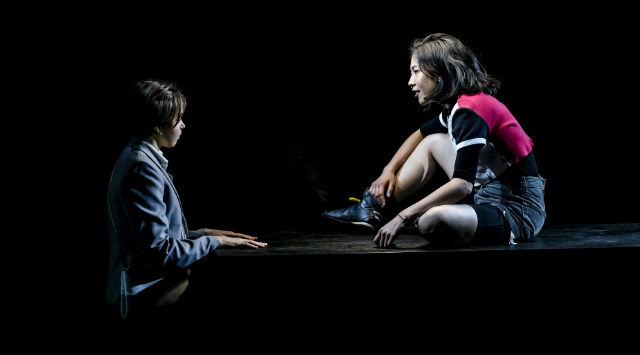
Shaz and Tina have stumbled out from the races, and are in an alleyway waiting for their ride to arrive. It is unclear if their hyperactive behaviour is due to an overindulgence of alcohol, but in their show Shaz And Tina: Waiting For Uber, the two young women spend fifty minutes being restless and incoherent, as though in a Samuel Beckett play that goes nowhere. In this case however, our storytellers are less in an existential crisis, than they are trying to entertain by creating mayhem. There is a lot of audience participation.

Shaz in particular is keen to engage the strangers around her, especially if they are of the tall, dark and handsome variety. It is the races after all, and her harmless flirting certainly befits the spirit of things. In fact, a substantial portion of the show involves a dating game, like those seen on television, with Tina trying to find Shaz a match from three volunteers. The production is humorous, although it must be said, in an awkward way, just as the two personalities we encounter are themselves extremely awkward specimens of the suburban kind.

The presentation feels improvised, loosely structured, but very live. Although the laughs delivered are not always as big as one would hope, they are both consistently amusing, able to fill the time with with quirky inventions and a frenzied energy. As Tina, Nisrine Amine is intense and snarky, and as Shaz, Lisa Robinson is gawky and mischievous. The pair’s easy chemistry provides a solid foundation for the work, allowing us to trust that no matter how long the Uber is going to take, the women are determined to keep us occupied.

www.facebook.com/shazandtina

Review: A Girl In School Uniform (Walks Into A Bar) (Futura Productions)

Venue: Kings Cross Theatre (Kings Cross NSW), Sep 20 – Oct 5, 2019
Playwright: Lulu Raczka
Director: Hannah Goodwin
Cast: Michelle Ny, Caitlin Burley
Images by Jarryd Dobson, Indiana Kwong

Theatre review
The city has been experiencing frequent blackouts, during which women and girls would disappear, many of whom would be subsequently found murdered. 16-year-old Steph is out looking for her best friend who has gone missing. She is certain that Bell, a young woman working in a bar, is withholding valuable information. Lulu Raczka’s A Girl In School Uniform (Walks Into A Bar) sees those two characters imagining the fate of a vanished girl. They play out scenarios by pretending to be male perpetrators of violence, thereby revealing the dangers that women know themselves to be subject to.

In the many blackouts that occur during the course of the production, the audience is repeatedly thrust into a state of anxiety, made even more unnerving by Hannah Goodwin’s very taut direction. Fear is always in the air, with the audience positioned to confront the constant threat that defines daily reality for most women. It is that sensation of when we walk into a bar, and our awareness of being looked upon as a piece of meat, is instantly heightened. The show is incredibly well designed, with Sophie Pilcher’s lights and Jessica Dunn’s sound wonderfully precise in manipulating our visceral responses for this gritty journey. Ella Butler’s work on set and costumes too, is highly accomplished. There is a sharpness to the aesthetic of A Girl In School Uniform that translates as a certain brutal coldness in how the world can be, even for young girls.

Actor Michelle Ny brings sass as well as dramatic intensity to the part of Bell, demonstrating impressive versatility in a role that requires of its performer, a wide range of attitudes and emotions. Steph is brought to life by the strong stage presence of Caitlin Burley, marvellous in conveying both innocence and fortitude for the role. The pair is exceptionally well rehearsed. Their chemistry and timing for this extremely technical two-hander has us agape in amazement, leaving us firmly persuaded by all that they present.

In the play we observe the dark to be infinitely more harrowing for women, but the incessant power failure is allowed to become a new status quo, exposing the ease with which society disregards our safety. We are comfortable with the idea that there is a weaker sex, and continue to foster behaviour and beliefs to reinforce that repugnant imbalance. We make things harder for women, often through the disinformation that women are naturally more challenged, usually due to bogus notions of biology or religion. The system will insist that we accept our fate, that we must respond to blatant injustice with resignation. Realising that acquiescence is almost always a choice, is how we can begin to address these issues of gender.

www.futurafilms.co

Review: The Weir (The Vanguard)

Venue: The Vanguard (Newtown NSW), Sep 24 – 29, 2019
Playwright: Conor McPherson
Director: Vanessa Papastavros
Cast: Nick Barker-Pendree, Damien Carr, Martin Estridge, Daniela Haddad, Alex Neal
Images by Natalie Cartney

Theatre review
Valerie is moving from Dublin to the northwest of Ireland, and in between looking at properties, parks herself at a small rural pub where she is acquainted with several locals. In Conor McPherson’s The Weir, a sleepy town provides the perfect setting for the time-honoured tradition of telling ghost stories. Residents have little to distract themselves but each other, and a landscape that bears histories most fondly remembered through word of mouth, morphing and fantastical. While various supernatural tales form the entertaining crux of The Weir, they are surpassed by a nostalgic depiction of community, one that leaves a strong and perhaps surprising impression.

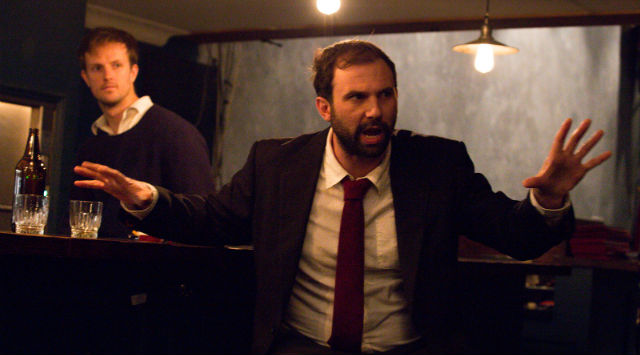
With the theatrical action set in a real bar, we are immediately engaged through the unmissable familiarity and intimacy of the physical context. Directed by Vanessa Papastavros, the production is pared down but effective. Dynamics between characters are rendered with a remarkable authenticity, with a cast of five that is endearing and compelling, manufacturing an easy chemistry that provides foundation for their performance, able to transport us effortlessly through time and space.

Actor Damien Carr brings a richness to the role of Jack, animated but also considered, adept at communicating a sense of depth that gives the show its gravity. Realtor Finbar is played by Nick Barker-Pendree, memorable for the confident zeal he introduces to proceedings. Valerie, the blow-in, is portrayed by Daniela Haddad with an understated and elegant naturalism, appropriate for these tight confines. Martin Estridge and Alex Neal are charming and very believable pub dwellers, both offering valuable colour to this memorable representation of small-town life.

No matter how outlandish our stories, for as long as they resonate, we can be sure that truth can be located therein. If ghosts are real, it is only because we believe in a certain essence of life, that exists beyond the flimsy nature of matter. It reflects an understanding of the eternal, that in one form or another, each entity leaves behind an imprint, whether significant or minuscule, and that our actions when alive must have an impact. This could be construed as wishful thinking or indeed, delusions of grandeur, but the fact remains that ghosts have always been, and we have always known ourselves to be consequential.

www.thevanguard.com.au