Review: Lip Service (Ensemble Theatre)

Venue: Ensemble Theatre (Kirribilli NSW), Aug 17 – Sep 30, 2017
Playwright: John Misto
Director: Nicole Buffoni
Cast: Tim Draxl, Amanda Muggleton, Linden Wilkinson
Images by Prudence Upton

Theatre review
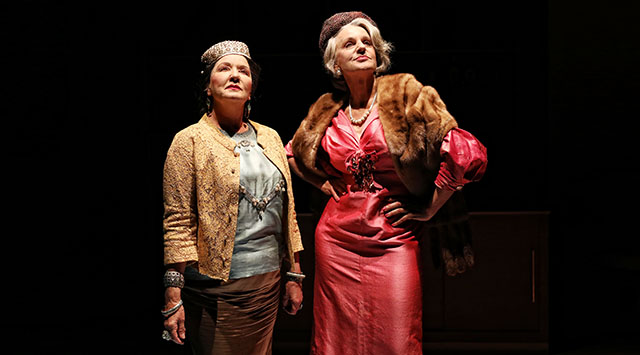
Helena Rubinstein founded one of the world’s first cosmetics companies, whilst living in Australia early last century. Subsequently establishing herself as a businesswoman of international fame and fortune, we meet her later in life, in John Misto’s Lip Service, picking up from when she meets Patrick O’Higgins, who becomes her personal assistant, friend and surrogate son. Rubinstein’s extraordinarily flamboyant personality and a concomitant acerbity is the centrepiece of the play. Misto appropriately eschews sentimentality in this biography of a very hard woman, crafting instead lines of dialogue that are relentless, and exquisite, in their bitchiness, for a show that proves itself tremendously funny by any standard.

It is a story of unbridled ambition and searing ruthlessness. Misto uses Rubinstein’s rivalries with Elizabeth Arden and Charles Revson (of Revlon fame) to reveal a woman of remarkable intelligence and fortitude, along with unmistakable flaws, creating for our heroine, a magnificent aura of mythical proportions. It is possible that direction and design elements of the production could deliver something more elaborate, but Misto’s script is strong enough to hold its own, especially with a leading lady of dazzling charm at its helm.

Amanda Muggleton plays Rubinstein with a great deal of diligence. Her approach is considered and precise, so that every hilarious quip hits its mark, but there is also a definite soulfulness in her portrayal that has us endeared throughout. Opening night is not quite flawlessly polished, but we go away impressed by both Muggleton and Rubinstein, wishing to be entertained further, even after 2-and-a-half hours of incessant laughter. Also memorable are supporting actors, Tim Draxl as O’Higgins and Linden Wilkinson as Arden, both with comic ability and remarkable presences that ensure our satisfaction.

To reach such heights of commercial success, sacrifices must be made. Some might say that Helena Rubinstein goes to her grave not knowing true happiness, but it is undeniable that her accomplishments are greater than most could even imagine. In Lip Service, we watch her give a poorly received speech at a college, about work being the only real salvation. Mere mortals might be able to experience love and other simple joys, and it is regrettable that those pleasures had eluded Rubinstein, but what she was able to achieve as a Jewish woman in the twentieth century was exceptional, and the enduring legacy she leaves behind is a phenomenon that far exceeds any reasonable criterion. Few would dare follow her path, but the inspiration one can draw from it, is inexhaustible and divine.

www.ensemble.com.au

Review: I’d Rather Goya Robbed Me Of My Sleep Than Some Other Son Of A Bitch (Théâtre Excentrique)

Venue: Old 505 Theatre (Newtown NSW), Aug 22 – Sep 2 2017
Playwright: Rodrigo Garcia (translated by William Gregory)
Director: Anna Jahjah
Cast: Gerry Sont, Sister Ursuline
Image by Emma Lois

Theatre review
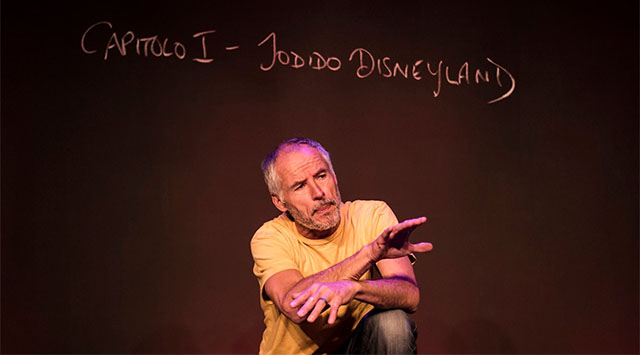
It is unlikely that one should lose sleep to something sacred. We worry about money, work, and all other things that feed the ego, but art and philosophy tend not to keep us awake at night. In fact, they can be relied on to offer the comfort that lulls us into slumber. Rodrigo Garcia’s 50-minute monologue I’d Rather Goya Robbed Me Of My Sleep Than Some Other Son Of A Bitch, is about a middle-aged man resisting the profanities of daily life that can so easily overwhelm our existence.

His two young sons, dreaming about visiting Disneyland, are the inspiration for his attempts at shifting focus onto a higher plane of consciousness. The importance of art and philosophy is all he wants to impart, and he stakes his entire life’s savings of 5,000 Euro on the exercise. Indeed, to be able to gift the best to your dearest, is worth every penny, even if all one gets in return is intangible.

The work is hugely passionate, almost hysterical in its desire to expound its anti-capitalistic ideals. Rarely overtly political, it talks little about what it rejects, choosing instead to delve fervently into its earnest and fantastical explorations, involving in part, the Prado Museum and a long cab ride. Director Anna Jahjah creates a sense of urgency appropriate to the writing, along with a whimsical optimism that helps open us up to the play’s intellectual provocations. Gerry Sont is effervescent as actor of the piece, a warm, likeable presence although not quite humorous enough for what is required. Live music by Sister Ursuline (cello and vocals) provides a romantic dimension, to the discussion of sacred versus banal, art against commerce.

The staging encompasses both the earthy and the ethereal. In being human, we are of the mundane, but also inseparable from the many greater realms that our minds allow. Social forces will insist on our compliance with regards all things pragmatic. Rules, regulations and bills will attempt to shape our lives in a certain way, but our spirit cannot be contained. As long as we understand that the capacity for imagination is real, then what we become, is beyond repression.

www.theatrexcentrique.com

Review: 4:48 Psychosis (Workhorse Theatre Company)

Venue: Old Fitzroy Theatre (Woolloomooloo NSW), Aug 16 – Sep 9, 2017
Playwright: Sarah Kane
Director: Anthony Skuse
Cast: Ella Prince, Lucy Heffernan, Zoe Trilsbach
Image by Andre Vasquez

Theatre review
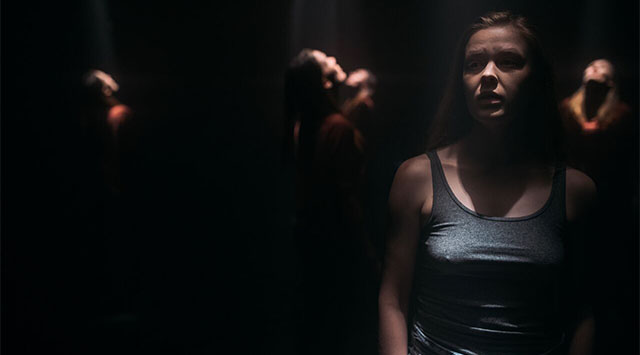
A large mirror forms the backdrop, and for much of the show, we watch the actors through their reflections. It is a peculiar sensation, to look into the mirror over a prolonged period and not be familiar with the person therein. In Sarah Kane’s world of mental illness, 4:48 Psychosis is often incoherent, but undeniably truthful. The characters speak, not always for the purpose of communication with an external presence, but to achieve a kind of sentience, or to find a way for things to make subjective sense.

Charged with emotion and an abundance of hopeless desperation, it is the rock-bottom of a dark existence that we encounter, a place where we are able to think of death as salvation. The work is difficult because of the deeply fragile omnipresence of a person’s impending suicide. Director Anthony Skuse is right to steer the show away from any sense of sensationalism or pleasure, so that we remain in the regretful bleakness of a fellow human being’s agony.

There is little that should be enjoyable of the work, but we discover that annihilation is seductive, and that poetry is beautiful, even (or especially) when tortured. It is a polished production, sensual and intense, with memorable design work by an excellent team of creatives. Benjamin Freeman’s music is heard for the entire duration, striking in its exacting sensitivity.

A cast of three women present an extraordinary study of a diseased mind. Thoroughly complex and remarkably focused, what they bring to the stage is replete with authenticity, but also unabashedly dramatic. The extremely well-rehearsed group, Ella Prince, Lucy Heffernan and Zoe Trilsbach are individually captivating, whilst maintaining an impressive cohesiveness that secures our attention, come hell or high water. We may not understand much of what they have to go through, but they are nonetheless demanding, of our concentration, our validation, our empathy.

Public discourse requires that we talk of suicide as fundamentally unacceptable. Forbidden by law and religion, the thing that is most unequivocally owned by the self, is one’s life, yet the decision to end it, is thought of as repugnant. In our refusal to condone suicide, we declare human life to be sacred. It is a social contract, that all must be given care. As Sarah Kane asks repeatedly in the play, “what do you offer your friends to make them so supportive?” the question becomes increasingly irrelevant. For any person to be given support, a currency of exchange is not needed. By the same token however, one can think of being, as essentially personal, and no debt will be owed, when extinguished.

www.workhorsetheatreco.com

Review: Melba (Hayes Theatre)

Venue: Hayes Theatre Co (Potts Point NSW), Aug 11 – Sep 9, 2017
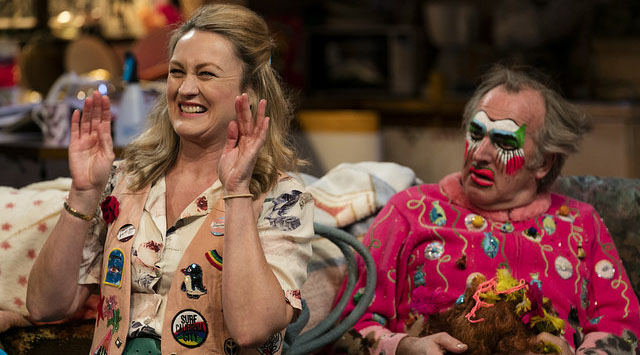
Book & Lyrics: Nicholas Christo
Music: Johannes Luebbers
Director: Wayne Harrison
Cast: Annie Aitken, Michael Beckley, Caitlin Berry, Andrew Cutcliffe, Blake Erickson, Genevieve Lemon, Emma Matthews, Adam Rennie, Samuel Skuthorp
Image by Clare Hawley

Theatre review
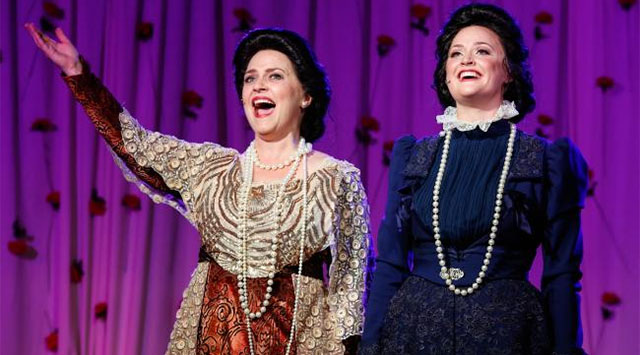
Nellie Melba was the first Australian musician to have achieved international stardom, a legendary figure whose story provides inspiration not only to artists who dream of making it big, but also for women everywhere who know how it is to be told to tame their ambitions. She became wife and mother early in life, as was de rigueur in late nineteenth century, and in the musical Melba, we see her struggle to acquire the independence necessary for professional success. A fabulous selection of classical arias are inserted into a new work of musical theatre, with book and lyrics by Nicholas Christo, and music by Johannes Luebbers.

The original material is delightful, with scandalous details in Melba’s story providing an unexpected sense of titillation to proceedings. Director Wayne Harrison keeps us invested in the show’s characters and narratives, for a production that captivates at every point. Design elements however, are generally underwhelming, with set and costumes requiring greater imagination and boldness, for a more accurate approximation of our fantasies, of the diva and her circles.

Performers Annie Aitken and Emma Matthews share the eponymous role, each bringing to the stage, their phenomenal talents and abilities. It is a strong concept, to have disparate disciplines, opera and musical theatre, represented in this quite unique format for Melba, but it is not always a seamless blend in its efforts to accommodate two physical manifestations of the same personality. Nonetheless, the magnificent quality of singing in the show is sufficient to remedy most of its shortcomings. Also noteworthy is Andrew Cutcliffe who successfully turns us against the forsaken husband Charlie. His creation of a persuasive villain for the piece, is efficacious, and impressive.

In its efforts to keep the memory of our heroine, dignified and noble, Melba can often feel compromising in how it portrays her humanity. The picture it delivers is unbelievably pristine, and the drama is subsequently more gently rendered than is perhaps desired. We need people to look up to, especially trailblazers who show us that the impossible can be done, but it is important that we understand that flaws and foibles are what we have in common, especially when the magic they possess can seem so unattainable to mere mortals.

www.hayestheatre.com.au

Review: Hir (Belvoir St Theatre)

Venue: Belvoir St Theatre (Surry Hills NSW), Aug 12 – Sep 10, 2017
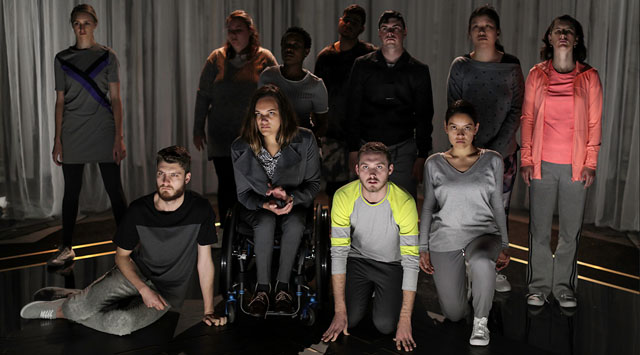
Playwright: Taylor Mac
Director: Anthea Williams
Cast: Kurt Pimblett, Greg Stone, Helen Thomson, Michael Whalley
Image by Brett Boardman

Theatre review
Paige is suddenly emancipated. By a stroke of luck, her abusive husband Arnold has turned invalid, revealing a fortuitous way out of misery. She revels in her new freedom with a maniacal glee, and together with her now transgender son Max, their household is transformed to radically embrace every concept of anti-patriarchy that they come across. Taylor Mac’s Hir is a revenge story, centring on a protagonist who tries to find independence and a better life by subverting prevailing notions of gender, the very thing she identifies to have been responsible for her adversities.

The play is uproarious, with Paige in various states of hysteria, desperately seeking redefinition for her existence. The action begins when her elder son Isaac, having been dishonourably discharged from war, returns to the deliberate chaos at home (set design by Michael Hankin is remarkably mirthful). Unable to come to terms with the shock of the new, Isaac attempts to restore the old order, and things quickly escalate. We watch Paige being confronted by her position as mother and wife, as she persists with the project of queering everything, and are enthralled by the brutal tenacity at which she sticks to her guns, in a face off with a past she is determined to be rid of. It is a wild premise that the playwright establishes, and the ride that we get taken on, is as emotionally powerful as it is entertaining, all the while maintaining a level of intellect that many will find irresistible.

It is a spectacular production, painstaking in the way its progressive, and sometimes obscure, ideas are interpreted with brilliant lucidity, to be presented alongside some thoroughly enjoyable comedy. Director Anthea Williams brings to the piece, a boldness of spirit, that allows its controversial qualities to speak poignantly and persuasively. Hir is political theatre, unapologetic in its desire to make an impact on the way we think.

Playing Paige is the absolutely scintillating Helen Thomson. The actor is gloriously funny, with perfect timing and faultless instincts that have us hopelessly captivated. A portrayal of a woman reclaiming space, strength and sovereignty, Thomson is commanding and, when required, vulnerable. She is called upon to make some very extreme statements about womanhood, and although not to everyone’s tastes, the way she delivers each audacious proclamation, is beyond gratifying.

If Paige finds the answers she wants, she will discover that it is not necessarily happiness, but a heavy burden that she will encounter, when living a life of integrity and enlightenment. When we reject conventions and systems that are unfairly stacked against us, we are guaranteed only honesty and liberation. To not expect hardship is foolish. In the struggle against deceit and inequity, fulfilment when derived, is often more painful than joyous. It is how the bastards keep us dishonest, by issuing modicums of petty bribery that offer an illusory sense of security and comfort, so that we maintain the eternally exploitative status quo. In cases when a straw does break the camel’s back however, a woman scorned will unleash a fury of mythical proportions, to seek redress and to aggravate for a revolution.

www.belvoir.com.au

Review: Dignity Of Risk (ATYP / Shopfront Arts)

Venue: ATYP (Walsh Bay NSW), Aug 9 – 26, 2017
Dramaturg: Jennifer Medway
Director: Natalie Rose
Cast: Mathew Coslovi, Holly Craig, Teneile English, Caspar Hardaker, Riana Shakirra Head-Toussaint, Steve Konstantopoulos, Wendi Lanham, Brianna Lowe, Sharleen Ndlovu, Jake Pafumi, Dinda Timperon
Image by Tracey Schramm

Theatre review
11 performers take to the stage, each with intimate revelations, for a discussion about the personal versus the social, from a perspective of individual lack and disadvantage. Not all of the cast is disabled, but Dignity Of Risk requires that human inadequacies are laid bare, for an examination of how each person navigates the world, with their own sets of imperfections. Through a display of weakness, it is the image of strength, previously imperceptible, that persists. The human spirit is everywhere, but it can only be brought to view by the expression of vulnerability.

The production takes a gentle tone, but it speaks with great power and a sublime beauty. The nonchalant delivery of lines, coupled with the unassailable authenticity the personalities invariably portray, initiates a slow burn that eventually, and surprisingly, overwhelms. Natalie Rose’s direction and Jennifer Medway’s dramaturgy, are consciously resistant of a sensationalist approach. They build poignancy through sensitivity and nuance, without a reliance on conventional narrative structures, and their trust in a universal benevolence pays off. A highlight is Holly Craig’s solo dance sequence, incredibly elegant and sensual, made even more moving later in the piece, when she explains the meanings that dancing holds for her, as a person with vision impairment.

In a show that talks a lot about our bodies, Margot Politis’ choreography plays a significant role, and what she does with movement, gesture and positioning, is nothing short of inspiring. Set to the wonderfully rousing electronic music of James Brown, the many non-verbal sequences of Dignity Of Risk are masterfully manufactured for our visceral response, involuntary yet hugely enjoyable. The production is visually sumptuous, with Melanie Liertz’s set and Fausto Brusamolino’s lights offering a range of ethereal dimensions that juxtapose delightfully against the very earthy, corporeal concerns of its players.

All of us have shortcomings but not everyone has the privilege of being able to hide them. For some, identity is intrinsically linked with their deficiencies, while others are allowed to be known only for their successes. No matter the faults we have, as defined by society or by the self, we all wish to be regarded with respect, and we all deserve to be seen for our capacity to contribute, as people who share in the earth.

www.atyp.com.au | www.shopfront.org.au

Review: After The Dance (New Theatre)

Venue: New Theatre (Newtown NSW), Aug 9 – Sep 9, 2017
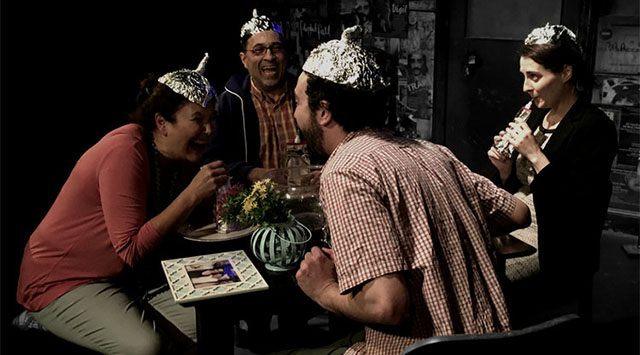
Playwright: Terence Rattigan
Director: Giles Gartrell-Mills
Cast: Tom Aldous, Callum Alexander, Lloyd Allison-Young, George Banders, John Michael Burdon, Sandra Campbell, Rowan Davie, Peter Flett, Matt Ford, Valentin Lang, Lauren Lloyd Williams, Amelia Robertson-Cuninghame, Alyssan Russell, Claudia Ware
Image © Bob Seary

Theatre review
It is England in the 1930s. David is fabulously wealthy, and dreadfully miserable, living a life with no aim and purpose. Terence Rattigan’s play is about a writer who has everything, including two women vying for his affections, but who remains obstinately unfulfilled. Time has not been kind to After The Dance, which feels sorely irrelevant, with its archaic, although honest, worldview. We no longer despise work, and we no longer tolerate the representation of women as accessories for the libido and vanity of men. We have thankfully moved beyond Rattigan’s depiction of a failed existence, as exemplified by his protagonist’s persistent disquiet.

Director Giles Gartrell-Mills shows us the emptiness of David’s days, through the inconsequential and foolish ways personalities in his household spend their time. There is a worthwhile discussion to be had about the overindulgence of alcohol that is perhaps the only thing in the show that retains some resonance, but we are never able to really empathise with those who appear onstage. When we see Helen and Joan fighting over David, we question his appeal, having seen only evidence of his shortcomings, and the narrative’s persuasiveness begins to suffer.

Actor George Banders faces the grim task of making David a likeable figure, and even though his attempts are doubtlessly confident, the battle seems to be ill-fated from the start. More impressive is Amelia Robertson-Cuninghame as Joan, the vivacious wife who, although rudimentarily written, is memorable for the performer’s conviction at delivering surprising complexity, and a refreshing sense of panache. Also noteworthy are Brodie Simpson’s costumes for the show’s female characters, each outfit beautifully fitted and thoughtfully assembled.

David connects with nothing, and finds himself in a painful abyss of solitude. Loneliness is universal, but as we discover in After The Dance, how we talk about it changes with time and space. We can invent endless concealments so that the plague of loneliness can be diminished, but finding true release from it, requires that the self must go through the most genuine of reflections, and the most brutal interrogation. David suffers from writer’s block, unable to find expression for what he knows to reside within, yet he looks only outward, hoping for respite to come from others. A large mirror sits in the drawing room where all the action takes place, but in spite of his vanity, David takes not one look into his own eyes.

www.newtheatre.org.au

Review: The Telescope (Old Fitz Theatre)

Venue: Old Fitzroy Theatre (Woolloomooloo NSW), Aug 4 – 12, 2017
Playwright: Brooke Robinson
Director: Carissa Licciardello
Cast: Tel Benjamin, Alison Chambers, Cecilia Morrow, Nicholas Papademetriou

Theatre review
Fighting technological progress is a futile exercise, but we can be certain that not all efforts at advancement are worthwhile. In this short play by Brooke Robinson, a family of four is being forced out of their home, because a giant telescope for the purposes of detecting alien life in space, is scheduled to be installed. Lenny has been fighting hard to prevent the loss of her home, but when the government’s generous compensation arrives, we discover that she is the only one who wishes to remain. Her parents and brother have decided to take the money and run, leaving Lenny to grapple with the fact that she has been abandoned, replaced by cold hard cash.

Replete with cynical wit, the humorous dialogue of The Telescope leads us into a delightful, and misanthropic, probe of the modern family. Kinship is no match for money and technology, but there is little melancholy in this staging, directed by Carissa Licciardello, who pushes her actors to extraordinary lengths of camp and slapstick. It is a marvellous cast, in a tightly rehearsed, exhilarating performance.

Alison Chambers and Nicholas Papademetriou are very charming as parents who cannot wait to fly the coop, both impressive with the accuracy at which their comic instincts are implemented, in this piece of absurdist theatre. There is a lot of exaggeration, but the points it makes ring true. Cecilia Morrow is the sentimental Lenny, and we recognise her helpless devotion to a hopeless cause. Her agoraphobic brother Daniel is portrayed with a goofy exuberance by Tel Benjamin, who brings to mind a generation unable to engage with life outside of the electrical.

It is much too late to lament the proliferation and impact of technology. Our trajectory is fixed, and we must sink or swim. The characters in The Telescope choose between love and realities of the times, but truth is that we have both. On the other hand, we must acknowledge the ridiculous spending of billions in space, while continents of people are left to languish in poverty. No matter how far we evolve, the morals of humanity’s story rarely change. In the discussion of tech and morality, we must always return to the simple idea, that selfishness, in whatever guise, is wrong.

www.oldfitztheatre.com

Review: One Flew Over The Cuckoo’s Nest (Sport For Jove Theatre)

Venue: Seymour Centre (Chippendale NSW), Aug 3 – 19, 2017
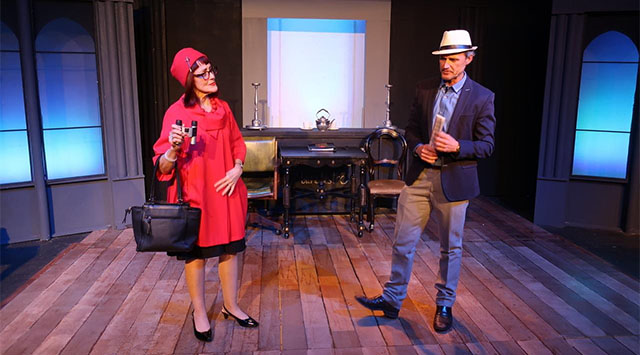
Playwright: Dale Wasserman (adapted from novel by Ken Kesey)
Director: Kim Hardwick
Cast: Matilda Brodie, Laurence Coy, Patrick Cullen, Anthony Gooley, Travis Jeffery, Felicity Jurd, Stephen Madsen, Wayne McDaniel, Joshua McElroy, Tony Poli, Nick Rowe, Di Smith, Wendy Strehlow, Bishanyia Vincent, Johann Walraven
Image by Marnya Rothe

Theatre review
The action takes place inside a male psych ward, except of course, the allegory is in reference to the mad world that all of us inhabit. In Ken Kesey’s One Flew Over The Cuckoo’s Nest, McMurphy (made famous by Jack Nicholson in the film version) represents the wild man that we have to tame. He turns up full of life, impressing upon us that he is not in fact insane, but a product of nature in its splendid rawness, and is clearly out of place in this environment of medicated placidity. It is probably no surprise that in this 1962 work, it is a woman who is charged with the business of suppressing that sublime nature.

Nurse Ratched has successfully emasculated everyone we see, and McMurphy must find a way to escape her wicked depravity. Man’s authenticity is upheld as desirable and esteemed, even if all the women who cross McMurphy’s path are debased and humiliated. The rebel’s story is always a powerful one, and it is no different here, whether or not we warm to its central character. It is after all, a battle for dignity and innocence, and we will only be allowed to side with the righteous hero.

Anthony Gooley’s charisma serves him well in the role of McMurphy. Dynamic and intuitive, and effortlessly captivating, it is a pleasure to watch the actor fill the stage with his brand of robust theatricality. Simultaneously portraying qualities that are menacing and vulnerable, the character that he presents is complex, considered and hence, convincing. Ratched is a surprisingly human manifestation, under Di Smith’s interpretation. Hints of warmth and kindness make her a believable personality, but an impotent villain. In the absence of a formidable opponent, McMurphy looks to be a rebel without a cause, and dramatic tension is significantly compromised.

Director Kim Hardwick’s approach is a contemplative one, and although never lacking in verisimilitude, sections that deal with aggression and chaos, can seem too gently manufactured. Individual patients in the show are fascinating, often beautifully performed, but they feel strangely distant. Without a threatening presence, the group misses an opportunity to have us more viscerally engaged. The production however, boasts accomplished design work, especially noteworthy are Martin Kinnane’s lights; compelling when subtly rendered, and utterly remarkable when his creativity turns bold or extravagant.

We play by the rules, thinking them necessary for self-preservation, even when we judge them unsound. When one’s own sanity comes into question, it is invariably societal expectations that provide the measure at which behaviour must be gauged and contained, whether or not conditions of that acceptance are based in logic. McMurphy’s radical disobedience involves him acting from unmitigated impulse, alone, and the consequences he has to face are dire. It is true, that much of what we endure, is unfair. It is also true, that rules are made to be broken, and when the lunatics take over the asylum, redress can be achieved, if unity, and solidarity, can be found.

www.sportforjove.com.au

Review: Acts Of Faith (Popinjay / Emu Productions)

Venue: King Street Theatre (Newtown NSW), Jul 18 – Aug 5, 2017
Playwright: Melvyn Morrow
Director: Elaine Hudson
Cast: Taylor Owynns, Joseph JU Taylor

Theatre review
A property developer and a nun may seem an unlikely pairing, but because they meet in Sydney, it makes sense that both are in the real estate market, trying to take advantage of one another. Melvyn Morrow’s Acts Of Faith is a response to this city’s obsession with property prices, and our unabashed pursuit of preposterous inflation and personal gain.

The play features a string of deceptions by untrustworthy types, determined to make the most of a system that feeds the rich and greedy. It reflects our increasing emphasis on money, as a society that has moved away from defining characteristics of mateship and the fair-go, to what is today a guiltless infatuation with materialism. Even a mother superior has to participate in this gluttony for her narrative to materialise on the twenty-first century stage.

Dialogue in the show takes on a very formal tone that can seem old-fashioned, but undeniably suited to the archaic institutions being represented. Director Elaine Hudson ensures that actors approach their parts with impeccable logic, and that they deliver their lines with an enjoyable sense of rhythm and buoyancy. Although we are kept engaged in every scene, the comedy could benefit from a greater sense of flamboyance in delivery. Taylor Owynns and Joseph JU Taylor bring their warm presences to the story, both impressive with the precision and conviction that they put on display.

In a world that insists on everything being monetised, the modern economy is brutal with how it dictates the way we live, and how our personal choices must conform to its principles of profit maximisation. Religious organisations too are participants in this race for money and power, yet they hide behind disguises that appear celestial and traditional, to gain an upper hand in a system that allows them to benefit exclusively, from donations, tax breaks and the like. Numbers do not lie, but they can only work their magic when applied with diligence and fairness.

www.kingstreettheatre.com.au