Review: Gaybies (Darlinghurst Theatre Company)

darlotheatre2Venue: Eternity Playhouse (Darlinghurst NSW), Feb 6 – Mar 8, 2015
Playwright: Dean Bryant
Director: Dean Bryant
Cast: Cooper George Amai, Sheridan Harbridge, Rhys Keir, Steve Le Marquand, Zindzi Okenyo, Olivia Rose, Georgia Scott
Image by Helen White

Theatre review
Plays about LGBT experiences often fail the test of time. They reflect certain moments in political causes, and social progress renders most stories passé after their periods of relevance are over. Mart Crowley’s The Boys In The Band (1968) and Jean Poiret’s La Cage Aux Folles (1973) now seem dated and contrived, but there is no denying their historical significance and the respective parts they have played in the human rights movement for gay men in the west. Dean Bryant’s Gaybies comes out of current debates about marriage rights of same-sex couples, and their detractors’ apprehension about parenting by LGBT families, should laws be changed to permit these unions.

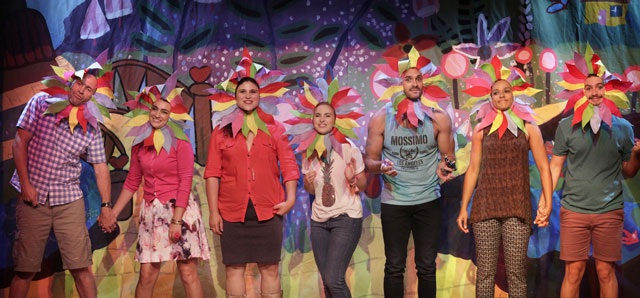
Bryant’s script takes the form of verbatim theatre, composed of interviews he has conducted with children of same-sex parents, as well as a few lesbian and gay adults in the process of conception. The work is a timely response to community concerns, and a colourful look at contemporary family lives in Australia, providing a perspective that challenges notions of conventionality and presumptions of what makes a favourable set of circumstances for children to thrive. It is the kind of text that would either be daring and controversial, or merely preaching to the choir, depending on the audience it plays to, but Bryant’s own direction injects inventive variety and surprising humour to ensure a delightfully engaging experience for all but the very bigoted.

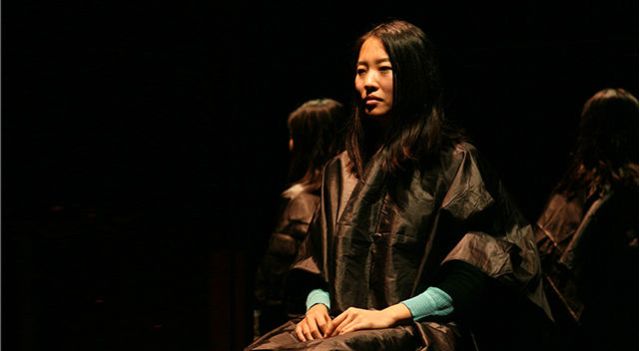
The brilliant cast brings a palpable tenderness to the production, with all seven performers taking on three roles each, demonstrating versatility and a good amount of heart and soul. Zindzi Okenyo has a gentle but magnetic presence, ensuring that we stay on her side from start to end. Her style is understated and honest, with an infectious enthusiasm that gives weight to her stories. Also very affable is Rhys Keir, who creates big distinctions between each of his characters, allowing them to be individually memorable. Keir’s impulses feel authentically spontaneous, and the vibrant energy he brings to the stage is refreshing and full of charm. Crowd favourite Sheridan Harbridge delivers a polished yet moving performance, with a visibly solid connection between the actor and her material. Harbridge’s comic and vocal abilities serve her well in the show, and we cannot help but fall under her spell repeatedly.

Owen Phillips’ set design is a straightforward but effective idea, executed with elegance. His facsimile of a community hall relies on our personal associations with a space characterised by ordinariness, and like the show’s very concept, visual aspects are kept pleasantly simple. Even though the absence of a traditional narrative structure means that we lose opportunities for greater emotional indulgences, what Dean Bryant and his cast provide are important testimonials and a valuable documentation that would function as a sign of the times, and without doubt, a step towards the momentous and inevitable legalisation of marriage for all.

www.darlinghursttheatre.com

Review: Tartuffe (Nine Years Theatre)

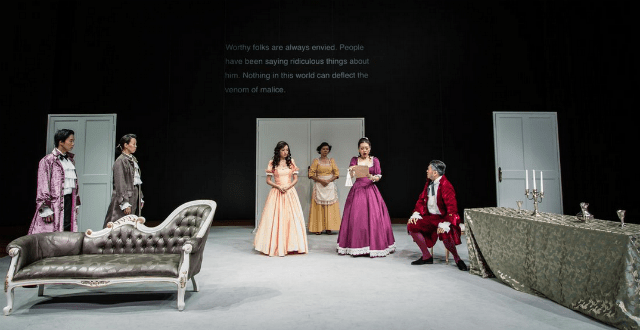
nineyearsVenue: National Museum of Singapore (Singapore), Feb 4 – 8, 2015
Playwright: Molière (Mandarin translation by Nelson Chia)
Director: Nelson Chia
Cast: Mia Chee, Jalyn Han, Hang Qian Chou, Koh Wan Ching, Neo Haibin, Darius Tan, Jean Toh
Image by Bernie Ng

Theatre review (first published at Auditorium Magazine)

The most noble function of humour, is that it allows for difficult things to be said. Taboo subjects are suddenly open for discussion under the guise of laughter, and with a pretence of jest and banter, sensitive issues can be dealt with in a manner so that the likelihood of causing offence is minimalised (and self preservation for the comic is usually secured). Where there is a sore spot, there inevitably lies an area of contention that represents fertile ground for artists to investigate. In the theatre, in particular, comedy is often used on surface levels to entertain, while it advocates socio-political perspectives that may be less effectively rendered within other contexts, or in fact, completely inappropriate to articulate in the absence of comedic devices.

Molière’s Tartuffe was first performed in 1664. but its resonances persist, and productions continue to appear all over the world in wildly different incarnations. Its themes of religion and hypocrisy, along with the miscarriages of justice in relation to patriarchal forms of economic organisation, are more than familiar; in societies everywhere, these are problems that people grapple with veritably. Singapore is one of the more advanced Asian countries, without the chronic wealth disparity that neighbouring places face, but its history of secrecy and scandal pertaining to the upper echelons in governmental, business and religious bodies, connects firmly with the acerbity of Molière’s play. It remains a problem that men in high places often wield their power in self-interested and misguided ways, behind our backs and to the detriment of communities within their influence, so the relevance and importance of Tartuffe as a timeless farce cannot be understated.

Nelson Chia’s direction places emphasis on the poignancy of the narrative’s themes and stories. The sociological implications of the title character’s villainy as well as the instances of aristocratic ignorance are clearly demonstrated, so that the moral of the parable is resolute and prominent. Chia’s own adaptation draws a beautiful parallel between Tartuffe’s behaviour and contemporary concerns with religious extremism, but his text is also compassionate to personal practices of faith, mindful that religion per se is not the enemy, but the corruption of our spiritual lives is what we are to be wary of. This Chinese language version introduces an alternate ending, replacing the original’s somewhat frothy wedding sequence with a surprisingly dark but authentic reading of consequences that was perhaps previously absent. Also meaningful is the way gender is presented in the production. Orgon’s misogyny and cruelty in forcing his daughter to abandon the man she loves in order to marry another of her father’s choice, and Marianne’s own obedience are obviously problematic by our standards, but Chia depicts that injustice with sensitivity, and a necessary gravity that reveals the repugnance of that situation. It is noteworthy that the voice of reason, Cléante is played by female actor Koh Wan Ching, whose work adds an unusual dimension that encourages a distinctly gendered interpretation of the text. It can be seen that a dichotomy is formed, with wisdom only ever emerging from the feminine, and all male characters straying far from the heroic. Traditional patriarchy is a problem, and we see it exemplified here.

Less successful however, is the play’s comedy. Molière’s unmistakeable absurdity is watered down and portrayed with a disappointing naturalism. Without sufficient laughs, the work is left with scenes that seem too didactic, and the shortage of irony in performances makes the script’s frequent sarcasm seem awkward. The abundance of earnestness in the company’s approach is comforting to observe, but also a mismatch for the writing’s raucous tone. There is to be sure, a sense of humour at work, but one that is not always appropriately gauged. Hang Qian Chou is entirely miscast as Tartuffe. The role requires a flamboyance and cutting satirical edge that the actor struggles to locate, and although his creation feels genuine, the lack of theatricality in his work is a substantial flaw. Theatre is always a collaborative endeavour, where individual talents merge to produce something that encompasses diverse skills and perspectives. Chia’s Tartuffe seems to be of a singular vision, and it is to his credit that the production is a cohesive one, but many in his cast appear stifled and are able to express only within regimented frameworks.

Exceptions include Darius Tan who shows excellent conviction and professional focus in the role of Orgon, head of the house. With Tan’s youthful energy, impact is slightly lost of a man desperate to find salvation beyond death, and the familial connotations of wills and property one leaves behind are also diminished, but his sense for timing and dramatic tension is a considerable asset to the production. Tan has a good sense of plot dynamics, and he conveys relationships and personality transitions with charm and clarity. It is not unusual that those who play the sprightly housemaid character Dorine would make an impression, but Jalyn Han is exceptional on this stage. Her vibrant energy contributes an aliveness to scenes, with impulses that feel spontaneous and fresh, a contrast to several other moments in the show that come across too arduously rehearsed. Han’s confident and entertaining presence is a breath of fresh air in an atmosphere that can tend toward being slightly rigid, and her intuitive creativity keeps us engaged and amused while maintaining a simultaneously coherent sense of storytelling.

Design elements are deliberately basic, but they reference the era of Louis XIV appropriately. The set consists of just three doorways and two pieces of furniture, with wings and crossover completely exposed, indicating a minimalist spirit that values the distilled essences of things over ornamentation, and an attentiveness toward the craft of performance above all else. The production is not the prettiest or the most extravagant, but it is certainly and thoroughly honest. All we have before our eyes are actors with their craft, and no apologies are made for this. The entertainment value of this Tartuffe is not wholly gratifying, and if we had laughed harder, the emotional impact of Molière’s classic would have been more affecting. Nevertheless, the story is well told, and its valuable lessons are imparted with salience. We leave knowing exactly what is being communicated, if only we are able to feel it too.

www.nineyearstheatre.com
Review: Between Us (ATYP)

atypVenue: ATYP (Walsh Bay NSW), Feb 4 – 21, 2015
Director: Sarah Parsons
Playwrights: Joel Burrows, Tahlee Fereday, Sharni McDermott, Tom Mesker, Julia Patey, Kathleen Quere, Callan Purcell, Caitlin Richardson, Fiona Spitzkowsky, Amanda Yeo.
Cast: Katy Avery, Christian Charisiou, Jordan Cowan, Patrick Cullen, Rebecca Cuttance, Airlie Dodds, Kelly Huynh, Lucia May, Dominic Roebuck, Gemma Scoble, Michael Smith
Image by Tracey Schramm

Theatre review (of preview performance)
The ten short pieces in Between Us are connected by the idea of secrets. These young Australian stories range from the deep and dark to the wonderfully inspired, all with a personal and revelatory perspective that aim to divulge something truthful. Nine are monologues, perhaps a reflection on the introspective nature of early adulthood. We do not get fervent commentary on our society and politics, but we are certainly witness to a fierce interrogation into human behaviour and its nature.

Direction by Sarah Parsons is adventurous and quite masterful. Her courageous use of space gives emotional and spacial dimension to each piece, respecting their individually distinct voices, and allowing their individual idiosyncrasies to take shape on stage. Transitions are sensitively and creatively manoeuvred so that the experience is fluid and cohesive as an integrated entity, while each writer’s own colour is staunchly retained. Parsons’ work with actors is wildly impressive in Between Us. Every segment is performed with surprising depth and sophistication, so that characters are meaningful beyond their ten minutes of showtime. We are drawn into these bite sized moments, sometimes seeing with astonishing clarity what is being expressed, and sometimes seduced into a sense of intrigue that leaves us hungry for more.

Fiona Spitzkowsky’s Accidents Happen is a remarkably funny yet brutal piece about parenting and ambition. Her blend of the macabre with a casual, almost unassuming everyday humour is a thrill to experience. Performed by Rebecca Cuttance with impeccable timing and focus, this is a programme highlight that exemplifies the intelligence and talent that is being showcased at ATYP. Pink Hair by Amanda Yeo is written with beautiful structure and shrewd acumen. It is technically accomplished, but also visceral and engaging. Kelly Huynh’s interpretation gives a magnetism and moving humanity to the play’s protagonist, and we are enthralled by her thorough authenticity and precision, without the actor having to move a limb more than once or twice during the segment’s entire duration. Also noteworthy are the production’s three male players, Christian Charisiou, Patrick Cullen and Michael Smith, all memorable for their refreshing and solid presences, and conspicuous, burgeoning star quality.

There is so much to like about Between Us, including its design aspects and technical proficiencies. Melanie Liertz’s set and Alexander Berlage’s lights are outstanding, and stage management is executed to perfection by Olivia Benson and her crew. It is almost unbelievable that these short plays can conspire to deliver something so substantial and rewarding, but it does. It is no secret that the Australian Theatre for Young People is a crucial element in the continuing progress of our artistic landscape, but on this occasion, the stepping stone has itself become a thing to celebrate.

www.atyp.com.au

Review: The Credeaux Canvas (Lambert House Enterprises)

lamberthouseVenue: Seymour Centre (Chippendale NSW), Jan 29 – Feb 14, 2015
Playwright: Keith Bunin
Director: Ross McGregor
Cast: Emilie Cocquerel, Carmen Duncan, Felix Johnson, James Wright

Theatre review
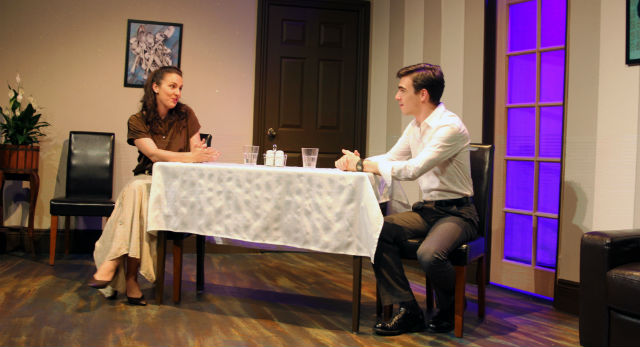
In Keith Bunin’s The Credeaux Canvas, the commodification of art and youthful ambition are explored through the intertwined lives of three young Americans in 2001 New York City. This is a story of broken dreams and deceit, as well as the often underplayed hardships of growing up. On the surface, Bunin’s characters have everything in the world going for them, each with talent, intelligence and social access, but they make choices that are doomed from the start, and all have to pay the price for their mistakes. The play delves into relationships and events, but leaves us to question the ways humans err, and to investigate what it is that likens us to the moth that gets burned by a flame.

This is a handsome production, beautifully and thoughtfully designed to evoke an accurate sense of time, space, and drama. Emma Vine’s set of a dilapidated apartment is executed with sophistication and flair, and lighting by Liam O’Keefe adds variety and nuance to scenes with careful subtlety. A highlight of the show is music by Christopher Gordon, who takes charge of scene transitions with great imagination and impressive elegance.

Ross McGregor directs the show with a passionate sensibility. He tries to keep scenes active and lively, but is restricted by individual abilities of his cast. Leading lady Emilie Coquerel is polished and energetic, but her character never feels believable enough, although it must be said that her transformations are depicted with good clarity. The key role of Winston is played by James Wright, who brings a natural naiveté to the painter’s wide-eyed entrance into adulthood. Both Coquerel and Wright can be overly self-conscious, most notably in a nude scene where the actors engage uncomfortably in a long conversation, revealing not much more than their bodies.

Felix Johnson is a dynamic performer who shows great commitment in his supporting part of Jamie, with an endearing emotional volatility that allows us to identify and engage with his narrative. Veteran actor Carmen Duncan appears in just one scene, but blinds the audience with her formidable talent and skill. She plays art collector Tess with sensational presence and brilliant humour, captivating the crowd in a way that only extensive experience and that enviable star quality can.

Death is mentioned several times in The Credeaux Canvas, and indeed, life is short, and although we only have one chance at it, mistakes are made so that they can be rectified, and through regret, we can grow. There is a darkness to the play’s conclusion with its characters finding themselves at a juncture where they can either continue on roads of destruction, or make a change for the better. It is a significant point in time for them, but their story gives us the knowledge that every moment is an opportunity to move, from the dark to the light.

www.facebook.com/credeauxcanvas

Review: Beyond Therapy (Understudy Theatre)

understudytheatreVenue: King Street Theatre (Newtown NSW), Jan 28 – Feb 14, 2015
Playwright: Christopher Durang
Director: Johann Walraven
Cast: Tel Benjamin, David Hooley, Andrew Johnston, Rebecca Scott, Nadia Townsend, Jasper Whincop

Theatre review
Christopher Durang’s sensational Beyond Therapy was first staged in 1981, at a time when psychotherapy and counselling were just arriving into the consciousness of the mainstream. Unlike the tendency today to class every colourful mode of behaviour and thought pattern as dysfunction of one sort or another, the play emerges from a period which paid attention to the peculiarities of human expression to locate machinations that might be able to provide explanations to our ever-present existential angst. The inevitable interrogation of normalcy, and the dismantlement of conventional expectations takes pride of place in Durang’s meditation on life for the thirtysomethings, but Johann Walraven’s direction of the piece does not always adhere to that sense of chaotic ideology. Walraven’s exploration of the play comes from a realistic perspective, trying to find coherence in what is essentially absurd and wild at heart. His need to find understanding is entirely reasonable, but the approach causes a muting of what could have been a comedy that guffaws at a much higher octane. The show is about being crazy, and although Walraven does not forget that fact, his interest in grounding the action in a place of logic sometimes gets in the way.

Performances by the cast of six are committed and focused, but an air of restraint permeates the atmosphere. The material requires no straitjacket, and when the actors find moments of abandonment, the production clicks right into position. Nadia Townsend plays Dr Wallace with a kind of Saturday Night Live sensibility, playing for laughs rather than earnest authenticity and her approach works well. There is no need for actors to provide explanation for Durang’s words because they are loud and clear on their own. They should, however, bring an energy to the stage that embodies a manic universe that the text is keen to reveal, so that its raucous comedy can be unleashed. Chemistry in the work is honest and resolutely present, especially in a sequence that sees Rebecca Scott’s character Prudence taunting the patrons at a restaurant. The ensemble loses its self consciousness and takes on an exciting unhinged humour, delivering some of the biggest laughs of the show.

Themes in Beyond Therapy are timeless and universal. It talks about growing up and marriage, within a context that investigates the meanings of sanity and social acceptability. Great art attempts to excavate the layers of fictions that we place between our daily lives and a sense of truth that seems to lie in an irrefutable core somewhere. We go about our business moving from one day to the next with the niggling suspicion that most of what we do is farcical, and entirely laughable if not desperately pointless. Yet, most of us would rather play the role of the sane, persisting with the anxieties and uncertainty of a life done in appropriateness. We believe that the alternative is out there, but we are afraid of what it might present, especially when madness begins to look no more closer to truth than our private falsities.

www.kingstreettheatre.com.au

Review: PUNCTURE (Legs On The Wall / Form Dance Projects / Vox – Sydney Philharmonia Choirs)

Venue: Riverside Theatre (Parramatta NSW), Jan 21 – 25, 2015
Director: Patrick Nolan
Choreographer: Kathryn Puie
Composer: Stefan Gregory
Images by Prudence Upton

Theatre review
Dancers are at the forefront in the exploration of theatrical space. Without the burden of words and narratives, they open up senses to what the physical presence of things and bodies can do on a stage, and how we communicate between persons, to create meaning where little or none had existed before. Puncture features a great number of people, some are dancers, and the others singers, introduced as though emerging from the audience, and we are encouraged to identify with them, and to read their performance as though what they present have come from us, even if we feel secure in our seats with temporary passivity. The mix of characters features a beautifully diverse range of ages and ethnicities that reflect the breadth of human experience, and of Australian life. The vocalists in particular, are almost a visual copy of the viewing crowd, and efforts at incorporating them into the dance, provide some of the more emotional moments of the piece.

Patrick Nolan and Kathryn Puie have created in Puncture, something that is a little less self-conscious, and a little more accessible than what we have come to expect of modern dance. They investigate the notion of inclusiveness to address the art of performance, as well as the consumption side of show business. It is a noble ambition to blur the lines of where the show starts and where it ends, but redefining audienceship is a difficult exercise. While not always successful, the ideology of breaking barriers provides strong impetus that shapes the show into something that feels adventurous and earnest. We are at our most engaged when the cast tackles the unconventional. The incorporation of rigging (executed behind the scenes by Jon Blake and Felix Kerdijk) to lift bodies 4 metres away from the ground, the soprano on an aerial hoop, and the tender interchanges between choristers and dancers; we are kept fascinated and entertained.

The 22-strong choir is led by Music Director Elizabeth Scott and Composer Stefan Gregory, with accompaniment on piano by Luke Byrne and on percussion by Bree Van Reyk. The marriage between what we hear and see is wonderfully cohesive, with the music at its most successful when it ventures into the avant garde. Even at its most daring, all the sounds are elegantly resolved, except when words like “hello” and “love” are used, disrupting the abstract beauty that wishes to be experienced in personal ways. It is noteworthy that there are many intriguing personalities in the choir, who could have been featured more heavily in the work’s choreography. Trained dancers tend to lose their individualities in the very discipline they invest in, and the juxtaposition provided on this occasion with non-dancers on the same stage is a main feature. Getting the singers to do more with their bodies is probably challenging, but it is precisely the idea of redefinition that would be elevated further, and the meanings that one draws from Puncture can therefore be more powerful.

Many in the show are dedicated and accomplished dancers, but this is not a piece about athleticism or superhuman faculties. It is an expression of how we live, feel and breathe as individuals and as collectives. Its themes are not always clear, but it articulates its concerns with sensitivity and focus. These artists intend to show us something important in their inimitable ways, and if we think that everything important can be put into words, then they have proven us wrong.

www.legsonthewall.com.au / www.form.org.au / www.sydneyphilharmonia.com

Review: After Dinner (Sydney Theatre Company)

Venue: Wharf 1 Sydney Theatre Company (Walsh Bay NSW), Jan 15 – Mar 7, 2015
Playwright: Andrew Bovell
Director: Imara Savage
Cast: Glenn Hazeldine, Anita Hegh, Rebecca Massey, Josh McConville, Helen Thomson
Images by Brett Boardman

Theatre review
As our societies become increasingly concerned with political correctness, theatre seems to have to reach back through the annals of time to locate comedies that appeal to wide audiences, and ones that do not disrupt any of our delicate sensibilities. Contemporary subject matter is replaced with nostalgia, and we can laugh at days gone by in the safety of imagining that things have improved since. Andrew Bovell’s 1988 play After Dinner is a harmless piece about loneliness and sex. It does not resonate with great poignancy, but it does strike a chord with accurate depictions of human emotion and behaviour.

The production’s core feature is its extraordinary cast. All five actors are brilliant comics and they take the opportunity to showcase their very best under the generous direction of Imara Savage, who cleverly places focus on performance above all else. The script and its humour have aged significantly, but Savage’s team apply a modern interpretation that gives an unexpected edge to what could have been a desperately clichéd farce.

Helen Thomson plays Monika with magnificent aplomb. There is a fearless abandon to her approach that gives the show an air of wildness and decadence, encouraging the crowd to indulge in the text’s many mischievous, and occasionally blue, jokes. Thomson’s extravagant sense of humour is infectious and irresistible, and the almost ridiculous bigness of her performance is given solid support by a gentle empathy she invests into her character’s underlying sadness. The role of Stephen is played by Josh McConville, who manages to miraculously marry sleaze with sweet, creating a persona that is as repulsive as he is charming. The actor’s physicality is perfectly exploited (with the help of stunning work on wigs by David Jennings) to create an appearance and a movement vocabulary that is nothing short of hilarious, and very evocative indeed, of a kind of unfortunate barfly from the era.

Design elements of the production are effective but less than ambitious. The look and sound of the work is surprisingly tame for a decade that is associated with poor taste and general gaudiness, but fortunately, all the action that takes place on stage is anything but beige. Beneath the energetic and incessant provision of laughter, is a view into modern lives, and the challenges we experience with issues of intimacy. Instead of after dinner tribute bands, we talk today, about hook up apps and sexting, but continue to be confounded by the search for love and some of its illusions of fulfillment. With the unfathomable advances in information technology, communications have taken over every aspect of every second, yet loneliness is more present than ever before.

www.sydneytheatre.com.au

Review: The Winslow Boy (The Genesian Theatre)

genesianVenue: The Genesian Theatre (Sydney NSW), Jan 17 – Feb 14, 2015
Playwright: Terence Rattigan
Director: Nanette Frew
Cast: Matthew Balkus, Meg Mooney, Lois Marsh, David Stewart-Hunter, Sonya Kerr, Lachlan McNab, David Prickett, Tom Massey, Jane Thorpe, Mehran Mortezaei, Roger Gimblett

Theatre review
Terence Rattigan’s 1946 work The Winslow Boy centres around the theme, “let right be done”, and its distinction from the concept of attaining justice. Not a great deal is made of this intellectual dissection in Nanette Frew’s direction, but in place of philosophical depth is quaint nostalgia and lighthearted entertainment. The interpretation is anti-naturalistic, with more than a hint of stylistic emulation of English theatre and life in the 1910s, resulting in a production that is staid and distant to begin with, but slowly warms up to something that is ultimately quite delightful.

There are good performances in the piece, including Sonya Kerr who plays Catherine Winslow, a suffragette finding her way through a changing world for women. Kerr is vibrant and playful, bringing a fun liveliness to the space. Her enthusiasm is not always matched by colleagues, but her persistence pays off and she creates the most engaging character of the show. In the role of Sir Robert Morton is Roger Gimblett whose chemistry with Kerr is a highlight. Gimblett is a dynamic actor who delivers effective drama, but would benefit with greater familiarity with his lines. The master of the house Arthur Winslow is performed with elegant gravity by David Stewart-Hunter who is a convincing patriarch, if a little oversubtle in approach.

Many audiences love a period piece, and Genesian’s The Winslow Boy satisfies on some levels. Cosmetically, it is well put together (especially Sandra Bass’ hats and Sharon Case’s wigs), but much of the execution feels surface, with characterisations and storytelling requiring further development. The production gives its creators much to be pleased about, but bars can always be raised higher in artistic expression, even when tackling a century old tale.

www.genesiantheatre.com.au

Review: Short+Sweet Theatre 2015 Top 80 Week 2 (Short+Sweet)

shortsweetVenue: New Theatre (Newtown NSW), Jan 14 – 18, 2015
Festival Director: Pete Malicki
Image by Sylvi Soe

Theatre review
Week two of 2015 Short+Sweet Theatre features a wealth of talent. There is exciting writing, clever direction, inspired acting, and sharp costuming to be found peppered through the night. Although no single work is able to be outstanding in every creative capacity, memorable moments are many, and the event continues to be an important one for Sydney artists and audiences alike.

Robert Renshaw’s Chat To Death teeters on the precipice of pornography, but the dangerous eroticism he explores is thrilling and beautiful, although quite explicit. The context he builds is not perfectly resolved, but his use of language more than satisfies. In Ryan Pemberton’s Business Meeting, a macabre and very quirky take on what happens in corporate boardrooms is beautifully directed by Pemberton whose sense of humour is odd, unique and very appealing. Direction is also a highlight in Rachel Welch’s So Says The Sea. James Hartley finds nuance in a deceptively simple script, and portrays surprising depth in just ten minutes. His cast is a strong one, especially Petrie Porter and Aleks Mikic who both impress with committed and meaningful interpretations of what could have been quite plain characters.

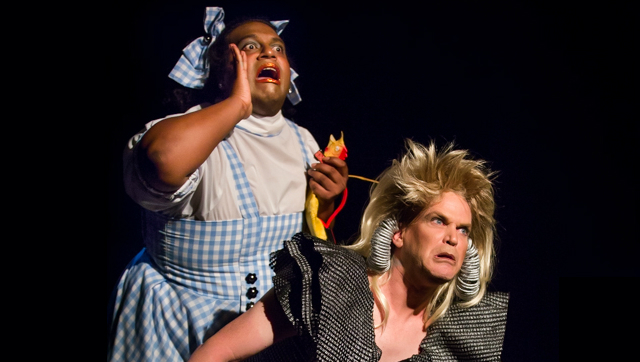
Other fabulous performances include Matthew Friedman, whose own piece The Least Impossible Thing That Happened This Evening opens the programme with vibrant energy and genuine enthusiasm. Equally buoyant is Jo Ford’s Chance You Can Dance, whose outrageously camp actors Hilary Park and Drew Holmes deliver irresistible laugh out loud sequences with their charming references to familiar cultural archetypes. Gavin Vance’s Screamers! The Wizard Of Aussie! Aussie! Aussie! (pictured above) stars the unforgettable Joseph Chetty who plays an Australian version of Dorothy Gale, blending drag comedy with a bawdy cabaret approach to present a scathing critique of the Abbott government, culminating in a live rendition of ‘Somewhere Over The Rainbow’ that is thoroughly and utterly electrifying. Dorothy’s call for a better national leader is a convincing one, and for a quick minute, she makes us believe in the pot of gold that lies at the end.

www.shortandsweet.org

Review: Bad (Old Fitz Theatre / Red Line Productions)

redline2Venue: Old Fitzroy Theatre (Woolloomooloo NSW), Jan 14 – 31, 2015
Director: Scott Witt
Cast: Penny Greenhalgh, Kate Walder
Image by Yael Stempler

Theatre review
Bad is a show performed by clowns about acting (amongst other things). Along with director Scott Witt, performers Penny Greenhalgh and Kate Walder have devised a work that uses clowning traditions and influences from Commedia dell’arte, to deliver a theatrical experience that is slightly left of centre. Their show is more amusing than it is funny, and their ideas are familiar rather than original, but there is an earnestness and purity to their approach that can be quite charming.

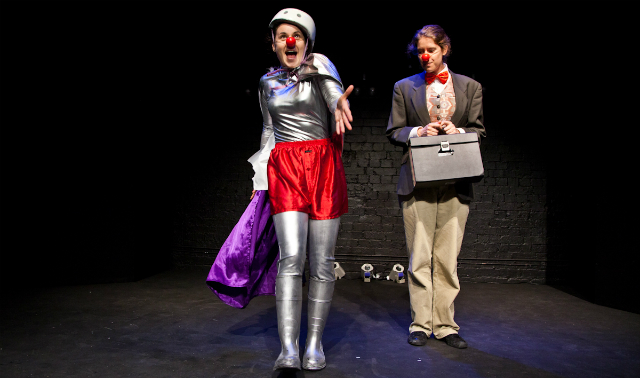
Walder is the “stunt woman” clown who speaks with a French accent, toddling around in a pair of tap shoes. Insisting that she is Cate Blanchett, the Hollywood and theatre star, she goes on to present a show entitled ‘Where’s My Bucket, Mom?’, enlisting the help of Greenhalgh, “philosopher” clown who gradually warms to the idea of being Geoffrey Rush (another star of stage and screen). The plot and story are chaotic and random, but we are always brought back to the theme of performance. Walder and Greenhalgh explore the nature of the theatrical space and the experience of acting using their unconventional methods, with mixed results. The pair is well rehearsed, but the play’s frenzied style and structure require more intense energy levels to provide a sense of abandonment and absurdity to match its concepts. Both actors seem fairly cautious, creating a space that feels safe, where we would prefer a sense of danger and unpredictability.

Not every actor is a clown, but all clowns act. They give us something unique, that can be found in their license to transgress. Clowns do not speak much, because they communicate in better ways. They reach out to us in realms that are beyond words, so that we understand the world from a different perspective. When done right, they impart a kind of wisdom that brings unexpected enlightenment. Bad is not always good, but what’s worse is doing things the same way over and over again. There is a courage at play here, and we need more of it.

www.oldfitztheatre.com