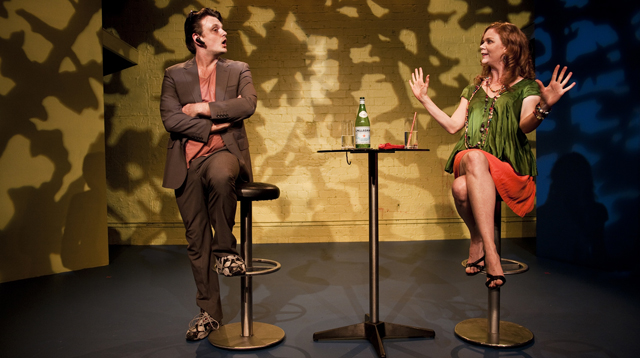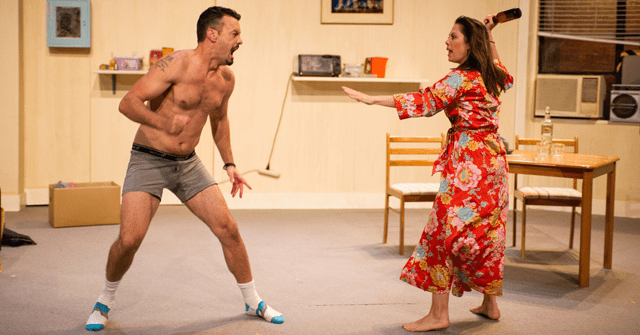
Review: The Motherfucker With The Hat (Workhorse Theatre Company / Darlinghurst Theatre Company)

workhorseVenue: Eternity Playhouse (Darlinghurst NSW), Sep 19 – Oct 19, 2014
Playwright: Stephen Adly Guirgis
Director: Adam Cook
Cast: John Atkinson, Troy Harrison, Megan O’Connell, Zoe Trilsbach, Nigel Turner-Carroll
Image by Kurt Sneddon

Theatre review
Few would claim to have experienced a perfect childhood. We sustain damage from the carelessness of parents, the cruelty of peers, and the dysfunctions of society. In The Motherfucker With The Hat, characters are seen to grapple with their individual histories, some trying to overcome agents of hindrance, and others submitting to destruction. Through themes of infidelity and disloyalty, we observe the way mistreatment of friends and lovers is rationalised, and through those betrayals, the demons that people carry within are exposed in the play’s violent narratives.

Stephen Adly Guirgis’ script is colourfully detailed. Interchanges are deep and revealing, and dialogue is relentlessly exciting. The characters speak the language of New York’s lower classes, with a rich idiosyncratic flavour derived from a passionate city and its spirited residents. The story is a compilation of altercations between personalities who do not shy away from confrontation. They express an exhaustive gamut of emotions, which makes for excellent drama, but whether their sentiments encourage empathy, depends largely on the audience’s ability to relate to each character. Direction of the work by Adam Cook is suitably rambunctious. The show is a lively one, always able to provide something amusing, even controversial, to spark the senses. Even though his work can at times feel emotionally distant, Cook extracts consistently brilliant performances from his cast.

In the role of Jackie is Troy Harrison whose spectacular presence anchors the production in a wild and turbulent space that resonates with an unusual authenticity. Through an extraordinary complexity, Harrison conveys a sense of profundity to the proceedings, in which his commitment to creating both entertainment and meaning is clear. Harrison’s portrayal of aggression is not always effective but the vulnerability he displays is powerful. Zoe Trilsbach plays Veronica, an unapologetic addict dependent on alcohol, drugs and lies. The actor has a fierce dynamism that gives her character a willfulness, and she paints an intriguing portrait of hypocrisy and delusion with the character’s determination. There is a vehemence to Trilsbach’s voice and physicality that gives accuracy to the play’s social context, and grants a fascinating insight into the role’s mental and emotional states. It is certainly an outstanding and memorable performance.

Supporting players too, are impressive. Nigel Turner-Carroll’s comedy is confident, mischievous and unpredictable, adding a necessary lightness to the production with the part of Julio. The role of Ralph experiences the greatest transformation in the plot, and John Atkinson’s depiction of that journey is delightfully dramatic. Both Atkinson and Megan O’Connell, who plays his wife Victoria, deliver very solid and captivating soliloquies that stay with us for their intense and palpable humanity. The couple’s desperately flawed relationship is presented with an unflinching honesty that is quite chilling.

Production design is marvelously conceived. The many set changes are handled with great elegance, and every setting is sensitively constructed. Dylan Tonkin’s set and costumes, and Ben Brockman’s lights are not attention-grabbing, but their work allows us to be transported effortlessly to a land far away. Composer and sound designer Marty Hailey is responsible for the urgent pulse that drives us from one explosive scene to another. His music is a metaphysical representation of the story’s progression, and a perfectly executed dimension of the show that finds beautiful harmony with its more tangible elements.

The play talks a lot about sobriety. It is concerned with how a person can grow and improve, through the search for honesty and self-awareness. Julio is the only character in the piece who does not suffer from addiction issues, and he is presented on stage as the only one who finds happiness and fulfillment. He is also the clown. There is an artifice and implausibility to Julio that signifies the absurdity of completeness as a state of being. To err is human, and to struggle, it seems, is evidence for being alive.
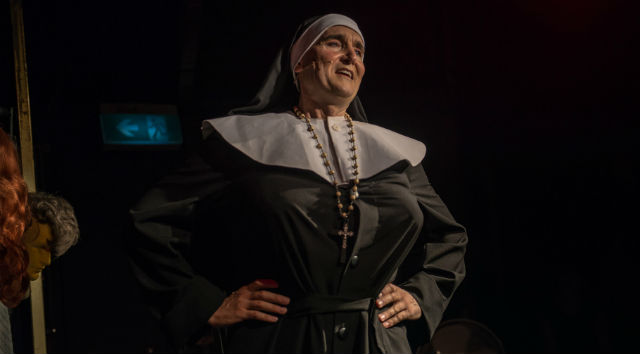
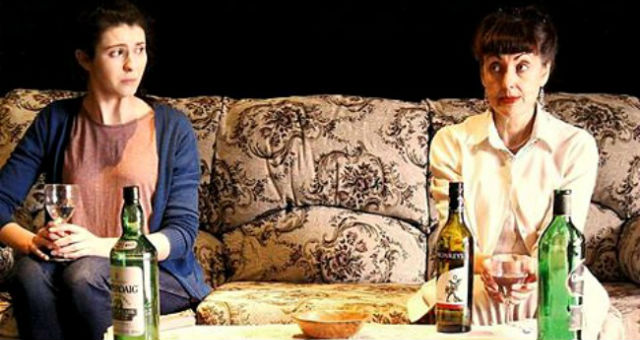
www.workhorsetheatreco.comwww.darlinghursttheatre.com

Review: Desperately Young At Heart (New Theatre)

roberthofmannVenue: New Theatre (Newtown NSW), Sep 23 – 27, 2014
Director: Stuart Maunder
Cast: Robert Hofmann, Cherie Boogaart, Tommaso Pollio
Image by John Marshall

Theatre review
Robert Hofmann’s work Desperately Young At Heart features the singer in various guises, performing humorous renditions of jazz and musical theatre classics. The show’s title reveals the fun-loving approach taken by Hofmann, but it serves also as a warning that nothing particularly poignant transpires. The songs are linked by a performance that sees Hofmann transform with wigs and costumes, although no obvious narrative connects each incarnation. Its sense of pageantry feels at home in the cabaret format, and while not terribly original, the show does afford an amusing glimpse into the creative mind of its author.

Hofmann’s baritone voice is accomplished and confident, with shades of opera that give his singing an enveloping power. The gender diversity of his characters is a key feature of the show, but Hofmann’s liberal use of falsetto is less effective. Mezzo-soprano Cherie Boogaart’s appearance is brief but memorable. Her comic abilities are competent, but it is her voice that truly delights. Pianist Tommaso Pollio is the unsung hero of the piece, single-handedly controlling the many mood transitions with ease and flair.

The presentation tries to be loud and outrageous, but it is the quieter moments when Hofmann works with more subtlety that resonate better. Desperately Young At Heart strength is the matured skill of its performers, whose expertise is clear to see. It is an opportunity for the artists to practise a genre of theatre different from their usual vocations, and results are mixed. It is not an enormously adventurous venture, but their enthusiasm in presenting a labour of love is quite infectious.

www.facebook.com/robert.hofmann.singer

Review: Aunt Agony (New Theatre)

auntagonyVenue: New Theatre (Newtown NSW), Sep 15 – 22, 2014
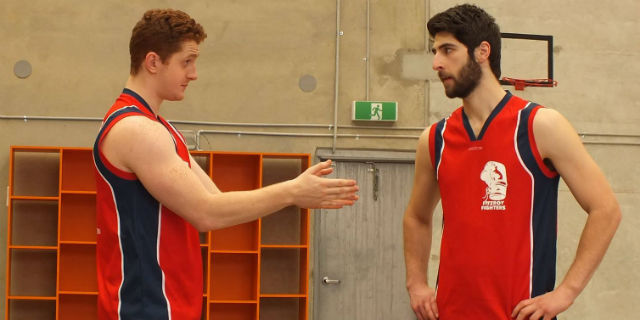
Director: Michael Campbell
Playwright: Richard Black
Cast: Sasha Dyer, Dave Kirkham, Taylor Owynns

Theatre review
In a society that overvalues youth, we often forget that quirky old people are much more amusing and fascinating creatures than their offspring. Richard Black’s Aunt Agony is a farcical black comedy that imagines the secret wild life of Aunt Lynn from the conservative Upper North Shore of Sydney. Lynn is an eccentric and flamboyant lady who lives with a cat and a dark side. Her niece Christine has just ended a relationship and seeks refuge in Lynn’s apartment. Their love-hate relationship reveals a series of antics, funny and sinister, that forms the plot of this surprisingly textured show. Black’s characters are vibrant and his scenarios whimsically formulated, with punchy dialogue and timely sociopolitical references.

The work becomes tighter in pace after the halfway point. Early scenes move a little slow, preventing tension from taking form satisfactorily. Perhaps some edits to the script can provide some energy. The actors’ rhythms can also benefit from an increase in speed, but Michael Campbell’s direction is quite accomplished. He injects a wonderful playfulness to the production, and makes brave choices that befit the idiosyncrasy of the lead character. The play’s more nefarious elements are handled with just enough seriousness to retain their sobering reverberations, but they do not get in the way of the overall joviality of the show.

Lynn is played by the effervescent Taylor Owynns who is endearing from her very first entrance. She has a likability that keep us on her side no matter how abhorrent her shenanigans become. Owynns performs a charming madness, but some of her techniques can feel slightly repetitive. The show requires a high level of energy from her, and she delivers on most occasions especially when in close collaboration with Sasha Dyer who takes on the role of Christine. Dyer comes to life when the show’s brashness escalates. She is a spirited performer who works well with physical comedy, and there are many opportunities for her talents to shine through on this stage. Dyer’s firm commitment and focus makes substantial what is essentially a supporting part. Also providing effective support is Dave Kirkham whose good humour makes his brief appearances delightful and memorable.

Design of the show is pleasant and efficient, but the set leaves empty space in the down stage area, which is not often utilised. Moving set pieces closer to the audience would allow more intimacy and hence create greater impact. The production leaves a lasting impression with meaningful morsels littered through its text. It is often hilarious with a giddy silliness, but its entertainment value is sometimes coupled with poignancy, proving itself to be the kind of madcap comedy that refuses to underestimate its audience.

www.newtheatre.org.au

Review: The Sheds (New Theatre)

theshedsVenue: New Theatre (Newtown NSW), Sep 17 – 21, 2014
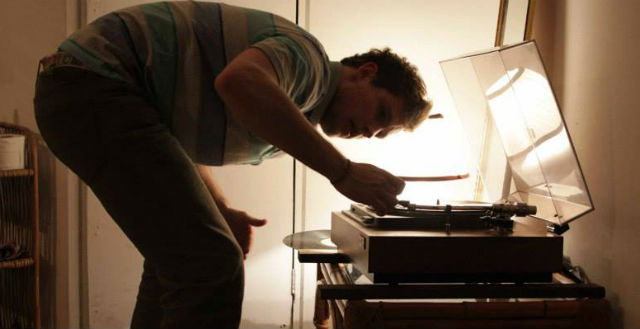
Director: James Cunningham
Playwright: James Cunningham
Cast: Patrick Chirico, Ludwik Exposto, Andii Mulders

Theatre review
James Cunningham’s The Sheds begins when an AFL player Darren Anderson decides to reveal his homosexuality to his team and the public. It is not about the experience of being in the closet, but what happens after one decides to come out in an almost entirely male environment. Cunningham’s concepts for the play are strong. The tensions between the sporting industry and the very rare occurrences of fracture in its overwhelming heteronormativity are fertile ground for exploration, and indeed an area that our society needs to examine more closely. It is also a credit to the script that Anderson is portrayed as a liberated personality, without emphasis on his struggles, thus preventing the context from being dated and banal. Anderson’s character is paralleled by his friend and colleague Jimmy Davis, who has his own secrets, and the narrative is made substantial by Davis’ repression and its subsequent dramatic consequences.

Unfortunately, execution of Cunningham’s concepts are disappointing. His script is too obvious and plain, with unimaginative dialogue that feels compelled to tell too much, as though it is playing to a radio audience. Speech patterns for each of its three characters do not seem to vary. The way language is used does not sufficiently relay the differences in background and personalities. We appreciate that they are close compatriots who play for the same team, but the story requires a more distinct style of conversation for each character. Cunningham’s direction tries to create movement for the stage, but it can feel superfluous at times. There is a lot of pacing around, and changing of clothing, as though the actors are unable to deliver their lines without being told what to do with their hands. Transitions between scenes are handled without finesse. The actors often leave the stage, only to walk back in, a quick moment later. The passage of time can be conveyed more creatively than simply providing exits and entrances.

The cast is a good-looking one that represents a contemporary multi-ethnicity. The men are all athletic, which makes their depiction of the sporting space convincing, and while their instances of full-frontal nudity can seem a little gratuitous and distracting, it is nonetheless pleasurable to watch. The acting is not strong, with stilted performances and poor diction that make the plot a challenge to follow, but their energy levels are generally buoyant and there is a good level of enthusiasm that fills a lot of the show’s fifty minutes.

There is an urgent need for diversity in Australian theatre, and The Sheds makes a contribution. It talks of ethnicity, sexuality and mateship in a way that is fresh and timely. Cunningham’s voice is unseasoned, but it is a necessary one. We do not expect success to come out of every experimentation, but it is the courage to try that will always impress.

www.facebook.com/theshedsplay

Review: This Is Our Youth (The Kings Collective)

thekingscollectiveVenue: TAP Gallery (Darlinghurst NSW), Sep 16 – 21, 2014
Writer: Kenneth Lonergan
Director: Dan Eady
Cast: Joshua Brennan, Scott Lee, Georgia Scott
Image by Kate Williams Photography

Theatre review
Not all stories are universal. There will be characters we are interested in, and others that we do not give two hoots about. Kenneth Lonergan’s This Is Our Youth is a lamentation of sorts about spoilt rich kids. It is concerned with the neglected offspring of wealthy baby boomers, providing a perspective of new money in 1980’s Manhattan and the repercussions on its subsequent generation. Lonergan’s script is full of mischief and energy, but embodies the pointlessness of the characters it portrays. Their lives are lost, frivolous and sordid. Everything is dazed and confused, but the writing provides a rich and colourful inventory of drama and jokes for an electrifying work of theatre, and this is what The Kings Collective delivers.

The cast is extraordinary. Three young actors, sublime as a group but individually sensational, give a performance that is quite literally flawless. They all make bold choices that delight and surprise us, but are always thoughtful and sensitive to the creation of depth in their characters. We are enthralled by the dynamism in their work but never lose sight of contexts and circumstances. Joshua Brennan is Dennis, the misguided alpha male, whose bravado, anger and aggression are the only things getting him through life that do not come in small self-sealing plastic bags. Brennan’s range begins at bombastic, and then escalates further. His work is outrageously flamboyant but completely engaging, and one is able to sense a lot of substance behind his delicious madness. The material gives him many opportunities for comedy and he executes them brilliantly, but poignant moments at the end are slightly less effective even though his portrayal continues to be convincing.

Georgia Scott transforms the supporting role of Jessica into a memorable one. She fools us with a Barbie-esque appearance and surreptitiously shifts the play into intellectual gear. Scott brings a palpable complexity with strength, humour and tenderness, creating an authentic sentimentality that gives the production its humanistic aspect. Her romantic scenes with Warren are beautiful and real, allowing the play to speak compassionately, albeit fleetingly. The feminine voice is only secondary in the play, but Scott’s work is disproportionately impressive.

Warren is a clever young man who suffers from a lack of confidence and direction. He allows his father and friends to dominate him, and seeks refuge in drugs to silence his intelligence. Scott Lee’s moving depiction of that impotency gives the play its weight, and his comedic flair sets the tone of the production. Lee’s phenomenal chemistry with both colleagues shows an openness in approach that gives theatre its sizzle, and every second is kept lively by his marvelous commitment and presence.

Direction of the piece by Dan Eady ensures excellent entertainment and precise storytelling, without an instance of misplaced focus or loss of energy. This is the tightest of ships that any captain can hope to deploy. Audiences will laugh, be touched, and be provoked into thought, but the play’s social message is not a particularly potent one. It is hard to summon up any empathy for the very rich, even if they are innocent young adults. This Is Our Youth is thrilling and amusing, and while it does have some depth, they can be tenuous. Fortunately, theatre is about the craft as much as it is about meanings, and on this occasion, the artists are alchemists that have turned lead into gold.

www.thekingscollective.com.au

Review: Procne & Tereus (Montague Basement)

montaguebasementVenue: TAP Gallery (Darlinghurst NSW), Sep 16 – 20, 2014
Director: Saro Lusty-Cavallari
Playwright: Saro Lusty-Cavallari
Cast: Christian Byers, Lucinda Howes, Victoria Zerbst

Theatre review
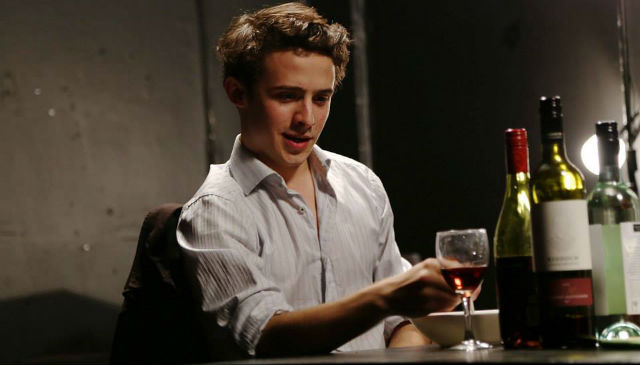
Philomela visits her sister Procne’s home. Procne and her boyfriend Tereus are only a little older but their lives seem a world away from Philomela’s university student existence. The couple is expecting a child, but Tereus is more interested in the wine. He enjoys the intoxication and likes the way its price tag makes him look. The play begins in a space of middle-class ordinariness, but like in many middle-class spaces, there is an insidious deluge of quiet anxiety. Not enough happens to write home about, but its inanity gradually wears you down into sickness. In Procne & Tereus, we associate that anxiety with early adulthood, and a sense of being at crossroads, always wondering what that crucial next step holds. The young cast play older characters, and we see our frightening reflection in their portrayal of innocence lost.

Saro Lusty-Cavallari’s script is simple but poignant. His love for the art of inference makes that which is not being said, speak louder. His direction is even more accomplished, with a brave and adventurous spirit that emerges alongside thoughtfulness and subtlety. Not all manoeuvres are elegant, but there is always clarity in intent and a theatrical flair that feels natural yet purposeful. Lusty-Cavallari’s work is conceived with complexity, but his execution is articulate and concise. His talent is real, and its development is incredibly exciting.

Tereus is played by Christian Byers who deceives us with a surface of frivolity. His darkness within is almost completely hidden but Byers drops hints of malice that unnerve with a dangerous delight. It is a relaxed performance, sometimes silly in tone, but there is an impressive measuredness that accompanies his exaggerated nonchalance. Lucinda Howes as Procne, brings realism to the production with a restrained and minimalist approach that is strangely engaging, but her energy levels can read a little muted at times. Victoria Zerbst’s commitment to the role of Philomela is spine-tingling, and her presence shines through when performing the more surreal sections of the play.

Lighting by Eunice Huang and sound by Lusty-Cavallari and Byers, are key features of the production. Atmosphere is shaped and varied beautifully, contributing substantially to the narrative’s coherence. This Greek tragedy leaves us at a satisfying, albeit apocalyptic end. It relates marriage and family to questions about gender and sex. The story is grim because it is about our taboos. It shows us some of our greatest fears, and warns us about our unexamined but commonly-held beliefs. It leaves us nowhere to hide because its truths prevail.

www.montaguebasement.com

Review: Four Dogs And A Bone (Brief Candle Productions / Sydney Independent Theatre Company)

briefcandleVenue: Old Fitzroy Theatre (Woolloomooloo NSW), Sep 16 – 27, 2014
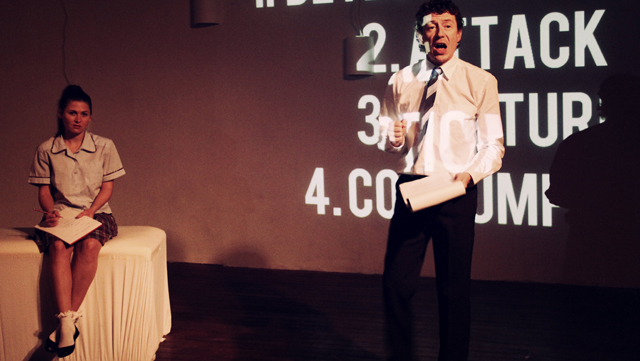
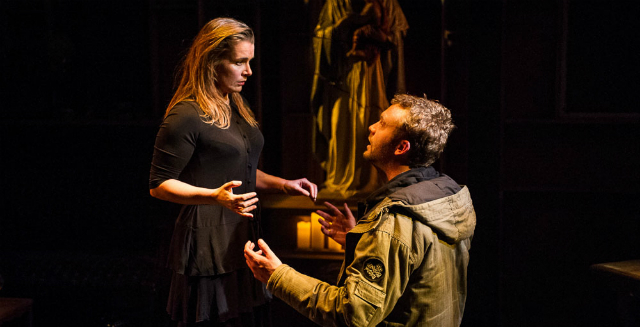
Playwright: John Patrick Shanley
Director: Kate Gaul
Cast: Amanda Collins, Melinda Dransfield, Paul Gerrard, Sonny Vrebac
Image by Katy Green-Loughrey

Theatre review
There are four actors and only four scenes in John Patrick Shanley’s Four Dogs And A Bone. It is a work about horrible people trying to make a film, and their self-serving manipulations to change the film to their advantage. The personalities are thoroughly caricatured, and the script derives its humour from their absurd behaviour.

Performances are uneven in the production. The first scene features the stronger players Melinda Dransfield and Sonny Vrebac kicking off with some promise. Brenda is a starlet who lies and sleeps her way up the career ladder. Dransfield has moments of brilliance in the role and delivers laughter with a more subtle approach than her cohorts. Sonny Vrebac plays the film’s penny-pinching producer Bradley, who is so highly strung that he develops a canker sore the size of a jumbo shrimp in his rectum. Vrebac’s comedy is the most consistent in the piece, and the personal narrative he is able to communicate for his character is clearest in the group. Vrebacg’s vibrancy is an asset to the production, and the slump in energy levels is noticeable in scenes without him.

Chemistry between actors is an issue that seems to arise from their focus on individual styles. We do not see a sense of cohesion, which results in missed opportunities for laughter and amusement. Amanda Collins focuses her efforts on creating a snake-like persona for Collette but does not manufacture enough substance for her story to resonate. It is noteworthy however, that she displays good commitment and focus, and leaves a memorable impression with a flamboyant display of devastation from being described as a “character actor”. Paul Gerrard as Victor, the screenwriter for the film, tends to underplay his role, allowing his more extravagant colleagues to overwhelm his work, but he does have a solid presence that gives the show a firm grounding.

This is a staging that does not quite take off until its final scene. Economic realities mean that much of what we see in the theatre can be revealed too early in the creative process, and opening night of Four Dogs And A Bone feels prematurely presented. Art strives for an imagined notion of perfection, but no art of great merit is created in an idealistic environment without challenges that need to be overcome. The factor of time and the practicalities of money can be cruel to artists, but they are also what compels us to hold their work in great esteem.

www.sitco.net.au | www.briefcandleproductions.com

Review: Jennifer Forever (Two Peas)

twopeas1Venue: Old 505 Theatre (Surry Hills NSW), Sep 17 – 28, 2014
Playwright: Tara Clark
Director: Tara Clark
Cast: Dominic McDonald, Gemma Scoble

Theatre review
Note: This review reveals a key plot twist.

The play begins with ambiguity, danger and tension. Our minds and emotions struggle with meanings and morals, trying to form a narrative while jostling for head space with our own senses of right and wrong, theatrical representations and social acceptability. The work is about sexual predators, sex work and the way sex is used to construct perspectives of the world and the way we live in it. These ideas are best enjoyed in an air of uncertainty, instability and disquiet. When Tara Clark’s Jennifer Forever is provocative, it has a fierce and unsettling energy, but when it dissolves into a more assertive political position, its arguments lose their edge to become more conventional.

The strength of Clark’s writing lies in its passionate dialogue and the textured characters it presents. Fiery and thought-provoking confrontations between Man and Girl are used to great dramatic effect by Clark’s own direction. Playing Girl is Gemma Scoble who attacks her counterpart with a sadistic glee. She performs Girl’s two age brackets convincingly but can sometimes be too surface in her approach. She is persuasive as a figure of power and aggression but moments of vulnerability are not as compelling. Dominic McDonald’s performance as Man is impressive in its complexity. He makes the role despicable, intriguing and palpable, with an ability to find qualities that are universal to the human experience. McDonald has a sensitivity that allows us to connect with the daunting character that he portrays, and the several stages of transformation he performs is gripping entertainment.

For several scenes, Man addresses the audience directly in a series of lectures, but it is not just this element that makes the play feel excessively didactic. Clark has a clear message she wishes to relay, and her voice is unapologetic and direct. The story quickly subsides and we witness intense quarrels about the main themes of the text. The characters give way to the big ideas that take centre stage, but what remains becomes too simple and obvious in comparison. Jennifer Forever‘s timely look at paedophelia is honest and refreshing. It reflects our contemporary concerns and even though its theatrical effectiveness waivers, it addresses our need for discussion on the topics. We are at the precipice of a disintegrating taboo and achieving a greater understanding that will protect and heal is crucial.

www.thetwopeas.com

Review: Europe (Slip Of The Tongue)

slipofthetongueVenue: Seymour Centre (Chippendale NSW), Sep 10 – 27, 2014
Playwright: Michael Gow
Director: James Beach
Cast: Pippa Grandison, Andrew Henry
Image by Kurt Sneddon

Theatre review
Making sense of humanity requires that we look at history. History gives us meaning and inspiration, it tells us how we should progress. The same follows for the concept of nationhood. The conceit of nations is a discussion about identity in relation to histories. Australia is thought of by many as a derivation of sorts. Its European settlement and ancestry has shaped its public image into one that is invariably referential. It constantly negates its first cultures and its recent migrations, to place emphasis on its ties with the European continent. We are spurned, forgotten and disparaged, yet we are desperate, supplicant and nostalgic. We define ourselves in European terms, and our score cards are created in their image. We wait for acceptance and approval like abandoned babies suffering from developmental retardation. We live in the shadows of parents who no longer remember our birth.

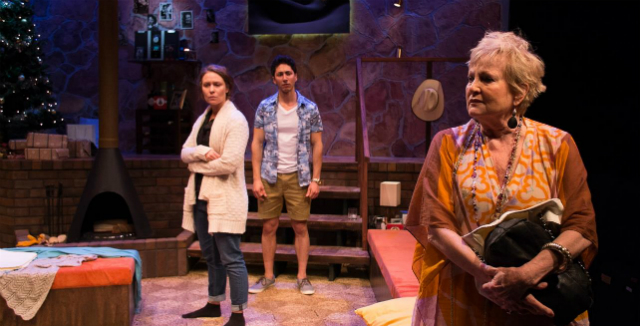
Douglas sacrifices every dollar on flights to Europe. He seeks to rekindle a week long romance with Barbara who had visited Australia briefly. Douglas believes that his life would be perfect if he wins her over. Barbara is perplexed that a flippant moment from the past has returned to haunt her. Douglas is surprised by her reaction and says repeatedly that he would leave, but misses every train. Michael Gow’s script is a comical love story, and a meditation on Australian whiteness. It examines tenuous connections with a motherland, and the existential angst of the castaway. James Beach’s direction is thoughtful and gentle. The duplicitous nature of the narrative is conveyed successfully, and the minimalism of his staging creates a tenderness that reflects Douglas’ internal complexion. There is a languidness that detracts from humour in the early scenes, but the resulting show is an elegant one that speaks intelligently, with an openness that welcomes interpretation.

Pippa Grandison is suitably continental in her approach. She succeeds in portraying the foreignness of Barbara, and her conscious efforts at creating a sense of exotic otherness is well considered and entertaining. Barbara is a stage actor, and Grandison could benefit from playing up her theatricality further, especially in the early segments where more energy could be put into the comedy of the characters’ encounters. Aussie country boy Douglas is played by Andrew Henry who uses just enough stereotyped conventionality to depict cultural relevance, but more appealing is the authentic naiveté he brings to the role. Henry’s work is confidently simple, which ensures that small gestures speak volumes, and dialogue is allowed to resonate. It must also be noted that his performance of intoxication at the play’s conclusion is completely delightful.

Romance provides spice to life. We long for attention and adoration to be reciprocated, so that some kind of affirmation can be established, but that attainment is only temporarily satisfactory, for romance is a need that can never be sated. As long as we keep thinking of ourselves as a chip off the old block, or as the apple that has fallen a little too far from the tree, we will forever be an inferior echo that fails to be its own self determining entity. There is much to love about our own place on earth. We need to acknowledge our histories but we need to make the best of the here and now, wherever we may be.

www.slipofthetongue.com.au

Review: Other Desert Cities (Ensemble Theatre)

ensembletheatreVenue: Ensemble Theatre (Kirribilli NSW), Sep 4 – Oct 18, 2014.
Playwright: Jon Robin Baitz
Director: Mark Kilmurry
Cast: Lisa Gormley, Deborah Kennedy, Diana McLean, Stephen Multari, Ken Shorter

Theatre review
It is Christmas time and we visit the home of an older Californian couple, both prominent figures from the right wing of politics. Polly and Lyman Wyeth are not always politically correct, but their self awareness gives them an air of relaxed charm. Their children Brook and Trip have arrived for the festivities, but we soon discover that all is not well. Brook is set to publish a tell-all memoir and takes the opportunity to reveal the book to her family. Jon Robin Baitz’s Other Desert Cities, is a tale about the damage our closest ones inflict upon us, family secrets, and the stories we dream up in place of missing pieces. We keep the truth from one another because we think that people need to be protected, and also because of shame. We can choose our friends, and run away from them when intimate revelations become problematic, but family ties are hard to break, so we keep the peace, by perpetuating lies.

Baitz’s script is classically structured. It is amusing, gripping and surprising, with the potential to be incredibly moving. Its themes of family disintegration, mental illness, regret and guilt are all loaded with sentimentality, and when handled well, could be heartbreaking. Mark Kilmurry’s direction brings out the dramatic conflicts of the story with some success, but tension does not build up sufficiently. It is an energetic show, with good amounts of shouting and crying, but the plot does not always engage. The cast seems to be discordant, each finding separate emphases, and their chemistry does not quite convince.

Lisa Gormley invests heavily into her character’s depression and her torment is clear to see. Her early scenes before confrontations begin, feel forced and inauthentic, but her work in the second act is the show’s saving grace. Ken Shorter’s naturalism is a joy to watch. His presence is genuine and strong, but he brings a warmth to the role that does not always serve the narrative well.

Ailsa Paterson’s set design confines the Wyeths in the 1970s. Their home is dated, and we see that they have not moved on for over twenty years. We live the consequences of our decisions, good or bad. There is no assurance that doing the right thing would lead to brighter days, but the Wyeths’ story gives hope that resolutions can be found if you try hard enough.

www.ensemble.com.au