Review: V.D. (Copanirvana Theatre Co / Sydney Independent Theatre Company)

sitco2Venue: Old Fitzroy Theatre (Woolloomooloo NSW), Oct 28 – Nov 15, 2014
Playwright: Pete Malicki
Director: Lisa Eismen
Cast: Eliza St John
Image by Katy Green Loughrey

Theatre review
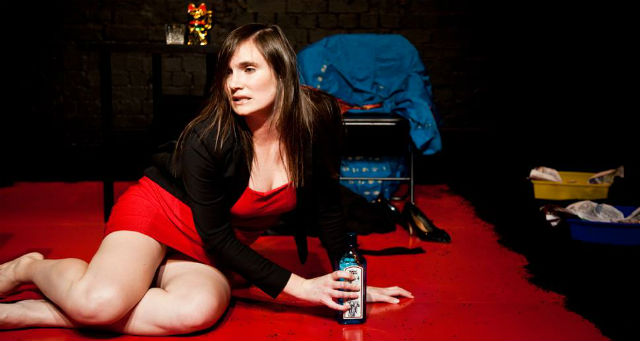
This is a story about a woman in love only with two things; herself and alcohol. Pete Malicki’s script is crafted with some skill. His jokes are incessant, and timed with a natural flair. His characters are abused and ridiculed, and no one is presented in a positive light. There is very little beauty and inspiration in the play, but it has a humour that will appeal to many. It is a harsh truth that Australians find alcohol funny. We laugh at people making destructive decisions and falling over due to drunkenness, and V.D. capitalises on that unfortunate part of our culture. It also takes advantage of the fact that making women desperate and dateless gets laughs easily. Sophie Webb is hopeless, almost idiotic, but she is not unrealistic, and of course, our artistic landscape must make room for all kinds of characters no matter how undesirable.

The script is skilfully executed by director Lisa Eismen and actor Eliza St John. Presentation of the comedy is wide ranging, from the very broad to the very subtle. Character development is sometimes uncomfortable in the plot, but the women manage to create a narrative that is often believable, although the show’s ending is quite bewildering. St John’s performance is masterful. She is wild, intuitive and considered, with a conviction that can turn water into wine. Her work is completely absorbing, and she manages to endear herself to her captive crowd, like using sleight of hand techniques to mask the hideous uselessness of the woman she portrays.

The world can be an ugly place, and it is necessary to know its flaws. The theatre is not reserved for snowdrops and daffodils, and artists must not be censored, but audiences look for morals in stories, and maybe even find meaning in listening to what is being said. What V.D. articulates is sometimes true, but also very sad indeed. Life is worth living because of hope, and we need to acknowledge the darkness that we live with, but we must always recognise it as such.

www.sitco.net.au

Review: Blue/Orange (Ensemble Theatre)

ensembletheatreVenue: Ensemble Theatre (Kirribilli NSW), Oct 23 – Nov 29, 2014.
Playwright: Joe Penhall
Director: Anna Crawford
Cast: Ian Meadows, Dorian Nkono, Sean Taylor
Image by Clare Hawley

Theatre review (originally published at Auditorium Magazine)
Health services are a crucial part of all civilisations, where access to medical professionals is a basic human right, regardless of class and creed. The subject of mental health is a growing area of concern in the West, with awareness and understanding of relevant issues fast improving through our communities. Joe Penhall’s script centres around Christopher, a mental health patient with the UK’s National Health Service. Surrounding him are two doctors, Bruce is the younger of the pair, idealistic but naive, and Robert is the authority figure of the hospital, seasoned and carnivorously ambitious. A fight ensues with Christopher caught in the middle, and as the plot unfolds, the play’s themes expand simultaneously. Christopher’s African ethnicity and low social status are the linchpin that brings into discussion, not just the intriguing process of psychiatric diagnosis and the health industry in general, but also race relations in contemporary settings and the machinations of authority (and its betrayal) in our daily social structures.

The ideas are big, but Penhall’s story is precise and simple. His captivating dialogue is rich with humour, controversy and intellect, consistently entertaining our senses and challenging our ethics. Some portions could be more succinct, but Penhall’s words and their rhythms are brilliantly crafted, as evidenced by the thrilling and energetic narratives that the show’s cast and director are able to create from the text. Anna Crawford’s direction is decidedly wonderful. The comedy of the piece is powerfully delivered, and the immense joy of being in an auditorium with laughter erupting at every turn is simply theatrical magic. Crawford introduces a daring freedom that encourages her actors to make risky choices, and much to our delight, they all seem to work. Likewise, the many scenes of altercation are loaded with explosive drama, always with a threatening tension and dangerous intrigue. Philosophical and ethical arguments in the work are the ingredients that make it feel substantial, and they are perfectly tuned, disallowed from disrupting dramatic flow, but often given an ambiguity that makes the ideas seductively confronting.

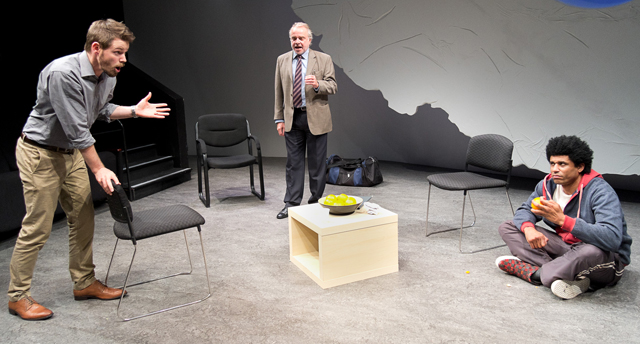
The use of space is however, not always elegant. Actors are frequently positioned so that their facial expressions are not available to big sections of the audience, which can be frustrating as well as distracting. Set pieces are composed of generic furniture elements from public sector offices, all terribly unattractive. The space has not been designed to be a realistic one, yet the several chairs and tables seem to use the notion of realism or accuracy as a convenient justification. A work of this calibre requires greater imagination and creativity in its visual design, and not be allowed to pale in comparison.

In the role of Robert is Sean Taylor, whose virtuoso performance bears the kind of astonishing glory that leaves a lasting impression. The most dangerous villain is the one who combines truths with lies, so that you are kept on his side, giving him benefit of the doubt until too late. Taylor makes it hard for us to know if his character is an evil racist doctor, or a progressive thinker, and our struggle in trying to figure him out is a masochistic pleasure. The actor is full of confidence and his presence is all-consuming; we cannot keep our eyes off of him. Taylor’s marvellous voice provides all that we need to know, and his face expresses everything his character wishes, but also contradicts the doctor’s intentions.

The show is thoroughly rehearsed, with every actor appearing to know exactly what they wish to achieve, yet the stage feels to be a spontaneous one. Dorian Nkono is extremely lively and likeable as Christopher, the patient who may or may not be schizophrenic. Nkono’s control over his physicality and the way he uses movement enrich the role and provide a vibrant energy that elevates the play to a level of theatre that is more than words. His sense for comedy is outstanding. Nkono is a truly funny actor whose approach ranges from subtle to slapstick, but an emphasis on storytelling makes his work authentic and compelling.

The young Dr Bruce is played by Ian Meadows who has the arduous task of maintaining composure as the only unassertive personality in the show. He often gets overwhelmed by his gargantuan counterparts, but he resists irrelevant exaggeration, and delivers a performance that is ultimately a truthful one. Meadow’s work is less flamboyant, which means that the ideological arguments he represents can get subsumed at certain points, but he manages to find a climax at the concluding moments to match in energy and produce an impressive ending to the piece.

Racism and mental illness are contentious issues that elude easy definition. We understand them in abstraction, but how they are discussed and dealt with in reality involves constant negotiation between vacillations of subjectivities. In Blue/Orange,  the powerful and the powerless collide in a system that attempts to be fair, just and democratic. We might all want the best for the world that we share, but our perspectives are different, and finding agreement on a unified destination becomes problematic. The doctor should know what is best for the patient, but the patient is not without rights and opinions. In assigning authority to some, society risks the removal of rights from others, but the ironic creation of power structures seems to be the only mechanism we have for finding harmony.

www.ensemble.com.au
Review: Five Women Wearing The Same Dress (Act IV Theatre Co)

activtheatreVenue: TAP Gallery (Darlinghurst NSW), Oct 28 – Nov 2, 2014
Playwright: Alan Ball
Director: Deborah Jones
Cast: Nadim Accari, Kaitlin DeLacy, Chloe McKenzie, Eleanor Ryan, Melinda Ryan, Wendy Winkler
Image by Tim Levy

Theatre review
Weddings are traditional affairs that expose the roles that we play for others in daily life, and our obligations as friends and family members. Participation in weddings often involves some level of reluctance, and most would probably prefer to be some place else doing something less painful. Alan Ball’s fabulous script is about the interactions between five bridesmaids after a wedding ceremony. The women have distinct personalities, with nothing in common, except for the hideous purple dress forced onto their bodies, and an unconcealed dislike for the bride. The play’s context positions the women in relation to the concept of marriage, and we observe how the supposed universal ideal of matrimony is no longer relevant to modern lives. Ball’s fascinating characters reveal their individual idiosyncrasies and it becomes clear that fulfilment and happiness might have little or nothing at all to do with marriage.

Ball’s writing is entertaining, whimsical and punchy. The charming language of the American South is showcased beautifully, and the women’s lives are vividly imagined, with a familiarity that allows us to find points of association. Their worlds seem real, because Ball exposes their imperfections in a way that demonstrates a humanity that we can relate to. Direction of the work is provided by Deborah Jones who brings a clarity to narratives and motivations. She keeps energy levels high, but there is a stasis to the atmosphere that prevents the show from providing a more dynamic experience. The comedy is written well, but it is not a uniformly strong cast, so the results of delivery are mixed and chemistry is not always fine. It must be noted that although some performances are less effective, every actor is clearly full of conviction and focus, and the stage is always an engaging one.

Eleanor Ryan is outstanding in the role of Mindy, a jovial lesbian who exemplifies the liberated individual in a world overrun by peer pressure and broken promises. Ryan’s comic timing is a highlight of the production and her creation is the most endearing of the group. Her style is much more flamboyant than her colleagues, but she retains a grounding authenticity that keeps her character believable and interesting. The complex role of Georgeanne is played by Wendy Winkler, who captivates with a clever blend of tragedy and irony. Her depiction of strength and optimism in the role’s banal existence is delightfully inspiring.

This is a play about women from a man’s perspective, and even though it is debatable if the writer knows the gender well, he certainly does understand the human condition. The anxieties it expresses and the desires it explores are absolutely real for many of us. Five Women Wearing The Same Dress often feels like light entertainment, but what it leaves behind is altogether more deep and meaningful. We think about the choices that present themselves, and the ones that seem elusive. The decisions that we make shape the life that we live, but so do the circumstances that seem to be beyond control. When a wedding invitation arrives, one can only choose to accept or decline, but to respond with honesty and truth is infinitely more perplexing.

www.activtheatreco.com

Review: Once (The Gordon Frost Organisation / Melbourne Theatre Company)

Venue: Princess Theatre (Melbourne VIC), from Oct 1, 2014
Playwright: Enda Walsh (based on film by John Carney)
Music & Lyrics: Glen Hansard, Markéta Irglová
Director: John Tiffany
Cast: Tom Parsons, Madeleine Jones, Anton Berezin, Ben Brown, Gerard Carroll, Colin Dean, Brent Hill, Keegan Joyce, Amy Lehpamer, Jane Patterson, Greg Stone, Susan-ann Walker,
Images by Jeff Busby

Theatre review
Once is probably not the first musical that makes understatement its central intention, but it is certainly the most celebrated of the kind. Enda Walsh’s quietly sentimental work is not ambitious in a conventional sense. There are no stunning set changes or breathtaking costumes, nobody dies and no predictable resurrections occur. Instead, it is determined to find poignancy and emotional resonance through story, characters and songs. There is a distinct and appealing simplicity to Glen Hansard and Markéta Irglová’s musical compositions that make an impact in the absence of ostentatious spectacle, and Walsh’s ability to create affable yet colourful personalities make for a show that is powerfully endearing.

Direction by John Tiffany is sensitive to the melancholic sensibilities of the work, although the presentation of a large scale production in muted tones is sometimes clearly challenging, especially in the few, but important, scenes where music acquiesces to dialogue. An inordinate amount of versatility is required of the performers, including the ability to play instruments (accompaniment is provided by the cast itself) and in the case of leading man Tom Parsons who is a highly impressive vocalist, but a less compelling actor, several crucial sequences of emotional gravity tend to feel weaker when he communicates without the aid of music. His counterpart Madeleine Jones is more evenly talented, and she executes comedic aspects with an elegant flair. Tiffany handles lighthearted moments brilliantly, allowing an intimate connection with its audience that elevates the musical to something quite visceral, and spiritual.

The humorous role of Billy is played by Colin Dean who has the kind of eclipsing presence that wins our hearts with minimum effort. His authenticity is compelling to watch, and the confidence he displays gives his work an uplifting quality. Also memorable is Amy Lehpamer as the fiery Czech, Reza. Lehpamer is a quadruple threat who inspires with proficiencies in singing, dancing, acting and on the violin. Her comic timing is a marvel, and even though the supporting role is a small one, the vibrant performer finds opportunities to steal the limelight with delightful results.

The production is finely balanced, relying heavily on the shifting elements of live performance on each night to make the experience rewarding, leaving little room for complacency. The silences in the show mean that imperfections can become glaring, even if they are few and far between. Choreography by Steven Hoggett is effective and beautiful at times, but also awkward and overdone in certain numbers. The cast moves well, but when gestures become elaborate, the performers tend to appear uncomfortable. The story of Once talks about art and aspiration, dreams and conviction, and the way life can be designed by one’s own imagination. It swims against the tide with an unusual determinedness and audacity, to create something original, moving and thoroughly surprising.

www.oncemusical.com.au

Review: Henry V (Bell Shakespeare)

bellshakespeareVenue: Sydney Opera House (Sydney NSW), Oct 21 – Nov 15, 2014
Playwright: William Shakespeare
Director: Damien Ryan
Cast: Michael Sheasby, Matthew Backer, Drew Livingston, Damien Strouthos, Gabriel Fancourt, Eloise Winestock, Danielle King, Darcy Brown, Keith Agius, Ildiko Susany
Images by Michele Mossop

Theatre review
As the years pass, we become increasingly accustom to war being a fact of life. Wartime is no longer a set of specific and exceptional circumstances, especially with the proliferation of mass media and the normalisation of conflict as a topic of daily interest. Shakespeare’s Henry V includes the ambiguities and tensions between tragedy and heroism, but four centuries on, we seem no longer able to tell a story like this without letting casualties take centre stage.

Damien Ryan’s vision certainly reflects contemporary attitudes on the essential destructiveness of war. The injured and the dead are not obliterated from our sight, but are left critically present on stage to abate any hint of glory that might surface. The use of symbols and the visual lavishness of Ryan’s work is fiercely thoughtful, almost omnipresent. Space is explored to its creative limits, with the astonishingly dynamic use of bodies, sets and props to convey emotions and concepts. Ryan’s brand of theatre is captivating and exhilarating, but also undeniably sensitive and intelligent. His Henry V is complex but accessible, innovative but unpretentious. It aims to be a theatre for all, catering to aficionados, students and everyone else, encompassing every age and background. Shakespeare’s language is challenging for many, and the director works thoroughly to bring elucidation, although detractors are unlikely to have a change of heart with this text, which is probably one of Shakespeare’s more obscure pieces.

The production is visually beautiful, with accomplished and adventurous work from designers on all fronts. Anna Gardiner’s intricate set gives the stage an intimacy and provides performers with extensive possibilities for inventiveness. Gardiner’s costumes are not extravagant but accurately and astutely conceived, consistently effective in each character transformation and evolution. Sian James-Holland’s lighting design is one of the show’s main features. Her work is ambitious and powerful, at times conveying the plot more completely than other more tangible elements can manage. Also outstanding are music and sound designer Steve Francis’ achievements in his very specific control over atmospherics, and vocal composer Drew Livingston’s many charming and surprising songs accompanying the script.

Clearly, the performances are not the only stars of the show, but this is an undeniably excellent ensemble of actors. The chemistry they have found with each other, and in every scene, is exemplary. There is an athleticism to their creation, assisted by movement director Scott Witt, that is often breathtaking and marvelous to behold. The constant variation in tone and mood that they manufacture gives the production an extraordinarily textured feel. Keith Agius plays the more mature roles and is memorable for the depth of meaning he is able to bring to his lines. It is the gravity and an intensity that he puts into speeches that sets him apart. Matthew Backer shines with a distinct sense of humour that follows his assured presence, and his singing voice is quite sublime. The most vibrant actor will always leave an impression, and on this occasion, it is Damien Strouthos who wins us over with his agile, flamboyant and impossibly energetic approach.

It is clear that Shakespeare is revered internationally, but the universality of his writing is arguable. As societies become more aware of ethnic, gender and other differences in experience and background, it becomes less likely that any artist can claim to be relevant to everyone, but theatre is in a unique position of sheer proximity where it has the potential to move and touch, in a visceral manner. Shakespeare’s words might not always make sense, but what it gives birth to, is often blisteringly remarkable.

www.bellshakespeare.com.au

Review: Anyone Can Whistle (Sydney University Musical Theatre Ensemble)

museVenue: King Street Theatre (Newtown NSW), Oct 15 – 25, 2014
Book: Arthurs Laurents
Music & Lyrics: Stephen Sondheim
Director: Olivia Aleksoski, Alexander Andrews
Cast: Dani El-Rassi, Sarah Gaul, Curtis Gooding, Jordan Shea, William Wally Allington
Image by nick&nick Photography

Theatre review
Stephen Sondheim’s 50 year-old musical still works. Its themes of corrupt governments and the gullibility of humankind remain relevant, and the farce constructed around those societal issues make for scenarios that are amusing yet meaningful. Sydney University Musical Theatre Ensemble’s production might be an amateur one, but it features the vibrancy and enthusiasm of its young members that impress despite inadequate training and an overall lack of sophistication. The five-piece band headed by Music Director Douglas Emery delivers scaled down but punchy accompaniment that delights us with a sparkling joyousness, even if accuracy and cohesion can be improved.

Choreography by the ambitious Louise Flynn is loud and exciting, with the cast’s varying levels of dance ability utilised intelligently. Flynn has a keenness for theatricality and a lot of fun, which manifests effectively on a stage that is consistently colourful and dynamic. India Cordony as Police Chief Magruder takes every opportunity to inject comedy into her dance, and the results are outrageously memorable. Aidan Kane’s physical discipline pays off with a polish and professionalism that helps him stand out from the chorus line.

Dani El-Rassi and Jordy Shea are fiercely committed in their roles, and both present moments of brilliance that will further improve with greater confidence. William Allington as Treasurer Cooley is also engaging, with an effortless charm that keeps his performance buoyant. The show’s biggest parts are demanding, and not satisfactorily created on this occasion. Their love story is a substantial piece of the plot but the desperate shortage of chemistry between actors is quite painful to watch.

The work is directed by Olivia Aleksoski and Alexander Andrews who have used their wonderful troop of stars cleverly. Each personality is given room to shine, and although the show’s plot is not always clear or affecting, the energy that bubbles on stage is always refreshing. The miracles that happen in the story might have been fabricated, but it should be remembered that most artists are also faking it… until they make it someday.

www.museatusyd.com

Review: Kryptonite (Sydney Theatre Company)

sydneytheatrecoVenue: Wharf 1 Sydney Theatre Company (Walsh Bay NSW), Sep 11 – Oct 18, 2014
Playwright: Sue Smith
Director: Geordie Brookman
Cast: Ursula Mills, Tim Walter
Image by Lisa Tomasetti

Theatre review
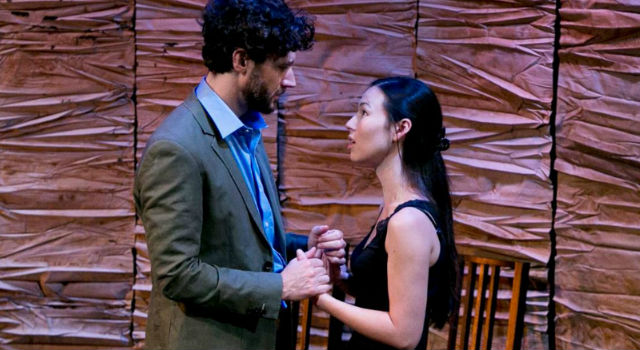
Through an international love story, Sue Smith’s Kryptonite examines the relationship between the personal realm and our wider circumstances. When Lian first met Dylan at an Australian University in pre-Tiananmen 1989, she was a new immigrant from China and Dylan had looked every bit the quintessential middle class Australian preoccupied with surfing and student protests. Over the years, Lian returns to Dylan for a series of brief but dramatic encounters, and by 2014, they are almost entirely different people, and we question if the countries from which they emerge, have evolved correspondingly, into virtually unrecognisable entities.

Freedom, idealism and innocence are put through the wringer in Smith’s play, in which we witness the ravages of time on the beauty of youth. Growing old is a tragedy, but not because of the inevitable deterioration of flesh. It is what happens to the heart and soul as time wears on, not just for each person, but also for the worlds in which we dwell. We cannot travel back in time, and our nations will never revert to a purer state. Indeed, the past is painted as though through rose-coloured glasses, but it is a persuasive picture that Smith creates. In Kryptonite, the loss of our innocence is certain, and sad. Smith’s work is emotional and powerful, with a perspective of our recent histories that feels accurate and is deeply perceptive.

The character Lian is particularly well-written, with an authenticity in speech and sense of humour that is quite outstanding. Performed by the brilliantly astute Ursula Mills, the role becomes thoroughly familiar, even though realistic Chinese women are rarely seen on our stages. She is surprisingly funny, and her motivations in each sequence are concise, keeping us engaged with her storytelling in a plot that can be a little convoluted at times. Mills is required to speak and sing in Chinese languages over the course of the show, but proficiency is lacking although her conviction remains strong. There is an oversimplification in some of Lian’s darker moments, but the actor never fails to bring a delicious fire to the drama when required. Also captivating is Tim Walter who is yin to Mills’ yang. Chemistry between the two are not quite exceptional, but they find a harmonious balance that brings great elucidation to the play’s themes and concepts. Walter’s work is thoughtful and confident, but the lightness in his presence, while delightful for the younger Dylan, is a hindrance in several of his graver moments. His depiction of a jaded politician in his late forties is not entirely convincing, but as a young man confused and enchanted by the object of his affections, Walter is charmingly captivating.

Geordie Brookman’s direction retains the challenging nature of the plot’s non-chronological timeline, but provides a good sense of clarity to the narrative. He succeeds in manufacturing a believable romance out of a complex framework of dramatic shifts in time and spaces, but some of the script’s political details are subsumed by his emphasis on pace and rhythms. The show is an enjoyable one. Its scenes are dynamic and unpredictable, always introducing fresh elements to ensure a gripping experience. Design aspects are not greatly ambitious, but they help tell the story with efficiency and elegance.

Kryptonite talks about how we have changed as nations of people, but its views of China are more exacting than how it sees its own country. The Australian play shows the evolution of a foreign land through its distinct junctures of transformation, but it is less brutal with its self-reflection. Yet again, we find meaning through the definition of an other, but this time, we move focus from our perverse European obsession to a place closer to home. China is a significant trading partner, with an astronomical rise in recent times that sees its influence spread across the world, not only in monetary terms, but also cultural and social. The first officially recorded Chinese migrant arrived in 1818 and today, Australians with Asian heritage number at 2.4 million. While we still seem to avoid it like a comic hero avoids a mythical adversary, the importance of finding a way to articulate that experience and relationship is impossible to overstate.

www.sydneytheatre.com.au

Review: Calpurnia Descending (Sisters Grimm / Sydney Theatre Company)

sistersgrimmVenue: Wharf 2 Sydney Theatre Company (Walsh Bay NSW), Oct 9 – Nov 8, 2014
Playwright: Ash Flanders, Declan Greene
Director: Declan Greene
Cast: Paul Capsis, Ash Flanders, Sandy Gore, Peter Paltos
Image by Brett Boardman

Theatre review
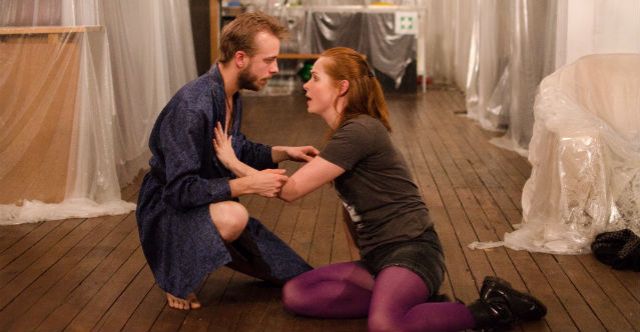
Calpurnia Descending borrows heavily from the 1950 Hollywood films, All About Eve and Sunset Boulevard. With an exploration into the evolution of show business and media, we observe that artifice and female rivalry persist as dominating themes that shape our consumption of popular culture through the years. Ash Flanders and Declan Greene’s script is a decadent high camp romp that exercises its creators’ eccentric and original vision, with a resulting beast that is more about heresy and iconoclasm than it is about entertainment or storytelling. In spite of its meaningful central ideas, the work does not aim to deliver poignancy but is interested instead, in unusual perspectives of theatre and innovative modes of experiencing live performance.

Half of the show is seen on a cinema sized screen. We can hear sounds from the live action emanating from behind the projection, so we know that the actors are creating the show in real time, but the significant length of the filmic portion means that it feels strangely close to being at the movies. It is understandable that Greene, as director, chooses the video format to discuss our obsession with screens big and small, but placing the production in a theatrical context is a curious decision, given the obvious affiliation with film and its possibilities. Nevertheless, Greene’s work is vibrant, colourful and thoroughly quirky, often with an air of vaudeville permeating the atmosphere. He is sensitive to energy levels, and although the show’s sense of humour is specific, he maintains a pace that is tight and lively, ensuring an amusing experience for most audiences.

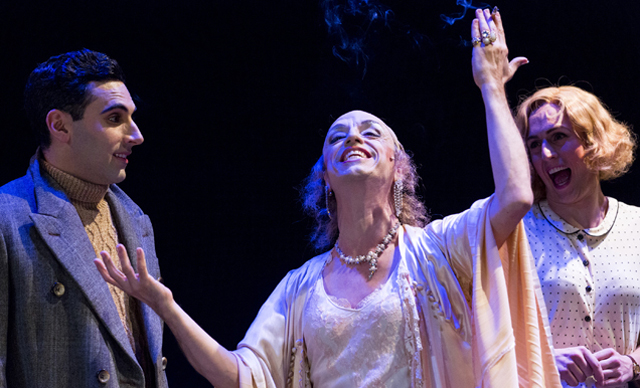
Paul Capsis does his best Norma Desmond in the role of Beverly Dumont, a star of the Broadway stage poised to make a sensational comeback at the ten-year anniversary of her misreported death. Capsis brings a drama and grandiosity that the part requires, along with excellent comic timing and a gripping presence. The role is simple, but the actor’s work is beautifully complex, adding gravitas to something that is determined to revel in its silliness. Calpurnia Descending‘s version of Eve Harrington is the duplicitous Violet St Clair, played with mischievous exuberance by Flanders whose wide range of camp extends from delightful to macabre. The actors form a strong and balanced team in their portrayal of a malevolent sisterhood, but not much is made of the inevasible drag element. There is no obvious commentary that arises from the casting of male performers, and the production would not present too differently without it, so perhaps a point is made about the irrelevance of gender in the narratives we weave.

At a time when some of us can spend virtually every waking moment in front of a screen of some description, the production should be able to provide some resonance with its interest in the way we relate to mass media and its celebrities, but its preoccupation with depicting shallowness prevents us from connecting in an authentic way. Be that as it may, the show is memorable for being adventurous and rich with original thought, and it is the artists who dare to push the boundaries that we must value the most.

www.sydneytheatre.com.au | www.sistersgrimm.com.au

Review: Kill The PM (Unhappen)

unhappenVenue: Old 505 Theatre (Surry Hills NSW), Oct 8 – 26, 2014
Playwright: Fregmonto Stokes
Director: James Dalton
Cast: Nicholas Hiatt, Zoe Jensen, Michael McStay, Lily Newbury-Freeman
Image by Lucy Parakhina

Theatre review
We must not take our democracy for granted. It is a key element to meaningful lives, as it insists that every person and their liberties are included. The ideal is a world in which everyone has an equal say, even if we end up with a messy and inconvenient state of affairs, but today’s reality sees a grave inequality of power and influence. As Australia becomes increasingly capitalistic, previous notions of a classless society are quickly eroded, acquiescing to the dominance of the 1%. Our leaders are still democratically elected, but there is no camouflaging the fact that prevailing ideologies of government are disproportionately geared towards the benefit of the wealthiest. One person may still receive one vote, but our voices do not carry the same weight, and the loudest have proven themselves to be the most selfish.

Fregmonto Stokes’ Kill The PM is inspired by the fantasy of the masses, and begins with the most simplistic of ideas. The assassination of a leader is a proposition symptomatic of the disquiet that citizens experience, but the play does not indulge extensively in that premise. Instead, it explores the absurdity of the suggestion that the murder of one person is all the revolution that is required to cause an effective change in the way our nation carries on its business. Stokes’ writing has a sense of wildness that is dramatic and exciting, with surrealist aspects that keep us intrigued. There are unexpected ambiguities which make the script rich and thoughtful, but its narrative structure falters at certain junctures when a more poetic approach takes over. Stokes’ work is thought-provoking, but it has an uncomfortable gentleness that contradicts its powerful subject matter.

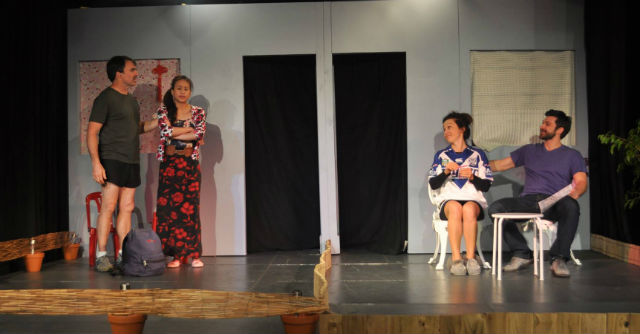
Direction of the piece by James Dalton suffers the same shortage of aggression. The characters are blinded by passion but what happens on stage is oddly subdued. The cast does not portray sufficient conviction for the story to take hold, and their relaxed disconnection from the plot (and each other) is frustrating. This is a story that should speak to anyone who is even remotely interested in politics, but none of the players manage to find points of resonances for the contentious issues being discussed.

Fortunately, the production shifts gears in the middle, giving up its unsuccessful naturalism for a spectacular theatricality in a series of dreamlike sequences. Dalton’s strengths with visual aesthetics and his talent at manipulating atmosphere rescue the show to some extent, although its core messages would benefit from greater elucidation. It is the formidable design team that shines in this production, with Dylan Tonkin’s set leaving the greatest impression, having given the venue an extreme transformation with daring innovation, excellent taste and a sophisticated flair. Benjamin Brockman’s lights are another highlight, cleverly adapting to the theatre’s unconventional facilities, and using gadgets that function charmingly as set pieces in addition to providing interesting illumination.

Kill The PM suggests that the elimination of any single person or group would not be advantageous, regardless of how blood thirsty our primitive selves can be. We see the importance of community in the process of affecting policy changes, but also the difficulties in locating ways that people can unite to find strength and commitment. Having a voice in any political climate is challenging, and it is only as collectives that we will be heard. The theatrical arts are fundamentally collaborative, and we must value the egalitarianism that allows individuals to come together to create and to speak. Regimes come and go, but art endures, and at the theatre, the subversive can find expression, and sometimes, have an impact.

www.unhappen.org

Review: It’s War (Bulldog Theatre Company)

bulldogVenue: Factory Theatre (Marrickville NSW), Oct 9 – 19, 2014
Playwright: Alex Lykos
Director: Alex Lykos
Cast: Jenny Apostolou, Chris Argirousis, Marissa Marie Kaye, Janette Lakiss, Ben Maclaine, Maria Tran

Theatre review
Note: This review reveals a key plot twist.

Discussions about race never seem to cease in Australia. Our history of migration over the last 226 years has seen a multiculturalism that has required constant arbitration and re-imagination. In our theatre landscape however, these discussions are few and far between, with an Anglo-Saxon culture persisting with its dominance in production and output. Alex Lykos’ It’s War attempts to shed light on racial relations at a grass roots level, with a story about neighbourly altercations involving characters from diverse ethnicities. We live in a time where the representation of that diversity is usually suppressed in mainstream media, as the depiction of difference can often be interpreted as malicious. Faces of “minorities” are presented occasionally, but they are discouraged from displaying modes of behaviour that may be too idiosyncratic. The notion of colour-blindness is well-meaning, but it tends to institute a kind of assimilation, reducing differences to a generic beigeness that serves as an image of a unified nationhood.

Lykos’ show however, exaggerates our differences by amplifying racial stereotypes, which is uncomfortable viewing for our political correct sensibilities, but also thoroughly amusing. It is challenging to laugh too heartily at a script that characterises Vietnamese women as dog-eating mail order brides, Indians as smelly curry munchers, “Aussies” as spineless, and Greek men as adulterous closeted poofters. We strive hard in our daily lives to distance ourselves from such misrepresentations, but Lykos’ efforts at finding universality through gross overstatements for every character is an interesting proposition, and because no one is spared his distortion, the show’s comedy becomes almost feasible.

Maria Tran approaches her role Ngoc Bich with an extremely coarse, but hilarious, interpretation of the recent migrant. Tran is the only actor who puts on a speech accent that is drastically unlike her natural voice, presumably because the character has only spent five years in Australia. It is debatable whether making Ngoc Bich a mail order bride actually helps with the plot but nevertheless, Tran provides many of the biggest laughs of the production with her impressive comic abilities, and enthusiasm for the stage. Also memorable is Jenny Apostolou as Soula, who creates the only realistic personality in the play. Apostolou brings an authenticity that is otherwise missing in the show’s lampoonery tone, and her reassuring presence gives a professional polish to her work. Performances in general are funny, if a little uneven, but cast chemistry is strong, displaying a good level of camaraderie and trust.

The work is neither sophisticated nor subtle, but its structure is taut and every scene is engaging. There is a vibrant energy in the writing and also in its performances, which help moderate some of the more alienating and controversial touches of the script. “Can we all get along” is Rodney King’s immortal quote from the 1992 Los Angeles riots that has found resonance the world over, and that simple message is just what It’s War wishes to say.

www.bulldogtheatre.com