Review: Thom Pain – Based On Nothing (Sydney Independent Theatre Company)

Auditorium_American-issue_TVenue: Old Fitzroy Theatre (Woolloomooloo NSW), May 5 – 10, 2014
Playwright: Will Eno
Director: Julie Baz
Actor: David Jeffrey

Theatre review (originally published at auditoriummag.com)
Thom Pain (Based On Nothing) is about fear, loss and loneliness. Will Eno depicts a state of sadness that is genuine in its erratic complexity, but also joyful and humorous in its profound observations. Thom Pain is a man who has experienced disappointments, and he knows what betrayal and injustice feels like. Eno’s script expresses the process that one needs to go through in order to emerge renewed and strengthened, but Pain has not yet found that enlightenment.

His struggle is the flesh and blood of this work, and a representation of a condition of being that is too easily forgotten. The human capacity to leave pain behind after it subsides, makes this a valuable piece of rumination. We get over things and move on, but Pain’s very presence demonstrates some of the intricacies of our coping mechanisms, and watching them in action is fascinating. The writing has a rambling incoherence that seems theatrical, but also poignantly realistic. We are rarely clear of mind at troubled times, and Eno utilises that natural inability to make sense of things, to great dramatic effect. Everything is strange yet familiar. The audience observes the peculiarity of Pain’s behaviour, while feeling a close affinity to the character.

Thom Pain (Based On Nothing) is a work of art that cuts deeply and meaningfully, revealing an image of our own humanity through a mirror that is rarely uncovered. It is also a work of excellent entertainment, with performer David Jeffrey providing the one-man show considerable pathos and a very charming whimsy. In spite of his considerable actorly talents, Jeffrey brings a quality of diffidence to the stage that gives his character an authenticity that we not only warm to, but almost feel protective towards. The text’s unconventional structure risks alienating its audience, but we care for the man Jeffrey creates, and he makes us sit and listen intently.

He is very funny, and very wry. He wallows, but he is also self-effacing. He plays with our emotions, taking them on an unpredictable and haphazard journey, to all the spaces we messily label “mixed emotions”. Jeffrey’s achievement however, goes further than succeeding in making us laugh and cry. The actor’s portrayal of melancholy is so charged with vulnerability, it reminds us of feelings we bury deep within. The same ones we can sense in our bodies almost everyday but are rarely allowed to surface. Jeffrey makes that pain emerge with a quiet wonder, and in the safety of the theatre, we encounter the closest friend of all, our own broken hearts.

Melancholia is the overriding tone, and perhaps theme, of the show. Director Julie Baz creates an atmosphere thick with moody pensiveness, and it is seductive. The evocative and beautiful underscoring music is a selection of pieces from Sergey Akhunov’s Big Elegy To John Cage, which contribute greatly to the production’s introspective texture. Melancholy visits us all and people relate to it in different ways, ranging from repulsion to pleasure. Accordingly, the production’s appeal would vary according to tastes, but the liberal amount of comedy intelligently added to Baz’s weighty microcosm, ensures that the work speaks to many.

It is often too easy to overindulge in lengthy well-written passages, putting too much trust on the words to work their own magic. Baz is conscious of the pitfalls of extended monologues and wisely encourages the actor to embellish with movement, both exaggerated and subtle, resulting in a performance that is energetic and optically dynamic. The use of space is similarly active, but stage design is overly minimal due to Eno’s specifications. He believes that “there is a humility about theatre and life in the script; it should be there in the production, too.” This is a persuasive argument, but it is also true that the script could benefit from greater visual flourish and imagination. Pain talks about magic, and there are moments where our eyes wish for something slightly fantastical to materialise.

The view inside Pain’s mind is bittersweet, truthful, and scarred, and therefore beautiful. His story is hopeful, yet he seems oblivious to the good around him, and inside of himself. Blinded by fear and dejection, he is a whirling dervish in search of salvation. For us, his magnificent dance is a spiritual lift, and we desire only the best for him, in the trust that a new dawn is always on the approach.

www.sitco.net.au

Review: Event For A Stage (Carriageworks)

rsz_10296577_10154052802420464_5556522318690470678_nVenue: Carriageworks (Eveleigh NSW), May 1 – 4, 2014
Artist: Tacita Dean
Actor: Stephen Dillane

Theatre review
English visual artist Tacita Dean’s Event For A Stage is her first work in the “live theatre” medium. Unsurprisingly, the piece is not concerned with theatrical conventions, and it certainly places no interest on the fabrication of a narrative. The rectangular stage is surrounded by audiences on all 4 sides, and Dean, the artist sits front row with us, in a darkened corner. A big chalk circle is drawn on the stage, with two people operating a film camera within the circle, and another two people outside of it. A microphone is suspended from the fly bars into the middle of the circle. For the duration of the 45-minute work, the actor Stephen Dillane walks around the stage, usually following the chalk line, but uses regular disruptions to the circular stroll to create a sense of action or to emphasise certain points in his monologue.

Over the course of the performance, Dillane walks up to Dean and obtains, with visible resentment, sheets of theatre and performance theory, which he reads aloud, effectively using them as scripts. The writing is insightful and fascinating, and Dillane’s interpretation of them is thoroughly compelling. In addition to Dean’s sheets of paper, Dillane also gives us coherent and interesting accounts of conversations he has had with the artist, or about events and people from his personal life. Further, he reads sections from a slim novel he keeps in his pocket, and performs extracts from Shakespeare’s The Tempest. The work however, is not about stories. Its main crux deals with the nature of theatre and performance, the sociology of spaces in a theatrical venue, and the relational dynamics between artists and audiences.

There are layers upon layers of ideas that are touched upon in this deconstruction of performative spaces. Things get complex, but Dillane’s supreme ability to connect, keeps us from confusion or perplexity. One of the main themes discussed relates to contrivances that arise from the convergence of creators and spectators. The presence of film cameras helps illustrate the point, while simultaneously adding to the multiplicity of the artist’s concepts in its obvious extension into other televised or filmic media. Dillane also talks about the danger that sits below the surface of theatrical artifices, and his close proximity from us is a constant threat to our presumption of security, with the cameras amplifying the stakes at hand.

Event For A Stage approaches theatre with concepts and conventions from the visual art world, in a collision of forms that is fresh and exciting. It seeks not to emulate familiar precedents, but like all great works of theatre, it enthrals, intrigues and informs, even if its subject matter (its self) is a little haughty.
 

www.tacitadean.net

www.carriageworks.com.au

Review: His Mother’s Voice (Bakehouse Theatre Company)

rsz_attachmentVenue: ATYP (Walsh Bay NSW), Apr 30 – May 17, 2014
Director: Suzanne Millar
Playwright: Justin Fleming
Actors: Alice Keohavong, Angela Tran, Arisa Yura, Dannielle Jackson, Harry Tseng, John Gomez Goodway, Jonathan Lourdes, Michael Gooley, Monica Sayers, Renee Lim, Isaiah Powell
Image by Tessa Tran, Breathing Light Photography

Theatre review
China’s Cultural Revolution ended officially in October 1976, but its after-effects are felt everyday the world over. Today, China’s influence on the global economy develops rapidly, and the country is now widely known to be Australia’s largest trading partner. According to the 2011 census, 4 percent of Australians identify themselves as having Chinese ancestry, and that number continues to grow. Justin Fleming’s His Mother’s Voice is a story about the Cultural Revolution, and the defection of a Chinese pianist to Australia.

Fleming’s script is colourfully structured. With the story of Qian Liu as a young boy, it sets out to provide a dramatic background of the Cultural Revolution that would assist audiences who might be unfamiliar with that slice of history. When Qian matures and becomes a successful pianist, he takes an opportunity to defect to Australia, and the story takes a turn that allows a more direct connection with its intended audience. Fleming’s focus however resides with the relationship between Qian and his mother Yang Jia, who struggles against all odds to teach her son the piano, in the firm belief that music is integral to their family identity and survival. The universal ties between parent and child is rightly central to the story, as it is a theme that we all have an affinity for.

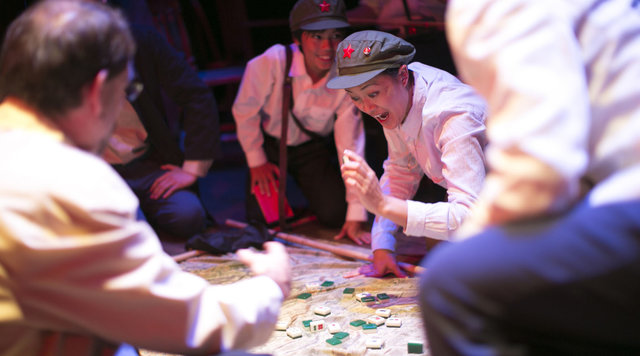
Director Suzanne Millar’s sensitive creation of scenes from the revolution are dynamic and fascinating. Her talent in the use of space and sounds crafts a show that is relentlessly engrossing (lighting designer Christopher Page and sound designer James Colla execute Millar’s vision with great elegance). She has a deep understanding of the audience’s senses, and we are kept entirely under her spell. The stage is kept very busy, but our minds are always carefully guided through all the action with clarity. The show she has built is an entertaining one, but casting issues prevent it from being the moving experience it wishes to be.

Henry Tseng is a perfect visual fit for the lead role, but a lack of authenticity in his characterisation disrupts the crucial relationships Qian has with his mother, and his wife. Without a believable emotional centre, the story is one we hear, but do not feel. Qian’s Australian wife is Emma Fielden, played by Dannielle Jackson. Jackson has a delightful effervescence that brings a necessary lightness to the often heavy going narrative, but can be slightly distracting when scenes require more gravity.

Renee Lim as Qian’s mother Yang Jia, is star of the show. Her performance is powerful yet varied, and her strong presence is consistently engaging. The level of commitment she exhibits is impressive, and it is noteworthy that she exercises restraint effectively on many occasions, although her emotional scenes are unmistakably remarkable. John Gomez Goodway and Michael Gooley both play their paternal roles with excellence, and Alice Keohavong and Monical Sayers are memorable in a humorous scene as bumbling officials negotiating Qian’s farcical reconciliation.

His Mother’s Voice is earnest, and beautiful. It does not always resonate, but it is fiercely captivating. The exoticism involved in dealing with foreign cultures is often tricky, but this production handles matters with respect and dignity. Fleming and Millar are to be commended for looking abroad in their search for artistic inspiration, and for a show that tells us who we are by finding the similarities that lie in the seemingly drastic differences between us and them.

www.bakehousetheatrecompany.com.au

Review: Chroma (The Australian Ballet)

chroma
Venue: Sydney Opera House (Sydney NSW), Apr 30 – May 17, 2014
Choreographers: Wayne McGregor (CHROMA), Stephen Baynes (ART TO SKY), Jiří Kylián (PETITE MORT and SECH TÄNZE)
Image by Jess Bialek

Theatre review
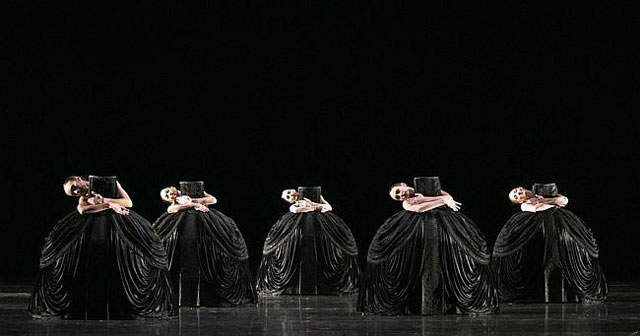
The programme begins with Wayne McGregor’s 2006 work, Chroma. Set against the powerful and aggressive music of Joby Talbot and Jack White III, this very modern ballet is instantaneously captivating. Its exquisite set is designed by John Pawson, evoking sensibilities proffered by the minimalist art movement. Covered in white and with its corners rounded off, the stage glows with a warm and quiet spirituality that finds a strange harmony with the vigorous soundscape conducted by Nicolette Fraillon. The dance creates a new grammar based on the balletic form. It is characterised by a dynamic desire for freedom, and it seeks in movement, the expression of all that is beautiful, emotive, and sublime. Inspired by a concept of nothingness, what transpires is a process of distillation with an outcome that displays honesty and necessity. The dance is fresh and new, but it is at no point hollow. There is an originality in its shapes and tempo that seems completely natural, even though it intends to break new aesthetic ground. McGregor’s earth shattering creation is a true work of art, but more than that, its deeply transcendent quality affects us as though it is by nature, sacred.

Stephen Baynes’ new piece Art To Sky is considerably more traditional. It is impressively technical, and the dancers’ athleticism is wonderfully pronounced here. The most well rehearsed and precisely performed work of the night, it showcases the company in glorious light. Chengwu Guo’s solo sequence is remarkably powerful, executed with great flair and exactness. An exceptionally tender pas de deux featuring Madeleine Eastoe and Andrew Killian is touching in its passionate fluidity, and sensitively embellished by the talents of lighting designer Rachel Burke.

Czech choreographer Jiří Kylián is featured twice. His Petite Mort (1991) is as sensual as the title suggests, but also unpredictable. Surprising movements, coupled with unconventional combinations of the dancers’ bodies make for startling and breathtaking beauty. There is however, a lack of depth with its realisation on this stage. The performers require a more thorough engagement with the work to muster a greater range of subtleties to exalt more life. Kylián’s Sechs Tänze (1986) is a delightful and theatrical creation that is equal parts camp humour and extraordinary choreographic innovation. It is engaging, provocative and endlessly fascinating, and the dancing seems to be particularly enthusiastic for this section. This morsel of genius is undeniably the perfect choice for closing the show on a high note.

www.australianballet.com.au

Review: Cruise Control (Ensemble Theatre)

ensembleVenue: Ensemble Theatre (Kirribilli NSW), Apr 26 – Jun 14, 2014
Playwright: David Williamson
Director: David Williamson
Actors: Helen Dallimore, Michelle Doake, Kate Fitzpatrick, Kenneth Moraleda, Peter Phelps, Henri Szeps, Felix Williamson
Image by Clare Hawley

Theatre review
This review will discuss several key plot details that are controversial and problematic, including the play’s conclusion, which is extremely contentious. If you do not wish to discover specifics of the show, it is advisable that you return to this review after attending the performance.

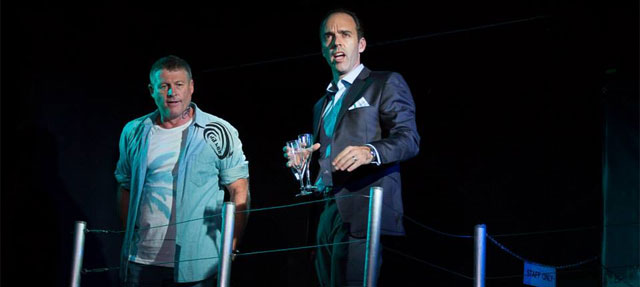
Cruise Control features 3 married couples on a cruise liner, and their service attendant. The travellers are differentiated by nationality, but they are all of Caucasian appearance. All are wealthy, but the show goes to great lengths to demonstrate their individually distinct characteristics, using the most old fashioned stereotypes to set up dynamics. The posh British, the laid-back Australians, and the elderly Jewish New Yorkers.

Felix Williamson plays British writer Richard Manton, the most outrageously offensive character imaginable. He is pompous, insulting, self-absorbed, and slaps his wife in the face. The man has no redeeming features, but the actor’s work is marvellous, providing scene after scene of tension and frisson. Fiona Manton is played by Michelle Doake who does a good job of providing some dignity to a woman who inexplicably remains in love with an awful man who abuses her. She is successful in her career and owns everything in the Manton household, but bizarrely persists with her dysfunctional marriage. At the end of the voyage, we catch a glimpse of her emancipation due to the sudden death of her husband, only to discover that she is plunging immediately into another relationship with a co-worker who has declared his love via the internet. Doake is a strong actor, but not even Meryl Streep can make this turn of events digestible.

Imogen Brodie is an Australian woman, with no vocation or discernible talent. Played by Helen Dallimore who has excellent presence and timing, Mrs Brodie is an attractive wife, who swans around complaining about her husband and flirting with Richard Manton, and eventually serves as the unwitting seductress who causes the death of Manton. The charismatic Peter Phelps takes on the role of dinky di larrikin Darren Brodie. He is irreverent, spends too much time working on his surf wear business, and is more than a little rough around the edges. He might be covered in tattoos and a “Bra Boy”, but because he tells Manton to stop hitting his wife, gives bottles of expensive champagne to service staff, and refuses to wear a dinner suit, he is depicted as the Aussie with a heart of gold. Phelps might be extremely likeable, but having him commit murder at the very end of the play, and inviting applause for it is completely preposterous.

The Wassermans are played by stage and screen veterans Kate Pitzpatrick and Henri Szeps. Aside from inconsistencies in their New York accents, both put on charming performances and provide all the humour that is required of their characters. Szeps shines in his supporting role, with a brilliant playfulness that makes his character endearing and enjoyable. Fitzpatrick is strong in her role, but she does not escape the uniformly poor representation of females in this outing. Silky Wasserman issues several threats to her cowering husband, constantly talking about divorce only to reveal that her menace is empty and frivolous.

It is arguable whether the explicit identification of the Wasserman’s Jewish heritage is necessary, but there is no question that the inclusion of Filipino cruise attendant Charlie, is problematic. Played by Kenneth Moraleda, Charlie seems to exist purely to show some kind of strange altruistic awareness that there are less fortunate people in the world. He does not participate in the main narratives, except to serve alcohol to the main players. We do however, hear about his struggles at making ends meet, which is totally irrelevant to the stories unfolding. Worse still, the guests make a big gesture of a generous gratuity payment when saying goodbye, further humiliating Charlie’s position of servitude. Also inappropriate is Phelps mimicking a Chinese language when on the phone for business dealings. Many in the opening night crowd did find it funny, but it is clearly nothing more than an archaic stunt that is terribly ill judged.

David Williamson’s writing is loved by many, but this latest work does not live up to that adulation. Several flaws in his directing ability are also exposed, most notably with the inelegant use of space, and frequently awkward handling of scene transitions. There is however, good chemistry between all actors, and the plot does communicate clearly at every point. This is a production that is technically accomplished, with every element of design and performance coming across polished and professional, which makes this lost opportunity even more lamentable.

www.ensemble.com.au

Review: Shakespeare’s Reservoir Dogs (The Vanguard)

reservoirdogsVenue: The Vanguard (Newtown NSW), Apr 29 – May 2, 2014
Playright: Steven Hopley (based on the screenplay by Roger Avary and Quentin Tarantino)
Director: Steven Hopley
Actors: Chris Miller, Richard Hilliar, Diego AR Melo, Lukasz Embart, Jerry Retford, Patrick Magee, Leof Kingsford-Smith, Anthony Campanella, Dominic Santangelo

Theatre review
Quentin Tarantino’s 1992 film debut, Reservoir Dogs established him early on as a popular new auteur. Combining violence, humour, popular culture references and non-linear narratives, Tarantino’s distinctive and refreshing style captured the attention of many, and the film has now garnered cult classic status. Steven Hopley’s new adaptation is a faithful yet radical retelling, keeping characters and events intact, but transposing all the “colourful” language of the original into the style of William Shakespeare.

Shakespeare’s Reservoir Dogs script is a thorough rejuvenation that shows an unusual flair and love for the Bard. Hopley’s direction of his own writing is mindful of audiences that might find the new text challenging, taking great care to utilise all his actors’ capacities to stage a show that is surprisingly accessible. This staging understandably features less of the film’s memorable ultra-violence, but its elements of humour are played up considerably to great effect. Hopley does not shy away from opportunities to make light of this “self-parody”. Management of the unconventional timeline is slightly flawed, but the constant referencing of Tarantino’s film is handled with remarkable sophistication, and for fans of the original in particular, this new staging is tremendous fun.

The cast amassed by Hopley and producer Russall S. Beattie is an impressive one. Full of passion and commitment, the men are individually strong performers who have managed to find excellent chemistry within their group. Chris Miller’s playfully flamboyant performance as Sir White provides a firm anchor for the production. He shows a genuine affinity for the material at hand, and is wonderfully entertaining in his enthusiasm. Richard Hilliar, in the role of Sir Orange, has a presence that is consistently dynamic. The actor has an engaging charm and an understated approach to comedy that is delightfully amusing. Anthony Campanella has a memorable soliloquy that he executes with outlandish gusto. His ability to communicate meaning with his Shakespearean lines is second to none. A crowd favourite is the show’s troubadour, played by Dominic Santangelo. He has a license to play the fool, and is clearly not afraid to use it.

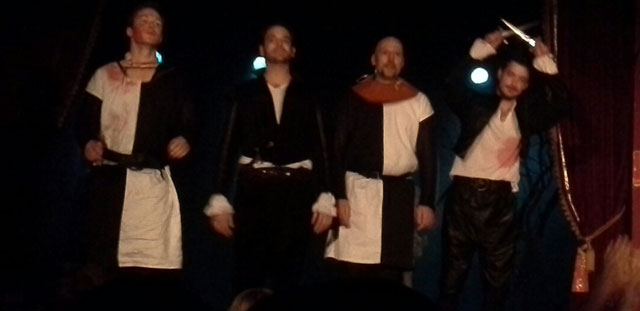
Also noteworthy is Tristan Coumbe’s work as costume designer. Tribute is paid to the film’s unforgettable imagery, of characters in black suits and white shirts. Coumbe’s Tudor style interpretations using modern fabrics, including black leather, contribute not only to the players’ believability, they also convey an interesting sense of time and space in the absence of set pieces. The costumes’ contemporary, sexy edge is a good reflection of the show’s boisterous irreverence.

Familiarity with the film is not necessary, but it would certainly help with enjoyment of this “update”. Many in attendance on opening night responded buoyantly to recreations of classic scenes and celebrated lines. Nostalgia in the air was evident. For those less au fait with Tarantino’s work, the quality of performance by this exceptional ensemble is more than adequate to please any discerning theatregoer.

www.thevanguard.com.au

Review: Pride And Prejudice (The Genesian Theatre)

genesianVenue: The Genesian Theatre (Sydney NSW), Apr 26 – Jun 7, 2014
Playwright: Simon Reade (based on the novel by Jane Austen)
Director: Owen Gimblett
Actors: Jena Napoletano, Chris James, Timothy Bennett, Shane Bates, Christopher Butel, Camilla Vernon

Theatre review
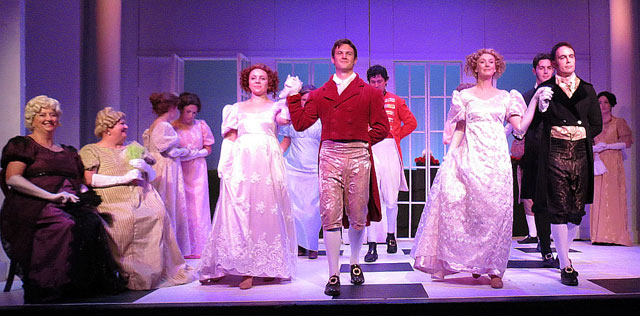
Simon Reade’s recent update of the Austen classic is a witty, swiftly-paced adaptation that caters to today’s impatient audiences and our short attention spans. Scenes are short, and humour is planted at every opportunity with just enough subtlety. The Bennett parents especially, are written with an upbeat playfulness that could provide enough comedy for any viewer who might be less inclined towards old fashioned romance.

Timothy Bennett plays Mr Bennett to excellent effect. He is funny, warm and charming, with a confident demeanour that establishes him as the most proficient performer on stage. Bennett’s comic timing is strongest in the cast, and his every appearance is keenly anticipated. Jena Napoletano shows good commitment as Elizabeth Bennett. She gives her role a delightful presence, and works well with other members of the cast who generally suffer from a lack of experience. It is unfortunate that more roles are not taken up by stronger actors, as the script clearly shows great promise.

Notwithstanding the amateur standard of some character portrayals, the Genesian’s Pride And Prejudice is blithesome and enjoyable. It may not live up to our own imagined versions of the much-loved novel, but it is certainly able to give more than a little enchanting reminder of our endearment for sweet Elizabeth and her Mr Darcy.

www.genesiantheatre.com.au

Review: Attempts On Her Life (Sydney University Dramatic Society / Periscope Productions)

rsz_suds___periscope_present__attempts_on_her_lifeVenue: University of Sydney Studio B (Camperdown NSW), Apr 23 – 26, 2014
Directors: Clemence Williams, Benjamin Sheen
Playwright: Martin Crimp
Actors: Daniel Beratis, Bridget Haberecht, Felicia King, Brittany Lewis, Brendan McDougall, Steffan Rizzi, Julia Robertson, Jack Scott, Harriet Streeter, Leili Walker

Theatre review
The subject matter is brutal, intense and grim. Martin Crimp’s writing however, is not interested in conventional storytelling. He places emphasis instead on exploring theatrical structures that work with plots in unusual and challenging ways. Artist and audience are required to invent new approaches in order to relate to the text and its artistic form. Preconceived notions about the nature of theatre are brought to turmoil in the face of Crimp’s determined sense of nihilism.

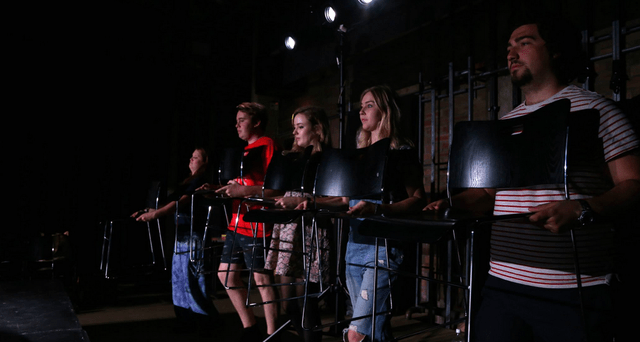
Directors Clemence Williams and Benjamin Sheen do an excellent job of extracting a style of performance from their cast of ten that is cohesive and authentic. The harmony and assuredness of the ensemble gives the stage an energy that captivates, and their individual personalities contribute to a show that is layered and complex. Williams and Sheen do well to create variation between scenes, which keeps things unpredictable and nimbly paced. It is noteworthy that the team is comprised of two separate groups, SUDS in Sydney and Periscope in Melbourne, but there is not a hint of discernible disjunction onstage.

Actor Leili Walker stands out with strong presence and a sharp focus. There is a lack of self consciousness in her performance that conveys confidence beyond her years. Also memorable is Julia Robertson who engages with clear motivations that are always intensely genuine. It is remarkable that she is able to introduce psychological truth into a performance that is persistently characterised by an overt anti-naturalism.

Somewhere in Attempts On Her Life lies a tale that is disturbing and devastating. Its insistence on a wildly non-narrative mode of expression means that the play does not move us emotionally. We are forced to access instead, our mental capacities, where we are, hopefully, more likely to be inspired for social change and political action.

www.sudsusyd.com

www.facebook.com/periscope.prod

Review: Lies, Love And Hitler (CADA Studio Productions / Sydney Independent Theatre Company)

rsz_photo_by_katy_green_loughrey___llh8___james_scott__langley___doug_chapman__bonhoeffer____flickr___photo_sharing_Venue: Old Fitzroy Theatre (Woolloomooloo NSW), Apr 15 – May 3, 2014
Playwright: Elizabeth Avery Scott
Director: Rochelle Whyte
Actors: James Scott, Doug Chapman, Ylaria Rogers
Image by Katy Green Loughrey

Theatre review
Romance and art are not usually complementary; theirs is a fraught relationship. Art conventions are concerned with all that is deep in the human experience, and romance pursues something that is often inane and fleeting. Elizabeth Avery Scott’s script however, manages to place romance in its centre, and through themes of ethics, politics, history and religion, tells a story that is engaging and intelligent.

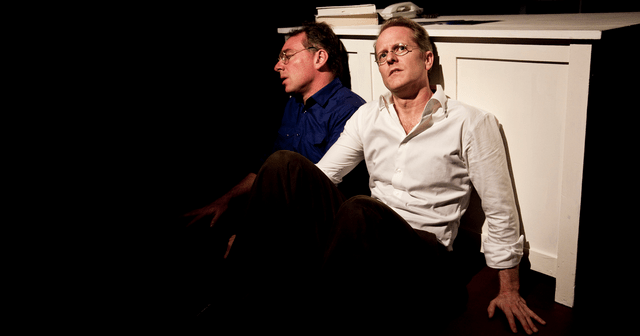
Scott’s structure for Love, Lies And Hitler discusses the nature of ethics, and unpacks perennial questions that we face in every ethical dilemma. A parallel is drawn across time and space, between a university lecturer’s love affair with a student, and a German theologian’s involvement in the plot to assassinate Adolf Hitler. The stakes are different, but our thought processes are intriguingly similar when determining right from wrong.

With topics like capital punishment, sexual harassment and Nazism put in focus, the play’s solemnity is inescapable. Director Rochelle Whyte handles the play’s dark sides with sensitivity and reverence, and her skill in introducing seamlessly, the apparition of Dietrich Bonhoeffer from 1945, into scenes at a university in modern day Australia is commendable. Less effective are her interpretation of the script’s moments of levity. These are frequently hurried through, and jokes are neglected, resulting in a show that feels heavier than necessary.

Ylaria Rogers plays Hannah and Hermione, displaying great efficiency and simplicity with both characters. Rogers places emphasis on moving the plot along swiftly, and telling her parts of the story clearly, but her portrayals would benefit from greater complexity and presence. James Scott is a very dynamic Paul Langley. His charisma quickly connects him with the audience, and we enjoy the tenacity in his performance, which is confident and thoroughly considered. There is however, a deliberateness to his style that can at times make his character seem less than authentic. Bonhoeffer is played by Doug Chapman, who has a subtle and naturalist approach that contrasts strongly with the other actors, and consequently, and ironically, helps him leave the greatest impression. Chapman provides a healthy counterbalance to the production with his restraint, which is also a quality that keeps us engrossed.

Stories about genocidal persecution and Hitler never dry up. They also never fail to fascinate. Love, Lies And Hitler is a show that entertains and enlightens. We think about our individual ethical boundaries and moral structures, while it seduces us with love stories past and present, and a surprising brand of romance that does not patronise.

www.cada.net.au

Review: The Jungle Book (Emu Productions / King St Theatre)

rsz_1620714_737788869599707_8034336185139306069_nVenue: King Street Theatre (Newtown NSW), Apr 14 – 26, 2014
Book and Lyrics: Markus Weber (based on the original by Rudyard Kipling)
Composer: Michael Summ
Director: Markus Weber
Actors: Maria De Marco, Badaidilaga Maftuh-Flynn, Mark Power, Mandy Fung, Bernard Wheatley, Brett O’Neill, Kyle Stephens
Image by Lorina Stacey Schwenke

Theatre review
Markus Weber and Michael Summ’s version of The Jungle Book is a beautifully-written musical derived from Rudyard Kipling’s famed writings. Familiar characters are retained, and even though these songs are less well-known, they are delightfully catchy and pleasantly melodic.

Markus Weber’s current production is fairly minimal, and relies on the strength of the songs and text to carry the show. Musical arrangements are joyful and effective for most of the material, but several numbers need an update from an unfortunate and uncomfortable 1990s pop/rock sound. Weber’s use of space is thoughtfully varied. The multi-tiered stage is designed well, and used cleverly to keep the attention of the audience. It is noteworthy that although a vast majority of the crowd is very young, the musical has enough content to entertain any adult companion.

There are moments however, where performances falter, and confusion emerges. Even though performances are spirited, calibre of players vary dramatically. The show is designed for children, but the roles are not simple, and it relies heavily on what the actors can bring to the production.

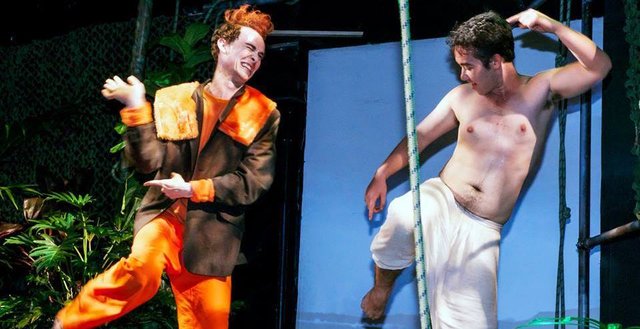
Maria De Marco’s singing voice is strongest in the cast, using it wonderfully to convey the story wonderfully despite not having assistance from microphones. She plays Bagheera, the black leopard who delivers several poignant moments that give the production a necessary shade of gravity. Badaidilaga Maftuh-Flynn plays Mowgli, the only human character. Maftuh-Flynn performs with conviction, and has the gift of being able to portray emotion with great clarity without appearing to be doing very much at all. Brett O’Neill is a vibrant King Louie, the amusingly deluded monkey who never fails to entertain. O’Neill’s energy is big and focused, and his keen sense of comic timing shows him to be the most polished actor on this stage, leaving an excellent impression, notwithstanding the brevity of his appearance.

The Jungle Book‘s message of ecological awareness is a critical one. The anthropomorphism of wildlife imparts to younger generations, values of conservationism that are noble and necessary. Providing children with an understanding that animals are not our slaves or property is a responsibility we must take, if only for our own survival.

www.kingstreettheatre.com.au