Review: Hedda Gabler (Belvoir St Theatre)

belvoir

Venue: Belvoir St Theatre (Surry Hills NSW), Jun 28 – Aug 3, 2014
Playwright: Adena Jacobs (from Henrik Ibsen)
Director: Adena Jacobs
Cast: Branden Christine, Lynette Curran, Ash Flanders, Marcus Graham, Anna Houston, Oscar Redding, Tim Walter
Images by Ellis Parrinder

Theatre review (originally published at auditoriummag.com)
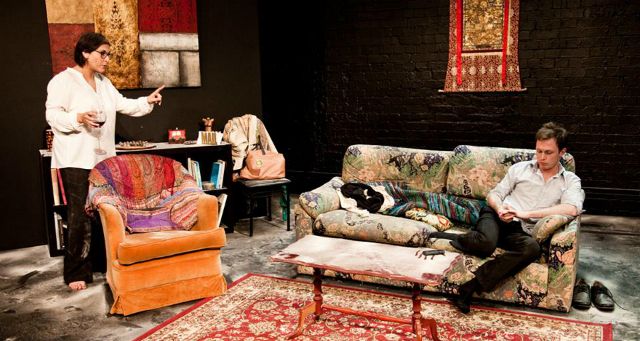
Not every audience member would know what Ibsen’s story is about, but virtually everyone who enters the Belvoir Street venue would be aware, even before the show commences, that the main woman on this occasion, is played by a leading man . Gender subversion remains controversial in the twenty-first century. We all invest on a deeply personal level, gendered concepts that are applied to our daily lives, both consciously and unconsciously. Adena Jacobs’ Hedda Gabler is strange. Like the unusual casting decision, Jacobs’ work resists conventions, expectations and sometimes, comprehension. It is easy to be dismissive of Jacobs’ artistic decisions when they are unexplained and mystifying, but to paraphrase the art critic Robert Hughes, “no painting that is of any quality can be easy to understand because the value of a painting is its ability to expand one’s experience, and so if it were easy to understand, then it would fall within what you already knew.”

Within the landscape of Australian theatre, Jacobs’ creation is a valuable one that deals with issues of feminism, transgenderism, racism, and social aspirations. Before the show begins, a television set on stage plays what looks to be a telenovela. We see a wedding taking place in the soap opera, as well as familiar archetypes arguing and displaying exaggerated emotion. The stories it tells have been told thousands of times before, with unchanging dramatic arcs and predictable conclusions. Jacobs’ work reinvents dynamics and mechanisms, using a 120-year-old text as starting point. What happens to Ibsen’s characters do not change, but how they are presented is drastically overhauled. The production bears a severe and muted tone, almost rejecting any empathy from its audience. We are encouraged to observe, but feelings are sacrificed for contemplation. We react in a way that is diametrically opposed to the experience of watching bad television. Impotent passivity becomes political action.

In an environment of “strangeness”, the viewer’s mind goes into overdrive, persistently questioning artistic choices, and ceases to be a receptacle for easy entertainment. The director’s hand is prominent. Much as we ponder the enigma of Hedda, we never stop wondering what Jacobs wishes to say. Her message is not a straightforward one, which results in a play memorable for its depth and complexity, although there is no question that many would find her approach daunting. Big issues cannot be reduced into easily digestible morsels if their essence are to be retained, but battles must be chosen wisely, and some might consider the aggressively alienating nature of Jacobs’ Hedda Gabler to be self-defeating.  The conviction of her vision however, is undeniable, and the idiosyncratic style evident in this staging demonstrates an originality that must not be buried.

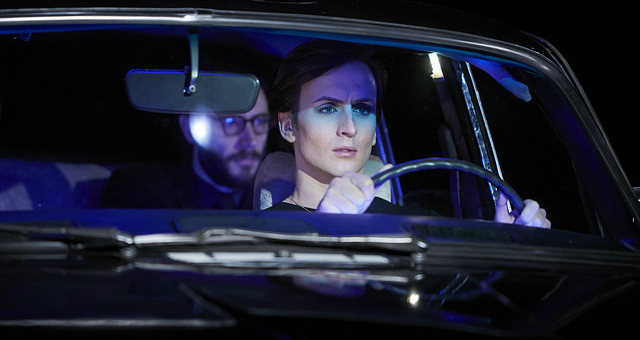
Dayna Morrissey’s set design provides an appropriately sterile beauty to Hedda’s world. It conveys luxurious decadence, but also a distant coolness that is reflective of her disconnection from that world. Action is kept away from the audience. We want a better understanding of the characters but they are always around the house or in the car, both located far upstage, claustrophobic and inaccessible. These people do not connect with each other, and it follows that we too are estranged. Danny Pettingill’s lights are glamorous but rarely warm. It is a cruel and chilly kind of beauty that is achieved, one that speaks volumes about Hedda’s depressive state. Costumes by David Fleischer are oddly naturalistic, especially on the male characters. Thought is put into exposing Hedda’s body rather than concealing it, which is remarkably intriguing, but its aesthetics seem an uncomfortable match against the sophistication created by set and lights.

Performances in the piece vary subtly in style and tone between actors. Each appears almost to be starring in individual shows, thereby enhancing the quality of isolation in each character. Marcus Graham is an exuberant Judge Brack. Complete with toothy grin and a Hollywood tan, Graham plays up the role’s artifice and disingenuity with flair. Brack’s falseness is cunning and understated, but also doubtless. Eilert Lovborg is played with great conviction and vigour by the effortlessly magnetic Oscar Redding. His portrayal is the most dramatic of the group, leaving a strong impression with the only truthful outpouring of emotion in the production.

Ash Flanders as Hedda Gabler is highly provocative, but does not embody his character with great authenticity. His work is quite literally a drag act, where a performer pretends to be singing, dancing or acting, while pretending also to be “the opposite sex”. His work seems to emulate legendary film actors like Greta Garbo, Marlene Dietrich and Joan Crawford, which is an interesting fit for a production that often takes stylistic cues from classic cinema. Hedda’s famed mysteriousness suits Flanders’ method, as he hides more than is revealed, but his presence lacks the allure and power of those movie stars who were able to achieve a great deal while appearing to be doing very little. Flanders is seen half naked for most of the duration, which prevents us from forgetting the contentious dimension of gender being discussed. Having a man play an Ibsen woman is a novelty at this particular point in time, but it also makes a poignant statement. Hedda is a tragic heroine created by a man, with her victimisation and subsequent demise inflicted by her playwright. The surest way for a feminist interpretation of the text is either to reconstruct it radically, or simply not to have a woman play the part at all. Maybe this is a role that makes better sense when taken on by a man.

Branden Christine is the only actor not of Caucasian appearance. She plays Berta, the maid who barely speaks but exudes a silent but impactful tension. The colour of her skin, along with the stark degraded social position she occupies is challenging, if not purposefully antagonising. The production makes several powerful statements, and the one about ethnic discrimination is unintended by Ibsen, but is central to this staging.

This is a work about freedom, and its opposite. It exposes the way people come under each other’s control, and depicts the struggle for an idealistic life in the most pessimistic manner. There is however, more than a glimmer of hope that exists in the form of the production’s transgressions. Revolution happens when oppressive structures are dismantled. Jacobs’ efforts at inventing a new theatrical language, and her interpretation of the classic text, propels theatre towards something far greater than recreation. It improves culture and political discourse. Points of comfort in our shared notions of art are the canary in a coal mine, which this production of Hedda Gabler locates and unleashes upon them, ruthless waves of disruption.

www.belvoir.com.au

Review: Every Second (Michael Sieders Presents / Darlinghurst Theatre Company)

ensembletheatreVenue: Eternity Playhouse (Darlinghurst NSW), Jun 27 – Jul 27, 2014
Playwright: Vanessa Bates
Director: Shannon Murphy
Actors: Simon Corfield, Glenn Hazeldine, Julia Ohannessian, Georgia Symes
Image by Louis Dillon-Savage

Theatre review
Art emerges from all walks of life in Australia. The egalitarian nature of our society means that diverse voices are heard in theatres that reflect the many facets and classes that co-exist on this land. Correspondingly, stories are told that do not necessarily speak to all audiences across all spectrums of communities. Vanessa Bates’ Every Second is a well structured script with thoroughly explored characters, but their concerns are specific, and probably not as universal as initially hoped for; or perhaps, it is not always an artist’s priority and indeed responsibility, to consider how a work might be read and received. Bates’ expression of upper-middle class worries is valid, but finding the empathy from audiences might prove to be a challenge.

The story involves two married couples, both desperate to conceive. Through their crusade to fall pregnant, we observe the mechanics of the wife-husband relationship, discovering its resilience and points of weaknesses, its evolution, and struggle for longevity. Child-bearing and marriages can be alienating concepts for many, but the play does explore more general themes of love and self-fulfillment, although to a lesser extent. Shannon Murphy’s direction is careful to keep all her characters appealing in spite of their individual faults and annoyances. The people on stage, and their relationships, all feel genuine, and the pain they experience does manage to resonate even if contexts fail to connect. Indeed, Murphy’s strength is in creating vulnerability and palpable emotions that are immediate and powerful.

Andy McDonnell’s set is a visual representation of the quagmire being played out. The circular structure, reminiscent of a whirlpool or tornado, is a constant reminder of the pressure and volatility that overcomes the characters. The greatest effect of McDonnell’s design is the focus it puts on the actors by shrinking the stage, and literally containing them within the structure itself. With the assistance of lighting by Verity Hampson, the vast venue becomes intimate, thereby enhancing intensity of the dialogue and amplifying energy of performances.

Julia Ohannessian as Meg is powerful and exuberant. The woman she portrays is at time exasperating, but Ohannessian works hard to provide dignity, and manages to elevate her role from mere baby-making machine. She wins our understanding and affections, transforming a neurotic housewife into an authentic persona. Meg’s husband is played by Simon Corfield who bravely embodies a man buckling under the stress of a fractured home life. We catch Tim at a time when he can do no right, but Corfield’s portrayal is full of humanity and compassion that allows us to see him in the same forgiving light. Glenn Hazeldine delivers many surprising moments of laughter. His comic abilities are impeccable, and he keeps the show buoyant as Bill. Hazeldine’s chemistry with stage wife Jen (played by Georgia Symes) is touchingly tender, and a scene that sees their declaration of love for each other leaves a beautiful impression.

Every Second is compelling entertainment, performed by a skilled and thoughtful cast. Their story does not cater to a very wide audience, which depending on your perspective, could be a good or bad thing. Art should have no rules about social acceptability and conventions. Theatre should exist for all, even for the bourgeoisie.

www.darlinghursttheatre.com | www.michaelsiederspresents.com

Review: The Mercy Seat (Gentle Banana People / Sydney Independent Theatre Company)

gentlebananaVenue: Old Fitzroy Theatre (Woolloomooloo NSW), Jun 24 – Jul 5, 2014
Playwright: Neil LaBute
Collaborating directors: Samantha Young, Andrew Wilson, Peter Mountlord, Alistair Wallace
Cast: Rebecca Martin, Patrick Magee
Image by Katy Green Loughrey

Theatre review
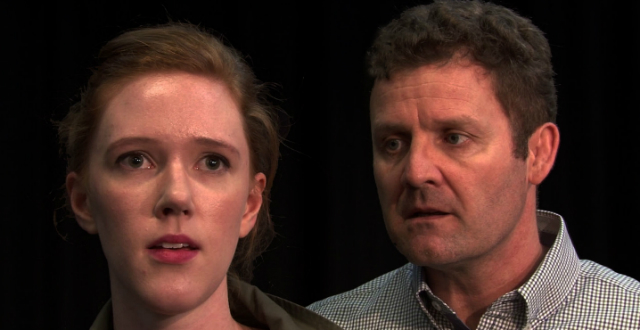
This is a love story that is not particularly romantic. It is however, written with a great sense of truth, and is reflective of real experiences in our love lives. Yes, there is some sweetness, but, like in life, the relationship being explored is fraught with issues. We are refused the clichéd and comforting notion of a love that fixes everything. Instead, what Neil LaBute discusses is the inherent difficulties, and there are many of them, when two people get together. The themes in The Mercy Seat are innumerable. Through Abby and Ben, we observe the often ugly complexities of love, relationships and human nature. Theatre does something noble, when it provides difficult revelations.

The production is directed well. Emphasis is placed on the narrative, and it is clear that work has been put into bringing nuances to light. The writing’s intrigue and its structural quirks are materialised beautifully. The unorthodox characters are allowed to be challenging, always fluctuating between  likeable and objectionable. The story is told without convenient heroes and villains, but it communicates successfully, probably because of the way its honesty speaks closely to our deepest feelings. We understand Abby and Ben because their fears are so fundamental and intimate, they leave us nowhere to hide.

Rebecca Martin as Abby is spirited and flashy. The actor is a determined entertainer, and never fails to grab our attention. There is considerable bravery in her work. We feel Martin’s heart on her sleeve, and she portrays a character with very clear intentions and emotions, conveying an internal journey that is complicated, yet coherent and recognisable. The role of Ben is played by Patrick Magee, whose comic timing is impeccable. He delivers the subtle and dark comedy with a gentle assuredness, careful to prevent funny moments from obfuscating his impressively earnest characterisation. Magee is a dynamic performer, and the enthusiasm at which he oscillates light and shade is thoroughly enjoyable. Both actors are able to deliver a wide range of tone and emotion, but both share a common lack in authenticity when playing sadness.  A reason could be the speed and energy at which their performance is pitched. The characters go through very drastic alterations in mood, which is terribly exciting to watch, but evidently difficult to embody. Even though the actors have excellent chemistry throughout the piece, they do not muster up a convincing sexual energy which is important to their tale.

We sometimes cry at the theatre, but those tears are usually shed for the people on stage or for the scenarios that we witness. Seldom do we react emotionally for our own circumstances that a work recalls. The Mercy Seat strikes a chord when you least expect it. The show ends with a little pessimism, along with some idealism. How we choose to proceed is incumbent upon ourselves.

www.sitco.net.au | www.pantsguys.com

Review: Oleanna (Sydney Theatre School / Actors Not Feelers)

Oleanna 4 MEDVenue: Sydney Theatre School (Chippendale NSW), Jun 25 – Jul 6, 2014
Writer: David Mamet
Director: Jerome Pride
Cast: Grace O’Connell, Jerome Pride

Theatre review
David Mamet’s script is powerful, complex and intellectual. It is an anarchic work about anarchy. It makes its point by shattering conventional paradigms of discourse, and uses theatre to discuss politics in a way that would be challenging for any audience. There are many ways that texts can be interpreted, but Mamet’s Oleanna is resilient, with a message that is unyielding. There might be room for some ambivalence in the plot, but what it wishes to say is clear. Anyone taking it on must capitulate to its structure in order for the characters to make sense, and for dramatics to take effect, or risk a show that is unconvincing and nonsensical.

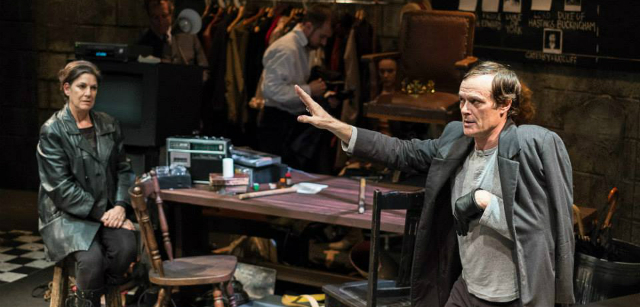
Jerome Pride’s direction handles the play’s concepts carefully. Reverence is paid to the writing, and the results are manifestly impressive. Controversial and sophisticated ideas are expressed with surprising clarity. Daring propositions avoid the curse of sounding like highfalutin abstraction, and are made credible and real. Both actors enthrall with interesting and dimensioned portrayals. The pace and tone of dialogue are perfectly tuned, so that we are gripped from beginning to end. Design elements however, are neglected. There is no need for very much embellishment but the set and costumes are overly basic. The actors’ work would benefit with a more defined sense of space, especially with the cast’s eagerness for movement.

John is played by Pride, who invests in his role, an appealing coupling of impulsiveness and thoughtfulness. We can see him thinking, but we also feel the instinctual timing that he trusts to rely on. The story’s characters are flawed, and we need to be repulsed by them as much as we relate to them but Pride’s creation is endearing, which poses a problem for the production. Perhaps better wardrobe choices could play a part in helping to create a less affable impression.

John’s adversary is Carol, whose development over the course of the play is startling. Grace O’Connell’s performance is not entirely convincing. Some of her creative choices lack authenticity, and we come away slightly confused with the character’s evolution. Nevertheless, O’Connell comes to life after the first act. Her energy and conviction is spellbinding. There is a lot to enjoy in this actor’s work, which is robust yet heavily nuanced.

Mamet’s story gives us important and difficult questions, but it is debatable whether answers are to be found therein. Oleanna deals with the injustices in our lives. It talks about systematic oppression and victimhood, but more significantly it talks about the prospect of dismantling those systems and imagines its alternative. The show’s title refers to a failed utopian state. We always want something better, and in some cases, we know exactly what needs to be improved but the question must always be asked about how we get there. Removing the status quo requires a replacement, but it is human nature that seduces and shapes every new status quo into tomorrow’s conundrum.

www.sydneytheatreschool.com

Review: Richard III (Ensemble Theatre)

ensembletheatreVenue: Ensemble Theatre (Kirribilli NSW), Jun 24 – Jul 19, 2014.
Also playing at Riverside Theatres (Parramatta NSW). 22 July – 26 July.
Playwright: William Shakespeare
Director: Mark Kilmurry
Actors: Danielle Carter, Patrick Dickson, Matt Edgerton, Mark Kilmurry, Amy Mathews, Toni Scanlan

Theatre review
Tales about Machiavellian ambition are timeless. The darkest parts of human nature often relate to our ability to compromise morality in order to satisfy the urges of greed and vanity. Political climates seem to evolve, but shades of betrayal and deceit are persistent. As long as the need for kings and leaders remain, the threat of malice at the highest rungs will always be present.

Mark Kilmurry’s direction of Richard III is colourfully creative, but faithful. His playful style ensures that we are consistently involved with his stage (even when the Shakespearean language becomes challenging) but his artistic liberties are careful to keep original intentions intact. Kilmurry’s creation is a rich theatrical experience that explores the collaborative nature of the art form thoroughly. Cast and creatives are allowed freedom of expression, which in turn encourages a level of audience engagement that is sophisticated, intelligent and surprisingly enjoyable. As leading man, Kilmurry is mesmerising, delightful and appropriately repulsive. He invites us to share his love of the text, and everything within it that is genius and delicious. It is a supremely confident performance by a skilled showman who knows how to steer a vehicle, and we are his trusting happy passengers.

Danielle Carter’s portrayal of Queen Elizabeth is enigmatic and very strong. Her impressive presence is utilised effectively, and the solid stillness in her performance contrasts and stands out from a busy production. Carter’s scenes of confrontation with Kilmurry are especially dynamic. The chemistry and timing between both actors are phenomenal, forging moments of gold for fans of high drama. Matt Edgerton plays a total of five characters. This is a tall order, and one of the show’s few misjudged decisions, but Edgerton’s energy and focus are entrancing. This is an adventurous cast with a passion for their work that has elevated a classic play into an event brimming with charm, wit and poignancy. Amy Mathews closes the show with a soliloquy that is heartfelt and starkly genuine, reminding us of the gravity in Richard III‘s story and evils that prevail in our world.

The production’s design and technical aspects are equally accomplished. Set, props and costumes are subtle but evocative, all contributing to the small space an aesthetic that is beautifully au courant. Nicholas Higgins’ lighting and Daryl Wallis’ sound design are sensitively considered, never drawing undue attention to themselves, but consistently adding to the action on stage. Stage manager Rebecca Poulter should also take a bow for the incredibly smooth running of what must be a complicated backstage and control booth, to which we are completely impervious.

Kilmurry is a leader of fabulous talent. His show is brilliantly put together, and everyone he enlists is showcased marvelously. Shakespeare’s work is probably not very much about democracy, but drawing parallels with our own governmental structures is irresistible. It provokes questions about secrecy in high offices, and the trust we lay upon the people we elect. It prompts us to remember the value of irreverence that is so much a part of our national identity, and to cherish our ability in this country to question authority. We must not forget that the bastards do need to be kept honest.

www.ensemble.com.au

Review: My Name Is Truda Vitz (Somersault Theatre Company)

TRUDA13Venue: TAP Gallery (Darlinghurst NSW), Jun 25 – Jul 6, 2014
Writer: Olivia Satchell
Director: Pierce Wilcox
Cast: Olivia Satchell
Image by Julia Robertson

Theatre review (of preview performance)
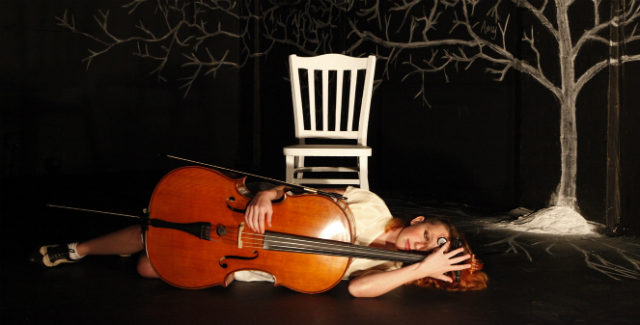
Olivia Satchell’s work is a personal journey of discovery and invention. It is concerned with family history and Satchell’s link with her ancestral past. Truda Vitz is Satchell’s grandmother, and this show obsessively explores her life from memory, investigation, and rigorous fantasy. It becomes clear that lives today can be hollow without acknowledgment of what had come before. Satchell finds meaning and establishes her own identity by thinking about blood relations. She tries to see what her grandmother might have seen, and feel what would have been felt. From an unexplained longing, she makes a connection with the dead in her writing, acting, and through the music of her cello.

Satchell’s performance is quiet but it contains passion. There is not great sadness or elation, but we see the manifestations of a meditative process that is deeply truthful even though a sense of fiction is always present. As an actor, Satchell’s strongest quality is her presence and confident engagement with her audience. The weakest quality of the production is the overly languid tone that persists from beginning to end. Although it only goes for an hour, one cannot help but wish for greater fluctuations in mood and emotion. The show is sincere and thoroughly authentic, but it grows cool where more power could be fabricated.

The sound of Satchell’s cello is sublime. In the small venue, subtleties are easily magnified, and the musical instrument’s every nuance becomes sensationally beautiful. Widely described as being able to produce sounds that are closest to the human voice, it adds a dimension of dialogue to the one woman play. At certain times, it allows us to feel like Satchell is speaking with herself, and at others it represents a voice from the afterworld. The cello’s resonances are mighty, and its incorporation into the fabric of the work shows good creativity and impressive sensitivity.

Life without romance can prove fruitless, but romance itself often seems absurd. My Name Is Truda Vitz is more sweet than bitter; it is lighter than it is dark. Its melancholy is gentle and mild, perhaps an accurate reflection of the artist’s inspiration and inner world. This is theatre that embraces simplicity, in a time when simplicity might be at its loneliest.

www.somersaulttheatre.com

Review: The Violent Outburst That Drew Me To You (Siren Theatre Co / Griffin Theatre Company)

griffinVenue: SBW Stables Theatre (Kings Cross NSW), Jun 18 – Jul 12, 2014

Playwright: Finegan Kruckemeyer
Director: Kate Gaul
Cast: Emily Ayoub, Renee Heys, Michael Cutrupi, Natalia Ladyko, Anthony Weir

Theatre review
Teenage life is difficult. In The Violent Outburst That Drew Me To You, we observe that adults are really just teenagers covered in calluses. The essence of things do not change, but we lose our innocence, choosing to cope with the world by growing thicker skin wherever possible, and also to turn a blind eye whenever required. Connor and Lotte are younger and purer versions of us. They are old enough to detect and to call bullshit on offending circumstances, and young enough to remain unconvinced that evils are ever necessary. Their idealism is rarely a match for machines of the establishment, and Finegan Kruckmeyer’s writing invites us to lament the brevity of youth and to reflect upon the many years we live in states of compromise and imperfection, that we thoughtlessly term “growing up”.

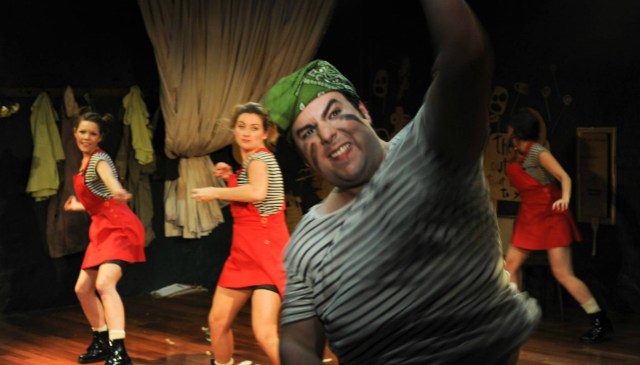
Kate Gaul’s direction is a celebration of youth. Her creation is energetic, mischievous and very vibrant. Borrowing elements from children’s television and theatre, the production is joyfully buoyed by big characters, song and dance numbers, and colourful costumes. There is even shadow play, with the stage turning into an over-sized zoetrope on several occasions. Jasmine Christie’s production design and Daryl Wallis’ sound design help transform script into action. The show arrests our senses, providing an immersive experience that makes adventurous use of the theatrical form. We have lots to see and hear beyond the writer’s words. The spirit of collaboration is alive under Gaul’s stewardship.

Connor is played by Michael Cutrupi, whose portrayal of the teen spirit is amusing yet genuine. His sense of rebellious wonder is deeply appealing. We relate easily to his character, who bears qualities that are universally familiar. Anthony Weir is memorable for a host of personalities, all whacky and wonderful. Weir is able to make every line tickle, especially in song. His vocal abilities are limited, but his commitment as a comedic actor is outstanding. Renee Heys brings extraordinary passion and presence to her roles. She is a versatile actor who is effective, quiet or raucous, and her talents are showcased remarkably well in this production. Not every role gives much room for showing off, but every performer on this stage is focused, precise and strong.

The work ends abruptly. The narrative quickly turns serious, and the tonal transformation happens faster than we are able to adapt. It suddenly loses connection at the end, but the message can still be heard. The flaw is small but the opportunity for greater poignancy seems to have been missed. Regardless, Kruckemeyer’s writing concludes wisely and we are served up substantial food for thought. The play is meaningful for young and old, perhaps in different ways, but it contains truths that will resonate with every open heart.

www.sirentheatreco.comwww.griffintheatre.com.au

Review: O.C. Diva (Hayes Theatre Co)

hilarycole1Venue: Hayes Theatre Co (Potts Point NSW), Jun 15 – 29, 2014
Directors: Hilary Cole, Jay James-Moody
Musical Director: Steven Kreamer
Cast: Hilary Cole

Theatre review
Hilary Cole’s cabaret show takes on the familiar structure of a singer with a microphone, and her musical director on piano. The format works well for Cole, whose voice is an absolute delight, and her ability to convey clear stories and emotions through song demonstrates real talent. As is customary, the song list is composed mostly of familiar standards, but unexpected twists are introduced for added dimension as well as comic effect. Blondie’s 1979 hit “One Way Or Another” gets a surprising mash up treatment with Andrew Lloyd Webber’s “Phanton Of The Opera”, delivering laughs as well as an impressive opportunity to showcase Cole’s musical flair and her musical director Steven Kreamer’s prowess as an accompanist. There is also a one-woman “duet” with Cole being joined by her own impersonation of Bernadette Peters, that illustrates her admiration for the Broadway superstar, and reveals an unexpected versatility.

Direction of Cole’s performance is effective in the comic sections. Her punchlines are subtle but defined, and the jokes are well written. The young performer’s level of confidence is still in teething stages, but she manages to connect well in the venue’s intimate setting. Cole does fidget and stroll around excessively, and her eyes often withdraw into an introspective downward glance, but her passion for the stage is vibrant and infectious. There is a significant portion of the show that looks back at Cole’s experience with obsessive compulsive disorder. The performance becomes vulnerable and truthful, but also overly dark and depressing. Balance is lost here, and one is reminded of the work of Sandra Bernhard and Liza Minnelli where melancholic humour is retained when dealing with bleaker subject matter. Sadness does have a place in the cabaret, but a greater sense of show needs to be applied.

Cole is a beautiful performer, both physically and vocally. She is also a quirky personality, which justifies the choice for a show that is slightly unorthodox in tone. Ultimately, O.C. Diva‘s most memorable moments involve Cole’s singing, which proves to be much closer to perfection than she believes it to be. After divulging her anxieties about personal deficiencies, the show ends at a point of catharsis where she confesses the need for trust. It is evident to all in the audience that she can certainly rely on her talents to take her very far indeed.

www.hayestheatre.com.au

Review: National Play Festival 2014 (Playwriting Australia)

mothsVenue: Carriageworks (Eveleigh NSW), Jun 12 -15, 2014

Artistic Director: Tim Roseman

Festival review
This year’s National Play Festival was held in Sydney’s Carriageworks. It featured talks, panel discussions, masterclasses, as well as full-length readings of new works. Suzy Goes See attended four of the highlights.

Free Speech: In Their Words featured a panel of four actors, chaired by John McCallum, theatre reviewer and academic. Insights and anecdotes were shared from the perspective of actors, about the experience of working with playwrights, and the presence of playwrights in the rehearsal studio. It appears that writers can be fairly involved in the rehearsal process, and many do not consider their writing complete until rehearsals begin, or indeed conclude. The actors talk about writers who prefer to be less involved, but it seems that their input is a valuable part of the actor’s process. We do not hear of troublesome personalities.

(+65) Singapore Calling is a showcase of works by Checkpoint Theatre of Singapore. Faith Ng’s For Better Or For Worse is read by Jean Ng and Julius Foo, who were the original cast in last year’s premiere production at the Drama Centre in Singapore. Memorable for its use of language, the play explores the fairly mundane world of a married couple in their fifties. The performers are thoroughly engaging, with laughter and pathos delivered effectively, but the work seems a little parochial, unable to extend its insights of a private world into something more universal. Ng’s writing is a charming morsel that represents a part of middle-class life, and would connect well with the right audience, but its potential for greater social significance is questionable.

A short excerpt of a second play, The Weight Of Silk On Skin by Huzir Sulaiman is performed by John Shrimpton. The monologue features another fifty-something character of Chinese heritage, but the English language is radically different in Sulaiman’s text. The character’s accent is of an American variety, and he talks of subjects like 90’s minimalism and Giorgio Armani. One wonders if it is cultural cringe that has necessitated the addition of this extract to supplement the other already lengthy presentation. In any case, it is a shame that a second session was not added for Checkpoint Theatre to present Sulaiman’s script in its entirety.

Samson by Julia-Rose Lewis is about teenagers. Through an examination into the way they communicate, we learn about the world they inhabit. Tom Conroy’s performance as the 15 year-old Rabbit leaves the greatest impression. His work is animated and rich, and even though his mature appearance is at odds with the character being portrayed, we are convinced by what he creates. There is also a dimension of commentary in Conroy’s acting that provides a sense of sophistication to the writing. Lewis’ script has a structure that keeps us engaged. Its balance of melancholy and humour is appealing, and even though the characters might prove slightly obscure, they bear enough colour and depth to keep us entertained.

Moths by Michele Lee is a thorough examination of the Asian-Australian experience. It is highly self-aware, constantly investigating clichés and thus avoiding them. It goes into ideas about what it must be like for Asians in Australia, and dispels each of those notions. There is a sense that definitions are to be resisted in order for each individual to reach their greatest potential. Labels, in language or concept, serve only as hindrances.

Lee’s script is particularly strong in its first half, where a group of Asian-Australian actors workshop a new play based on their perspectives about a supposedly unique experience of identity. The material here is often profound and rarely articulated. In its efforts to avoid being too introspective, the work attempts to extend into an imaginary future with the same cast of characters for the subsequent half. What results is slightly unfocused, but the concepts it introduces are strong.

www.pwa.org.au

Review: Trafficked (Darling Quarter Theatre)

traffickedVenue: Darling Quarter Theatre (Darling Harbour NSW), Jun 13 – 15, 2014
Playwright: Carli Carey
Director: Carli Carey
Cast: Sorcha Harrop, Amy Fisher, Michael Smith, Jace Pickard, Isaac Reefman

Theatre review
The play begins with television news reports from a commercial station about the subject of human trafficking and modern slavery. As is often the case with commercial news, the stories are sensationalist, and the network’s watermarked logo exists almost as a reminder to take everything we see with a grain of salt. Of course, its themes are genuine, but we have learned as a society to remain sceptical about the things we are told, and we demand concrete evidence before outrageous claims can be believed.

Trafficked tells horrific tales of young Australians in captivity and enslaved. They look and sound like any young adult we know, and are even of Caucasian appearance. The play subjects them to incredible cruelty, and tells their stories with earnest fervour. The characters are intertwined and build relationships with each other, but everything they say is addressed directly to the audience. It feels like documentary, but there is absolutely no indication that their words are not entirely fiction. Their stories are unbelievable, and we struggle to be convinced by anyone.

Performances are uneven, but Michael Smith and Sorcha Harrop work hard to make their parts meaningful. They have good focus, and show excellent commitment in tricky moments of melodrama. Smith has a good presence that makes him the most memorable element of the production. Harrop succeeds in encouraging some empathy, and impresses with the stamina she displays for her arduous role.

Technical aspects are very lacking. Light and sound design are poorly judged, and execution seems to go awry from start to end. It is obvious that there is a serious lack of experience in the crew, and it is unfortunate that a more accomplished production manager had not been assigned to assist and nourish this young crew.

Every project in the arts is an opportunity to grow. Director Carli Carey and her team have not created a masterpiece on this occasion, but they have succeeded in turning talk into action. They have put money where their mouths are, and are therefore one step ahead of those who dream but do nothing.

www.traffickedproject.com