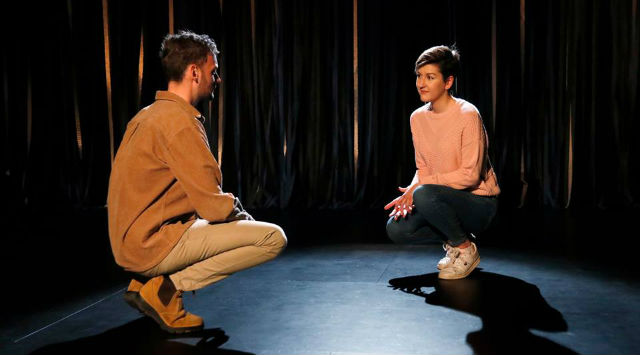
5 Questions with Alana Birtles and Eleni Cassimatis

Alana Birtles

Eleni Cassimatis: What compelled you to audition for Everyone I’ve Ever Loved Or Slept With Or Both?
Alana Birtles: I decided to apply to audition for Everyone because I thought the title was very intriguing. I also liked the idea of investigating relationships and how people ‘mark’ or ‘stain’ us. Those particular words stood out to me.I also think the Sydney Fringe is a great festival and I jumped at the opportunity to be a part of it.

The process has been quite unusual, as we’ve been devising all while using a script. Can you explain what the process has been like for you?
It’s been a really interesting process devising and collaborating on this script. I’ve never worked in this way professionally before. I feel like it gives you a lot more room to play and discover, and I feel like it brought us closer as an ensemble. As each interpretation of this work will be unique, this will be the only time this version will be performed which is also a really cool thought.

Can you explain to everyone what “cup casting” is, and why we’ve been doing it?
Cup casting is this magical process by which we put ‘character names’ into a cup (a very particular cup mind you) and we each pull one out to see who we will be playing. It’s actually worked out amazingly as we all got characters/scenes that we had originally said resonated with us.

Have any moments or scenes from the play resonated strongly with you?
Yes there’s one scene in particular that I felt strongly about. Without giving anything away I’ll say that the scene is a complex one in its emotional variations but also the concept behind it. This is an instance where the magic cup casting worked because I actually ended up being allocated that scene. Otherwise, I believe the play presents a multi-faceted view of relationships that is relatable to everyone. Dissecting the play, the entire ensemble has related to particular experiences in the play or known someone that has had a similar experience.

We’ve been having a weekly guac comp during the rehearsal period… got any hot tips for a killer guac?
Ah the guac comp; one of the highlights of my Saturday’s. I am an avid avocado fan and pride myself in my guac-making abilities. I believe lots of flavour and freshness is key. I like to add a bit of raw garlic and Spanish onion, but I think you shouldn’t be afraid to utilise a decent amount of lemon, salt and pepper. I’m not usually a fan of coriander but I’ve been converted when used in guac. Coriander with a bit of tomato adds freshness.

Eleni Cassimatis

Alana Birtles: How are you enjoying working as part of a democratic ensemble?
Eleni Cassimatis: The collaborative nature of our democratic ensemble has been a lot of fun. As we are devising our way through a new text, it has meant we can basically pave our own way through it. Our cast and creative team are made up of a wonderful group of artists who all have a brilliantly diverse range of experience in various acting/theatre-making forms, meaning what each person brings to the table is a different wealth of knowledge, and therefore the experience of each scene or ‘vignette’ in the play has been injected with a variety of storytelling forms. On top of this, our cup casting has meant some scenes have been cast completely out of control, and then we’ve had the fun job of making it make sense!

What’s been the most challenging part of the process for you so far?
The most challenging part of the process for me was probably in the initial phases of staging the play – making myself succumb to the fact that we were going to have no idea what exactly the play was, or how exactly we were telling this story, and allowing myself to just play and create with no clear ending. St Clair’s text has been left so open for us, which at first seemed daunting, but gave us an abundant amount of delicious possibilities.

St Clair’s rejected a masculine story arch in her writing. How have you found working on a play that’s structure is more cyclical than linear?
The play’s structure, being more cyclical than linear, means that there isn’t a defined start point and end point to the story, and that where the play begins and where it ends could actually be anywhere in this order of experiences. In rejecting the traditional masculine story arch, Saint Clair has created an experience for the audience that gets ‘left hanging’ and doesn’t have a clear resolution, but what could instead be a new beginning. I’ve found working on this structure to be full of discoveries, because each time we would work out what one scene could be, we would find that it would open up hundreds more possibilities for what the preceding and subsequent scenes could be. I think it let us be more ok with pieces not directly connecting to each other, because they were still part of the inherent circling motion of the entire play, and thanks to the brilliant writing we were able to step back and trust that all the pieces connected and linked to form their own version of the traditional storyline.

Everyone explores intimacy and human connection in abstract fragments, which isn’t unfamiliar content in the theatre. How does this production present this universal experience in a different light?
I think the best way to talk to this is that in Everyone, we get to see little slices of life, which are short (or sometimes longer) glimpses into the relationship between couples or groups of people. These transactions explore many different assets of human connection and intimacy, are transient, and over the course of the play will hopefully resonate with and reflect experiences that everyone can relate to! The play breaks these concepts open and addresses them as the characters live out their experiences in front of the audience, and by allowing the characters to passionately try to work things out & make sense of things for themselves, pulling the audience in and along with them on the way.

There are 400 shows playing as part of the Sydney Fringe. Why should people come see Everyone?
Firstly – the title. Come on guys, how can you not be wanting to know more? Second – what a crew and cast I get to work with – working with Liz has been incredible, the guys at Revolving Days are amazing, and the 5 other actors I have got to spend this last six weeks with have been an absolute blast. I am so proud of the work we’ve created, I love the idea that no other version of this play will ever be the same, and love that I got to play part in putting St Clair’s work on it’s feet in the public for the first time.

Alana Birtles and Eleni Cassimatis can be seen in Everyone I’ve Ever Loved Or Slept With Or Both by M Saint Clair.
Dates: 4 – 8 Sep, 2018
Venue: Blood Moon Theatre


5 Questions with Jessica Bellamy and Kirsty Marillier

Jessica Bellamy

Kirsty Marillier: How does it feel to be staging Shabbat Dinner for the third time?
Jessica Bellamy: It feels very strange to be staging Shabbat Dinner for the third time. It felt strange staging it the other two times, too, though. I’m still getting my head around the idea of autobiographical theatre and the fact that anyone wants to take a night off their Bachelor viewing schedule to see my family story. But then I try to channel the confidence of a universally reviled politician deciding to make a tilt at national leadership. I ask myself: “why not me?” I would like to continually build my professional confidence so it’s akin to that of a mediocre white guy.

To offer a more serious answer to this question, it is quite rare for an Australian playwright to get multiple productions of their play in a five year period. I’m glad this work resonates with people, and I’m also really lucky it was championed and incubated by the much-missed Tamarama Rock Surfers, who supported me becoming a playwright by giving me the opportunity to make shows.

If you could be one character from Broad City for the day, who would you be and why?
Ilana! Everyone wants to be Ilana, right? I’ve actually written an article for Feminartsy journal explaining why I love her so much. I love the way she traverses her city like it was meant for her. Her effervescence, her passion, and her incredible fashion sense. The way she is styled reminds me that it’s OK to have big, frizzy hair, to wear whatever you want, to feel safe (or that you deserve to feel safe) walking the streets of your city at night.

What is your favourite dish to eat at Shabbat?
Bloody borscht, mate! It’s heaven! Anyone with a womb should eat beetroot at least once a month. A traditional Shabbat dinner would involve chicken soup, and when I can be bothered I might whip up a vegan version using vegie stock and alphabet noodles. My own strange version of the real deal.

What advice would you give teenage Jessinka?
Don’t worry so much. No one cares as much as you think they do. There’s no certain thing you have to achieve by a certain time. Say what you think, get angry, demand your rights, and take up space.

What does your family think about the play?
My family have been very generous about this work, especially considering the fact that it is so personal. They have also supported me in my personal growth over its three seasons. I’ve learnt a lot about my own value system through making this show, and I’m making decisions now, in my thirties, that I wouldn’t have had the emotional intelligence to make any earlier. This involves weighing up a cost-benefit analysis of anything autobiographical I write. Asking myself: who benefits from this, and who is challenged, in a way they haven’t asked to be, by me deciding to write something? When a story belongs to more people than just me, these things need to be negotiated and carefully considered.

I will paraphrase another Russian writer, Maria Tumarkin, whose memoir workshop I went to a few years ago. She said that if her work is going to hurt people, she won’t do it. Caring for people is more important to her than whatever art might come out of being provocative.

Ultimately, I value my relationships over anything I’ll make in my career. And I know that I’m a strong enough writer to make excellent work that also prioritises care in every element of its creation. In my first few years of practice, I didn’t really understand the fact that art – this great amorphous thing – could be chopped and changed to abide to your moral code. I used to think the art was the art, and I had to get out of its way. I’m getting better at thinking a little wider now.

Kirsty Marillier

Jessica Bellamy: Did little Kirsty know she wanted to be an actor?
Kirsty Marillier: Yeah she did. It all started from around age 9. In year 3, I was cast in a tiny role as the indigo fairy. During the performance I fell over on stage in front of the entire school and I reckon I made a pact with myself that it would be the last time I would EVER let people laugh at me on stage unless I had told them to. I auditioned for the lead the next year and got it! I also had a wonderful performing arts program at Leeming Senior High School and some really inspired teachers. I think I owe a lot of my drive and confidence to them.

What’s a family recipe as significant to you as some of the food we serve in Shabbat Dinner?
My GiGi’s Magwinyas. Magwinyas are deep fried savoury doughnuts that you break apart and shove curry inside. They are not for the faint hearted; oily as and have zero nutritional value but are insanely good and give you that combined sweet/savoury dopamine hit. Yum. They are really hard get to right because you need to make sure you knead them with “gentle hands”. So they have enough air. It’s an art form and my Gig is going to give me lessons on them next time I’m in Perth.

How do you get those curls so stunning, girl?
Girl, it’s called Shea Moisture and Priceline have 20% off as we speak. I also started making my own aloe vera gel. You need fresh aloe vera and an entire Sunday to do it but it’s worth it. I also sleep with my hair in a pineapple and wrap it in a silk scarf, it’s a process.

What are the ways you connect to a play about Jewish ritual and Torah stories?
This play centres around tradition, women and food. How we inherit tradition from those who came before us, and the intergenerational effects of migration. I’m a coloured South African woman. I moved to Australia at age 10, have religious parents and 7 South African aunties scattered around Australia. It would be pretty hard for me not to connect with this play.

I said to someone a few of weeks ago that this show (in 2015) was my first encounter with intersectional feminism. It was the first time I’d said that out loud, but it’s totally true! I’ve learnt a lot about my own culture and feminist practice doing this show. How one can re-appropriate culturally specific beauty regimes to suit their own life, how perspective and clarity on your gender and identity can be found by unpacking your past, and how the women in our lives have influenced us more than we know. They hold power in their rituals and it’s something to celebrate! (I feel like I’ve gone on a tangent but I thought it would be an interesting thing to add.)

I connect with this show by thinking about the women in my life, past and present. How much they have made me who I am and how I carry their stories with me.

What do you want to be doing artistically in 5 years’ time?
I want to be writing. I’d love to have a play or two under my belt. I also want to more involved in the telling of culturally diverse stories. I want to see more people of colour on stages; I’d like to help push that process along in any way possible.

Jessica Bellamy and Kristy Marillier are appearing in Shabbat Dinner, by Jessica Bellamy.
Dates: 10 – 15 September, 2018
Venue: SBW Stables Theatre

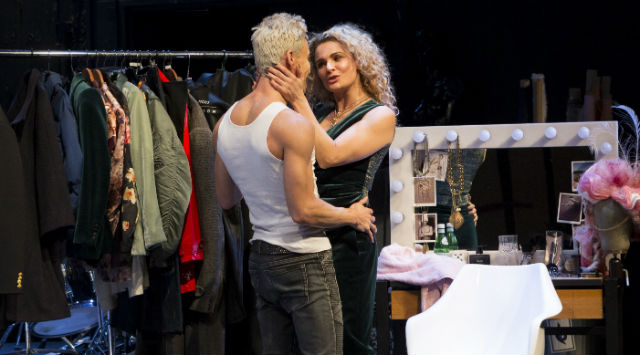
Review: The Maids (Glitterbomb / 25A Belvoir)

Venue: Belvoir St Theatre (Surry Hills NSW), Aug 25 – Sep 15, 2018
Playwright: Jean Genet (translated by Bernard Frechtmann)
Director: Carissa Licciardello
Cast: Alexandra Aldrich, Skyler Ellis, Amanda McGregor
Images by Jasmin Simmons

Theatre review
Jean Genet’s The Maids is based on a 1933 murder in France. A pair of sisters work as maids in a rich man’s house, isolated from the rest of the world. Their shared oppression turns them monstrous, as they gradually bring to fruition, the heinous contents of their imagination. We may no longer, in the West, have servants of that kind, but it is a story that draws parallels with the many inequalities that persist, or are in fact escalating, in these supposedly modern times. We look at the birth of evil, from evil, and are made to consider the repercussions of a society determined to maintain its hierarchies.

Carissa Licciardello directs an extraordinarily intense and flamboyant production, using Genet’s macabre poetry to inspire a marvellous sense of heightened drama. Three wonderful actors work in perfect tandem, delivering a sensational piece of grotesque theatre, intriguing and powerful with what they bring to the stage. Alexandra Aldrich and Amanda McGregor play the sisters, both commanding in presence, as Claire and Solange, compelling from beginning to end, even when Genet’s writing turns impenetrable and obtuse. Male actor Skyler Ellis takes on the role of Madame with aplomb, demonstrating excellent nuance alongside the role’s predictable extravagance. Watching the maids feud with a man, creates a fresh intellectual dimension, helping the old play speak with more pertinence than it would otherwise have.

Humans have an insatiable desire to control one another. Our thirst for power, when untamed, has the ability to blind us to the fact that people’s freedoms are always essential. Compromises can be reached in all our interactions, of course, but it is clear that transgressions occur frequently, with or without our acknowledgement. The servants have no choice but to submit to the consequences of their poverty, but when people are subjected to conditions unnatural and perverse, it is certain that morbidity will result.

www.dasglitterbomb.com | www.belvoir.com.au

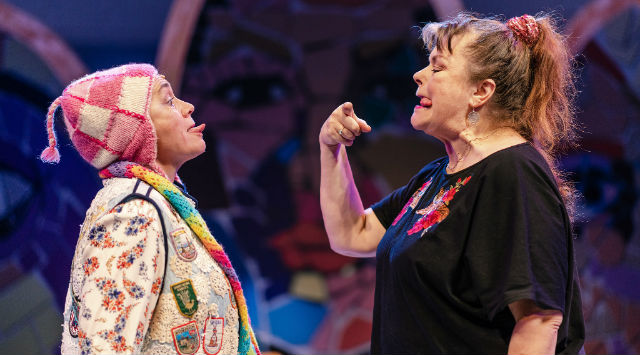
Review: The Misanthrope (Bell Shakespeare / Griffin Theatre Company)

Venue: Sydney Opera House (Sydney NSW), Aug 28 – Sep 28, 2018
Playwright: Molière (a new version by Justin Fleming)
Director: Lee Lewis
Cast: Simon Burke, Danielle Cormack, Catherine Davies, Ben Gerrard, Rebecca Massey, Hamish Michael, Anthony Taufa
Images by Brett Boardman

Theatre review
Alceste believes that the only truths are the ones in her own head, refusing to accept any behaviour she perceives to be contrary, and charges them all with hypocrisy. As fate would have it, her lover Cymbeline is no believer in fidelity, and when Alceste has to confront Cymbeline’s covert flirtations with several others, matters of the head and heart come to agonising conflict, in this tale about how we value our principles. Justin Fleming’s new adaptation of Molière’s The Misanthrope brings the play into our contemporary times, by immersing it deep into our obsession with popular culture, and even more significantly, by altering the genders of its key roles.

Alceste is now a woman, played by Danielle Cormack, a powerful and captivating presence, appropriately representing the influential position of our lead character, although a persistently sombre approach to the central role, does significantly diminish the humour of the piece. Cymbeline, previously Célimène, is now a male pop star, convincingly portrayed by Ben Gerrard who luxuriates in the part’s farcical narcissism. Sexuality is turned entirely fluid in this rendition of The Misanthrope, with every personality capable of gay and straight love, and orientation is no longer a concern.

The production looks vivid, absolutely glitzy at times, with Dan Potra’s very flashy costumes leaving a particularly strong impression, but the show is often underwhelming, unable to excite with its comedy or philosophies. Director Lee Lewis succeeds at making things modern and coherent, but an air of banality does, unfortunately, pervade.

Passion for one’s beliefs, is often the propulsion that moves us to greater planes, but it is perhaps more exigent than ever, that we should learn as societies, to accommodate the opinions of others at these very fractious times. Unable to reconcile her disdain for all that is dishonest and insincere, Alceste is increasingly isolated, ultimately left only with a doctrine that has achieved nothing. It is a huge challenge, to hold on to what is right, yet able to negotiate all the contrarians that inevitably surround. To find the answer to our peace is difficult, but imperative.

www.bellshakespeare.com.au | www.griffintheatre.com.au

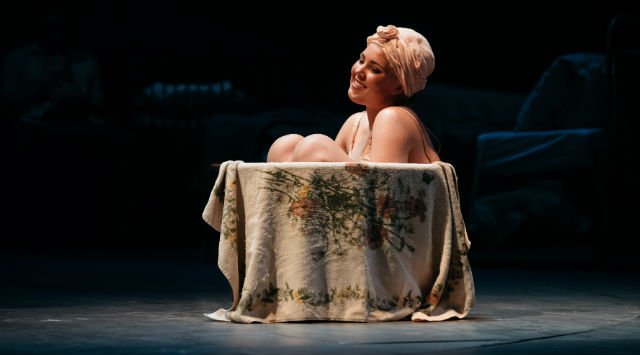
Review: The Secret Singer (Darlinghurst Theatre Company)

Venue: Eternity Playhouse (Darlinghurst NSW), Aug 28 – Sep 9, 2018
Playwright: Joanna Weinberg
Songs: Joanna Weinberg
Director: Joanna Weinberg
Cast: Genevieve Lemon, Kate Mannix
Images by Stephen Reinhardt

Theatre review
Jenny wants to sing in seven different choirs, one for each day of the week. It is a particularly unusual ambition, considering she has been unable to vocalise a single note in public, for the last ten years. When she reaches out to singing teacher Emjay for help, a deep connection instantly develops between the two, in Joanna Weinberg’s The Secret Singer, for a meaningful story about the fragile yet resilient human spirit.

Weinberg’s style as writer and director, is naive but tender, and her show, while not glossy with polish, is an uplifting and soulful work, that resonates with our indomitable capacity for hope. In the role of Emjay, performer Genevieve Lemon brings great warmth to the production; her earnest approach has the ability to convert any sceptic. Kate Mannix plays Jenny, with a gentle but effective humour, capturing our imagination with her confident interpretation of a very likeable character. Also noteworthy is Matthew Reid’s musical accompaniment on keyboard, impressive with its technical accuracy and emotional sensitivity.

To sing out loud, is to assert one’s position in the world. There are many who will want to silence others, and in that figurative stealing of voices, people are rendered powerless. It takes courage to sing, just as it takes courage to live with authenticity and joyfulness. Our communities can be supportive, but they can also be stifling. When choirs do their job well, all voices are heard, and no one is allowed to be drowned out. Harmony is not easy to achieve, but it is what our social selves must always strive for.

www.darlinghursttheatre.com

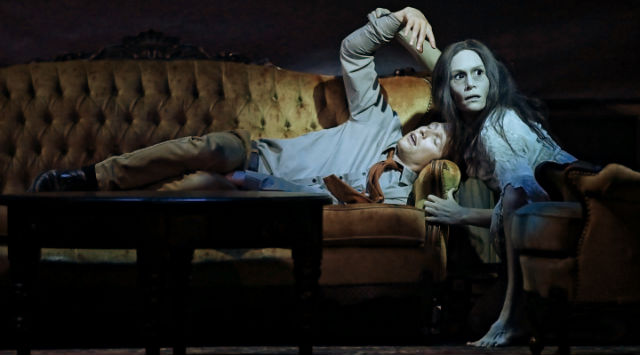
Review: Horror (Sydney Opera House)

Venue: Sydney Opera House (Sydney NSW), Aug 29 – Sep 2, 2018
Artistic Director: Jakop Ahlbom
Cast: Andrea Buegger, Sofieke De Kater, Yannick Greweldinger, Silke Hundertmark, Gwen Langenberg, Reinier Schimmel, Luc Van Esch, Thomas Van Ouwerkerk
Images by Prudence Upton

Theatre review
The action takes place in a haunted house. No words are spoken, but we know exactly what happens in each moment, mainly because we have seen everything before at the cinema. The horror film genre relies on special effects and creative editing, both technical features unavailable to the live format. In Jakop Ahlbom’s Horror, however, capacities of the stage are pushed to their limit, to achieve something that is best described as a tribute to the great classics of fear and revulsion. The show aims to frighten, and like the vast majority of scary pictures, it is only occasionally successful in that regard, although there is no denying the production’s very persistent entertainment value.

Cleverly designed on all fronts, from set and lights, to hair and makeup, and of course the obligatory cacophony of jolting sounds, Horror is an innovative tapestry of creative imagination. A skilful cast portrays a range of supernatural beings, performing unearthly acts that have us amused and fascinated. It is a well-oiled operation, every moment executed with impressive precision. Some of its gimmicks can feel underwhelming, but the show is ultimately a satisfying one, memorable more for its hits than for its misses.

We are afraid of ghosts, because we understand the mistreatment that people suffer when alive. These beings return from the dead, with nothing to lose, and their vengeance is both justifiable and boundless. To see them, is to think of ourselves at our angriest, except completely unrestrained. Our biggest fear perhaps, is when people believe that they can act without consequence. Ghosts, and so many of our intangible creations, teach us to be good whilst being keenly aware of our capacity to be bad, and telling ghost stories is as though to put a curse on the evil, when they are hiding in plain sight.

www.horrortheshow.com | www.sydneyoperahouse.com

Review: She Loves Me (Hayes Theatre)

Venue: Hayes Theatre Co (Potts Point NSW), Aug 24 – Sep 15, 2018
Book: Joe Masteroff
Music: Jerry Bock
Lyrics: Sheldon Harnick
Director: Erin James
Cast: Caitlin Berry, Zoe Gertz, Joel Granger, Jay James-Moody, Tony Llewellyn-Jones, Kurt Phelan, Suzanne Steele, Georgina Walker, Rowan Witt
Images by Noni Carroll
Theatre review
Balash and Nowack have been exchanging anonymous love letters, unaware that they are colleagues, both working at the same cosmetics store. Based on Miklós László’s 1937 play Parfumerie, the musical She Loves Me first appeared 1963 on Broadway, and although a terribly old-fashioned story, its songs are utterly and eternally charming, still able to delight audiences today. Its characters are perhaps no longer believable, and they present little that we can relate to, but the show would most certainly appeal to those seeking a healthy dose of nostalgia in their entertainment.

Musical direction for this revival, is executed wonderfully by Steven Kreamer, who breathes new ebullient life into these half-century-old songs. His team of musicians, along with David Grigg’s sound design, deliver for our ears, an unexpectedly rich and exciting experience. Choreography by Leslie Bell, too, is enchanting, bringing to the stage a sense of extravagance that consistently fascinates our senses.

Much of the comedy in She Loves Me is outdated, but several big laughs are had when supporting player Jay James-Moody occupies centre stage; his comic inventiveness is an absolute godsend. Caitlin Berry and Rowan Witt are the leads, both excellent singers, with strong presences that manage to sustain our attention, even when the story wanes. Director Erin James keeps the production active and energetic, but the plot’s flimsiness seems impossible to rectify.

The nature of romance changes with time. In the Tinder age, we are encouraged to always anticipate the next better thing. Unlike us, people of Balash and Nowack’s generation were more likely to believe in that one true love, at a time when moving mountains to find them, had seemed a completely reasonable thing to do. The stakes are significantly lower now, as we become increasingly independent and pragmatic, able to attain fulfilment without narrow definitions of success and love. Many have been let down by dreams of happily ever after, but if we are able to appreciate the things that are, and not hanker only for what could be, chances are that heaven, is already here.

www.hayestheatre.com.au

5 Questions with Rizcel Gagawanan and Joy Gray

Rizcel Gagawanan

Joy Gray: Why did you want to be a part of this production?
Rizcel Gagawanan: First of all, “all-female production”, enough said. Second, I’ve always wanted to act in a Shakespeare play. Growing up I wasn’t exposed to a lot of theatre but everyone knew Shakespeare or at least knew of it. These days to get my Shakespeare fix I watch National Theatre Live at the cinemas. The performances are so amazing but what would be even more inspiring would be to see more POC actors on a Shakespeare stage. So here I am!

Why did you want to be an actor?
My mum put me in the ‘Johnny Young Talent School’ when I was 4 because I was a handful, so I guess from a young age I started to love performing but mostly it was because I had no shame. However, I’ve only come back to acting in the last 4 years and it’s the same things that brought me back, loving to perform (and having no shame), but also the passion to create and tell stories. More specifically telling stories that matter to me and represent me. As I was growing up it was rare to see someone who looked like me on TV or on stage. These days that’s starting to change but we have a long way to go. I believe that my work as an actor is helping change that.

What are your hobbies?
I run long distance, I recently ran City2Surf, 14km in 95 minutes! I’m hoping to finish a half marathon some day (…some day). In my spare time I’m either sketching in an art gallery or having embroidery dates with friends, and Netflix is a hobby too right?

If you could be in any movie, what character would you play?
I think TV shows beat films in terms of great badass female lead characters. I’d like to play an action hero like a spy/assassin character like Maggie Q’s Nikita and Jodie Comer’s Villanelle in Killing Eve but with the comedy antics of Ali Wong. If only I could do my own stunt work.

What are your top 5 movies?
In no particular order: Crash, Coming To America, Crazy Rich Asians, Get Out, and all the Harry Potter movies.

Joy Gray

Rizcel Gagawanan: Who has influenced you the most in your life?
Joy Gray: I would say my older sister has influenced me the most because she has always put me on a pedal stool and has consistently been the positive voice in my head when it comes to loving who I am, and going for my dreams. She has also influenced my decisions in occupations, as I am often in a care giving type of work environment, having followed her lead in life.

How has working with only women in the rehearsal room impacted the creative process for you?
Women can be great to work with in this capacity because we tend to have great emotional and intuitive intelligence. This intelligence can create an atmosphere of sincere relationships. Having sincerity on stage is important for the creative process because it allows an easier space to fully realize the way in which the actions and reactions given by your fellow cast mates are affecting the words being said and their meaning.

What was it about the play that made you want to audition?
I wanted to audition for this play because I wanted to do Shakespeare and I liked the idea of doing an all-female show. I also liked the musical aspect of the show. I auditioned because I wanted to challenge myself and gain experience as an actor. It was icing on the cake that this play is embracing women who want to destroy the status quo, and She Shakespeare is doing this by keeping all the unique elements of the play intact, but also keeping the characterizations that make women unique and beautiful.

What made you want to become an actor?
I have always been interested in how people communicate with each other, whether their through words, or the many kinds incremental gestures with their face and body. This fascination led me into the study of psychology and neuroscience. Underneath that academic attraction, I have also have a need to break out of my interior and exterior shell, and acting is the embodiment of changing who you are. I know I would rather just stay safe inside my head, inside my living room, with a Virtual Reality headset, but acting forces me to be social, to think about, and be in different scenarios; and it’s tough! On a lighter note, I grew up in a family who loved to go to the cinema, who loved music, dancing and technology. I married a man who is a musician and a philosopher, who also appreciates a myriad of live performance such as opera, spoken word, and of course stage acting.

What’s the worst movie you’ve ever seen?
The worst movie I have ever seen is Tommy Wiseau’s The Room. It is also the funniest movie I have ever seen. I loved going to see it at a cinema full of people armed with plastic spoons for throwing, who are yelling the phrase “because you’re a woman!”. I liked the cringe worthy sex scenes that looked completely wrong and sounded hilarious to a repetitive cheesy, 90’s jazz music score. The absolute best thing about the movie is the horrendous acting and dialogue. It is infamous!

Rizcel Gagawanan and Joy Gray can be seen in Macbeth , by William Shakespeare.
Dates: 29 Aug – 8 Sep, 2018
Venue: PACT

Review: The Harp In The South (Sydney Theatre Company)

Venue: Roslyn Packer Theatre at Walsh Bay (Sydney NSW), Aug 16 – Oct 6, 2018
Playwright: Kate Mulvany (from novels by Ruth Park)
Director: Kip Williams
Cast: Joel Bishop, Luke Carroll, Tony Cogin, Jack Finsterer, Benedict Hardie, Emma Harvie, Anita Hegh, Ben O’Toole, Lucia Mastrantone, Heather Mitchell, Tara Morice, Rose Riley, Rahel Romahn, Jack Ruwald, Guy Simon, Bruce Spence, Helen Thomson, Contessa Treffone, George Zhao
Images by Daniel Boud

Theatre review
When Margaret Kilker met Hugh Darcy in 1920, life in rural Trafalgar was idyllic but inert. The couple, both Irish-Australian, young and hopeful, soon headed to Sydney for a brighter future, setting up home in Surry Hills, where they found community, and formed the foundations of a legacy never intended or even imagined.

The Harp In The South is a six-and-a-half hour epic, in two parts, by Kate Mulvany, based on two of Ruth Park’s novels from the 1940’s and another from 1985. Composed mainly of migrant perspectives as experienced by three generations of Irish women, the play offers contemporary audiences a version of our city’s recent history that feels counter-cultural, one that is derived not from contrivances of the establishment, but from stories told by the poor and disadvantaged. All the wonderful things we associate with this city, are built upon the fortitude of those who bear injustice and genuine hardship. Instead of hearing once again about the great white forefathers who take every credit, The Harp In The South restores the voices of forgotten individuals, and places them in the mythical centre of Sydney’s eminence.

Mulvany’s adaptation is exhilarating and witty, replete with irresistible drama, and brimming with inspiration. A palpable soulfulness informs her every manoeuvre, revealing a deep love of the subject and the material, that proves to be completely and profoundly affecting. Although concerned with a cultural specificity, Mulvany’s play contains a sensibility of inclusiveness, that understands the diverse realities of those to whom this story is relevant. The Kilker-Darcy household leads the action, but their truth can only resonate within a context of multiculturalism, and the accompanying portrayals of Indigenous, Chinese, Greek and Italian characters provide not only a degree of ethnological accuracy, they also make an important statement about the way we have, for a long time, sought to share space in harmony.

Director Kip Williams’ vision is exquisite, for a production extraordinary in what it achieves, not only in aesthetic terms, but even more valuable is its promise to galvanise society, through highly persuasive, and sentimental, depictions of our common past, involving all the complexities in our endeavours to be good families, friends and neighbours. Even though the events that unfold are from a different era, every scene rings true, with a familiarity that emanates from its absolute honesty. The Harp In The South is tremendously soulful, and it speaks to all who have an intimate connection with Surry Hills and its surrounds.

Flawlessly designed, the show looks and sounds magnificent. David Fleischer’s sets, Nick Schlieper’s lights and Renée Mulder’s costumes, form an impeccable collaboration delivering theatrical grandeur, with a pervasive and melancholic nostalgia best described as beautiful. Music by The Sweats and sound design by Nate Edmondson, combine new with old, real with abstract, seamlessly cajoling us from one dimension to another, making us laugh and cry at will. The songs we choose to sing, are the truest indication of who we are, and the many melodic renditions of The Harp In The South are like spiritual disclosures, engineered to touch us in the heart and in the mind.

A large cast of actors, play a very large number of characters, each one fabulously evocative, no matter how brief their appearance. Contessa Treffone, marvellous as both Josie and Dolour, is onstage for a substantial portion of this durational challenge, persistently impressive with her spirited and delightful comedy, and triumphant with the integral vulnerability she brings to the show. Margaret and Hugh are brought to life by Anita Hegh and Jack Finsterer, both reliably poignant, but also cuttingly humorous when appropriate. Heather Mitchell too is splendid, and thoroughly amusing, as the matriarch Eny Kilker.

Unforgettably funny, are Benedict Hardie and Rahel Romahn in all their innumerable guises, although Helen Thomson is a clear favourite, unequivocally outstanding with an incomparable volume of laughs, particularly wonderful as the bawdy brothel madam Delie Stock. Lesbian nuns Theopilus and Beatrix are a thrilling pair, performed playfully yet tenderly, by Lucia Mastrantone and Tara Morice, endearing as a sisterly set, and independently formidable in an astonishingly varied range of personalities.

We can proclaim to know ourselves, but art can often surprise with new epiphanies. There is no end to how humanity can understand itself, and it is imperative that we are committed to finding ever greater truths, if we should continue to believe in better tomorrows. We may not be direct descendants of the people in The Harp In The South, but they show us so exhaustively, who we are, as Sydneysiders, as Australians. The shoulders we stand on were not always solid, but all our strength today must be attributed to that past.

www.sydneytheatre.com.au

Review: Constellations (Chippen Street Theatre)

Venue: Chippen Street Theatre (Chippendale NSW), Aug 23 – Sep 1, 2018
Playwright: Nick Payne
Director: Victor Kalka
Cast: Alice Birbara, Henry Hulme
Image by Omnes Photography

Theatre review
In Nick Payne’s Constellations, parallel universes converge in conventional theatrical time, to tell a simple love story. Moments shared by Marianne and Roland, are presented on stage in multiple contradictory manifestations, toying with ideas that disrupt the linearity of our existence, to imagine a nature that is more complex than the typically singular perspectives of how we experience the world.

Director Victor Kalka places appropriate emphasis on the production’s depiction of time, with precisely calibrated lighting and sound cues (executed by a very diligent stage manager, Christopher Starnawski) that provide absolute clarity to how the plot unfolds. There is however, an unfortunate monotony to proceedings, even though the writing provides ample opportunity for a more playful and variable approach to how each scene is performed. Actor Henry Hulme delivers a sense of authenticity with his understated presence as Roland, but a lack of exuberance keeps us alienated. Alice Birbara’s portrayal of Marianne is more animated and inventive, although a greater exploration into the play’s comedy would provide a more satisfying result.

As individual beings, we have little control over how the planet spins, but to believe that fate is beyond manipulation, is to render humanity meaningless. Even if one thinks that all choices we make are predestined, to absolve oneself of responsibilities, is analogous to giving up on life. It is true that we are but a speck in the great scheme of things, and all our successes and failures are ultimately no more than a question of vanity, but if those ephemeral concerns are all we have that would allow our participation in this time and place, then being human is an indulgence we must engage in, with the utmost relish.

www.chippenstreet.com