Review: Little Egypt’s Speakeasy (Grand Moustache / Django Bar)

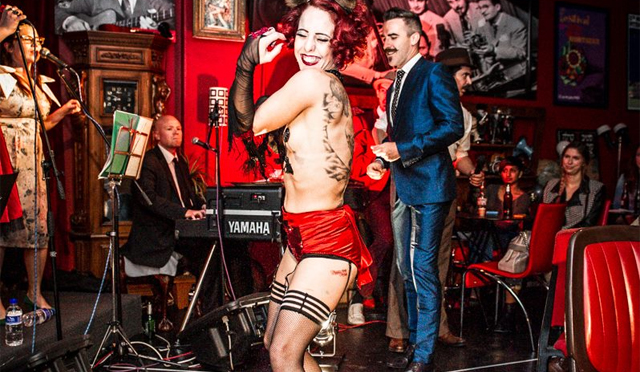
grandmoustacheVenue: Camelot Lounge (Marrickville NSW), Nov 6 – 9, 2014

Writers: Luke Escombe, Lucian McGuiness, Dominic Santangelo
Director: Lucian McGuiness
Cast: Brian Campeau, Kelly Ann Doll, Amos Elroy, Luke Escombe, Danica Lee, Lucian McGuiness, Katie-Elle Reeve, Dominic Santangelo, Damien Slingsby, Elana Stone, Aaron Flower, Nick Hoorweg, Evan Mannell, Mathew Ottignon
Image by Frank Farrugia

Theatre review
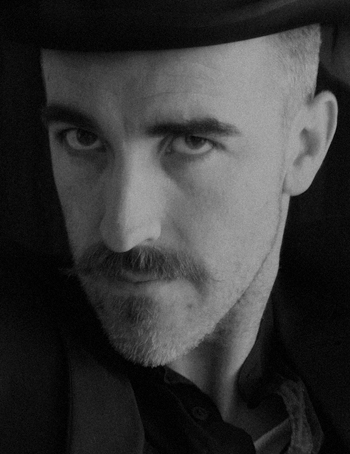
The term speakeasy refers to the illegal trade of alcohol during the American “prohibition” period from 1920 to 1933, and Little Egypt is the name of an exotic dancer from even earlier in the twentieth century. Lucian McGuiness’ show Little Egypt’s Speakeasy draws inspiration from both, to recreate the setting of a nightclub filled with sounds and sights from the 1950s. McGuiness is leader of the handsomest band in town, with four kooky vocalists, and a beatnik MC who provides the thread that helps us imagine the narrative that the show is vaguely built upon. Incorporated flawlessly are two burlesque dancers and the band leader’s comedic brother Don who owns the joint.

There are some stellar performances in the piece. The dancers Kelly Ann Doll and Danica Lee are both scintillating and drop dead gorgeous. The MC and narrator Amos Elroy has the deepest voice imaginable from a baby face, with a use of words and humour that is transportative and quite magnificent. Singer Elana Stone is vibrant in personality and in voice, and her male counterpart Brian Campeau is simply divine with a Chet Baker style sensuality, only with much stronger pipes. McGuiness is star of the show with an extraordinarily sharp presence that exemplifies the irresistible sexual allure of the entire evening.

Don and his club’s story do not quite take hold, but the introduction of a through line for a cabaret show is ambitious and astute. It is almost human nature to want to follow a plot, and the experience is certainly enriched with Don and the MC bringing cohesion to the many separate items presented. Little Egypt’s Speakeasy brings a taste of the bohemian life to Sydney, and it is delicious.

camelotlounge.wordpress.com | www.lucianmcguiness.com

5 Questions with Dimitri Armatas

dimitriarmatasWhat is your favourite swear word?
Fucking/fucken shit! Both of these alternatives, I find, have an incredible way of doing two things at once. Firstly, it helps to release all the frustration you’ve got inside you, which is the reason for swearing in the first place. Secondly, if said properly, will come out in an altering pitch and speed, allowing for ultimate success in execution.

What are you wearing?
Black t-shirt and jeans. T-shirts and jeans, the forever winning combination.

What is love?
I’ve got nothing, but…indescribable

What was the last show you saw, and how many stars do you give it?
Henry V at the Sydney Opera House. It was a great show with an interesting choice of staging, and always good to see a young cast showing the power of the Bard lives on. I would give it 3.5/5 stars.

Is your new show going to be any good?
With a great director and the quality of the talent within the cast, I really think it’ll be spectacular.

Dimitri Armatas is appearing in his own play Haus by Black Raven Productions.
Show dates: 5 – 15 Nov, 2014
Show venue: King Street Theatre

Review: Daylight Saving (Darlinghurst Theatre Company)

darlotheatreVenue: Eternity Playhouse (Darlinghurst NSW), Oct 31 – Nov 30, 2014
Playwright: Nick Enright
Director: Adam Cook
Cast: Helen Dallimore, Belinda Giblin, Rachel Gordon, Ian Stenlake, Christopher Stollery, Jacob Warner
Image by Helen White

Theatre review
Nick Enright’s Daylight Saving was written at the dawn of the 1990s. Director Adam Cook’s straightforward staging in 2014 preserves its original sensibilities, but time has not moved on far enough for the play to feel like a classic. Instead, the production appears outdated despite its very polished execution on all fronts. Enright’s story about the farcical turmoil of well-to-do north shore Sydneysiders no longer bears an edge to rival the more relevant comedies of today, and its “first world problems” context can be quite grating when presented without sufficient mockery.

It is evident that Cook has an excellent understanding of the text and the way dynamics are ingrained into the dialogue. His work feels faithful to the author and to the milieu being referenced, and if produced in ten or so years, the play might come across more charming and nostalgic. Cook’s flair with actors gives the show a confidence that allows it to gleam with impressive professionalism, and the cast is an endearing one, even if the characters they play tend to be annoyingly lightweight. Leads Rachel Gordon and Christopher Stollery provide the narrative with a sturdy anchor, and a surprising authenticity, but they are also less colourful than supporting players, resulting in a loss of emotional connection with the audience.

Jacob Warner lights up the space with his entrance late in the piece as Jason Strutt, a spoilt and insolent tennis star. The part is small, but the actor leaves a lasting impression with enthusiastic and risky comedic choices. Also quirky is Helen Dallimore’s madcap rendition of the desperate girl next door Stephanie, who exists mainly to make the protagonists look good, but Dallimore’s gleeful performance is a fiercely delightful one. Belinda Giblin’s sharp humour as Bunty sees her coming on and off stage like a mini hurricane, and Ian Stenlake’s compelling mix of casanova and goofball is oddly alluring.

Daylight Saving is a story about small things that disrupt very comfortable lives. Its frivolity will certainly appeal to some, but its lightness would also prove unbearable to others. Although Enright’s comedy is not quite universal, the conviction of performances on this occasion is magnetic, and audiences will engage and respond, if only in appreciation for the vibrant energy that fills the theatre.

www.darlinghursttheatre.com

5 Questions with Claire Lovering

claireloveringWhat is your favourite swear word?
Lord Voldemort. No matter how many times you say it aloud, it still feels naughty.

What are you wearing?
A singlet and sarong… I’ve been lying on a hammock all afternoon pretending I’m on a tropical island. It worked surprisingly well, and it’s cheaper than flights to Barbados.

What is love?
It seems to me that love is everywhere. Often, it’s not particularly dignified or newsworthy, but it’s always there – fathers and sons, mothers and daughters, husbands and wives, boyfriends, girlfriends, old friends. If you look for it, I’ve got a sneaky feeling you’ll find that love actually is all around. (Works best when read by Hugh Grant.)

What was the last show you saw, and how many stars do you give it?
Is This Thing On? at Belvoir. It was brilliant. I can’t remember the last time I laughed that much at the theatre. I give it 4 and a half stars. I will deduct half a star because I sat in the front row and due to my irrational fear of audience participation I spent a good 96% of the show terrified I’d be picked on.

Is your new show going to be any good?
It better be; I’ve had to learn to play the xylophone for it… I say that like it’s been forced upon me, but I wrote the show so I only have myself to blame.

How Lord Voldemort is that?!

Claire Lovering is performing in her own one-woman show, River.
Show dates: 18 – 23 Nov, 2014
Show venue: The Old 505 Theatre

5 Questions with Hugh O’Connor

hughoconnorWhat is your favourite swear word?
Cunt. It just sounds so great, the way the consonants sit in your mouth. For me it’s the perfect curse word. I need to stop saying it around kids.

What are you wearing?
Beige shorts and a grey reebok singlet. No shoes, I hate wearing shoes. I’ll take comfort over fashion any day.

What is love?
My family, my husband. Love is their acceptance and unyielding support. Love is something I couldn’t live without. Gosh, I am a total romantic!

What was the last show you saw, and how many stars do you give it?
I really don’t see enough theatre. I spend so much time working in them that as soon as I get any free time I spend it out in the real world! So the last show I saw was my own show, The Witches, which was at Griffin Theatre. And of course I give it 5 stars (but seriously it was really good).

Is your new show going to be any good?
I bloody hope so! The cast is top notch, and I love Nick Enright. It should be really a fun and engaging show.

Hugh O’Connor‏ is production designer for Daylight Saving, from Darlinghurst Theatre Company’s 2014 season.
Show dates: 31 Oct – 30 Nov, 2014
Show venue: Eternity Playhouse

Review: Journey’s End (The Theatre Troupe)

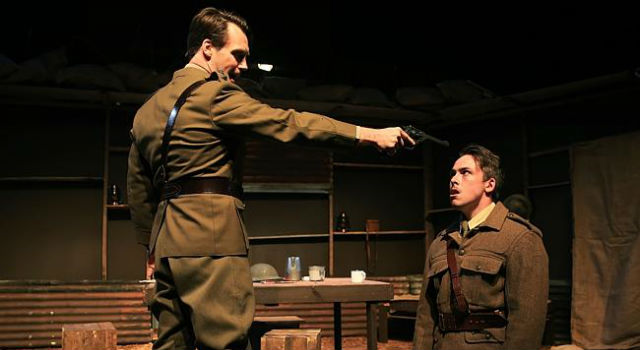
theatretroupeVenue: Seymour Centre (Chippendale NSW), Oct 21 – Nov 15, 2014
Playwright: R.C. Sherriff
Director: Will Usic
Cast: Andrew George, Will Usic, Yannick Lawry, Jack Douglas, Jeremy Bridie, Richard Cotter, Ian Bezzina, Jim Robison, Steve Tait
Image by Toby Zerna

Theatre review
Journey’s End was first performed in 1928, ten years after the end of World War I. Its playwright R.C. Sherriff based the play on his experiences as a British officer in the trenches, and what he had provided is a perspective that feels unusually personal and specific. Focus is moved from the big picture of ideology and territories, to looking at individual lives of those “boots on the ground” as they try to cope with persistent threat, danger and fear.

Will Usic’s work in directing actors is strong. He extracts thoughtful performances from the entire cast, and all are able to instil in their portrayals something that feels genuine and dignified. There are some issues with plot that indicate a need for the very long text to be edited, and while many character interchanges are dynamic and moving, several scenes of dialogue fail to ignite. Poetic license is required but not often utilised in the production. Sherriff’s writing is borne out of stiff upper lip England, so sentiment and passion are extremely restrained, and can make for uncomfortable viewing by today’s conventions.

Usic in the role of Osbourne is the stand out performance of the piece. He is palpably present, and sensitively conscious of conveying the very subtle emotional shifts that exist in those highly precarious situations of battle. His reactions to his comrade’s lines reveal as much as the words themselves do. Also engaging is Yannick Lawry’s humorous take on Trotter, who brings charming levity to the grave proceedings. Lawry pitches his character’s jolliness just right, so as to deliver comedy but also to retain the dark qualities of the narrative. Young Raleigh is played by Jack Douglas with excellent conviction, who maps out the part’s evolution beautifully and convincingly. Leading man Andrew George is believable as Captain Stanhope, with his effortlessly domineering stature, but there is a monotony to his depiction of the role’s depression that detracts from the dramatics of the production.

Set design (uncredited) is ambitious and effective. The stage is pleasantly transformed, and acting space is elegantly accommodated. Sound design (also uncredited) and Toby Knyvett’s lighting are under-explored in the first two acts, which adds to the aforementioned monotony, but both are intelligently conceived and executed thereafter to represent the horrific destruction of lives at war.

There is a delicate balance to be found when discussing the honour of people who serve in battle. Journey’s End does not glorify war, but it shows camaraderie at its deepest. The exaltation of those who have sacrificed can be worthwhile, but the condemnation of war must prevail.

www.facebook.com/TheTheatreTroupe

Review: V.D. (Copanirvana Theatre Co / Sydney Independent Theatre Company)

sitco2Venue: Old Fitzroy Theatre (Woolloomooloo NSW), Oct 28 – Nov 15, 2014
Playwright: Pete Malicki
Director: Lisa Eismen
Cast: Eliza St John
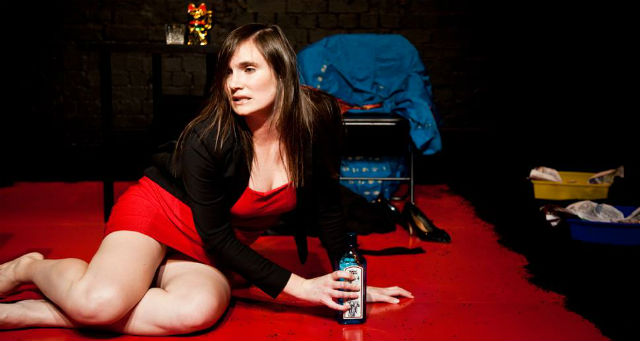
Image by Katy Green Loughrey

Theatre review
This is a story about a woman in love only with two things; herself and alcohol. Pete Malicki’s script is crafted with some skill. His jokes are incessant, and timed with a natural flair. His characters are abused and ridiculed, and no one is presented in a positive light. There is very little beauty and inspiration in the play, but it has a humour that will appeal to many. It is a harsh truth that Australians find alcohol funny. We laugh at people making destructive decisions and falling over due to drunkenness, and V.D. capitalises on that unfortunate part of our culture. It also takes advantage of the fact that making women desperate and dateless gets laughs easily. Sophie Webb is hopeless, almost idiotic, but she is not unrealistic, and of course, our artistic landscape must make room for all kinds of characters no matter how undesirable.

The script is skilfully executed by director Lisa Eismen and actor Eliza St John. Presentation of the comedy is wide ranging, from the very broad to the very subtle. Character development is sometimes uncomfortable in the plot, but the women manage to create a narrative that is often believable, although the show’s ending is quite bewildering. St John’s performance is masterful. She is wild, intuitive and considered, with a conviction that can turn water into wine. Her work is completely absorbing, and she manages to endear herself to her captive crowd, like using sleight of hand techniques to mask the hideous uselessness of the woman she portrays.

The world can be an ugly place, and it is necessary to know its flaws. The theatre is not reserved for snowdrops and daffodils, and artists must not be censored, but audiences look for morals in stories, and maybe even find meaning in listening to what is being said. What V.D. articulates is sometimes true, but also very sad indeed. Life is worth living because of hope, and we need to acknowledge the darkness that we live with, but we must always recognise it as such.

www.sitco.net.au

Review: November Spawned A Monster (Fly-On-The-Wall Theatre / Sydney Independent Theatre Company)

sitco1Venue: Old Fitzroy Theatre (Woolloomooloo NSW), Oct 28 – Nov 15, 2014
Playwright: Alex Broun
Director: Robert Chuter
Cast: James Wright
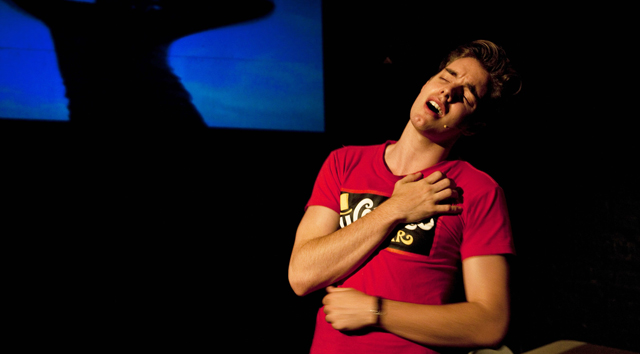
Image by Katy Green Loughrey

Theatre review
Morrissey’s music courses through the veins of his fanatic devotees, and William is a young Melbournite who has the rock star’s records underscoring key events of his life. We meet him at a time of mourning, having recently encountered a deep personal loss. The struggle for clarity, direction and a new lease on life is a familiar experience, and Alex Broun’s script is an honest representation of that shared phenomenon. Melancholia is created beautifully in a plot that takes us from everyday banality to extraordinary circumstances, with gentle humour and a generous slew of Morrissey songs that provide poignant irony, and a remarkable coolness.

Also very cool, is Benjamin Brockman’s lighting design for the production, which gives a sense of differentiation between scenes so that we perceive a variety of moods as the leading man goes through scenes of transformation and evolution. Brockman’s work is intelligent and sophisticated, giving the show a visceral sensuality that connects with Morrissey’s omnipresence. Robert Chuter’s direction of the one-man show cleverly finds every opportunity to manufacture shifts in tone, preventing the production from ever being monotonous in spite of its monologue format. Chuter finds nuance in William’s journey and depicts the human condition at a time of sorrow with great sensitivity.

In the role of William is James Wright, who has the challenging task of memorising an eighty-minute play entirely on his own, along with singing a big selection of the idol’s highly idiosyncratic greatest hits at regular intervals. Wright is an enthusiastic performer who has the ability to be engaging, but his confidence levels are inconsistent, and on this stage, there is simply nowhere to hide when the actor’s consciousness is fractured, however briefly. Notwithstanding its energetic rhythm, November Spawned A Monster is chiefly about pain, which Wright does not sufficiently embody. It is almost a metaphysical quality that can be perceived when a person lives with a broken heart, and on the stage, that quality can be forcefully seductive, but that brand of charisma which we can see in Morrissey, is sadly absent in this show.

“Youth is wasted on the young”, said George Bernard Shaw, but William’s story is a reminder that feeling stranded in one’s youth is important for achieving an understanding of grief, and therefore, gaining an appreciation of all that is significant in life. It is not all a bed of roses, but that’s how people grow up.

www.sitco.net.au

5 Questions with Lucian McGuiness

lucianmcguinessWhat is your favourite swear word?
Kutwijf. It’s Dutch, and very satisfying though sexist. Look it up.

What are you wearing?
About 5 extra kilos, a fine salt, pepper and ginger moustache and some clothes I guess. For the show I dress the moustache up and wear some really spanking outfits from local and imported ingredients. That’s when I look my best.

What is love?
My daughter. She’s consistently the coolest, smartest and most beautiful person I know.

What was the last show you saw, and how many stars do you give it?
The Shadow King at Brisbane Festival last month. There’s a bit at the end that ties the Shakespearean morals to Aboriginal rights in Australia that moves you. 4 stars.

Is your new show going to be any good?
My new show, quite frankly, is one of the best things going. All previous incarnations of this ensemble have sent the audience into a fit, and the Speakeasy takes all that and makes it bigger, tighter, better and funner. Funner is a word, right?

Lucian McGuiness is writing, directing and performing in Little Egypt’s Speakeasy.
Show dates: 6 – 9 Nov, 2014
Show venue: Django Bar, Camelot Lounge

Review: Blue/Orange (Ensemble Theatre)

ensembletheatreVenue: Ensemble Theatre (Kirribilli NSW), Oct 23 – Nov 29, 2014.
Playwright: Joe Penhall
Director: Anna Crawford
Cast: Ian Meadows, Dorian Nkono, Sean Taylor
Image by Clare Hawley

Theatre review (originally published at Auditorium Magazine)
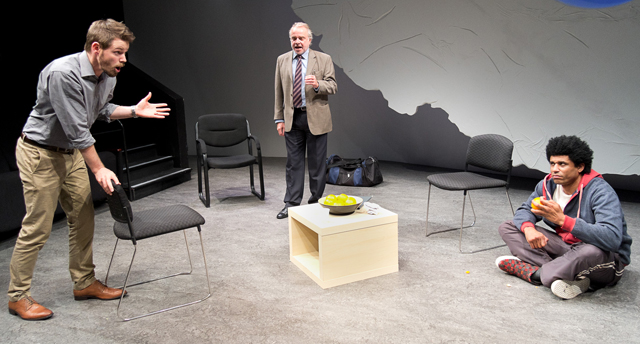
Health services are a crucial part of all civilisations, where access to medical professionals is a basic human right, regardless of class and creed. The subject of mental health is a growing area of concern in the West, with awareness and understanding of relevant issues fast improving through our communities. Joe Penhall’s script centres around Christopher, a mental health patient with the UK’s National Health Service. Surrounding him are two doctors, Bruce is the younger of the pair, idealistic but naive, and Robert is the authority figure of the hospital, seasoned and carnivorously ambitious. A fight ensues with Christopher caught in the middle, and as the plot unfolds, the play’s themes expand simultaneously. Christopher’s African ethnicity and low social status are the linchpin that brings into discussion, not just the intriguing process of psychiatric diagnosis and the health industry in general, but also race relations in contemporary settings and the machinations of authority (and its betrayal) in our daily social structures.

The ideas are big, but Penhall’s story is precise and simple. His captivating dialogue is rich with humour, controversy and intellect, consistently entertaining our senses and challenging our ethics. Some portions could be more succinct, but Penhall’s words and their rhythms are brilliantly crafted, as evidenced by the thrilling and energetic narratives that the show’s cast and director are able to create from the text. Anna Crawford’s direction is decidedly wonderful. The comedy of the piece is powerfully delivered, and the immense joy of being in an auditorium with laughter erupting at every turn is simply theatrical magic. Crawford introduces a daring freedom that encourages her actors to make risky choices, and much to our delight, they all seem to work. Likewise, the many scenes of altercation are loaded with explosive drama, always with a threatening tension and dangerous intrigue. Philosophical and ethical arguments in the work are the ingredients that make it feel substantial, and they are perfectly tuned, disallowed from disrupting dramatic flow, but often given an ambiguity that makes the ideas seductively confronting.

The use of space is however, not always elegant. Actors are frequently positioned so that their facial expressions are not available to big sections of the audience, which can be frustrating as well as distracting. Set pieces are composed of generic furniture elements from public sector offices, all terribly unattractive. The space has not been designed to be a realistic one, yet the several chairs and tables seem to use the notion of realism or accuracy as a convenient justification. A work of this calibre requires greater imagination and creativity in its visual design, and not be allowed to pale in comparison.

In the role of Robert is Sean Taylor, whose virtuoso performance bears the kind of astonishing glory that leaves a lasting impression. The most dangerous villain is the one who combines truths with lies, so that you are kept on his side, giving him benefit of the doubt until too late. Taylor makes it hard for us to know if his character is an evil racist doctor, or a progressive thinker, and our struggle in trying to figure him out is a masochistic pleasure. The actor is full of confidence and his presence is all-consuming; we cannot keep our eyes off of him. Taylor’s marvellous voice provides all that we need to know, and his face expresses everything his character wishes, but also contradicts the doctor’s intentions.

The show is thoroughly rehearsed, with every actor appearing to know exactly what they wish to achieve, yet the stage feels to be a spontaneous one. Dorian Nkono is extremely lively and likeable as Christopher, the patient who may or may not be schizophrenic. Nkono’s control over his physicality and the way he uses movement enrich the role and provide a vibrant energy that elevates the play to a level of theatre that is more than words. His sense for comedy is outstanding. Nkono is a truly funny actor whose approach ranges from subtle to slapstick, but an emphasis on storytelling makes his work authentic and compelling.

The young Dr Bruce is played by Ian Meadows who has the arduous task of maintaining composure as the only unassertive personality in the show. He often gets overwhelmed by his gargantuan counterparts, but he resists irrelevant exaggeration, and delivers a performance that is ultimately a truthful one. Meadow’s work is less flamboyant, which means that the ideological arguments he represents can get subsumed at certain points, but he manages to find a climax at the concluding moments to match in energy and produce an impressive ending to the piece.

Racism and mental illness are contentious issues that elude easy definition. We understand them in abstraction, but how they are discussed and dealt with in reality involves constant negotiation between vacillations of subjectivities. In Blue/Orange,  the powerful and the powerless collide in a system that attempts to be fair, just and democratic. We might all want the best for the world that we share, but our perspectives are different, and finding agreement on a unified destination becomes problematic. The doctor should know what is best for the patient, but the patient is not without rights and opinions. In assigning authority to some, society risks the removal of rights from others, but the ironic creation of power structures seems to be the only mechanism we have for finding harmony.

www.ensemble.com.au