Review: A Nest Of Skunks (Collaborations Theatre Group)

depotVenue: The Depot Theatre (Marrickville NSW), Aug 3 – 13, 2016
Playwright: James Balian, Roger Vickery
Director: Travis Green
Cast: Peter Condon, Jeannie Gee, Penelope Lee, Amanda Maple-Brown, Brendan Miles, Aanisa Vylet

Theatre review
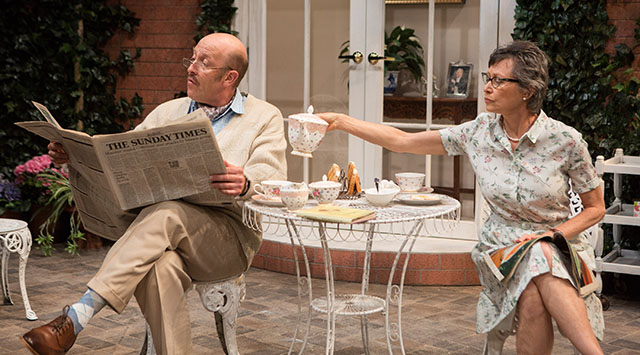
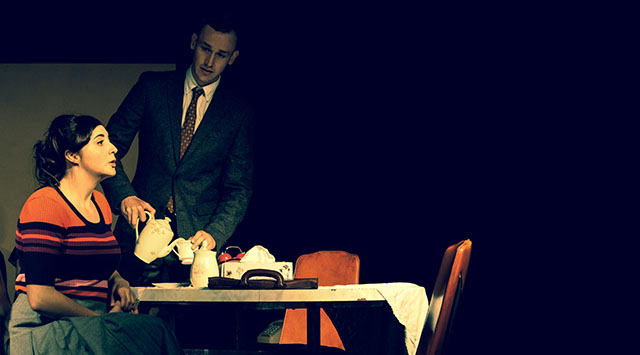
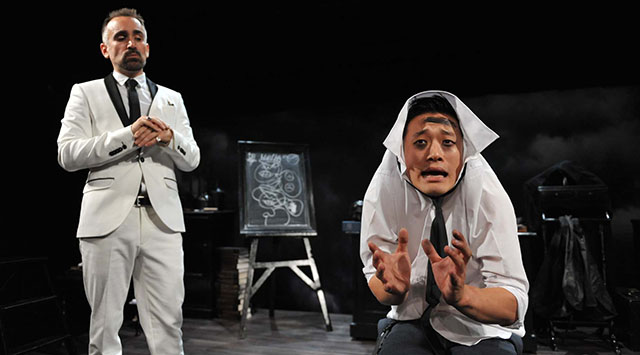
It is the future, and the slang word for refugees is “skunks”. Even though there is no indication as to how far ahead in time A Nest Of Skunks is set, our imagination does not have to work very hard at all to believe that society has disintegrated to that level, where we liken asylum seekers to an animal known for its repulsive stench. In fact, we often forget that events in the play are not actually taking place in the here and now, being so used to prevailing sociopolitical attitudes towards the needy that are already full of contempt.

The script, by James Balian and Roger Vickery, is taut, confrontational and stimulating. It appeals to our decency, demanding that we think about the repercussions of political decisions with compassion and rationality. Convincing parallels are drawn between Nazism and how public ideology is currently evolving, and in its dystopic vision, we see that it takes only a few small steps before fascism ascends again. A Nest Of Skunks is gripping drama, with compelling twists and turns that provide food for thought, along with excellent entertainment. Director Travis Green creates a powerful statement with the text, and although a couple of crucial plot revelations require greater clarity, his storytelling is nonetheless affecting.

There are accomplished performances in the piece, most notably by Brendan Miles whose robust presence and emotional authenticity, ensure that the show is held together by our tremendous empathy for his character Stephen. There are slight issues with the portrayal of language barriers between cultures in the play, but they do not dampen our enthusiasm for Miles’ very moving interpretation of a man in turmoil and desperation.

Refugees are used as pawns in the quest for power by those in the business of government. We are made to fear the weak. Instead of providing help, we turn against the innocent, employing harsh and cruel measures in the name of protecting our self-interest. A Nest Of Skunks demonstrates that resistance is the only instrument we have that could turn the tide. Characters in the play make radical decisions to do the right thing, but what is required of us is only reason, so that we may triumph against lies and greed, and all the irrationality peddled by fear-mongers who wish to undermine the best of our immortal human spirit.

www.facebook.com/CollaborationsTheatreGroup

Review: Who Am I (The Old 505 Theatre)

old505Venue: The Old 505 Theatre (Newtown NSW), Aug 2 – 20, 2016
Playwright: Russell Cheek
Director: Stephen Abbott
Cast: Russell Cheek

Theatre review
Watching game shows on television is perhaps one of the most frivolous ways to spend time. Obscure questions might be asked of its contestants, but what it offers viewers is mind-numbing entertainment that does little more than to help soothe away the day’s worries. None of it holds meaning for us after the 25 minutes have past, and we scarcely remember anything that had secured our undivided attention previously. This is not the case for Russell Cheek, who in 1993 participated in Sale Of The Century, one of the countless game shows to have appeared on our screens since the early days of broadcast technology. It was a life changing experience for Cheek, and in Who Am I, memories of that special time is presented to us, by a protagonist still spirited and surprisingly engaging in his one man show.

Cheek’s show entices with nostalgia, humour and a rare optimism. The prospect of sitting through 70 minutes of a man recollecting an event that is of consequence only to himself, seems farcical and banal at the outset, but we soon find ourselves investing in his tale. It is a story that appeals to our insatiable thirst for hope, and proves itself to be buoyant to a remarkable degree. Cheek is here to share in his joy, and it is terribly infectious. The script is simple but rigorously worded, so that its imagery is vivid, and the punchlines it delivers are definite. Stephen Abbott brings a discerning approach to direction that gives the show a delightful and relentless playfulness, while maintaining an air of elegance to proceedings. Cheek wins us over with charisma and a genuine eagerness to connect, and even though certain sequences seem slightly under-rehearsed, his ability to put all at ease makes for a pleasurable time at the theatre.

It is a turning point in life, with talent and chance coinciding to provide Russell Cheek with not just a unique anecdote for the ages, but also financial rewards and the associated freedoms that many of us can only dream of. We discover a comfort in the knowledge that dreams do come true and fairy tales can happen, and when it is a good person who has reaped the benefits, we are all the happier.

www.old505theatre.com

Review: Black Hands Dead Section (Sydney University Dramatic Society)

sudsVenue: PACT Centre for Emerging Artists (Erskineville NSW), Aug 3 – 13, 2016
Playwright: Van Badham
Director: Zach Beavon-Collin
Cast: Adrien Stark, Alice Birbara, Amelia McNamara, Anna Rowe, Anna Williamson, Bianca Farmakis, Cameron Hutt, Charlie Meller, Elliott Falzon, Eloi Herlemann, Emma Throssell, Hal Fowkes, Hannah Craft, Helena Parker, Henry Hulme, Isabella Moore, Jimmy Pucci, John Kenedey, Joshua Powell, Julian Hollis, Laura McInnes, Louisa Thurn, Maddie Houlbrook-Walk, Nick Jackman, Nell Cohen, Oliver Ayres, Patrick Sunderland, Victoria Boult, William Hendricks
Image by Clare Hawley

Theatre review
West Germany’s Baader-Meinhof Group were a far-left militant group in the early 1970’s, that had orchestrated acts of terror, including bombings and assassinations, in its efforts to instigate social and political change. In Black Hands Dead Section, playwright Van Badham provides a history lesson on the gang, looking at past events through a contemporary lens, mindful that terrorism is the hottest of today’s issues. No society thinks of itself as aggressors; in Australia, terrorists are foreign and we are its innocent victims. The simple but dishonest dichotomy frees our conscience, so we can continue with life as we know it, without having to understand the complexities of how we are responsible for our own woes.

Characters in the play begin as perfectly reasonable Western middle-class individuals, passionate about what they believe to be right, and although sometimes radical with their ideas, these personalities are familiar ones that we relate to readily. We want the same things of life, and our world views coincide. Gradually however, their actions become increasingly reprehensible, and we struggle to find the line at which us had become them. It is this ambiguity that is missing from public discourse about “religious extremists”. Dehumanising the enemy makes things convenient, but the lack of transparency and truth in how we talk about perceived threats, compounds our fears and prevents us from solving problems.

This student production features 29 enthusiastic actors, some more talented than others. The unevenness in ability certainly makes for challenging viewing, and although nuances and details are sorely lacking in their interpretations, they make their point loud and clear. Acts I and II feature an inordinately large number of characters and scene changes, which would test even the most accomplished directors and designers, so it comes as no surprise that this simple staging often leaves us confused with its every who, what, where and why. Thankfully, Act III turns uncomplicated and is more successfully rendered, eventually leading us to a cogent conclusion.

There are no easy answers in any war, because all life must be valued equally. If we believe that those in opposition must be annihilated, then no one is safe, and human nature is nothing but a perpetual death wish. We have to find the root of every evil before we can genuinely be rid of them, but this is not how we do politics (never have and probably never will), and when we look at the past, the truth is unquestionably full of doom and gloom. War has always been, but so has the longing for peace, and we cannot give up the desire for something better as it is that very desire that defines humanity. Characters in Black Hands Dead Section wishe for a better future, but it is their refusal to include every adversary in their vision of the ideal, that keeps them fettered.

www.sudsusyd.com

Review: Broken (Darlinghurst Theatre Company)

darlotheatreVenue: Eternity Playhouse (Darlinghurst NSW), Jul 29 – Aug 28, 2016
Playwright: Mary Anne Butler
Director: Shannon Murphy
Cast: Ivan Donato, Sarah Enright, Rarriwuy Hick
Image by Helen White

Theatre review
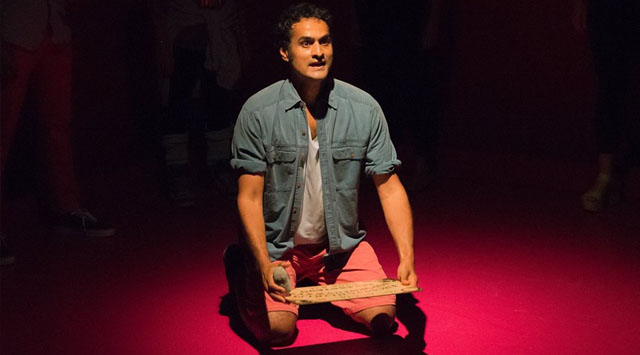
Two extremely traumatic events happen in Mary Anne Butler’s Broken. Ash, Ham and Mia are regular people encountering dreadful circumstances, and their agony is positioned within their very ordinariness, compelling us to relate to their hurt with the most immediate intimacy. It is a poetic piece of writing, with characters speaking directly to us, or perhaps to themselves, but only occasionally engaging each other in dialogue. Instead of demonstrating incidents as they occur, we are given recollections, as though in psychotherapy sessions where the subject has to access memories, from which levels of understanding can be reached over time, as the dust begins to settle. The text is experimental, often very powerful in its description of shocking details relating to the horrors being faced and the accompanying emotions, but it is arguable if the words address sufficiently, the essentially spatial nature of a theatrical script.

The staging involves three stationary microphone stands, with a cast restricted by their apparatus. The play features crippled personalities, and what we see are three individuals confined to tight spaces, unable to gain a breakthrough for their struggles. Frustrated, stifled and depressed, they are caged in and try as they might to talk themselves out of darkness, their efforts are futile. The show is appropriately sombre, and although never short of emotional intensity, its dramatic qualities are subdued. Much is made of speech and sounds, including the slightly awkward incorporation of foley techniques, but physical and visual aspects of the production are heavily reduced. Without strong imagery to coincide with its verbal aspects, the production relies heavily on the audience’s imagination, which may not always be an effective means of allowing the story to connect.

Actors are uniformly strong, with impressive cohesion in their presentational style and tone. Thoroughly well-rehearsed and precisely executed, Ivan Donato, Sarah Enright and Rarriwuy Hick’s portrayals are confident and convincing. The harrowing nature of their depictions proves to be of no hindrance to the depth of exploration they are able to provide, and even though opportunities for interaction between players are infrequent, their timing as a group is beautifully polished, and a pleasure to witness.

Accidents can ruin us, and even though life must go on for those who survive, recovery is not always a surety. In Broken, we are subject to an examination of our being during the worst of days, without an opportunity to escape into the promise of a brighter future. Plunged into hopelessness, the play keeps our consciousness inside its pain, before we are able to again take a departure, and let our human resilience wipe it away from memory.

www.darlinghursttheatre.com

Review: The Hanging (Sydney Theatre Company)

stcVenue: Wharf 1 Sydney Theatre Company (Walsh Bay NSW), Jul 28 – Sep 10, 2016
Playwright: Angela Betzien
Director: Sarah Goodes
Cast: Luke Carroll, Ashleigh Cummings, Genevieve Lemon
Image by Lisa Tomasetti

Theatre review
When a girl becomes a woman, her body changes and her mind expands. The world’s ugly sides begin to reveal themselves, and she is disoriented, trying to understand her new place in the bigger scheme of things. She may choose to subsist in delusion, pretending that her guardians can shield all evils, or she can test the waters in a life fraught with danger, seduced by its honesty and the knowledge of its inevitability.

In Angela Betzien’s The Hanging, three 14-year-old girls vanish from their private school privilege, and the nation is gripped. We make assumptions based on beliefs about innocence, and create visions of their victimhood. When one of them returns, the mystery deepens and all is not what it seems. Inspired by Joan Lindsay’s Picnic At Hanging Rock, the 1967 novel is also an actual presence in the play that characters refer to. We are reminded of how we had reacted to the older story, and wonder if the way we think about girls, their desires and their strength, are trapped in fictive and romantic idealism.

Betzien’s plot structure makes for an intriguing experience, with fragments of potent curiosities scattered through its dialogue, intimating but not divulging what the three girls try to hide. It is enthralling theatre, made even more sensational by its subtle incorporation of many au courant social and political concerns. Its ideas are progressive and plentiful, and they elevate the play from its mystery genre to something altogether more important and affecting.

Having adopted Lindsay’s Australian Gothic aesthetic, the production is viscerally haunting in a familiar way, similar to the book and its famous film adaptation, but also sensitively updated to its contemporary context for a more evolved portrayal of femininity, and its encircling issues. Director Sarah Goodes brings a strong sense of import to the themes of the story, whilst pursuing dramatic tension for the very fascinating narrative. A stronger ambience of danger and sexuality could make the show even darker and more powerful, but Goodes’ work is undoubtedly enchanting. We are invested in the riddles of The Hanging right from the start, and she makes us hunger for each revelation that she delivers in perfect time, every one of them satisfying.

Restrained but intense performances by Luke Carroll, Ashleigh Cummings and Genevieve Lemon bring to the stage a distinct flavour, partly a conventional, almost soap opera approach using common archetypes, coupled with a confident embrace of a more silent and poetic approach to acting. Lemon is particularly memorable in the role of Corrossi, sharp and abrasive, with surprising emotional range, interpreting beautifully, the being of a middle age modern woman, and the perspectives of a high school teacher who has seen legions of girls blossom and decay.

Society is disparaging of femininity, and underestimates the young. When Ava, Hannah and Iris disappear, they expose our beliefs and expectations, along with the prejudicial ways we think about adolescent girls. The Hanging questions the way we nurture and offer guidance, confronting us with difficult truths about the instability of human volition, freedom and fortitude, especially volatile in the teenage years. In an effort to find a real understanding of how we are, the reflections we see in the play are necessarily pessimistic. It refuses denial of the bad inherent in what we do and think, making us acknowledge the less than perfect aspects of our nature. There are masochistic pleasures discoverable in its gloomy expressions, but for those less morbidly-inclined, its important lessons although disturbing, are relevant to one and all.

www.sydneytheatre.com.au

5 Questions with Bodelle de Ronde and Curly Fernandez

Bodelle de Ronde

Bodelle de Ronde

Curly Fernandez: With your artistic practice are there any art movements through time you feel an affinity with or get strong inspiration from?
Bodelle de Ronde: There are certain artists who have inspired me with their images when I’ve been creating a character. For me it’s portraits that come alive and I get a strong feeling of who that person is, or landscapes/scenes that conjure up an atmosphere I can use in my work and captures my imagination. Artists like John Singer Sargent, Edvard Munch, John William Waterhouse, Marc Chagall, Sir John Everett Millais, Frida Kahlo.

What is your most exciting cultural heritage memory when you were growing up?
Realising I came from a large family of such a different culture from the one I grew up in. Whenever we had get-togethers in Bangkok I’d be surrounded by aunties and cousins all speaking in a language I learnt to pick up but didn’t quite understand but it didn’t matter because we still had so much fun together. I gained a strong sense of belonging, family and identity spending school holidays in Thailand.

Do you have any obsessive compulsive tendencies?
I’ll check the oven’s off before I go to sleep but because I live in a shared house that hasn’t been such a silly thing to do.

Five items you would take to a deserted island?
Photos. Music. A spear for catching fish (aka Cast Away!). A collection of Haruki Murakami. Pen and paper.

How does the Orpheus myth translate to modern audiences?
Hopefully a bond of love is something that audiences will always relate to. As well as his sense of displacement being in the underworld, surrounded by people whose actions seem familiar and yet ajar with normality. The struggle to fight for what you believe in and the question of how far you are willing to go for that cause is also very topical.

Curly Fernandez

Curly Fernandez

Bodelle de Ronde: What’s your most memorable moment on stage?
Curly Fernandez: I performed a one man show at La Mama many years ago. It was called The Delusionist. Famous speeches from history retold. My wife directed it, my newborn daughter crawled around the space whilst we rehearsed and teched. My sound designer was my babysitter and my SM was our best friend. It was a real family project. My mother in law came one night and led a standing ovation. It wasn’t so much for my performance but for our family. She was very proud of what Lauren and myself had done, made a life in art with our family.

What’s your biggest turn on?
Great physiques. Great coffee. Great underwear. Yes in that order.

What’s the biggest challenge for you when devising theatre?
For me personally it’s feeling ok with suggesting ideas or things that pop into your imagination that have no logical base and then seeing them fail and not being ashamed of it but honouring the idea or vision, as sometimes something exquisite arises from it.

What drew you to this project?
Michael Dean had seen me over summer and was keen to work with me, and had spoke with a friend of mine. Everyone talked highly of his devised work. Importantly in the audition it was that himself and myself were able to talk quite freely and honestly.That was the key. We also share similar heritage.

Your character, based on Persephone, is an outsider. How do you relate to this?
I’m black.

Bodelle de Ronde and Curly Fernandez are appearing in Orpheus.
Dates: 18 – 27 August, 2016
Venue: Blood Moon Theatre

5 Questions with Cheyne Fynn and Cindy Wang

Cheyne Fynn

Cheyne Fynn

Cindy Wang: What is your ethnicity?
Cheyne Fynn: Ooh I get this question a lot I am Australian born and raised; my parents however are South African with a splash of Mauritian on my mother’s side.

How would you describe your character PJ in five words?
Five words is difficult for a character who spends most of the play pretending to be someone/something he isn’t but I’ll give it a go – anxious, boisterous, loyal, intelligent, cheap.

There are a few semi-adult scenes throughout the play. How do you feel about that?
It’s nothing compared to what goes on back stage, so it’s fine by me.

What made you decide to become an actor?
Was there a different path to choose other than acting? I don’t know if I ever chose acting. Since I was a kid, it’s all I wanted to be and all I wanted to do. I never made the conscious decision though, it just was who I was. My parents however always wanted to me get into teaching as a ‘fallback plan’… I don’t know why but the thought of being a starving actor just always had more appeal.

If you were a sales person, how would you sell the play House Of Games to a group of conservative board members?
I’d wrap it up in a hundred dollar bill and tell them there is a good night to be had!

Cindy Wang

Cindy Wang

Cheyne Fynn: Rumour has it you saw your first kiss in the House Of Games rehearsal room! How was that experience?
Cindy Wang: I am a huge prude, and like a good sheltered kid, it was really awkward watching it, but I’d like to believe I pulled myself through the experience and came out a better person!

Your character Edna is not a physical person in the original script. What have you found to be the best and most challenging part of creating a whole new character?
Perhaps it’s due to the lack of experience on my part, however, when you’re given so much freedom to do whatever you want for a character it gets a little overwhelming, it’s as if someone said, “What slice of cake do you want? And you really want to say porque no los dos?”

If money were not an issue, what’s the one thing you would ask for (and no, world peace is not an answer, you are not trying out for Miss Universe)?
I would want to buy a country so I could tell people I own one just because I’m a materialistic prick. However, if it weren’t a want rather a need, I would probably buy a house so I wouldn’t need to worry about that in 5-10 years’ time.

Do you have any show superstitions or rituals?
No, however, sometimes, during a really late night on the weird side of the internet, I read about the strangest things and I read about it being lucky (or unlucky, depending on the internet source) if you saw 11:11 on your clock. Not too long after that, 11:11 always happens to be on my watch when I looked at it.

If you could go back in time and give yourself one piece of advice what would it be?
I would tell myself to trust my instincts, relax, enjoy yourself, and follow the flow. However, knowing the young me, I would have said “omg… time travel exists.” Yeah, I had a short attention span.

Cheyne Fynn and Cindy Wang are appearing in House Of Games by David Mamet.
Dates: 9 August – 10 September, 2016
Venue: New Theatre

Review: Three Sisters (Sport For Jove Theatre)

sportforjoveVenue: Seymour Centre (Chippendale NSW), Jul 28 – Aug 13, 2016
Playwright: Anton Chekhov (translated by Karen Vickery)
Director: Kevin Jackson
Cast: Tom Campbell, Paige Gardiner, John Grinston, Noel Hodda, Zoe Jensen, Graeme McRae, Michael McStay, Kenneth Moraleda, Lyn Pierse, Lauren Richardson, Shane Russon, Justin Stewart-Cotta, Dorje Swallow, Janine Watson
Image by Marnya Rothe

Theatre review
There are few absolutes in life, but change is certain. The world transforms from moment to moment, and how each person experiences the flux of being is where we discover meaning. In Chekhov’s Three Sisters, characters talk about progress, expressing hopes for the future, but are unable to propel themselves into action. Passivity is the enemy, and they succumb to its control. Years pass by and each day in their provincial estate becomes increasingly forlorn and depressed. There is something about the comfort of wealth that prevents individuals from reaching the best of their potentials; in the absence of urgency, one is left frozen, unable to attain greatness that can only result from courage and risk.

The production is both courageous and risky. Under Kevin Jackson’s direction, actors make bold decisions with how their stories are told. They commit to a highly animated style of presentation, uncommon in our day and age, that delivers wonderfully amusing results, but can at times be jarring to our benumbed bourgeois sensibilities. Whether or not we find interpretations believable in psychological terms, Jackson brings a level of clarity to the ideas being discussed that allows the hundred (and some) year-old Three Sisters to speak with an unexpected relevancy.

The director’s love of acting is evident in the amount of detail he encourages from the cast, but at over three hours long, the play is too much of a good thing. Nonetheless, the delightful ensemble of twenty diverse actors (resplendent in costumes by Emma Vine) is teeming with vigour, and evenly impressive. The most memorable scene belongs to Irina, Masha and Olga in Act III when they confide in each other, sharing feelings about sad events, but guffawing at themselves. The contradictions they perform are not only effective in reinforcing Chekhov’s commentary on aristocracy, but a sophisticated device that marries irony with theatricality, for a complex representation of humanity at a moment of despondence.

The tragedy of not being able to realise one’s dreams is made more pitiful when there is nothing ostensibly in the way. The women and men of Three Sisters have no one to blame but themselves for their disappointments, and we react with laughter and with sadness, a bittersweet acknowledgement of their predicament that we readily relate to. In the play, happiness is a concept detached from realities, and the concept becomes increasingly abstract with age. We end the show with women on the verge of a nervous breakdown, but the conclusion is a buoyant one for it provides answers to burning personal questions, along with an optimistic perspective of what can often be a very dark existence.

www.sportforjove.com.au

Review: Beirut Adrenaline (Théâtre Excentrique)

excentriqueVenue: Belvoir St Theatre (Surry Hills NSW), Jul 27 – Aug 14, 2016
Playwrights: Jalie Barcilon, Hala Ghosn
Director: Anna Jahjah
Cast: Danielle Dona, Neveen Hanna, Mansoor Noor, Eli Saad, Sana’a Shaik, Delphine Vuagnoux
Image by Emma Lois

Theatre review
The play is set wartime, approximately thirty years ago in Beirut. We do not see politicians or armies, only civilians who attempt to live every day with as much normalcy as they can muster. Amidst constant worry and foreboding, every step they take becomes a heavy one, with repercussions that no one can be certain of. Their experience may now be considered a chapter of the past, but war is ever-present, and its unchanging complexion means that every story of survival, or otherwise, serves to help us reflect on the many dark events of our day.

The stress and anxiety from that state of emergency is portrayed well in Beirut Adrenaline, even though time and space is, in the play, often confused. Like the experience of trauma, the production opens with a sense of disoriented bewilderment, and we are forced into an inconvenient struggle to figure out each of its story’s where, when and who. It takes considerable time before we are able to form enough narrative coherence, but it is a worthwhile investment that ultimately does take us to a satisfying conclusion.

Neveen Hanna and Eli Saad play the bigger parts in the show, and are both affecting. We warm up to them slowly, but their efforts are fundamentally passionate, with an impressive sincerity especially moving at the climactic end. Mansoor Noor’s animated approach for his teenage character is delightful, and the confident demeanour he brings to the stage is refreshing and quite critical in adding a quality of exhilaration to its often sombre tone.

Although Beirut Adrenaline is rough around the edges, unable to provide a polished telling of its pessimistic tale, it does leave us with a truthful and evocative essence of those terrifying experiences. It is in our nature to want easy answers and impeccable solutions, but war is a beast that will forever resist our every grasp and restraint. The notion of world peace exists only in the phantasmagoric land of fairy tales and beauty queens. To find any progress, our existences must include the acknowledgement of suffering, especially of those we call our enemies.

www.theatrexcentrique.com

Review: Twelfth Night Or What You Will (Belvoir St Theatre)

belvoirVenue: Belvoir St Theatre (Surry Hills NSW), Jul 23 – Sep 4, 2016
Playwright: William Shakespeare
Director: Eamon Flack
Cast: Peter Carroll, Anita Hegh, John Howard, Lucia Mastrantone, Amber McMahon, Anthony Phelan, Keith Robinson, Damien Ryan, Nikki Shiels, Emele Ugavule
Image by Brett Boardman

Theatre review
Characters in Shakespeare’s Twelfth Night Or What You Will are drunk with infatuation. They chase after that sweet sensation of being overcome by the notion of love, obsessed with finding reciprocation from the object of their desire. It is an escape from the harsher realities of life, this frivolous respite. Taking us away from stories of war, of incarcerated children, or of religious schism. Countering the dark with light, we can go to the theatre for mirth, seeking refuge in its momentary illusions so that our souls can rest and be comforted, like a baby, safe in her mother’s womb.

The production understands the joy it has to deliver, in order that it may bear any meaning at all. Director Eamon Flack’s approach takes things back to basics, creating a show that looks and feels as if presented by a troupe of Elizabethan travelling players, who have little more than their bodies and voices to tell the story with. Flack’s experimentation with working from a script that is virtually unedited, means that we rely on the actors to make every line of dialogue count, including the many instances of “archaic nonsense” (Flack’s words) that only the scholarly would appreciate. It is a tall order, and the results are predictably mixed. The very accomplished and esteemed cast delivers three hours of wonder, amusement and laughter, along with interludes of bewilderment and boredom. Anthony Phelan’s camp humour is outrageous, completely gleeful in its tenacious need to tickle our funny bone. Keith Robinson is charming as Feste, breaking through the fourth wall for a firm connection with his audience, daring to improvise beyond Shakespeare’s words. Peter Carroll and Lucia Mastrantone impress with their energy and precision, both inventive in their surprising artistic choices.

The world can spin too fast, too manic for mere humans to cope. Retreating into the classics can help us regain composure, and with the old-fashioned Twelfth Night, we can hope to find our feet again, in everything that is placid and familiar. Tradition is valuable in the way it reminds us of what is good and time-honoured, giving us an understanding of humanity’s nature, helping us define our place in the world, but it is also the basis on which we decide what needs to change, and how we can progress and become better. Shakespeare is a past that continues to haunt us, but we can make of him what we will.

www.belvoir.com.au