In Rehearsal: Leaves

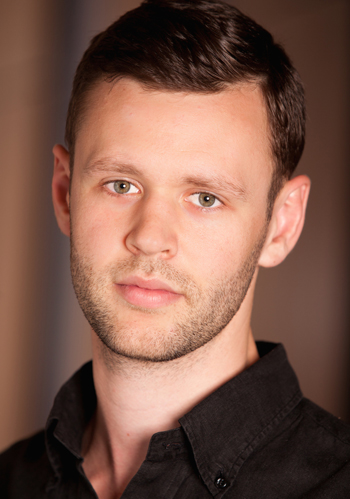
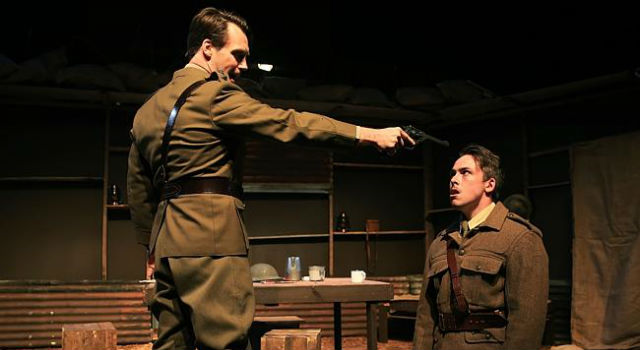
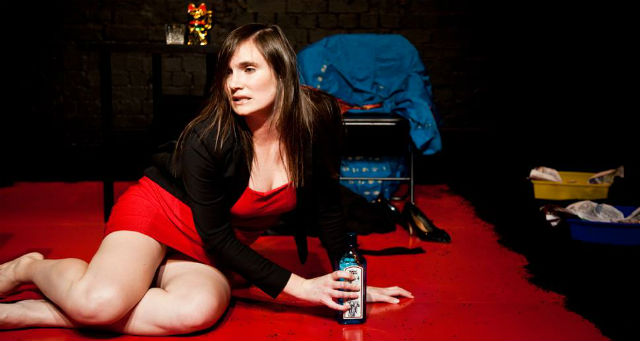
Rehearsal images above from Leaves by Théâtre Excentrique.
At King Street Theatre, from Nov 19 – 29, 2014.
More info at www.theatrexcentrique.com
Photography by Kyle Stephens

5 Questions with Jacki Mison

jackimisonWhat is your favourite swear word?
My favourite swearword is ‘motherfucker’ because hey, why limit yourself to just one? I love the fact you can elongate either, or both words for extra emphasis.

What are you wearing?
PJ’s, which involves a singlet & a pair of boxers.

What is love?
When you rejoice in someone else’s being… and that includes my dog!

What was the last show you saw, and how many stars do you give it?
The best thing I’ve seen in the last few months, which I absolutely loved, was Sugarland at ATYP.

Is your new show going to be any good?
Well if you feel like watching something that is sharp, witty, will make you laugh out loud and is NOT 3 hours long, then yes, it is good, very, very good! So come along and enjoy….

Jacki Mison is appearing in The God Of Carnage, by Yasmina Reza (translated by Christopher Hampton).
Show dates: 26 Nov – 7 Dec, 2014
Show venue: TAP Gallery

Review: Switzerland (Sydney Theatre Company)

Venue: Sydney Opera House (Sydney NSW), Nov 3 – Dec 20, 2014
Playwright: Joanna Murray–Smith
Director: Sarah Goodes
Cast: Eamon Farren, Sarah Peirse
Images by Brett Boardman

Theatre review (originally published at Auditorium Magazine)
The term masterpiece is used to describe a work of outstanding creativity, skill and workmanship. Although it is far too early to declare that Switzerland is Joanna Murray-Smith’s most celebrated work, there is no doubt that the playwright has founded something extraordinary with this fictional account of American author Patricia Highsmith’s very last days. Along with Sarah Peirse’s phenomenal performance as Highsmith, this is a production that will be remembered as one of the grandest achievements from two of contemporary theatre’s geniuses.

Highsmith died in Switzerland in 1995, but the story takes place in 2001. In her austere living room, she receives a guest Edward Ridgeway, who has arrived from New York as a representative from her publisher, despatched to obtain Highsmith’s signature on a contract for a new instalment to her famed Ripley series of novels. The young Ridgeway is bright and aspirational, but timid in the presence of the great writer, who has no qualms about berating and offending the rookie at every opportunity. Ridgeway presents himself as a devotee of Highsmith’s oeuvre, and uses all his might to complete the task at hand. The subject of his imploring however, is difficult and mean, and she proceeds to turn his visit into a living hell. Like Highsmith’s books of suspense in the crime fiction genre, Switzerland too is intriguing and seductive, with an unmistakeable Hitchcockian sensibility to its plot and pace. The breathtaking work is a remarkably gripping experience not commonly found in live performances that tend to appeal to emotions more than they do our very visceral responses and indeed, nerves.

It is always tempting to think of writings about writers to be at least partially autobiographical, and Murray-Smith does seem to be extremely personal and revelatory about that creative process in the palpable intimacy witnessed here. Highsmith was more interested in the “why” of murder, than the “how” of it, and this play thoroughly explores human behaviour and psychology, providing a window through which we discover the manifold logic behind the way we tick, especially in our dark moments. The characters thrive in their morbidity; conversations rarely veer from death and destruction, but the play is not deadly serious. It is often piercingly funny, particularly in the way Highsmith’s eccentricities and nastier qualities are accentuated. More than entertaining, Murray-Smith’s comedy helps with her macabre narratives, making them more convincing and threatening. It is the way light and dark vacillate that makes us lose ourselves, and fall headfirst into this indulgently baroque world of deception and narcissism.

Sarah Goodes’ direction is tense, taut and terrific. The deeply complex text is brought to life with crystal clarity in its narrative and characterisations, yet the astonishing multilayeredness of its themes is retained. It is the kind of play that seems to touch on everything, even though its story is ostensibly about something simpler. The context of a hermitic novelist is far removed from many of our own lives, but at no point does Goodes allow us to feel estranged from its themes and ideas. The script’s ambitious structure switches mode constantly within its three single-scene acts, taking cue from Highsmith’s unpredictable and capricious temperament. The direction’s acceding variances in tone and atmosphere are sensitively formed, and the results are edge-of-the-seat exhilarating.

In Switzerland, leading lady Peirse is perfection incarnate. She is at once Maria Callas, Greta Garbo and Bette Davis, bringing to the production a charisma that outweighs the Sydney Opera House, and a storytelling ability that seizes and manipulates our imagination as though reducing us to children hypnotised by a lullaby. Her Highsmith is obnoxious, contemptible, almost evil, yet we are drawn to her helplessly, desperate for her every utterance and gesture. There is a mysterious skill involved in the way Peirse makes each moment of her performance seem majestic, while letting us see textures of subtlety and importantly, authenticity. A real character exists on that stage, but the enormity of the actor’s power is its awe-inspiring double. Many excellent actors grace the stages in the lucky city of Sydney, but it is the splendour on this occasion that causes one to bemoan the ephemerality of the theatrical form.

The role of Ridgeway is equally substantial. The character is half of the story and script, even though he is necessarily subservient. Eamon Farren is a strong actor who tackles the role thoughtfully, and with evident conviction, but he is often eclipsed by Peirse. There is an unfortunate imbalance arising from the difference in levels of experience that is almost inevitable. Pitting an 80 year-old character against a twenty-something, and casting actors with over twenty years’ discrepancy in their respective craft maturation in a two-hander, proves to be more than a little precarious. Our attention resists being split 50/50, and Farren is outclassed and relegated to unofficial supporting actor. Nonetheless, the actor’s accomplishments in creating an interesting personality is significant and so is his contribution to the effectiveness of the plot. The chemistry of the pair is also noteworthy, with an impressive fluency to their dialogic rhythms.

All the action takes place in the living room. Michael Scott-Mitchell based his set design on Highsmith’s final home, suitably bringing to focus the Brutalist environs in which she dwelt. Taking a sharply angled perspective of the house, the stage is shaped like a dagger, reflecting Highsmith’s love of weaponry, and the harshness she had embraced into all aspects of life. Scott-Mitchell’s creation is masculine and perversely beautiful, with a large working fireplace in the centre that provides warmth to the visual aesthetic, but also a menacing sense of impending doom. Lighting is subdued but is central to mood changes and assists in illustrating character transformations. Nick Schlieper’s work is unassuming, but very elegant. Steve Francis’ memorable music compositions between scenes are cinematic and evocative, bringing to mind Hitchcock collaborator Bernard Herrmann’s more noir opus.

In Switzerland, Highsmith humorously claims to be neutral, never judging the actions of her characters, content to sit back and observe things unfolding, seemingly on their own accord. She washes her hands of all their sins and misdeeds, almost extricating herself from the part she plays as their sole architect. The show however, bears the fingerprints of all its authors and they should be immensely proud of their artistic marvel. Tom Ripley lives on as a literary landmark, and Joanna Murray-Smith’s play will likely go on to be a considerable part of Australian theatre legacy.
,

www.sydneytheatre.com.au

Review: Little Egypt’s Speakeasy (Grand Moustache / Django Bar)

grandmoustacheVenue: Camelot Lounge (Marrickville NSW), Nov 6 – 9, 2014
Writers: Luke Escombe, Lucian McGuiness, Dominic Santangelo
Director: Lucian McGuiness
Cast: Brian Campeau, Kelly Ann Doll, Amos Elroy, Luke Escombe, Danica Lee, Lucian McGuiness, Katie-Elle Reeve, Dominic Santangelo, Damien Slingsby, Elana Stone, Aaron Flower, Nick Hoorweg, Evan Mannell, Mathew Ottignon
Image by Frank Farrugia

Theatre review
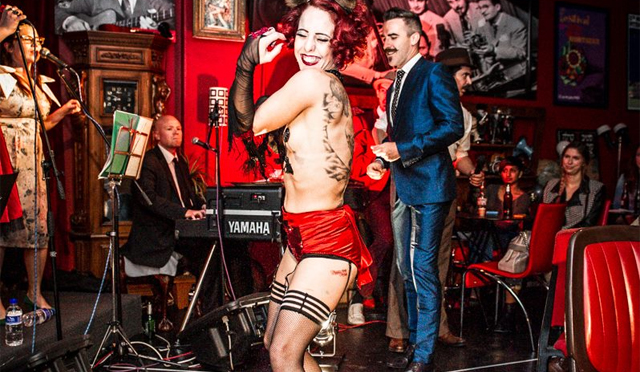
The term speakeasy refers to the illegal trade of alcohol during the American “prohibition” period from 1920 to 1933, and Little Egypt is the name of an exotic dancer from even earlier in the twentieth century. Lucian McGuiness’ show Little Egypt’s Speakeasy draws inspiration from both, to recreate the setting of a nightclub filled with sounds and sights from the 1950s. McGuiness is leader of the handsomest band in town, with four kooky vocalists, and a beatnik MC who provides the thread that helps us imagine the narrative that the show is vaguely built upon. Incorporated flawlessly are two burlesque dancers and the band leader’s comedic brother Don who owns the joint.

There are some stellar performances in the piece. The dancers Kelly Ann Doll and Danica Lee are both scintillating and drop dead gorgeous. The MC and narrator Amos Elroy has the deepest voice imaginable from a baby face, with a use of words and humour that is transportative and quite magnificent. Singer Elana Stone is vibrant in personality and in voice, and her male counterpart Brian Campeau is simply divine with a Chet Baker style sensuality, only with much stronger pipes. McGuiness is star of the show with an extraordinarily sharp presence that exemplifies the irresistible sexual allure of the entire evening.

Don and his club’s story do not quite take hold, but the introduction of a through line for a cabaret show is ambitious and astute. It is almost human nature to want to follow a plot, and the experience is certainly enriched with Don and the MC bringing cohesion to the many separate items presented. Little Egypt’s Speakeasy brings a taste of the bohemian life to Sydney, and it is delicious.

camelotlounge.wordpress.com | www.lucianmcguiness.com

5 Questions with Dimitri Armatas

dimitriarmatasWhat is your favourite swear word?
Fucking/fucken shit! Both of these alternatives, I find, have an incredible way of doing two things at once. Firstly, it helps to release all the frustration you’ve got inside you, which is the reason for swearing in the first place. Secondly, if said properly, will come out in an altering pitch and speed, allowing for ultimate success in execution.

What are you wearing?
Black t-shirt and jeans. T-shirts and jeans, the forever winning combination.

What is love?
I’ve got nothing, but…indescribable

What was the last show you saw, and how many stars do you give it?
Henry V at the Sydney Opera House. It was a great show with an interesting choice of staging, and always good to see a young cast showing the power of the Bard lives on. I would give it 3.5/5 stars.

Is your new show going to be any good?
With a great director and the quality of the talent within the cast, I really think it’ll be spectacular.

Dimitri Armatas is appearing in his own play Haus by Black Raven Productions.
Show dates: 5 – 15 Nov, 2014
Show venue: King Street Theatre

Review: Daylight Saving (Darlinghurst Theatre Company)

darlotheatreVenue: Eternity Playhouse (Darlinghurst NSW), Oct 31 – Nov 30, 2014
Playwright: Nick Enright
Director: Adam Cook
Cast: Helen Dallimore, Belinda Giblin, Rachel Gordon, Ian Stenlake, Christopher Stollery, Jacob Warner
Image by Helen White

Theatre review
Nick Enright’s Daylight Saving was written at the dawn of the 1990s. Director Adam Cook’s straightforward staging in 2014 preserves its original sensibilities, but time has not moved on far enough for the play to feel like a classic. Instead, the production appears outdated despite its very polished execution on all fronts. Enright’s story about the farcical turmoil of well-to-do north shore Sydneysiders no longer bears an edge to rival the more relevant comedies of today, and its “first world problems” context can be quite grating when presented without sufficient mockery.

It is evident that Cook has an excellent understanding of the text and the way dynamics are ingrained into the dialogue. His work feels faithful to the author and to the milieu being referenced, and if produced in ten or so years, the play might come across more charming and nostalgic. Cook’s flair with actors gives the show a confidence that allows it to gleam with impressive professionalism, and the cast is an endearing one, even if the characters they play tend to be annoyingly lightweight. Leads Rachel Gordon and Christopher Stollery provide the narrative with a sturdy anchor, and a surprising authenticity, but they are also less colourful than supporting players, resulting in a loss of emotional connection with the audience.

Jacob Warner lights up the space with his entrance late in the piece as Jason Strutt, a spoilt and insolent tennis star. The part is small, but the actor leaves a lasting impression with enthusiastic and risky comedic choices. Also quirky is Helen Dallimore’s madcap rendition of the desperate girl next door Stephanie, who exists mainly to make the protagonists look good, but Dallimore’s gleeful performance is a fiercely delightful one. Belinda Giblin’s sharp humour as Bunty sees her coming on and off stage like a mini hurricane, and Ian Stenlake’s compelling mix of casanova and goofball is oddly alluring.

Daylight Saving is a story about small things that disrupt very comfortable lives. Its frivolity will certainly appeal to some, but its lightness would also prove unbearable to others. Although Enright’s comedy is not quite universal, the conviction of performances on this occasion is magnetic, and audiences will engage and respond, if only in appreciation for the vibrant energy that fills the theatre.

www.darlinghursttheatre.com

5 Questions with Claire Lovering

claireloveringWhat is your favourite swear word?
Lord Voldemort. No matter how many times you say it aloud, it still feels naughty.

What are you wearing?
A singlet and sarong… I’ve been lying on a hammock all afternoon pretending I’m on a tropical island. It worked surprisingly well, and it’s cheaper than flights to Barbados.

What is love?
It seems to me that love is everywhere. Often, it’s not particularly dignified or newsworthy, but it’s always there – fathers and sons, mothers and daughters, husbands and wives, boyfriends, girlfriends, old friends. If you look for it, I’ve got a sneaky feeling you’ll find that love actually is all around. (Works best when read by Hugh Grant.)

What was the last show you saw, and how many stars do you give it?
Is This Thing On? at Belvoir. It was brilliant. I can’t remember the last time I laughed that much at the theatre. I give it 4 and a half stars. I will deduct half a star because I sat in the front row and due to my irrational fear of audience participation I spent a good 96% of the show terrified I’d be picked on.

Is your new show going to be any good?
It better be; I’ve had to learn to play the xylophone for it… I say that like it’s been forced upon me, but I wrote the show so I only have myself to blame.

How Lord Voldemort is that?!

Claire Lovering is performing in her own one-woman show, River.
Show dates: 18 – 23 Nov, 2014
Show venue: The Old 505 Theatre

5 Questions with Hugh O’Connor

hughoconnorWhat is your favourite swear word?
Cunt. It just sounds so great, the way the consonants sit in your mouth. For me it’s the perfect curse word. I need to stop saying it around kids.

What are you wearing?
Beige shorts and a grey reebok singlet. No shoes, I hate wearing shoes. I’ll take comfort over fashion any day.

What is love?
My family, my husband. Love is their acceptance and unyielding support. Love is something I couldn’t live without. Gosh, I am a total romantic!

What was the last show you saw, and how many stars do you give it?
I really don’t see enough theatre. I spend so much time working in them that as soon as I get any free time I spend it out in the real world! So the last show I saw was my own show, The Witches, which was at Griffin Theatre. And of course I give it 5 stars (but seriously it was really good).

Is your new show going to be any good?
I bloody hope so! The cast is top notch, and I love Nick Enright. It should be really a fun and engaging show.

Hugh O’Connor‏ is production designer for Daylight Saving, from Darlinghurst Theatre Company’s 2014 season.
Show dates: 31 Oct – 30 Nov, 2014
Show venue: Eternity Playhouse

Review: Journey’s End (The Theatre Troupe)

theatretroupeVenue: Seymour Centre (Chippendale NSW), Oct 21 – Nov 15, 2014
Playwright: R.C. Sherriff
Director: Will Usic
Cast: Andrew George, Will Usic, Yannick Lawry, Jack Douglas, Jeremy Bridie, Richard Cotter, Ian Bezzina, Jim Robison, Steve Tait
Image by Toby Zerna

Theatre review
Journey’s End was first performed in 1928, ten years after the end of World War I. Its playwright R.C. Sherriff based the play on his experiences as a British officer in the trenches, and what he had provided is a perspective that feels unusually personal and specific. Focus is moved from the big picture of ideology and territories, to looking at individual lives of those “boots on the ground” as they try to cope with persistent threat, danger and fear.

Will Usic’s work in directing actors is strong. He extracts thoughtful performances from the entire cast, and all are able to instil in their portrayals something that feels genuine and dignified. There are some issues with plot that indicate a need for the very long text to be edited, and while many character interchanges are dynamic and moving, several scenes of dialogue fail to ignite. Poetic license is required but not often utilised in the production. Sherriff’s writing is borne out of stiff upper lip England, so sentiment and passion are extremely restrained, and can make for uncomfortable viewing by today’s conventions.

Usic in the role of Osbourne is the stand out performance of the piece. He is palpably present, and sensitively conscious of conveying the very subtle emotional shifts that exist in those highly precarious situations of battle. His reactions to his comrade’s lines reveal as much as the words themselves do. Also engaging is Yannick Lawry’s humorous take on Trotter, who brings charming levity to the grave proceedings. Lawry pitches his character’s jolliness just right, so as to deliver comedy but also to retain the dark qualities of the narrative. Young Raleigh is played by Jack Douglas with excellent conviction, who maps out the part’s evolution beautifully and convincingly. Leading man Andrew George is believable as Captain Stanhope, with his effortlessly domineering stature, but there is a monotony to his depiction of the role’s depression that detracts from the dramatics of the production.

Set design (uncredited) is ambitious and effective. The stage is pleasantly transformed, and acting space is elegantly accommodated. Sound design (also uncredited) and Toby Knyvett’s lighting are under-explored in the first two acts, which adds to the aforementioned monotony, but both are intelligently conceived and executed thereafter to represent the horrific destruction of lives at war.

There is a delicate balance to be found when discussing the honour of people who serve in battle. Journey’s End does not glorify war, but it shows camaraderie at its deepest. The exaltation of those who have sacrificed can be worthwhile, but the condemnation of war must prevail.

www.facebook.com/TheTheatreTroupe

Review: V.D. (Copanirvana Theatre Co / Sydney Independent Theatre Company)

sitco2Venue: Old Fitzroy Theatre (Woolloomooloo NSW), Oct 28 – Nov 15, 2014
Playwright: Pete Malicki
Director: Lisa Eismen
Cast: Eliza St John
Image by Katy Green Loughrey

Theatre review
This is a story about a woman in love only with two things; herself and alcohol. Pete Malicki’s script is crafted with some skill. His jokes are incessant, and timed with a natural flair. His characters are abused and ridiculed, and no one is presented in a positive light. There is very little beauty and inspiration in the play, but it has a humour that will appeal to many. It is a harsh truth that Australians find alcohol funny. We laugh at people making destructive decisions and falling over due to drunkenness, and V.D. capitalises on that unfortunate part of our culture. It also takes advantage of the fact that making women desperate and dateless gets laughs easily. Sophie Webb is hopeless, almost idiotic, but she is not unrealistic, and of course, our artistic landscape must make room for all kinds of characters no matter how undesirable.

The script is skilfully executed by director Lisa Eismen and actor Eliza St John. Presentation of the comedy is wide ranging, from the very broad to the very subtle. Character development is sometimes uncomfortable in the plot, but the women manage to create a narrative that is often believable, although the show’s ending is quite bewildering. St John’s performance is masterful. She is wild, intuitive and considered, with a conviction that can turn water into wine. Her work is completely absorbing, and she manages to endear herself to her captive crowd, like using sleight of hand techniques to mask the hideous uselessness of the woman she portrays.

The world can be an ugly place, and it is necessary to know its flaws. The theatre is not reserved for snowdrops and daffodils, and artists must not be censored, but audiences look for morals in stories, and maybe even find meaning in listening to what is being said. What V.D. articulates is sometimes true, but also very sad indeed. Life is worth living because of hope, and we need to acknowledge the darkness that we live with, but we must always recognise it as such.

www.sitco.net.au