Review: Follow Me Home (ATYP)

Venue: SBW Stables Theatre (Kings Cross NSW), Jun 16 – Jul 3, 2021
Playwright: Lewis Treston
Director: Fraser Corfield
Cast: Laneikka Denne, Jasper Lee-Lindsay, Sofia Nolan, Thomas Weatherall
Images by Tracey Schramm

Theatre review
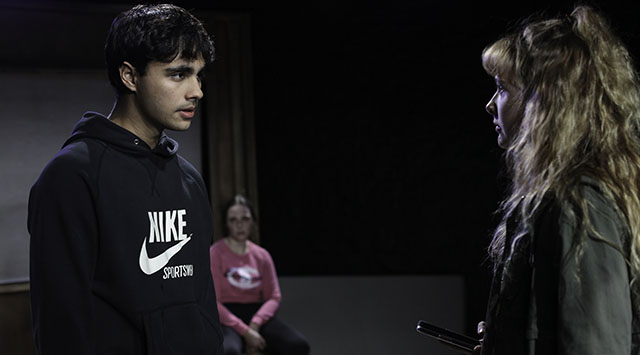
Lewis Treston’s Follow Me Home is comprised of anecdotes, from young Australians who have experienced homelessness. Although unified by a central theme, the stories are varied and surprising, able to reveal to viewers, the pervasive ignorance that surrounds these issues. To see the way people are treated as though discarded, especially at a tender age, is to interrogate our values as a community. Treston’s writing is incisive, and wonderfully dynamic. His dialogue sparkles and pops, to draw us in, and to keep our emotions invested.

The production is directed by Fraser Corfield, who exercises great restraint in stylistic terms, placing emphasis entirely on the quality of performance by a remarkable group of actors. It is worth noting however, that lighting design by Martin Kinnane contributes significantly to the tone of storytelling, and to the ways we respond to the play. Hugh Clark’s video projections provide a dimension of documentary authenticity, that helps us connect the onstage drama, with real world conditions just outside of the auditorium.

The ensemble radiates an unbridled enthusiasm, with four tremendously likeable actors taking on a wide range of roles, in disparate scenes that share a common urgency. Thomas Weatherall brings splendid detail to his characters, and a conspicuous intelligence that allows the narratives he presents, to be perfectly mapped out for our delectation. Sofia Nolan demonstrates great capacity for nuance, blending meaningful subtlety into the playful theatricality she unleashes for each of her personalities. Laneikka Denne is memorable for her earnest renderings, and Jasper Lee-Lindsay’s interior truthfulness proves captivating, in a showcase of some extraordinarily talented performers.

We need to acknowledge that there is something so deficient in our culture, that to have individuals languishing and suffering on the streets, is a normalised expectation. A new-born baby abandoned in a public restroom will cause an uproar, but when people grow past some arbitrary age, we are happy to completely renounce responsibility over their well-being. Each of us understands the fragile nature of life, and we know exactly what it feels like to need help, but rarely are we ready and willing to offer assistance. That frame of mind, is at the very core of our nation’s problems.

www.atyp.com.au

Review: The Woman In Black (Ensemble Theatre)

Venue: Ensemble Theatre (Kirribilli NSW), Jun 11 – Jul 24, 2021
Playwrights: Susan Hill, Stephen Mallatratt
Director: Mark Kilmurry
Cast: Garth Holcombe, Jamie Oxenbould
Images by

Theatre review
Arthur Kipps has engaged the expertise of an actor, to help him process, psychologically and emotionally, a traumatic event that has come to define his existence. The Woman in Black is a 1987 play, adapted by Stephen Mallatratt, from the 1983 book by Susan Hill. One of London’s longest-running productions, it is known for being an unusual example of a live show in the horror genre, with ghosts and the human imagination, creating a sense of dread and a series of scares, that form a crucial part of the theatrical experience.

Kipps is suffering from the aftermath of having been sent, as a junior solicitor, to a haunted house after the death of a client. Having seen and heard a series of strange and terrifying occurrences, he lives to tell the tale, if only in attempts to exorcise those dark imprints from his mind. The Woman in Black is a classic story, told in the most conventional way. Decades have past since the play’s original premiere, and although few have tried to emulate it on stage, innovations on the genre for the screen, have advanced by leaps and bounds.

In comparison with the multitude of horror films that have appeared over the last four decades, The Woman in Black feels too dated, and much too meek, for a worldly contemporary audience. Director Mark Kilmurry’s approach brings an appropriate air of nostalgia to the staging, but genuine instances of tension are desperately few. Spatial limitations in the auditorium mean that apparitions do not materialise in unsuspected places, and without sufficient possibilities for supernatural elements to be explored, much of the show’s efforts to scare, prove disappointing.

Production designer Hugh O’Connor is obviously restricted by what he can achieve for the set, but his work on costumes are finely detailed, on characters who look elegant at all times. Lights by Trudy Dalgleish are lush and beautiful in a classically gothic way, but it is Michael Waters’ sound design that does a lot of heavy lifting, complete with shrieks and screams urging us to get into the spirit of things.

Performers Garth Holcombe and Jamie Oxenbould are an excellent pair of storytellers, both dedicated and compelling. Oxenbould impresses with his deftness at switching seamlessly between personalities, in this “play within a play” format, but it is Holcombe’s insistence on conveying emotional truth, that provides the production with its saving grace. Beneath the flamboyant theatricality required in the portrayal of terror, is Holcombe’s embrace of the role’s psychological authenticity, which elevates the production to one that is worth ultimately, more than the sum of a few thrills and spills.

Kipps tries hard to heal himself of damage, one that is not unlike any mental injury that every person inevitably sustains from simply being alive. We watch him get on stage in order that he may go back in time, to re-enact and to relive the worst moments, in hope of attaining a new understanding of a confusing time, or simply to numb himself of memories that relentlessly haunt his every day and night. Indeed, art has the capacity to provide solace where all else fails, and at its most powerful, is able to bring concrete transformations to lives awaiting improvement. For those who only crave being scared out of their wits however, alternatives on the idiot box would probably deliver a more satisfactory result.

www.ensemble.com.au

Review: Happy Days (Old Fitz Theatre)

Venue: Old Fitzroy Theatre (Woolloomooloo NSW), Jun 12 – Jul 3, 2021
Playwright: Samuel Beckett
Director: Craig Baldwin
Cast: Belinda Giblin, Lex Marinos
Images by

Theatre review
Winnie is trapped in a mound of dirt, unable to move, and yet she persists in carrying on with life, in whatever way she can. The unyieldingly abstract Happy Days by Samuel Beckett evokes what feels to be an infinite number of themes. In its refusal to impose restrictive parameters on the story that it tells, choosing instead to include vague references as to who Winnie might be, and what might have happened to her world, we discover that the storytelling happens predominantly inside the viewer’s head. One of art’s fundamental purposes is to inspire, and when Beckett is done well, the resonances from his work are entirely transcendent, and on this occasion, the mind’s eye is certainly provided plenty to latch onto.

Set design by Charles Davis, manufactures for the stage a vision of the apocalypse. We find Winnie stuck in the remains of a planet that has been burnt to the ground. There is ash everywhere, and behind her stands a faded billboard touting “there is nothing like Australia,” from when tourism, and money, had meant something. The juxtaposition of a genuine artefact from the realm of commerce and advertising, against an imaginary disaster zone, makes so pertinent the self-destructive nature of modern existence.

Restrained work by Veronique Benett on lights, and Shareeka Helaluddin on sound, deliver a ghostliness that seems to have come to haunt us from the future. Yet the catastrophic scenario is immediately recognisable, prompting us to consider Winnie’s predicament not to be an imaginary tomorrow, but a parallel today. Directed by Craig Baldwin, the show’s atmospherics are flawlessly rendered, to connect with our subconscious and intuitive selves, who are sure to have a greater appreciation of the work, than their usual more cerebral counterparts.

Actor Belinda Giblin is exquisite in the role of Winnie. After approximately half a century of performance experience under her belt, it is perhaps not surprising that the level of preparedness Giblin brings should be anything less than comprehensive, but to watch her in action is completely disarming. Every word she conveys is imbued with extraordinary intensity and formidable meaning, determined to hold us captive where Beckett’s writing would normally leave us cold.

Also wonderful is Lex Marinos, who plays Winnie’s husband, Willie. Willie is in a state of perpetual discombobulation, always in the picture, but barely present. Deeply committed to the supporting part, it is a generous performance that we see from Marinos, who honours the centrality of Giblin’s work in Happy Days. Both actors are embarking on their eightieth decade on this earth, and with them comes not only a bountiful sense of worldliness, their very bodies and faces provide an important context of time, to the material that we engage with.

When we watch Winnie suffocating in her mound of dirt, it always feels like the end is nigh. For Winnie herself though, the end seems never to arrive. There is an element of resignation in Winnie’s interactions with each day, but that is only due to the irrefutable physical limitations that she finds herself subject to. Her mind however is limitless, and with that, hope is always a glimmering companion, as are regret and reminiscence.

When we say that we are running out of time, it only means that there is time left. There is an urgency in Happy Days indicating that for as long as we are denied the finality of death, something must be done. It may appear that Winnie is tragically unable to leave the world a better place than how she had found it, but we must recognise that in reality, we are in many ways unrestrained. To acknowledge the freedoms that we still have, is to be able to bring improvement to this life.

The walls might have started crumbling down, and the trees might be falling at a desperate pace, but with each breath taken, space for making better choices is always a possibility. Winnie’s incapacitation demonstrates, ironically yet so clearly, our inexorable ability to act. It is how we choose to act, that is always the pressing question.

www.redlineproductions.com.au

Review: Grand Horizons (Sydney Theatre Company)

Venue: Roslyn Packer Theatre (Sydney NSW), Jun 7 – Jul 3, 2021
Playwright: Bess Wohl
Director: Jessica Arthur
Cast: John Bell, Linda Cropper, Vanessa Downing, James Majoos, Johnny Nasser, Zindzi Okenyo, Guy Simon
Images by Prudence Upton

Theatre review
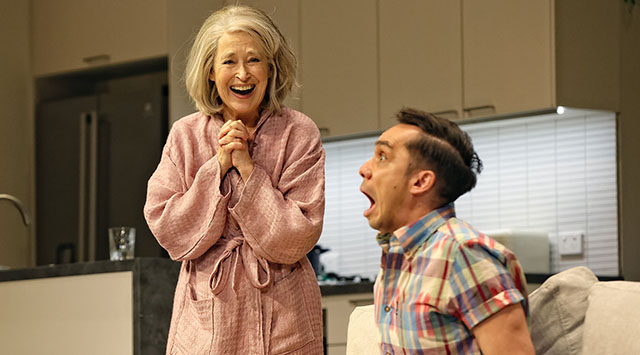
Nancy has asked for a divorce. Instead of congratulating her on daring to reach for happier days in the twilight years, her adult sons desperately try to change her mind, determined to keep her tethered to a life that she clearly deems unsatisfactory. At the centre of Bess Wohl’s Grand Horizons is Nancy and Bill’s 50-year marriage, offering a framework through which our basic values as individuals and as collectives, are interrogated. The very idea that a person’s efforts to end a bad relationship, are met with despair, is a clear indication of our capacity to be so distorted in the ways we conceive of existence.

It is a surreptitiously philosophical work, accomplished with a wonderful sense of humour, and often with a subversive streak. Wohl diminishes the persuasiveness of her own arguments however, by rendering the family’s wealth invisible in her discussions about female independence. The desire to lead us to a pleasing conclusion too, can feel somewhat of a cop out, but the play is undeniably enjoyable, full of wit and whimsy that makes for a hilarious and thought-provoking experience.

Nancy’s big beige sterile house, is an ironic picture of middle-class mediocrity and boredom. Production designer Renée Mulder delivers a comedic conflation, of aspiration and of depression, in her interpretation of boomer suburban resplendence. Lights by Verity Hampson and sound by Clemence Williams are subtly resolved, to honour all the clever ideas and the incessant jokes, that make Grand Horizons quite the unforgettable experience.

Certainly memorable is actor Linda Cropper, who brings extraordinary complexity, along with brilliant timing, to the role of Nancy. It is a remarkably intelligent performance, conveying great integrity for the older woman who finally realises that she deserves better. Also highly entertaining is Guy Simon as Brian, the gay son, who has a difficult time extricating his own identity from his parents’ parting of ways. Simon plays the flamboyant drama teacher with a dazzling theatricality, keeping the laughter sustained for as long as he remains on stage.

It is a strong cast overall, but supporting player James Majoos is exceptional in his single appearance, as the carefree Tommy, incredibly extravagant in approach, for one of the play’s more outrageous scenes. Director Jessica Arthur proves herself a formidable creator of comedy; her strategies vary from delicate to bold, demonstrating an adventurous creative spirit, and a serious commitment to tickling her audience.

We place far too much emphasis on the length of relationships, and invest far too little into understanding what makes a good one. Elizabeth Taylor married and divorced eight times, because she knew when she had become unhappy, and made sure to improve conditions whenever necessary. For that, she was routinely ridiculed and insulted. On the other hand, people like Nancy who tolerate untold decades of misery, are revered solely for the longevity of their unions, with the actual experience of those years and years, seemingly irrelevant. Few things are worth greater celebration, than when a woman finds the courage to walk away from a failed marriage. The danger and humiliation that she has to contend with, is a price that she is willing to pay, for the promise of a better life.

www.sydneytheatre.com.au

Review: Come From Away (Capitol Theatre)

Venue: Capitol Theatre (Sydney NSW), Jun 3 – Aug 22, 2021
Book, Music & Lyrics: Irene Sankoff, David Hein
Director: Christopher Ashley
Cast: Zoe Gertz, Sharriese Hamilton, Douglas Hansell, Kolby Kindle, Phillip Lowe, Simon Maiden, Sarah Morrison, Emma Powell, Katrina Retallick, Kellie Rode, Ash Roussety, Gene Weygandt

Theatre review
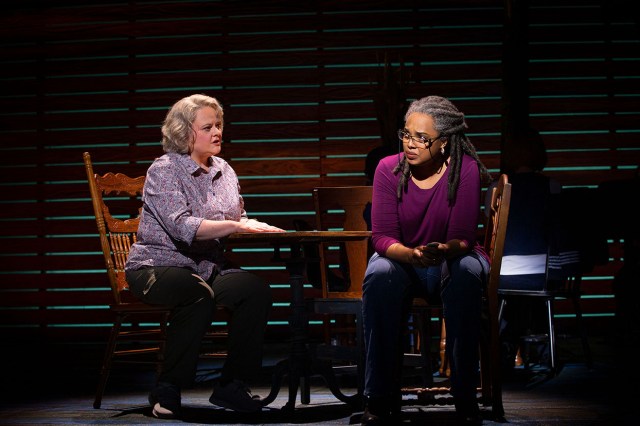
At the moment the disaster of September 11, 2001 occurred, hundreds of aeroplanes were mid-air across the Americas, thrust into utter chaos. Thousands of passengers had to be diverted as a result of the terrorist attack, to safer harbours, including the island of Newfoundland, at the outer east of Canada. The musical Come From Away comprises a collection of anecdotes from the five days, during which international strangers were welcomed by country folk into their homes, at a historic time.

Written by David Hein and Irene Sankoff, the material is warm and witty, offering a way for us to look back at a traumatic event, without having to engage directly with its immense darkness. Instead, it is the overwhelming goodness of ordinary people that comes to the fore. Directed by Christopher Ashley, the show eschews the usual manipulative cheesiness of the musical format, trusting in our collective memory of that fateful day, to transport us to a space of deep emotion and great empathy.

The staging feels deceptively simple, but in the absence of predictably flamboyant manoeuvres, thoughtful details are introduced instead, notably by Kelly Devine’s choreography, for a theatrical experience that is surprisingly sensitive in its rendering, to achieve an authentic expression of the human need for connection. Howell Binkley’s lights too, are memorable for delicately shifting us from nuance to nuance, never overly dramatic, but always precise in how they convey mood and tone for each scene.

The ensemble cast is brilliantly cohesive. Each performer is given plentiful opportunity to shine as individuals, but it is their tightness as a group that makes their presentation feel bulletproof. All are required to play multiple characters, and for the audience to discover every personality to be a likeable one, is truly remarkable. Similarly, musicians in the productions are no less than awe inspiring. Their work is spirited and exhilarating, incredibly rousing in this story about humans at their best, at a time of crisis.

Come From Away emerges from a horrific incident, yet we find it to be full of light and hope. In some ways, there is a sense that twenty years ago, even in the midst of tragedy, we knew clearly the distinction between right and wrong, good and bad. With the passage of time however, it may seem that an erosion of innocence has accelerated, probably through the Trump years, where seeing the worst of people is no longer a shock, but almost a matter of course. Fortunately though, the good people of Newfoundland do not seem fictitious; they only seem very far away.

www.comefromaway.com.au

Review: The Cherry Orchard (Belvoir St Theatre)

Venue: Belvoir St Theatre (Surry Hills NSW), May 29 – Jun 27, 2021
Playwright: Anton Chekhov (adapted by Eamon Flack)
Director: Eamon Flack
Cast: Peter Carroll, Priscilla Doueihy, Nadie Kammallaweera, Kirsty Marillier, Lucia Mastrantone, Mandela Mathia, Sarah Meacham, Josh Price, Pamela Rabe, Keith Robinson, Jack Scott, Charles Wu
Images by Brett Boardman

Theatre review
The Russian aristocracy as we had known them, were no longer to be, in Anton Chekhov’s The Cherry Orchard. Members of Ranevskaya’s household scramble around, filled with anxiety at the prospect of the old world’s demise, completely at a loss as to what to expect of the future, and how to continue existing as the inevitable begins to set in.

In director Eamon Flack’s 2021 version, the power transitions that occur in The Cherry Orchard are represented not only by the idealism of our young. An unmistakeable racial dimension is introduced, with the emergence of the middle classes expressed as a parallel dialogue, about the changing status of Australia’s people of colour.

It is a valiant attempt by Flack to breathe new life into the play. Aside from successfully locating a contemporary resonance for the old tale, he replaces early twentieth century naturalistic styles with a theatrical exuberance, that makes the show more appealing to today’s compromised attention spans. The freshly sharpened farcical tone is enjoyable, as are its efforts at broadening the scope of Chekhov’s work, to be inclusive of the marginalised, such as the LGBT community, and people living with disabilities.

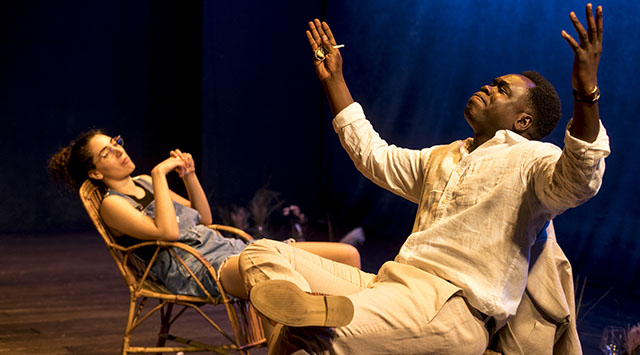
Actor Mandela Mathia is captivating as Lopahkin, the businessman with a recent background of peasantry. Now riding on the wave of new money rising, the Black man is confident but still humble, which Mathia portrays with admirable exactitude. It is a precise and varied performance, from one who proves as likeable as he is compelling. The old white guards are exemplified in The Cherry Orchard by Ranevskaya, slothful and ignorant, but nonetheless well-intentioned. Played by Pamela Rabe, the role is appropriately comical, with an air of deteriorating glamour that becomes progressively fragile.

Funniest in the ensemble include Lucia Mastrantone, unforgettable as the kooky governess Charlotta, and full of mischief as she invents one trick after another. Charles Wu takes a more understated approach, but is no less hilarious as the incredulously suave Yasha, complete with perfectly timed hip thrusts, almost convincing us that it might be possible to bring sexy back to Chekhov.

Set design by Romanie Harper is surprisingly stark, but its clean lines and minimal approach deliver an elegant, if slightly nondescript vista. Harper’s costumes are more imaginatively rendered, with each character’s appearance distinctly and eccentrically conceived. Lights by Nick Schlieper provide a warmth that keeps us reminded of the notion of home, that is fundamentally embedded within this narrative about power and property. Stefan Gregory’s use of eclectic music styles bring valuable energy to the work, whilst establishing a sense of indeterminacy to time and place, that allows us to connect with The Cherry Orchard in personal ways.

A little more than a century after the completion of Chekhov’s final play, we find ourselves back at a point of disgraceful wealth disparity. What may have been a hopeful forecast of a new way of life, can now be seen to be overly optimistic. There is no doubt that things have improved on many fronts, but the inordinate concentration of wealth today at the top end of town, reveals the failure of efforts to redistribute wealth, and to alleviate poverty. People might no longer wish to call themselves aristocrats and peasants, but all we have to do, is to look at all the numbers, that never lie.

www.belvoir.com.au