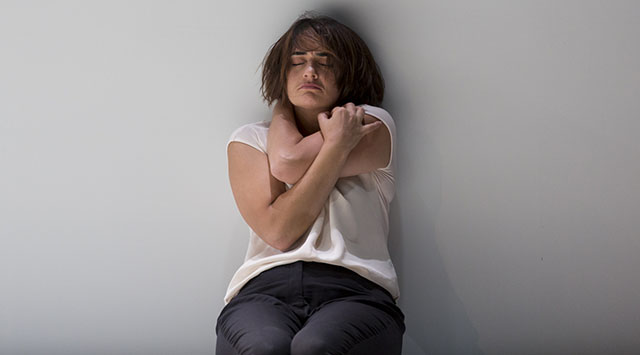
 Venue: Belvoir St Theatre (Surry Hills NSW), Mar 20 – Apr 25, 2021
Playwright: Sally Sara
Director: Anne-Louise Sarks
Cast: Deborah Galanos, Sheridan Harbridge, Amber McMahon, Mansoor Noor, Toni Scanlan
Images by Brett Boardman
Theatre review
When Suzie returned from Kabul in 2011, it was the shock of the normal, that started her on an agonising downward spiral. In prominent Australian journalist Sally Sara’s semi-autobiographical playwrighting debut Stop Girl, Suzie is her doppelganger, through which stories of trauma and of healing, could be told. After years covering the war in Afghanistan, in addition to other disasters all over the world prior, Suzie intends to buy a home, ready to put down her roots in Sydney for a new phase in life. What greets her however, is a torrent of mental health disintegrations, preventing her from experiencing the comparative peace on this land, that the rest of us almost always takes for granted.
There is unequivocal passion and honesty in Sara’s writing, but an undue conventionality, in form and style, unfortunately delivers a show that can feel predictable and repetitive. Much has been written about post-traumatic stress disorder, often in more affecting ways, and although Sara’s critical need to share her story cannot be denied, Stop Girl sadly, brings nothing new to stories about the aftermath of war, that we have heard countless times before.
Directed by Anne-Louise Sarks, relationships between characters are conveyed with believability and warmth. There is a stilted quality to the delivery of dialogue, but each personality in the play is convincingly depicted, even though the production never quite attains the level of naturalism that it aspires. Stop Girl has a simple point to make, about the lack of care for those returning after having made unimaginable sacrifices, and Sarks leaves us fully persuaded.
In the lead role is actor Sheridan Harbridge, who comes to life when Suzie falls into a state of psychological torment, allowing us valuable insight into the workings of severe upheaval on the human mind and body. Best friend Bec is played by a spirited Amber McMahon, offering an effective point of reference and contrast, that demonstrates the degree to which our protagonist has deteriorated. Mansoor Noor is memorable as Suzie’s resilient fixer and producer Atal, an important embodiment of our responsibilities towards those in war-torn countries. Also very accomplished are Deborah Galanos and Toni Scanlan, both performers showing admirable commitment to their parts as psychologist and mother, respectively.
Intermittent video projections documenting Susie’s memories of Afghanistan, created by Jack Saltmiras and Susie Henderson, bring a sense of dynamism to the presentation. Music by Stefan Gregory and Hamed Sadeghi, are reliable in manufacturing swift transformations of atmosphere, and along with Paul Jackson’s lights, take us succinctly through each dramatic fluctuation of Susie’s emotional journey. Robert Cousin’s set design is elegant if slightly unambitious, and Mel Page’s costumes offer thoughtful solutions for a production that looks appropriately understated.
Keeping the Australian people ignorant, is advantageous for big business and career politicians. The less we know, the better. When we are in the dark, we can be sold anything they want. Journalists who go against all odds, risking life and limb, to bring us the whole and awful truth, are our unsung heroes. When they are no longer able to contribute, it appears that we discard them, on a metaphorical human trash heap, courtesy of our endlessly intensifying obsession with a capitalistic way of life. Even when we know that all humans have a use-by date under this system of running things, we do little to save ourselves from this inevitable consequence. All we have, is to prescribe to capitalistic principles of “every man for himself”, to be selfish and to hoard, should we hope to live with any dignity in our final days. For those who wish to do better, their concluding scenes, it seems, are likely to be grim.
 Suzy Goes See