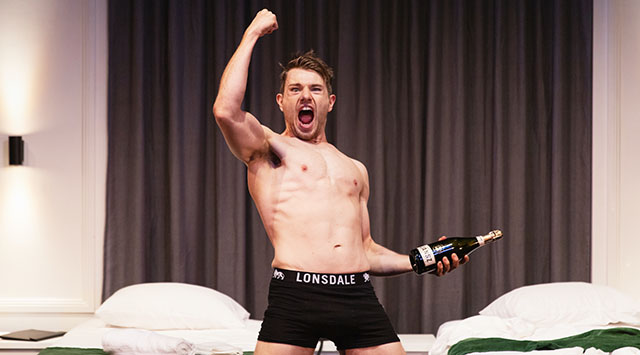
 Venue: Seymour Centre (Chippendale NSW), Feb 11 – Mar 6, 2021
Playwright: John Donnelly
Director: Ed Wightman
Cast: Ben Chapple, Deng Deng, Cassie Howarth, Tom Rodgers
Images by Becky Matthews
Theatre review
Jason is an English superstar on the football field. Spectacularly talented, and with an unquestionable dedication to his sport, but the fame and fortune bestowed upon him, as is the case with many in his position, are completely beyond reason. In John Donnelly’s The Pass, Jason’s excesses come at a high price, one that is disproportionate to the actual activity that he is ostensibly being rewarded for. The story is ultimately about human dignity, and how individuals in these modern times, can so easily and unknowingly, find their souls peddled off to the highest bidder.
We understand that to make a living requires a certain amount of sacrifice, that for the vast majority, trading labour and skill are the only ways to secure money for paying off bills. As part of that exchange, we think it reasonable to concede to things like codes of behaviour and of clothing, or to concepts pertaining to company and professional culture. It is a persistent commodification of our minutes and days, that slowly erodes away idiosyncrasies and sometimes humanity, in service of an economic system with dubious priorities.
In The Pass, it is Jason’s sexuality that suffers the worst, in a process of dehumanisation that accompanies what he perceives to be the pursuit of success. As he becomes increasingly well-known, the need escalates, to sublimate everything personal that might contradict the longstanding image of an idolised footballer. To play the part of an invulnerable straight white male, he pushes away his sexual attraction to men, gives up on his relationship with his Black best friend, and hides in hotel rooms drowning his sorrows in drugs and alcohol. To be a lean mean money-making machine, Jason constantly finds himself at breaking points, unable to retreat or reform, only knowing to endure the anguish that he clearly thinks to be justified.
Donnelly’s writing is a strong, powerfully observed piece on what may be termed advanced capitalism, and its devastating effects on a person’s nature. The protagonist’s fear of his own homosexuality is juxtaposed against conventional parameters of success, to offer a meaningful perspective into one of the ways money can turn into a destructive force, in each of our lives. This theatrical cautionary tale is directed effectively by Ed Wightman, who brings purposeful attention to central themes of The Pass; whiteness, heteronormativity and misogyny, all of which are usually invisible, due to their insidiously mundane prevalence.
Set design by Hamish Elliot delivers a series of convincingly swish hotel rooms, in a resolutely cool palette that communicates the detachedness with which Jason regards his existence. Matt Cox’s lights help us navigate a variety of moods, as we watch Jason go through a gamut of volatile emotional states. Gay pop star Ricky Martin’s 1998 hit She Bangs, now resonant for its connotations of closeted sexuality, is featured throughout, in a sound design by Daryl Wallace.
Leading man Ben Chapple gives a rhapsodic performance as the very lost Jason, with an enjoyable intensity that makes him a compelling watch. The actor’s robust energy is memorable, but a greater exploration into nuances would allow audiences a richer appreciation of the text. Cassie Howarth is gloriously sassy and remarkably intricate in her portrayal of Lyndsey, adult entertainer with a heart of gold, who brings valuable depth to a production that can sometimes, gloss over less dramatic but nonetheless important portions of dialogue. Jason’s intimate confidante Ade is played by Deng Deng, a likeable and sensitive, if slightly too introspective performer. The very comical Tom Rodgers brings to life, the young hotel attendant Harry, raucous and genuinely funny, but whose poor execution of a transphobic joke, leaves a bad taste in the mouth.
In dealing with the downfall of a sporting hero, The Pass presents an opportunity to talk about ubiquitous power structures that benefit few, yet are upheld by virtually everyone. We can focus the story to talk about white supremacy and racism, misogyny and the patriarchy, homophobia and transphobia, ableism, poverty, etc., but that requires us to acknowledge that the way we rally around heroes, sporting or otherwise, is symptomatic of the problems we suffer. It seems to be a natural impulse for us to create gods out of humans, but once systems of hierarchies are manufactured, it is always easy to forget those at the bottom rungs. It is only logical to submit to the fact that any disadvantage is inherently abhorrent, but for us to give up our idols, is clearly not something we seem ever to be capable of. Even if the gods themselves, would be better off, taking a step down from their pedestals.


 Suzy Goes See