Review: The Irresistible (Sydney Opera House)

Venue: Sydney Opera House (Sydney NSW), Sep 11 – 15, 2019
Playwrights: Ariadne Daff, Zoe Pepper, Tim Watts
Director: Zoe Pepper
Cast: Ariadne Daff, Tim Watts
Images by Rémi Chauvin, Dan Grant

Theatre review
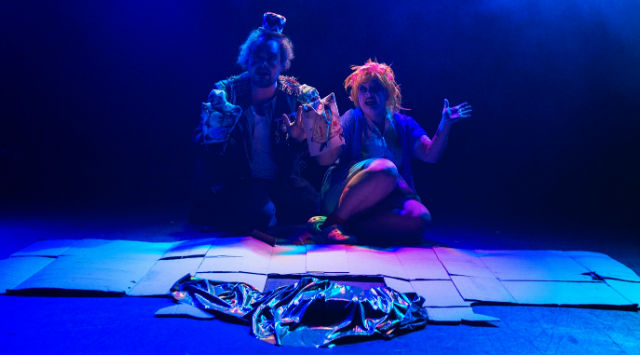
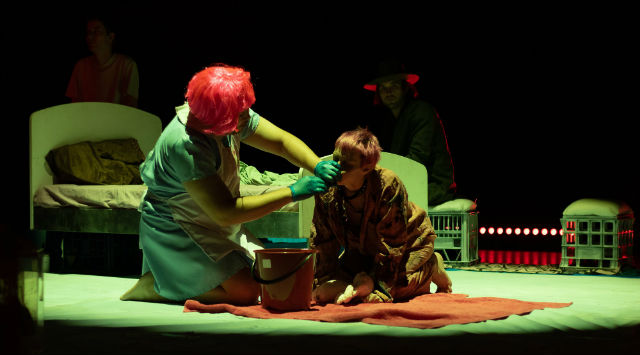
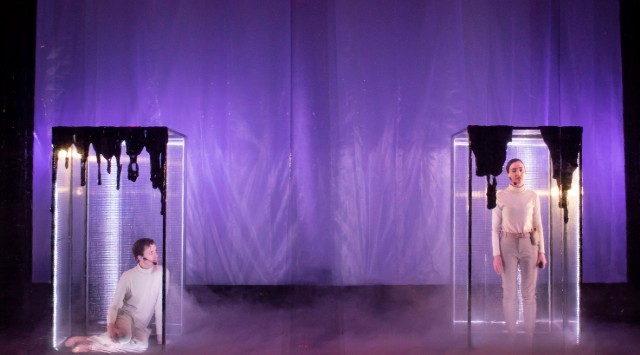
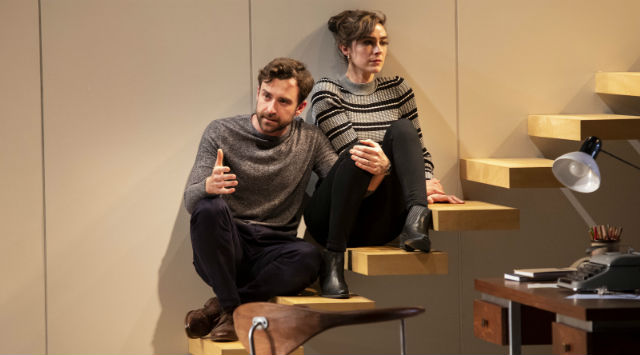
April wants to give her sister Bridget a break from motherhood, so little Cassie comes to stay. We soon discover that the child is not only a handful, she is in fact bizarre. The Irresistible too is often a strange exercise, with two actors playing a range of characters, behind translucent screens blurring our vision, and microphones altering their voices as if to say that it matters not, which actor is assuming which role.

The action is episodic, involving disparate narratives that our minds will insist on assembling a coherent picture out of, but the greatest pleasure in The Irresistible is to luxuriate in the extraordinarily imaginative approaches being applied to each theatrical moment. The magic is not in the stories themselves, but in how those stories are used to subvert our expectations, and therefore deal with what we consider to be normal in art and life. Director Zoe Pepper seems to imply that when we encounter the opposite of normal, an interrogation into who we truly are, comes to the fore. It is hard for humans to properly see ourselves, until a catalyst is introduced to turn us weird, and to force a deviation from the ordinary.

Performed by Ariadne Daff and Tim Watts, the simple text becomes springboard for experimentation, with their irrepressible desire to always manufacture something surprising, resulting in an experience that has us utterly mesmerised. The pair is outrageously inventive, both spirited in the kookiest way possible, and impossibly precise in their delivery of a technically demanding work. Sound by Phil Downing and music by Ash Gibson Greig are astonishing in their ambition and scope, daring to surpass other elements to become the most important and effective design aspects of the production. Jonathon Oxlade’s set and Richard Vabre’s lights manipulate our attention so that we cannot look away, keeping our sight intrigued and hopelessly engrossed for the entire duration.

The character Christian finds himself seduced by the performance of adult entertainer Neve, and responds by trying to dominate and consume her. At the theatre, we can never be sure how power dynamics can manifest themselves. Being capitalist, we enter with the subliminal notion that if someone is going to be the boss, the paying audience must surely be in charge. Art however, cannot let itself be subject only to market forces and the taste of the masses. It is responsible for moving discussions forward, to find advancements for our civilisation. For our society to progress, it seems artists are the only ones left willing to take the lead. We need the shock of the new, and The Irresistible is an excellent case in point.

www.sideponyproductions.com.au | www.thelastgreathunt.com

Review: Romeo & Julien (The Sydney Fringe)

Venue: 107 (Redfern NSW), Sep 5 – 14, 2019
Playwright: William Shakespeare
Director: Jamie Collette
Cast: Ali Aitken, Jackson Blair-West, Jayden Byrne, Sasha Dyer, Daniel Gabriel, David Halgren, Ryan Hodson, Cynthia Howard, Samantha Lambert, Charles Mayer, Chiara Osborn, David Soncin
Images by Isabella Torv

Theatre review
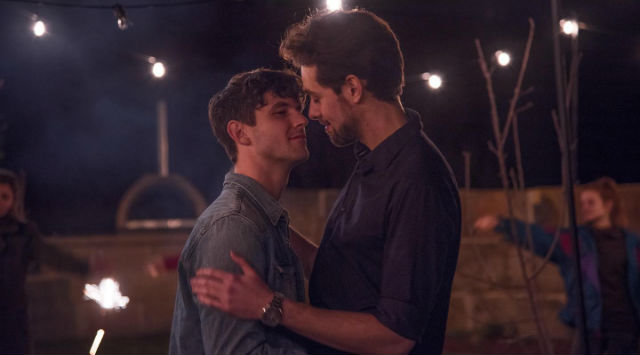
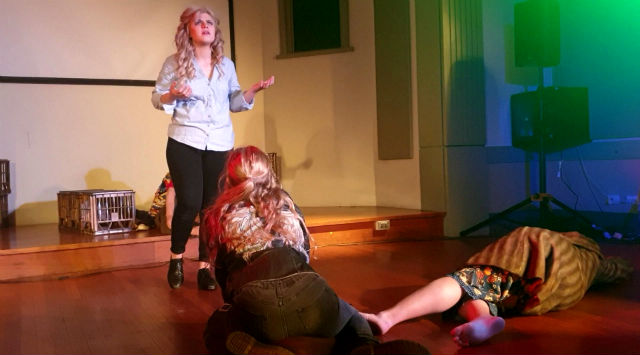
Juliet is now Julien, so the question would obviously relate to how this new perspective of gender in Shakespeare’s Romeo And Juliet would result. It might come as a surprise, that turning a heterosexual love story into a gay one, does not necessarily involve a complete and fundamental transformation of the centuries old play. The Capulet and the Montagues are still at loggerheads, and the drama we encounter is still about blood and kinship. All the conflict in Romeo & Julien come from the same sources as Shakespeare had intended, and it seems that making boys of both lovers, does not change anything in their story.

If one can accept the validity of an artistic license in this gender alteration, one could probably be willing to see that the original narrative can remain, given our understanding that gender is ultimately a meaningless construct. As director, Jamie Collette’s efforts at imposing a new inclusiveness to an old icon of Western literature is laudable, but his creative spirit can seem insufficiently radical, when viewed against the inevitably conservative associations when taking on the Bard. Nonetheless, there is inventiveness and vigour in Collette’s staging, ably assisted by Scott Witt’s dynamic fight choreography, and Sara Delavere’s colourful live music accompaniment.

The ensemble is not always cohesive or balanced, but strong acting by several individuals provide moments of professional sheen. Daniel Gabriel plays an androgynous, possibly bigender, Mercutio, introducing much needed flamboyance to proceedings, leaving an impression with the sheer magnitude of their stature and bold presence. Friar Lawrence is given detailed rendering by the dazzling David Halgren, who locates unexpected, and entertaining, dimensions for the pivotal role. Romeo is on this occasion, a tentative, quiet type, as performed by an overly naturalistic Jackson Blair-West. All eyes are on Jayden Byrne, who brings surprising emotional range to Julien, and is particularly satisfying as pop star, in several enjoyable musical interludes.

We are beginning a new era in which queerness does not have to tear our families apart. We have dreamt of a time of unprecedented normalisation, when queer people no longer have to come out, and in Romeo & Julien, we are given the opportunity to imagine that possibility. Whether one is inclined to find this Shakespeare title romantic or dreary, the present re-gendering is unlikely to cause any transformation to those prior opinions. It is true that whether one is male or female should have no bearing on outcomes, but it is undeniable that we have grown to expect queerness to add spice, especially when old and painfully obsolete texts are concerned.

www.facebook.com/RomeoAndJulien19

Review: Confessions Of A Custard Melon Pan (The Sydney Fringe)

Venue: 107 (Redfern NSW), Sep 12 – 14, 2019
Playwright: Arisa Yura
Director: Courtney Stewart
Cast: Arisa Yura

Theatre review
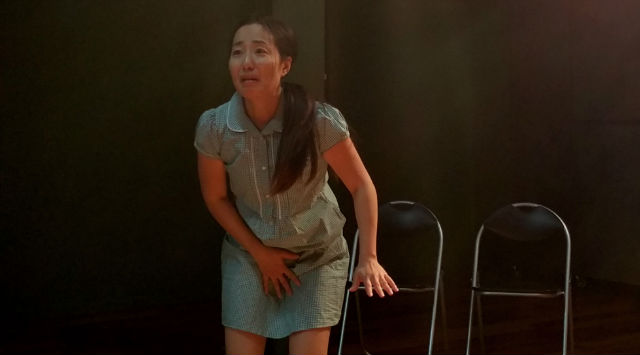
Arisa Yura is of the 1.5 generation, having moved from Japan in her early teens. She bears characteristics of her home country, but is also assimilated into Australian life. In her autobiographical work Confessions Of A Custard Melon Pan, we observe the contradictions, challenges and comedy of an existence straddling two very different cultures. Scenes are set alternately in both places, but Yura remains bi-cultural no matter the location, and is therefore always accompanied by a disquieting sense of displacement. Our incontrovertible corporeality implies that home is a staunchly singular notion, but many in the 21st century have roots growing in more than one terrain, which lead to the creation of complex identities requiring an almost constant negotiation with environments and communities, wherever one finds themself situated.

It is a one-woman bilingual play about not being able to just be. Yura demonstrates what it is like, caught between two worlds, but trying to construct one coherent entity. Her writing is charming and humorous, deft at communicating weighty ideas with a light touch. The blend of languages is cleverly rendered, and proves a surprising auditory pleasure. As performer she is focused, energetic and intuitive, with a simplicity in approach that never fails to drive home any point she wishes. Direction by Courtney Stewart introduces a delicious exuberance, keeping us amused and engaged. Sound design by Michael Toisuta makes accurate calibrations to mood from moment to moment, but several instances of scene transitions, when the performer is changing costumes off stage, require greater attention.

The custard melon pan is a confectionery half yellow, half white. Racial minorities in this country do not have the privilege of forgetting the colour of our skin. To live in a place where whiteness has imposed itself as the standard, those of us who are not, must constantly have colour on our minds, and deal with the burden of always being designated the other. When Yura returns to Japan, hoping to shed the labour that none would wish to acquire voluntarily, she discovers that colour goes beyond skin. She is again inadequate, even though her flesh and blood are meant to make colour inconsequential in her home land. We watch it dawn on our protagonist, that it is no longer she who has to find a way, but Australia that needs to make peace with its own future and origins.

www.arisayura.com

Review: The Real Thing (Sydney Theatre Company)

Venue: Sydney Opera House (Sydney NSW), Sep 9 – Oct 26, 2019
Playwright: Tom Stoppard
Director: Simon Phillips
Cast: Johnny Carr, Charlie Garber, Rachel Gordon, Geraldine Hakewill, Shiv Palekar, Julia Robertson, Dorje Swallow
Images by Lisa Tomasetti
Theatre review
Henry has an excellent relationship with words and philosophy, which is just as well, being a successful playwright much like his creator Tom Stoppard. In The Real Thing however, we discover that his cerebral talents do not extend to matters of the heart. It is that very human conundrum we deal with in Stoppard’s extraordinarily rigorous piece of writing, that it is one thing to be able to know so deeply all that can be intellectualised, yet be unable to have much control over how one loves. People in the play are smart. Their understanding of the world is astute and penetrating, and their talk is very highbrow, but when we observe the way their feelings are being enacted, it seems there is no escaping the fools that we ultimately are.

Couples in The Real Thing wrestle with issues of fidelity. They cheat, they are suspicious, they are apologetic, and they fail repeatedly. They struggle with the need to be faithful, often engaging in discussions about the meaning of love and monogamy, but what they say have little bearing on how they feel. A constant discord exists between logic and emotions, prompting us to wonder if there can be more than one real thing in the human experience, if what we think and how we act are so often not in concurrence.

Director Simon Phillips brings remarkable clarity not only to these immediate themes, but also to the many tangential musings that make The Real Thing memorable. The density of the text is translated on stage by Phillips into a luxuriant tapestry of inspiring observations emerging from Stoppard’s brilliant mind. In the role of Henry is the sensational Johnny Carr, bringing a startling truthfulness to dialogue that could very easily be turned, under the wrong hands, highfalutin and empty. The actor’s presence and timing have us captivated, as we find ourselves enraptured, deeply invested in the many meaningful discussions that provide the foundation, for an admittedly bourgeois narrative. Geraldine Hakewill too, is engaging as Annie, a strong counterpoint in the story, effortlessly convincing with the complexity she portrays, whether playing subject or object in this tale about affection and attraction.

Production designer Charles Davis delivers a spectacular set, wonderfully imagined for the revolve stage, to facilitate poetic parallels between words and visions. His costumes are quiet but effective, able to bridge the time disparity inherent in reviving a 37-year-old work. Lights by Nick Schlieper are correspondingly sophisticated, always pleasing with the imagery he manufactures, and exacting in the way he shifts our impulsive responses from scene to scene.

It is likely that one can arrive at the conclusion that realities are multitudinous, yet there is something in our nature that cannot resist the idea that there could be a singular essence to things, that there is a fundamental truth in how we regard the world. It is as though a key exists, that life is only ever experienced as a sort of mystery that requires solving. Henry’s racing thoughts are incessant, and luckily for us, always beautifully articulated, yet we only ever see him carry on like a fool for love, as though knowledge can never live up to its promise of having the answer to everything.

www.sydneytheatre.com.au

Review: Splinter (Griffin Theatre Company)

Venue: SBW Stables Theatre (Kings Cross NSW), Sep 6 – Oct 12, 2019
Playwright: Hilary Bell
Director: Lee Lewis
Cast: Lucy Bell, Simon Gleeson
Images by Brett Boardman

Theatre review
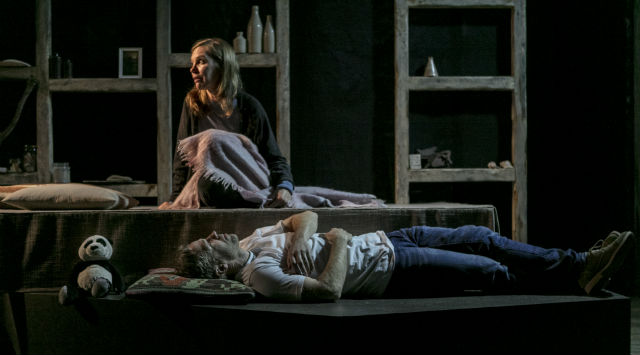
Five-year-old Laura has just returned home, after a nine-month disappearance. Her parents are understandably traumatised, but relieved to have their nightmare come to an end. In Hilary Bell’s Splinter however, we see that the family’s problems do not vanish quite so easily, as questions arise about this sudden reunion. There are only two actors in Bell’s play, with little Lauren an apparition that we all have to conjure up with imagination, which proves a fascinating device for something that positions itself within the genre of psychological thriller. The ideas in Splinter are engaging, but it is arguable if its dialogue and plot structure are always effective in delivering the tension so crucial to this form of storytelling.

The show begins innocuously, perhaps even drearily, as a conventional family drama that overloads the stage with saccharine sentimentality. It takes a considerable while before director Lee Lewis introduces suspense elements that let the entertainment begin, by which time our boredom with the daytime television style of presentation had almost completely taken hold. At just over an hour long, there is little opportunity for us to settle sufficiently into the real substance of the piece, but the intrigue that does eventually manifest, is admittedly chilling.

The late transformation in atmosphere is cleverly manufactured by creatives including Alyx Dennison, whose sound design confirms the gear switch, giving us necessary cues to swiftly change focus in our interpretation of the narrative. Video projections by Mic Gruchy and lights by Benjamin Brockman become increasingly theatrical, thus guiding our minds into more pronounced spaces of fantasy and delusion.

Lucy Bell and Simon Gleeson perform the piece with extraordinary conviction, both bringing admirable intensity to a tale involving unimaginable suffering. Gleeson has the additional dimension of paranoia to help enrich his character, which he utilises compellingly, for several powerful moments of bloodcurdling dread. Bell is given less extravagant material, but nonetheless offers a reliable, self-possessed counterpoint that prevents Splinter from veering away from its central truthfulness.

Genre is infinitely more prevalent in film, because the form deals almost exclusively in illusion, and is therefore perfect for stories that require drastic alterations to reality. Theatre that venture into those territories must be praised accordingly, for even daring to test the possibilities of the live stage. There is a supernatural quality to Splinter that is almost inevitable, in its depiction of psychological disturbance. In those moments, the audience participates in seeing things that are not present, almost like artists who have the Midas touch, able to make something out of nothing, and in the process, giving to their communities a kind of magic that brings elevation to us all.

www.griffintheatre.com.au

Review: U.B.U: A Cautionary Tale Of Catastrophe (Tooth And Sinew)

Venue: Kings Cross Theatre (Kings Cross NSW), Sep 10 – 21, 2019
Playwright: Richard Hilliar
Director: Richard Hilliar
Cast: Tristan Black, Lib Campbell, Rachael Colquhoun-Fairweather, Emily Elise, Sam Glissan, Gideon Payten-Griffiths, Shane Russon, Idam Sondhi, Nicole Wineberg
Images by Ross Waldron

Theatre review
The prime minister has a secret plan to depose the king, and have him replaced by a civilian best described as a lazy idiot, in Richard Hilliar’s U.B.U: A Cautionary Tale Of Catastrophe. PM Fuller Bjullshitt owns mines, and wants to make sure that his personal interests are protected by laws of the land that continue to be neglectful of environmental concerns. Given the preposterous state of politics today, the play’s premise is entirely within the realm of possibility, but written in an absurdist style, we are confronted with the lines between fiction and truth, except there is no hiding the fact that many of the worst things being depicted are no different from the news that we are subjected to in real life.

Hilliar’s exuberant consolidation of current affairs and contemporary ideals, is a pertinent representation of Australian culture as it stands, turned satirical by its colourful wit, base but clever, in appropriate alignment with popular notions of our national identity. Having brought his own considerable skills as director to U.B.U, Hilliar’s show is rambunctious, fun-filled and campy, a highly entertaining work that facilitates discussions about doing the right thing, beyond left and right conceptions of politics. Costumes by Tanya Woodland, along with Ash Bell’s hair and makeup design, are a visual feast, powerfully enhanced by Ryan McDonald’s imaginative lights.

Extraordinary passion from all nine of its ensemble cast, makes it an occasion to remember. Sam Glissan and Emily Elise are as mad as each other, playing Pa and Ma Ubu with an incredible wildness that creates a grotesque quality, so reflective of what we feel to be happening right now all over the world. Lib Campbell and Idam Sondhi are another formidable couple, with exquisite timing and chemistry, making us laugh at all the ugliness that we know ourselves to be capable of. Tristan Black’s incisiveness and precision as Bjullshitt ensures that we are attentive to both the meanings and hilarity of U.B.U; his “Mr. Segue’s Song” is an unequivocal highlight.

The show ends with a heavy-handed, earnest call to action. An uncontainable need to appeal to the body politic disrupts the entertainment, as the urgency to make its point finally exceeds its commitment to theatrical magic. Resignation is perhaps too easy, and U.B.U wants to help us avoid it. As we sit and watch everything crumble, the urge to submit to that seemingly inevitable extinction of our kind, can indeed feel irresistible. Humans however will always be defined by our activity and conduct, and for as long as we are here doing something, there is always the inescapable decision between good and bad.

www.toothandsinew.com

Review: Cats Talk Back (New Theatre)

Venue: New Theatre (Newtown NSW), Sep 9 – 14, 2019
Playwright: Bess Wohl
Director: Sahn Millington
Cast: Callum Alexander, Jason Blake, Taylor Buoro, Shayne de Groot, Jodine Muir, Daniel Mulholland, Julian Ramundi, David Woodland
Image by Elissa Blake

Theatre review
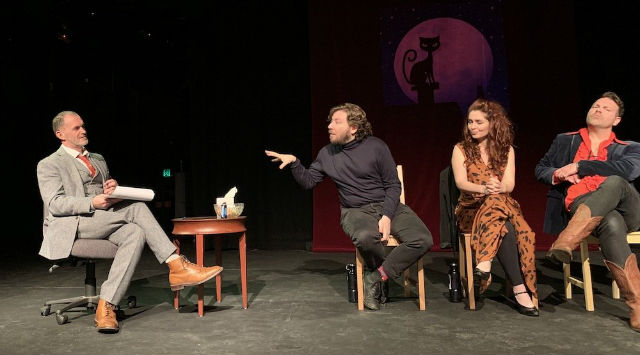
Not long after the closure of Cats the musical after an 18-year run on Broadway, five of its performers converge at a small panel event, to talk about life on the legendary show, and to relive, quite publicly, their glory days. Bess Wohl’s Cats Talk Back captures a moment of limbo, during which we see people stranded, cut off from the past, yet unable to move forward. The writing is often amusing, if slightly twee and predictable with its comedy.

Directed by Sahn Millington, the production is excessively naturalistic in approach, with a humour that seems needlessly restrained. Actors with a tendency for a more exaggerated style of performance, like Daniel Mulholland and David Woodland, are able to create distinctive characters that add spark to the production, but can also at times, seem discordant with the show’s overall subdued tone. Chemistry between players is hesitant, with each personality taking on separate approaches, unable to establish a cohesive sense of play as an ensemble. Theatre critic Jason Blake presents a version of himself, acting as moderator of the panel, notable for his easy charm and a sardonic timing that delivers several memorable laughs.

Nobody cares about these ex-cats, except the artists themselves. Every human is part of something bigger, but as is so clearly demonstrated in Cats Talk Back, we are almost always interested only in our individual experiences of the world. Narcissism is relentless, and it makes us fail to see that what feels like self-preservation, is actually gradually harming us all. Like characters in the show, we obsess over our little lives, consumed by the anxiety derived from notions of personal inadequacies, of not being loved. We long for personal satisfaction, and spend all our energies in pursuit of an elusive happiness, when it is abundantly clear that there are much more important things to do.

www.newtheatre.org.au

5 Questions with Tariro Mavondo and Jayna Patel

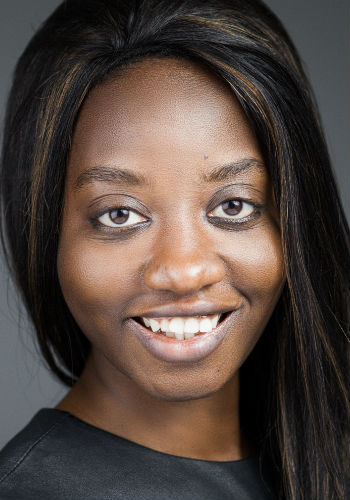
Tariro Mavondo

Jayna Patel: Do you have any pre-show rituals or routines?
Tariro Mavondo: Yes I do. My rituals usually differ depending on what the role I’m playing requires, for instance if it is a highly physical role I will do an intensive physical as well as vocal warm up. I always do a 15-30 min movement yogic sequence to get me into my body and out of my head as well as a set of personal affirmations and 10-15 min breathing meditation. A ritual for a while now has been to brush my teeth before every show to cleanse the day and enter the theatrical space of imagination, possibilities and wonder. I’m partial to candles, dim lights and soft music in my dressing room  and maybe one or two hard hitting tracks too.

If you were to recast the play with celebrities, who would you cast as who?
In line with Adena’s casting because I think she nailed it I would cast Frances McDormand in the principal role of Titus, Vanessa Williams as Tamora, Danai Gurira as Aaron, Peter Dinklage as Saturninus, Travis Fimmel as Bassianus/Marcus double, and I’d still cast Jayna, Tony and Grace because y’all stars in my eyes!

If you had the chance to have dinner with William Shakespeare, what would you ask him?
I’m interested in the theory of Emilia Bassano a black woman who was one of the first professional females writer’s in Elizabethan England having wrote his plays and the theory of her being the dark lady he refer to in his sonnets so I’d probably ask him about that. I’d also put on my best hip hop artists and ask him if he digs it because my guess is he’d be really into it!

Your purple hair for this show is so bold and beautiful! Is there anything you wouldn’t do to your hair for a show?
Thank you! Yeah I’m loving the vibrancy and vitality of wearing purple hair. I have done many things to my hair for the screen and stage there really isn’t anything I wouldn’t do I don’t think. Although my preference is keep it as natural looking as possible and not wear wigs that are closer to European hair if the character doesn’t require that. Black hair has a complete politic of its own and reclaiming the nappy kinky coil look when I can is important to me.

What’s your favourite kind of pie? (excluding Chiron & Demetrius flavour)
I don’t eat very much meat so I’d probably pick a sweet dessert pie – anything with apple. Apple and rhubarb or blueberry. Apple pie is probably my favourite winter dessert I’m also largely dairy free but cream on my apple pie is a must, haha definitely my guilty pleasure!

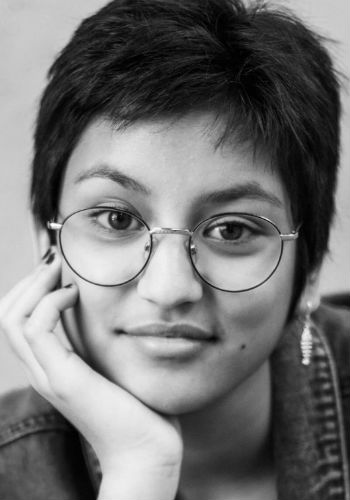
Jayna Patel

Tariro Mavondo: What has been your favourite part of making Titus Andronicus? And why? 
Jayna Patel: I love Adena’s style of theatre making because it is a collaborative process, and as a young person who often has no say in what goes on to the stage (and sometimes in life!) it’s really refreshing and empowering to have been able to contribute.

You often wear cool political t-shirts and musical theatre t-shirts, what’s your favourite? And why? 
My favourite t-shirt says ‘anti-colonial, anti- capitalist, for climate justice’ because I’m a climate activist who’s frankly quite scared for the future of the planet given the current environmental and political situation – I love being able to express my views & send an important message using what I wear! 

What drew you to wanting to work on Titus?
It’s a pretty funny story actually. Before I was sent this offer I had no idea what Titus Andronicus was, in fact I wasn’t too fond of any Shakespeare at the time! But my mum came to me and said “oh hey, there’s this Shakespeare play thing going on, and they want a 15 year old to audition, do you wanna give it a go?” and i said “sure why not!” So I hear that I actually got in and I’m stoked, and then my dad says “isn’t that Shakespeare’s most violent play?” and the excitement began there…

As your first main stage gig at the Opera House how are you feeling? And how are you managing the school load as well?
The first day we got into the venue, I was buzzing with excitement/nerves and I haven’t stopped! I cannot wait to hit the stage with this amazing team of artist and creatives. And as for school work… uh, let’s just say hopefully none of my teachers are reading this article!

Catch Tariro Mavondo and Jayna Patel in Titus Andronicus, by William Shakespeare.
Dates: 27 Aug – 22 Sep, 2019
Venue: Sydney Opera House

Review: Affliction (The Sydney Fringe)

Venue: Legs On The Wall (Lilyfield NSW), Sep 7 – 8, 2019
Playwright: Lauren Orrell
Director: Steve Le Marquand
Cast: Jack Berry, Martelle Hammer, James Hartley, Deborah Jones, Isaro Kayitesi, Lauren Orrell, Luke Townson
Images by Isaro Kayitesi

Theatre review
Lucy is 12 years old, with mental health issues requiring professional medical care, but she tries to secretly tame elements of paranoia and psychosis, afraid of repercussions if the truth of her condition is made known. Lauren Orrell’s Affliction reveals the stigma surrounding mental illness, and the ignorance that still exists in relation to the subject. It offers a valuable glimpse into personal experiences that are too often hidden, allowing us to gain a better understanding of those challenges. The play is sometimes educational in tone, but its best moments are humorous in an absurdist style, with an irony that is smart and satisfying.

Directed by Steve Le Marquand, the production is macabre but surprisingly colourful in its explorations of some very dark ideas. A more intimate environment would allow us greater engagement with the characters, but the vastness of space is otherwise visually appealing. A video interlude by Marianne Khoo brings an unexpected dimension to the story, and an additional opportunity for twisted laughs that many will find enjoyable. Music by Clare Heuston offers excellent tension to some very theatrical scenes of psychological turmoil.

Playwright Orrell is also star of the show, convincing in her portrayal of a troubled child, strong not only with the emotions she is able to express, but also with the sheer physicality that she presents on stage. A grotesque nurse Doreen, is played by James Hartley whose comedic chops prove to be highly amusing. It is a small part that leaves us wanting much more. Deborah Jones is fabulous in her various roles, impressive with the range of monstrous personalities she is able to embody so effortlessly.

Affliction can feel pessimistic, but its creator makes a powerful and positive statement, about overcoming adversity with this ambitious work. Orrell talks openly about her own struggles with mental health, and to see her channelling those frustrations into art is most reassuring. We see a woman rejecting cultural impositions, choosing instead to define her own life, and to build her own identity, from what she sees to be authentic and meaningful. Disadvantage can sink us, but more than likely, the human spirit can see us swimming our way to the top.

www.catchmydisease.weebly.com

Review: Marisol (The Sydney Fringe)

Venue: Erskineville Town Hall(Erskineville NSW), Sep 3 – 7, 2019
Playwright: José Rivera
Director: Erin Louise Cotton
Cast: Chloe Baldacchino, Isabelle Fredericks, Sarah Maguire, Elizabeth Nicholls, Simon Thomson, Matthew Vautin

Theatre review
Marisol Perez is informed by her guardian angel that there is a revolt in the heavens. God is old and senile, no longer able to serve the universe, and a struggle for power is now under way. This means that earthlings are for the moment, no longer protected by the divine, and in José Rivera’s Marisol, it appears that when left to our own devices, we can only devolve into chaos and violence. The writing is surreal, and although approaching 30 years old, its apocalyptic sensibility seems more relevant than ever.

The production is at its most gratifying when actors are able to embody the play’s bizarre qualities, and approach the performance with an unabashed extravagance, whether dramatic or comedic. Matthew Vautin and Elizabeth Nicholls have strong moments on stage, both able to convey the dehumanised madness of the play’s dystopian vision. The eponymous role is taken on by Chloe Baldacchino, who brings a delicate timidness that can seem out of place. Director Erin Louise Cotton shows us the utter confusion of a world abandoned by all that is celestial, but without communicating anything particularly powerful with the text, Marisol leaves us with little more than an empty nihilism.

When we once again feel as if everything is going to hell in a handbasket, and the pessimism cripples us from being able to take any meaningful action that would make this world better, it is perhaps useful to indulge momentarily in delusions, that there are higher beings in the ether who have a greater purpose beyond our comprehension. It is one thing to feel disappointed with the way things are, but quite a lot worse when we turn hopeless, thinking that life is absolutely meaningless. The truth is that we know nothing outside of our tiny individual existences, but dreaming up gods and deities has always proven to be useful in making the human experience at least tolerable. We manifest the divine in our image and imagination, relating to them as separate superior entities, but actually, we can only ever pray to the sacred that resides within.

www.gradco.studio