Review: The White Spirit Cult (The Sydney Fringe)

Venue: Yellow Umbrella (Potts Point NSW), Sep 13 – 22, 2018
Creator: Joanna Joy
Cast: Anca Frankenhaeuser, Emalyn Knight, Keila Terencio
Images by Emily Contador-Kelsall

Theatre review
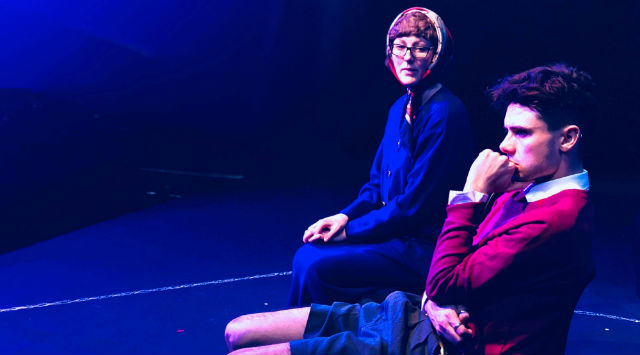
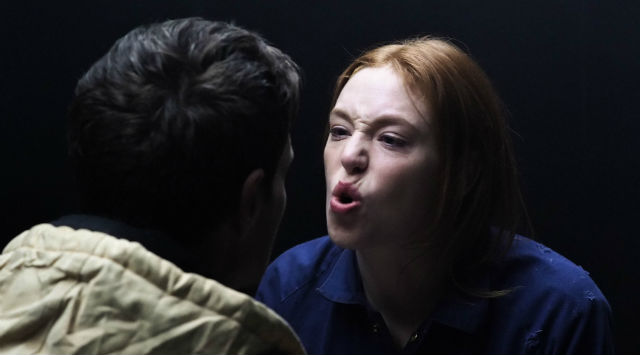
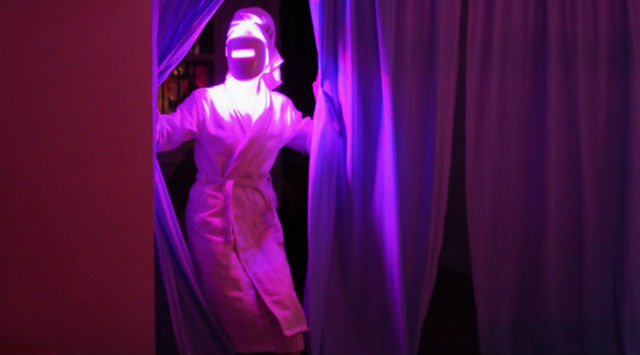
Three women in the basement of a house are obsessing over their bodies. They try to resist centuries of objectification, humiliation and commodification, thinking up ways to overcome that sense of inadequacy so fundamentally conditioned into the way we conceive of ourselves. The White Spirit Cult emerges from ideas around shame and purity, an artistic endeavour that frames the feminine experience of virtue, in its many physicalised forms, as being inherently illusory and absurd. Like many modern women who have wised up to forces of oppression, the work attempts to deconstruct those myths that have always tainted our self worth.

The women want to be able to see the cult for what it is, but change is hard, and we witness them resisting their own emancipation, often luxuriating within their own masochistic worship of the false god. It is an ethereal and surreal presentation of ideas, but inexorably realistic. We relate to every word that is being said, regardless of the subject’s age or cultural background. Our adversity unites us, but the suffering sisterhood must be careful not to serve the elevation and advancement of the cult’s objectives. It may ultimately be about rebellion and self-determination, but the show is only able to offer inspiration, as we come to the realisation of our evident incapacity to establish something new.

We may be able to talk about a place outside of the cult, but it is clear that many of us are still on the inside of it. Performers Anca Frankenhaeuser, Emalyn Knight and Keila Terencio are a beautiful embodiment of our dissatisfaction. They are spirited and determined, but also lost in their angst. What they represent is true; we can be joyful, or proud , or indeed, wise, but that disquiet is a sensation hard to abandon.

www.facebook.com/WHITESPIRITCULT

Review: Accidental Death Of An Anarchist (Sydney Theatre Company)

Venue: Sydney Opera House (Sydney NSW), Sep 10 – Oct 27, 2018
Playwright: Dario Fo (adapted by Francis Greenslade & Sarah Giles)
Director: Sarah Giles
Cast: Caroline Brazier, Julie Forsyth, Bessie Holland, Annie Maynard, Amber McMahon, Susie Youssef
Images by Daniel Boud

Theatre review
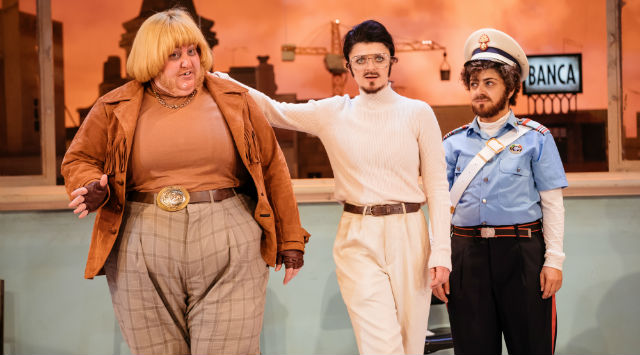
It is all over the news that an anarchist had fallen to his death from a Milan police station. The official word claims it a suicide, but there are suspicions of foul play. For Accidental Death Of An Anarchist, Dario Fo took inspiration from an actual incident of 1969, and inserted a Maniac into his 1970 imagination of events following the controversy, essentially accusing authorities of murder and corruption. It was a spectacularly clumsy cover up that required questioning, and Fo’s play has proven itself a timeless piece of writing that can always be relied on to help civilians weather any political storm. It reminds us that we are pawns in the game of the powerful, and that we have to endeavour to see beyond the wool that is constantly being pulled over our eyes.

This new adaptation by Francis Greenslade and Sarah Giles is a refresh, but a faithful one that retains the extravagantly farcical spirit of its original. Dialogue is given a stylistic update, but time, place and characters are left unmarred. Giles’ direction of the work is raucous, vigorously so, for a very broad comedy that might take some getting used to, but laughs are certainly to be had.

An all-female cast is charged with the joyful task of lampooning men in power, with Amber McMahon occupying the central role, exhibiting extraordinary verve and inventiveness as the irrepressible Maniac. Julie Forsyth is genuinely hilarious as Inspector Bertozzo, distilling masculinity to its ugliest components, for a cutting study in physicality and speech that conspires flawlessly with her remarkable theatrical timing. Also delivering uproarious hijinks is Bessie Holland, whose Inspector Pisani is a breathtaking invention of caricature at its finest, astute and acerbic in her observations of repugnant boys club behaviour.

The media landscape feeds us endless morsels of information that fight for our attention and outrage. An unexplained death today, is replaced by a racial slur tomorrow; even with the best intentions, we are unable to decipher the truth, much less find the wherewithal to contest the wrongs of the world. Those in power understand this, so they disseminate frivolous scandals that seem so important in the moment, and absorb all our time and bandwidth, until there is no way we can hold them to account.

www.sydneytheatre.com.au

Review: Next Lesson (New Theatre)

Venue: New Theatre (Newtown NSW), Sep 13 – 22, 2018
Playwright: Chris Woodley
Director: Alex Bryant-Smith
Cast: Michael Brindley, Sonya Kerr, Jens Radda, Kat Tait

Theatre review
In 1988, when Margaret Thatcher was UK Prime Minister, Section 28 was introduced, stating that a local authority “shall not intentionally promote homosexuality or publish material with the intention of promoting homosexuality” or “promote the teaching in any maintained school of the acceptability of homosexuality as a pretended family relationship”. Quite unbelievably, this piece of homophobic legislation was active until 2003, and for that period of 15 years, schools were in effect, encouraged to discriminate against LGBTQI students and staff, even though homosexual acts had been officially decriminalised since 1967.

Scenes in Chris Woodley’s Next Lesson take place in an English secondary school, featuring chronological vignettes beginning at the installation of Section 28, through to the passage of the Civil Partnership Act in Dec 2005, when same-sex unions were finally recognised. It tracks the evolution of LGBTQI experiences, children and adult, through tumultuous years, with predictably depressing accounts of institutionalised oppression. It is not a particularly imaginative work, but the authentic representation of emancipated queer lives, is certainly valuable.

The production is simple but impassioned, an earnest rendition that speaks from the heart. Performers Michael Brindley and Sonya Kerr bring a sense of gravity to their roles, encouraging us to respond with empathy. Jens Radda and Kat Tait are memorable with their humour, both spirited and playful when called upon to make us laugh.

It would be a mistake to think that the fight is over. The gay rights movement has delivered great advancements, but the work is not done for LGBTQI people in countless developing countries, and in ethnic minority communities within our own Western nations. Laws have changed, but attitudes are often still lagging behind. The recently appointed Australian Prime Minister Scott Morrison, in his second week of taking office, demonstrated a disdain for gender variance, by tweeting that “we do not need ‘gender whisperers’ in our schools” in reference to professional assistance being made available to students who are encountering personal challenges, in relation to their gender identities. As long as forces that work against justice are persistent, there can be no room for complacency. Fighters who win will only grow stronger, and hard won freedoms must be guarded at all cost.

www.newtheatre.org.au

Review: Luna Gale (Ensemble Theatre)

Venue: Ensemble Theatre (Kirribilli NSW), Sep 7 – Oct 13, 2018
Playwright: Rebecca Gilman
Director: Susanna Dowling
Cast: Michelle Doake, Lucy Heffernan, Georgie Parker, Scott Sheridan, Ebony Vagulans, Jacob Warner, David Whitney
Images by Phil Erbacher

Theatre review
A baby named Luna is being held under state care, while her teenage parents attempt to clean up their act. Social worker Caroline does her best to do what is right, but faces opposition from her manager and from Luna’s overly religious grandmother. Luna Gale by Rebecca Gilman is a classic piece of American drama, compelling, moving and incredibly taut; it discusses private lives under the interference of church and government, alongside timely stories of child abuse that are unequivocally pertinent. Both emotional and thought-provoking, Gilman’s play is wonderfully engrossing, and thoroughly satisfying.

Susanna Dowling’s persuasive direction ensures that we are wholly invested in Caroline’s ordeal, keeping us riveted and entertained for the entire duration of this thrilling production. Set design by Simone Romaniuk is appropriately staid in style, but highly efficient in the way it addresses the many scenic transformations as required by the text.

Performances are stellar, with actor Georgie Parker leading the cast in brilliant form. She does not always sound convincingly American, but as Caroline, the complexities she brings is exceptional, and the power of her delivery is entirely mesmerising. Parker’s work is intense, astute and inventive, always impeccably elegant no matter how operatic the action turns. The baby’s young mother Karlie is played by Lucy Heffernan, unforgettable with the vulnerable authenticity she puts on stage. Remarkably sensitive and nuanced, it is a poignant depiction of a girl in trouble trying hard to improve her circumstances, allowing even the most jaded of audiences to relate to those experiences.

When damaged children grow up, they can either perpetuate harm, or they can endeavour to amend inter-generational problems. Even though Karlie had given birth to new life, she proves herself incapable of caring for Luna, placing the baby in grave danger as a result of neglectful behaviour. Caroline chose not to be a mother, committing instead to the thankless task of saving children from their failing parents. No one escapes childhood completely unscathed, but most are able to imagine better ways forward. The ones who are trapped in cycles of violations, will need help in trying to break free. How our communities are willing to offer remedy, is testament to the quality of people we are.

www.ensemble.com.au

Review: The Elements Of An Offence (New Theatre)


Venue: New Theatre (Newtown NSW), Sep 10 – 16, 2018
Playwright: James Gefell
Director: Alice Livingstone
Cast: Amelia Robertson-Cuninghame, Sarah Aubrey

Theatre review
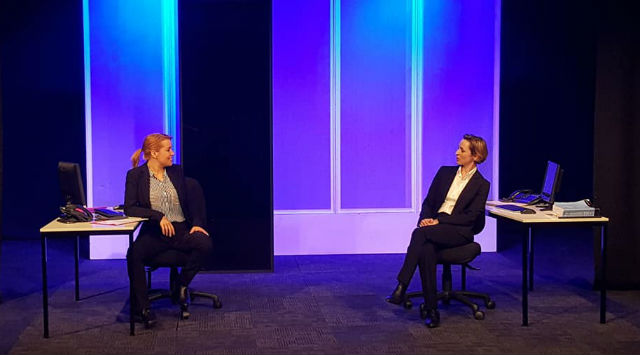
Rachel is Christine’s boss and girlfriend. They work at the police department, trying to do the right thing for the public and for themselves, negotiating endless bureaucracy along with the precarious nature of being both colleagues and lovers. It is also a story of competing principles, in a space where we expect virtue and decency to reign supreme. James Gefell’s The Elements Of An Offence also talks about corruption, as well as the au courant matter of power imbalances that pervade all our lives. We watch the women divided by their opposing positions concerning a case that they undertake, gradually being torn apart by an office culture that emanates from their patriarchal authorities.

The desk-bound characters are allowed little that could facilitate a more effective exploration of physical space, but both women are richly imagined for what is ultimately a fascinating work, with an engaging plot and very dynamic dialogue. Alice Livingstone’s direction is nuanced and enjoyable, although a greater sense of gravity to certain sections would provide emphasis to the play’s more pertinent ideas. Actors Amelia Robertson-Cuninghame and Sarah Aubrey find excellent chemistry as a team, convincing as bedfellows and captivating as duelling policewomen. They present a well-rehearsed show, fuelled by the formidable pairing, of conspicuous talent with remarkable conviction.

When systems are discovered to be unjust, those at the bottom will formulate strategies of disobedience. When one realises that playing by the rules will only reinforce one’s own oppression, defiance becomes a useful device, if not for the effective subversion of structures, then at least for the sake of maintaining one’s integrity. Rachel and Christine learn that doing their jobs well, ironically contributes to their own detriment. The choices they make, can no longer be pure, but they can help to make things better.

www.newtheatre.org.au

Review: Everyone I’ve Ever Loved Or Slept With Or Both (Blood Moon Theatre)

Venue: Blood Moon Theatre (Potts Point NSW), Sep 4 – 8, 2018
Playwright: M. Saint Clair
Director: Liz Arday
Cast: Alana Birtles, Mirian Capper, Eleni Cassimatis, Oliver Harris, Melissa Hume, Ian Runekcles
Images by Liz Arday

Theatre review
When a relationship ends, it is only natural that one should take stock of past loves. It is unclear how many characters are being discussed in M. Saint Clair’s Everyone I’ve Ever Loved Or Slept With Or Both, but all the emotions it explores, are honest and real. It features young people, for whom romantic love is mysterious and irresistible, almost necessary in their emergence into adulthood. The writing is poetic, sometimes transcendental, sometimes silly, but always beautifully rhythmic, and a pleasure to devour.

Stories of love and lust are presented by six spirited actors, in combinations that defy conventions of society and of the theatre. Roles are taken on by different performers, who swap their parts throughout the production, resisting our desire to lock people into types and categories, intentionally elusive to achieve a broader sense of universality in how it addresses the audience. Heteronormativity too is dismantled, not only in terms of the gay-straight binary, but also in its challenge of monogamy’s dominion, by allowing the ensemble to interact in combinations that exceed the ordinary romantic pair. Director Liz Arday demonstrates intellectual verve, whilst keeping us sensorily engaged with her fast, inventive show. The cast is excellent in collaborative scenes, delightful with their execution of some very fascinating choreography.

There are times in life, when lovers are our everything, and we cannot imagine existence without all the intense passion, and drama, that they bring. There is always much to enjoy of such relationships, but as the years pass, it is likely that these partners will gradually slip down one’s hierarchy of needs. Everyone I’ve Ever Loved Or Slept With Or Both resonates with a kind of innocence, a sweet wistfulness of when other people were able to fill the void. How one emerges from that misconception, is never a simple process, and unsurprising if it turns out to be a lifelong endeavour.

www.facebook.com/Revolvingdays

Review: The Humans (Old Fitz Theatre)

Venue: Old Fitzroy Theatre (Woolloomooloo NSW), Sep 5 – Oct 7, 2018
Playwright: Stephen Karam
Director: Anthea Williams
Cast: Di Adams, Madeleine Jones, Arky Michael, Diana McLean, Reza Momenzada, Eloise Snape
Images by Clare Hawley

Theatre review
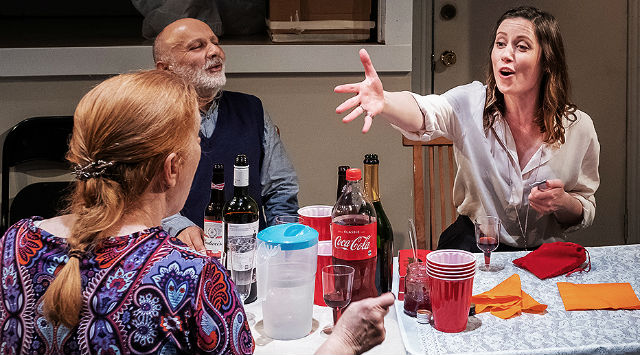
It is Thanksgiving and as is customary for American families, the Blakes gather to mark the occasion. All do their best to make it a joyous evening, but each have individual lives that are not going at all well. Stephen Karam’s The Humans talks about the hardship of modern existence for our lower-middle classes, and explores the resilience required to survive, with family being a source of strength that can provide some degree of support and grounding. It is an exceptionally subtle work, but intensely intriguing, that lures us deep into a discussion about concerns that are perhaps not immediately apparent.

The show is surprisingly entertaining, considering the coyness of its approach. Director Anthea Williams introduces a generous quotient of dramatic tension to accompany the deceivingly mundane goings on, and comedy aspects are certainly very well executed under her supervision. Family dynamics feel authentic, with a bitter-sweetness that many will find strangely comforting.

An ensemble of six likeable personalities take us through the messy business of celebrations at home, with Di Adams especially compelling as Deirdre, whose suffering is demonstrated palpably alongside a zest for life, for a splendid depiction of human spirit at its best. Similarly poignant is Eloise Snape’s performance as Aimee, a young woman with little to be grateful for, but who we see sustained by an extraordinary inner strength. The actor delivers some gloriously funny moments, whilst portraying, terribly convincingly, a painfully tragic character.

These people face considerable challenges, but loneliness is not one of their problems. They are unable to fix each other, but their love does try to conquer all. For those who have family to rely on, it is a refuge that can soothe the ravages of life, and that provides the assurance that for all the anxieties we must endure, an embrace is always there waiting. Home is where the heart is, and those who have a way back, must count themselves lucky.

www.redlineproductions.com.au

Review: Jersey Boys (Capitol Theatre)

Venue: Capitol Theatre (Sydney NSW), from Aug 29
Music: Bob Gaudio
Lyrics: Bob Crewe
Book: Marshall Brickman, Rick Elice
Director: Des McAnuff
Cast: Ryan Gonzalez, Cameron MacDonald, Thomas McGuane, Glaston Toft, Mia Dabkowski-Chandler, Cristina D’Agostino, Sage Douglas, Mackenzie Dunn, Glenn Hill, Luigi Lucente, Enrico Mammarella, Scott McConnell, Joshua Mulheran, Jack O’Riley, Matthew Prime, Daniel Raso, Rutene Spooner
Images by Jeff Busby

Theatre review
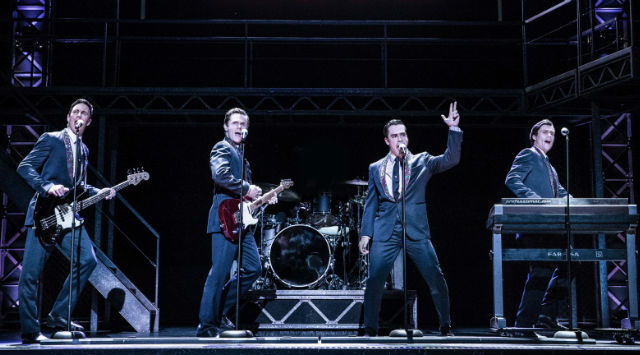
The Four Seasons have sold an estimated 100 million records, a figure virtually unheard of in the industry today. Jersey Boys takes place in the 1960s, when young American talents were able to think of the music industry as a realistic means of striking rich. A highly effective jukebox musical, filled with colourful characters and an infallible inventory of songs, the show is the proverbial, and predictable, rollicking ride, designed for sheer entertainment.

This Australian revival features an exceptional cast, with Ryan Gonzalez particularly mesmerising as Frankie Valli, complete with that trademark falsetto, celestial and ineffable. Gonzalez’s vocal abilities are a sublime joy from start to end, and his stage presence proves astonishingly compelling, despite his slight stature. He gives his all to the performance, leaving us thrilled and wanting more.

Cameron MacDonald too, is wonderful as Tommy DeVito, founding member of the group and charming villain of the piece. Brilliantly wicked, and quite alluring, MacDonald impresses with flawless timing, proving himself indispensable to the production’s dramatic effectiveness. Also noteworthy is supporting player Rutene Spooner, who sparkles in all his guises, and has us flummoxed by the incredibly nimble athleticism of his voice, whenever he is given an opportunity to sing.

We can easily tire of rags to riches stories; they rarely deviate from structures that are rigidly conventional. The magic of live musical performance however, is boundlessly and fantastically uplifting. Singers and musicians have the potential to move us in profound ways, and on this occasion, their renditions of these half-century old songs, have certainly hit the mark.

www.jerseyboys.com.au

Review: Ironbound (An Assorted Few)

Venue: Kings Cross Theatre (Kings Cross NSW), Aug 31 – Sep 15, 2018
Playwright: Martyna Majok
Director: Alastair Clark
Cast: Abe Mitchell, Ryan Morgan, Gabrielle Scawthorn, Benedict Wall
Images by Jasmin Simmons

Theatre review
We see Darja at different periods of her life, but whether she is in her twenties, thirties or forties, poverty remains the central defining feature of her misfortunes. Scenes in Martyna Majok’s Ironbound take place at a New Jersey bus stop, where Darja is always hoping to go somewhere, but never does. Between working two jobs, and relying on a series of men for help, her situation refuses to improve, no matter how much she tries.

Majok’s play presents the American Dream as a lie, arguing against the notion that hard work alone is the key to salvation. Darja is a female Polish immigrant, thoroughly disadvantaged, and seen by society to be no more than a worker ant. She has only her hopes and dreams to cling to, unaware that those who have sold her those aspirations, are also the very ones who stand to benefit greatest from her destitution. All she does is work for the man, and all the man wants, is to keep things unchanged.

Even though socially pertinent, Ironbound is not necessarily a story with universal appeal. It dispenses valuable information, but is also inevitably dreary. Director Alastair Clark has the unenviable task of making entertainment from experiences of poverty, which is difficult as well as being morally precarious, but he negotiates those lines well, for an engaging show that always has its heart in the right place.

Leading a very strong cast is Gabrielle Scawthorn, immensely authentic in the role of Darja, with a portrayal of desperation that is deeply thought-provoking. We do respond to her story with a level of pity, but it is ultimately the wider questions being raised that stay with us thereafter. Benedict Wall brings a surprising complexity to love interest Tommy, facilitating profound contemplation about the meaning of love, in this age of advanced capitalism. Darja’s first husband Maks is played by Abe Mitchell, an endearing presence with a wonderfully dynamic approach, signalling the end of innocence in the Western world. The young and privileged Vic is brought to exuberant life by Ryan Morgan, charming and humorous, in his depictions of our systemic injustices.

We want Darja’s suffering to end, but Ironbound refuses to sugar-coat any of its truths. She fights tooth and nail for a good life, but the world is determined to keep her down. It is a story about people who never stood a chance, and the lies we are fed to sustain the inhumane status quo of our calamitous inequities. Education and knowledge, and therefore art, can help set us free, that is true, but it is unlikely that the likes of Darja will ever get to see a work of theatre like this.

www.facebook.com/anassortedfew

Review: Macbeth (SheShakespeare / PACT)

Venue: PACT Centre for Emerging Artists (Erskineville NSW), Aug 29 – Sep 8, 2018
Playwright: William Shakespeare
Director: Shelley Casey
Cast: Megan Bennetts, Isobel Dickson, Rizcel Gagawanan, Joy Gray, Daniela Haddad, Prudence Holloway, Sonya Kerr, Emma Louise, Erica Lovell, Cassady Maddox, Suz Mawer, Emily McKnight, Beth McMullen, Lana Morgan, Grace Naoum
Images by Isobel Markus-Dunworth

Theatre review
If everything happens for a reason, then Malcolm must feel it the strangest twist of fate with this leadership challenge, in Shakespeare’s Macbeth. Although instigated by others, Malcolm is ultimately the one who undergoes complete transformation, by that story’s bloody end. This production features an all-female cast, but more notably, all its characters are now women. What seems to be minute alterations to Shakespeare’s words, turn his writing much more palatable, although some feminists would still prefer to see the time and energy of this passionate stable of talents, applied to projects more relevant to our times.

Director Shelley Casey proves herself an accomplished storyteller, carving out distinct characters and quick, engaging scenes for her captive crowd. Her style however is slightly too conventional, for a play in desperate need of reinvention, having been presented much too often in faithful renditions. Kyle Rowling’s work as fight choreographer is, on the other hand, truly noteworthy, in various sequences that give the show’s action quotient, an unexpectedly entertaining boost.

Leading lady Beth McMullen is a slight presence, who lacks the majesty we have come to expect of the role, but her intensity and unrelenting conviction, are admirable. It is a big cast of fifteen performers, of varying abilities, that impress with their unmistakable sense of cohesion. Gracie Naoum is a standout as Malcolm, bringing nuance to a staging that enjoys placing emphasis on its more raucous qualities. Also memorable is Rizcel Gagawanan’s interpretation of the Porter, mischievous and confident, for a theatrical moment audiences will find humorously endearing.

To “bring forth women-children only” is a futile wish, but when we look at the politics of this country (and many others), there is abundant evidence that the male of our species cannot help but create dissension wherever traditional power structures are in place. It might be naive to think that women would operate differently under those configurations of authority, but to address gender equality at all our offices and boards, is the first realistic step towards a more radical modification, of how we can better run the business of society. Whether we think of women and men as being essentially different, it is vital that all the divisions we do impose on our lives, are justly managed. All the old familiar violations, must no longer be tolerated.

www.sheshakespeare.com