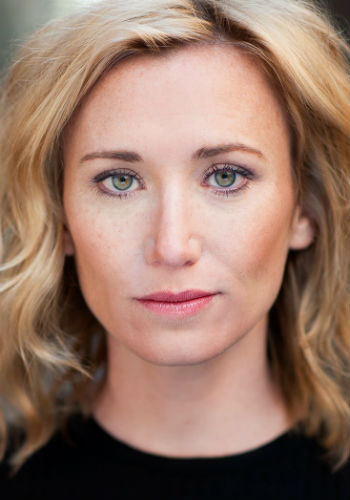
5 Questions with Anna Houston and Arky Michael

Anna Houston

Arky Michael: What do you love about being an actor?
Anna Houston: I love exploring and living with complex characters that do and say all the things I could never get away with in my own fairly pedestrian life. I get to behave really badly in this show, and it’s thrilling. I also love gluing my script into a scrapbook on day one of rehearsals. No brag, but I’m pretty good at it. My corners are VERY TIDY.

What should audiences expect from Permission To Spin?
Some big questions about how we live and how we treat other. The show is tightly packed with big ideas that fly at you so swiftly, so brutally, that you may need days afterwards to untangle them and formulate a response to the work. Also, heaps of lols. It’s really funny.

What do you find challenging about being an actor?
The industry itself has never been easy. There are so many terrifically talented actors out there not working. Staying optimistic and secure between acting jobs hasn’t gotten any easier since I entered the industry.

When was the last time you felt bliss?
Last night, falling asleep on the couch, heater turned up. That was bliss. Being safe and warm at night shouldn’t be a privilege, but in the Sydney we live in, it is. It feels like a gift. I’m lucky.

What personality traits do you admire most in men?
Empathy. Imagination. Kindness. Generosity. Humility.
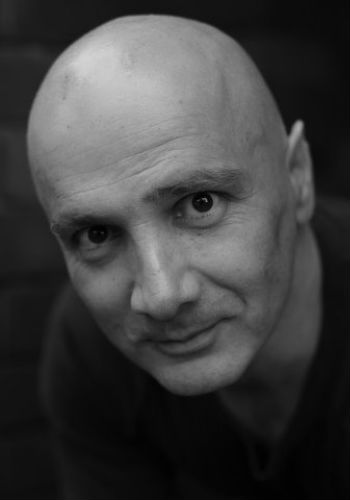
Arky Michael

Anna Houston: There are three very flawed characters in Permission To Spin. Which character – Jim, Martin or Cristobel – would you spend a year with on a desert island?
Arky Michael: I would spend a year in the tropics with Cristobel . Martin would turn cannibal and eat me and Jim would send me crazy with his weird neurosis. Cristobel would be the type who’d help me gather island detritus and flora to create and design our own line of natural fibre swimwear and resort wear which would occupy our years of marooned bliss. The label would be called PERMISSION TO SPIN – OUT, BABY!

We first worked together on a play in 2005. In the thirteen years that have followed, what’s the biggest change you’ve noticed in the Australian performing arts industry?
Big changes are the new technology platforms which have blown open the doors to multiple accessible forms of art practise : you can create your own podcasts, blogs, and make films with digital cameras and editing apps on your laptop. Also in the last 15 years, the welcome and long overdue implementation of a cultural shift to reflect the diversity of modern Australia on out stages and screens. What is worse is the continued lack of government policy to nurture the performing arts sector.

Your character Jim manages Miss Polkadot, a children’s entertainer. What was the first album you bought? How old were you?
I was thirteen or so, and I remember recording “Disco Inferno” from the radio onto a blank audio cassette in my purple themed bedroom. The curtains were purple , so were the furry bedspreads and there were a pair of lilac furry feet shaped mats on the floor. I remember this song sending me crazy with joy!

This play deals with some ethical grey areas. When faced with your own ethical dilemmas, who or what do you look to as your moral compass?
Unfortunately it is always a battle locating my moral compass in almost every situation. I’m not proud of this. My innate greed, selfishness and sheer opportunism make me a poor quality life companion candidate. Anything beautiful I want sole rights over, anything delicious I prefer not to share, any item of nice clothing that I covet, I will not stop scheming to acquire. I am a lonely man. But I do think Tanya Plibersek would be a good person to set moral standards by.

Arky Michael, you are not only a masterful actor, you are also a fashion savant. Which member of the Permission To Spin family would you most like to give a fashion makeover? (I know that several of my rehearsal room jumpers have been traumatising for you, so don’t hesitate to nominate me.)
Thank you for saying I’m a fashion icon, because this is a fact. I often hear youngsters yell out : “look mum, there’s a W.A.G.O.S.E.!” (walking art gallery of sartorial elegance). I’d give Anna Houston a makeover because she seems to be confused about what is appropriate clothing for sleeping and clothing when you are awake – she tends to favour ripped stockings, jeans her mum wore in 1935, jumpers that are for babies and she needs to increase the frequency of shampooing her hair. Is this too harsh? I fear it may be, but strangely I can’t find the delete button on this laptop.

Anna Houston and Arky Michael are appearing in Permission To Spin, by Mary Rachel Brown.
Dates: 3 – 28 July, 2018
Venue: Old Fitz Theatre
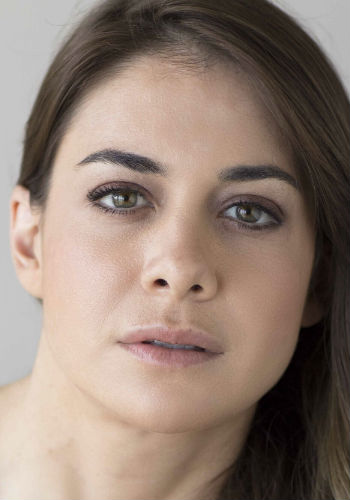
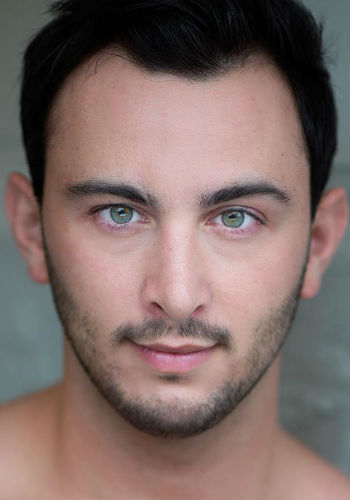
5 Questions with Antoinette Barboutis and Philip D’Ambrosio

Antoinette Barboutis

Philip D’Ambrosio: Why does this show matter in the current theatrical landscape in Sydney?
Antoinette Barboutis: There’s a paradox at play. It has very little relevance because of its context in the Sydney theatre scene. It’s either totally relevant, or complete trash. We are destabilising literary text and moving towards performance text- even a nexus of the performative and the narrative. I don’t want to fall under the pseudo avant-garde of post dramatic theatre. So, I’ve coined a new theatrical term “post ironic”.

It matters and it doesn’t matter on a personal level. I’ve seen productions this year that have given me cause to question the status quo- eg. scenographic replicas of Ivo Van Hove’s The Damned, glass-ceilings designed by men in Top Girls. Sadly, that leaves little room for mainstage reinvigorations. In saying that, we’ve used the worst-cliché Trojan Horses- Hamlet.

Does ‘New Australian Work’ get enough backing from the industry?
I don’t know Phil, I can’t answer this one. I’m new to this. I think there’s a lot of funding in it. ATYP, STC, PWA all seem to support new writing? I enjoy “Rough Drafts” a lot. But when the result in the Helpmann nominations (prophetic, I know) is “Hamlet”, albeit operatic, as Best New Australian Work- who knows?

With the use of drama school students in this production, who are so young in their development, were you worried their work wouldn’t stand up to the standard of theatre in Sydney?
Absolutely not! I believe so much more in the individual, than I do the actor. Textually, there’s a hierarchical structural at play, and completely contradicting this is the non-hierarchical structure used as a methodology in the acting. I’ve used the Brechtian technique of exploiting humanism, this anthropocentric approach is really to my taste! I’ve taken a lot of it trust in the process from watching hours of Tim Heidecker/Super Deluxe/Brown Cardigan. People as they are, are great.

How do you think audiences receive this production?
I aim to leave an audience free to produce their own interpretation. The audience should be able to question the material and I really encourage them to think their own solution. That’s the exchange I crave as an emerging auteur. In an early public reading, it polarised the audience- I see that as a sign of success. They will also have to think to determine the irruptions of truth vs fiction.

What is coming up next for Antoinette Barboutis?
I have nothing. I applied for a Greek tragedy, with a White-Anglo-Celtic director who called for “diverse” actors. I applied with noting I held an Athens residency card and a Greek passport. I did not receive a response. I didn’t get cast amongst all the other millennial 2017 Sydney Theatre Award nominated alumni for The Wolves– I didn’t even get an audition. It’s more telling of me, a Holocene I wasn’t maybe meant for- I want to be an actor.

Philip D’ambrosio

Antoinette Barboutis: Is it exploitative to expose the individual on stage?
Philip D’ambrosio: Ironically, you might be taking advantage of my status as an acting student here (even by asking me this very question) and using it as a device in the production to speak to the discourse you establish. I am the scapegoat of the production. But with permission and consent, the very essence of being on stage is to uncover what makes us humans, how we see the world and to be a vessel for storytelling. I have very little stage experience and I am so thrilled to engage with anti-didactic work at this level, that I can only bring myself- no ego. Would you say it is the acting students that become the anchor to moral reason and ethics? I sure as hell want to work in this industry but at what cost… we need to maintain our self-respect and give consent and know that we can set boundaries ourselves and not be governed by hierarchy.

Has this text given you strength to challenge the vicious cycles of abuse that occur in theatre?
The script is irreverent, unapologetic and completely bizarre – very much like me! I feel a strong connection with this style of post-dramatic theatre. I think that you have used this text to rupture the discourse surrounding abuse in this industry, mental health and female oppression. Cheers to that! I hope that it comes across as fearless and brave, as all theatre should be. We all need to find strength somehow. As a young gay male in this landscape, mental health is important so I want to back work like this. We all are struggling with our mental health, or self-worth. I am constantly plagued with doubt and to have someone to look up to when I was younger would have been nice. The industry is a difficult arena to navigate through and it needs to become softer and gentle so that artists can thrive and not self-combust. I think that the text has given me the power to remember, as fresh and naive as I might be, that I have a voice and I can be heard. With more in your face work like this, young emerging artists like us can help pave a new way so people of all walks of life can tell their stories and feel safe to do so.

When Hamlet drops his “dirty” stockings and exposes his genitals to Ophelia while she is domestically sewing, is this the timeless Shakespeare the theatre world embraces?
The world needs Shakespeare! We can’t ban it. (YES WE CAN) By using a Hamlet, you are in fact reinforcing its permanence and highlighting the power of the language to transcend time and place. Isn’t the the very reason you are using it in your play? It’s ironic. I get it. I think the work of Shakespeare allows us to see ourselves reflected and shaped through such great writing! It is clear that the resonance and beauty of his language gives us a poetic landscape to explore who we can be as humans. The scene in question, it can be see from different perspectives. All art is subjective, isn’t it? Well, let’s embrace the debate, let’s give our audience something to decide for themselves.

Is this show actually a comedy?
It’s pretty bloody funny from where I am sitting. I think it’s laced with all forms of irony and sarcasm. Do we need to label it? It’s post-dramatic theatre. The opening monologue will surely be a wtf moment. We will have to let the crowd let us know what it is by the end of it, because I’m just as confused as you are at this point. But isn’t that the point Antoinette? I’m a bit of a production myself, so if I trip on stage – it wasn’t on purpose.

Am I (Antoinette) actually a good actor?
I think that the level of professionalism we show each other in the rehearsal room makes a good actor for the most part; the openness and willingness to play, to be malleable and aware is key. Well, that’s what I’m learning at the Institution. You throw yourself completely into the work, which is to be admired. Your personality is unique and engaging, an important quality to have on stage, which a lot of trained actors can’t seem to bring to the table at times. However, I think the value we place on ‘good’ acting nowadays seems to take the focus away from storytelling. At the end of the day, we are a blank canvas and should aim to serve the story. If that is done successfully and audience is changed, we have done our job.

Antoinette Barboutis and Philip D’Ambrosio are in håmlet, part of Bondi Feast 2018.
Dates: 24 – 25 July, 2018
Venue: Bondi Pavilion