Review: The Readers (Belvoir St Theatre)

Venue: Belvoir St Theatre (Surry Hills NSW), May 5 – 19, 2018
Playwright: Scott Smart
Director: Elizabeth Nabben
Cast: Anni Finsterer, John McNeill, Scott Smart
Images by Clare Hawley

Theatre review
It is tempting to judge ourselves by things we read in the news. The extremities of society, whether the great successes or our dismal failures, give a powerful impression of the people we are, but routinely neglected are the smaller stories of millions of individuals, those that offer a more accurate picture of daily Australian life. Scott Smart’s The Readers puts focus on those who make up the regular working class, the ones who rarely make the papers.

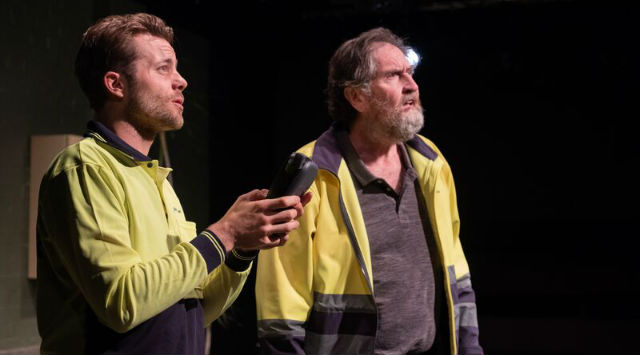
Peter and Lachlan read electricity metre boxes for a living, going about their business with little fuss or drama. They are two white men who seem to suffer no disadvantage, but their lives are not without challenges. In our current state of accelerating capitalism, what were once perfectly respectable jobs, are gradually turned humiliating. The play shows the insidious nature of how money is allowed to compromise the dignity of our workers. Peter and Lachlan have rules to abide by, but not all of them are reasonable.

The production is elegantly directed by Elizabeth Nabben, who manifests a quiet charm around her characters and situations. It seems society has accepted that employers will, by some degree, infringe upon their staff, and The Readers embodies a quality of nonchalance that reflects that reality. Working for someone does not mean that one becomes a stakeholder, one simply becomes an instrument of functionality, and will have to accept a certain amount of dehumanisation within their prescribed responsibilities. It is the profit motive that takes precedence, rather than the welfare of our communities.

John McNeill and Scott Smart play the key roles, both subtle but strong with their humour, delivering excellent nuance for this gentle piece of theatre. They form an amusing duo, comedic but also poignant, without having to reach for creative choices that may be too obvious. The third wheel Annie, a flimsy character with arguably unconvincing traits, is performed by Anni Finsterer who plays up the silliness to great effect, for moments of extraordinary hamminess that prove surprisingly delightful.

In The Readers, we see that the only thing trickling down from top to bottom, is the anxiety of business ownership. Profits, on the other hand, remain exclusively within the upper crust. Managers do not hesitate to exert pressure on those who have to put in the hard yards, but only shareholders stand to gain monetary wise. Peter and Lachlan never complain. Like most of our work force, people accept their lot, accustom to the feeling of disempowerment. We are taught to work hard, to grin and bear it, in order that rewards may be delivered. That belief is not a lie, but it is clearly not the entire truth.

www.belvoir.com.au

Review: Revolt. She Said. Revolt Again. (House Of Sand)

Venue: The Old 505 Theatre (Newtown NSW), May 2 – 19, 2018
Playwright: Alice Birch
Director: Charles Sanders
Cast: Violette Ayad, Anna Cheney, Enya Daly, Richard Hilliar, Moreblessing Maturure, Eliza Sanders
Images by Jasmin Simmons

Theatre review
The play begins as though a manual providing instruction on becoming a radical feminist, offering steps of revolutionary action to attain some kind of ideal state of being. For those who understand their subjugation, the idea of taking down the powerful is always appealing, but the truth remains, that vacuums are nonviable and breaking something down requires the installation of something new. Alice Birch’s Revolt. She Said. Revolt Again. is a thrilling ride for anyone with a taste for rebellion. Its militant spirit is seductive, with powerful declarations that will excite those similarly inclined. The piece evolves unexpectedly, introducing in later portions, complexities that confront its own passionate proclamations of earlier scenes. Birch wants us mobilised, but in a smart way. Activism cannot thrive only on impulse. Long term strategies must accompany courses of action, or we risk ending up at a place worse than before.

The show speaks resonantly, with director Charles Sanders’ intellect a fortifying authority that establishes clarity for all its arguments. The politics in Revolt. She Said. Revolt Again. are made compelling by Sanders’ palpable enthusiasm for the subject matter, and their insistence that we hear its messages, translates into excellent drama. Design style is fairly simple for the production, with Joanne Joy’s visual projections particularly effective in helping to assert some of the highly provocative concepts.

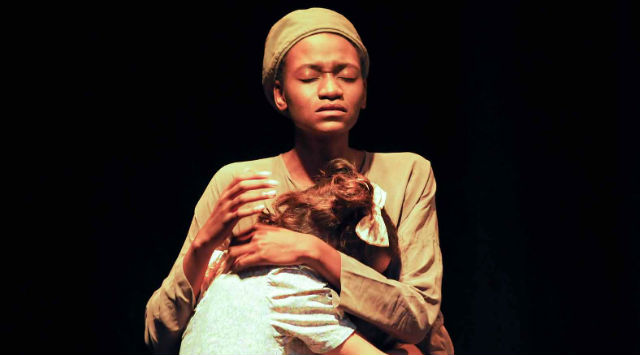
All six performers for the piece are impressive, each one given ample opportunity to put on display their individual talents, as well as a unifying and admirable conviction pertaining to the material at hand. Eliza Sanders imbues her lines with authenticity and precision, delivering a delightful acerbity with every utterance, and equally memorable for her disciplined physical expressions. The imposing figure of Moreblessing Maturure is accompanied with a tender vulnerability, especially convincing in a maternal role, conveying unassailable qualities of our humanity with beautiful restraint and confidence. The lone thorn among the roses is Richard Hilliar, whose comedy hits all the right notes, whether understated, madcap or frighteningly bombastic. Violette Ayad and Enya Daly bring emotion when we least expect it, creating additional dimensions to an already rich work, and Anna Cheney’s ability to oscillate between realism and the flamboyantly bizarre, has us fascinated and entertained.

Anarchy may not be the answer we need, but the power of resistance must never be underestimated. Revolt. She Said. Revolt Again. is full of inspiration, for those of us who recognise the concerns that it raises. Revolutions must start somewhere, and the personal can be the site on which we begin positioning the battleground. Warriors have the capacity for long, hard slogs, and they understand that to suffer the pains of combat, far surpasses the unbearable torment of injustice. Fights are best undertaken when there is light at the end of tunnel. In the business of social activism, soldiers will get beaten down every day, but a resilient optimism is the key conspirator, to the ability to know right from wrong.

www.houseofsand.org

Review: Yours The Face (Blood Moon Theatre / LZA Theatre)

Venue: Blood Moon Theatre (Potts Point NSW), May 1 – 12, 2018
Playwright: Fleur Kilpatrick
Director: Liz Arday
Cast: Daniela Haddad
Image by Liz Arday

Theatre review
Emmy is a female fashion model, and Peter is a male photographer. They meet on a job in London, both excited to be visiting from abroad, and both finding themselves attracted to one another. We watch nervously, waiting for disaster to strike, predicting the inevitable in this tale of power imbalance, but Fleur Kilpatrick’s Yours The Face refuses to fit into the mould. It is a relief to see Emmy resist being infantilised, that her sexuality and sense of self are presented as valid, even if the structures that she operates within are problematic.

The work challenges us to think about institutionalised sexism, whilst it presents individuals who seem blameless and who look to be acting with agency. It questions our participation in industries that thrive on inequity, making us think about the meaning of responsibility, in situations when acting in accordance with what is considered legal and permissible, are arguably ethically inadequate.

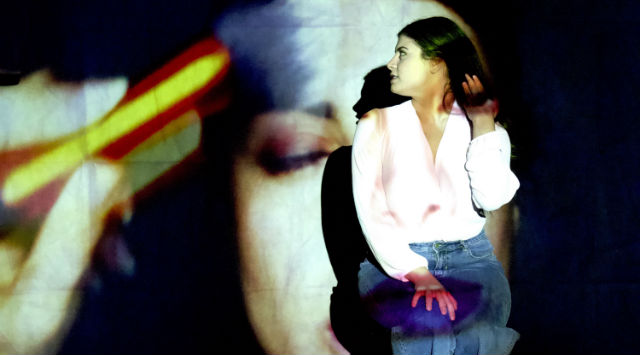
Daniela Haddad plays both roles, and proves herself sufficiently prepared, but the actor’s inexperience is evident in the demanding work. Positioned in front of a screen, with projections accompanying her entire performance, Haddad’s face is often obscured by the imagery, and we find ourselves routinely distracted by competing visual elements. Director Liz Arday’s concepts are strong, and they make for a show that is ultimately thought-provoking and rewarding, but the production is certainly demanding of its audience’s ability to concentrate.

When we are not actively taking down and taking over old systems, our involvement only serves to sustain them. There will be benefits that come with playing by the rules, but hidden costs have to be examined, and measured against what we deem to be genuinely decent. What Emmy and Peter do, are conventional and accepted, in fact they stand to become rich and famous if the stars align, but in Yours The Face, we observe that all is not well. Disease festers and exacerbates, when we choose only to pay attention to all that glitters.

www.lza-theatre.xyz | www.bloodmoontheatre.com

Review: Youth And Destination (Manifesto Theatre Company)

Venue: Kings Cross Theatre (Kings Cross NSW), Apr 27 – May 12, 2018
Playwright: James Raggatt
Director: James Raggatt
Cast: Jack Angwin, Georgia Blizzard, Gloria Bose, Julia Christensen, Maree Cole, Skyler Ellis, Alex Malone, Bardiya McKinnon, Nikita Waldron, Ross Walker
Images by Emily Havea

Theatre review
There is no conventional narrative in James Raggatt’s Youth And Destination, only a series of short sequences that offer insight into his young mind. The brevity of scenes allows the playwright to touch on a broad range of topics over the course of an hour, but the format prevents sufficient depth from being reached, aside from occasional dialogue that might inspire a sense of intrigue that encourages us to see beyond the mundane.

There is much to admire in the young; they are often inquisitive, passionate and fearless. Wisdom, although never restricted to the mature, can however be elusive. On this occasion, thoughts expressed are honest and very earnest, but the lack of life experience is evident, and Raggatt’s attempts at circumspection will not be able to satisfy every member of audience. Some nonetheless, will see themselves accurately reflected, in this work by young people, for young people.

An exceedingly pleasant group of actors prove themselves accomplished, with no fiction to perform but instead, putting on stage a convincing semblance of the self. In the absence of more complex story lines, their task is to make compelling, snippets of modernity, whether banal or extraordinary. Star of the show is not an actor, but lighting designer Martin Kinnane, whose aesthetic inventiveness and technical excellence, bring to the production a necessary polish, along with rigorous calibrations of mood, from scene to scene.

The young can tell us so much about the world, but pinning down the meaning of life, is not usually their strongest suit. Youth And Destination is a sensitive work, slightly overcautious with how it wishes to be perceived. Whether young or old, we all have to grapple with how others look upon us; we are so fundamentally social. It is incumbent on the artist however, to be courageous, and to always be revealing of their own truth, especially that which is unique and idiosyncratic in quality. Few can claim to speak for communities, but when we return to the individual in an exhaustive and meticulous way, what we say about the personal can become unimaginably significant.

www.kingsxtheatre.com.au

5 Questions with Chris Miller and Jacqui Robson

Chris Miller

Jacqui Robson: What are five words you’d use to describe Lennie Lawson and five words to describe Hugh Lusk?
Chris Miller: Lennie Lawson – Charming, boyish, manipulative, adaptive, psychotic. Hugh Lusk – Determined, confident, altruistic, ambitious, stubborn.

Where on the spectrum of human behaviour would these two men overlap?
More than likely, narcissism. Lawson is pathological and most definitely at the disordered end of the spectrum, lacks empathy and is a slave to his delusions. Lusk is empathetic, yet has a swagger of arrogance to him. Where they overlap is they both suffer from ‘magical thinking’: Lawson in the way he justifies his abhorrent acts of cruelty and Lusk in the way he clutches at straws to build a defence for Louisa Collins when the odds are stacked against him. Where they differ is Lusk has empathy and control whilst Lawson definitely does not.

What has been the hardest thing about playing Lennie?
I’ve done a hell of a lot of research on personality disorders and the Dark Triad (psychopathy, narcissism and Machiavellianism). It’s really heavy stuff. I’ve been exploring which spectrums I sit on, and ramping them up and walking around in public to get a feel for it… and it’s crook. I’m a naturally empathetic kid, so switching into psycho mode and exploring egocentric, sadistic magical thinking is not without its detriment. I’ve had to counterbalance with meditation and positive affirmations, which has actually been awesome as well. So it’s double edged. That, and I have to be consciously aware of not creeping out the cast and crew because I’m in so deep. Either way… it’s real juicy.

What’s it like being in these two productions at the same time?
Awesome! I freakin’ love it. Two totally different characters, pushed to the max, and a sensational team of directors, cast and crew. Jacqui (and the rest of the cast) are so talented, giving and supportive. Also, it’s a different experience playing real people of history. The back story is done for me; it almost feels like I’m allowing them in to possess me and, of course, I get to decorate the cake with Miller-isms. The main thing is just vehemently telling the truth.

Would Hugh Lusk take on Lennie Lawson as a client?
Hmmm, as ambitious as Lusk is, and although he fights for the underdog, Lawson is an abhorrent violent criminal with zero chance of redemption. The evidence is so stacked against him and cut and dry. So, my answer is no. It would be morally incongruent for Lusk to take the case.

Jacqui Robson

Chris Miller: What draws you to playing characters such as Jean Turnbull, June Dally Watkins and Louisa Collins?
Jacqui Robson: Each of these real-life women were caught up in extreme circumstances and I am grateful for the chance to explore their behaviours, and creatively make choices based on what I can only guess at why they did what they did. They are all complex and, in these stories, they experience terrible tragedies in different ways. I get to play with their strengths and vulnerabilities, but hopefully also honour their experiences.

Tell us about your process to delve deeper to find the truth and embody these characters.
I started with imagining how I would behave in their circumstances, and then try to understand why they acted the way they did. Then I looked into the research. For the Lennie Lawson story, there were helpful articles about the Lennie Lawson attack on SCEGGS that gave me some clues into Headmistress Jean Turnbull’s character and choices. There’s also plenty of content on June Dally Watkins around to give a guideline into her personality. How they behaved with Lennie Lawson is how I imagine I would have in those circumstances. (I might not have been as hardcore heroic as Jean Turnbull, though I’d like to think so.)

Louisa Collins is more difficult. She’s enigmatic. Playwright Gina Schien loaned me her copy of The Last Woman Hanged by Caroline Overington. It’s a brilliant collection of primary research with many contradictions in observations about how Louisa behaved, so I’ve found it challenging to make any decisions about her. She constantly surprises me. I’m making the best choices I can, so I just hope that I represent her as truthfully and compassionately as possible.

What’s the difference that you find in playing imaginary characters compared to actual women of history?
Playing real women of history brings with it a great amount of responsibility to represent them and their actions truthfully and accurately. History is decided by others so maybe it’s impossible to ever really do this, but I still try. Fictional characters are a lot more freeing and I care a lot less about what others’ think of my interpretation. If people don’t like my choices, I can’t do much about it and can’t worry about it.

Why act?
I bloody wish I knew. It’s like being on drugs. The creative highs are amazing. The lows – the poverty, rejection, artistic failure, bad reviews, objectification, inability to plan life – all suck immensely. Honestly, if I could get my creative kicks some other way, I bloody would.

What is your dream role and why?
I just like to be doing something, chasing something, acting in pursuit of that something. Give me a role in which I have a job to do. Preferably in a great ensemble piece with amazing dialogue. My favourite plays and shows are the ones where there are at least five people talking. I love to contribute to a symphony of fantastic dialogue in an electric scene where everyone is fighting for something (e.g. an episode of The West Wing, or Tracy Lette’s August: Osage County). My creative north star is probably Allison Janney playing CJ Cregg in The West Wing.

Chris Miller and Jacqui Robson are appearing in Deadhouse: Tales Of Sydney Morgue.
Dates: 24 April – 19 May, 2018
Venue: The Rocks Discovery Museum