Review: Talk (Sydney Theatre Company)

Venue: Sydney Opera House (Sydney NSW), Apr 3 – May 20, 2017
Playwright: Jonathan Biggins
Director: Jonathan Biggins
Cast: Valerie Bader, Helen Christinson, Paige Gardiner, Peter Kowitz, Lucia Mastrantone, Kenneth Moraleda, Andrew Tighe, Hannah Waterman, John Waters, Ben Wood
Image by Brett Boardman

Theatre review
Journalists are losing jobs every day, while the world transitions from traditional forms of news consumption to what is termed new media. In the digital age, information comes cheap, and its dissemination no longer relies on sources of authority and legitimacy. Instead, we find ourselves obtaining news from literally anyone, with little discernment, through things like social media or any of the millions of internet web pages.

What used to be considered a revered profession, is now dissolved into commentary, opinion and hearsay, coming from people who have demonstrated nothing that earns our trust, most of which is never verified or verifiable. A lot of Jonathan Biggins’ Talk is about the well-founded anxiety surrounding this changing landscape, as well as the ever-present threat that commerce and propaganda pose to our media organisations.

Three powerful bodies are represented in the play; the Australian Broadcasting Corporation, the Daily Telegraph, and a fictive mercenary radio station with its talkback star. We observe them finding their way around the case of an alleged paedophile, each one responding in their characteristic manner, with none able to report the truth. Biggins offers insight and perspective on an industry he knows well. The clarity of his deductions is valuable to how we understand the state of play today, in forces that have undeniable influence on all our lives. As a work of theatre though, the dialogue is often contrived, with a transparently didactic approach that gets in the way of its storytelling.

A lack of nuance in its depiction of archetypal personalities produces a kind of comedy that is perhaps too obvious and slightly hackneyed. Its characters are never surprising, although performances are uniformly polished and considered. Actor John Waters as the aforementioned talkback radio host John Behan, is entirely convincing, but the material at hand does not seem to encourage a depiction that is as comical and outrageous, as the real life examples he emulates.

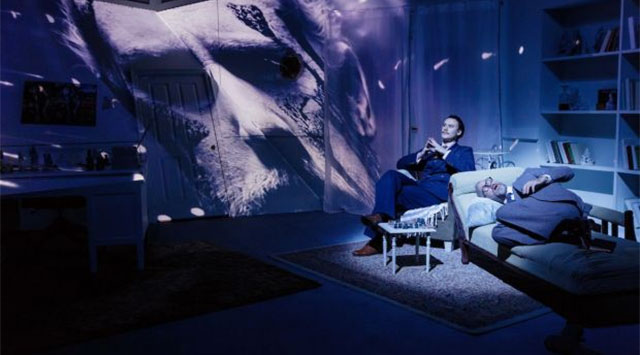
Production design is a straightforward affair in Talk, but for what it lacks in ingenuity, it compensates with efficiency. Mark Thompson divides the stage into three static portions, to accommodate the play’s three workplaces. If their only intention is to create believable and functional spaces for action to occur, then design faculties have passed with flying colours on this occasion.

We want the news to give us access to the truth, but truth is rarely the real priority for those who give us the news. As we become increasingly sceptical of the old gatekeepers, we reach for alternate sources in hope of locating information that is more accurate and relevant, but that can lead us into echo chambers that have us shielded from reality. It is a grim scenario that Talk leaves us with, but its pessimistic resistance of digital advancements in our media is overstated. Traditional formats were never without their problems. It is tempting to think of the past as simple and wholesome, but lying crooks have existed since the dawn of time, and we will have always have to be vigilant, no matter ink or pixels.
www.sydneytheatre.com.au

Review: The Play That Goes Wrong (Roslyn Packer Theatre)

Venue: Roslyn Packer Theatre (Sydney NSW), Apr 5 – 23, 2017
Playwrights: Henry Lewis, Jonathan Sayer, Henry Shields
Directors: Mark Bell, Sean Turner
Cast: Darcy Brown, Adam Dunn, Luke Joslin, George Kemp, James Marlowe, Brooke Satchwell, Nick Simpson-Deeks, Tammy Weller

Theatre review
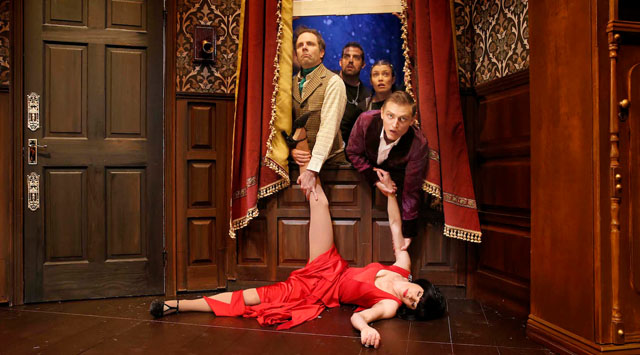
When embarking on any project, passion is a key propulsive ingredient that will make things happen, but nothing will go well if passion is the only positive quality it has going for it. A community theatre group in Cornley, UK puts on a 1920s murder mystery, with little more than the fire in their bellies. The lack of talent and skill onstage and off, generates a series of fantastic mishaps that constitutes the high energy comedy brilliance we find in The Play That Goes Wrong.

It is pure farce and slapstick, at their maximum amplification. Stories and characters are barely relevant, in this ambitious exploitation of high octane physical comedy, involving people and objects falling about constantly, in the most satisfying manner. It is an old-fashioned style of show, made new by its unusually voracious need for speed and excitement. Directors Mark Bell and Sean Turner may not be visionaries in the conventional sense, but what they brings to the stage is extraordinarily precise and wildly imagined. The laughs on offer here are ceaseless, limited only by the audience’s ability to respond with a sustained level of energy that could match the hilarity that unfolds on stage.

The charismatic cast gives an exceptionally tight performance. In the presentation of a play where everything goes wrong, nothing is allowed to falter, and the actors are simply impeccable. George Kemp and James Marlow display no limits to their capacity for silliness, proving themselves to be very endearing indeed. Brooke Satchwell and Luke Joslin impress us with their physical presence and agility, allowing their beings to flail and flounce about with great force and ingenuity, for unimaginably powerful comic effect.

Stage managed by Anneke Harrison, the production’s technical excellence is crucial to its success. The Play That Goes Wrong can be seen as a love letter to stage managers everywhere, the unsung heroes of all the great shows we have ever seen. These women and men make themselves invisible, so that we can lose ourselves in the illusion of every staged moment. We fawn over actors and the words of playwrights, but forget the operations out of sight that allow magic to happen, until they draw attention to themselves when things do go wrong. The character of the inept Cornley stage manager (played by Adam Dunn) is a hoot, but also a constant reminder of the magnificence that has to take place backstage in order that theatre can do its best.

www.theplaythatgoeswrong.com.au

5 Questions with Tyler De Nawi and Aanisa Vylet

Tyler De Nawi

Aanisa Vylet: I have been watching you play Uday Hussein. He is quite a cruel man and you as a person have the demeanour of a teddy bear. How do you channel his cruelty?
Tyler De Nawi: When I am behind closed doors in my own space I experiment with how far I can take something. I can have quite a lot of fun with myself… (I know that sounds dirty) but I know how to entertain myself. When I am alone, I can actually push myself to those extremes, to those states of anger, distress. I can drop my mask of Mr Nice Guy and play. It comes from play, playing at home, really taking time to understand what the text is saying. The play is written so well. I just try to let the text breathe on stage.

What is your relationship to Iraq as an Arab Australian?
I grew up with Iraqis and Asyrians in Western Sydney. The word ‘Saddam’ was thrown around loosely at school. Some loved Saddam, some hated Saddam, some didn’t even know how to feel about it… After more research, I have started to see the Husseins as ordinary people. Even though people considered him to be crazy, Uday Hussein was a boy who grew up with a father who would kill his own friends if they betrayed him. His father was unfaithful to his mum and Uday loved his mum. He was product of his own environment. Uday used to own tigers. To me, if he was an animal, he would be a tiger – a predator in captivity.

What is your favourite thing about your Uday Hussein costume?
He is like an “Arab Hugh Hefner”. He wears a three-piece suit with gold buttons on it and a gold tie. It is something else. We are so lucky to have found it. I am still trying to get my hands on a ring, a gold pinky ring. I think that will be my favourite part.

Have you ever been to Iraq?
Never. I have been to Lebanon, Syria, Egypt, Turkey… Wow, all the countries around Iraq but I never been there, no.

Do you feel targeted as an Arab?

I am proud to be Muslim. I am proud to be from an Arab background. We are complex just like every one else. We are messy. We are passionate. We are beautiful, just like everyone else. It is time to stop assuming you can label anyone. Just because I am Arab-Muslim does not mean you know me.

I believe art is the best way to help a society overcome these assumptions.

When I was a kid growing up, driving down the highway I saw big banners from world vision that showed an African child suffering. 20 years later, there are now Syrian kids on banners in the rubble that was once their city. How did we get to this? We haven’t even resolved what is happening in Africa. People from my own heritage have become a charity case. What is next?

Aanisa Vylet

Tyler De Nawi: In this play you are playing two characters – an Iraqi civilian whose home is being raided and a leper. I watch you embody these characters very well. To what extent do you go to embody a character?
Aanisa Vylet: I can inhabit distressed states of being very easily. I don’t know where it comes from. Perhaps it is in my blood, an ancestral pain. When I access those states I think about everyone who is currently suffering in Arab countries and the world right now. I channel anyone I know who is an outsider due to their health as the leper.

I also work in colours and through the physicality of that character. For the Iraqi woman, my feet are bare and I am trying to put on my scarf. As a person from an Islamic background, I understand the vulnerability and nakedness that she would feel when those parts of her body are bare in the presence of foreign military.

With the leper, my body is diagonal and made of sand. The leper is the color grey – the black moves inward, the white tries to reach out. The Iraqi woman is red – passionate and explosive.

If you were stranded in the middle of the desert as an outsider, decaying, what is the food that you would be wishing for?
My mother’s homemade vine leaves. Even though my mum hates cooking, her food is always made with love and makes me feel like I am at home. And Lebanese vine leaves with yoghurt and mint? That is the dish that describes my life. It takes forever to make but tastes so delicious you fight for the last mouthful.

What is your mission as an artist and why were you interested in telling this story?
My mission is to tell stories that are difficult to tell, stories that express the voices of people who are silenced who cannot tell their stories themselves. I aim to tell provocative and engaging stories that don’t exist yet.

And as for Bengal, when I first read the script I thought – “Fuck yes!” and then… “Thank God!” The writing hits the primal part of ourselves that we often forget in our daily life. We need writing like this. We need to be moved in our seats before our brain kicks in.

On top of that I was keen to share a narrative that dealt with “Operation Iraqi Freedom” and to work with the wonderful Mad March Hare Theatre Co.

If you had three wishes from a lamp what would they be?
I would wish that we had proper world leaders again, like Nelson Mandela, leaders who perform not for themselves but for the people they represent. My second wish would be that we respect and improve our treatment of animals and the environment… and I would want my mum to get the operations she needs and my brother, who has Down Syndrome to receive the best and most inclusive life possible.

Why should someone pay $40 to come and see this play?
Because it is incredibly moving, everyone involved is generously bringing themselves and their hearts to the work. Because this play is so relevant to our lives today. Because the play is funny – it is a wonderful and entertaining night at the theatre. This isn’t a close and open your eyes “why the hell did I watch this?” show. At this show you will see artists at play, trying new things. This is ground-breaking, brave theatre. Do yourself a favour – go.

Tyler De Nawi and Aanisa Vylet can be seen in Bengal Tiger At The Baghdad Zoo by Rajiv Joseph.
Dates: 12 Apr – 6 May, 2017
Venue: Old Fitz Theatre

Review: Hysteria (Darlinghurst Theatre Company)

Venue: Eternity Playhouse (Darlinghurst NSW), Mar 31 – Apr 30, 2017
Playwright: Terry Johnson
Director: Susanna Dowling
Cast: Miranda Daughtry, Michael McStay, Wendy Strehlow, Jo Turner
Image by Robert Catto

Theatre review
Sigmund Freud is near the end of his life, and the past returns to haunt him. We all change our minds, but writers have the burden of their work set in stone. In Terry Johnson’s 1993 play Hysteria, a fictive version of Freud is made to regret his declarations about women’s rape fantasies. It seems that the legendary psychoanalyst had misrepresented experiences of his patients, turning their reality into imagination, so that his work would be better received. Johnson’s piece about the need to redress denials of rape and molestation, is a timely discussion in the current climate of renewed interest in feminism, but Hysteria is a dry, and often inelegant, work that proves to be less than captivating.

The production looks smart enough, with Anna Gardiner’s set and costume design establishing a splendid first impression. Projections of Julian Tynan’s cinematography appear later in the piece, equally delightful with the imagery it presents. It is an accomplished group of actors, each one demonstrating a good sense of presence and conviction, but chemistry is lacking, and the stories they tell never seem to fortify. We are left feeling confused and detached, unable to adequately follow its narrative or to satisfactorily engage in any of its ideas. It is a laborious exercise for the audience, trying to work out the point of the exercise, and when we eventually gain clarity, Hysteria‘s concerns fail to resonate.

Individual elements of the show all look to be at least adequate, but they coalesce to form something that is altogether disappointing. Its characters are not lifeless; Salvador Dali is written in, presumably, to further enhance the quotient of eccentricity in Freud’s colourful world, but there is little in Hysteria that excites. Art does not owe us entertainment, nor does it promise to always be meaningful. In art, there is no right and wrong, but a work can certainly fall short of the standards it sets itself.

www.darlinghursttheatre.com

Review: White Rabbit Red Rabbit (Freefall Productions)

Venue: Kings Cross Theatre (Kings Cross NSW), Apr 4 – 15, 2017
Playwright: Nassim Soleimanpour
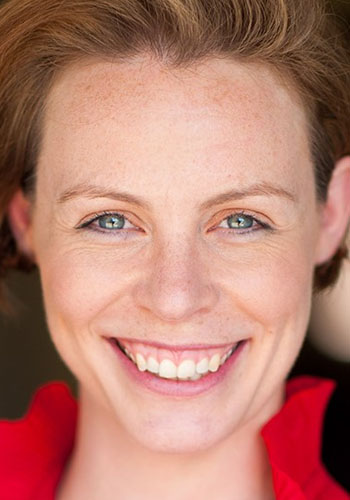
Cast: Ylaria Rogers
Image by

Theatre review
The play requires that its actor comes to the performance “blind”, not knowing anything about what lies on the pages of the playbook. It is a complete mystery to the person on stage, and also to those in the audience who are seeing Nassim Soleimanpour’s White Rabbit Red Rabbit for the first time. It is significant that the 2010 work was created when its 29-year-old author was forbidden from leaving his country Iran. The autocratic regime that he had to endure is not directly denounced in Soleimanpour’s writing, but its presence and influence on the piece, are clear.

We are made to consider how a police state operates, especially in terms of the complicity and compliance of citizens that allow inhumanity to thrive. The play shifts attention away from the way authorities intrude upon private lives, and looks instead at how the everyday person monitors and subjugates one another unconsciously, especially in cultures where freedoms are severely restricted. We are urged to think about the deficiencies in free will, and how easy it is for society to manipulate our empathy and deprive us of compassion. It wants us to see the tragedy that exists in our exploitable susceptibility to mistreating each other, and our readiness at forming habits of intolerance, hate and violence. It is to the writer’s credit that these grave and important issues are not only communicated powerfully in spite of its need to be cryptic, White Rabbit Red Rabbit is surprisingly humorous and entertaining.

Like Soleimanpour at the time of writing this script, actor Ylaria Rogers is in a position of vulnerability as she moves through the lines and instructions of every page. She submits to the text that she holds in her hands, but like those of us who have gathered to witness this unusual theatrical moment, our volition is constantly called to question. Ylaria’s obedience, and ours, come into examination, leading us to confront the nature of authority, and how it is constructed. Authority is often imagined, but even when it is real and life-threatening, the power of the masses can overthrow any dictator that sits atop. The conundrum is in our inability to perceive that collective force, and our failure to understand that the fear we experience is shared and can only manifest if we allow it to.

www.freefallproductions.com.au

5 Questions with Alison Bennett and Dymphna Carew

Alison Bennett

Dymphna Carew: What’s the best thing about devising your own work? What’s the worst thing?
Alison Bennett: Best thing would be letting your imagination run off to different places. Worst, is getting stuck and having no idea what to do.

If you weren’t an actor, what would you be?
A journalist or a bird.

What has been the highlight of creating and performing Trade so far?
Honestly, the highlight of Trade so far is seeing people turn up even when it’s really hard. Also, once we get into performance it is really fun.

Are you a romantic or a realist and why?
I am definitely a romantic but sometimes I think I’m a realist. It’s because I love to escape into my own world. When I was little I had an imaginary place called Ali Land. Not much room for realism in Ali Land.

During the creation of Trade, the biggest question we have had to ask ourselves is “how responsible are you?” What are some of the things you have discovered about yourself? Are you responsible? Have you changed after confronting yourself with this question?
This can get really dark because you start to think that the world can never change. Then I realised that I am responsible. I’m really responsible and I realised what a weird relief that was because that is something that can change. I had trouble seeing the light of the subject matter of change and I think that that’s it. If we can just put our hands up and recognise our own responsibility, then we can change. If it’s always bigger and scarier than us than it can’t.

Dymphna Carew

Alison Bennett: What would be your perfect Monday?
Dymphna Carew: My perfect Monday would be enjoying another day off after the weekend! Escaping for a long weekend and doing something active and adventurous.

What was the last dream you remember?
I had a really vivid dream a few nights ago and dreamt there was someone at my window trying to climb in. I remember desperately trying to move and call out to my partner, but I was paralysed. Then apparently I started to make some strange sounds and screamed, waking myself and my partner up. It was all a bit scary and weird. We probably watched too much Homeland before going to bed. Ooops.

What gets you really excited in the theatre?
I love live theatre and experiencing something so intimate with other people. When the space is used in an innovative and surprising way, that really gets me going. I appreciate experimentation and love original, imaginative and daring pieces of theatre. Any show that uses different art forms to make a story come to life and take the audience on a journey makes my heart sing.

How do you feel about being nude on stage?
Hmm. I don’t personally have a huge issue with being nude on stage, however I wouldn’t be getting my kit off for any old reason.

Skinny dipping? Love or hate?
I don’t mind a little skinny dip now and then.

Alison Bennett and Dymphna Carew can be seen in Trade .
Dates: 4 – 15 Apr, 2017
Venue: Old 505 Theatre

5 Questions with Lucy Goleby and Moreblessing Maturure

Lucy Goleby

Moreblessing Maturure: Fallen is a new Australian work. Why do we need new work and why did you choose this new work?
Lucy Goleby: I think it’s really important that theatre reflects, questions and challenges its social, geographical and political context. New work speaks to audiences with an immediacy, an urgency and a familiarity that makes an audience’s experience inside the theatre change the way they interact with the world outside it. This play, Fallen, allows audiences to do some of that metaphorical work themselves, asking them to draw conclusions and discover points of similarity and difference between London in 1848, we create for them onstage, and the world of Sydney in 2017, as they create for themselves offstage. Fallen seeks to explore the role of women in a patriarchy, how their relationships within a patriarchy are constructed and destroyed, and what, ultimately, empowerment looks like.

Is working in the female-led space that She Said Theatre encourages different to your previous acting experiences? If so, how?
Working with She Said and the incredible company of women has been challenging and empowering. I talk of Facebook and social media as an echo chamber, with my own opinions and passions reverberated back at me by like-minded individuals. In this room, I am surrounded by opinions and passions as fervent as my own. In simultaneously supporting and challenging each other, we have been strengthening ourselves as women to support and challenge the society we live in. Knowing that these remarkable women are conducting themselves with poise, passion, determination, intelligence and love makes me feel stronger and safer in my pursuit to do the same.

How can today’s 21st century society hope to relate to this text and its characters?
I think today’s audiences are smart story-recipients. They’re clever and quick with metaphor and symbolism, and easily capable of drawing comparisons between their own lives and experiences and those presented to them. Beyond that, the enormous revolution in television in the last five-odd years has created an audience that understands how to invest in multiple characters and multiple plotlines. Stories matter to us when we can see ourselves in them. This play and its women are both deeply familiar and uncomfortably confronting to the experience of 21st century Australian women. And men who’ve ever met a woman.

What would your character, Matron, think of 21st Century Australia?
I think Matron would be entirely overwhelmed and relieved. She is in the unenviable position of upholding and maintaining the very system that disenfranchises and devalues her. We’ve been talking a fair bit in rehearsal about the perpetuation of bad advice, and the insidious inheritance of unconscious bias. I believe in that idea that you can only dream what’s seen, and Matron’s capacity to make any kind of difference for the girls in her care is fundamentally flawed because she can’t dream a life for them that’s any different from her own.

Who should I invite to come and see this show?
Anyone who cares about what it means to be human. And those who like a stunning multimedia, fragile soundscape, emotionally rich direction, clever, detailed language, an intricate flexible set or a fully boned corset complete with hand-sewn period dresses. And your mum.

Moreblessing Maturure

Lucy Goleby: Describe the world of the play Fallen in five words.
Moreblessing Maturure: Precarious. Tense. Measured. Full. Live

What is one of the questions you hope this play asks or answers?
This is probably the thing I look forward to the most about this play- the foyer conversations before the play, during the intermission and in pubs, cars and trains after the curtain call. I asked a lot of questions after my first reading and I’d be more than content if the audience was also curious after watching the play, curious enough to read up about the history of Urania Cottage, the history of Australia, the herstory of women and particularly, these women. One burning question I’d hope this play asks is “where are we know?” Compared to 1846- where are we as a society when it comes to our relationship with our history, with femininity and liberation.

What has been the most unexpected moment or discovery of the process so far?
Aside from the phone call from Penny (the director) telling me I was going to play Julia, realising how noticeably different working in an unapologetically female-led and centred space was. Not only for myself as an individual but also as an artist, realising that “the norms” of a theatre space, which I’d learnt to be the ‘rules’ of theatre making-didn’t have to be so- that there was a different way to approach, to analyse to process to imagine stories- and that way was equally as valid . #suchdeep #muchwow

How is your character, Julia, similar to and different from you and what have you learned from her?
Julia, unlike myself, has a steadfast faith in the system she finds herself, in meritocracy- the notion that hard work leads to success (however that manifests) and thus any failure is due to individual inadequacy. That was the first big obstacle i had to work through in understanding Julia, as to WHY someone who has been wronged by her society in so many ways, continues to obey by the rules that actively maintain her lowly position. Julia also manages to be very similar to me in the way she navigates her world, in her ability to master the act of appeasing and knows how to keep-up-appearances when all she wants to do is yell to the heavens..yeah, we’re pretty Kool Kats

How will this play have changed you, as an actor and a person?
As a testament to Penny’s incredible ability, It’s introduced me to a new way to approach, discover and understand a character. This play has also set a precedent for myself as an artists as to the amount of complexity and nuance I am will accept in a role. Female roles aren’t accessories to adorn a male centric narrative- they deserve to be written with truth and dimension and dare I say: virility.

Lucy Goleby and Moreblessing Maturure can be seen in Fallen by Seanna van Helten.
Dates: 6 – 22 Apr, 2017
Venue: Seymour Centre