Review: As We Forgive (Griffin Theatre Company / Tasmania Performs)

griffinVenue: SBW Stables Theatre (Kings Cross NSW), May 11 – 21, 2016
Playwright: Tom Holloway
Director: Julian Meyrick
Cast: Robert Jarman

Theatre review
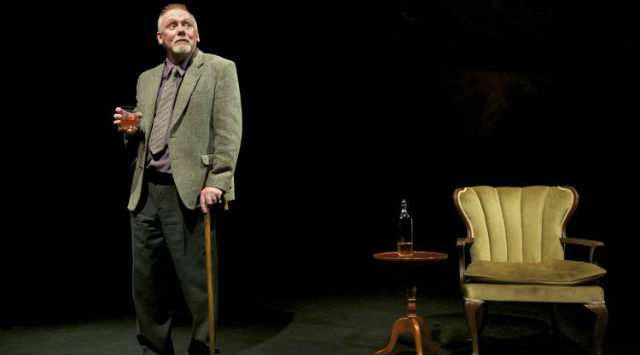
Forgiveness is complicated and unstable, and where it is most needed, its difficulty is at its greatest. In Tom Holloway’s As We Forgive, three monologues featuring an older man demonstrate the purpose of forgiveness, as it relates to a self that needs to find emancipation that can only be derived from an act of absolution. When we realise that life is short, the urgency for deliverance becomes even more pronounced, and Holloway uses the mechanism of age in his storytelling to amplify the poignancy of his message.

The writing is sublime, with evocative and powerful imagery that connect on levels of emotion, spirituality and intellect. Actor Robert Jarman does an exquisite job of the words, sensitively articulating each sentence so that the text communicates with richness and lucidity. Although quiet in presence and at times too gentle with his approach, Jarman is a charismatic personality effective at conveying profound sentimentality. There is an elegance to his work that is memorable for its simplicity, as well as an inner authenticity that contributes to the cogency of the play’s concepts.

The production is melancholic, beautifully so, but a more dynamic atmosphere would perhaps provide an experience that is more engrossing. Lisa Garland’s photo projections and Raffaele Marcellino’s music add tender dimensions to an already delicate staging for an overall effect that is undoubtedly appealing, but for its eighty-minute duration, greater fluctuations in energy levels is required.

The men in As We Forgive are consumed by vengeance, hatred and remorse. Their stories are dramatised but we perceive their feelings to be familiar and true. All our lives parallel, and no matter the obstacles we face, our humanity binds us, allowing us to recognise each other’s wounds and suffering. We may not all be lonely people, but finding forgiveness is a solitary task, and those who succeed are the luckier ones.
www.griffintheatre.com.au | www.tasperforms.com

Review: The Events (Belvoir St Theatre)

belvoirstVenue: Belvoir St Theatre (Surry Hills NSW), May 12 – Jun 12, 2016
Playwright: David Greig
Director: Clare Watson
Cast: Johnny Carr, Catherine McClements, Pitt Street Singers, Wycliffe Singers
Image by Luke Cowling

Theatre review
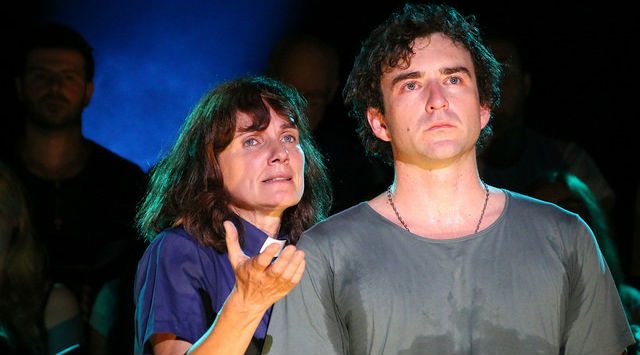
There are probably no issues more pressing than those pertaining to immigration, terrorism and mass shootings. Trying to make sense of these realities has become an everyday fixation in many of our lives, and David Greig’s The Events is a timely and sensitive expression of those concerns. Claire is a priest and choir leader whose life and faith is shattered by a traumatic incident that transforms the complexion of all that she knows. Fractured and struggling to find coherence, Greg’s writing is a reflection of the protagonist’s state of being. The play is not an easy ride, but it provides valuable insight for all of us who are part of this contemporary and complicated discussion on nationhood and security.

The play’s structure lends itself to intrigue and tension, which director Clare Watson manufactures well, but its restrained emotional dimension prevents the show from creating the same resonances that we have come to expect when dealing with its themes. There is no shortage of television coverage on these matters, and they are almost without exception, full of cheap sentimentality and irrational fear, which The Events does not replicate, but what it delivers instead can feel underwhelming and uncomfortably tepid. Perhaps its intention is to guide viewership to a more cognitive response for its deliberations, which is a challenging task that it accomplishes at varying degrees.

Catherine McClements is impressive with the thorough authenticity she introduces to the stage, and the ease with which she is able to convey the magnitude and intricacy of Claire’s psychological condition. The aforementioned disinclination for melodrama is disappointing, but understandable. The actor tells the story well, and we learn all there is to know about her character and the circumstances, even if we are not engaged on a more emotive level. Johnny Carr plays a variety of roles opposite the leading lady, engrossing but not always distinct (probably a comment on Claire’s disillusionment with the world), with an energetic approach that we rely on for a propulsive sense of momentum.

Claire has the strength to move forward but she needs time. When disasters strike, we can try to forge ahead in blindness but the scars and stains they leave behind do not disappear without effort. In The Events, we are urged, in times of trouble, to humanise individuals when all our instincts want is for perpetrators of violence to become demonised. It is a story about forgiveness, the truth of its emancipatory effects and the difficulty of its embrace. The problems we face are hard, they may even be thought of as insurmountable, but life persists in spite of it all and we must negotiate its good and its evil the best we know how.

www.belvoir.com.au

Review: Oh My God I Have Been Kidnapped & I Hate What I Am Wearing (The Old 505 Theatre)

old505Venue: Old 505 Theatre @ 5 Eliza St (Newtown NSW), May 10 – 28, 2016
Playwright: Drew Fairley
Songs: Mikey Lira
Director: Liesel Badorrek
Cast: Drew Fairley, Kate Smith
Image by Michael Bourchier

Theatre review
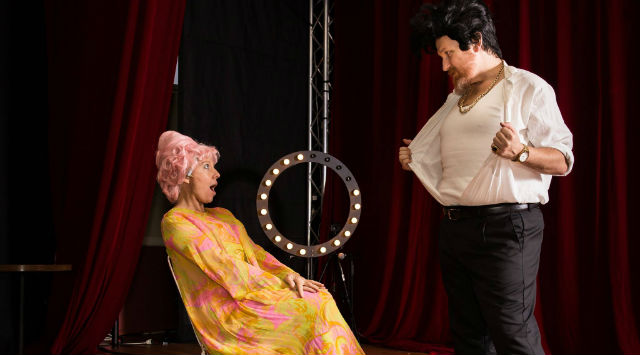
It is a comedy show with generous doses of cabaret, burlesque and musical theatre elements added to the mix. Completely frivolous and silly, Drew Fairley’s Kidnapped is pure entertainment that avoids serious themes and poignant emotional narratives, but impresses with the quality of talent that it showcases. Sugar is the aspiring artist at the centre of our attention, but it is the artists involved in telling her story that are remarkable.

Mikey Lira’s songs are charming and surprising, each with a strong sense of character that enriches the scenes in which they appear. Sound quality in the auditorium requires improvement (as does lighting design), but musical numbers in the show are a joy nonetheless. Choreography and other physical aspects of performance are cleverly devised, utilising every muscle of its actors to fill the space with movement and lively presence.

Formidable leading lady Kate Smith struts her stuff from head to toe, delivering comedy of the highest calibre, immense in its dexterity and inventiveness. Hilarious throughout, and deeply endearing, she has us in the palm of her hand and we find ourselves swept away into waves of laughter with her supreme, indomitable confidence. We never stop wanting more and she never ceases to amaze. Not content with being playwright, producer and musical director, Drew Fairley appears on stage with Smith, with similarly gleeful results. Fairley keeps the limelight squarely and appropriately on his co-star, but is himself more than a capable supporting actor. His work is full of sharp humour and extravagant flourishes, informed by a kooky sensibility that gives the show its irresistibly unique flavour. Chemistry between the two is flawless and stands as the key ingredient to Kidnapped‘s success.

There are few shows as funny as this, because convergence of talents are rarely as perfect as on this occasion. From its writing, to performance, to Liesel Badorrek’s very brave and instinctual direction, a beautiful harmony is established for a small but very special theatrical moment. It delights us, having us grin from ear to ear and cackle with joy, and it inspires us by showing us what artists can do when given the opportunity to demonstrate the best of their abilities. We have trouble giving artists what they are due in Australia, and although Kidnapped has today materialised gloriously in our fragile artistic landscape, we must think of other missed opportunities, and consider our priorities and responsibilities as a society, and we must decide to spend that investment on a little thing we call our soul.

www.venue505.com/theatre

Review: Telescope (Montague Basement)

montageubasementVenue: Leichhardt Town Hall (Leichhardt NSW), May 12 – 21, 2016
Playwright: Charles O’Grady
Director: Charles O’Grady
Cast: Shevvi Barret-Brown, Caillin McKay
Image by Omnes Photography

Theatre review
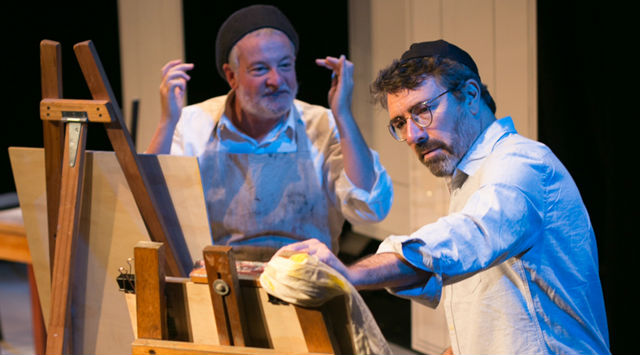
Experimentation often happens behind the scenes. A wealth of weird and wonderful things must happen in rehearsals before an audience is introduced to the mix. For Telescope, the experiment happens before our eyes but without us knowing. Each night, actors in the two-hander swap roles, which means that most would only ever see half of the picture. Charles O’Grady’s script is interested in the meanings of gender as experienced at home, and the surprising extent to which it pervades every corner of family life, insidious but unintended. Joss and Vic have a child going through early stages of gender transition. We do not meet Jem, but his presence is felt through the play, like a dark cloud that hangs over the living room in which all action is set. Sequences of mundanity and theatricality combine to form a plot that attempts to demonstrate the turbulent effect of gender coming into consciousness, and to explore the subtleties of how gender informs our relationships.

In between engaging scenes of argument and conflict, the production’s efforts at representing the banal can be overly indulgent. It takes a lot of time to cut to the chase, but while the audience desires drama, Telescope is interested in what happens in quiet moments. Joss and Vic are a very regular couple, but we are not allowed to disregard the minute conventionalities that inform us of their identities. We look for signs and gestures, usually hidden and ignored but sonorous on this stage, to come to an understanding of their relationship. We need to know who is the wife, who is the husband, but in that process of misgendering and determination, question the necessity of that very information. With our discovery of their respective genders, we consider its relevance to the story that unfolds, and indeed its machinations in real life outside of the auditorium.

Performances by Shevvi Barret-Brown and Caillin McKay are uneven, but effective when they find passion and when they are able to demonstrate hints of connection. There is a sense of detachment on the stage that, although challenging for a two-hour show, helps us observe human intimacy from an unusually critical standpoint.

Joss and Vic are unable to live and let live. They struggle to come to terms with Jem’s deviation, and are tormented by his self-determination. Their emotions are true, but also absurd. Vic and Jem are in a tug-of-war at opposite ends of the gender conceit, both insistent on what they deem irrefutable and real. Telescope not only makes us examine that binary, it leads us to its dissolution. The characters in the play speak only in terms of female and male, but what O’Grady puts on stage is a disruption of those simplistic and myopic ways of approaching life. Like feminism that works for the elimination of patriarchal systems, a revision to how we understand, practise and enforce gender in society would lead to greater equity, but that revision is of immense complexity, and we are only at the dawn of that political movement.

www.montaguebasement.com

Review: My Name Is Asher Lev (Eternity Playhouse)

asherlev1Venue: Eternity Playhouse (Darlinghurst NSW), May 8 – 29, 2016
Playright: Aaron Posner (from the novel by Chaim Potok)
Director: Moira Blumenthal
Cast: Annie Byron, Tim McGarry, John O’Hare
Image by Blumenthal Photography

Theatre review
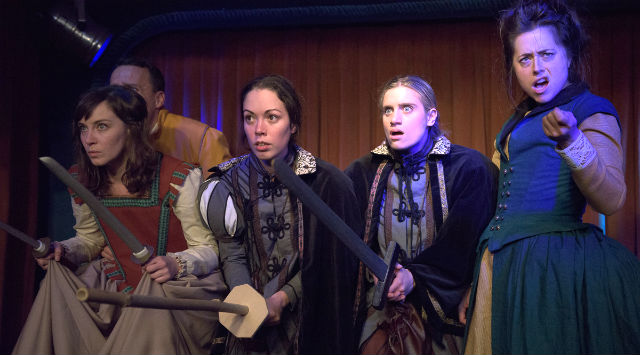
We meet Asher Lev from the time he discovers a talent for drawing, and follow his journey from prodigy to established artist. It is a short time getting to success, but the lessons he learns are profound, and writers Aaron Posner and Chaim Potok do an excellent job of sharing those wisdoms in the story. The theme is one that we all have to grapple with, some more often than others, but it is nonetheless universal; we must identify a true and authentic self, and live accordingly. Young Lev’s sense of authenticity is frequently at odds with the life his parents had envisioned for him, but it is that negotiation between forces that allows him to thrive as an artist and more significantly, develop into an independent autonomous being.

Direction by Moira Blumenthal is tender and melancholic, with detailed attention placed on family dynamics that are central to Lev’s experience of the world. The characters are believable and we relate to their psyches easily, but the production needs greater dynamism with its rhythm, and a more pronounced sense of humour to achieve variances in mood and tone between scenes. The role of the young artist is played by John O’Hare who although lacks the adolescent energy required, depicts acute emotional accuracy in order that we understand all the nuances of his conflicts and challenges. More compelling is Tim McGarry in a range of paternalistic parts who brings colour and surprising vibrancy to the show. Annie Byron is convincing as Lev’s mother, and chemistry between all three is beautifully forged for a show that makes a poignant statement about the complexities of family, history and individual fulfilment.

Whether we grow up to be copies of our parents, or turn out to only be partially similar to family members, there is no doubt that blood ties have a deep influence on the people that we become. As a child turns into an adult, they should be given choices and importantly, the strength to make them. We wish the best for our offspring, but they must become their own persons, and there comes a time when father no longer knows best. The world evolves, and it develops in directions that may not always be pleasing. When things become unbearable, we can call upon faith, and trust that something bigger than our own minds has great designs in mysterious ways, beyond our ability to currently comprehend.

www.encounters.edu.au

Review: Rosencrantz And Guildenstern Are Dead (Furies Theatre)

furiesVenue: Blood Moon Theatre (Potts Point NSW), May 10 – 21, 2016
Playwright: Tom Stoppard
Director: Chris McKay
Cast: Amy Victoria Books, Emily Burke, Lauren Crew, Krystiann Dingas, Emilia Stubbs Grigoriou, Leofric Kingsford-Smith, Amanda Maple-Brown, Logan McArthur, David McLaughlin, Sarah Plummer
Image by Stephen Godfrey

Theatre review
There is a lot of truth in what Tom Stoppard has to say in Rosencrantz And Guildenstern Are Dead. His existential angst may not be shared by all, but his ruminations about the nature of life are as real as they are fascinating. Through a long narrative in which nothing much happens, ideas about time, memory and volition are explored at great depth, not necessarily to provide enlightenment, but for the sheer pleasure of intensive introspection. The genius of Stoppard’s writing is in the very words collated to express abstractions that exist in our minds, making matter out of ephemeral concepts by having dialogue occupy the space of theatre.

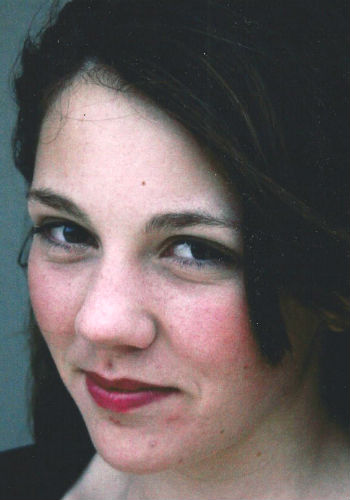
Direction by Chris McKay brings to the stage an articulate and thoughtful representation of the text’s meanings. Relying on little more than his actors’ bodies and voices (design is kept minimal, although costumes by Zjarie Paige-Butterworth are very accomplished), the poetic and philosophical qualities of the play are given resonance from beginning to end, reflecting a thorough appreciation of the material by its very able cast. Krystiann Dingas and Emilia Stubbs Grigoriou are Rosencrantz and Guildenstern, both passionate and expressive, help us distil one of the densest theatrical masterpieces, to achieve a level of immersion and comprehension that is admittedly rare in iterations of Stoppard’s work. Both actors are confident, dynamic and very likeable, which is a relief considering the two-and-a-half hour duration. Also remarkable is Amanda Maple-Brown as the Player. Flamboyant and exuberant, yet astutely nuanced, her work is resolutely entertaining, with a delightful and exhilarating presence that leaves a strong impression.

Every significant male character is performed by a female actor in this rendition of Rosencrantz And Guildenstern Are Dead. How that decision affects our spectatorship is entirely subjective, but it does bring to focus the quality of parts and opportunities available to women in theatre. Plays have certainly emerged from feminist ideologies, but none have attained the reverence that titles such as this inspire in all our Western societies. To combat the persistence of the theatrical canon and the misogyny therein, gender reversal is a subversive device that serves a purpose greater than experimentation. Finding a way to exorcise patriarchy from all the old and usual suspects that refuse to go away is critical to the development of art in every civilisation. We may not be able to remove masculinity from Michelangelo’s Creation Of Adam, but we can disrupt the hegemony imposed upon us on every screen and stage.

www.facebook.com/FuriesTheatre

5 Questions with Shevvi Barrett-Brown and Caillin McKay

Shevvi Barrett-Brown

Shevvi Barrett-Brown

Caillin McKay: What is gender?
Shevvi Barrett-Brown: Lies, identities, forced roles, aesthetics, fluid, oppression, occasionally fun, mostly something to escape.

What is the most challenging things about doing this show?
Learning 88 pages of dialogue, playing a character that I wouldn’t want to talk to in real life – and so finding an in to the character is difficult, as I’ve actively tried NOT to identify with 40 year old cis male upper middle class transphobes. I’ve also been curled up in the foetal position for a lot of rehearsal with a mysterious illness. Cailin bought me a lot of mandarins.

Answer as your character Vic: why haven’t you taken the washing down yet?
I had a double shift at work, I took Chloe to tutoring, took my dad to his doctors appointment and organised things with the bank, I’m busy. I’ll get to it.

Answer as your character Joss: what’s your favourite thing about having children?
Teaching them about the wonders of the world.

If you could be any animal what would you be?
Unicorn. I am queer.

Caillin McKay

Caillin McKay

Shevvi Barrett-Brown: What is gender?
Caillin McKay: Pretty simple really! Of course, it depends on the person you talk to. For example, my gender is *a truck drives past, blaring its horn. Suddenly foghorns sound and air raid sirens shriek*. Hopefully that explains it.

What is the most challenging things about doing this show?
The intense focus on how I move and hold myself has been the hardest part of the show for me.

Answer as your character Vic: why haven’t you taken the washing down yet?
Joss, I did. Two hours ago. That is the new load on the line. Which, I’d like to remind you, you promised to put up.

Answer as your character Joss: what’s your favourite thing about having children?
I’ve always wanted to be a parent! I always knew I’d be a good one. And I have been! The kids love spending time with me.

If you could be any animal what would you be?
A cat. Being able to comfortably sit on the floor sounds like heaven.

Shevvi Barrett-Brown and Caillin McKay are appearing in Telescope by Charles O’Grady.
Dates: 12 – 21 May, 2016
Venue: Leichhardt Town Hall

Review: Edward Gant’s Amazing Feats of Loneliness (Polyamorous Productions)

polyamorousVenue: PACT Centre for Emerging Artists (Erskineville NSW), May 4 – 7, 2016
Playwright: Anthony Neilson
Director: Natasha Pesce
Cast: Ralph Andrews, Will Hickey, Jonathan Lagudi, Nicole Wineberg
Image by Liam O’Keefe

Theatre review
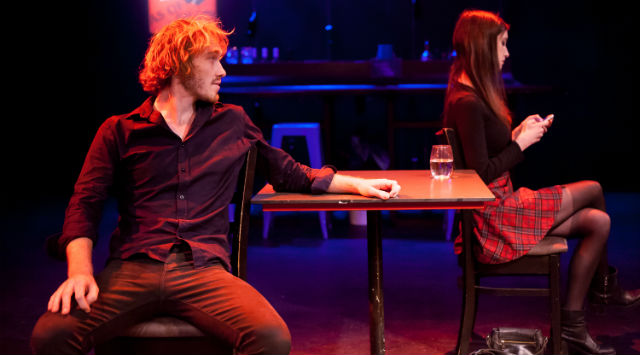
Edward Gant runs a vaudeville specialising in tall tales of loneliness. Even though the theme is one of sadness, his show is full of rambunctious fun, designed to elicit squeals of pleasure with outrageous and flamboyant sequences featuring his troupe of three mad performers. Edward Gant’s Amazing Feats of Loneliness is Anthony Neilson’s take on the “show within a show” format, brilliantly scripted to deliver extraordinary spectacle accompanied by disarming humour and an unrelenting melancholy. It is the most sophisticated of writing, traversing the basest of human experience to the most profound of our emotional landscapes. Subtly philosophical yet undeniably poignant, the audience is offered a plethora of ways to access its meanings, at whichever level of depth we choose to receive its wisdom.

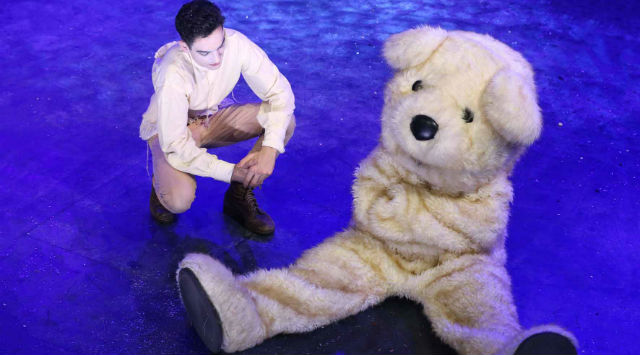
The wild stories are brought to life by Natasha Pesce’s exuberant direction. Her style is exciting, bold and very funny, particularly effective in the production’s first half where the text presents greater opportunities for ostentatious tomfoolery. Pesce’s eye for beauty is reflected in charming design details that provide a visual splendour, delightful for our senses while helping to convey story and sentiments. Four dedicated actors form a tight ensemble, boundless in mischievous energy and unified in what they convey. Nicole Wineberg is a perfect blend of slapstick, nuance and sexual allure for her demanding role. The actor is captivating in all her guises, whether coy, gruesome, rugged, or ludicrously vivacious in a bear suit, Wineberg is completely engrossing and very entertaining indeed. Equally madcap in approach is Ralph Andrews, memorable for his confident frivolity and distinctly wanton sense of comedy. His work is not the most physically disciplined, but the presence he brings to the stage is replete with an enthusiastic whimsy that appeals to our need for something more tender.

In loneliness, longing is the ringmaster who takes centre stage, controlling thoughts, decisions and behaviour. It is a driving force that can lead one to many possibilities, but its motive is self-obliteration. Longing may replace loneliness with some other sensation, but desire will always remain albeit in a different form, for life simply cannot be without desire. Edward Gant faces a dilemma with the eradication of his own loneliness and the show that must go on. Joy can take the place of pain, but it only exists in relation to its dark other. The pursuit of a happy life is meaningless without sadness, and the resolve of its existence is to be ignored at our own peril.

www.edwardgant.com

Review: Dirty People (Doonbrae Productions / Jackrabbit Theatre)

depotVenue: The Depot Theatre (Marrickville NSW), May 4 – 8, 2016
Playwright: Charlie Falkner
Director: Michael Abercromby
Cast: Charlotte Devenport, Sam Delich, Charlie Falkner, Sam Davenport, Zoe Jensen
Image by Tom Cramond

Theatre review
Charlie Falkner’s Dirty People is a delightful romp about the selfie generation. Its dialogue is clever and idiosyncratic, with hints of originality that gives the work remarkable character. There are moments of self-conscious social commentary that attempt to add a sense of gravity, but Michael Abercromby’s direction is more memorable for astutely delivering every nuance of comedy discoverable in the script. Abercromby’s style is vibrant and adventurous, with an infectious sense of humour that ensures an enjoyable time in the theatre for all concerned.

Although slightly rough around the edges, the youthful ensemble performs the work with excellent conviction. Their presentation is well-rehearsed, and chemistry is strong in every scene. They craft distinct personalities that convey the plot effectively, each one bringing their own charm to the stage. As an actor, Falkner demonstrates good timing and creates a rich interpretation of his part using a wealth of unexpected subtleties. Sam Delich brings a broader approach to get the laughs, and proves himself to be an endearing presence in both his roles. There is a good sense of cohesion in the cast, which is a pleasant surprise considering the diverse comedic tones they each embody.

Although Dirty People misses the opportunity for a more critical take on the state of the world today, it offers effervescent entertainment that is often silly but never stupid. Its satire is fun-loving, and even though thoughtfully conceived, it does not burden us with the disappointments of real life that are its inspiration. The nature of people is full of dirt, but how we aspire to find grace and decency is the key to an enlightened existence.

www.facebook.com/JackRabbitTheatre

Review: We Will Rock You (Sydney Lyric Theatre)

wewillrockyouVenue: Sydney Lyric Theatre (Sydney NSW), Apr 20 – Jun 26, 2016
Music & Lyrics: Queen
Story & Script: Ben ELton
Director: Ben Elton
Cast: Erin Clare, Casey Donovan, Jaz Flowers, Gareth Keegan, Brian Mannix, Thern Reynolds, Simon Russell
Image by Jeff Busby

Theatre review
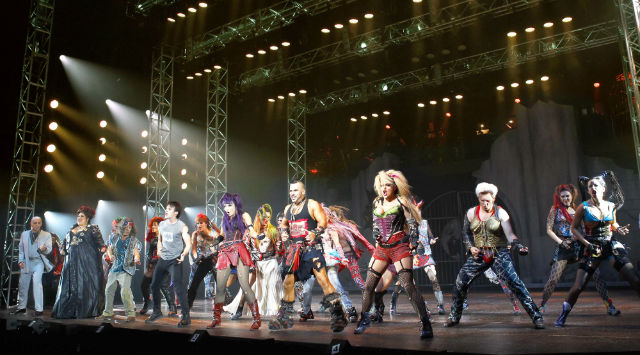
There is a scene in which the Bohemians declare that they do not know what rock and roll is. Ben Elton, writer and director of We Will Rock You evidently suffers from that same predicament. The production showcases some of the greatest rock tunes ever written, but in the interest of the musical theatre genre, builds characters and a narrative around them that unfortunately serve no real purpose except to dilute and dumb down the genius of Freddie Mercury and his Queen legacy.

Elton’s show features an endless series of dad jokes, and a tenuous context of anti-establishment that reads more like anti-progress and narrow minded, greying conservatism. It attempts to make jokes of pop culture icons such as Australian Idol, without acknowledging the fact that the strongest performer in its cast had been a prominent winner of that very franchise. It uses names like Britney Spears and Katy Perry as punchlines, as though we would all share its appetite in humiliating those women and obliterating their undeniable achievements. The show finds it energy from the music it is authorised to use, but unlike the musicians it attempts to pay tribute to, We Will Rock You is spiritless and banal.

The story is yet another take on the messianic allegory. Like Jesus from the Bible or Neo from The Matrix, Galileo is sent from the heavens to save us all. Whether or not one is concerned with the political incorrectness, and tastelessness, of creating opportunities for another white man to deliver us from evil, the trope is frankly, very desperately tired. As though its format is not already archaic enough, a female “lead character” is included for no discernible reason except to provide Galileo with a love interest, presumably to assure us of his hetero-masculinity in case, god forbid, Freddie Mercury’s gayness would befall him by association.

It is a well-performed show nonetheless, with an excellent band, and a strong cast that traverses the rock and musical genres effortlessly. The aforementioned Idol winner Casey Donovan steals the show as the villainous Killer Queen, winning us over to the dark side where everything is much more appealing and infinitely more rock and roll; very ironic indeed. Brian Mannix, frontman of 1980s rock bad Uncanny X-Men, is also on hand to bring hints of authentic flavour to a stage that is ostensibly tailored for a “family-friendly” type crowd. They may all be stars that we see having their glitzy moment in We Will Rock You, but it is certainly not rock heaven that they have taken us.

wwww.wewillrockyou.com.au