Review: The Naked Truth (Act IV Theatre)

activVenue: Blood Moon Theatre (Potts Point NSW), Apr 6 – 16, 2016
Playwright: Dave Simpson
Director: Ruth Fingret
Cast: Melanie Araya, Kaitlin de Lacy, Hayley Flowers, Jeannie Gee, Melinda Ryan, Wendy Winkler

Theatre review
A small group of women in Northern England sign up for a pole dancing class. They learn little about the art form, but end up with deep knowledge about themselves. Dave Simpson’s The Naked Truth is a classic British comedy, featuring colourful people, naughty jokes, ordinary adversities and a very feel good ending. The play is predictable in many ways, but its formula is tried and tested, and we cannot help but get drawn into its sentimentalities, and become emotionally invested into its various narratives of human drama. The bawdy jokes give an occasional edge that helps prevent it from becoming too sappy, with its humour cleverly positioned within the plot to create enjoyable mood fluctuations.

The cast of six is clearly dedicated and invigorated, but they struggle to find a naturalistic tone that the writing requires. Although the production is awkwardly stagy, admirable effort is put into its comedy. Kaitlin de Lacy and Melinda Ryan especially, hit many of their punchlines effectively, delivering big laughs and delighting us with their enthusiastic portrayals of larger than life women. Jeannie Gee as Sarah gives the show a sense of authenticity, with sensitive moments that are truly touching, and Melania Araya’s gravity-defying skills on the pole are simply staggering.

The women in The Naked Truth hold each other up, in spite of all their differences. They each make their individual life choices, and have encountered dissimilar obstacles, but with the strength of their sisterhood, are able to find ways to provide support for one another. It is a poignant story about how people can live in love and harmony, without having to conform and assimilate. It encourages each person to embrace their own uniqueness, and shows us how to appreciate others for their idiosyncrasies; a lesson which is probably the most important thing to learn in these days of fracture and pervasive segregation.

www.activtheatreco.com

Review: The Big Bruise (Montague Basement)

montagueVenue: 107 Projects (Redfern NSW), Apr 5 – 16, 2016
Playwright: Saro Lusty-Cavallari
Director: Saro Lusty-Cavallari
Cast: Samuel Brewer
Image by Omnes Photography

Theatre review
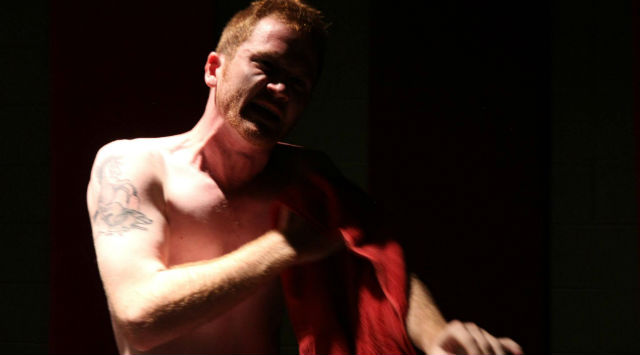
A young man is contemplating suicide. At work, at play and at home, it is all that he thinks about. Saro Lusty-Cavallari’s meditation on the subject is neither emotional nor intellectual, but what he does present in The Big Bruise is an honest representation that many are able to recognise. It is a work about the lightness and indeed meaninglessness, that life can appear to possess. The character in the play is lost and aimless, with only the temptation of death offering him a true force of gravity. In comparison, everything else is inconsequential and impotent, so he hangs on to his obsession and the certainty it provides.

Performing that strange amalgamation of angst and frivolity is Samuel Brewer, an engaging actor whose confident presence is called upon to give solid grounding to the piece. Brewer is an energetic performer, whether playing brash or subdued, with an audacious power to his delivery that keeps us transfixed. The one-man show is beautifully placed on a raw stage, thoughtfully designed by Lusty-Cavallari to convey the calm but troubled state of being in which his creation resides. Improvements could be made for a more absorbing experience, but its visceral and surprisingly sensual qualities leave a strong impression.

The protagonist in The Big Bruise wants so much of life, but spends all his efforts at ending it. It is true that identifying one’s passions can be the biggest challenge a person can face, for what happens thereafter is simply to follow that calling. For some, that revelation never arrives, but for most, it is only a matter of time. We can wait for that divine moment in passivity or we can be constructive and find ways to speed up that process. If all else fails, one should simply stop the narcissistic act of perpetual introspection and look beyond the individual, for much of the world is in need of love and care, if only we could shift our fruitless vanity onto something altruistic and altogether more selfless.

www.montaguebasement.com

Review: Replay (Griffin Theatre Company)

griffinVenue: SBW Stables Theatre (Kings Cross NSW), Apr 2 – May 7, 2016
Playwright: Phillip Kavanagh
Director: Lee Lewis
Cast: Jack Finsterer, Alfie Gledhill, Anthony Gooley
Image by Brett Boardman

Theatre review
It is an experimental script that plays with the elasticity of characters. We expect a certain amount of consistency from personalities in plays, and indeed in life, but Phillip Kavanagh’s Replay uses the idea of regret as motivation, to allow people in his story to go back in time to make amends, thus altering histories that lead to the present being inevitably changed. The concept fascinates, but the unconventional plot disrupts any emotional arc that could take hold, and we are presented with the challenge of engaging with characters who never become familiar.

The production is elegantly formed, with only minimal amounts of embellishment indicating its supernatural qualities. Director Lee Lewis is intent on giving a sense of authenticity to every moment, which results in scenes that are individually captivating, but the unusual writing prevents a feeling of poignancy to translate even though the intensity on stage is unmistakeable.

Performances are lively, with actors tending to do a little more than is necessary, but their energy and cohesive chemistry make them an endearing group that sustains our interest throughout the piece. Jack Finsterer is particularly delightful. Even when adopting the show’s animated tone of performance, the actor is able to retain a psychological and emotional accuracy amidst the constantly shifting time and space in which we find ourselves. Alfie Gledhill and Anthony Gooley are expressive actors who bring logic and coherence to a narrative that can easily turn confusing, both with a spirited approach that provides solid entertainment.

We have all experienced regret, and many of us have pasts that hold on too tightly. In our fantasies, the rules of time can be broken, and we can make every wrong right, so that life becomes completely disencumbered. Life without any difficulty is however, akin to death. It is fundamental to humanity that we strive to make things better. Stillness is a privilege that everyone must be able to savour every so often, but the essence of life is in its movement; of forging ahead, and of growing up. Regression can be made to look real on stage, but it ultimately is of service to no one. Looking back is sometimes necessary, but care must be taken so that we do not remain shackled by histories. It is the great unknown of the future that requires our attention, and we must endeavour to make the most of it.

www.griffintheatre.com.au

Review: Georgy Girl (State Theatre)

georgygirlVenue: State Theatre (Sydney NSW), Apr 2 – May 15, 2016
Book: Patrick Edgeworth
Music & Lyrics: The Seekers and others
Director: Gary Young
Cast: Sophie Carter, Pippa Grandison, Phillip Lowe, Mike McLeish, Adam Murphy, Ian Stenlake, Glaston Toft, Stephen Wheat
Image by Jeff Busby

Theatre review
Over 50 years of The Seekers’ history is charted in Georgy Girl. Predictably, all their hits are included in the musical, but very unexpectedly, virtually no sentimental dramatisation of events is found. It is a quiet story about unassuming personalities who happen to have achieved greatness is their careers. There is little in terms of narrative to get excited about, and the show is almost completely devoid of dramatic tension, but for fans of the band’s music, nostalgia abounds.

An excellent cast plays the famous musicians, and although they engage in little acting, their interpretations of classics more than fit the bill. Pippa Grandison heads the group, and in the role of Judith Durham, she impresses with a rich and powerful voice, effortlessly recalling the glory days of the Australian icon. Playing Durham’s husband Ron Edgeworth is the charismatic and flamboyant Adam Murphy who single-handedly introduces a sense of theatricality to the show. His charm offensive is a highlight, and probably the only memorable element for an admittedly small number of audience members who are less familiar with The Seekers.

The production is polished and professional, but it appears that little of the budget is spent on set design. The very rudimentary and underwhelming stage is a clear let down for those who have grown accustom to highly complex and sophisticated stagecraft that is now par for the course in events of this genre. Georgy Girl is minimal, subdued, and plain, qualities to be loved in folk musicians but hardly the characteristics we expect of a Broadway style musical extravaganza.

www.georgygirlthemusical.com

Review: Savages (Darlinghurst Theatre Company)

darlotheatreVenue: Eternity Playhouse (Darlinghurst NSW), Apr 1 – May 1, 2016
Playwright: Patricia Cornelius
Director: Tim Roseman
Cast: Josef Ber, Thomas Campbell, Yure Covich, Troy Harrison
Image by Helen White

Theatre review
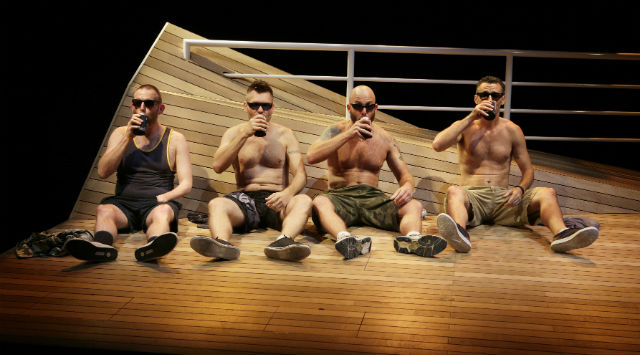
Not all men are arseholes, but the four blokes in Patricia Cornelius’ Savages are certainly frightful specimens of the species. They are close friends on a cruise holiday, intending to escape the daily grind but in fact, are in search of leaving behind civilisation altogether. Cornelius’ portrait of the middle-class Australian is one of privilege, ignorance and entitlement. The play does take care to explore her characters’ vulnerabilities as well, so that they become truthful and believable, but that honesty only serves to make them more repugnant, and their actions despicable. We recognise the challenges they face, for they are in fact commonplace, but cannot forgive their inability to find elevation and become better persons. Machismo is not at all an unusual dramatic subject, but when penned by male authors, bad behaviour is often accompanied by a warped sense of heroism, or at least some magnanimous sense of humour. Even though Cornelius does not create scenes of horror as Chuck Palahniuk, Martin Scorsese or Quentin Tarantino are want to do, her brutality lies in the merciless depiction of our average Joes as the very scum of our earth.

Director Tim Roseman’s approach is a surprisingly tender one. He brings balance to the bawdy goings on by indulging in the men’s private worlds, through earnest and deep portrayals of their suffering. We see that they are in some ways victims of a society that demands too much, but also realise their natural and unquestioned tendencies for mindless conformity. Roseman does excellent work in creating distinct segments out of what could easily be a singular poetic murmur, by providing a captivating plot manufactured with a great variety of tones, moods and emotions. Design elements are intricately dynamic, with Nate Edmondson’s very exhaustive and complex work on sound design playing an integral role in conveying subtexts and psychological undercurrents, and Sian James-Holland’s lights keeping visuals amusing with constant shifts in colour and movement. Also notable is Jeremy Allen’s evocative set design, which provides an intense intimacy to the small cast, and shapes the space in a way that allows acoustics to be perfectly established for every word of dialogue to ring with crystal clarity.

It is a cohesive production, with a very unified and charismatic cast. Their work is completely engrossing, with an outstanding sensitivity to rhythm, not only in speech, but also with their physicality. Each character is specific, but together, they tell an unambiguous and bold story. Yure Covich plays an effective alpha male, vibrant, brash and animalistic and effortlessly magnetic. His work as Craze is authentic to the degree that we are unable to identify the seam that separates actor from character, which in this case, is quite unnerving. In the role of Runt is Thomas Campbell, who brings both melancholy and comedy to what is essentially a context of severe grimness. Campbell plays the underdog with a beautiful sensitivity, but also wisely prevents the audience from placing undue sympathy for Runt’s culpabilities.

The end of Savages arrives abruptly. It is true that we have learned all there is to the four men, but we are deprived of their subsequent punishment. We wish for the lights to return, so that we may witness the atonement that must follow, but we are left to wonder if just desserts had indeed been served. The production is put together with impressive proficiency from all participants, and their talents are to be seen everywhere, but there is no escaping the sensation of overwhelming disgust that follows. Although it provides little pleasure or delight, the show raises important issues that affects us all. We are urged to think about how we practice gender, how we conduct friendships, and most of all, how we raise our children. If we believe that all babies are born innocent, then we must accept that a monster can only be created by the village that raises it.

www.darlinghursttheatre.com

5 Questions with Jacki Mison and Liam Nunan

Jacki Mison

Jacki Mison

Liam Nunan: If you could have the career of any other actor, who would that be?
Jacki Mison: Sigourney Weaver because I was a huge sci-fi fan growing up and Ripley was my idol! She’s tough, funny, smart and able to move across genres, stage and screen.

As a producer and actor, what drew you to putting on Orphans?
I had seen a fantastic production of Orphans done a few years ago by the Queensland Theatre Company and it was one of those shows that really stayed with me for a long time. The intensity of it, Dennis Kelly’s particular style of dialogue and the moral dilemma at the core of it, for my character Helen, led me to try and secure a production. It was also in a completely different ballpark to the last show I had produced, which was an American comedy, so it felt right to switch things up.

Tell us about Helen. What excites you most about playing her?
I love the fact that she is a survivor. She is one of those people who are capable of doing the things that need to be done. But the personal cost, while not always evident, eventually bubbles up. She’s incredibly complex and has a fascinating arc throughout the play.

If, when you died, you could come back as any character in theatre, who would it be?
Would love to be one of the witches from Macbeth!

What character or production in your body of work are you most proud of?
My Subway commercial…
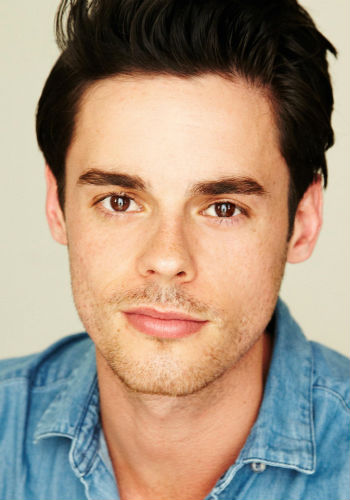
Liam Nunan

Liam Nunan

Jacki Mison: Dennis Kelly has written an intense, fast-moving play with Orphans. What has been your biggest challenge with the role of Liam so far?
Liam Nunan: Understanding Liam’s thought process. The play is written in a sort of chaotic frenzy of interrupting dialogue and if the rhythm isn’t spot on, the whole thing can come crashing down. You need to be hyper aware of what words trigger your impulse to launch over the other characters’ lines. Liam also changes his thought process faster than he has time to verbally articulate it. So he very often doesn’t finish his thoughts at all and talks himself in circles. So to answer your question; the acting bit.

Do you choose particular underpants for each character you play?
Great question, Jacki. Not by myself. I like to think it’s a collaborative process. I prefer to get the designers input early on before rehearsals begin and have some renderings sketched up to put forward to the director. If we can’t come to an agreement I usually get my agent involved. Surprisingly, most of the time, no one but me cares.

Who are the actors that most inspire you?
I’m inspired by actors that allow themselves to be inspired. I don’t know who said ‘Don’t be interesting. Be interested’ (or something like that) but the same can be said here. I love watching and working with actors that are open and ready to be inspired. They allow themselves to be changed by you and respond so organically, you can’t help but be changed by them.

What’s been your most embarrassing moment on stage so far?
In drama school we had just finished our first production open to the general public, The Winter’s Tale. We ran on for our curtain call, bowed, and ran off. In the wings everyone turned and ushered me to run back on to lead a second curtain call. ‘That makes sense’, I thought. ‘The audience have just sat through 3 and a half hours of 2nd year student actors doing Shakespeare whilst dressed as cowboys with southern American accents. It’s likely the best thing they’ve seen this year. I sure think it is. Of course they want more’. So I bounded back on stage. Half the audience were already making there way up the aisle. I look around, and of course I’m alone, dressed as Old Shepherd. The cast laugh. The audience look back and they laugh. Everyone laughs.

There was also the time in year 12 I had a testy blow out while I was singing ‘Maria’ in West Side Story.

If you had a choice of any role, stage or screen, what would it be?
Believe it or not, Liam in Orphans by Dennis Kelly. I’ve wanted to do this play for a while now. I saw a brilliant production of it at QTC a number of years back. I was absolutely shaken by it. I picked it up and read it maybe a year later and I was still just as moved. I thought ‘I must play this role’. I jumped at the opportunity and I’m thrilled I’ve been given the chance to play with such a complex character.

Jacki Mison and Liam Nunan can be seen in Orphans by Dennis Kelly.
Dates: 19 -30 April, 2016
Venue: Old Fitz Theatre

Review: King Charles III (Almeida Theatre)

stcVenue: Roslyn Packer Theatre at Walsh Bay (Sydney NSW), Mar 31 – Apr 30, 2016
Playwright: Mike Bartlett
Director: Rupert Goold, Whitney Mosery
Cast: Jennifer Bryden, Richard Glaves, Dominic Jephcott, Geoffrey Lumb, Lucy Phelps, Carolyn Pickles, Robert Powell, Ben Righton, Giles Taylor, Tim Treloar, Beatrice Walker, Paul Westwood, Emily Swain, Emily-Celine Thomson, Ryan Whittle, Karl Wilson
Image by Richard Hubert-Smith

Theatre review
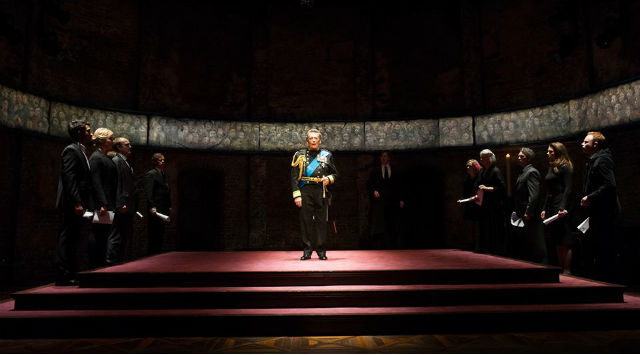
Many consider the monarchy to be an archaic and irrelevant institution. It is constantly under scrutiny and criticism, mostly for the notion that it bleeds the economy of money without seeming to contribute anything concrete. In Mike Bartlett’s imagined near future, Prince Charles finally ascends the throne, and we are presented with the astonishing circumstance of the new king exerting his right to influence governance of the United Kingdom. The silent figurehead decides to act according to his conscience, and opposes the passage of a new law by parliament, which results in unadulterated pandemonium and excellent drama. Bartlett’s story about the most famous family in the world is part Shakespearean, part tabloid influenced. The high and low brow concoction speaks to our perceptions about the royals; we think of them as enigmatic, grand and otherworldly, but also as gossip fodder, with petty concerns that our curiosity feels entitled to.

The show begins with exquisite humour, then develops increasingly heavy, ultimately ending in great pessimism similar to many cautioning fables about governments and democracy. Even though energy levels drop significantly as the plot turns serious, both its comedic and dramatic aspects are effectively conveyed. We are gripped by its fast moving scenes, each one short and scintillating, as though on steroids courtesy of prime-time TV. Its familiar personalities are seen just the way we expect them to be, but with additional dimensions that provide surprises to the startling narratives that unfold. Bartlett’s dialogue is endlessly amusing in its juxtaposition of contemporary speech with Shakespearean conventions, which the cast delivers with impressive skill and fluency.

Richard Glaves is a memorable Prince Harry, endearing and vulnerable just the way many would wish him to be. Humour in the production is extremely contained, but Glaves is able to find a sense of mischief within the restraints, consistently depicting emotional authenticity while asserting the entertaining qualities of his role. Charles is played by Robert Powell, imposing and noble, utterly believable as King. His portrayal bears little cosmetic resemblance to the character we see regularly on the news, but is full of nuance and texture. Even though appropriately stoic and stiff upper lipped, Powell brings complexity and psychological accuracy to the piece, replete with humane ambiguities that challenge our moralistic judgements. We find our opinions about Charles constantly shifting as we gain an increasingly deeper understanding of his nature and intentions.

We look for bad guys in the play, but there are no convenient answers. Democracy is what we value most in the collective entity we term society, and its machinations are evaluated in King Charles III in a theatrical but honest way. There are many Australians passionate about turning our country into a republic, and the play certainly pleads a strong argument for that case. Our democracy may be flawed but it is what we hold dear. In the play, Charles is a good man, and could well be a great leader, but he is not appointed by the people and further, unprotected by our legal and political processes. Civilisations need to work towards greater transparency, so that our progress may reach closer to democratic ideals, but the monarchy, by definition, contravenes those principles we revere in the highest regard. This story seems a wild one, but it resonates strongly and we believe its outrageous scenarios to be plausible, implying that there are dangers in our current systems, which although underestimated and overlooked, are in fact gravely threatening.

www.almeida.co.uk

Review: Plaything (The Depot Theatre)

depotVenue: The Depot Theatre (Marrickville NSW), Mar 30 – Apr 16, 2016
Playwright: Simon Dodd
Director: Julie Baz
Cast: Caspar Hardaker, Michael Harrs, David Jeffrey, Cherilyn Price, Cherrie Whalen-David
Image by Katy Green Loughrey

Theatre review
Two people walk onto the stage by accident and find themselves unable to escape the audience’s gaze. They become stars of the night’s play, not by choice but by circumstance. Much like how we live our lives, we are the protagonists of our stories not by our own choosing, but because we are brought into existence for reasons entirely beyond our control. The characters cannot resist the urge to create meaning and to achieve a sense of coherence, so that time can be filled with some semblance of reason and purpose, even though they know with absolute certainty that an end will come. Simon Dodd’s thoughtful script is joyful and amusing. Its existential concerns are rendered with a gentle touch so that the viewing experience remains light and upbeat, but his work leaves enough food for thought to prevent the show from becoming too frivolous. There is very funny dialogue to be found, and although its structure can be more refined, Dodd’s meticulous writing ensures that Plaything provides entertainment at every moment.

The show’s lead performers are equally strong, but in different ways. Cherrie Whalen-David is precise in her approach, and presents a well-rehearsed interpretation of her role that always seems considered and purposeful. David Jeffrey’s appeal is in the quality of mischief that he brings to the stage, and the important sense of play that he introduces into the creation of comedy for his audience. The humour in Plaything is most effective when we feel a genuine and lively impulse within its comic timing. In spite of the absurdist nature of its context, the show requires an authentic presence, a genuine sharing of time and space between audience and actors, for it to be truly engrossing. Direction of the work by Julie Baz is vibrantly energetic, with an urgency that keeps us engaged and intrigued. The plot’s unpredictability is well utilised to keep the show one step ahead of us, so that pleasant surprises steadily emerge.

There is a lot of fun to be had at Plaything. It is a clever script that demands a lot of its actors, and when they hit their mark, results are thoroughly satisfying. It is on one hand unafraid to be philosophical, and on the other, more than a little fond of sophomoric humour. We discover that drawing parallels between the creative process and the living of life itself can be just as funny as watching people drink copious amounts of urine. We also learn that the matter of taste is completely subjective, even where bodily fluids are involved.

www.thedepottheatre.com